Bookmarking Book Art – Monique Lallier

Monique Lallier: A Retrospective
Guilford College Art Gallery

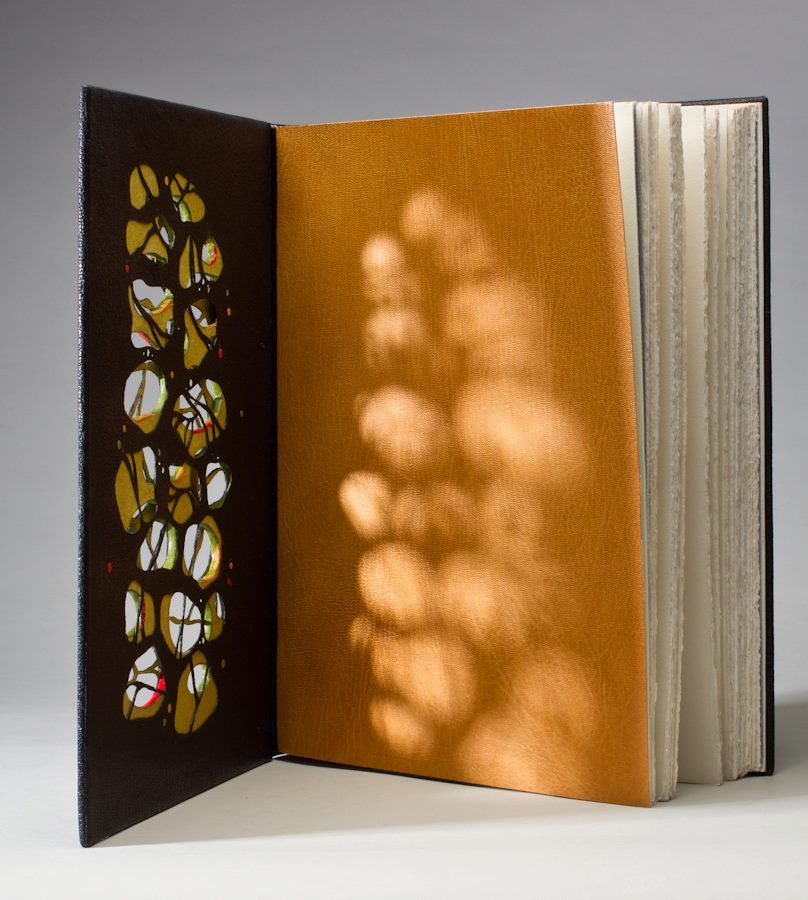
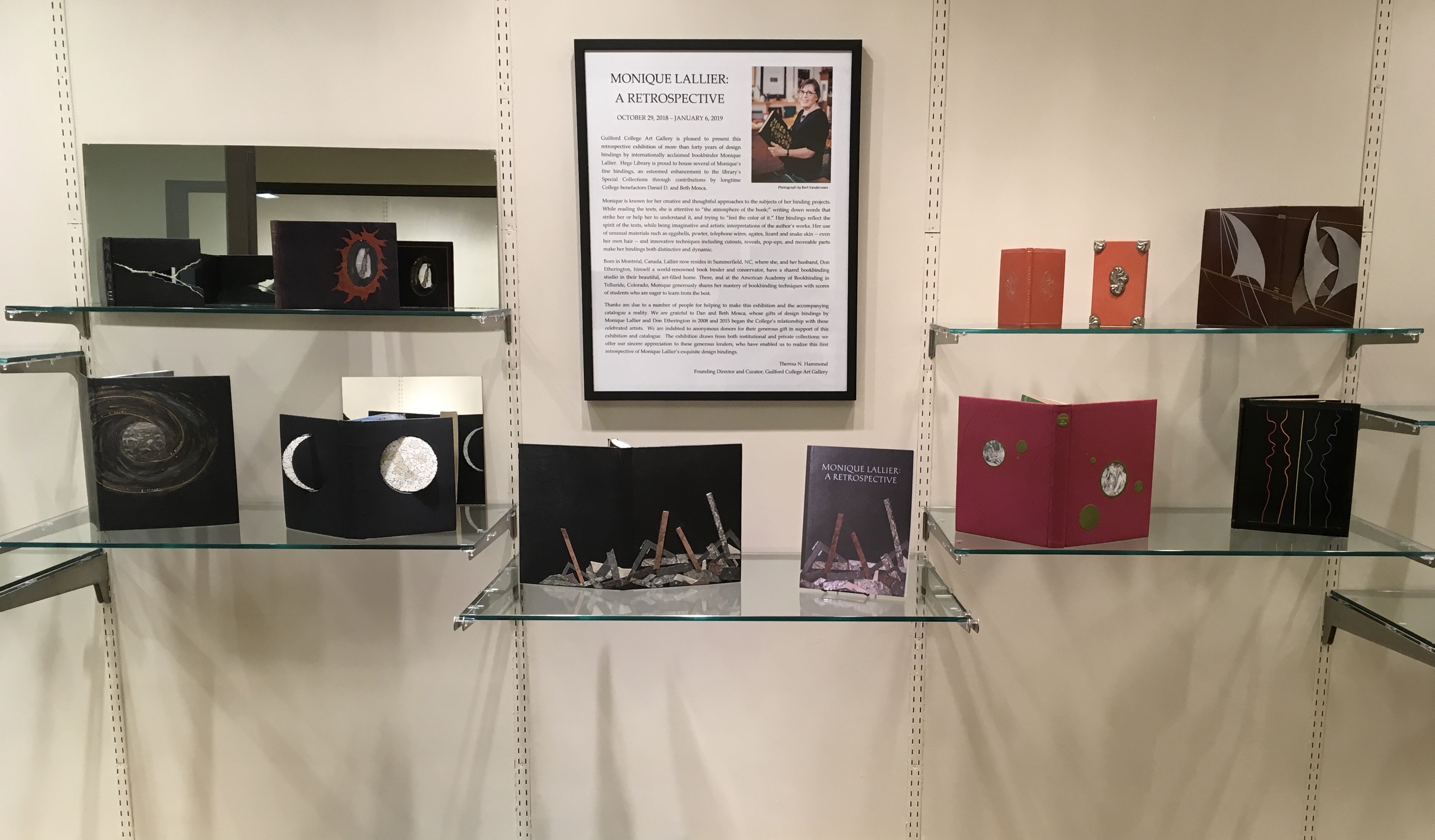
North Carolina can be a quiet state of hidden gems. Particularly those of the book arts, book art and publishing variety. The art gallery fronting the library on the Quaker-founded Guilford College campus in Greensboro is one such gem. Within that gem for the next two months is another.  The Gallery’s director and curator Theresa N. Hammond has marshaled its collection of Monique Lallier’s bindings and dozens of others from around the world for a retrospective on forty-six years of work by Lallier.

Lallier’s roots are in the tradition of fine French binding, which goes back to the practice of book buyers’ purchasing unbound books and taking them to their favorite specialist binder for customized binding, most often in leather. Lallier has written here about the technique in detail. While it is true to call Lallier a bookbinder, it misses what the displayed works say she is: a sculptor and artist of the book. For anyone lucky enough to visit Guilford College Art Gallery, the comments and photos below offer a handful of pointers to details and background supporting that statement. The exhibition catalogue including an insightful essay by Karen Hanmer as well as multiple views of the works displayed and several outside the exhibition will clinch the argument.
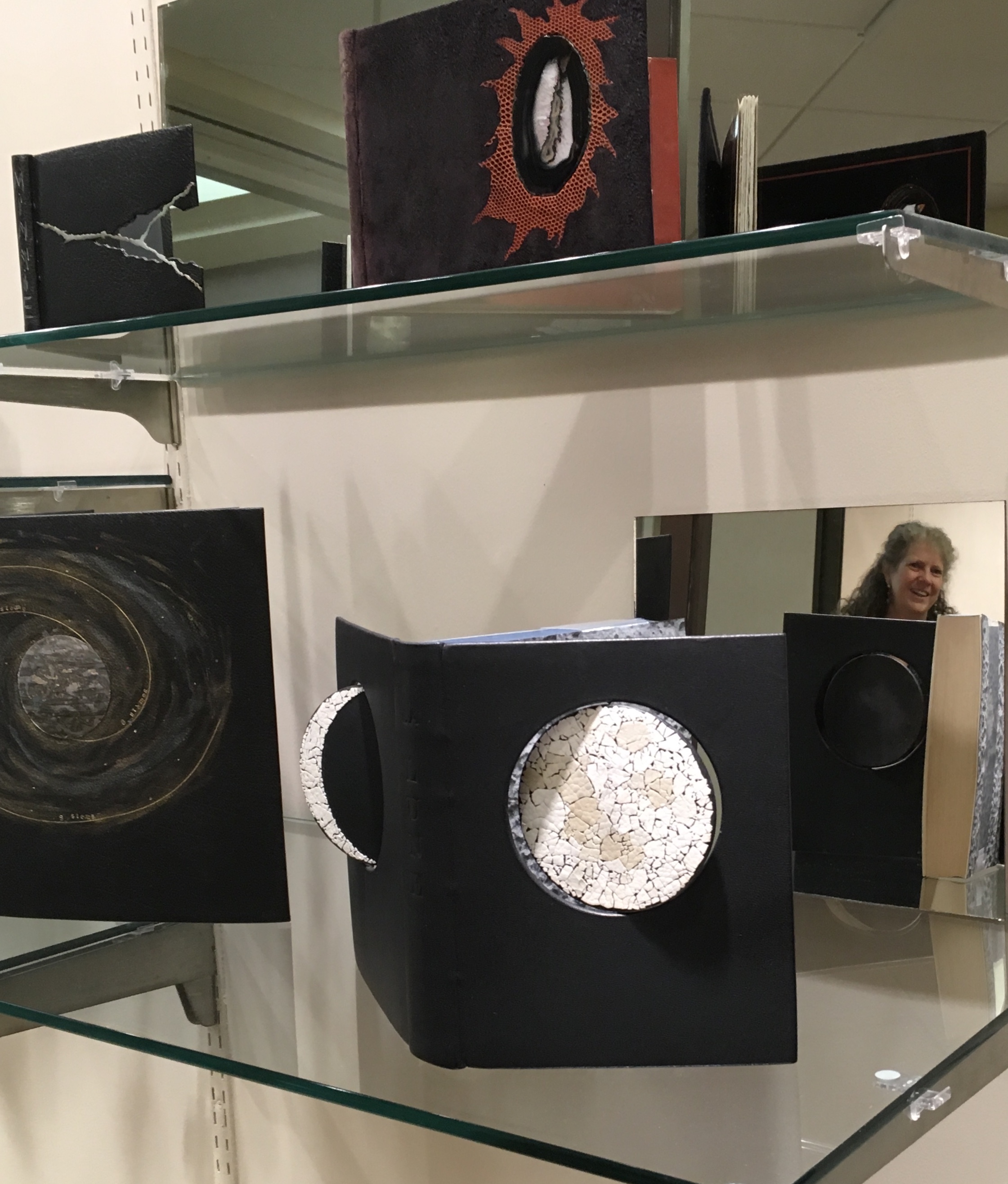
Be sure to take in all angles provided by the mirrors behind many of the works.
Theresa N. Hammond, the Gallery’s director and curator, reflected here behind La Lune (1971) and its swiveling “phases of the moon”, rounds coated in eggshells of differing colors.

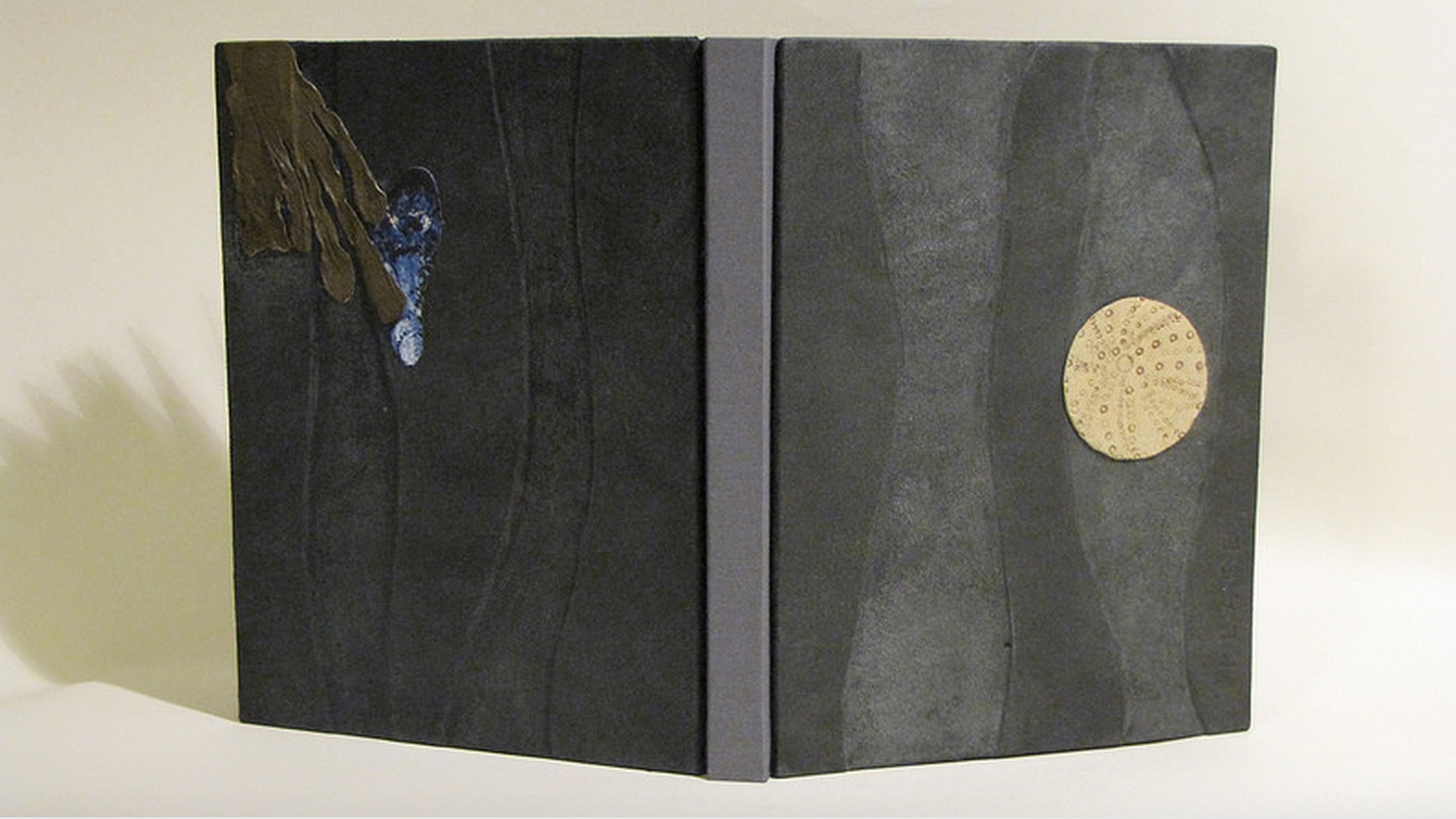
One of the distinguishing characteristics of Lallier’s artistry is her innovative use of materials: eggshells in La Lune (1971), her own hair in L’Eloge de la Folie (1974), translucent agates in Portes Sud (1979), silver in Histoire de Minnie (1982), wires from old telephones in Lignes (1986) and pewter in The Song of Songs, which is Solomon’s (2002).
L’Eloge de la Folie (1974)
Rarely does Lallier use on the cover an image from within the book at hand. Here is one of the exceptions. The cavorting monks from Erasmus’ satire come from Albert Dubout’s 1951 illustration of the classic. Lallier, however, couldn’t resist using her own hair to form their tonsures.
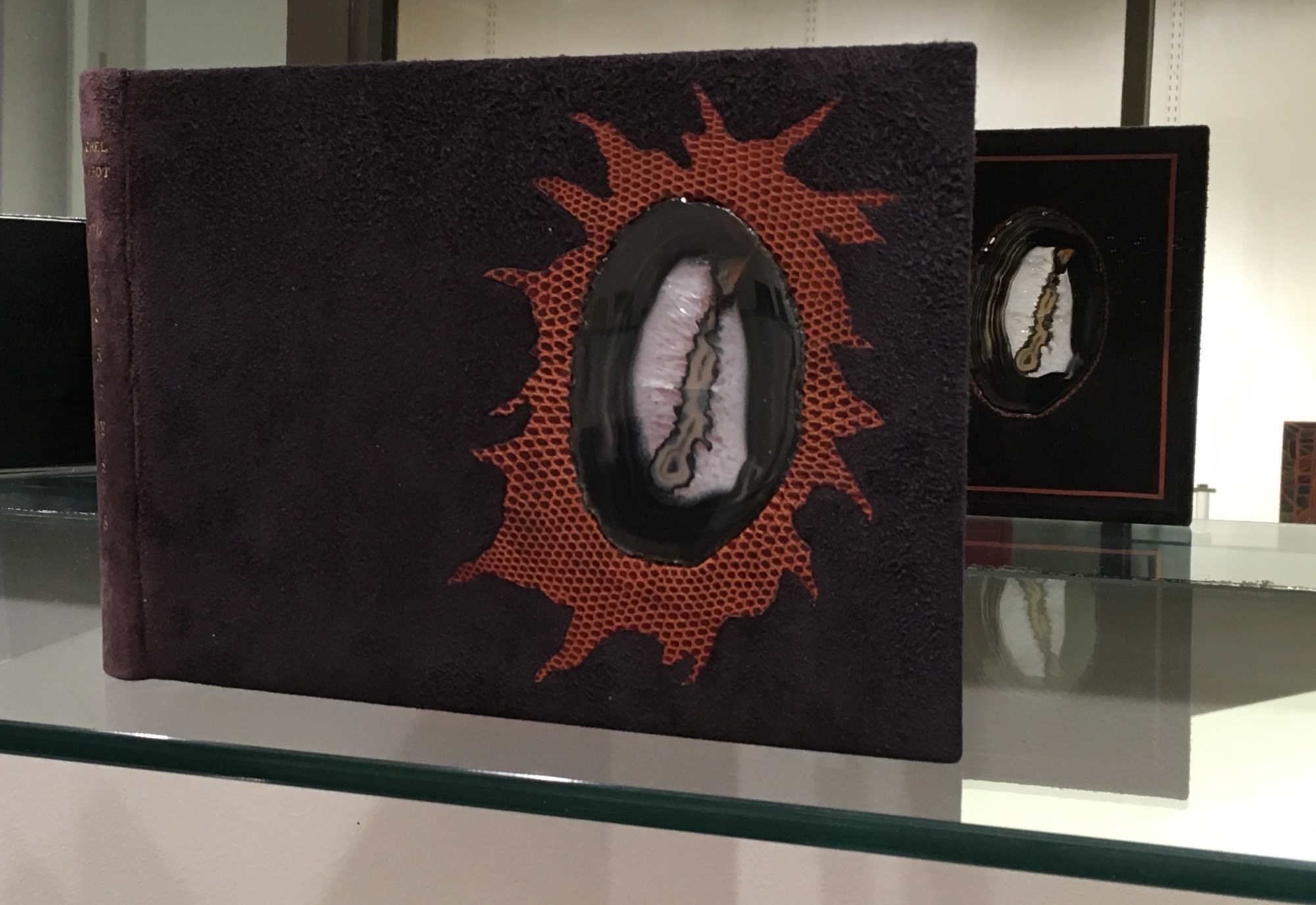
Portes Sud (1979)
Note in the reflection the light coming through the agate embedded in the cover.
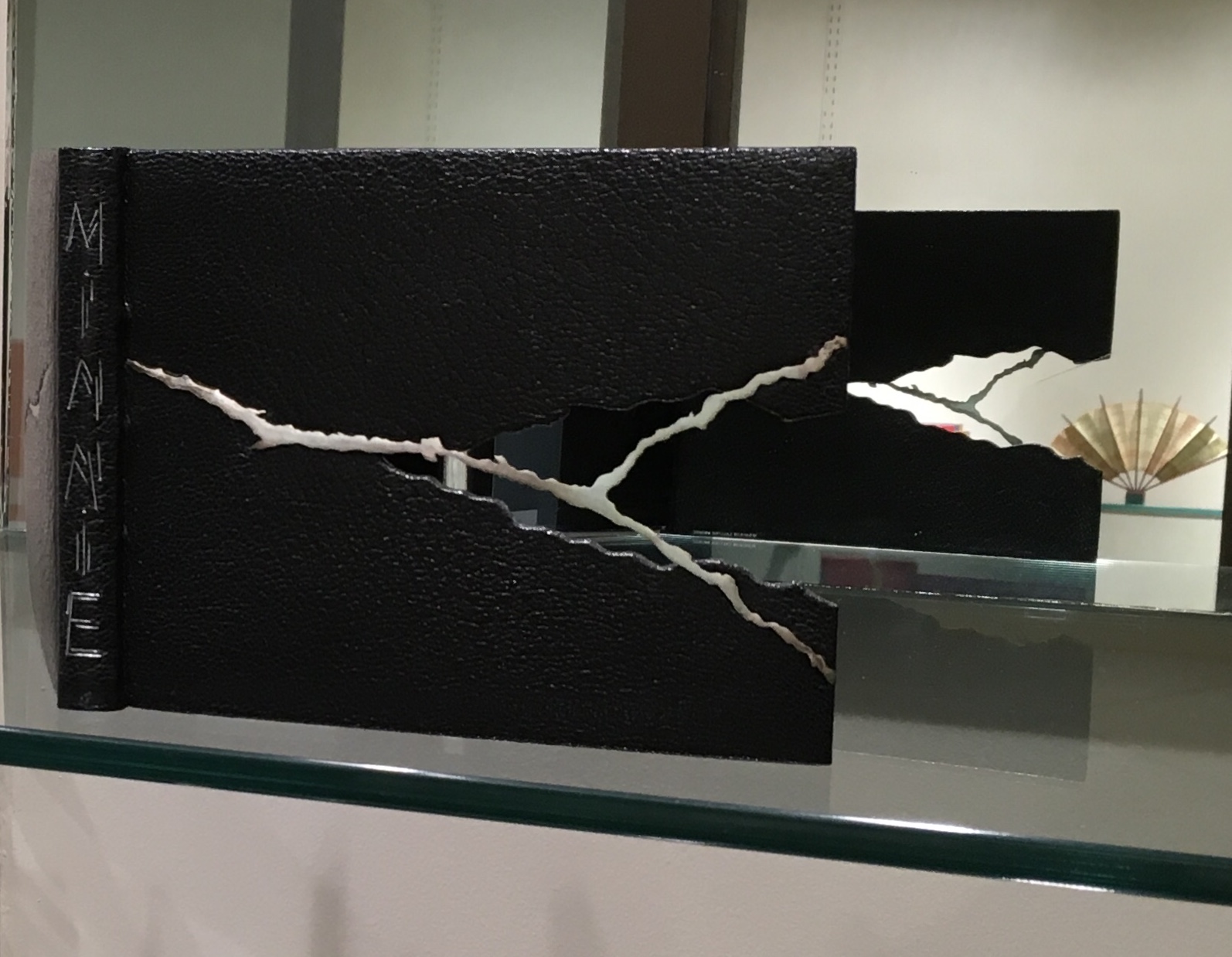
Histoire de Minnie (1982)
In the exhibition, be sure to look at the back cover where Lallier has used the silver piece, embedded in the front cover, to stamp the back cover.
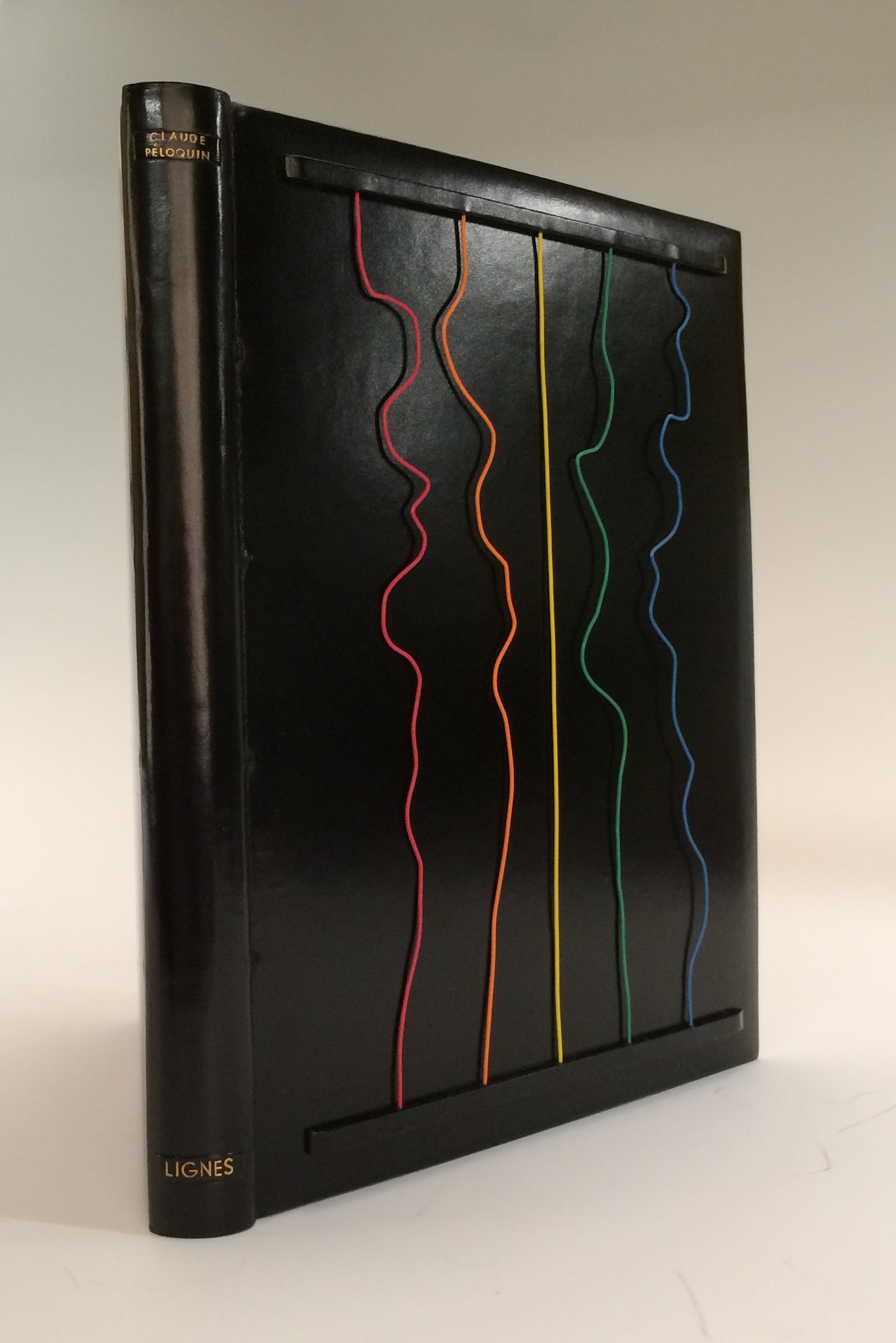
Lignes (1986)
This is Lallier’s only collaboration from scratch. For a Montréal exhibition whose organizers set the theme of “lignes” or lines, she conceived the cover design. Sharing only blank pages and not the design, she then asked Claude Péloquin to provide text and illustrations on the theme.
The “telephone wires” attached to the front cover are loose and manipulable by the reader — a tongue-in-cheek form of interactivity with lines of communication in the pre-Web age. 
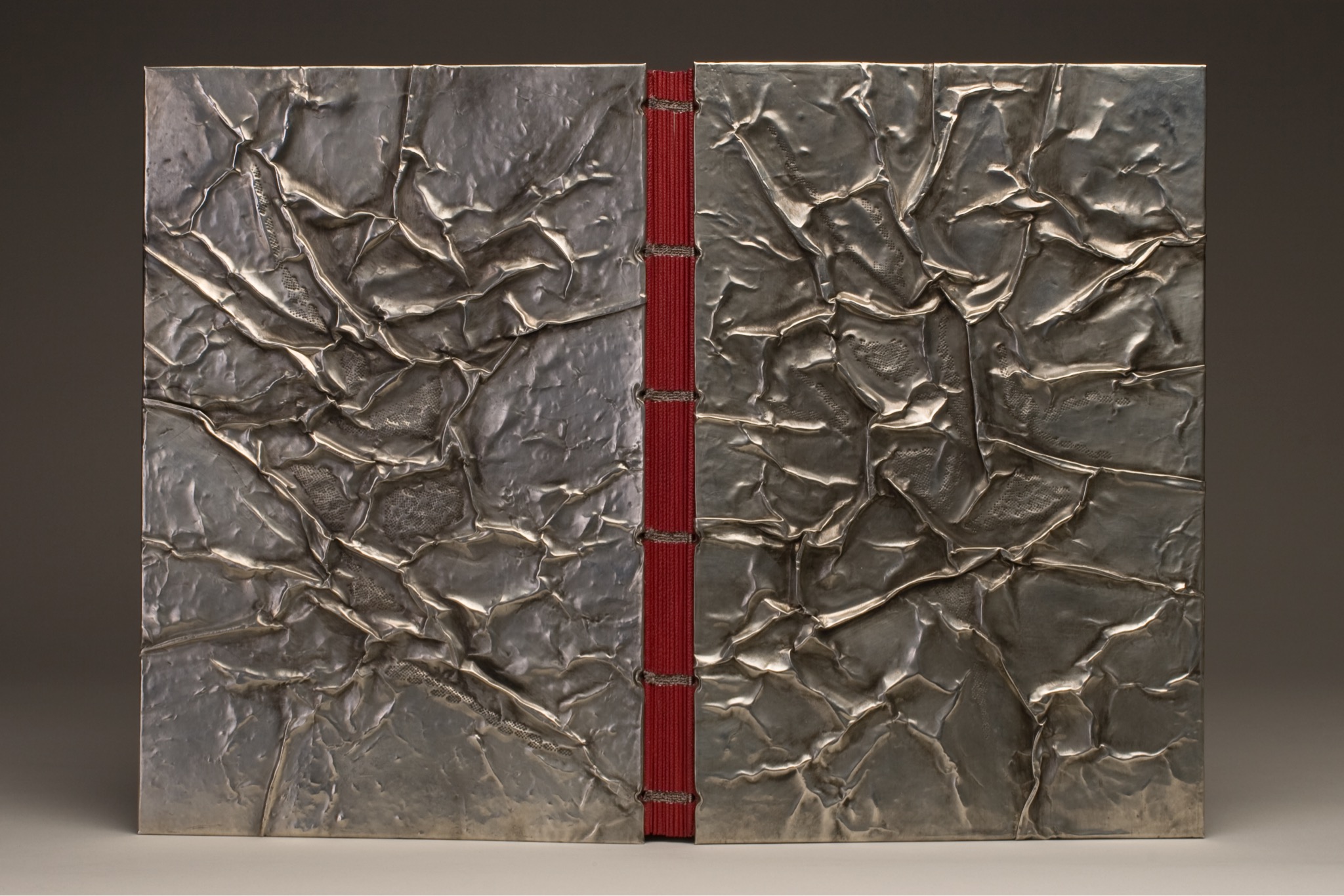
The Song of Songs, which is Solomon’s (2002)
Visiting a Parisian builders’ store with a friend selecting decor items, Lallier was entranced by sheets of pewter and its varying thicknesses. She bought some. The inspired result above sits alongside another in the exhibition — The Enchiridion of Epictetus (2003); be sure to look at the reflection of The Enchiridion to spot the use of pewter in the interior.

The odd materials chosen are frequently highly apropos of the book in question. In the catalogue, take a look at Le Papier, Le Livre (2015), which has embedded pieces of a wasp’s nest, entirely in keeping scientifically and historically with the subject. In 1719, the French naturalist René Antoine Ferchault de Réaumur published an essay to the Royal Academy of Sciences on the natural history of North American wasps and hypothesized how man could adopt their natural papermaking industry.

Another element of Lallier’s work to look for is the form of binding — not just the covers but the interior structure. Despite the glass cases protecting these items, it is easy to spot and enjoy the structural features, for example, the book in the form of a distinctively shaped Southern lady’s fan for The Birthday (1990). The catalogue shows a dos-à-dos (back-to-back) binding of the volumes of Pilgrim’s Progress (2003), a daring rebinding of a rare 18th century production. The Friends of the Library at University of Alberta made the courageous right decision.
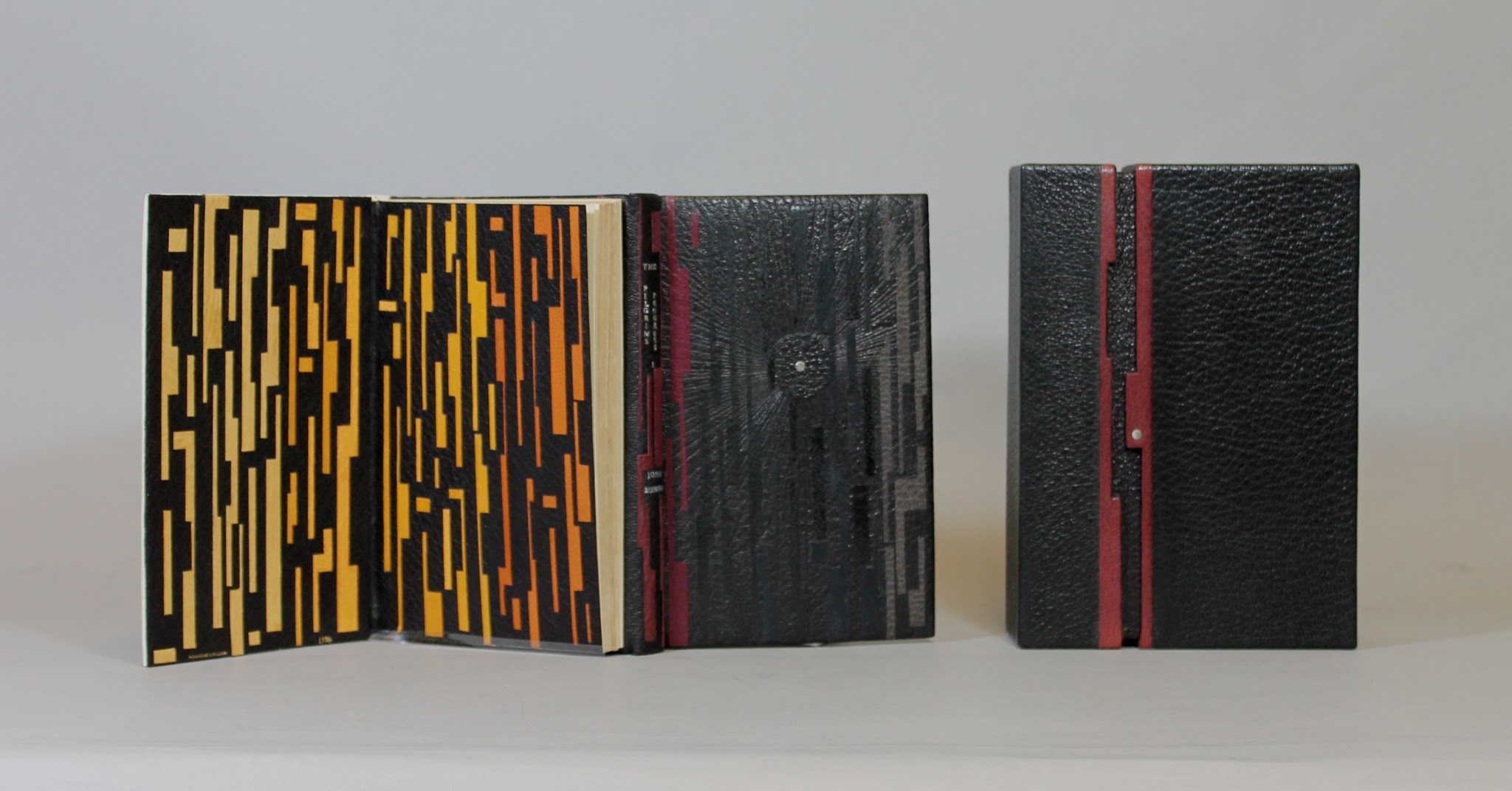
Pilgrim’s Progress (2003)
Dos-à-dos binding, showing the first part of the book, in which Pilgrim sets out on his journey in darkness, which Lallier marks with a black leather circle with a palladium dot at its center. 
Photo credit: University of Alberta.
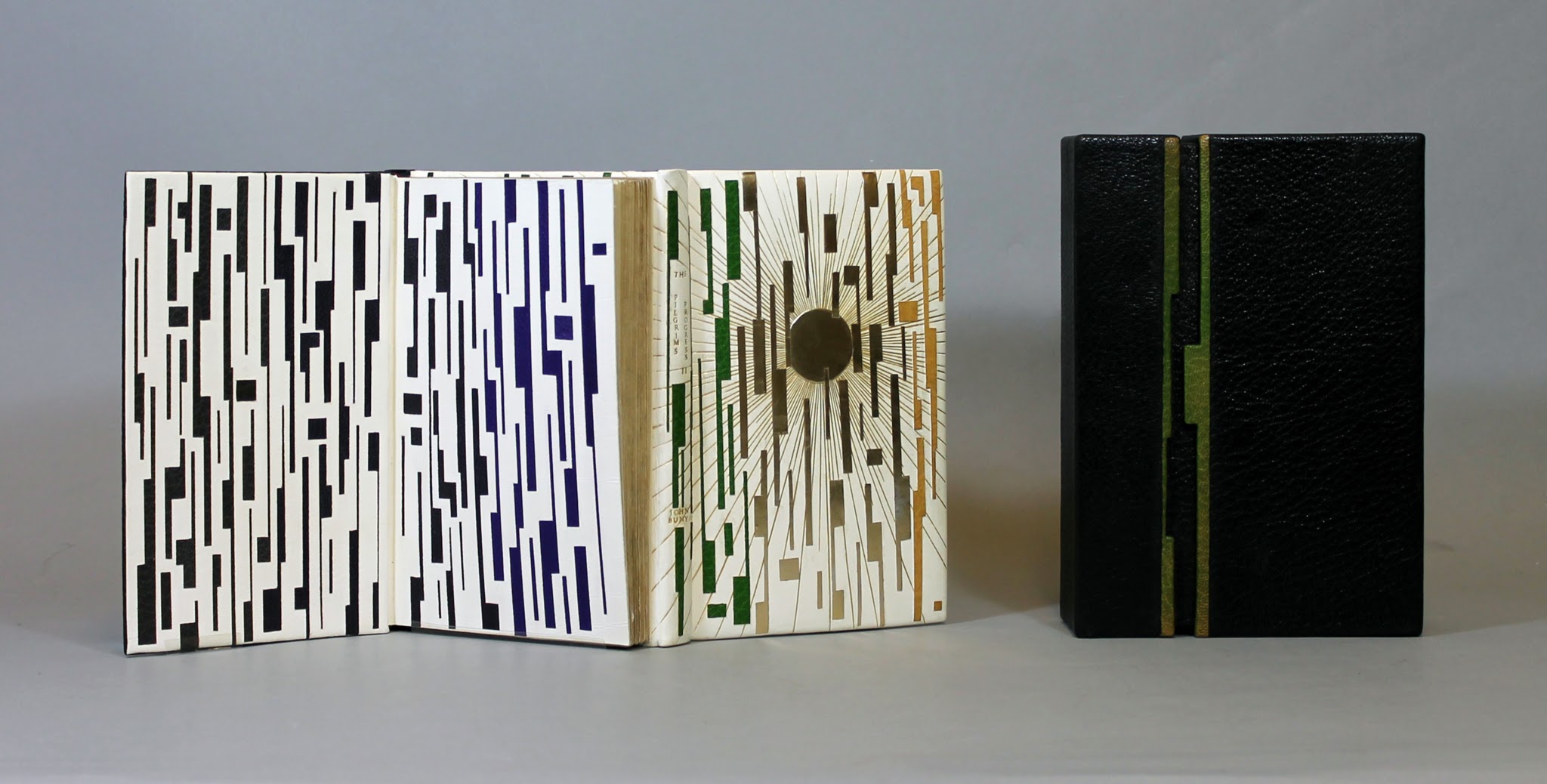
Pilgrim’s Progress (2003)
Dos-à-dos binding, showing the second part of the book, in which Pilgrim arrives at the Celestial City, which Lallier marks with a gold tooling radiating from a gold circle. 
Photo credit: University of Alberta.

Some of the interior and exterior forms are more subtle. Lallier has made extensive use of the stub binding technique (see below), and there are several examples of cross structure binding (see below).
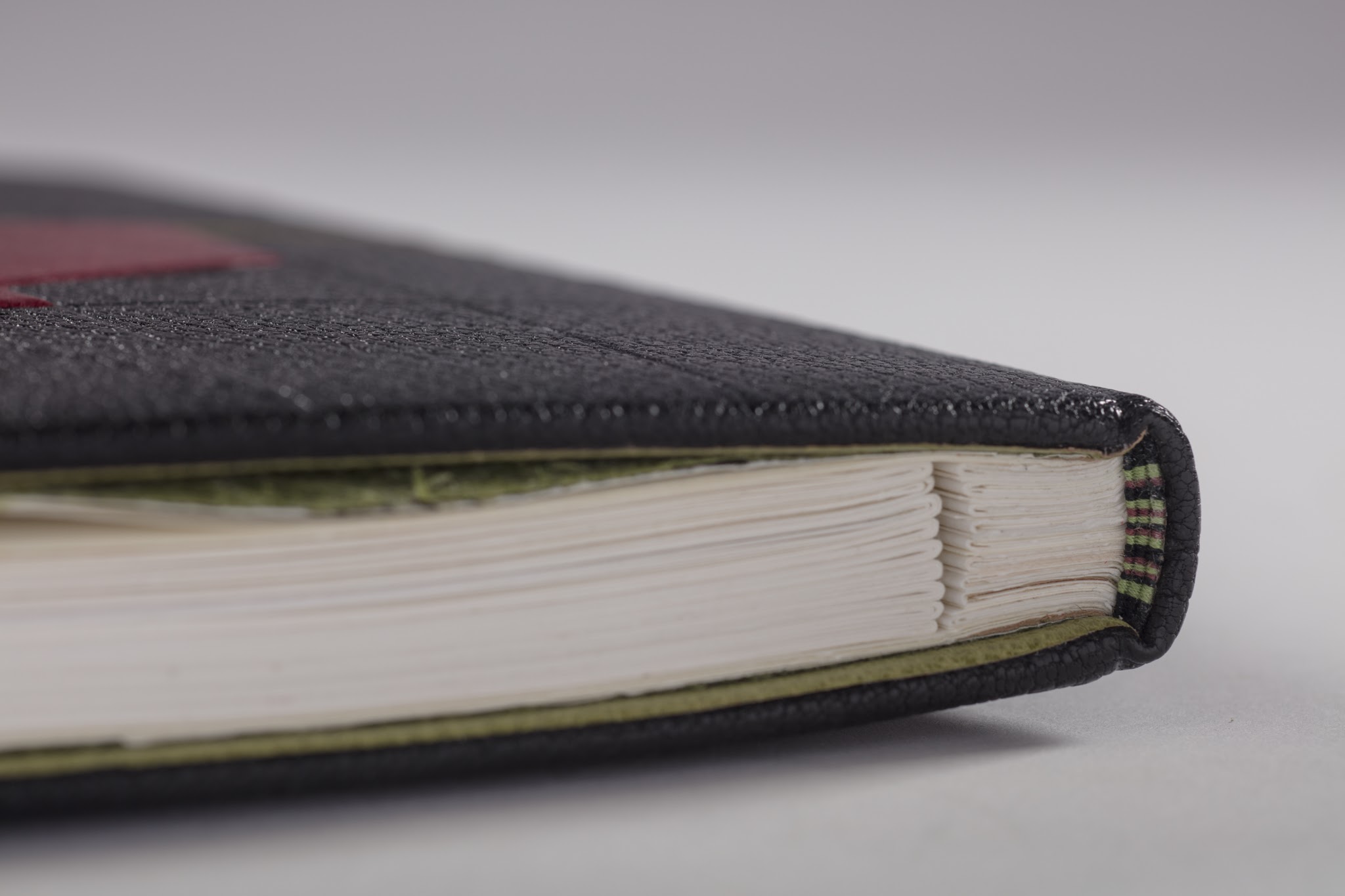
Look for this style of binding called montage sur onglets or stub binding that allows pages to lay flat or even be easily detached. Look for Le Chevalier Troyen (2014) and Inside the Book (2016), displayed side by side in the exhibition and showing this form of binding.
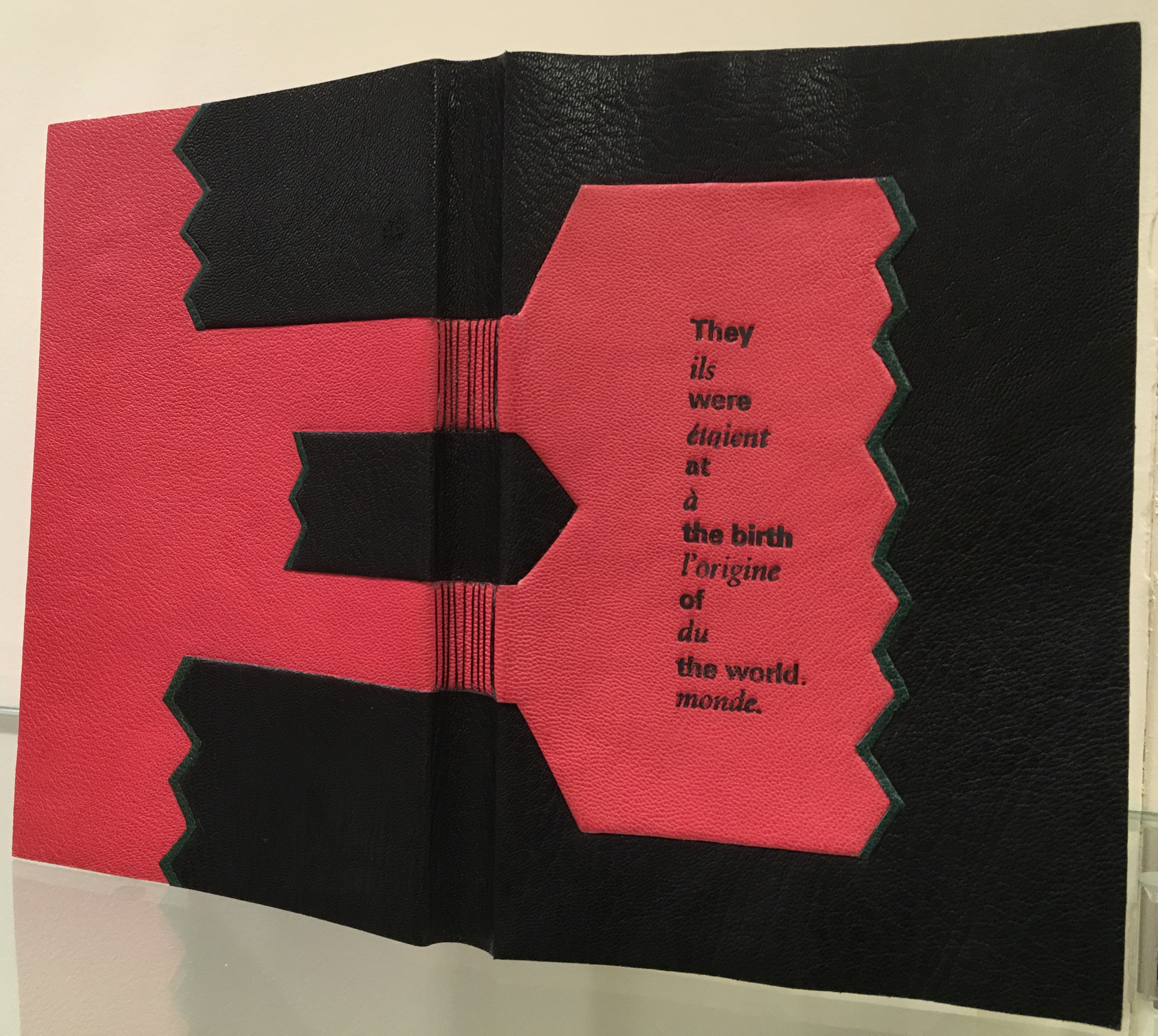
Le Livre des Origines  / The Book of Origins by André Ricard, 2005
In the exhibition, be sure to look closely at the spine’s deliberately exposed cross-structure binding in full goatskin leather. 

Le Livre des Origines is another one of those rareties where Lallier uses on the cover something from within the book. Stamped on the front, the phrase alternating in English and French comes from the text relating the Huron Nation’s creation myth as recorded in French by ethnologist Marius Barbeau, reinterpreted and rewritten by André Ricard. The alternating roman and italic presentation of languages reflects the book’s alternating pages of English and French. Note how the simple design in black and red with the diagonal onlays of green leather captures characteristic elements of the art of the Wyandot tribes, which can be explored here. A design philosophy of using imagination and craftsmanship in service to the book exemplifies itself again and again throughout the exhibition.

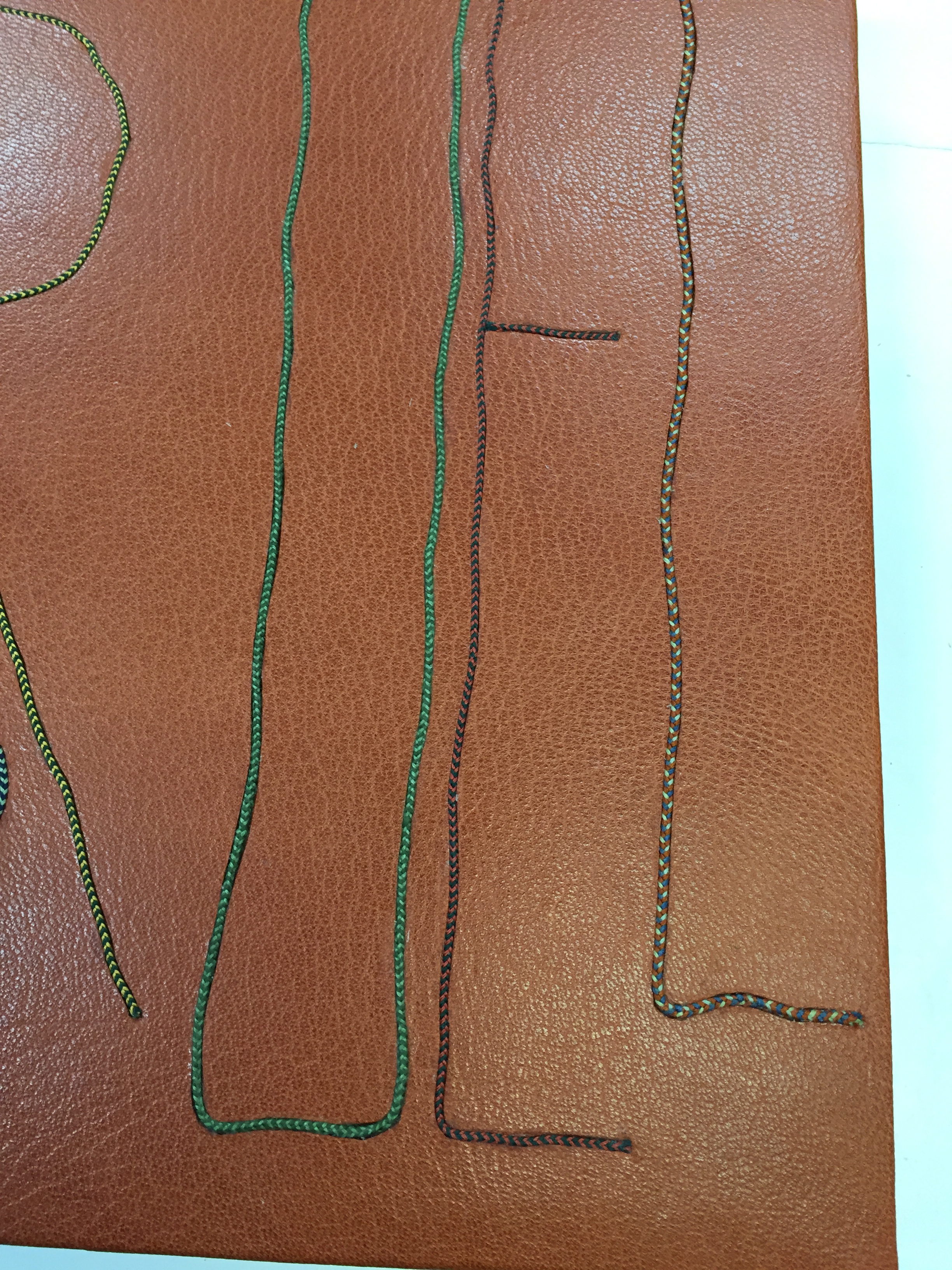
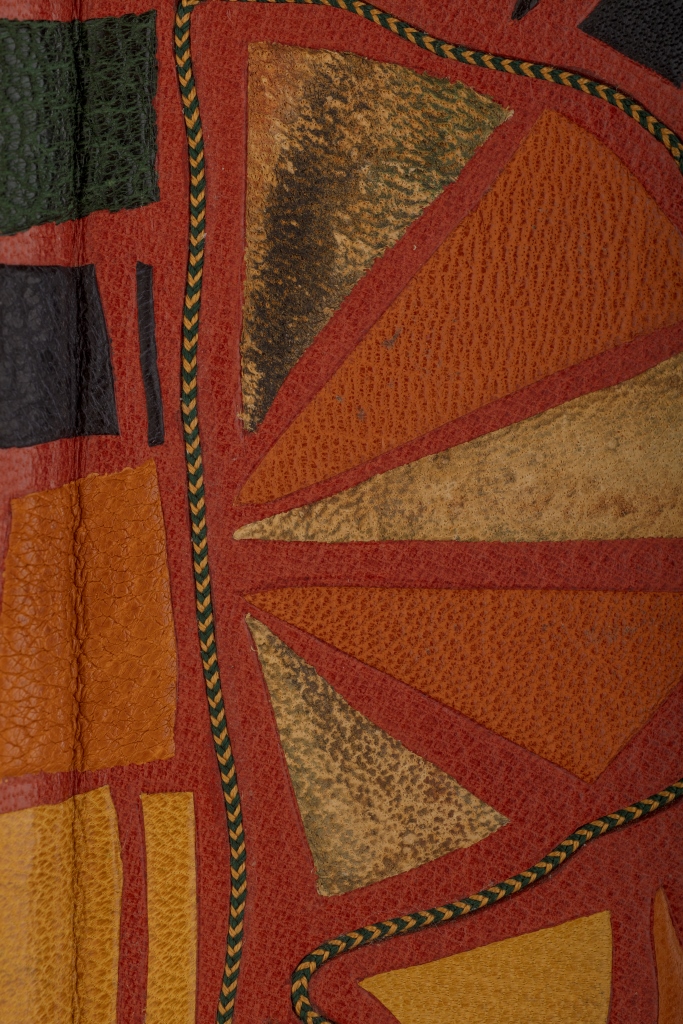
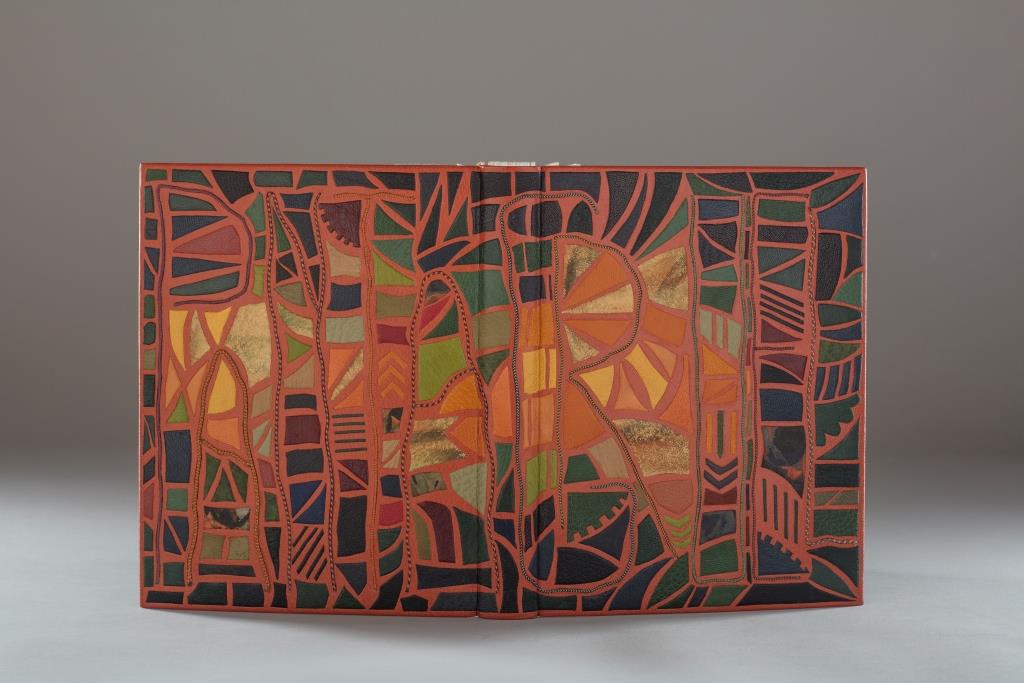
Which brings us to another characteristic of Lallier’s art to seek out: the painstaking handwork. For this, Pantagruel (2016) is worth a long look. Lallier once observed a student engaged in kumihimo braiding (the Japanese technique of using a disk to gather multiple threads of different colors into a single strand) and asked to be taught.  Inspired by André Derain’s illustrations of Rabelais’ riotous satire, she set out to use braids for the title’s letters, filled and surrounded with the colors from the illustrations. Some of the leather inlays are handpainted; all — even the smallest — are handcut, beveled, tucked in the covering leather and tooled. The series of process photos below — all courtesy of the artist — provide a look behind the scenes.
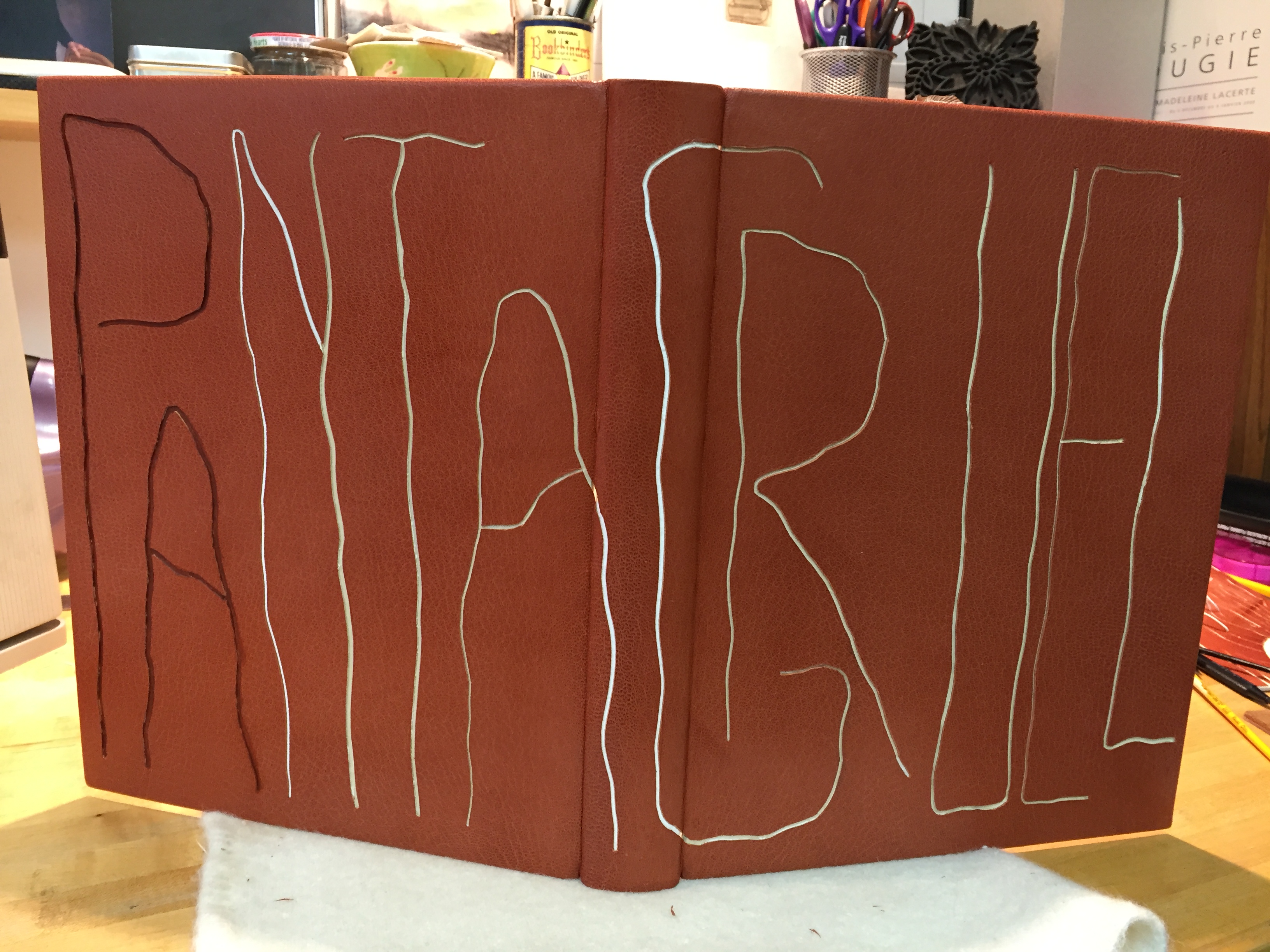
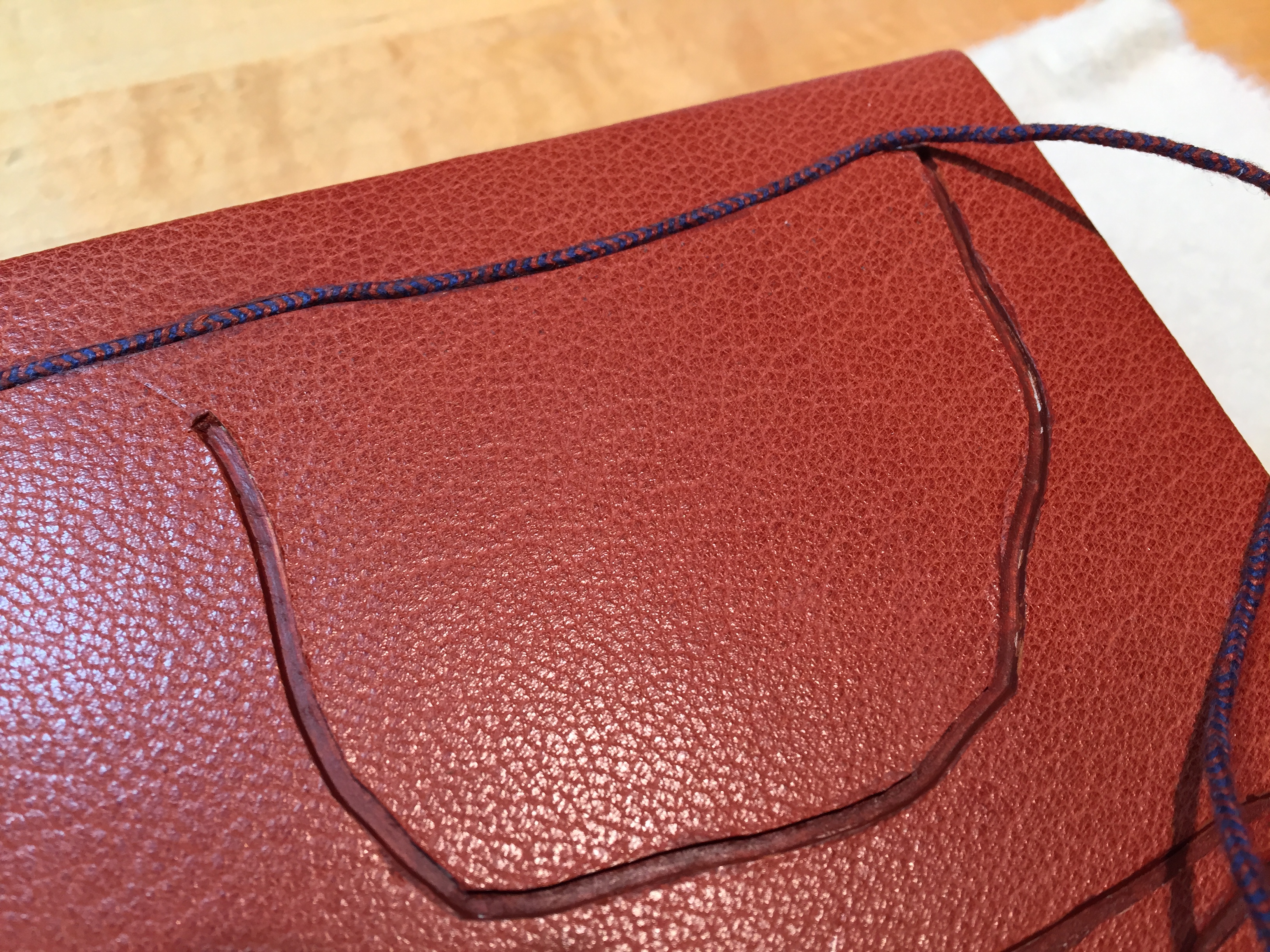
Pantagruel (2016)
Awarded one of 25 Silver Prizes at the International Competition of Designer Bookbinders (2016)

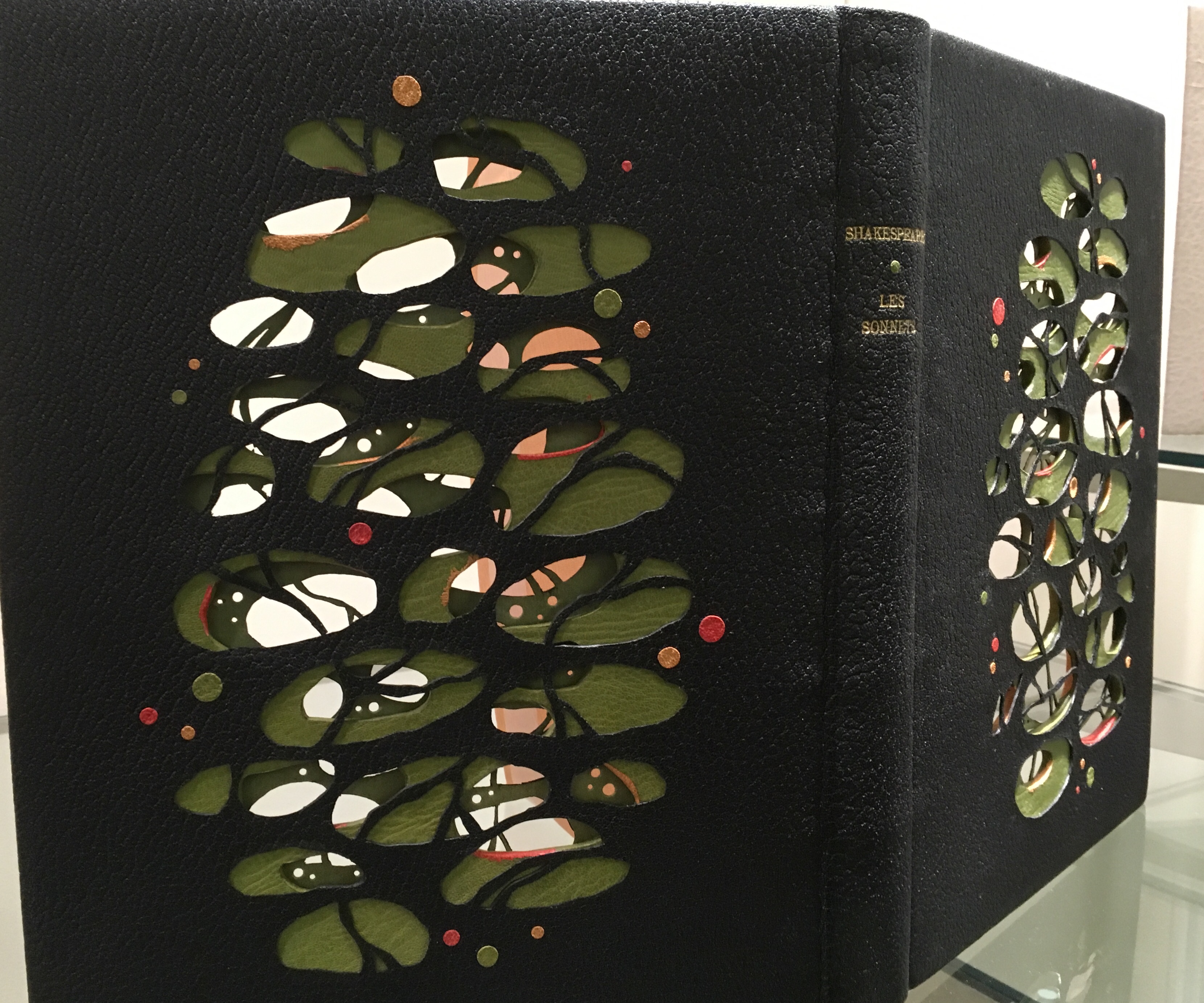
Shakespeare: Les Sonnets (2012) is another case in point of craftsmanship. Creation of this work began with a drawing (shown below) and then a maquette to enable Lallier to visualize the sculptural and aesthetic implications of multiple layers’ surfaces and edges being seen from all angles. The boards were cut out and lined with a green goat skin. The covering leather was also cut out and lined with green Japanese paper before covering. The doublures (linings of the book cover) received the same treatment before being applied to the inner boards.
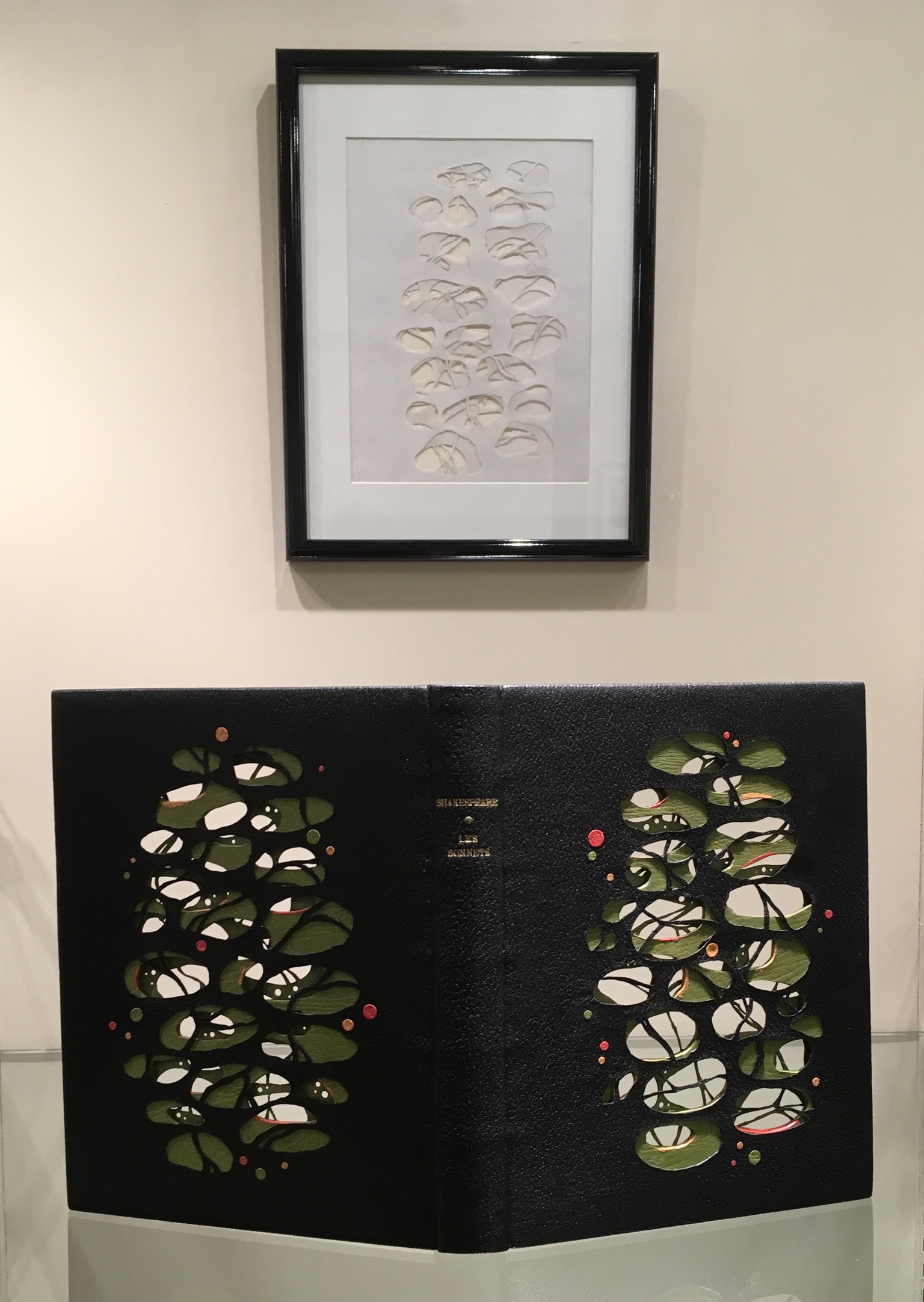
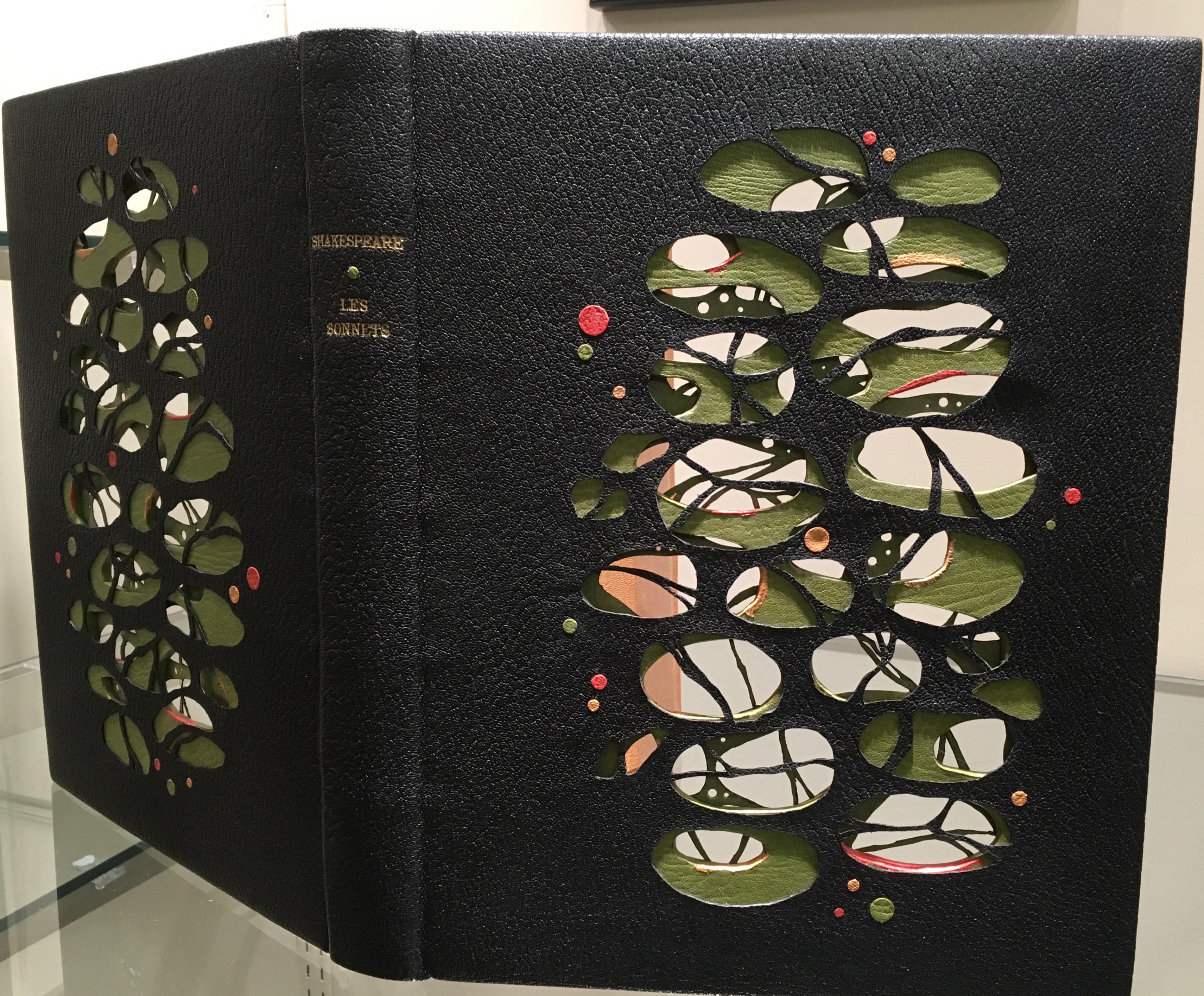
Shakespeare: Les Sonnets (2012)

There is a sense of movement in this three-dimensional, sculptural treatment of the cover, which brings us to a final pointer for visitors. Lallier’s signature and most original technique — the front cover panel that swings open along the fore-edge to reveal a hidden design. 
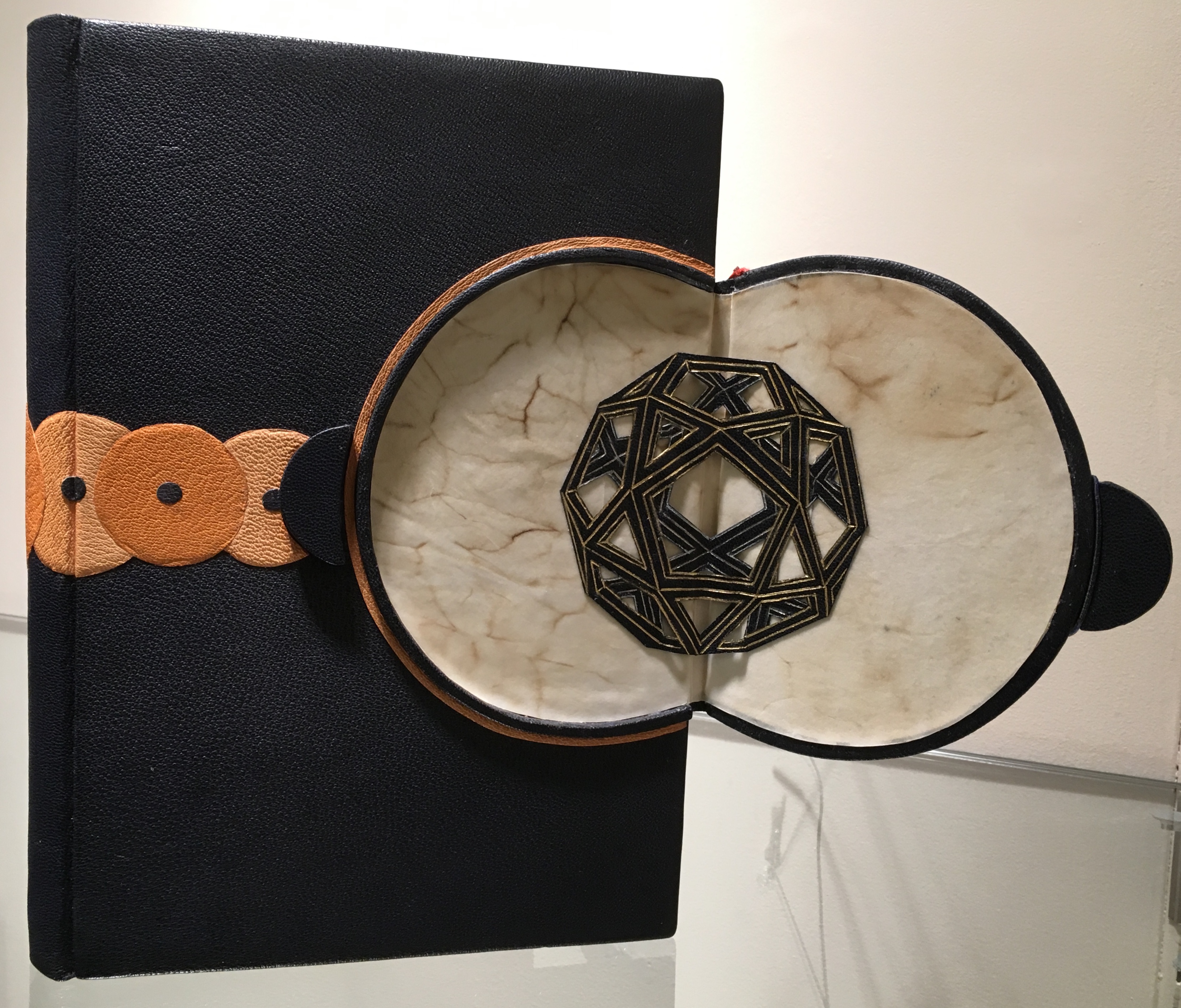
Excerpts from the Humorous Writings of Leonardo da Vinci (1996)
The open panel reveals a geodesic dome in leather with gold and palladium tooling. With the panel closed, the front cover’s design echoes a Da Vinci machine.
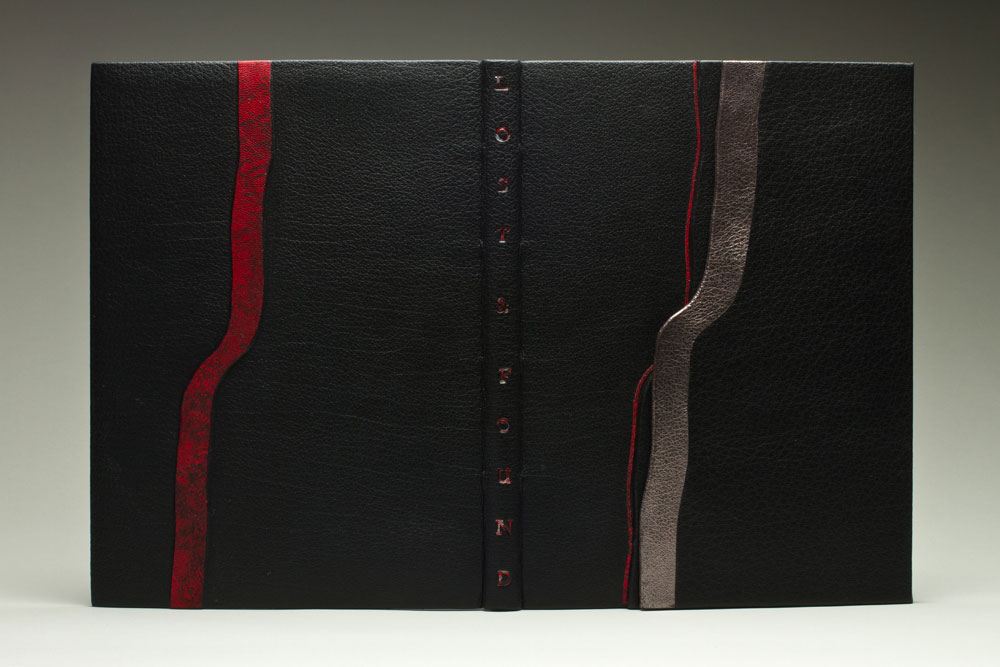
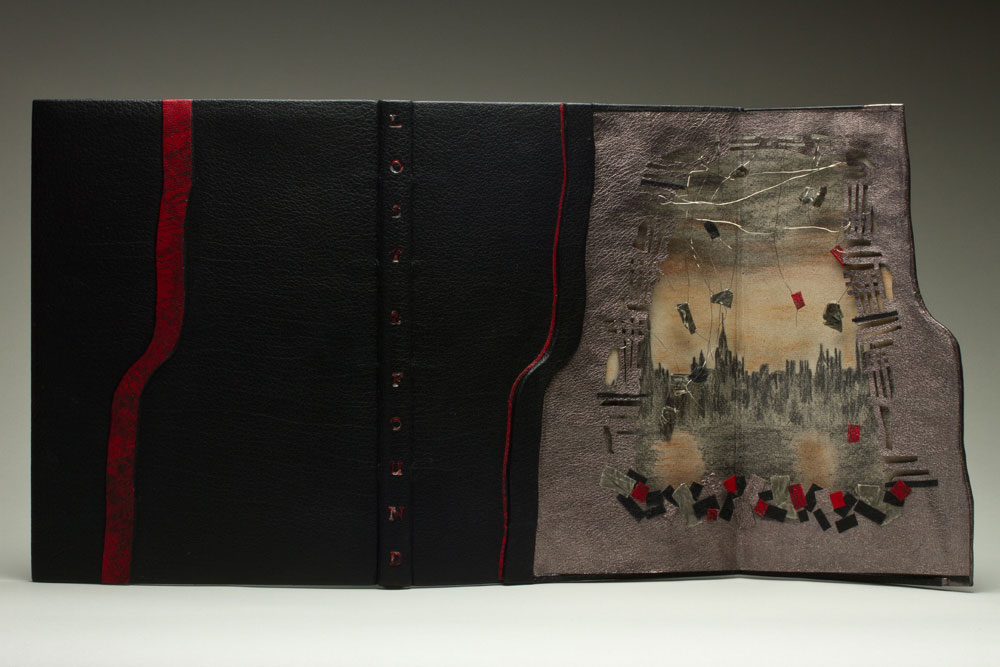
Lost and Found (2014)
The illustrations inside the book come from previously lost engravings by Rachel Reckitt, some showing the blitz of London from which Lallier has drawn the inspiration for her hidden panel.
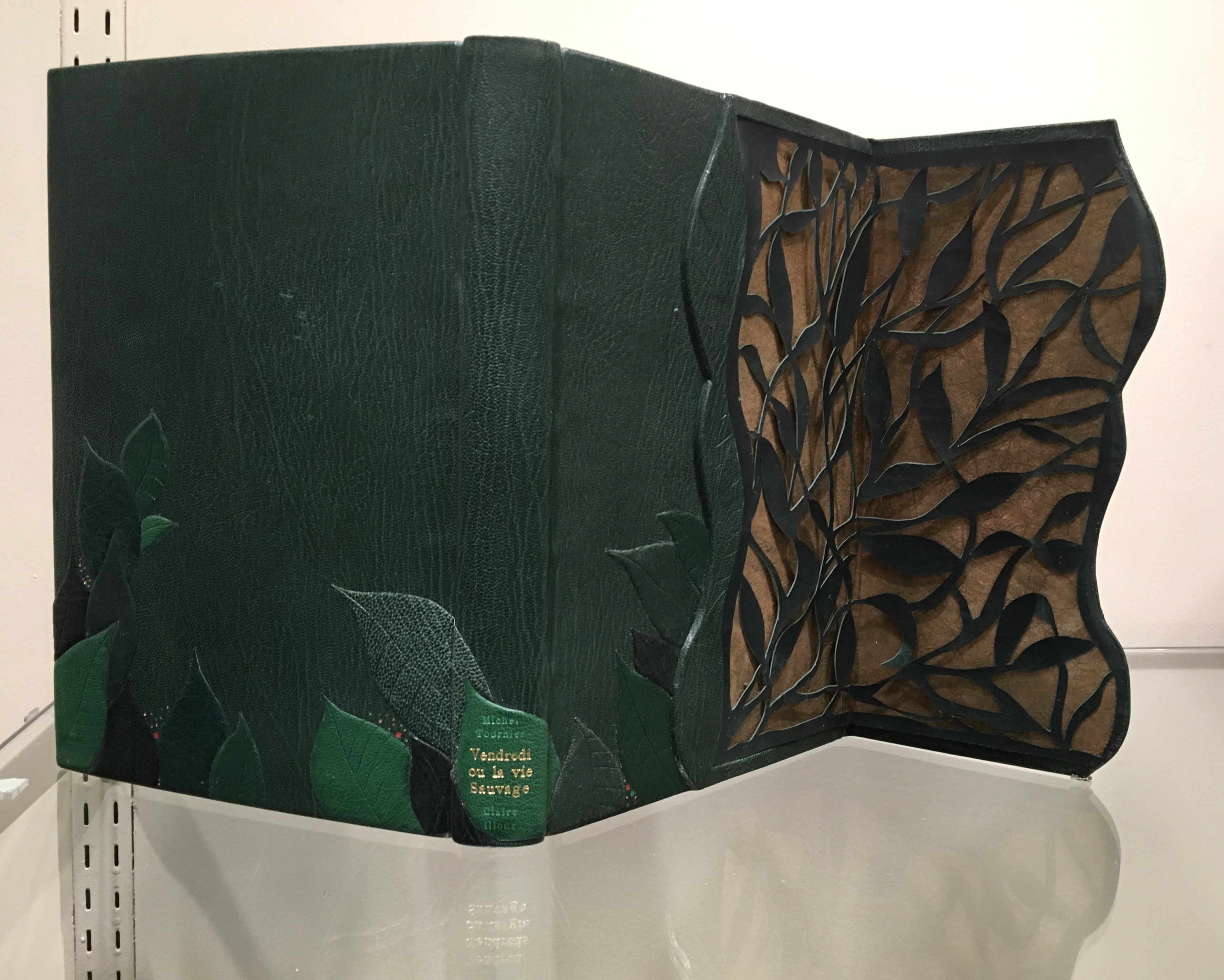
Vendredi ou la Vie Sauvage (2015)
Opening on layers on layers of carved foliage, the panel evokes the island on which Friday finds himself castaway in Michel Tournier’s version of Defoe’s Robinson Crusoe. In the exhibition, stand on tiptoe or someone’s shoulders to see the top edge’s coloring. Extraordinarily it resembles flower petals submerged in water. 
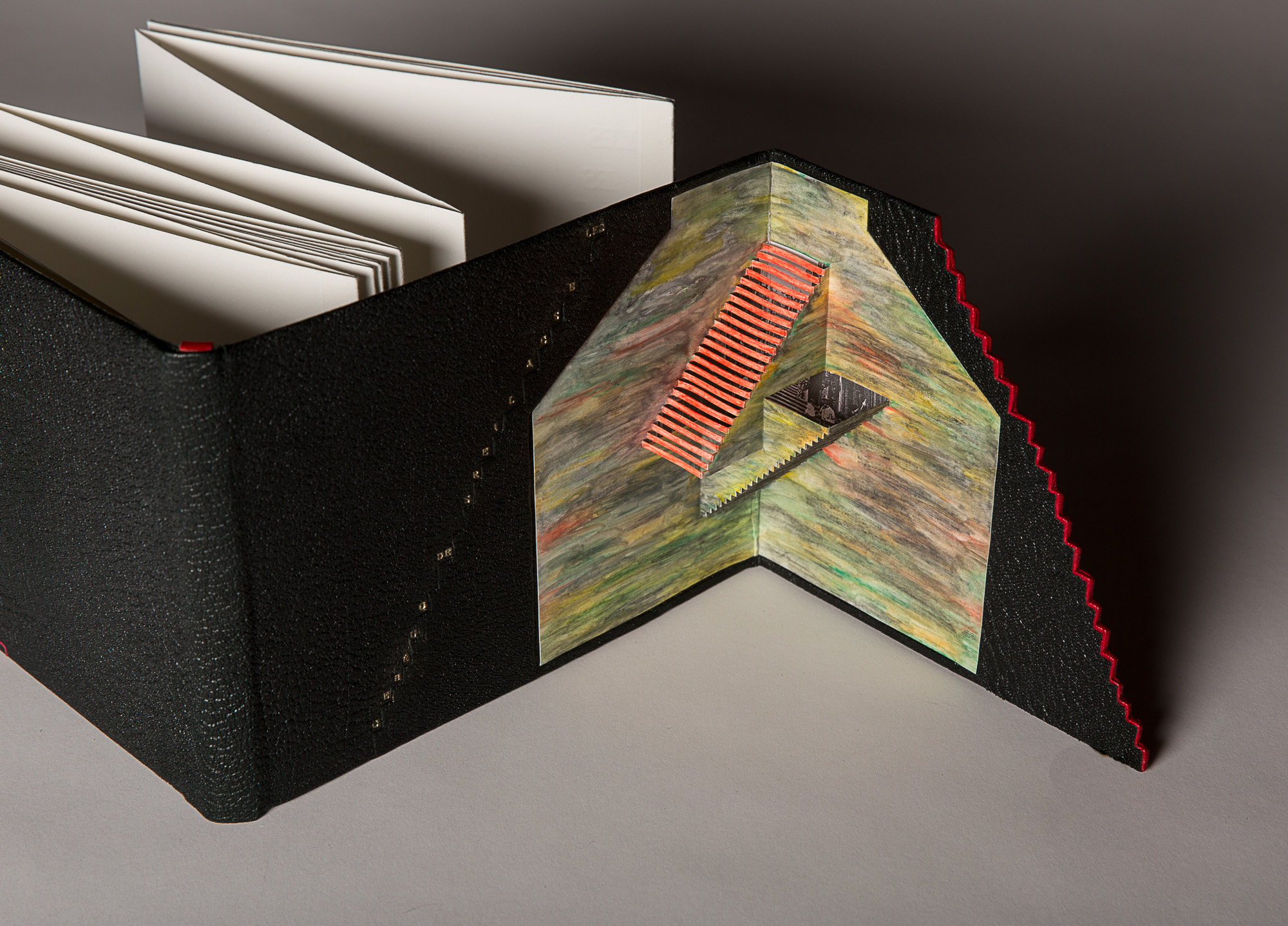
Les Escaliers de Québec (2013)
Bound in black Morocco leather in the “drop spine” technique, this work unites the stair-stepping accordion form of the text with a gold-tooled title climbing the steps of the front cover panel, which opens on a hand-colored pop-up set of Escher-like stairs.

Lallier’s unity of design with the text by Luc Bureau and illustrations by Ghislaine Bureau celebrating the famous thirty sets of stairs between the upper and lower parts of Québec can hardly be excelled.  Except that she does — again and again — with the examples on display.  This retrospective resoundingly affirms Lallier’s intention always to serve the book in front of her. Go judge for yourself.

Monique Lallier: A Retrospective runs from 29 October through 6 January 2019 at The Guilford Art Gallery on the campus of Guilford College. For more background on Lallier’s work, there is a series of interviews with Erin Fletcher of Herringbone Bindery here.

Bookmarking Book Art – Hedi Kyle’s The Art of the Fold: How to Make Innovative Books and Paper Structures (2018)

The [artists’ book] movement had its beginnings with a few individuals (conceptual artists Dieter Roth, Hansjörg Mayer, and Ed Ruscha immediately come to mind), but in the area of structural experiment and invention only one person seems to have been markedly influential (albeit seriously ignored): Hedi Kyle.

Alastair Johnston, “Visible Shivers Running Down My Spine”, Parenthesis, Fall 2013, Number 25.

While Alastair Johnston’s 2013 interview with Hedi Kyle is a rich one and welcome, it is inaccurate to say Hedi Kyle has been seriously ignored.  After all, in 2005, the Guild of Book Workers awarded her an honorary membership, and Syracuse University’s Library invited her to deliver that year’s Brodsky Series lecture. In 2008, the Philadelphia Senior Artists Initiative recorded her oral history and posted her artist’s statement along with an extensive list of prior exhibitions, honors, professional roles and board memberships stretching back to 1965.

If, however, Johnston’s assessment is accurate, subsequent events have rectified the situation. In 2015, Kyle delivered the keynote address “Four Decades under the Spell of the Book” for the Focus on Book Arts annual conference. In the same year, the 23 Sandy Gallery held a successful international juried exhibition entitled “Hello Hedi“, an echo of the 1993 exhibition organized by the New York Center for Book Arts entitled Hedi Kyle and Her Influence, 1973-1993. In 2016, the San Francisco Center for the Book held a solo exhibition for Kyle: “The World of Hedi Kyle: Codex Curios and Bibli’objets“.

And now, in 2018, Laurence King Publishers has brought out the eagerly awaited The Art of the Fold by Kyle and daughter Ulla Warchol, which is the immediate impetus for this essay. The authors aim their book at artists and craftworkers, but there is a secondary audience: anyone interested in book art or artists’ books or origami — and learning how better to appreciate them.

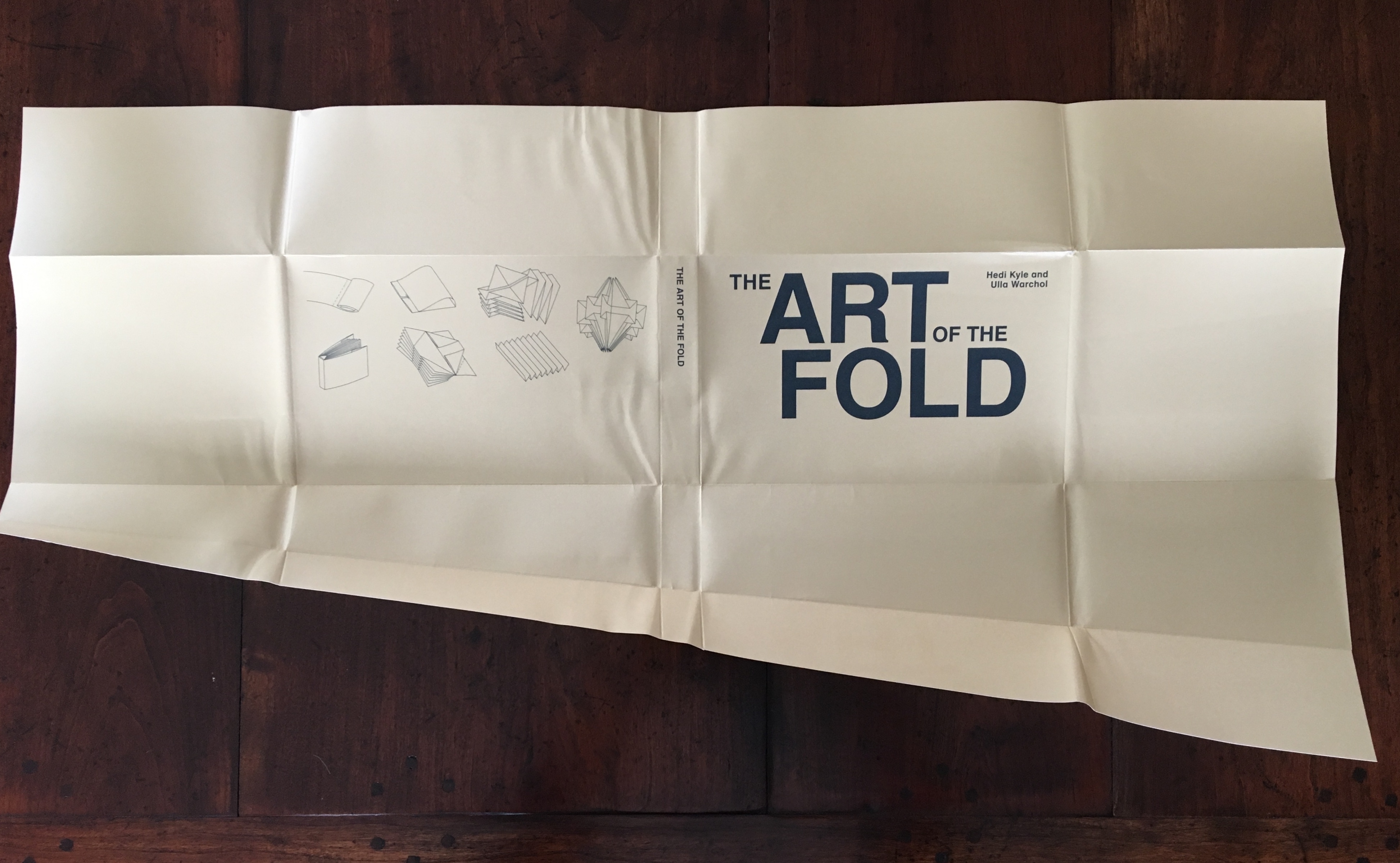
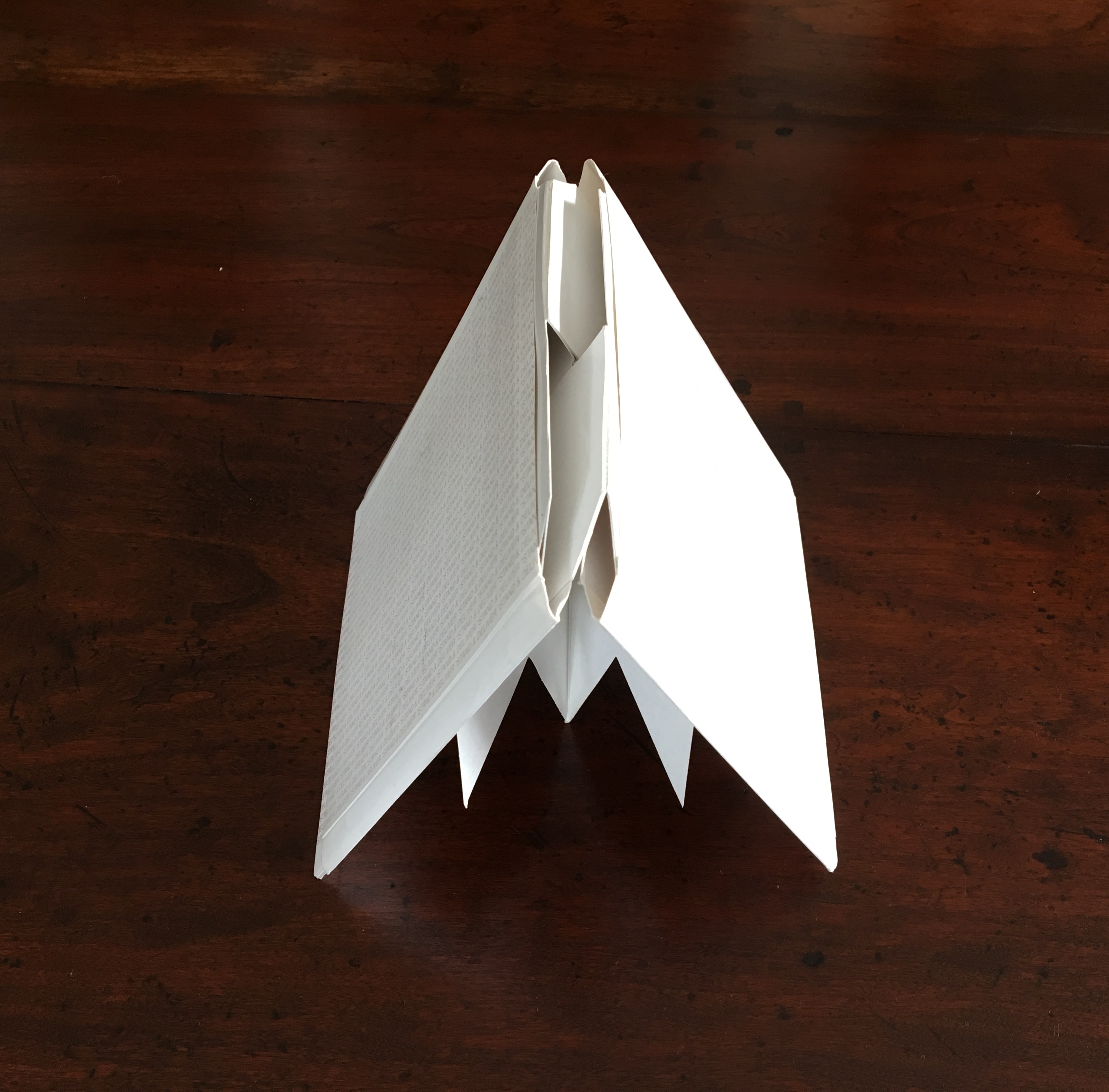
On picking up the book, the first thing its primary and secondary audiences should notice is the folded “dust jacket”. Why the quotation marks?  Just look:

“Dust jacket” unfolded, side 1

“Dust jacket” unfolded, side 2

This innovative, subject-appropriate cut, fold and print can set the reader on a hunt for precursors such as Peter and Pat Gentenaar-Torley’s Paper Takes Flight/Papier op de Vlucht, designed by Loes Schepens, where the multilayered dust jacket has small envelopes attached to hold paper samples from the contributing artists, or Doug Beube’s Breaking the Codex, designed by Linda Florio, where the dust jacket includes a perforated bookmark, whose removal implicates the reader in a bit of biblioclasm and challenges Western parochialism.

Paper Takes Flight/Papier op de Vlucht (2006) Peter and Pat Gentenaar-Torley Note how the book’s title is revealed on the second dust jacket from the bottom.

The five opened dust jackets displayed beneath the title page

Bottom-most dust jacket folded from the backboard to the right revealing the airmail envelope, which contains a blank sheet of airmail stationery

The Art of the Fold‘s clean, balanced design (Alexandre Coco) and excellent diagrams (authors) mesh well with the text. While this integrated clarity in the introductory section on Tools, Materials, Terminology, Symbols and Techniques will be appreciated most by artists and paper engineers, the secondary audience of library/gallery curators, aficionados and collectors will benefit from the description and comments in particular on materials, terminology and techniques. Knowing these points about an object of book art enhances appreciation of it and improves its handling, presentation and preservation.

Following this introduction, Kyle and Warchol provide 36 sets of detailed instructions across 5 sections:

  • The Accordion
  • Blizzards
  • One-Sheet Books
  • Albums
  • Enclosures

This double-page spread introducing the accordion structure shows off the the diagrams’ clarity, a feature throughout the book. Also in this spread are two important statements in the verso page’s final paragraph:

The accordion fold as an independent component is our focus point in this book…. Let us start with a brief visual display of a variety of folding styles. Hopefully they will inspire you to grab some paper and start folding. (p .28)

The focus on structure “as an independent component” is a strength and weakness. The strength is self-evident in the thoroughness and attention to detail. The weakness? More than occasionally, the authors make asides about the meaningful interaction of structure with content and, occasionally, with other components (type, color, printing technique, etc.). Some exemplars selected by the authors would have been welcome. The artist’s and reader’s challenge is to provide their own examples of how the structural component might work with different types of content, mixed media and other components that combine to deliver the artistic object.

The second statement — the exhortation “to grab some paper and start folding” —  illustrates an unalloyed strength of this book. As towering an authority and figure in the book arts and book art as Hedi Kyle is, she and her co-author go out of their way again and again to keep readers open to playing with the techniques and structures and finding their own  inventiveness and creativity. For those content to collect or curate, both statements push them to look for or revisit outstanding examples and inventive variants of the structures elucidated. After this section, a browse of Stephen Perkins’ accordion publications, a site running since 2010, would be a good start.

This double-page spread introducing the section on Blizzard structures delivers that blend of the anecdotal with essential engineering-like detail that is characteristic of the authors’ style throughout. Having explained how this family of folded structures that bind themselves got its name (a fold discovered in a daylong fold-a-thon due to a blizzard’s shutting everything down), the authors dive into the proportionality so key to getting them right. Perhaps because of its non-adhesive, origami-centric nature, the blizzard book structure generates more than its fair share of kitsch exemplars. When blizzard books do come along that rise to the level of art — integrating structure, content, printing, typography, color and other components of bookmaking in an artistically meaningful way — they stand out all the more. One such work took first place in the 23 Sandy Gallery’s juried exhibition in 2015, “Hello Hedi”:

Blizzard Book (2015)
Virginia Phelps

Next to The Accordion section, the One-Sheet Books section has the most models. It is also the section that most addresses that challenge mentioned above:

A book folded from a single sheet of paper, including covers, offers a unique opportunity to consider the content and cover as one comprehensive design exercise. We explore the coming together of printing, layout and folding. (P. 94)

Given this opportunity, some treatment of imposition would have been useful, especially for the Franklin Fold and the Booklet Fold Variations. For the Booklet Fold Variations, one could lightly pencil into the book’s clear diagrams the usual markings and enumerations as below.

Again, a few selected photographs of examples of One-Sheet Books that achieve the coming together of content, design, printing, layout and folding would have been welcome.

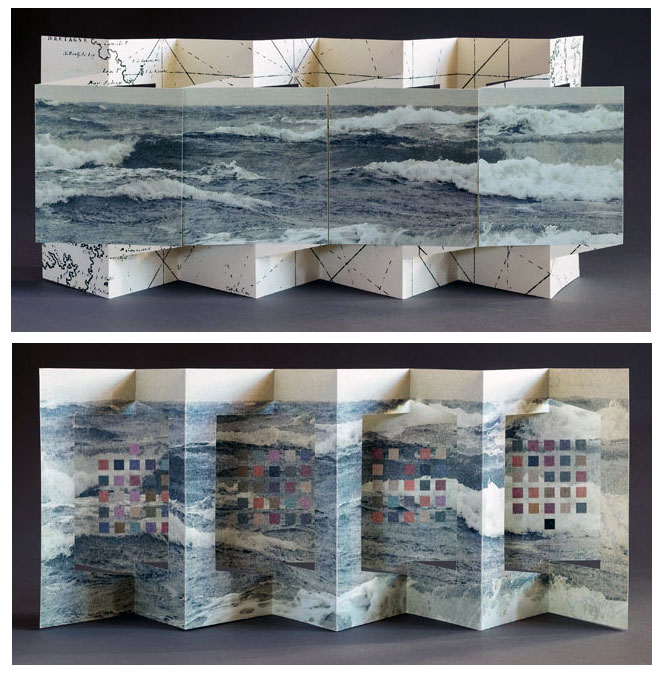
The double-page spread above with which the Albums section begins exemplifies the book’s quality of photography (by Paul Warchol, Ulla’s husband). Like the “dust jacket”, the crisply photographed Panorama Book structure (upper right) and the pages that explain it will send readers on a quest to make their own or hunt for outstanding examples such as these by Cathryn Miller and Cor Aerssens, a long-time friend and correspondent with Kyle.


Westron Wynde (2016)
Cathryn Miller
Author’s statement: “This book presents the poem ‘Westron Wynde’ in a purely visual form. Letters become colours, and are used as graphic elements. The book manifests the essence, if not the sense, of the poem.”
Westron wynde when wyll thou blow,
The smalle rayne down can rayne – 
Cryst, yf my love wer in my armys
And I yn my bed agayne!

Memories (2012)
Cor Aerssens

Memories (2012)
Cor Aerssens

Memories (2012)
Cor Aerssens

A cautionary, or perhaps encouraging, note though: the fact that some structures can enfold others will frustrate readers with strict classificatory minds and exhilarate the more freewheeling. The Phelps’ Blizzard Book highlighted above includes in its sections items exemplifying the Flag Book and Fishbone structures. Aerssens’ Memories is even more so an integrated variant of the Panorama Book structure, featuring as it does panels within panels, two 8-leaf booklets bound into front and back with paper hinges, and mylar folders holding pressed flora from Aerssen’s northern Dutch environs.

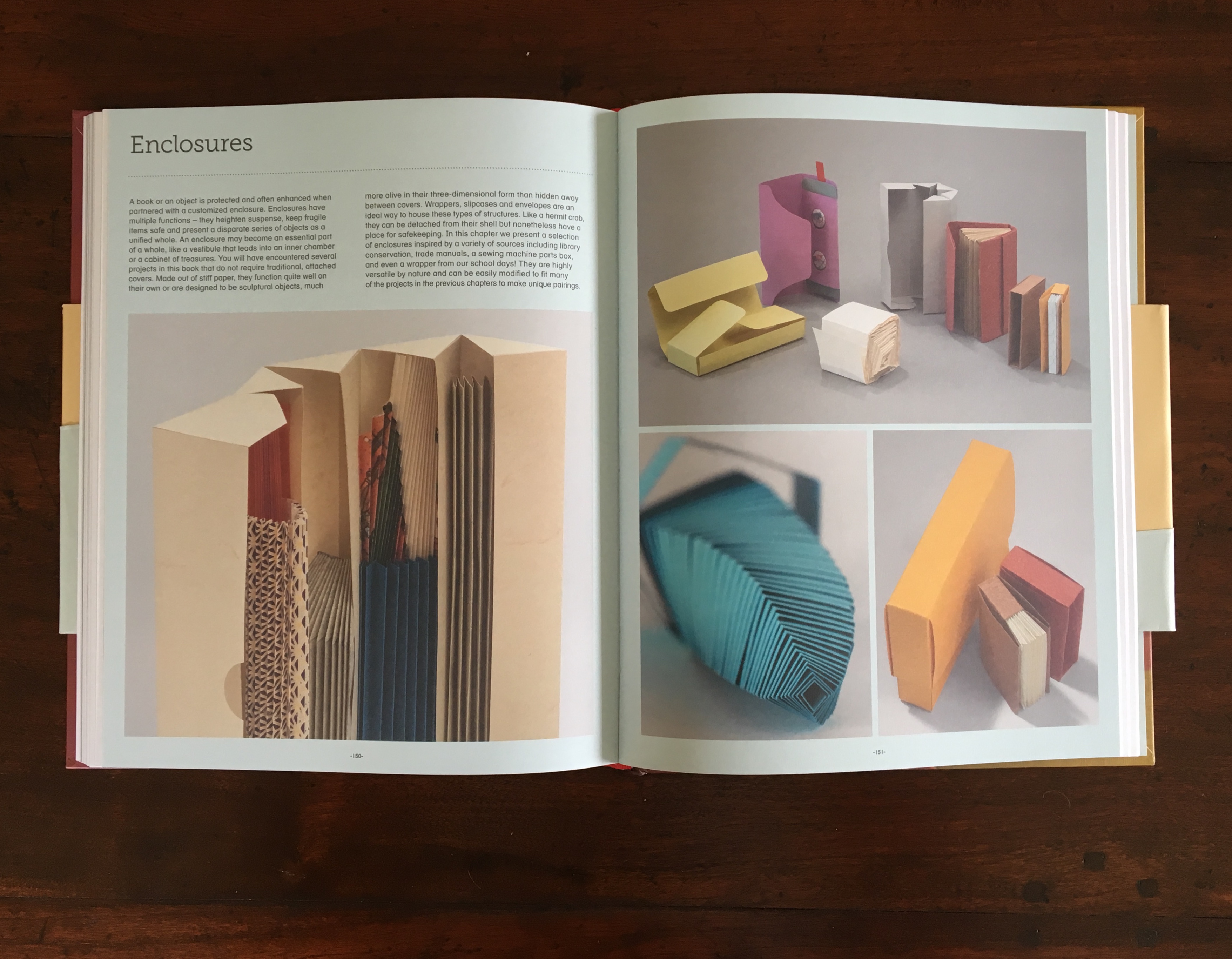
The Enclosures section presents fascinating structures, not all of which are suited “to fit many of the projects in the previous chapters”. For example, the second-most fascinating form — the Telescoping Ziggurat, shown in the lower left corner of the recto page above — looks incapable of enclosing any of the other 35 structures. The authors acknowledge it is “less of a book and more of a toy — a stimulating and curious object whose inherent mathematical quality mesmerizes as it spirals inward and outward”. The most fascinating form, however, is as much a book as stimulating and curious object: the Sling Fold structure.

This structure looks suited to enclosing scrolls or narrow, collapsed accordion books of diminishing height, and its mechanics invite playful integration with content and variations of color, typography or calligraphy, printing method and materials.

It would not do to conclude a review of this book without touching on the Flag Book structure, for which Kyle is so well-known. It is found in The Accordion section. The outstanding works implementing this structure are legion. Here it is below in all its glory, which is exceeded only by the Two-Sided Flag book in the pages following it. 

The Art of the Fold should become an instant classic. If readers are tempted to “grangerize” their copies with photos and clippings of favorite examples and variants, they would do well instead to create one of the authors’ album structures in which to keep them. There could be many editions of this classic to come.

Update: for more on Kyle and Warchol, see their interview with Helen Hiebert in her series Paper Talk.

Bookmarking Book art – Gabrielle Fox’s “Julia Chatfield’s Scrapbook”

Filmed by Jay Bachemin 

Julia Chatfield, a young Englishwoman, brought the scrapbook in question to Ohio in 1845.  Over 170 years later, Cincinnati bookbinder and conservationist Gabrielle Fox restored the centerpiece with fine wheat starch paste and reassembled the binding with goatskin leather. It is housed in the archives of the Ursulines of Brown County, founded by Chatfield.  If the craft and artistry exhibited in the original is more than outstanding, it is then a reminder that the book art of the 20th and 21st century has its hidden traditions.

Bookmarking Book Art – Ed Hutchins

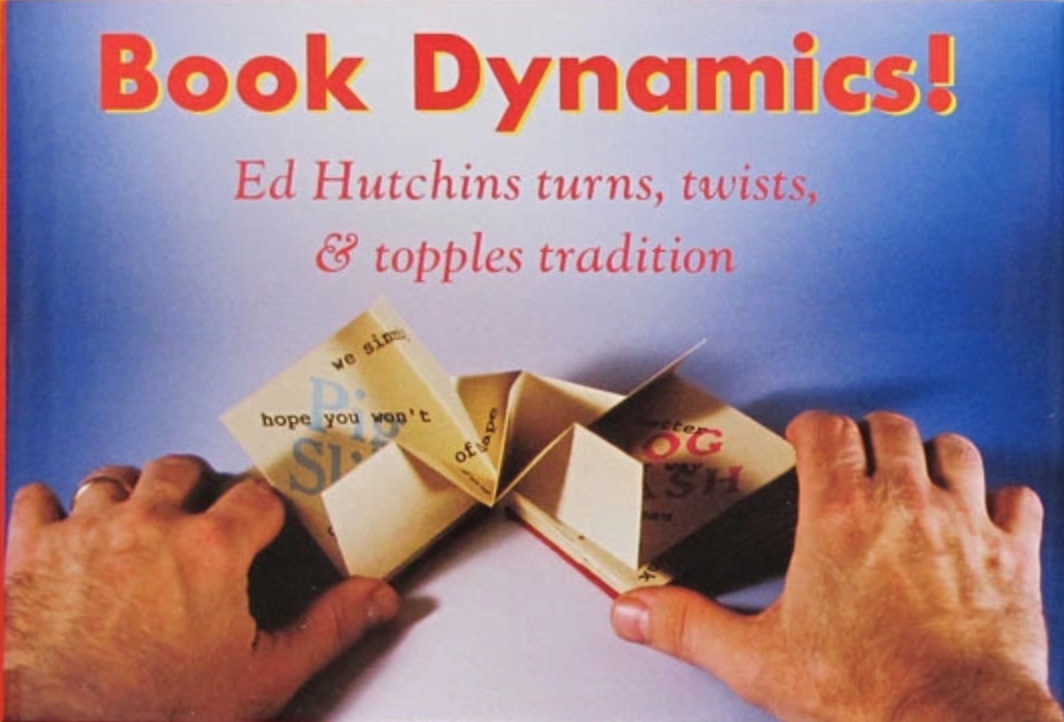
Book Dynamics! (2009)
Ed Hutchins

Ed’s books are a delight: witty and/or thoughtful ideas cleverly presented in unusual structures. Ed is a great believer in designing the form to suit the content, so no two books are alike. Some basic forms re-occur, but there are tweaks to the basic structures that individualize them for each version.

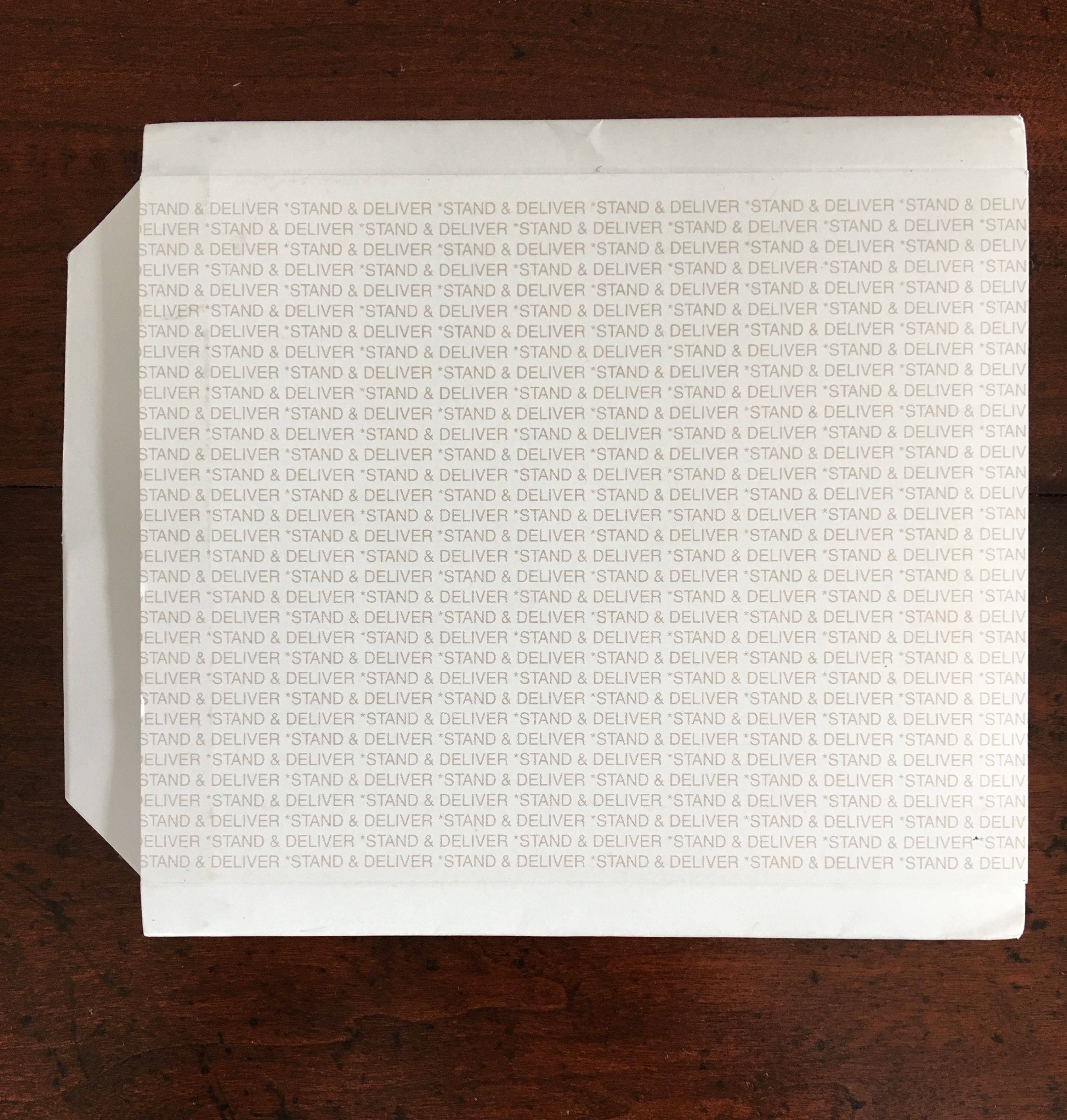
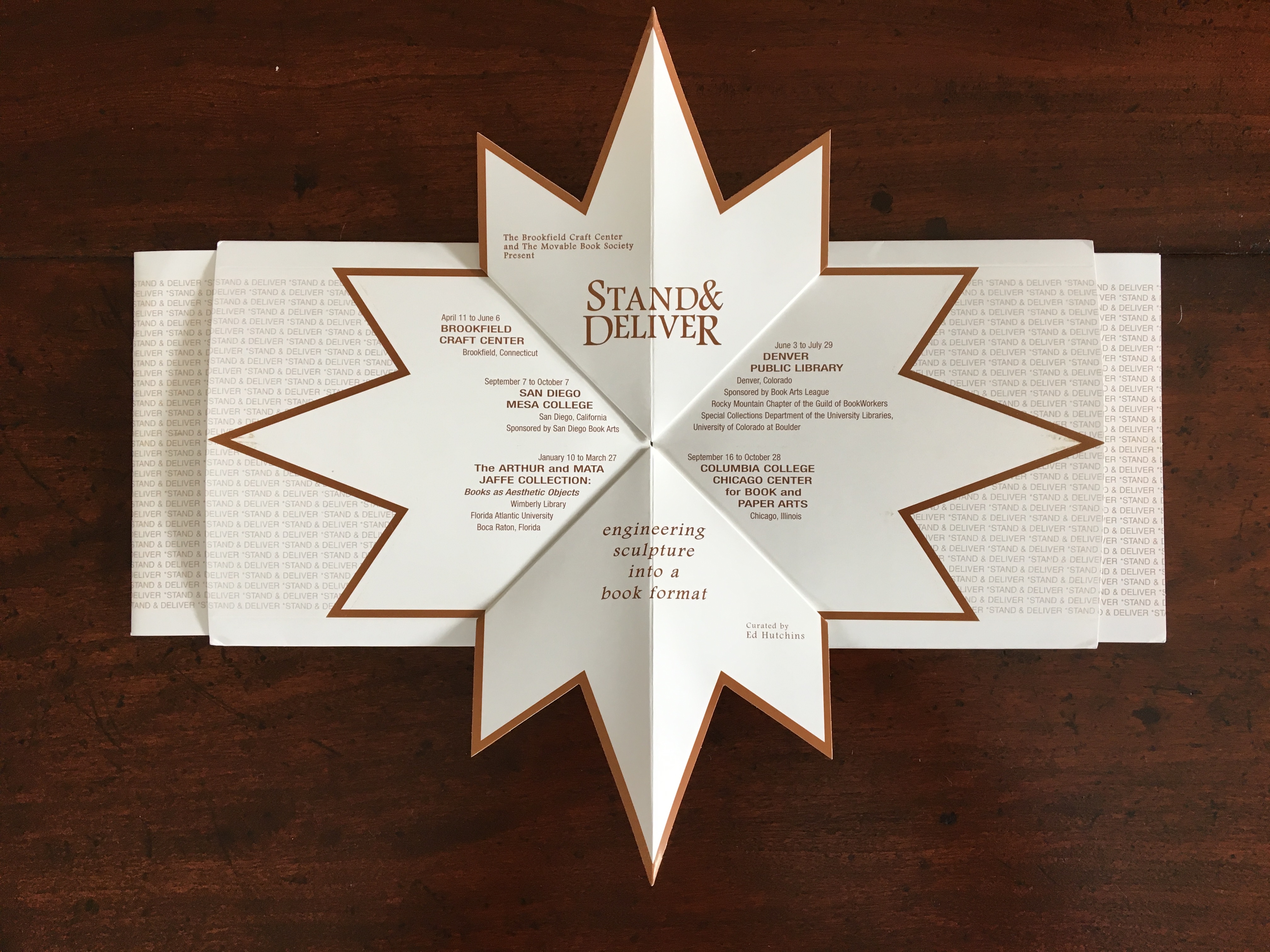
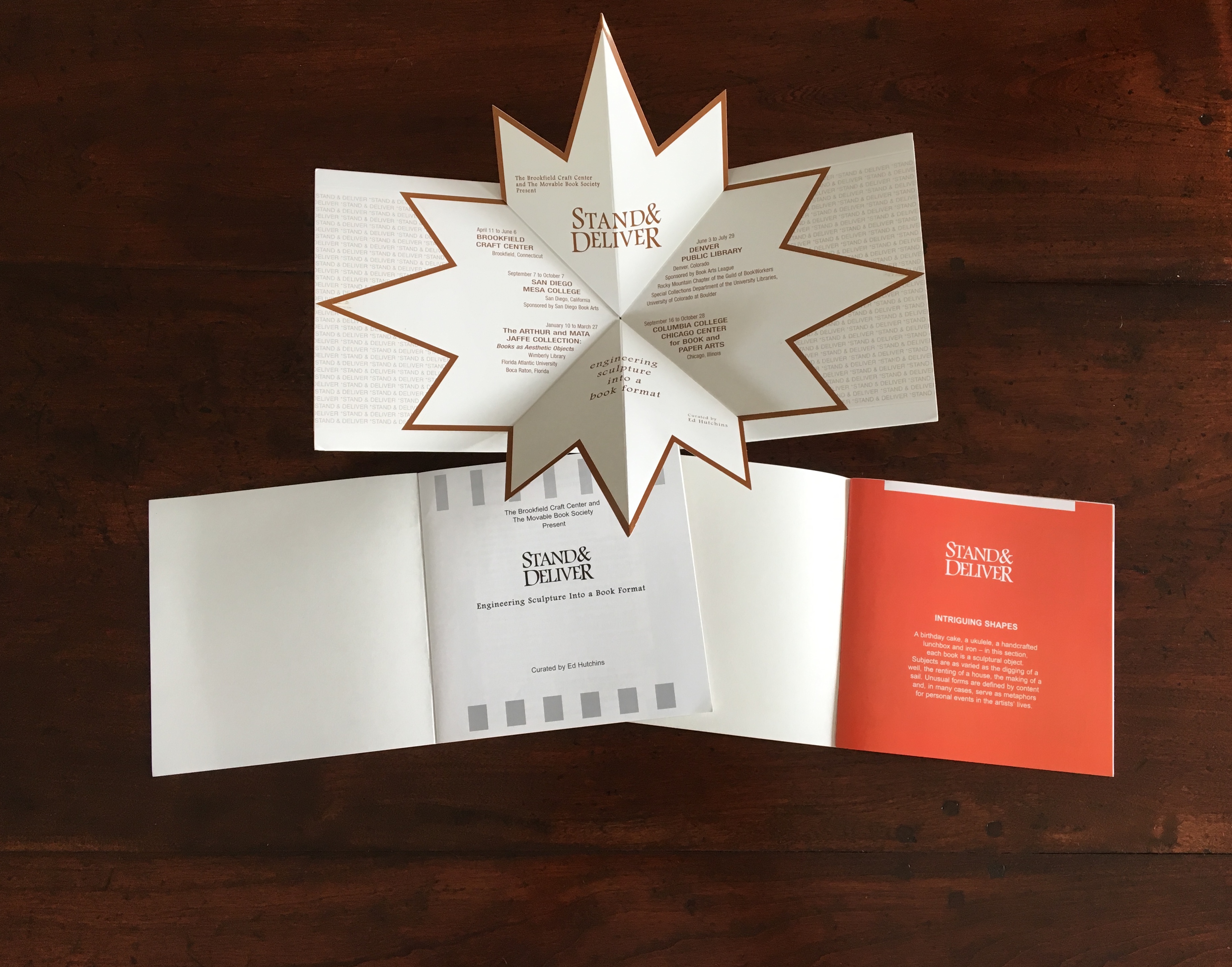
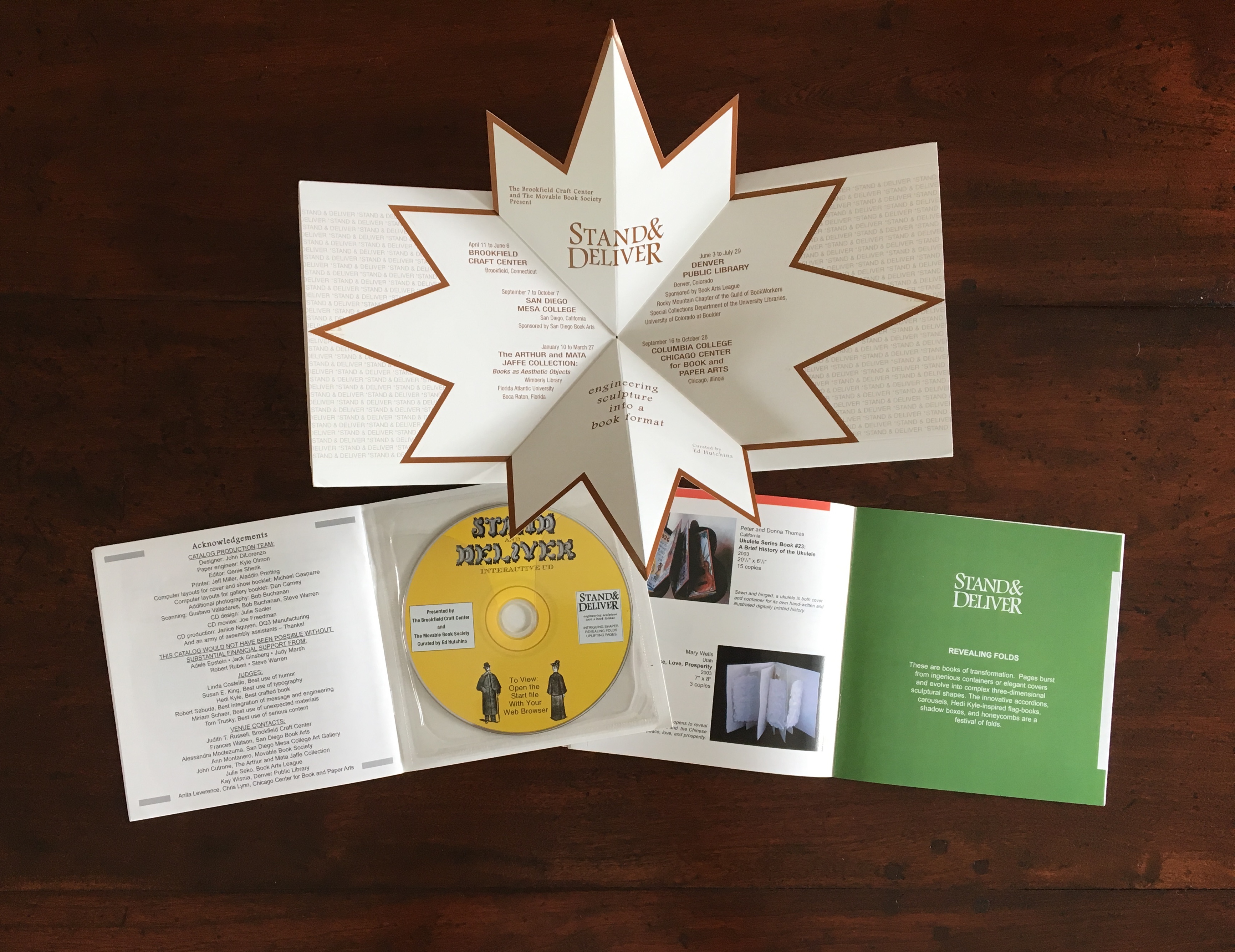
Miller’s review in Byopia Press is also a delight, providing multiple links and routes to information about Ed Hutchins as well as to other reviews of his work. Below are images of the catalog for Stand & Deliver, curated by Hutchins in 2003.

Engineered by Kyle Olmon and designed by John DiLorenzo, the catalog demonstrates great inventiveness in the pop-up structure and mechanism that nudges the two booklets from the left and right sleeves as the catalog is opened. Note also the use of colors to demarcate its sections that follow the themes Hutchins used to organize this exhibition: Intriguing Shapes, Revealing Folds, Uplifting Pages. And note the distinctive and subtle shifting placement of colors in the right-hand booklet: at the top on the orange page, a white bar that shifts to the right on the green page as an orange bar marks the end of the previous section on the facing verso page.  For an exhibition that traveled to five different locations, a more appropriately and intricately mobile catalog could hardly have been devised.

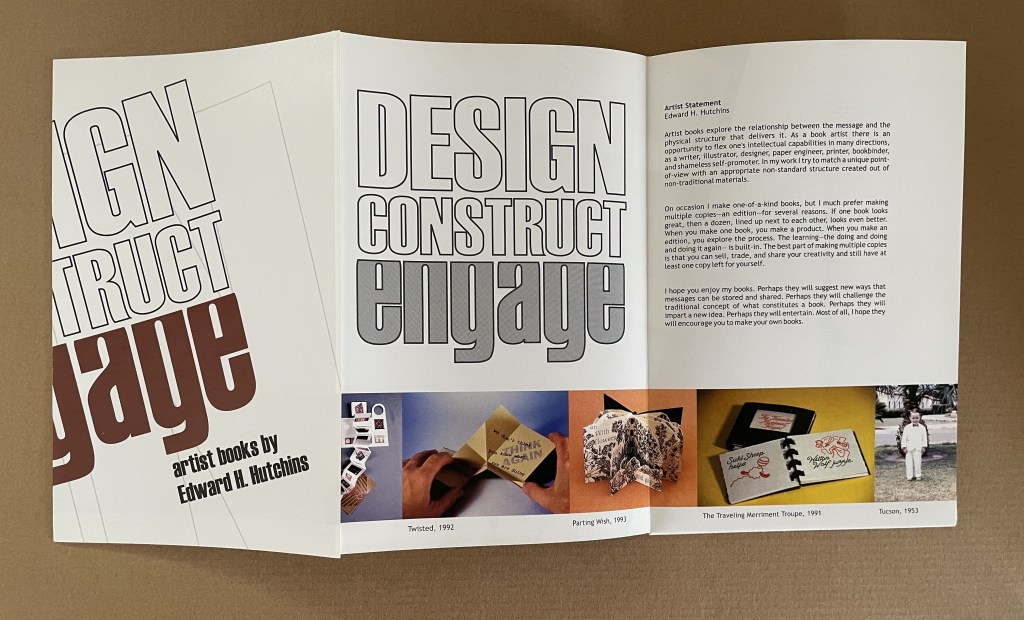
Design, Construct, Engage (2002)

Design, Construct, Engage (2002) Booklet-poster-catalogue in meander cut and fold. Closed: H220 x W140 mm. Acquired from Ed Hutchins, 26 January 2022.

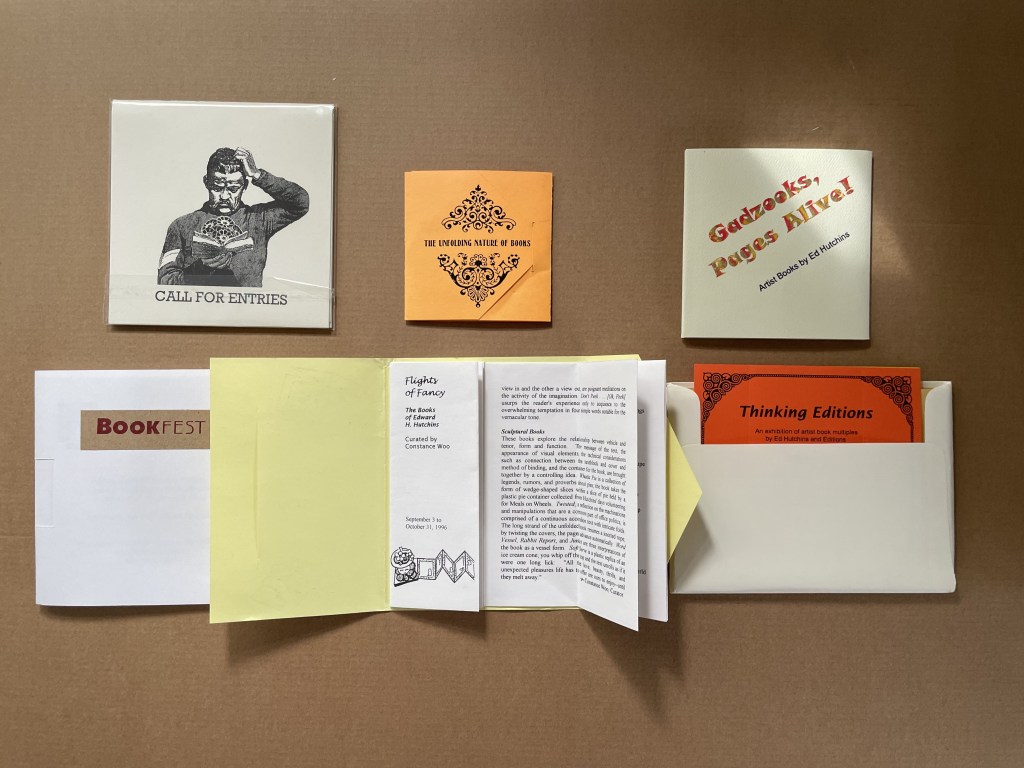
Ephemera (1996 – 2003)

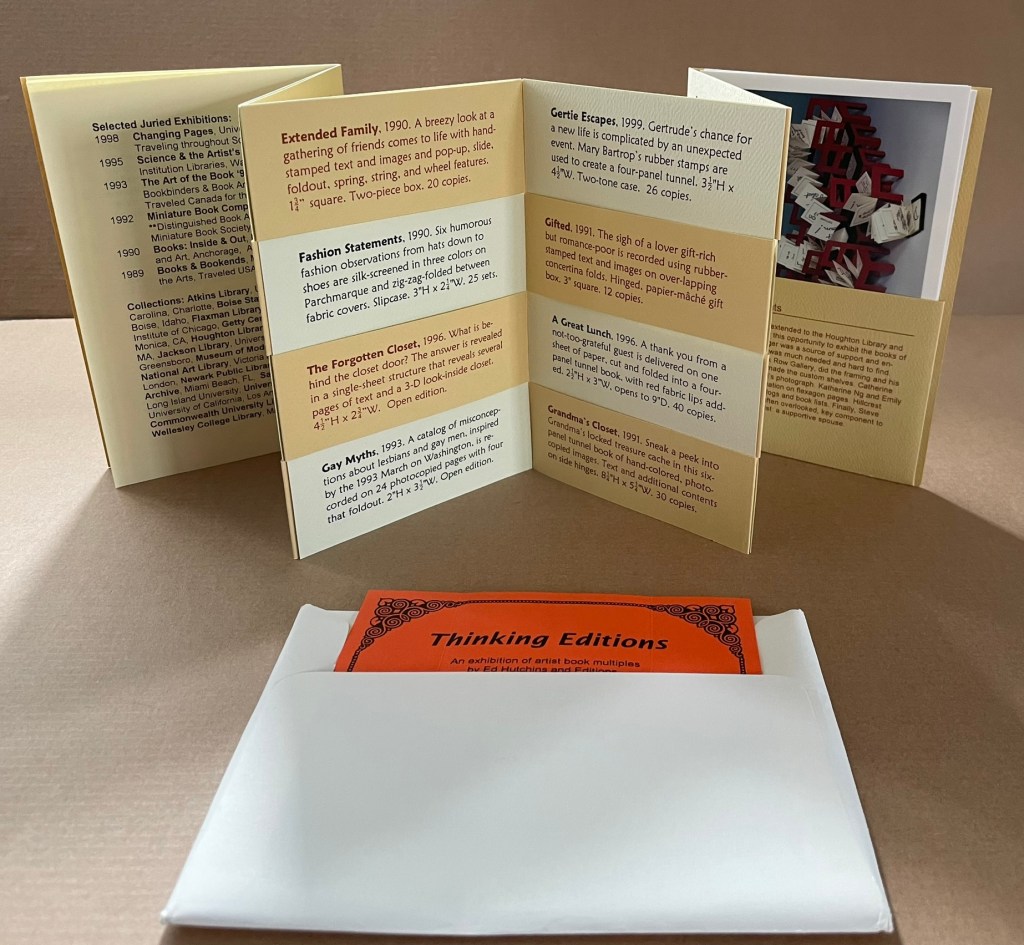
Flights of Fancy (1996) Envelope with tab, trifold, center-cut single sheet forming booklet H145 x W116 mm. Acquired from Ed Hutchins, 20 May 2014.

Gadzooks, Pages Alive (2002) Velcro-fastened trifold cover glued to 18 pages, fixed spinner inside cover. 107 x107 mm. [18] pages. Acquired from Ed Hutchins, 20 May 2014.

The Unfolding Nature of Books (1993) Envelope with tab, trifold, with split Turkish map in center. Self-enclosing evelope with split Turkish map construction exhibition list in center Closed: 85 x 85 mm. Acquired from Ed Hutchins, 20 May 2014.

Thinking Editions (1999) Accordion fold booklet with 16-page gathering saddle-stitched with single staple to first fold, four panels of accordion slit to receive four cards to create 8 interleaved pages, final panel has pocket holding 3 color postcards. H155 x W110. 28 pages. Acquired from Ed Hutchins, 20 May 2014.

Thinking Editions card (1999) Four-card construction displaying 7 views. 126 x 126 mm. Acquired from Ed Hutchins, 20 May 2014.

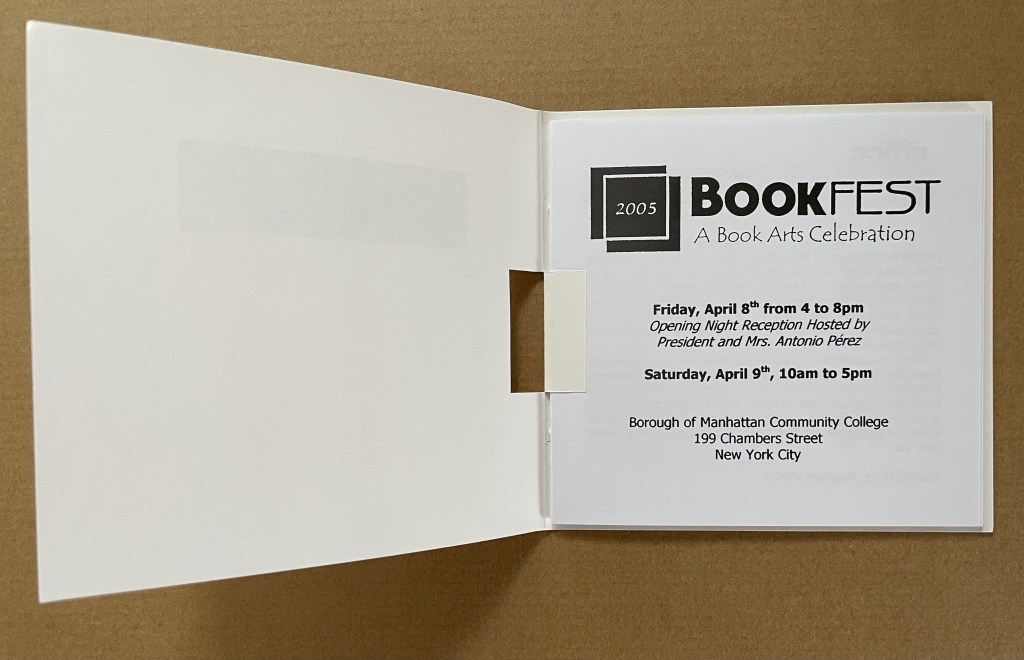
Call for Entries, Stand & Deliver (2002/3) Pop-up invitation with entry cards. Acquired from Ed Hutchins, 20 May 2014.

Books On Books Collection – J. Meejin Yoon

Absence (2004)

A “monument” to the Absence of the Twin Towers, this is a poignant work of book art by J. Meejin Yoon, architect, designer, educator, Professor and Head of the Department of Architecture at the Massachusetts Institute of Technology.  A simple video demonstrating the work appears here at the site of the Otis College of Art and Design. This book|object was published by Printed Matter, Inc. and the Whitney Museum of Art in 2004 when Yoon was an Assistant Professor at MIT.

Absence © J. Meejin Yoon, 2004
Absence
© J. Meejin Yoon, 2004

As you hold this small white brick of paper and turn its thick pages, a small pinhole appears on the page. Then two larger square holes emerge, one of which falls over the pinhole. Page after page — 110 pages for each floor of the towers — the two square holes repeat, creating two small dark wells in the field of white, until on the last page they take their place in the cut-out schematic footprint of the city blocks and buildings surrounding the Twin Towers. What you hold in your hands at the end is an object of art and book of memorial prayer.

Bookmarking Book Art – Wilber Schilling

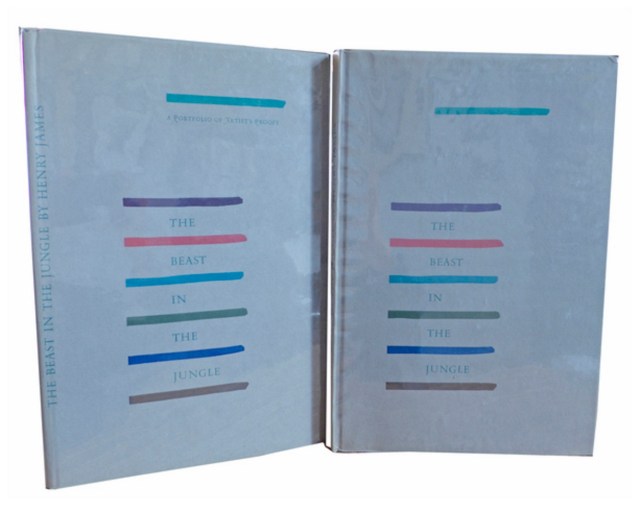
Henry James, The Beast in the Jungle, 1903. Allen Press, 1963. The copy shown is one of only 15 copies with an extra suite of 16 artist’s proofs, each titled, numbered 9/15 and signed by the artist in a separate portfolio.  Displayed online at Sophie Schneideman – Rare Books and Prints.

In his Books and Vines essays, Chris T. Adamson provides fresh, personal and insightful comments on fine book productions and their content such as Henry James’ “The Beast in the Jungle” from the Lewis and Dorothy Allen Press in 1963, pictured above.  An oenophile, as the title of his series suggests, Adamson also occasionally offers tips on the best wines with which to decant and read these works.

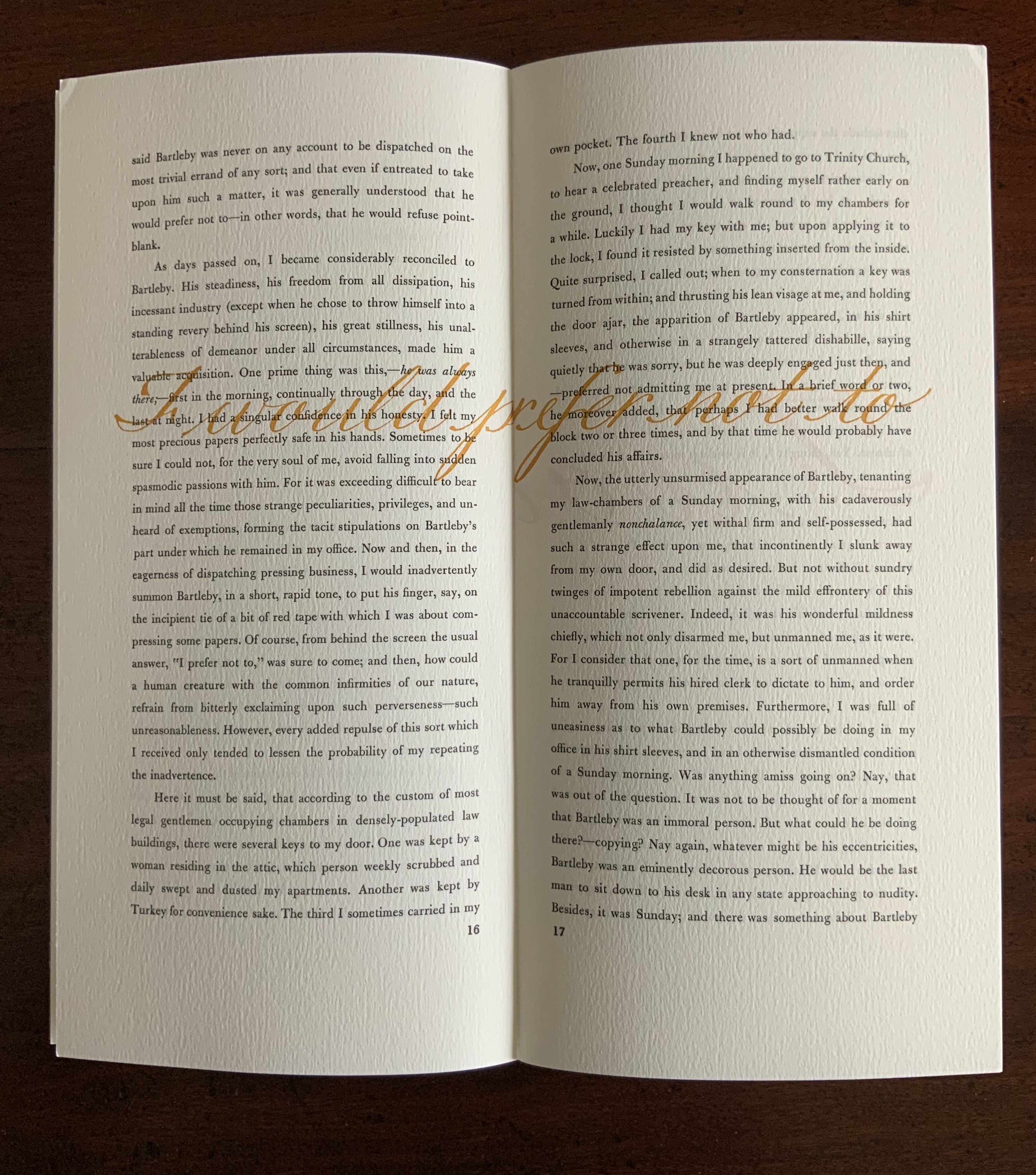
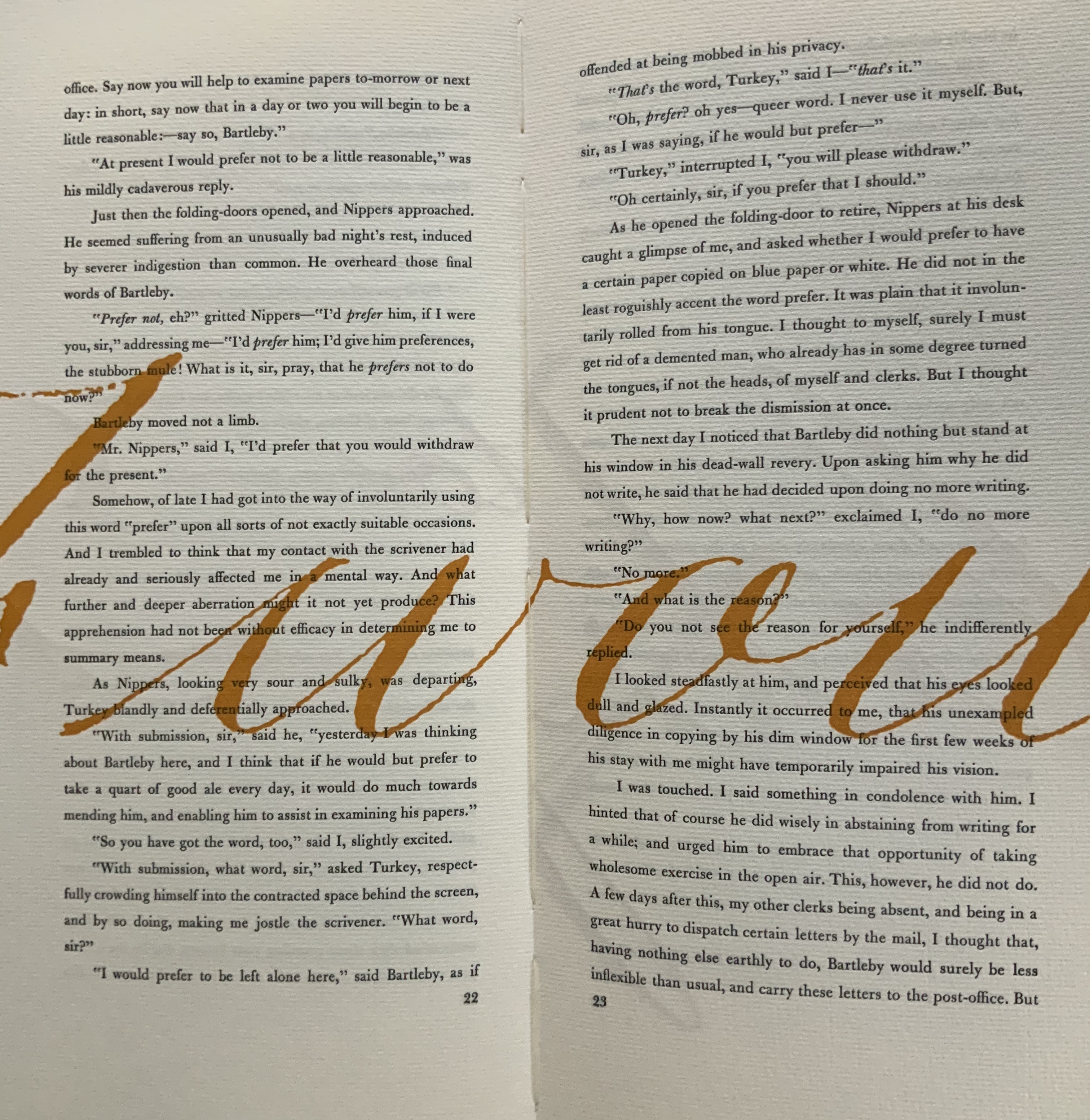
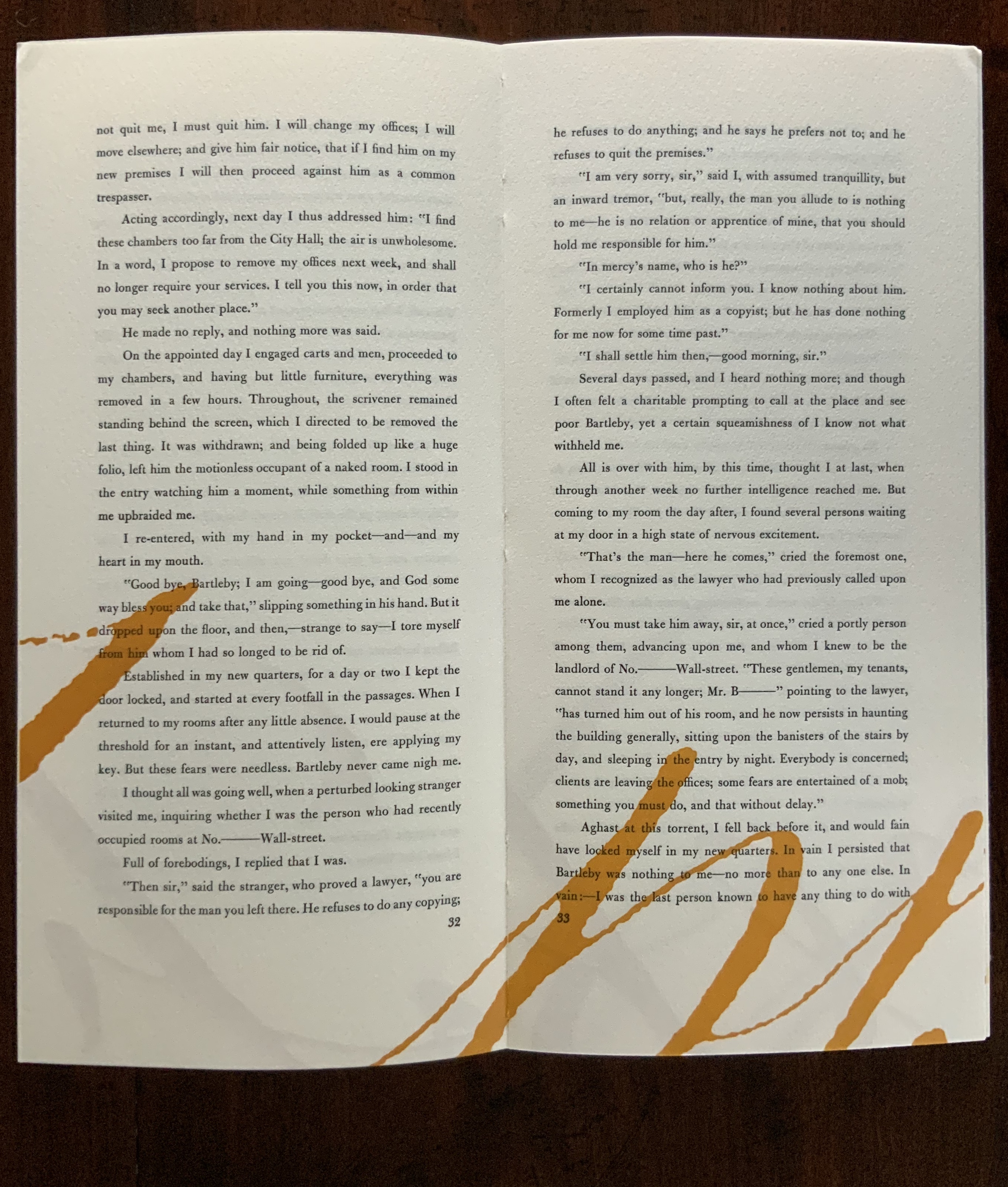
James is a favorite author at Books On Books as is Herman Melville. Indulge the punning coincidence of Adamson’s introducing us to Wilber Schilling’s Indulgence Press and his edition of Melville’s “Bartleby the Scrivener: A Story of Wall Street“.  Schilling’s edition of “Bartleby” – with Suzanne Moore’s original hand lettering of Bartleby’s classic statement “I would prefer not to” first appearing fully legible then becoming larger until it literally falls off the bottom of the final page – was an early career statement of an interest in more than fine press work but in book art as well.

Consider Schilling’s Half-Life/Full-Life and its binding a variation on the accordion/flag structure of Hedi Kyle and Claire Van Vliet.  The complexity of the form marries well with that of the intertwining, interleaving text and photos along the timelines of the Doomsday Clock and global warming.

Half Life/Full Life Wilber Schilling, 2009 ISBN: 0-9742191-5-0 Cover
Half Life/Full Life
Wilber Schilling, 2009
ISBN: 0-9742191-5-0
Cover

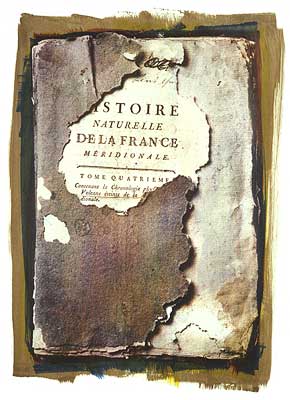
Schilling’s photography in Half Life/Full Life speaks to the importance of that craft in his overall portfolio. His photos of aging, decayed and unbound books are haunting and remind me of the found art of M.L Van Nice.

Natural History Multi-layered gum bichromate print 30" x 22" on Rives BFK 2004 Copyright © Wilber H. Schilling
Natural History
Multi-layered gum bichromate print
30″ x 22″ on Rives BFK
2004
Copyright © Wilber H. Schilling

Schilling has collaborated with Thomas Rose (visual artist and professor at the University of Minnesota),   Michael Dennis Browne (poet and librettist), Rick Moody (author of The Ice Storm) and Patricia Hampl (MacArthur Fellow poet and novelist). He has collaborated with Daniel E. Kelm (book artist, founder of the Garage Annex School for Book Arts and a collaborator with Suzanne Moore).

Given the influence of Marcel Duchamp and Joseph Cornell on works such as Arthur & Barbara (Arthur Danto and Barbara Westman) or Surplus Value Books: Catalog Number 13, you might say that Schilling has attempted to collaborate with them as well. The danger in that, of course, is highly derivative artwork. That early-career whiff of genius in commissioning the now famous calligrapher Suzanne Moore to hand letter “I would prefer not to” and spreading it in ever larger size across the pages might be what takes Schilling’s work beyond the derivative. His work is worth examining with that anticipation.

Postscript

The Books On Books Collection now holds a copy of Schilling’s edition of Bartleby as well as works by Suzanne Moore.

Bookmarking Book Art – New England Guild of Book Workers

For 2014-15, the New England Guild of Book Workers have organized a traveling exhibition: Geographies: New England Book Workits itinerary covering each of the 6 New England states.  Last year, the Rhode Island School of Design (RISD), the Wishcamper Center at the University of Southern Maine and the Bailey Howe Library at the University of Vermont hosted it. This year, the show has appeared at Williams College Library and is scheduled for Dartmouth College Library and the Creative Arts Workshop in New Haven, CT. Criss-crossing geographical boundaries as well as those of book art and the book arts, Geographies calls to mind the last line of Elizabeth Bishop’s “The Map“:

More delicate than the historians’ are the map-makers’ colors.

Or, in this case:

More delicate than the historians’ are the [book-artists’] colors. 

Although born in Nova Scotia, Elizabeth Bishop grew up as a New Englander in Massachusetts with her paternal grandparents. As a far-traveller and visual artist as well as poet, she would have enjoyed this exhibition and found it fitting if it had included a broadside of “The Map”.

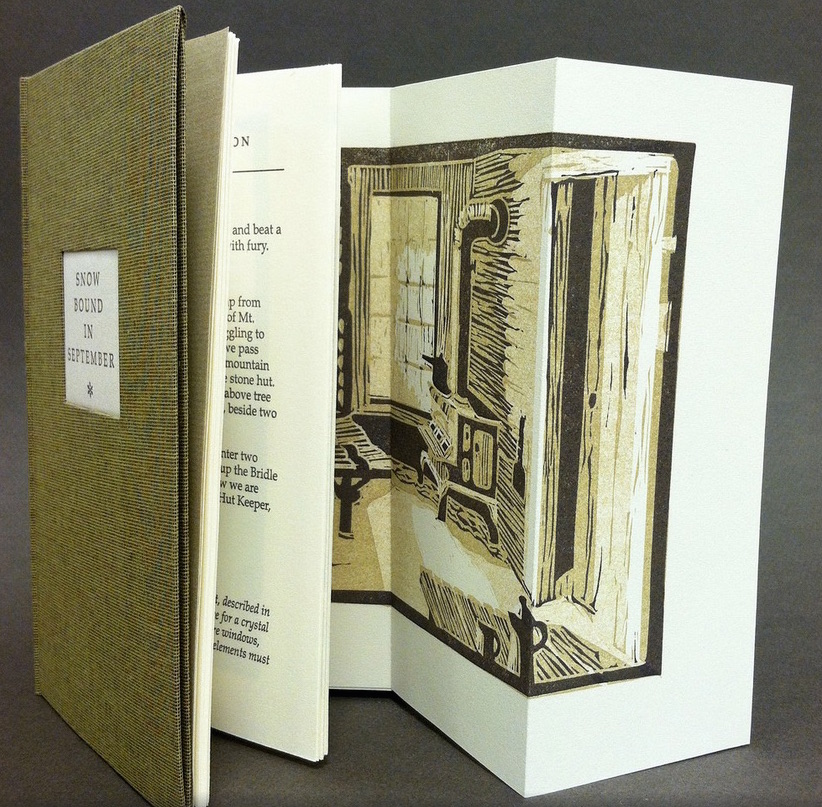
Nevertheless, what a range of “colors” from all the New England states and beyond – from historic to modern, from fine and design bindings to traditional and creative bookbinding, from artist books to calligraphic manuscripts, from masters to apprentices and from object to narrative. The latter finds a wintry exemplar in Snow Bound in September: A Re-Imagining by Laurie Whitehill Chong, retired Special Collections librarian and curator of Artists’ Books at RISD.

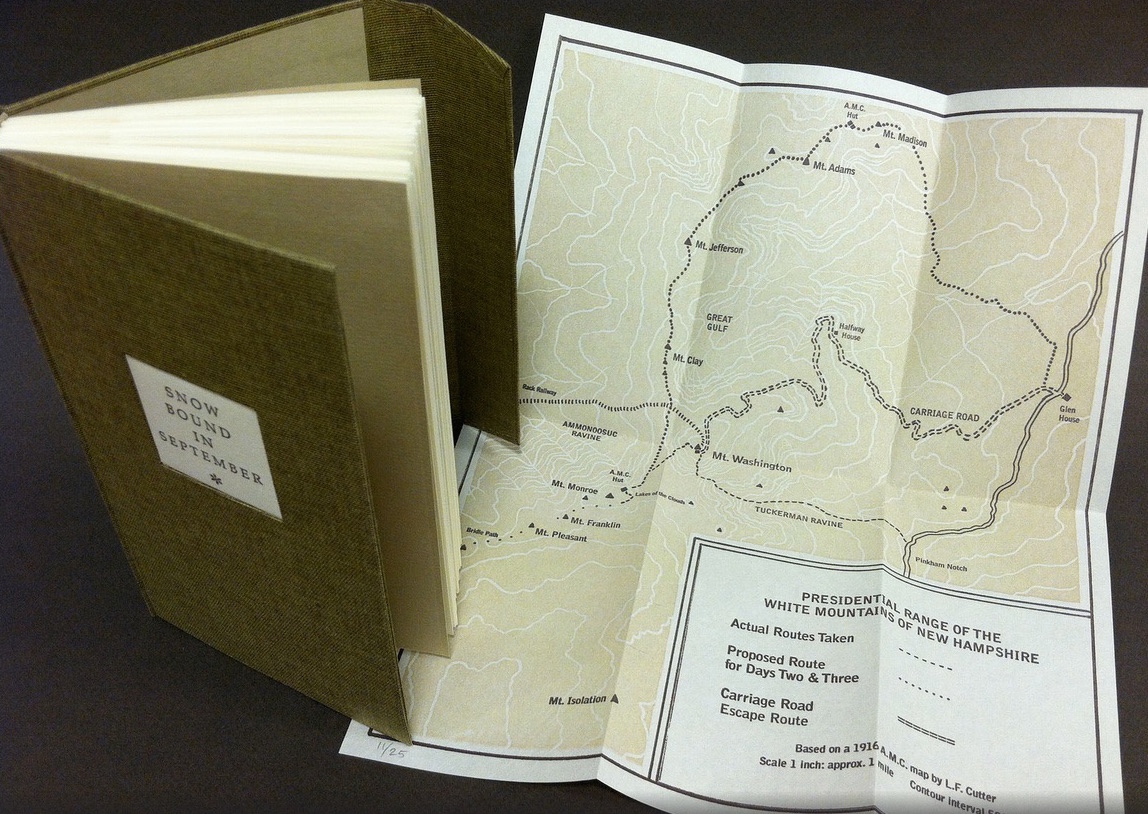
Snow Bound in September: A Re-Imagining © Laurie Whitehill Chong Artist Book, Text in Book Antiqua letterpress printed on Rives Lightweight paper using polymer plates, with 13 fold-out two and three-color linocut illustrations. Folded map in inside back cover pocket, letterpress printed using polymer plate and linocut; edition of 25 15.24 x 8.89 x 2.54 cm
Snow Bound in September: A Re-Imagining © Laurie Whitehill Chong Artist Book, Text in Book Antiqua letterpress printed on Rives Lightweight paper using polymer plates, with 13 fold-out two and three-color linocut illustrations. Folded map in inside back cover pocket, letterpress printed using polymer plate and linocut; edition of 25 15.24 x 8.89 x 2.54 cm Snow Bound in September: A Re-Imagining © Laurie Whitehill Chong
Cloth covered binding with flap and front pocket, smythe sewn.
Text in book Antiqua letterpress printed on Rives Lightweight paper using polymer plates, with 13 fold-out
two and three-color linocut illustrations. Folded map in inside back cover pocket, letterpress
printed using polymer plate and linocut. 
15.24 x 8.89 x 2.54 cm 
Edition of 25

The artist made this book the same size as her grandfather’s Appalachian Mountain Club hiking guide. Snow Bound is an invented ancestral narrative, in which the artist uses a surviving photograph and her grandfather’s notes about being stranded with his wife for five days on Mount Washington by a hurricane-driven snowstorm in September 1915 to re-imagine the ordeal from her grandmother’s perspective. Note the slotted front cover into which the flap extending from the back cover fits to keep the book closed, snug against the elements.

Snow Bound in September: A Re-Imagining © Laurie Whitehill Chong
Snow Bound in September: A Re-Imagining © Laurie Whitehill Chong Snow Bound in September: A Re-Imagining © Laurie Whitehill Chong

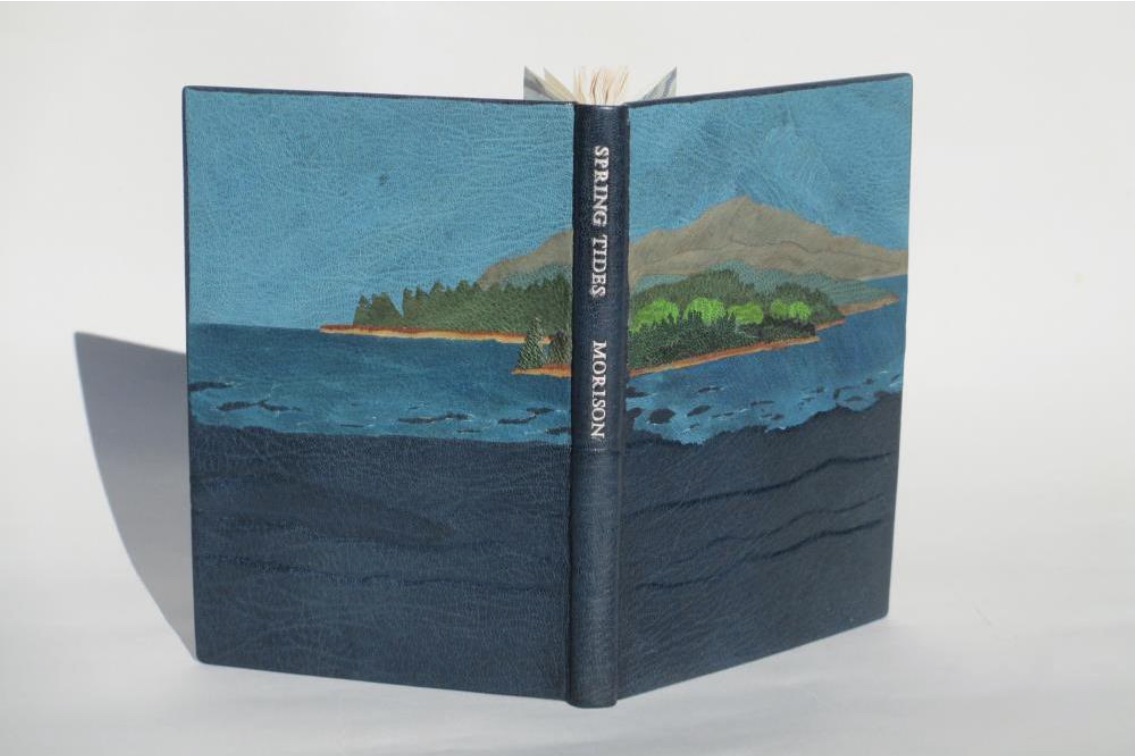
Julie B. Stackpole’s creative re-binding of Samuel Eliot Morison’s Spring Tides takes us from the New England mountains to the shore as can be seen from the layered binding.

Spring Tides by Samuel Eliot Morison Boston: Houghton-Mifflin Co., 1965. Julia B. Stackpole, Design binding  21.8 x1 5.0 x 1.6 cm  January 2014
Spring Tides by Samuel Eliot Morison Boston: Houghton-Mifflin Co., 1965. Julia B. Stackpole, Design binding  21.8 x1 5.0 x 1.6 cm  January 2014 Spring Tides
by Samuel Eliot Morison
Boston: Houghton-Mifflin Co., 1965.
Julia B. Stackpole, Design binding
21.8 x1 5.0 x 1.6 cm
January 2014

In Stackpole’s words:

The traditional tight-joint binding is covered in navy blue Niger goatskin with waves in the lower parts created by paring before covering. Cut-outs in the onlays of the lighter blue leather of the water help it transition from the dark of the navy to the sky’s azure. Onlays of other leathers create the forested landscape of the shoreline and hills. These blues were chosen because the only blue leather in a large enough piece to cover the whole binding was the dark navy, while I only had scraps of the water and sky’s blue. The endpapers are a Cockerell marbled paper over-painted with blue, with leather hinges.

Pictures of the works in the catalog (and others not) can also be found at the Williams College Flickr site (for now). I say “for now” because they will be  pushed downstream inevitably in the way of today’s digital flow.  They may even disappear; although as Matthew Kirschenbaum has explained in Mechanisms, something digitally forensic will remain. That boundary of the tangible and the digital, the haptic and the virtual, is only lightly but evocatively touched in this collection.

When Julia Stackpole writes in the online catalog about that Cockerell marbled paper that it “felt to me like the waves and the shoals and ledges of Maine waters”, you long to lay hands on the Spring Tide. Anne McClain’s Place includes photographs taken digitally of places on Maine’s midcoast that have been special to her her “entire life and will continue to be a constant as other things change and move on”. What is captured digitally is reproduced physically to fix those places that will “continue to be a constant”. But places do change.

Anne McClain, Place Drum Leaf Binding  19 x 15 x 1.8 cm  February 2014
Anne McClain, Place Drum Leaf Binding  19 x 15 x 1.8 cm  February 2014 Anne McClain, Place
Drum Leaf Binding
19 x 15 x 1.8 cm
February 2014

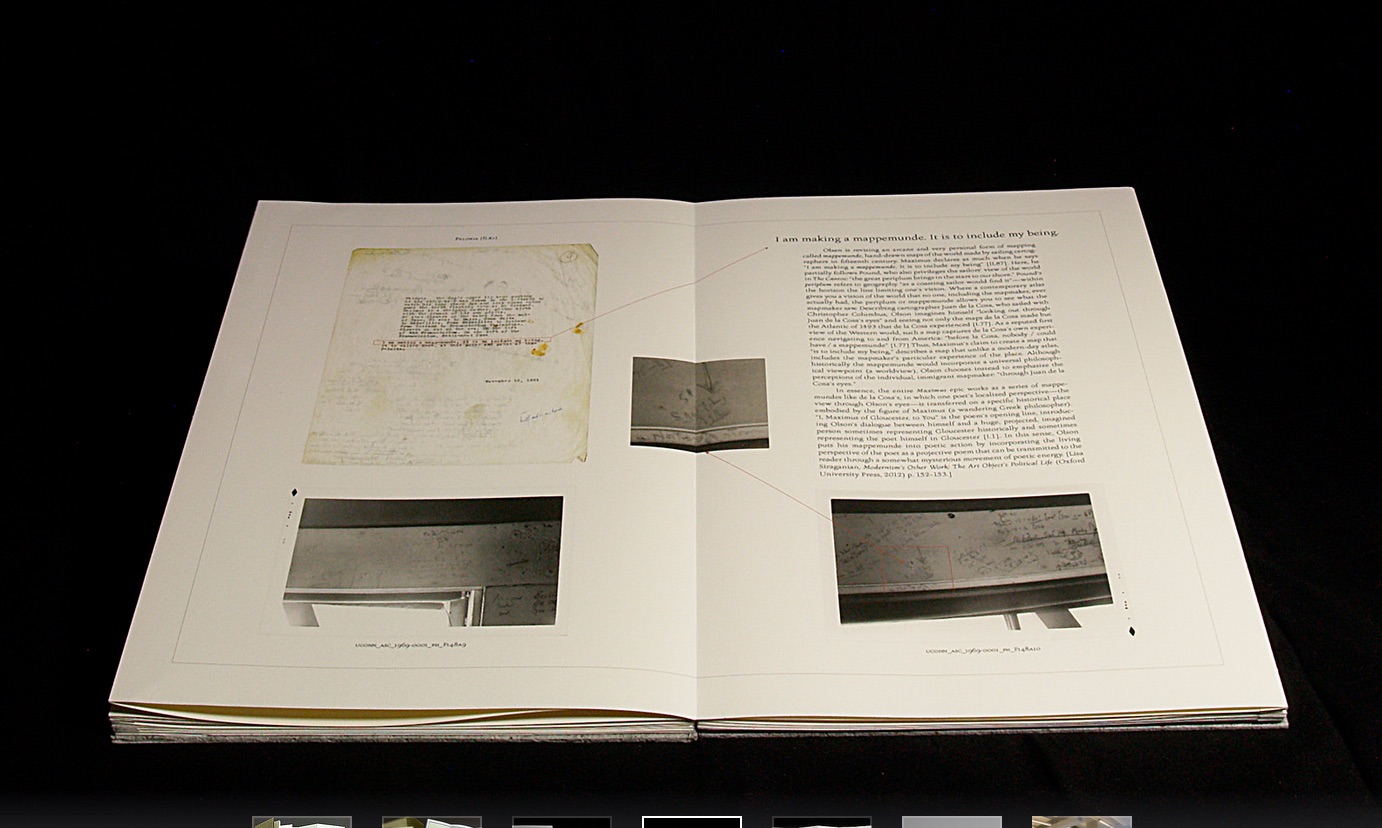
Rutherford Witthus’ contribution touches the boundary between the digital and physical most directly. His artist’s book is entitled 28 Fort Square: What Charles Olson wrote on the window casings of his apartment in Gloucester, Massachusetts, of which there are eleven copies.

Rutherford Witthus, 28 Fort Square: What Charles Olson wrote on the window casings of his apartment in Gloucester, Massachusetts, 2014
Rutherford Witthus, 28 Fort Square: What Charles Olson wrote on the window casings of his apartment in Gloucester, Massachusetts, 2014 Rutherford Witthus, 28 Fort Square: What Charles Olson wrote on the window
casings of his apartment in Gloucester, Massachusetts, 2014

In these 11 copies, Witthus digitally reconstructs the windows of Charles Olson’s apartment at 28 Fort Square where he wrote his main work, The Maximus Poems, and covered the window casings with meteorological data. The artist book “presents for the first time all of the images of the window casings”.

Rutherford Witthus 28 Fort Square: What Charles Olson wrote on the window casings of his apartment in Gloucester, Massachusetts Artist book Edition of 11 42 x 28 x 2.5 cm 2014
Rutherford Witthus 28 Fort Square: What Charles Olson wrote on the window casings of his apartment in Gloucester, Massachusetts Artist book Edition of 11 42 x 28 x 2.5 cm 2014 Rutherford Witthus
28 Fort Square: What Charles Olson wrote on the window casings of his apartment in Gloucester, Massachusetts
Artist book
42 x 28 x 2.5 cm
2014
Edition of 11

Athena Moore, chapter secretary of The New England Guild of Bookworkers, produced the catalog for this itinerant exhibition organized by Stephanie Wolff, Exhibitions Coordinator and Todd Pattison, Chapter Chair. If you have the chance to see the exhibition in its next venue, take it.

Just as Elizabeth Bishop questioned the depiction of the boundary between land and water on her map – “Shadows or are they shallows at its edges …”, you will find the juxtaposition of these works reminds you that the boundary between book art and the book arts can be shadowy or shallow indeed.

Bookmarking Book Art – Aldus Manutius, 6 February 1515 – 6 February 2015

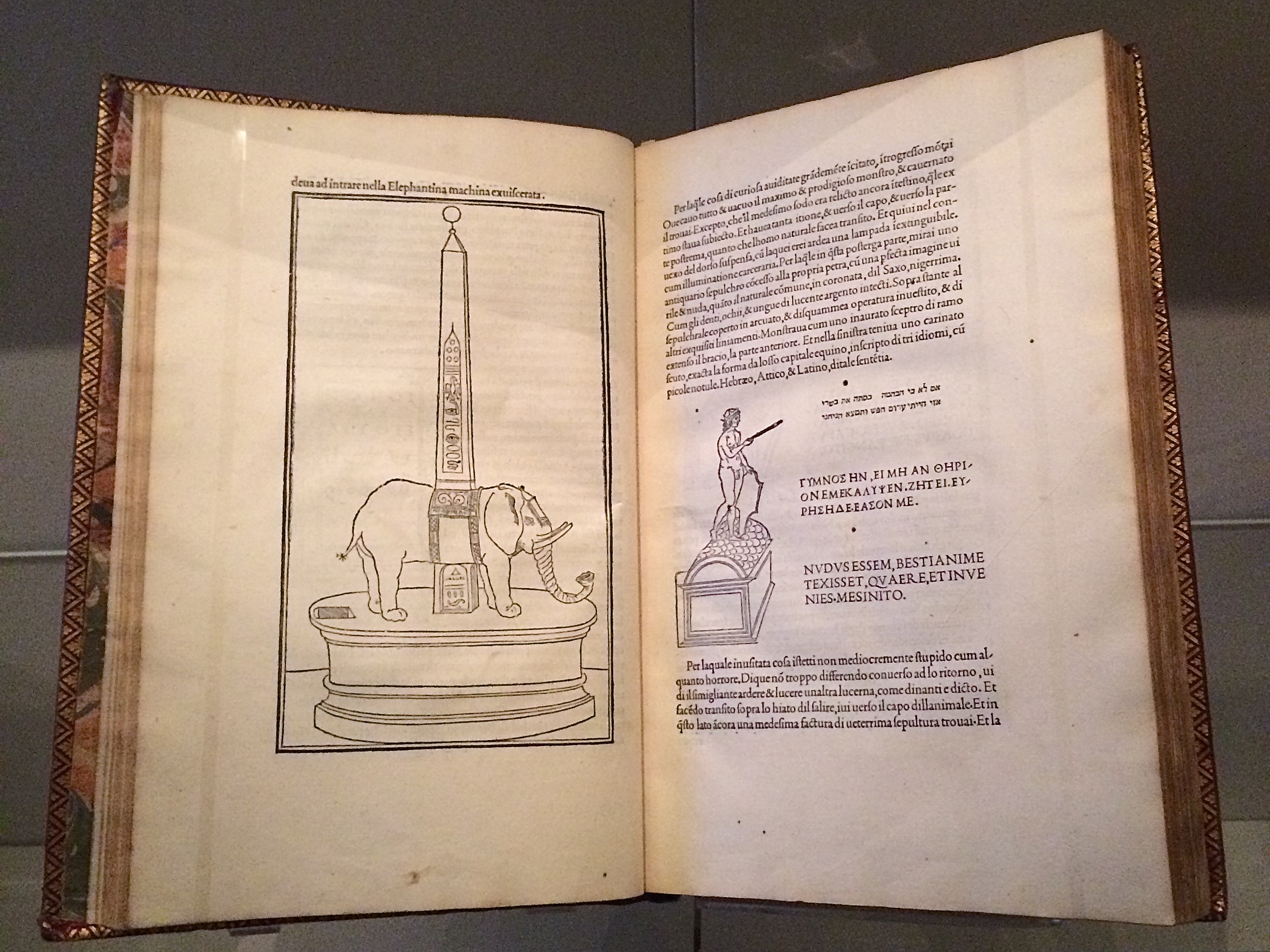
Hypnerotomachia Poliphili, Venice: Aldine Press, 1499.
Hypnerotomachia Poliphili. Venice: Aldine Press, 1499.

Late afternoon before the long worn wooden benches in the Bodleian’s Convocation Hall, 500 years after the death of Aldus Manutius, Oren Margolis served his audience well, providing them with a richer appreciation of the “finest printed book of the entire Renaissance”* – the Hypnerotomachia Poliphili – and of its publisher Aldus Manutius.

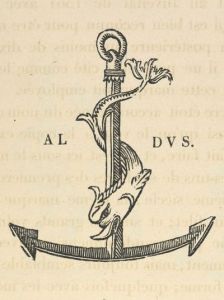
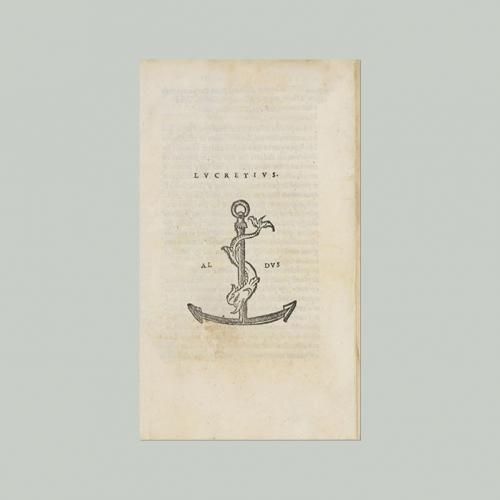
Drawing our attention to the more sculptural qualities of Venetian Renaissance printed books over the Florentine and to the  evidence of the humanist agenda that drove Manutius, he led us to the page where Poliphilo (lover of all things, but in particular Polia, the ideal woman pursued to the end of the book) stands before a carving that foreshadows the Aldine Press device: a dolphin entwined around the shank of an anchor. The Aldine Press device was inspired by a similar image on an ancient Roman coin given by Pietro Bembo to Aldus, who wrongly associated it with Augustus and his proverb Festina lente (“Make haste slowly”) and adopted both for his printing and publishing business.

Erasmus praised Aldus, saying that he was “building a library which knows no walls save those of the world itself”.

For all of 2015, the world enjoyed a multitude of celebrations of the contribution of Aldus Manutius to publishing, printing and the book. After Gutenberg, Fust and Schoeffer, Aldus Manutius was perhaps the most important printer of the Renaissance. His portable books are still here, although locked away or displayed under glass, no longer so portable. Until now.

The Manutius Network 2015 provides a running list, links for some of which are provided below, including the online exhibition associated with Margolis’s talk.  See also below, added in May 2016, the belated exhibition “Aldo Manutius: The Renaissance in Venice” at the Gallerie dell’Accademia in Venice.

IMG_1604

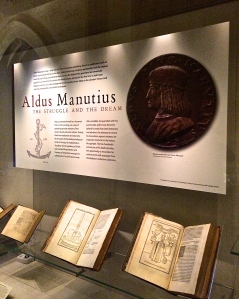
In the Proscholium, The Bodleian Library   Oxford

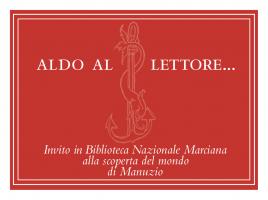
Invitation from the Biblioteca Nazionale Marciana

Invitation from the Biblioteca Nazionale Marciana

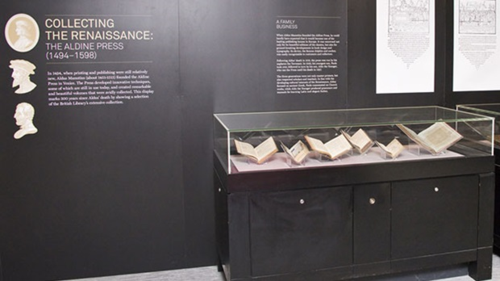
The British Library

The British Library

The Grolier Club exhibition. See the New York Times coverage here.
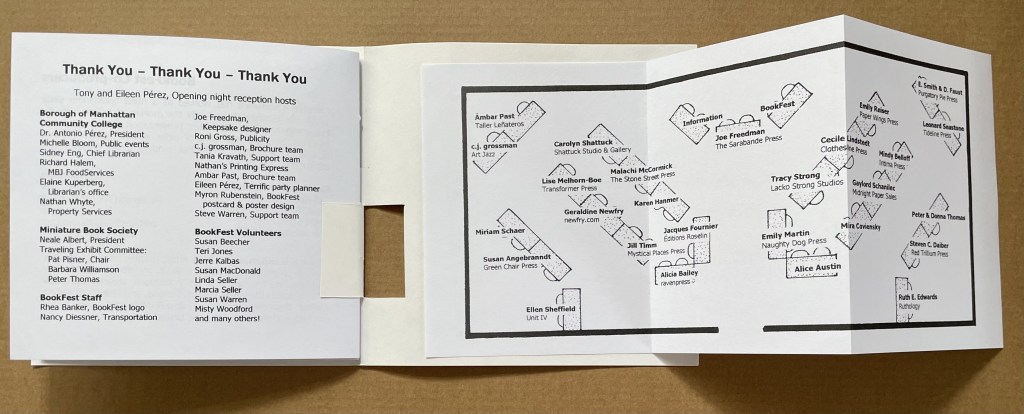
In aedibus Aldi The Brigham Young University's Harold B. Lee Library

In aedibus Aldi
The Brigham Young University’s Harold B. Lee Library

John Rylands Library University of Manchester

John Rylands Library
University of Manchester

The afterlife of Aldus : posthumous fame, collectors and the book trade
Edited by Jill Kraye and Paolo Sachet.
London : The Warburg Institute, 2018.

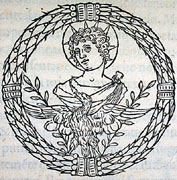
from Hypnerotomachia Poliphili, 1499 University of Glasgow

from Hypnerotomachia Poliphili, 1499
University of Glasgow

International Conference Celebrating Aldu Manutius University of California, Los Angeles

International Conference
Celebrating Aldus Manutius
University of California, Los Angeles

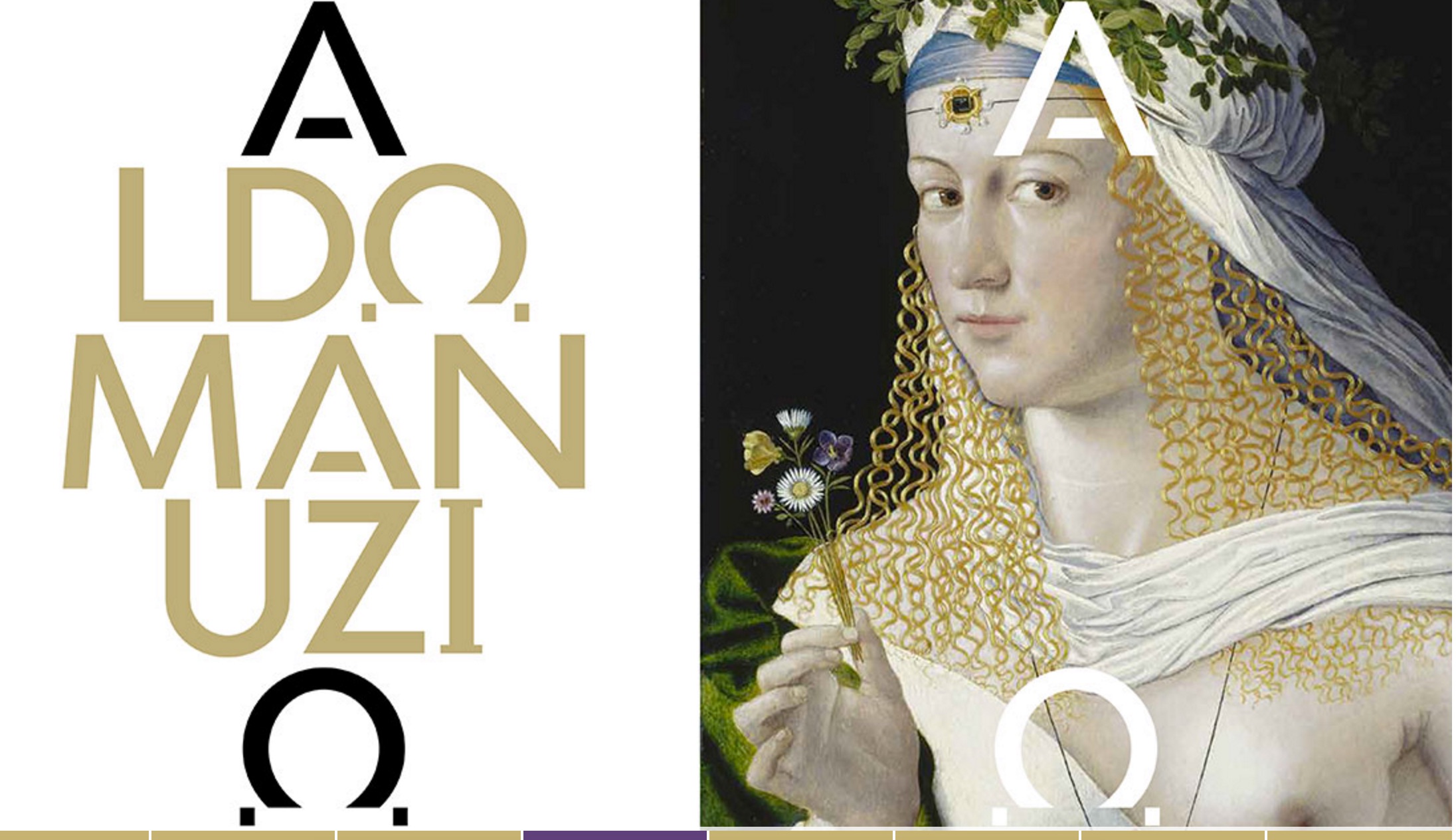
Aldo Manutius: The Renaissance in Venice http://www.mostraaldomanuzio.it/exhibition Exhibition poster containing detail of ‘Portrait of a Woman as Flora’ (c1520), by Bartolomeo Veneto © Eton College

Aldo Manutius: The Renaissance in Venice
Exhibition poster containing detail of ‘Portrait of a Woman as Flora’ (c1520), by Bartolomeo Veneto © Eton College

From Crispin Elsted’s review of the Thames & Hudson facsimile edition of the Hypnerotomachia Poliphili. Parenthesis, December 2000, No. 5:

I once spent three hours in a library with a copy of the Aldine edition of Hypnerotomachia Poliphili, and I have never known a book take my breath away so consistently. Every page is a masterpiece: the dance of text with the more than 170 woodcuts; the firm, male stature of the typeface; the crisp spring of the impression; the elegant proportion of the page — all combine to an end in which the craft of printing and design carry the text into an atmosphere not of its own making. This new edition has the appearance of a fine actor in a part lately played by a great one. Here are the signs of the grace that greatness lent the commonplace five centuries ago; and in these signs, the commonplace finds here another advocate for its small claims to our time. 
Timelines are, of course, for looking further back as well as forward.   Earlier this year, April 2012 marked the fifteenth anniversary of the publication of Liane Lefaivre’s Leon Battista Alberti’s Hypnerotomachia PoliphiliRe-Configuring the Architectural Body in the Early Italian Renaissance (Cambridge, MA: MIT Press, 1997) and the online publication of The Electronic Hypnerotomachia, which contains the facsimile text and illustrations.   The online publication of extracts from Lefaivre’s book illustrates the linking prefigured by the “card stack” approach of HyperCard.  What MIT Press and TU Delft,  Lefaivre’s affiliation, host on their servers are not ebooks or even e-incunabula of the sort we experience today, but they are clearly forerunners to them.

In twenty-eight more months, December 2014, we will see the 515th anniversary of the original work’s publication by Aldine Press (Venice, December 1499).   The founder Aldus Manutius did not normally publish heavily illustrated books.  The Hypnerotomachia Poliphili was the exception and the only commissioned work that Manutius undertook.   The exception reflects favorably on the overall success of his business and supports the view that Venice had become the capital of printing and publishing very shortly after the invention of printing by moveable type.

The book unveils an inscrutable, almost comic-book-illustrated story, glittering with made-up words in Greek, Latin, Hebrew and Arabic (including proto-Greek, -Hebrew and -Arabic fonts).  In addition to the page displays sculpted into shapes such as goblets, this one volume displayed the technological mastery of and improvement on the new Roman (as opposed to the heavy Gothic) typeface Bembo.  According to Norma Levarie in The Art & History of Books (New York, 1968), this singular volume revolutionized typography in France in less than twenty-five years.

Somewhat like software releases, though, the 1499 edition came with bugs.  The colophon to the Hypnerotomachia Poliphili falls at the end of a full page of errata.

“Venice Month December. 1499. in the house of Aldus Manutius, most accurately done.”

Initiated in 2015 in celebration of the anniversary and acknowledgement of the more than 100 Aldine editions in the Wosk McDonald Collection, Simon Fraser University’s Aldus@SFU is the digitization of 21 Aldine volumes published between 15011 and 1515. The image above is the edition of Lucretius’ De rerum naturam, published just after Manutius’ death in 1515.

See also “More Manutius in Manchester and More to Come“, Bookmarking Book Art, 1 June 2015.

Bookmarking Book Art – Helen Douglas

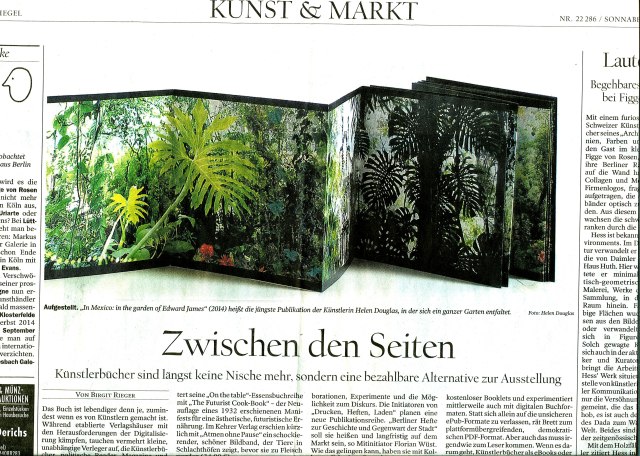
Helen Douglas, In Mexico: in the garden of Edward James (2014). Reviewed in Der Tagesspeigel

Helen Douglas has been kind enough to forward the notice above of her most recent work — In Mexico: in the garden of Edward James Based on her invited residency in Mexico City, this concertina book takes the viewer through Edward James’ jungle garden Las Pozas, its buildings and staircases, James’s surreal imagination and, best of all, Douglas’s own imaginative experience of them. See the interview at BookArtBookBlog that preceded the work’s unveiling at the London Art Book Fair at the Whitechapel Gallery and Berlin Art Book Fair.

When I go to Weproductions, the website of founding partners, Telfer Stokes and Helen Douglas, it is like taking a walk in Yarrow, Scotland, or taking the measure of paper samples between forefinger and thumb, or browsing in a bookstore, or lingering in an art gallery. Two of Helen Douglas’s works in particular elicit this: The Pond at Deuchar (2013) and A Venetian Brocade (2010).

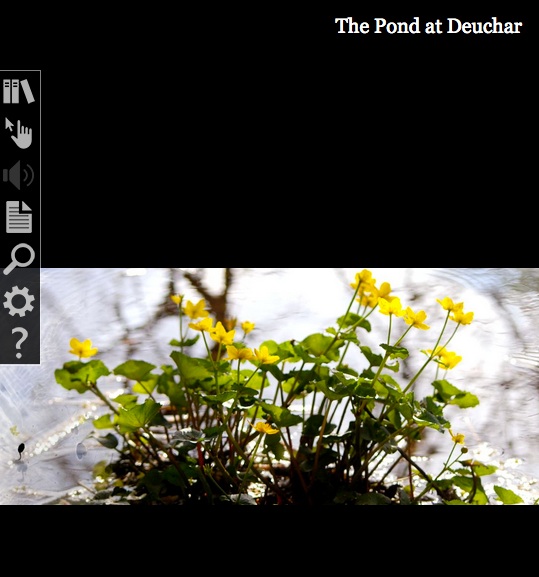
The Pond at Deuchar (2012)
“The Pond at Deuchar” E-Scroll artwork ©Helen Douglas
Application “Turning the Pages” © Armadillo Systems

Was it London Book Fair where I first saw this bookwork, appwork, scrollwork … this work of art?  What you see above leads you to the app. Clive Philpott’s postscript to this work, featured on Weproductions and published by the Tate, offers all the background and appreciation of the work you need to read. Read it, then go to The Pond at Deuchar*, lean forward and trail your fingers through its waters.

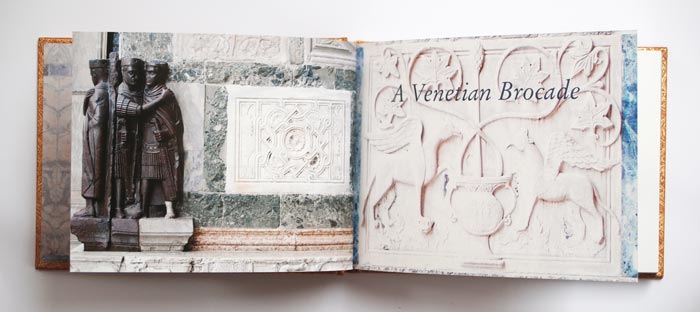
Helen Douglas and Marina Warner. A Venetian Brocade (Weproductions, 2010)

A Venetian Brocade equally makes the “act of looking” tactile and the “act of touching” insightful. The work reminds me of this passage from Joseph Brodsky’s Watermark (New York: Farrar Straus Giroux, 1992):

… bipeds go ape about shopping and dressing-up in Venice for reasons not exactly practical; they do so because the city, as it were, challenges them. We all harbor all sorts of misgivings about the flaws in our appearance, anatomy, about the imperfection of our very features. What one sees in this city at every steep, turn, perspective, and dead end worsens one’s complexes and insecurities. That’s why one—a woman especially, but a man also—hits the stores as soon as one arrives here, and with a vengeance. The surrounding beauty is such that one instantly conceives of an incoherent animal desire to match it, to be on par. This has nothing to do with vanity or with the natural surplus of mirrors here, the main one being the very water. It is simply that the city offers bipeds a notion of visual superiority absent in their natural lairs, in their habitual surroundings. That’s why furs fly here, as do suede, silk, linen, wool, and every other kind of fabric.

If you are lucky enough to buy one of the few remaining copies of A Venetian Brocade, you will see and feel how it leads to In Mexico: in the garden of Edward James. Appreciation of that double-sided leporello work’s extension of the Douglas’s concept of Visual Narrative and its kinship with James’s surrealism can only be enhanced by viewing The Secret Life of Edward JamesGeorge Melly’s documentary film from 1975.

But having indulged the surreal elements, think back to the pond at Deuchar, think back to the Tate’s association with Douglas’s work, then consider this work also held at the Tate:

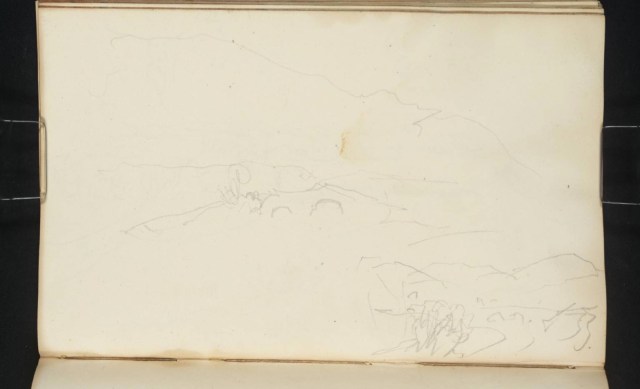
Joseph Mallard William Turner, “Deuchar Old Bridge, near Yarrow, Selkirkshire”, 1834, in The Edinburgh Sketchbook 1831-34, graphite on paper, 111×181 mm. Reference: D26161
Turner Bequest CCLXVIII 34 a

Here is a narrative of art across time and place to touch by looking and, by looking, to be touched by.

*Deuchar is pronounced “dew-ker”, the “k” as in “loch”.

Bookmarking Book Art – Book Arts Newsletter

Published by Impact Press at the Centre for Fine Print Research, UWE Bristol, this newsletter is an important tool, kept honed by Sarah Bodman.  The link will take you to the June 2013 issue.