When it comes to acquiring skills and professional training in book publishing, from the early days of the printing press onwards, learning by doing has been book publishing’s order of the day. Consider the following interview exchange between Mac Slocum (Tools of Change) and Theodore Gray (The Elements):
.
MS: What skills — or people with those skills — must be incorporated into the editorial process to produce something like the iPad/iPhone editions?
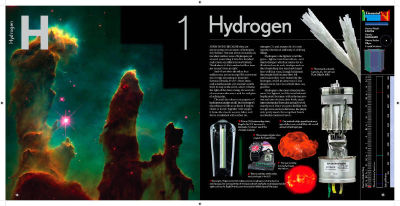
TG: Specifically in the case of “The Elements,” the skills required were writing, commercial-style stills photography, Objective-C programming, and a whole, whole lot of Mathematica programming to create the design and layout tool and image processing software we used to create all the media assets that went into the ebook.
Other ebooks might well require different skills. My next one, for example, is going to include a lot more video, so we’re gearing up to produce high-grade stereo 3D video. That’s one of the challenges in producing interesting ebooks: You need a wider range of skills than to produce a conventional print book.
Starting out in book publishing late in the last century, a novice would have consulted Marshall Lee’s Bookmaking and the Chicago Manual of Styleto learn the basics of design, editorial and production. If it were Trade publishing that beckoned, a familiarity with A. Scott Berg’s biography of Maxwell Perkins (“Editor of Genius”) would have been likely.
Maxwell Perkins, half-length portrait, seated at desk, facing slightly right / World Telegram & Sun photo by Al Ravenna. (Photo credit: Wikipedia)
But as with the acquisition of print publishing skills through learning by commissioning, designing, editing, printing, marketing and selling, the acquisition of the skills required for ebook publishing could use a hand up from appropriate resources. People like Joshua Tallent, Joel Friedlander, Liz Castro, Craig Mod, Matthew Diener are those resources — either by example or authoring — and novices today would do well to start bookmarking their output.
For notes on the availability of formal training and career conditions in publishing, see Thad McIlroy’s The Future of Publishing.
Related sources:
“Joshua Tallent of Ebook Architects on the State of Digital Publishing,” Bill Crawford, Publishing Perspectives
“Understanding Fonts & Typography,” Joel Friedlander, The Book Designer
Published by Impact Press at the Centre for Fine Print Research, UWE Bristol, this newsletter is an important tool, kept honed by Sarah Bodman. The link will take you to the June 2013 issue.
Two interesting words: “semantic” and “innovation.” Find yourself a good cup of coffee, a slice of sachertorte, the aroma of cinnamon and take the time to read this article by David Worlock.
“Getting” the fundamentals of digital publishing means “getting” semantics: the semantic web, taxonomies, ontologies, tagging and all that. David Worlock’s article is a good place to start to understand why.
This year is the centenary of Gerard Meynell’s trade periodical The Imprint, which was the scene of Stanley Morison’s first appearance in print. How appropriate then that Morison’s book A Tally of Types tells the story of the journal’s founding and, equally important, how the historic font called Imprint Old Face came into being. The font’s importance is that “the design had been originated for mechanical composition. … the first design, not copied or stolen from the typefounders, to establish itself as a standard book-face.”(p.21) Ironically, Meynell and his colleagues intended for the font to be freely available to the trade, but eventually it came into the ownership of Monotype Imaging, where it can be obtained today under the OpenType family.
As the world of print morphs into its digital incarnation, we see the same impetus behind the new generation of typographers, the ones born digital, but we see varying degrees of adherence to the “type wants to be free” movement.
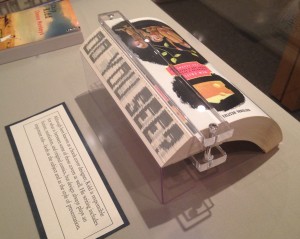
Chip Kidd’s novel The Cheese Monkeys, designed as well by him, sports a printed fore-edge. When the book is closed, the fore-edge is blank. Fanned in one direction, it shows the sentence as seen in the photo below.
Chip Kidd, The Cheese Monkeys: A Novel in Two Semesters, 2008, from the Chip Kidd Archives, on display Jan. 12 through April 24, 2015, in The Eberly Family Special Collections Library, Penn State University. Reproduced with permission of the Library
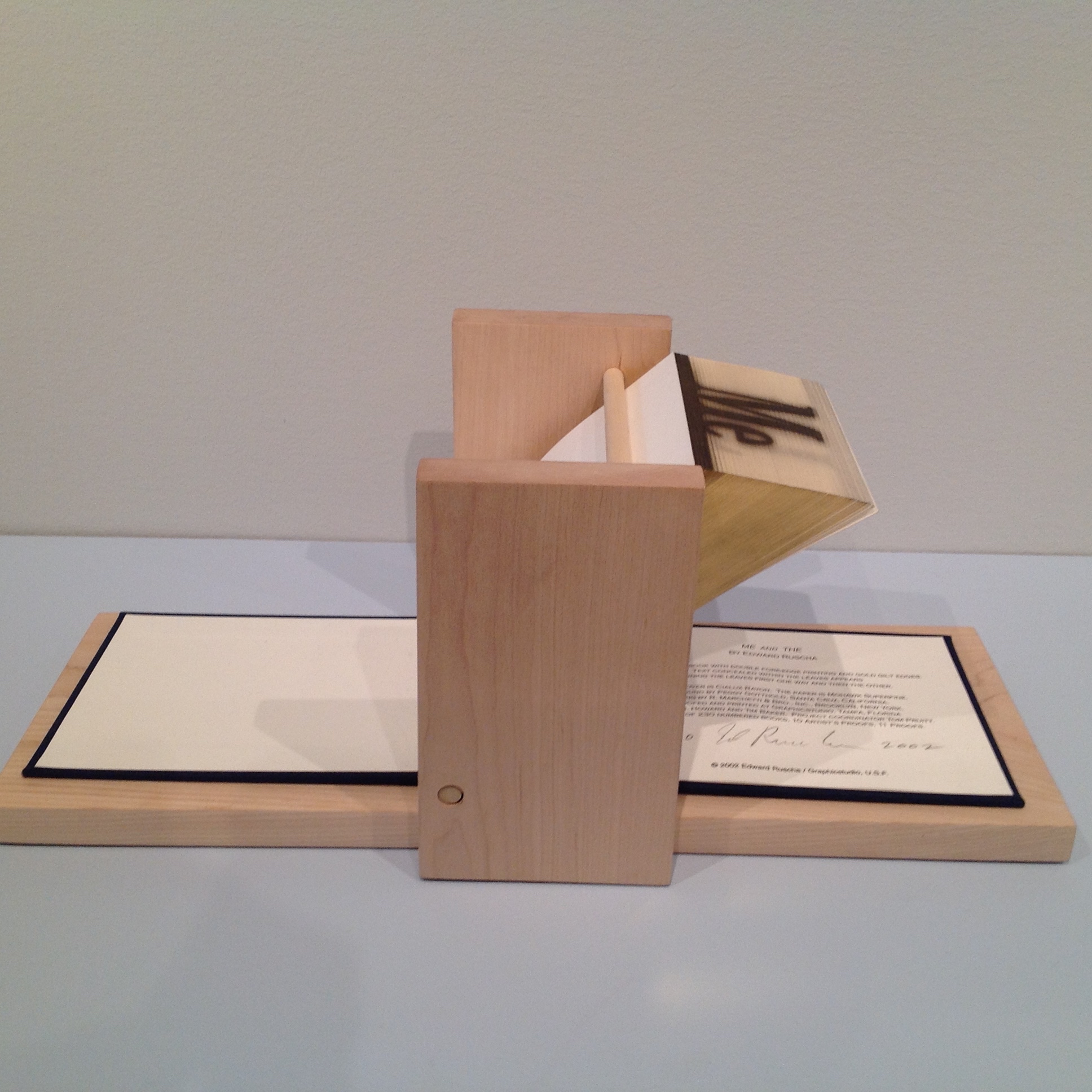
Fanned in the opposite direction, the fore-edge displays another phrase: “Good Is Dead”. The printing process is well described in a 2004 video by Graphics Studio|Institute for Research in Art, prepared about the making of Ed Ruscha’s fore-edge book Me and The.
Ed Ruscha, Me and The, 2002 Allan Chasanoff Collection, Yale University Art Gallery
This is similar to traditional fore-edge painting. Much of what is worth knowing about fore-edge painting can be learned from Martin Frost’s QuickTime Movie-rich website, but if you are a fan of the Folger Shakespeare Library, its holdings yield some outstanding examples under the hand of Erin Blake.
Jeff Weber’s bookAnnotated Dictionary of Fore-edge Painting Artists & Binders is probably the lengthiest treatment available on the subject. Hear him discuss his work here. Weber, who commissioned artwork from Frost, Margaret Allport (Costa) and Clare Brooksbank, has a particularly well-written article at the International League of Antiquarian Booksellers’ site.
Phillip J. Pirages, an antiquarian bookseller, provides an enlightening and entertaining talkon fore-edge painting of the 18th century and shows a superb example of the London binders Taylor & Hessey’s work — a two-volume set of the works of Alexander Pope, bound in red morocco leather and decorated on the fore-edges with scenes of Twickenham and Windsor.
The point of this bookmark is not merely to share a curiosity but to use that narrow, hidden curiosity as an illustration of the boundaries of book art and the book arts.
Updates
Thanks to Ann Kronenberg for this link to a 1940s film on the topic.
Thanks to Merike van Zanten of DoubleDutch-Design.com for this link from 4GIFS.com showing what appear to be biblical scenes painted on the fore-edge of a book.
Thanks to Peter Verheyen for this link to a history of decorating book edges with examples from the Maurits Sabbe Library and other Leuven and Belgian collections.
As with most book art (and almost all sculpture), Jody Alexander’s works celebrate the haptic so warmly that I wonder how an owner or viewer resists handling them. And celebrating the book arts (Alexander makes her own paper in the Eastern style), surely these bookworks on display should be touched —like the books on the shelves of public libraries — until they take on the wear and patina of fine books. Imagine the installation — call it “Touch This” — and what viewers would see and feel decades from now. A visit to her studio WishiWashi might come closest to this imagined event.
Alexander teaches at the San Francisco Center for the Book and blogs at Jalex Books Blog . As of this posting (12 May 2013), however, the most recent entry for information on exhibits, classes and new artwork is 5 July 2012.
Update:
Erin Fletcher at Flash of the Hand has tracked down Jody Alexander for an interview (2 August 2013).
While reading the interview, you will begin to understand the depth of Jody’s commitment to her materials and characters. This exclusive connection is the cause for such a well-rounded body of work. Her dedication to teaching is just as exceptional, offering her skills to several venues both online and in person. Read the interview after the jump and come back each Monday during the month of August for more posts on Jody Alexander.
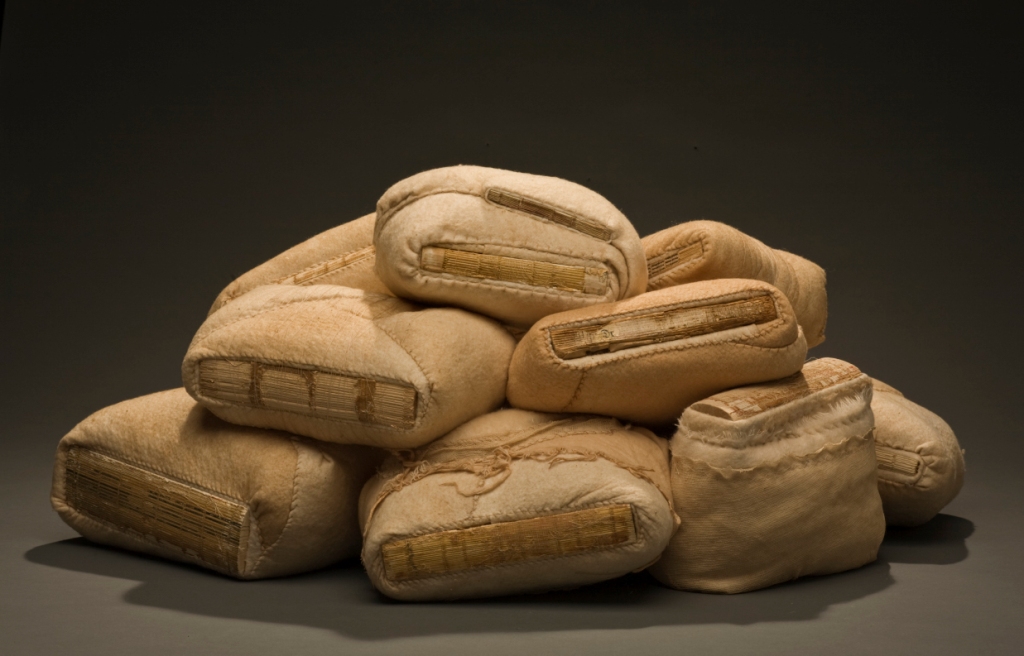
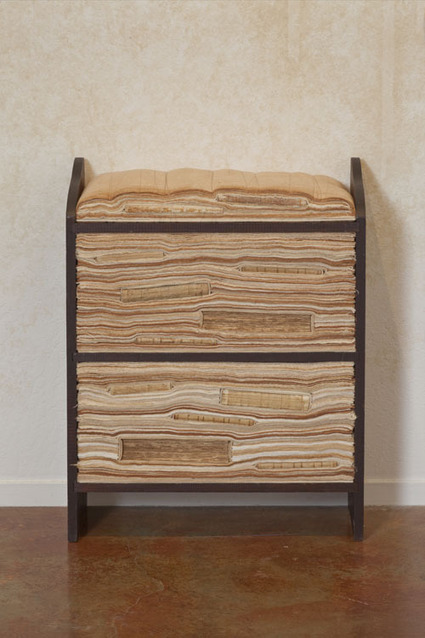
The photo above comes from Alexander’s series Sedimentals. This series, which “takes the form of tea staining cotton to replicate the colors of aged and browned bookspines and swaddling or layering them to create a safe haven for these beautiful objects, enshrining them”, is an interesting instance of book art to which Garrett Stewart’s Bookwork: Medium to Object to Concept to Art applies. Check out Alexander’s site, read Stewart’s book and see if you agree.
The Fine Press Book Association’s inaugural Student Type Design Competition sprang from the hope that by building bridges between printers and young type designers we might end up creating new material resources for the fine press community.
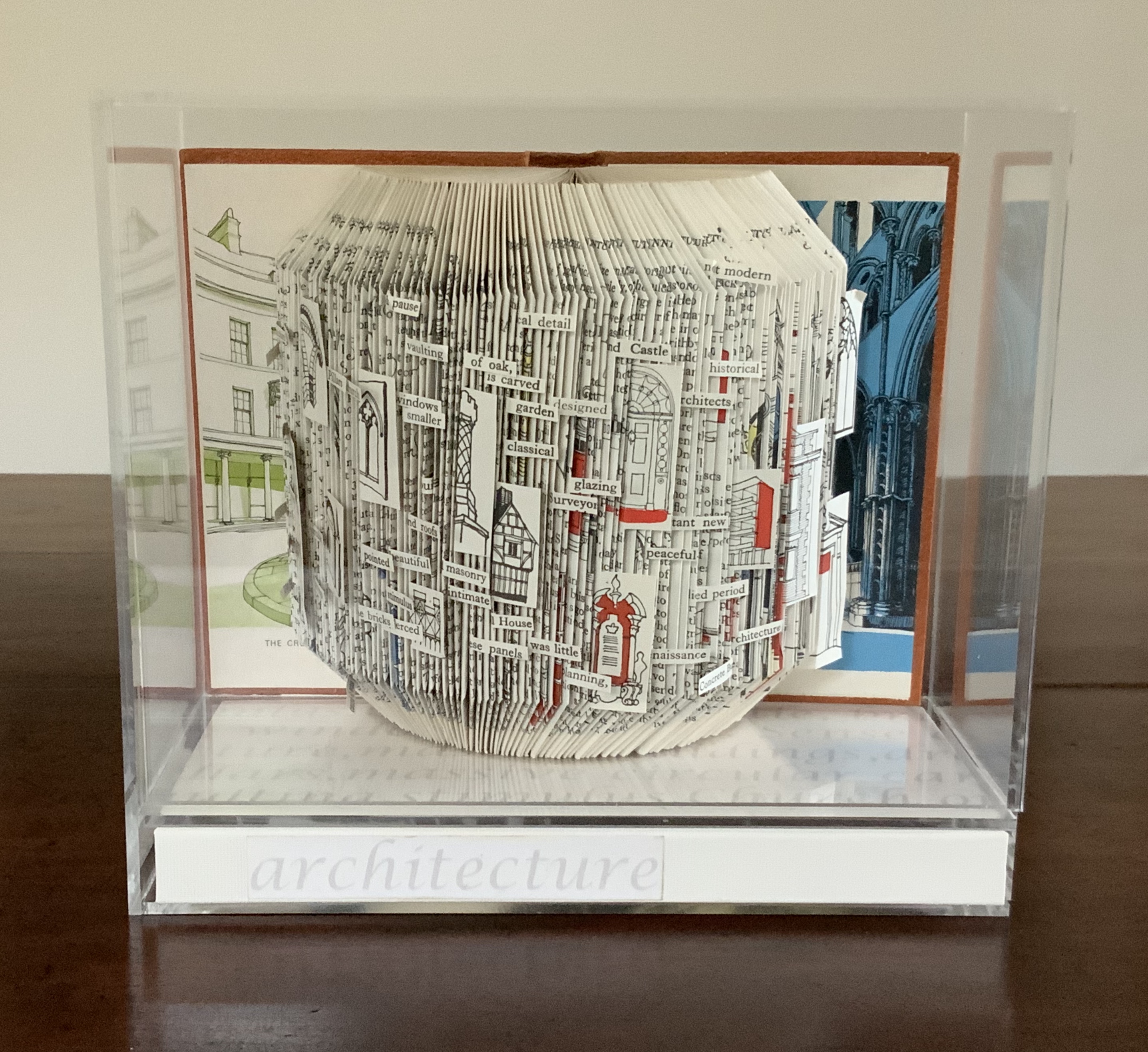
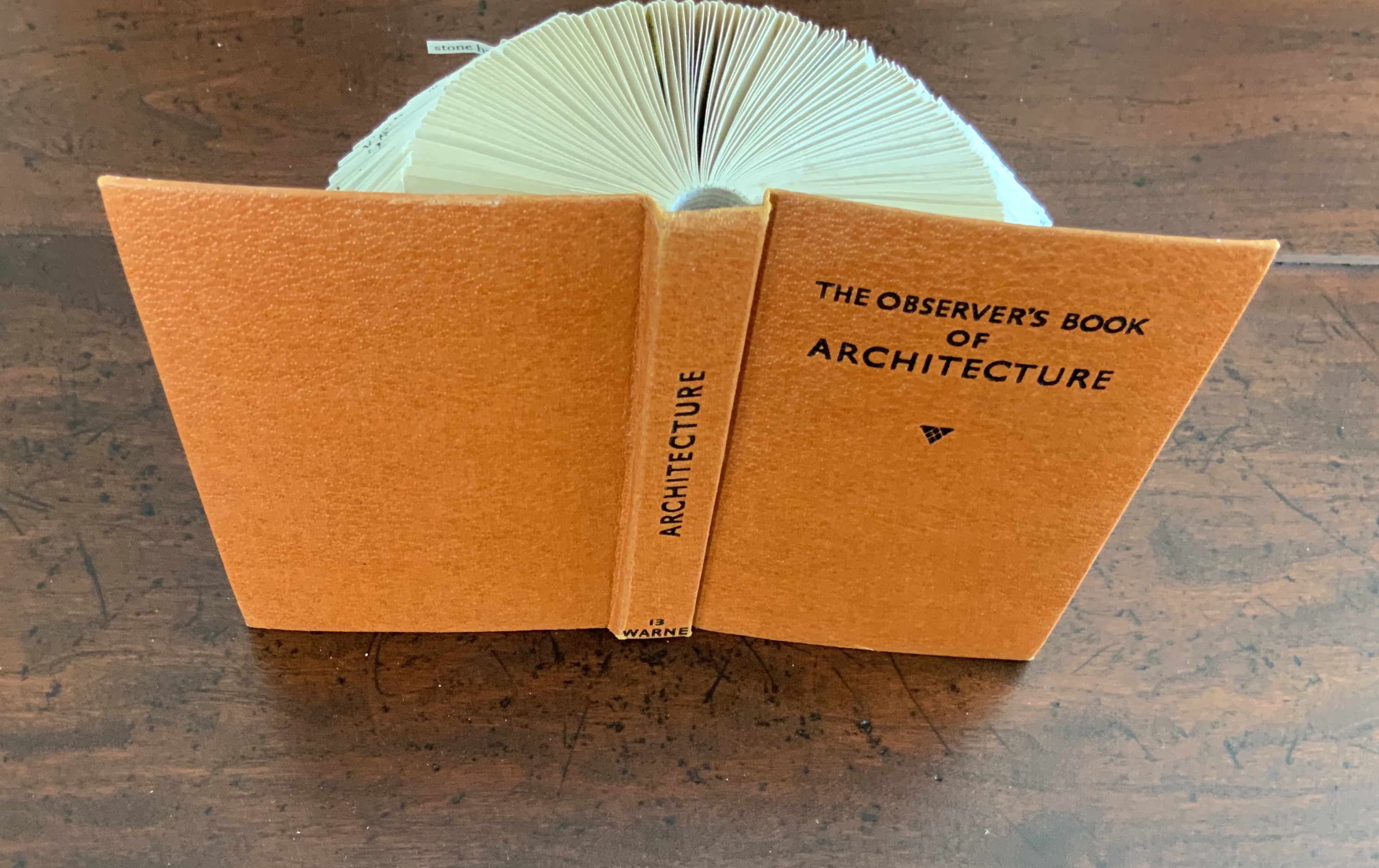
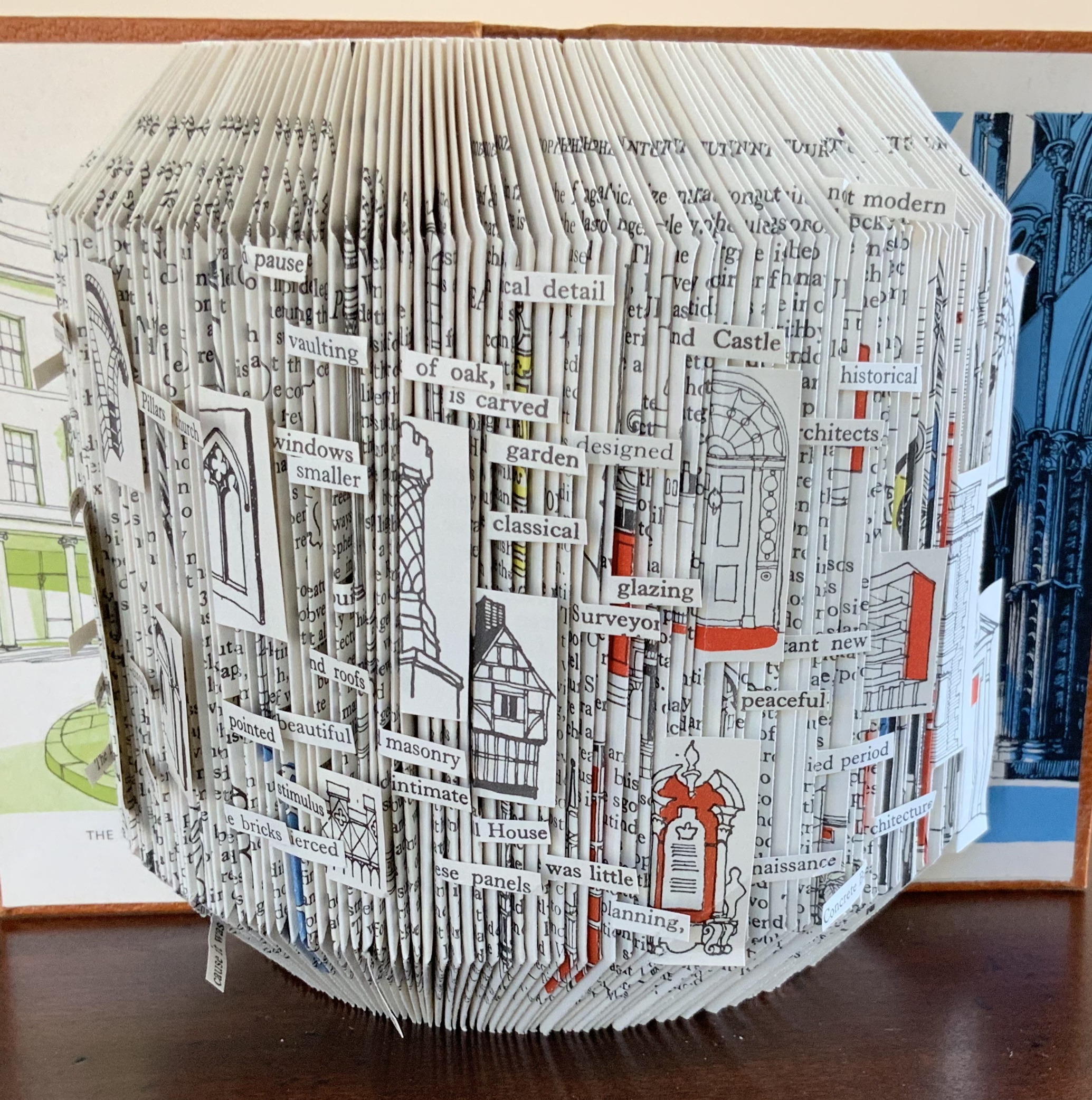
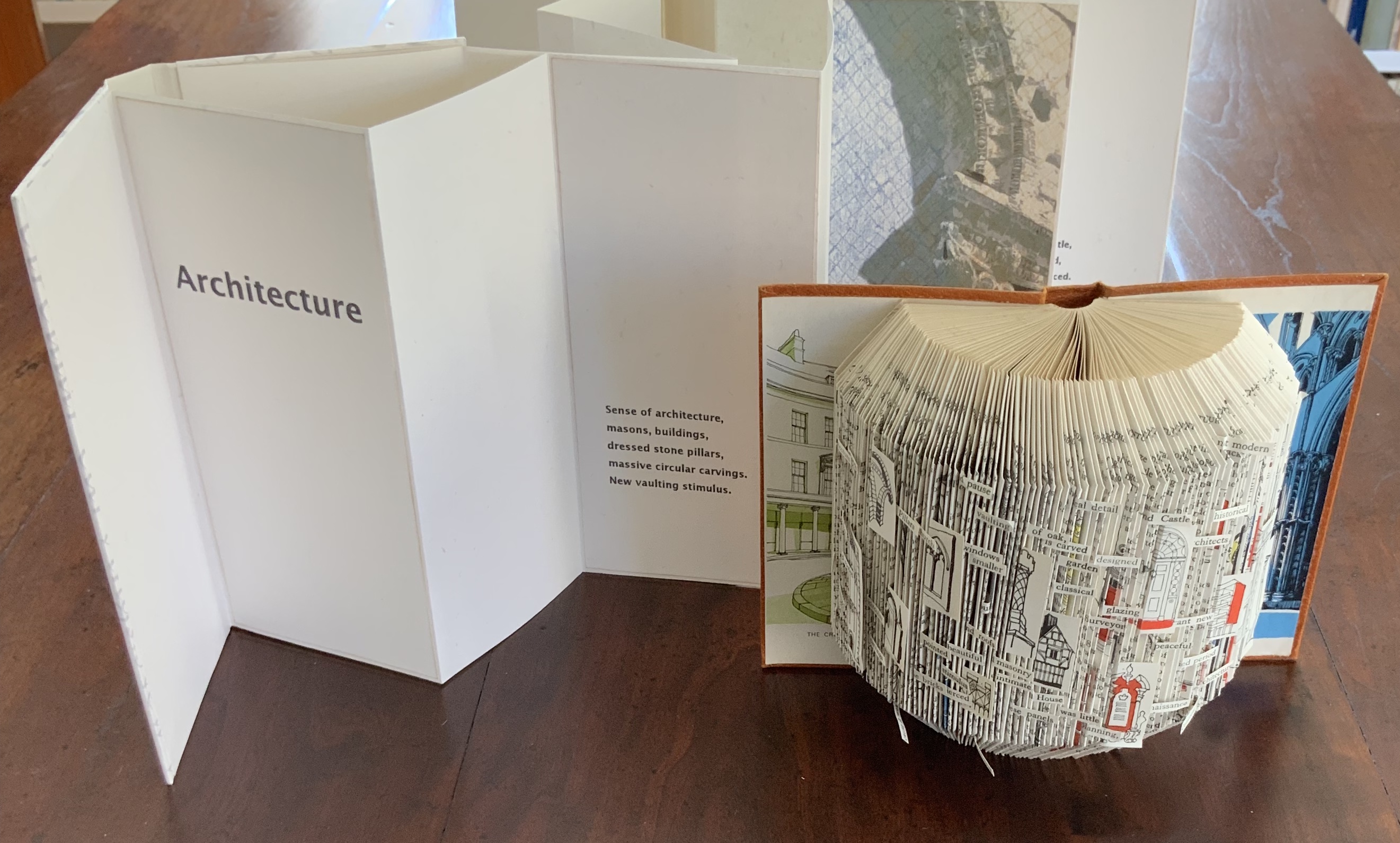
Folded book pages rarely generate a work that rises above mere craft. Heather Hunter’s Observer Series: Architecture (2009) achieves the necessary height. It combines the altered book with an accordion book that incorporates a found poem composed of the words excised and folded outwards from the folded pages of The Observer’s Book of Architecture.
The very fact of a found poem made of excised words that happen to fall at the folds shaping a column from a book on architecture chimes with the title of Bachelard’s The Poetics of Space.
Another work in the collection is Foldable Sculpture No. 1.
“Environmental memories,” not just of places but of cherished objects held in the hand, are Hunter’s chief inspiration, and the design of her bookworks is intended through touch, reading and exploration to evoke in the reader “unique feelings that become the reader’s own environmental memory.” Her artistic and literary influences and inspirations are an interesting blend of the 20th century Neo-Concrete and the 19th century Romantic movements. Links to illustrations of those sources of influence are embedded in the caption to Snowdrop.
Snowdrop ()
Hunter has regularly exhibited and demonstrated her work at Turn End Studios in Haddenham, Buckinghamshire.
Oratorical Type A by Nerhol (Ryuta Iida and Yoshihisa Tanaka)
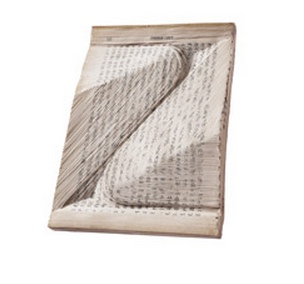
Oratorical Type Z by Nerhol (Ryuta Iida and Yoshihisa Tanaka)
The Japanese artists and partners Ryuta Iida and Yoshihisa Tanaka are known as NERHOL. Interviewed by Rebecca Fulleylove in the online magazine It’s Nice That, they explain the name:
We met at one of Iida’s exhibition and realised we had so much in common in regards to experience, design and taste. Gradually, we began working together. Our very first piece, Oratorical Type, used books as the theme, after sculpting them by carefully carving out certain sections of each page, it resulted in interesting dimensions. At that time, we still hadn’t decided on our name but soon came up with “NERHOL”, a mash-up of two words, “neru” to plan ideas and “holu” to sculpt and carve.
“To plan ideas” and “to sculpt and carve” those ideas in air, time, stone, wood or paper is that not a poem, a book, a building, a city — the work of art? That these two artists chose the letters of the alphabet as their first work together, that the alphabet and each of its letters came into being by collective human art and craft, marking our passage from orality to literacy, and that the alphabet, type and book are tools by which we have strived to evolve — how could they not be named Nerhol and their first work of art not be called Oratorical Type?
The British Library‘s “Medieval and Earlier Manuscripts” blog is a reliable source of visual delight and provocation to think about the interplay of the print and digital worlds. It also prompts the application of Ezra Pound’s critical technique of juxtaposing works, demonstrated so well in his The ABC of Reading.
I have read A Degree of Mastery from cover to cover twice. Once in New York between 2002 and 2005 when I was teaching “Professional Book and Information Publishing” at NYU and wanted readings to help provide students with a sense of the history, art and craft of the book. The second time here and now in Windsor looking for the “right something” to include in “Books On Books.”
On both occasions ebooks and digital publishing pervaded my thoughts, but only on the second time around did these questions and observations I want to raise now shape themselves as they have.
Annie Tremmel Wilcox weaves a memoir of her apprenticeship under the renowned bookbinder and conservator William Anthony. She weaves it with her diary entries, excerpts from an exhibit brochure “Saving Our Books and Words: The Conservation and Preservation of Books,” newspaper articles, correspondence, passages from “Japanese Woodworking Tools: Their Tradition, Spirit and Use” by Toshio Odate, step by step descriptions of mending torn pages and crumbling leather spines and plainspoken observation of fellow workers, conference attendees, librarians, government officials posing with restored documents, children making “books” from striped computer paper with wallpaper sewn on for covers and, of course, Bill Anthony, the “Johnny Appleseed of bookbinding.”
“Weaves” is the precise word for the structure of her book’s narrative, and it would be the right word for her ebook, if there were one. As I re-read it, this game of word substitution yielded questions that make this memoir a useful means to bookmark the evolution of the book.
Writing about some of the tools she learns to use — lifting knives, translucent bone folders, the spokeshave and others — she says of Anthony’s, “His tools were smarter than mine. They knew the correct way to cut paper or pare leather. By using them I could feel in my hands how the tools were supposed to work.” (48) For Wilcox and her reader, Bill Anthony is the master “shokunin,” craftsman or artisan. And when she quotes from Odate “For the ‘shokunin,’ utility and appearance must be enhanced by the tool’s ‘presence,’ that is its refinement and dignity….,” this reader asks,
What are the tools of the ebook maker? From whence comes their refinement and dignity — their “presence” — with which the “shokunin” imbues his creation as a result of his commitment to his craft? In what tools of the ebookmaker does “the spirit of the tool that records the ‘shokunin’s’ ability through the years to face the uncertainties of life, to overcome them, and to master the art of living” reside?
Too Zen? Perhaps.
An English grad student, Wilcox relished handling the University of Iowa‘s Sir Walter Scott Collection, its Leigh Hunt Collection and The Works of Rudyard Kipling. Confronted with earlier slapdash and botched work on certain volumes of the Kipling, she writes, “Certainly these volumes of Kipling are found on the shelves of numerous libraries across the country, but the integrity of ‘these’ volumes as a complete set has been lost.” (179) What constitutes the “integrity” of an ebook or its constituents? Are ebooks so “immaterial” that such a question is nonsensical?
The author’s apprenticeship included collaboration on the exhibit “Saving Our Books and Words.” In addition to coauthoring the exhibit’s brochure, Wilcox contributed to completing Anthony’s special project of developing for the exhibit a unique collection of models demonstrating “the evolution of the codex – the form of the book as we know it.”(181) In the brochure she touches on the immateriality and materiality of the Center’s work: “Simply defined, preservation is the attempt to save the intellectual content of books while conservation is the attempt to save both the intellectual content and its vehicle — the covers, paper, endbands, etc. The former is concerned with saving what the human record contains without regard to the forms it winds up in. The latter focuses on the artifact itself, attempts to save this book, this sheet.” (192)
What is the “form” of the ebook as we know it? Is the ebook as much “vehicle” as “content”? What are its equivalencies to the page or to what “binds” the “text block”? What does it mean to “conserve” an ebook? Of a digital copy, what are the materials; what is the artifact to be conserved?
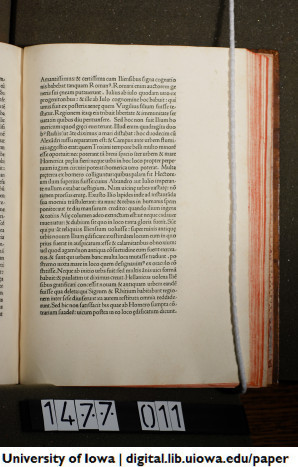
Wilcox ends her memoir with the completion of her “masterpiece,” the restoration of the incunabulum that Bill Anthony assigned her before his death and which she completed after it with the help of “The Restoration of Leather Bindings” by Bernard Middleton, author of the standard text “A History of English Craft Bookbinding Technique.” The work assigned was Pope Pius II’s “Historia Rerum Ubique Gestarum,” printed by Johannes De Colonia and Johannes Manthen in Venice in 1477, which when restored was “not a deluxe edition, but … had great integrity.” In the year 2547, of what will the preservation and conservation of today’s e-incunabula consist? Will some apprentice conservator understand the “form” of these ebooks “in the cradle” and, master of smart tools, restore them to their integrity?
With Ann Tomalak’s essay, perhaps we can see that future through her present lense on the past. Give it a read.







 Books On Books