Bookmarking Book Art – Architecture

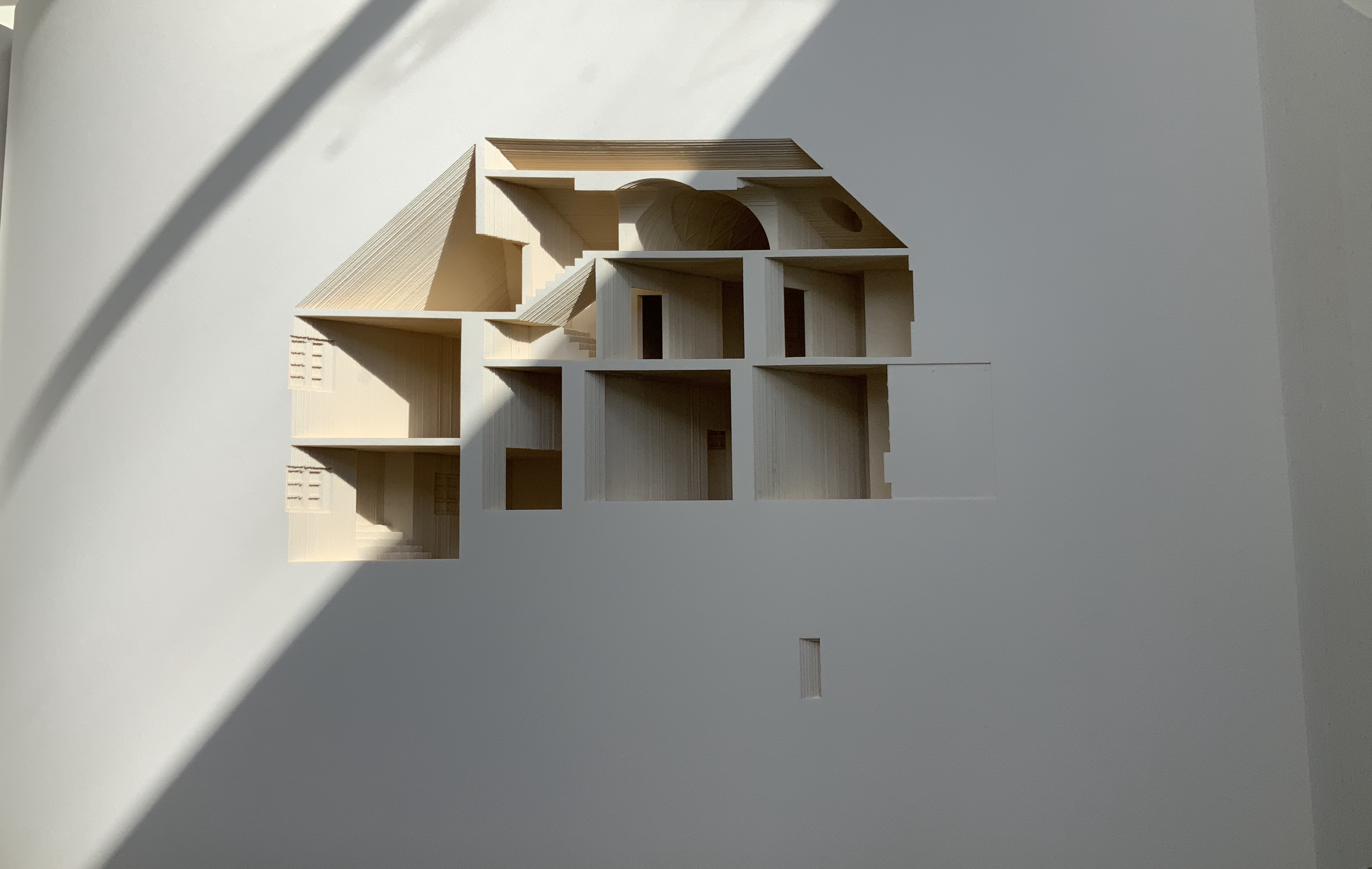
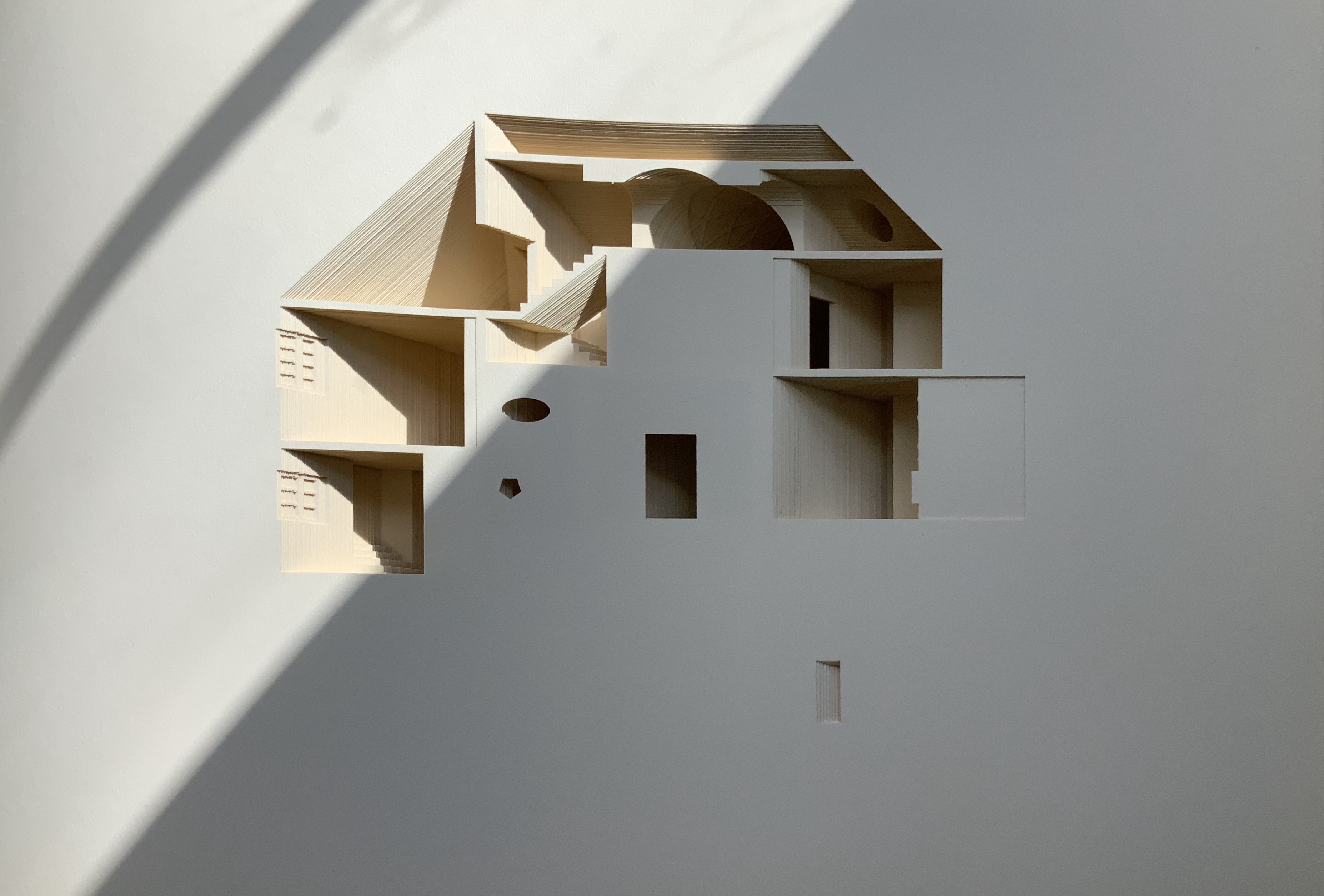
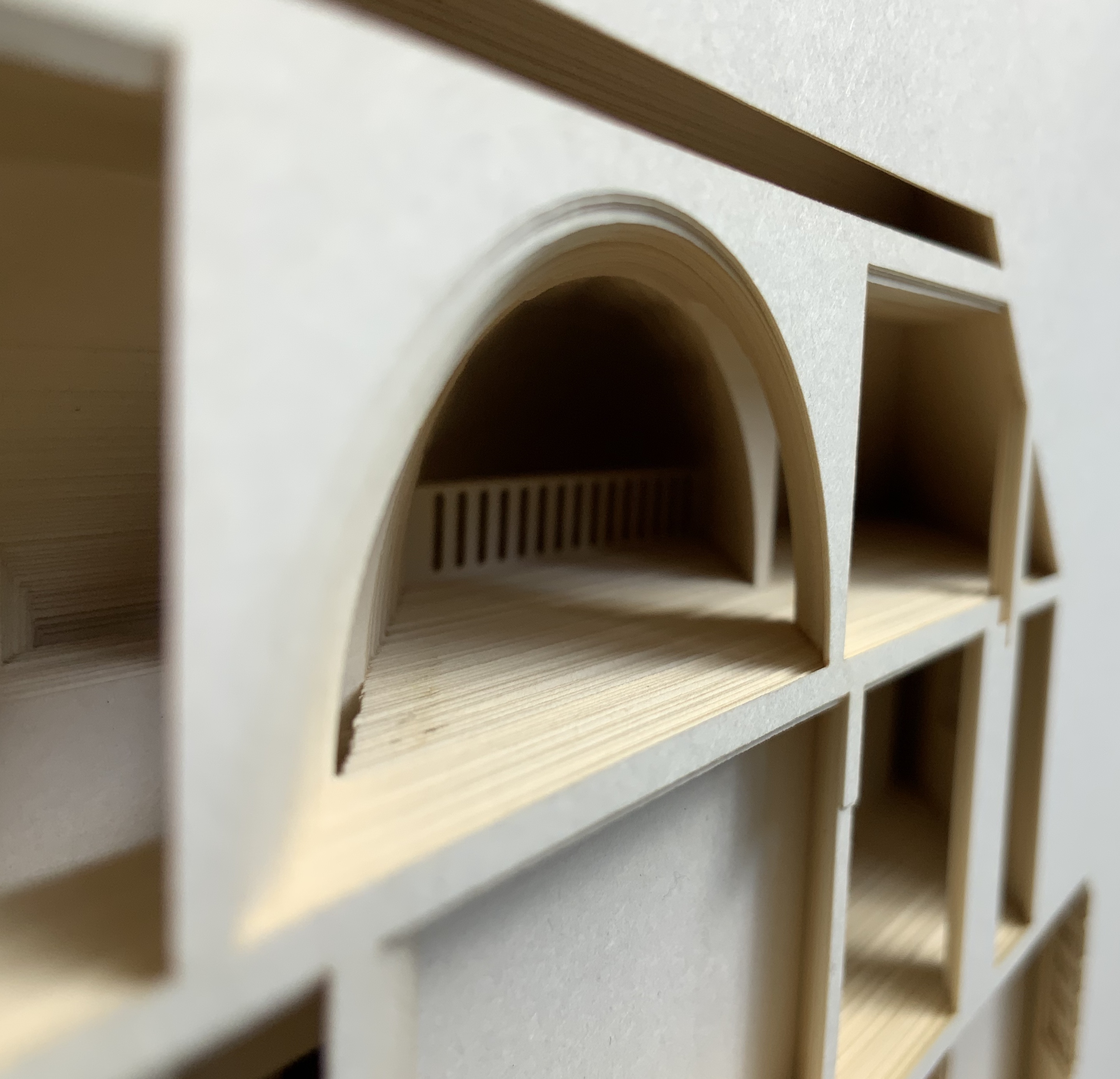
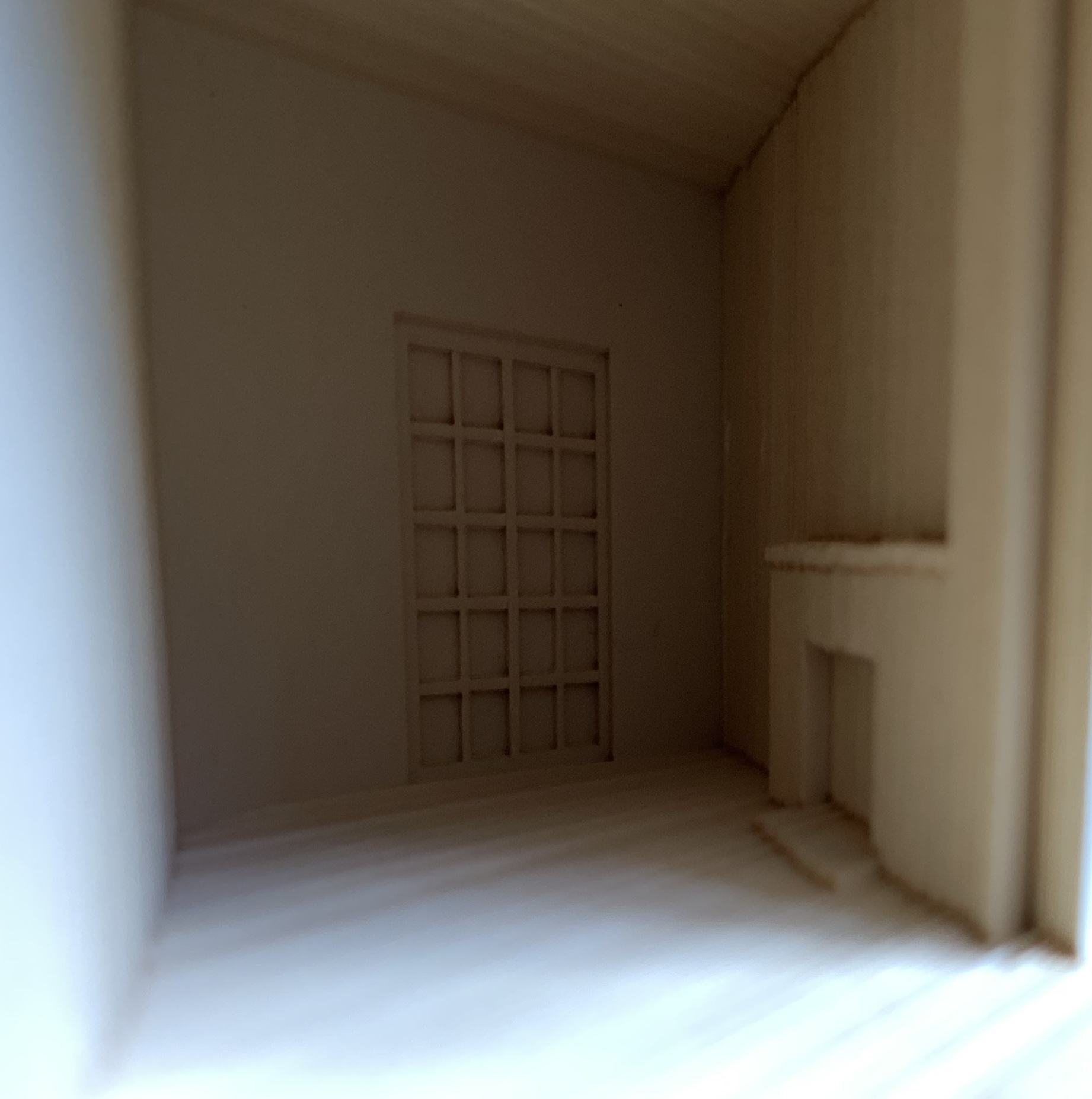
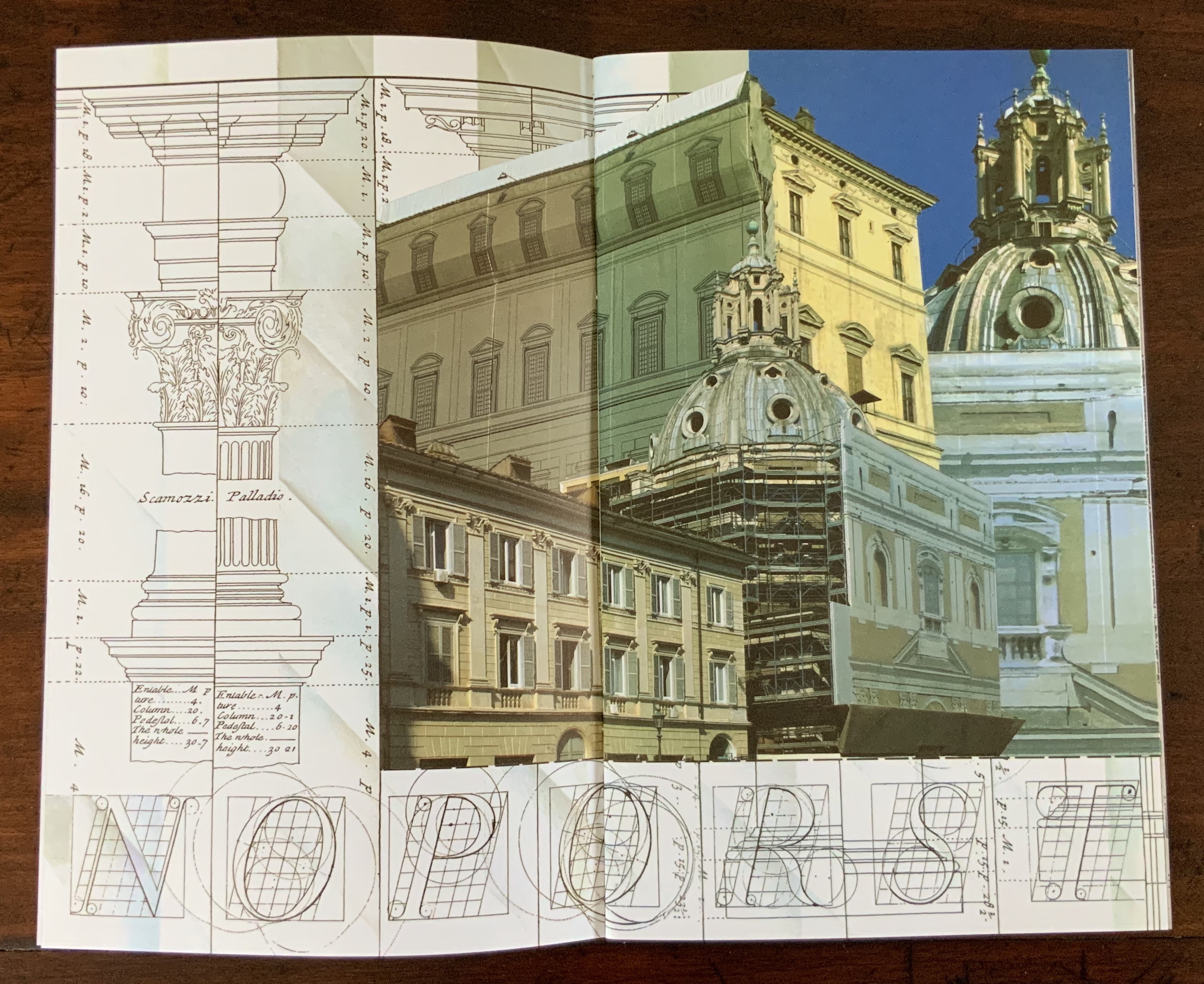
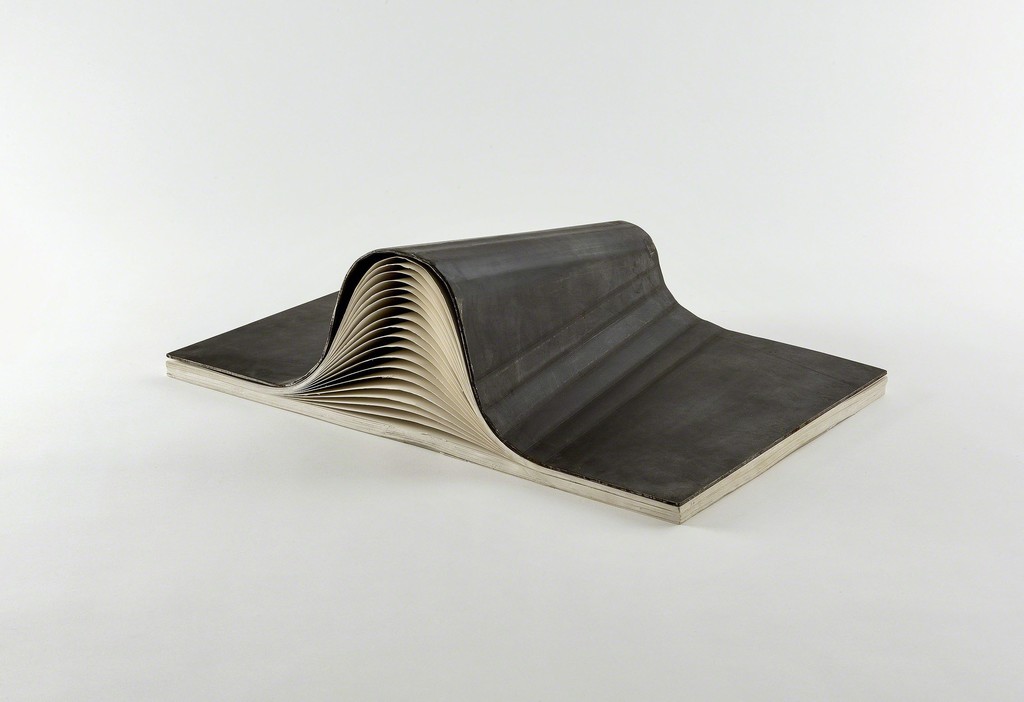
Architecture — be it theory, principles, practices or instances — inspires book art. Lay the book flat; you have a foundation. Open and turn it on its fore-edge; you have a roof beam or arcade. Stand it upright; you have a column or tower. Turn the front cover; you open a door. Put the text and types under a microscope; you have a cityscape. As the examples in this virtual exhibition show, architecture-inspired book art goes beyond these simple analogies.

There are seemingly unrelated texts that help considerably in going there. The Eyes of the Skin (2005) and The Embodied Image (2010) by Juhani Pallasmaa, architect, teacher and critic, are two of them. He writes as if he were an artist preparing an artist’s statement or descriptions of the book art below. The title of his earlier book gives away his alignment with the visual and tactile nature of book art. Pallasmaa’s two books will enrich anyone’s enjoyment of the works shown and mentioned here.

Updates:

Binding Space: The Book as Spatial Practice (2018) by Marian Macken.

Building Books: New England Book Artists’ Guild Exhibition. 30 January – 29 April 2023. USM (University of Southern Maine) Portland.

From the Books On Books Collection

Helen Malone

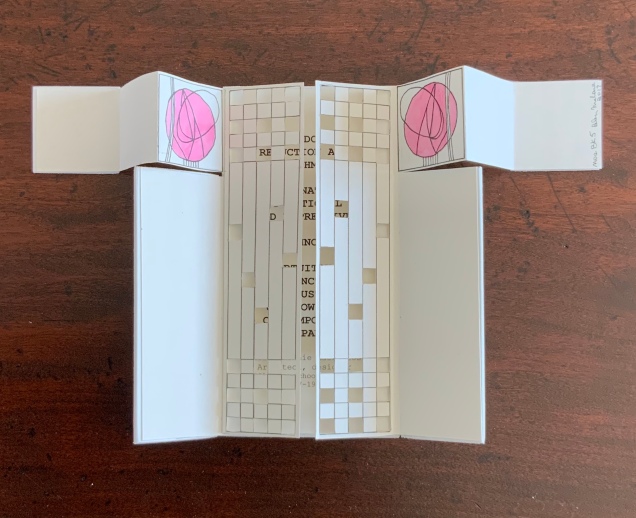
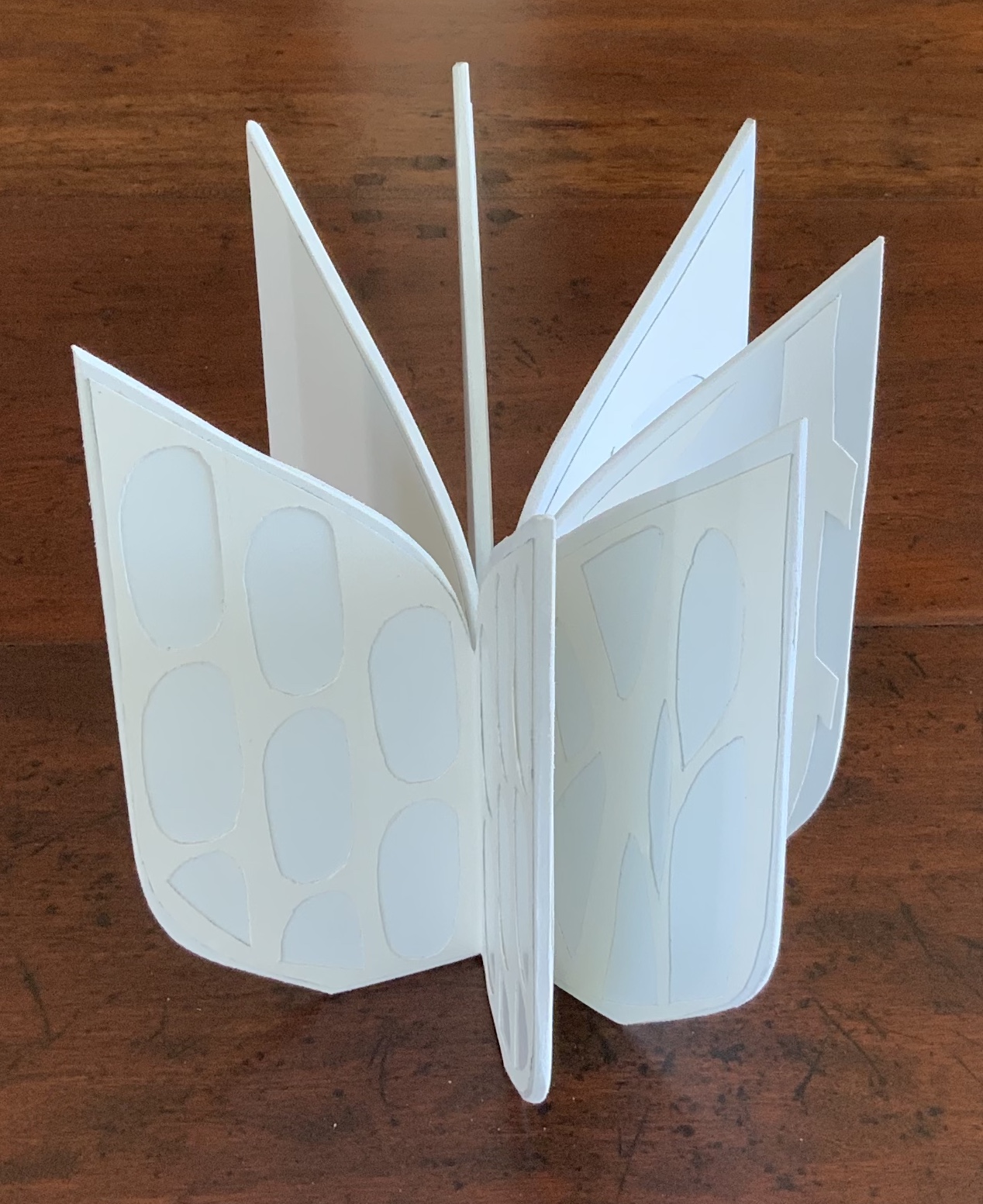
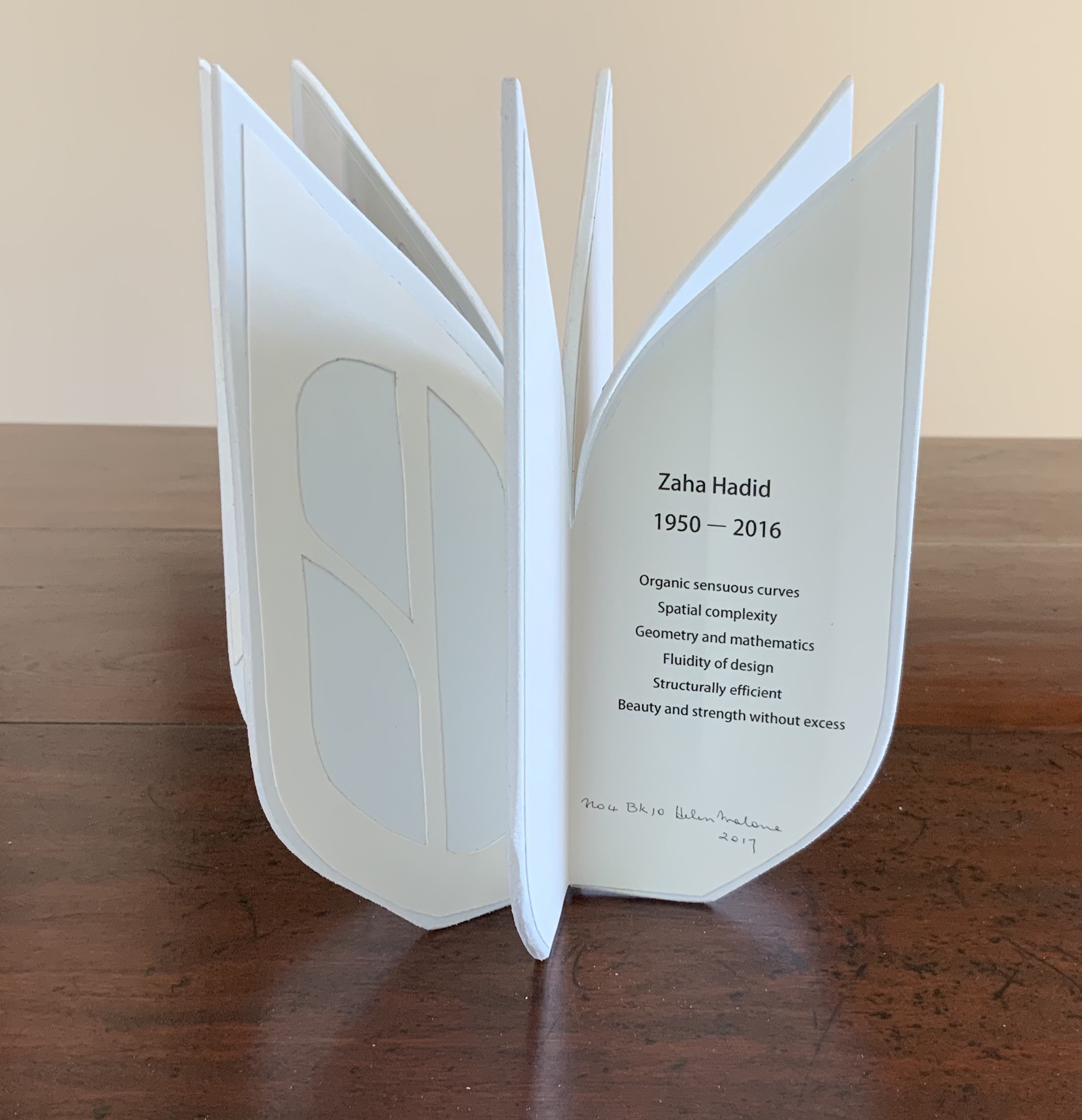
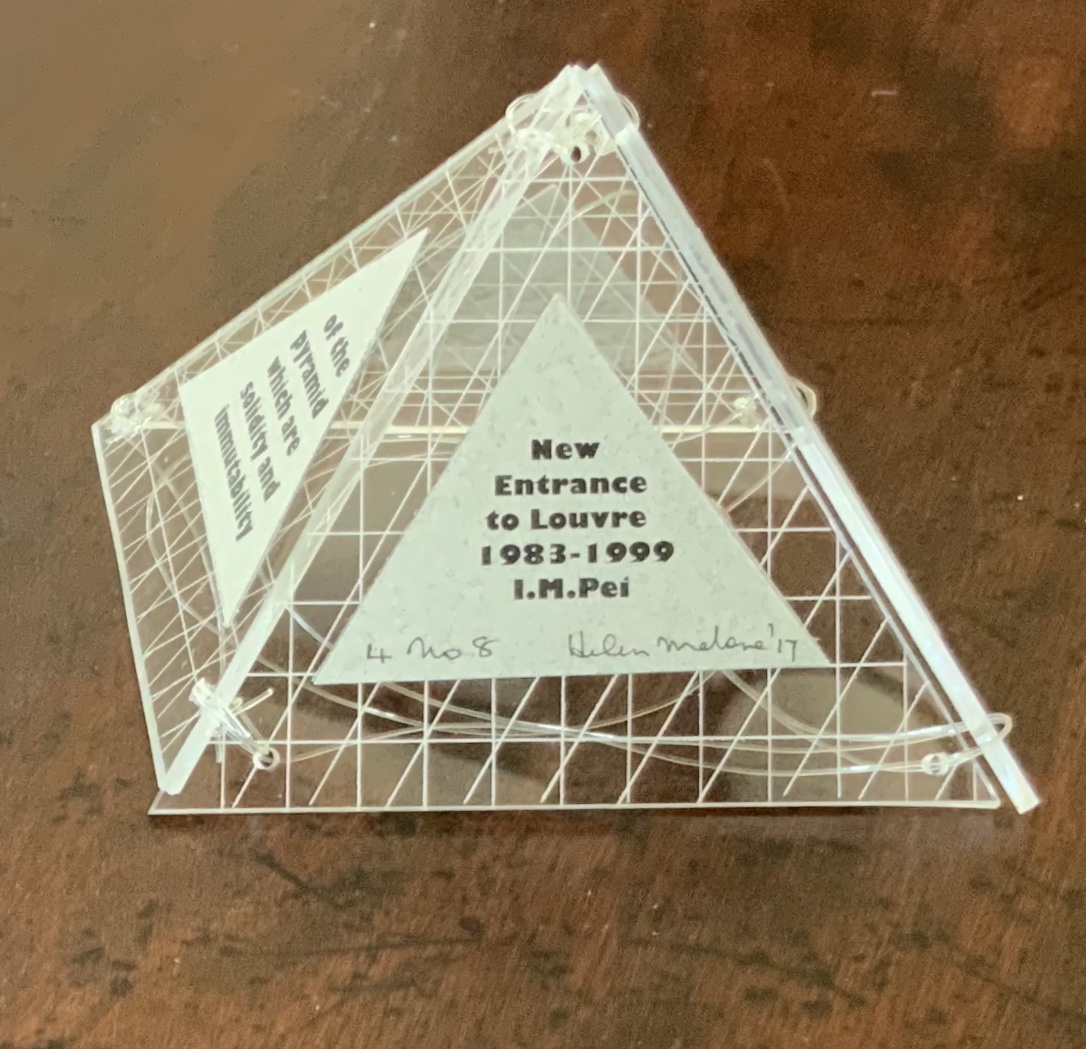
Malone’s Ten Books of Architecture is a good place to start in the collection. Like Pallasmaa, Malone takes a broad historical and, most important, haptic view of architecture from Vitruvius to Hadid. Each of the ten books is a bookwork that exemplifies its subject.
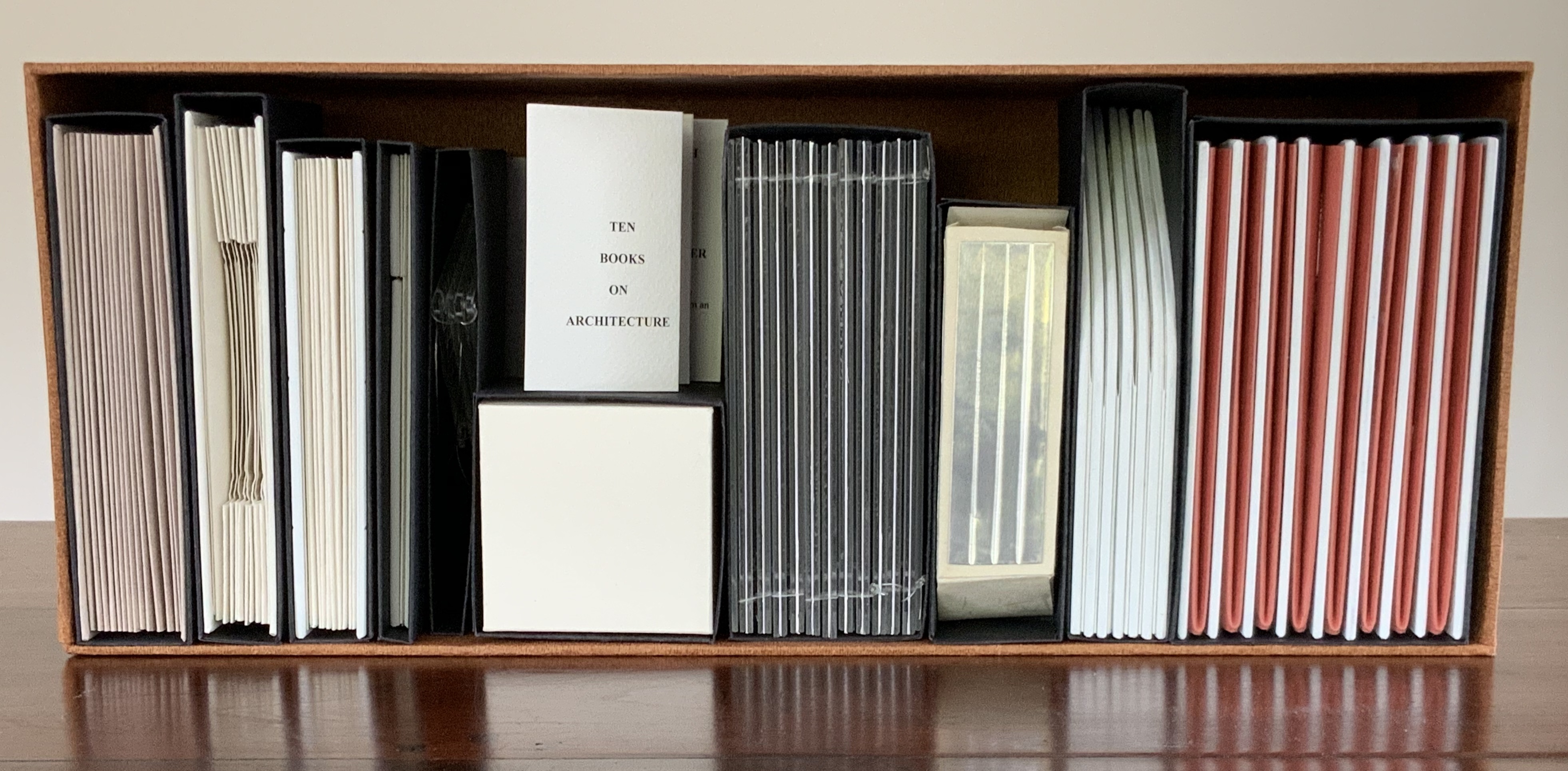
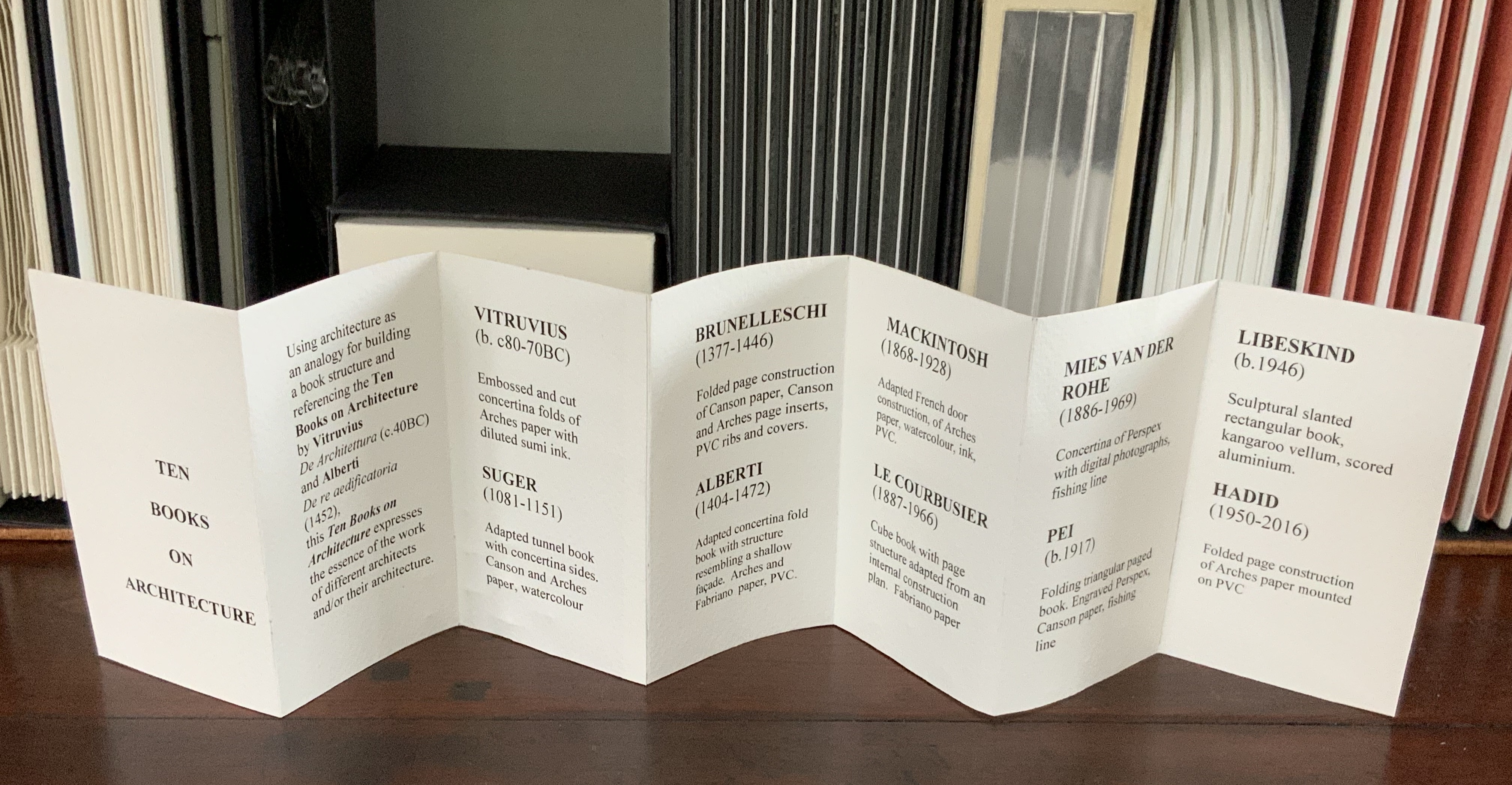
Photos: Books On Books Collection
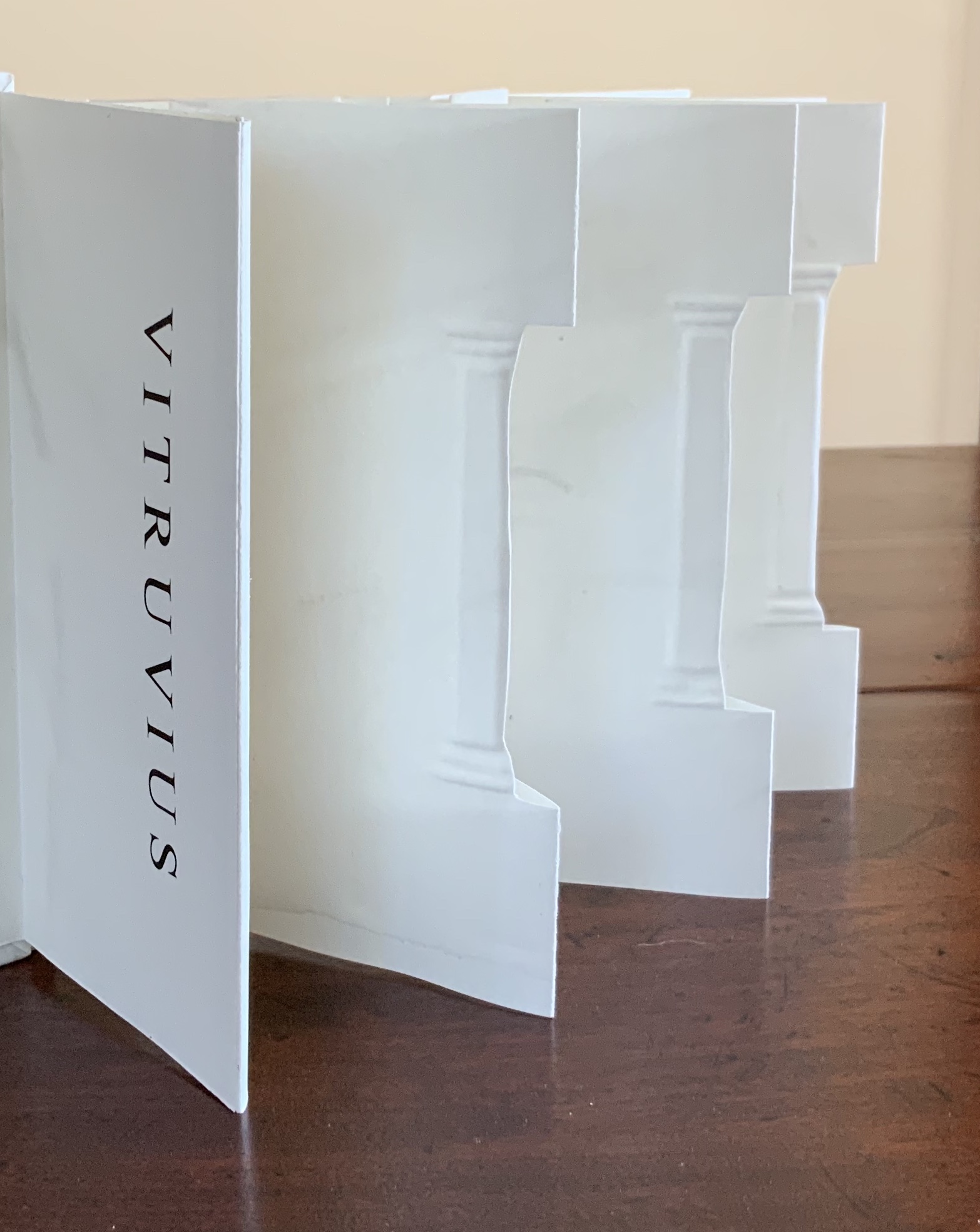
Marcus Vitruvius Pollio

The columns in this accordion book are made by embossing; the marbling effect comes from diluted Sumi ink.
Photo: Books On Books Collection
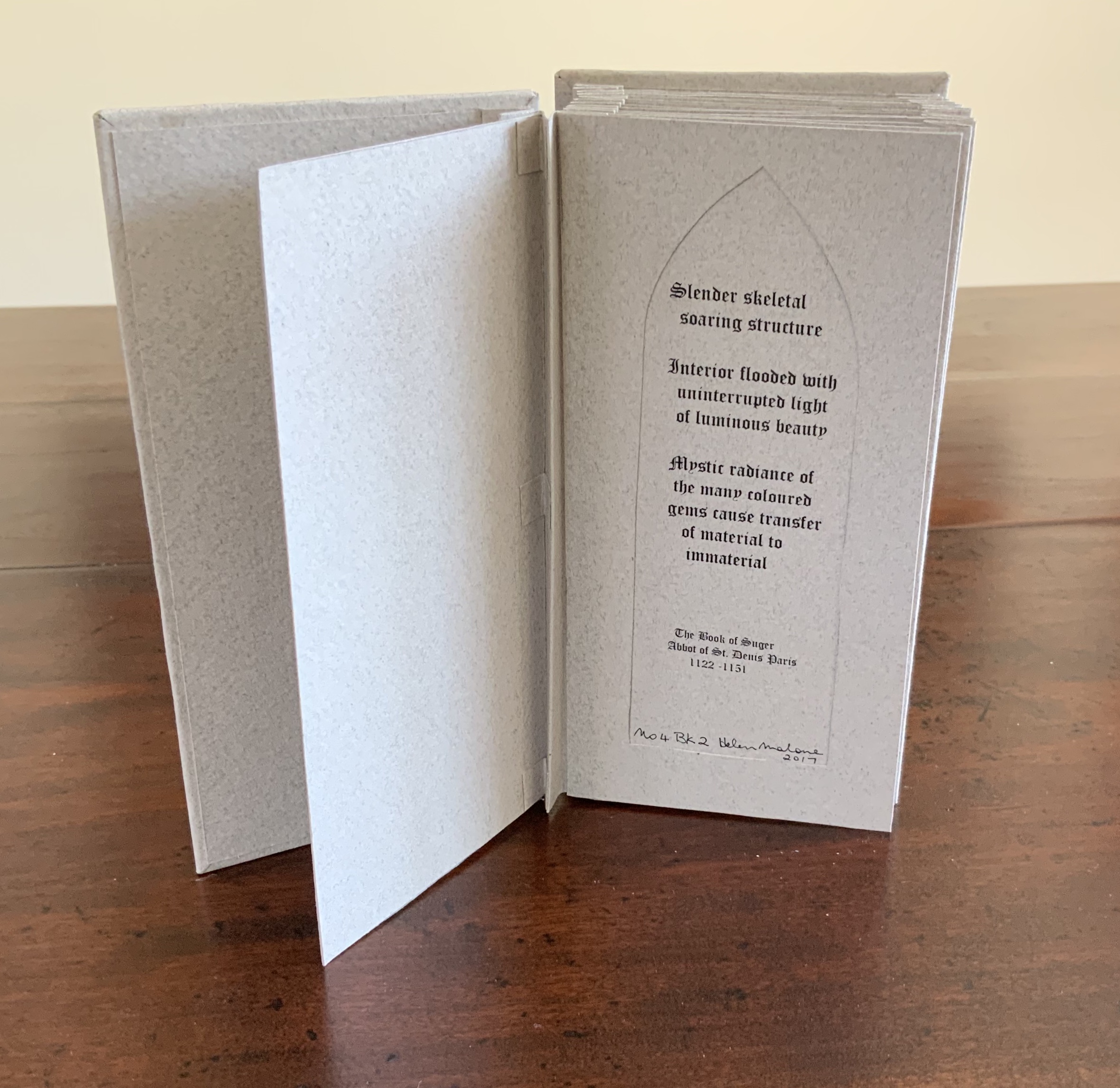
Abbot Suger of Saint-Denis

Adapted tunnel book with accordion sides
Photo: Books On Books Collection
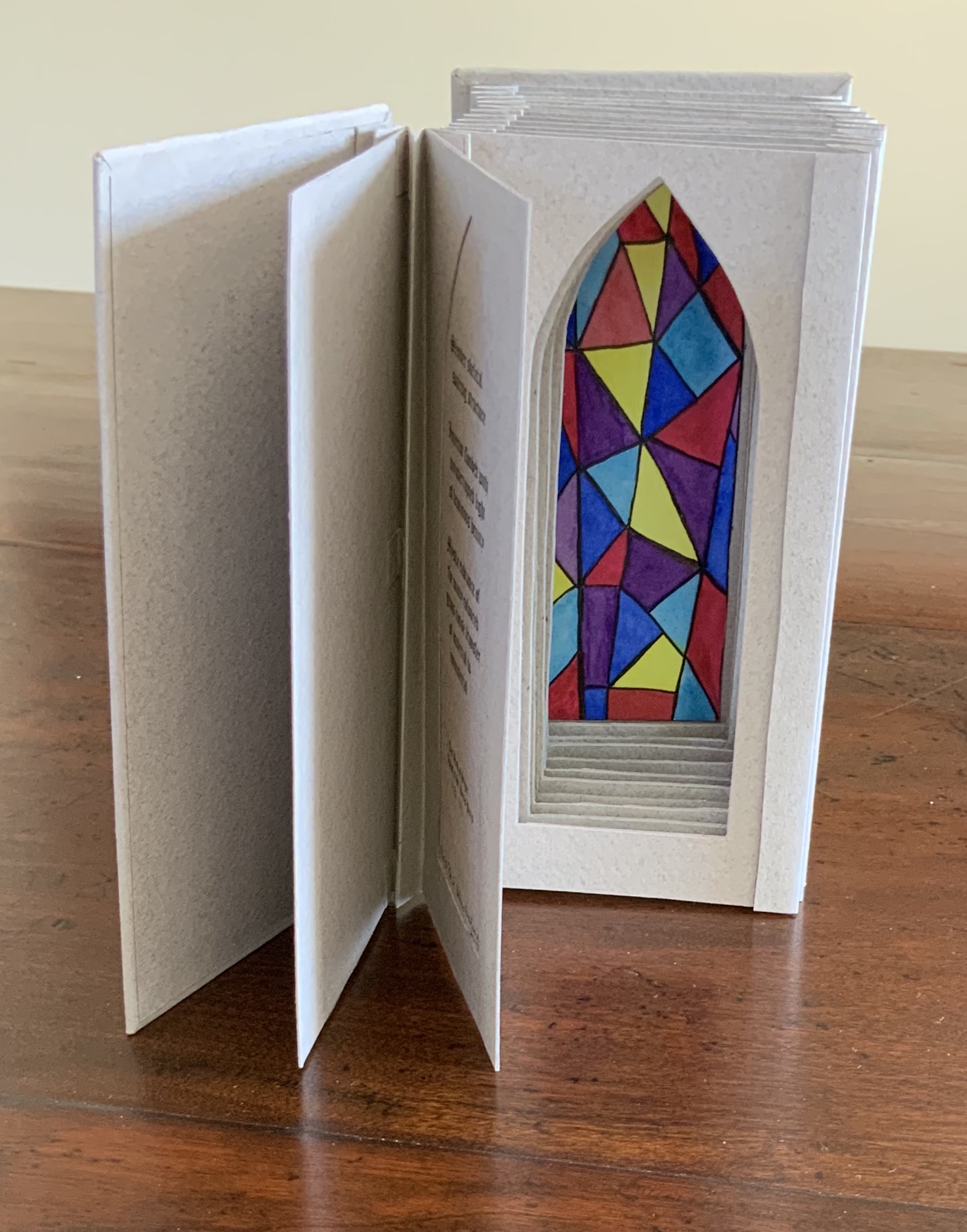

A watercolour at the tunnel’s end to evoke the stained glass clerestory windows in the Basilique Saint-Denis, Paris
Photo: Books On Books Collection

The aspiration to fuse the cosmic and the human, divine and mortal, spiritual and material, combined with the systems of proportion and measure deriving simultaneously from the cosmic order and human figure, gave architectural geometries their meaning and deep sense of spiritual life. The Embodied Image, p. 23.
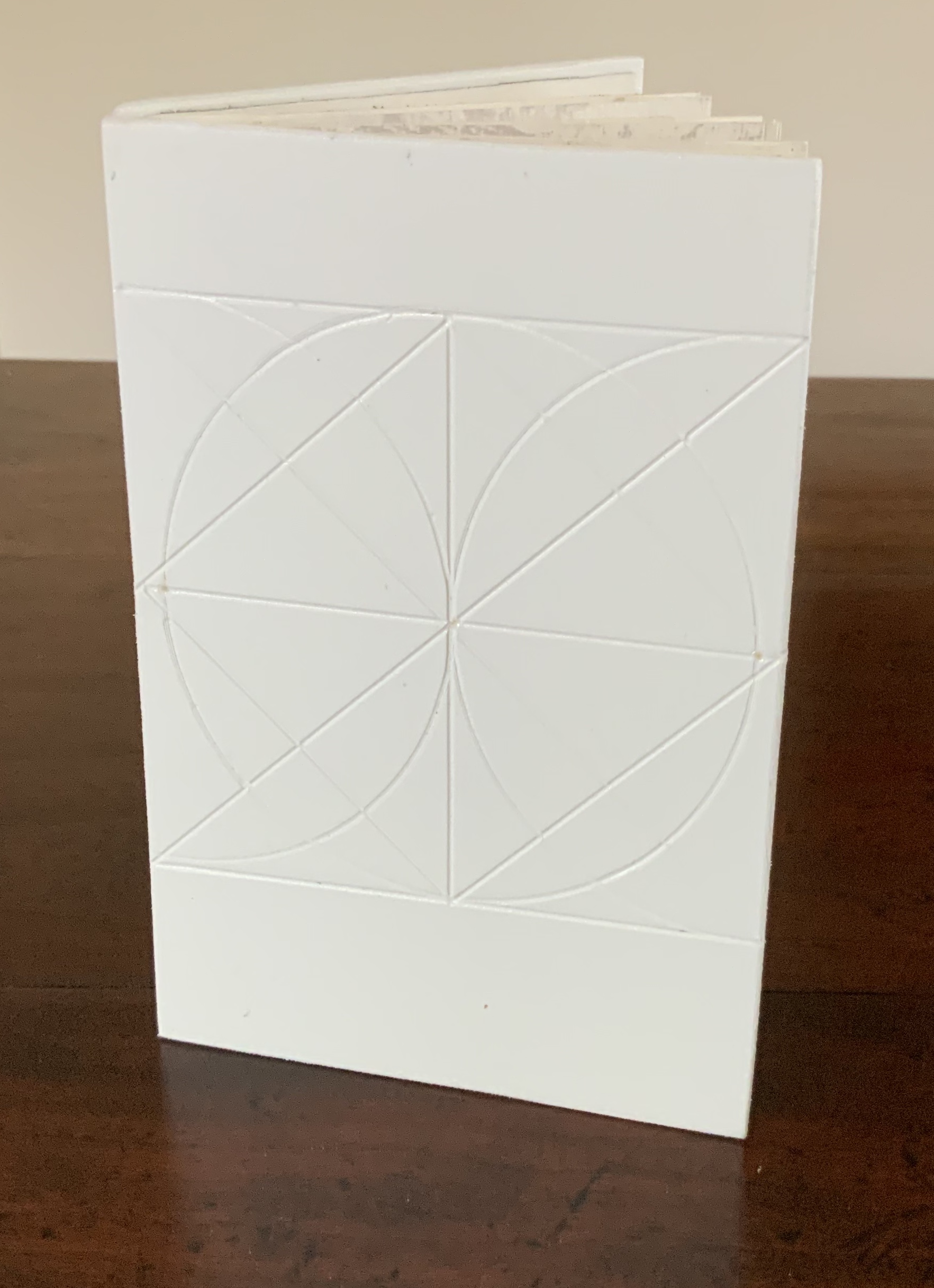
Leon Battista Alberti

Photo: Books On Books Collection

The texture of this book, its adapted accordion structure and Alberti’s words remind me of Geoffroy Tory’s Champ fleury: The Art and Science of the Proportion of the Attic or Ancient Roman Letters, According to the Human Body and Face  (1529) and its argument for finding the ideal shape of the letters in the human form and face. The alphabet as book art’s bones, bricks and beams?

And further apropos the link between the book and architecture, consider the connection that Vasari drew between Gutenberg and Alberti:

In the year 1457 [sic], when the very useful method of printing books was discovered by Johann Gutenberg the German, Leon Batista [sic], working on similar lines, discovered a way of tracing natural perspectives and of effecting the diminution of figures by means of an instrument, and likewise the method of enlarging small things and reproducing them on a greater scale; all ingenious inventions, useful to art and very beautiful. Lives of the Most Eminent Painters, Sculptors and Architects, vol. 1, trans. Gaston Du C. de Vere (London: Medici Society/ Philip Lee Warner, 1912-1914), 494.
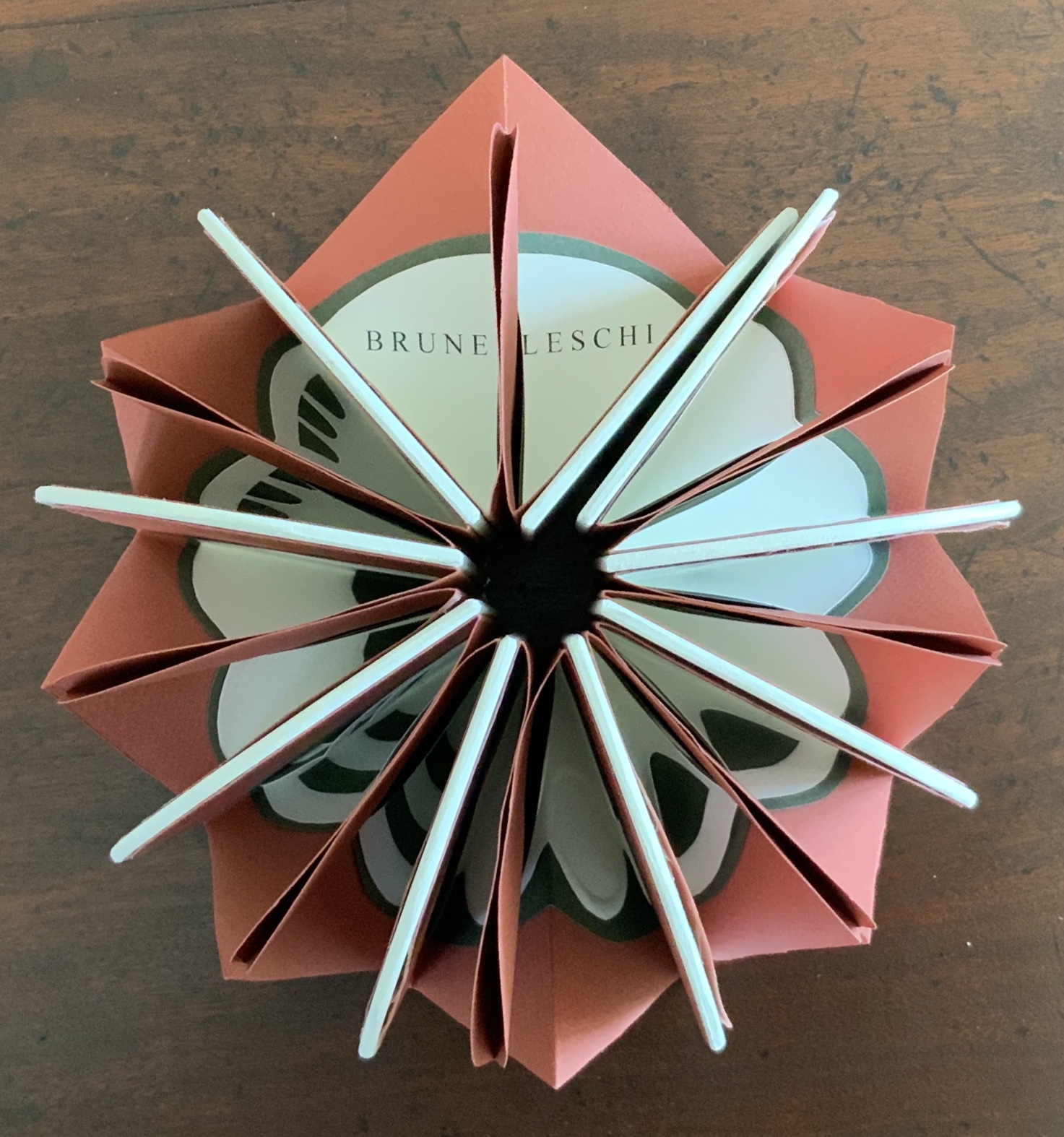
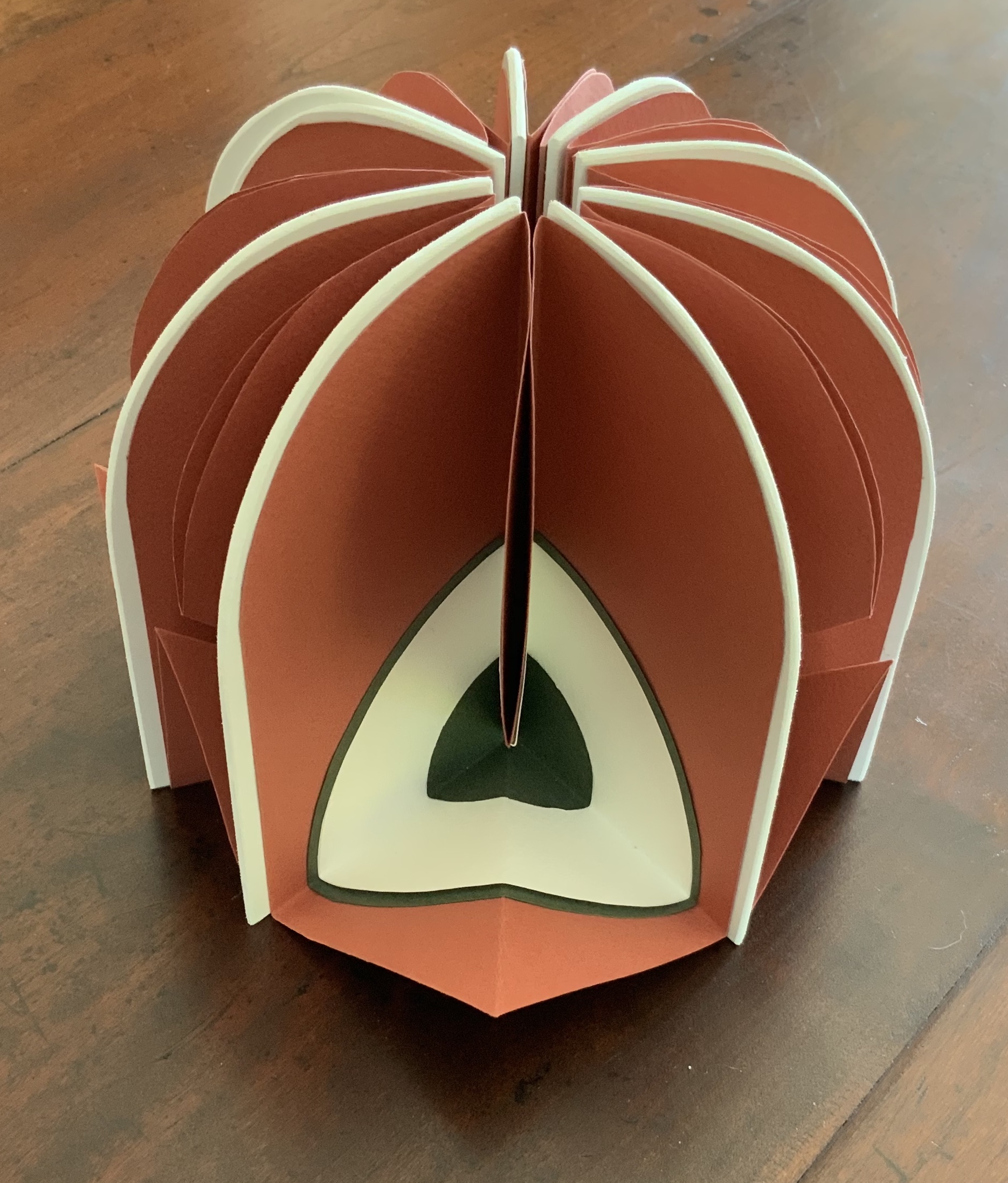
Filippo Brunelleschi

Photos: Books On Books Collection

In “An Architectural Confession”, Pallasmaa writes:

One’s most important teacher may have died half a millennium ago; one’s true mentor could well be Filippo Brunelleschi or Piero della Francesca. I believe that every serious artist — at the edge of his/her consciousness — addresses and offers his/her work to a superior colleague for approval. The Eyes of the Skin, p. 82.

Charles Rennie Mackintosh

“A paradox of enrichment and reduction”
Photo: Books On Books Collection
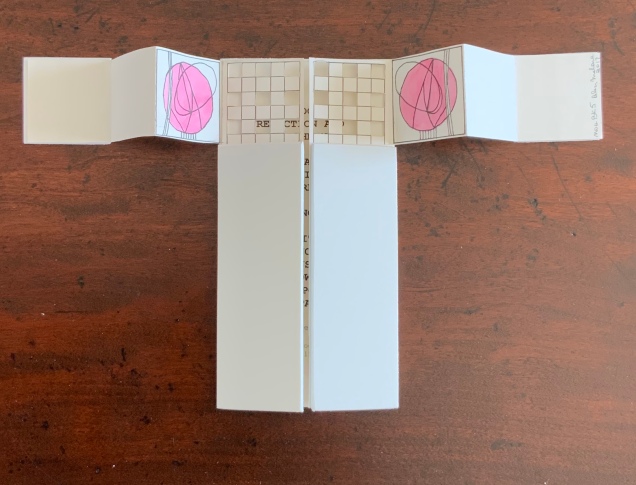
“New technologies”
Photo: Books On Books Collection
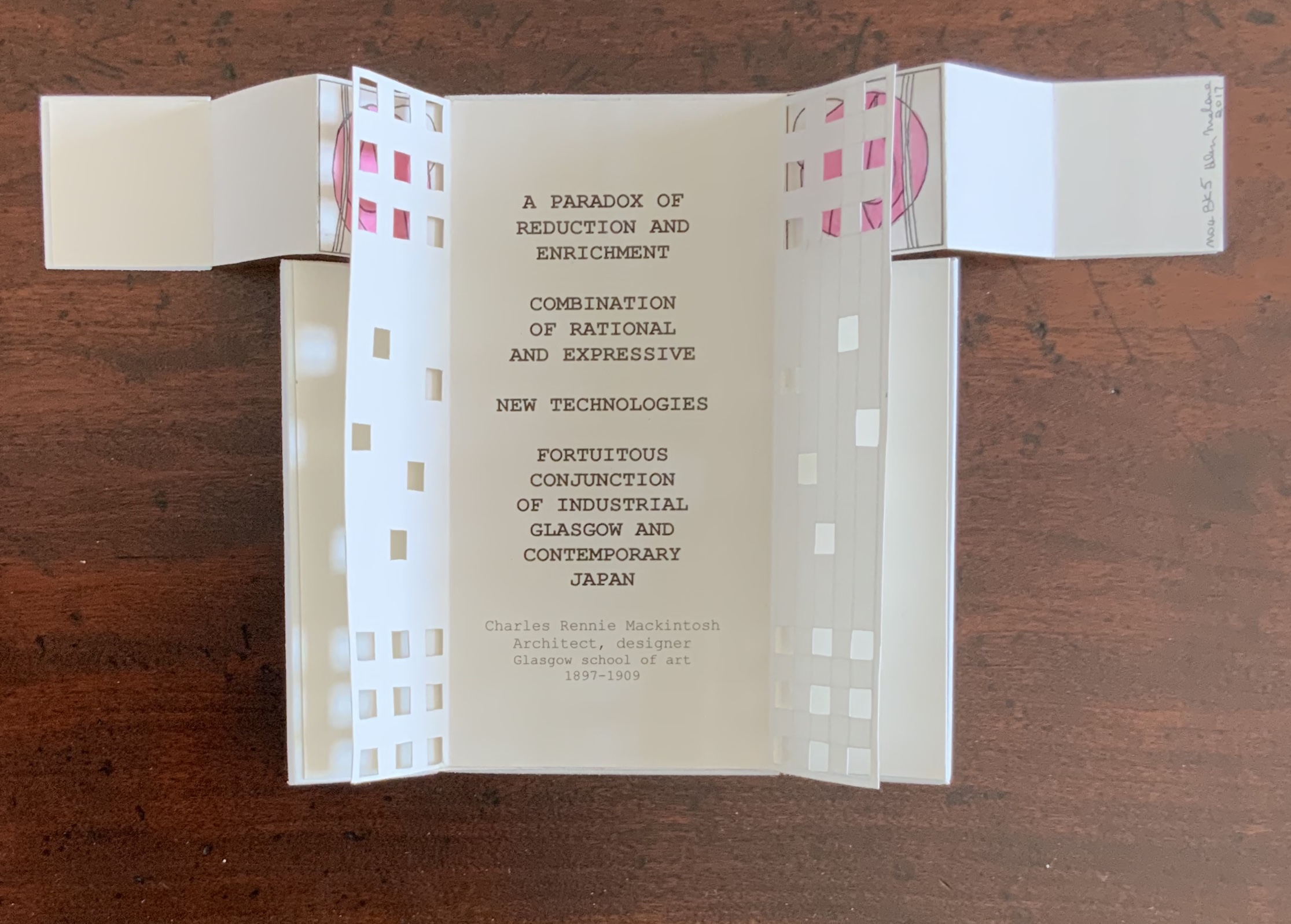
Photo: Books On Books Collection

Le Corbusier

This curiously textured cube sits perfectly alongside Pallasmaa’s observation: “The basic geometric shapes have their symbolic connotations, but more important than their conventional meanings are their conceptual and visual organising powers” (The Embodied Image, p. 58).
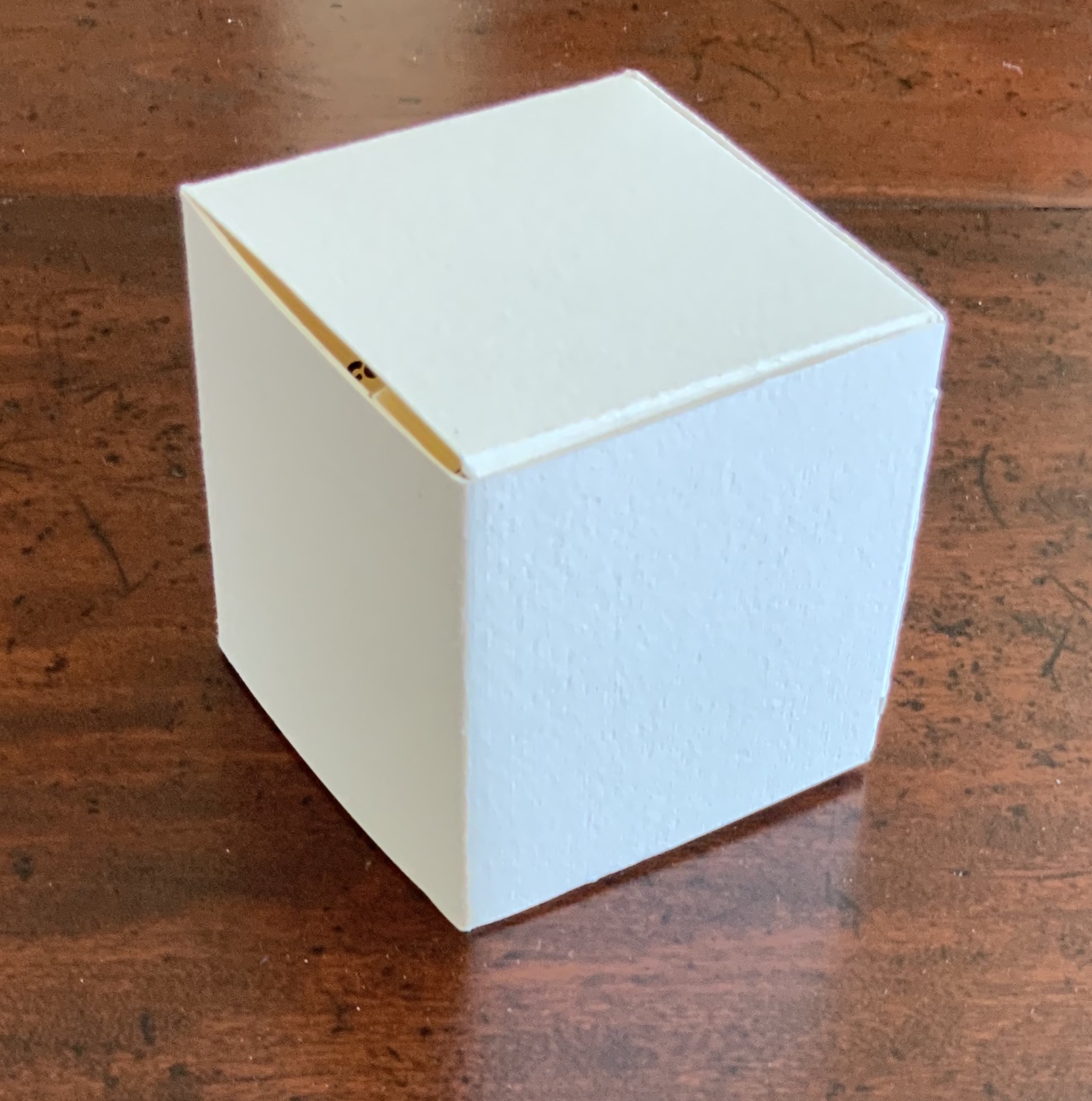
Photo: Books On Books Collection

Photo: Books On Books Collection
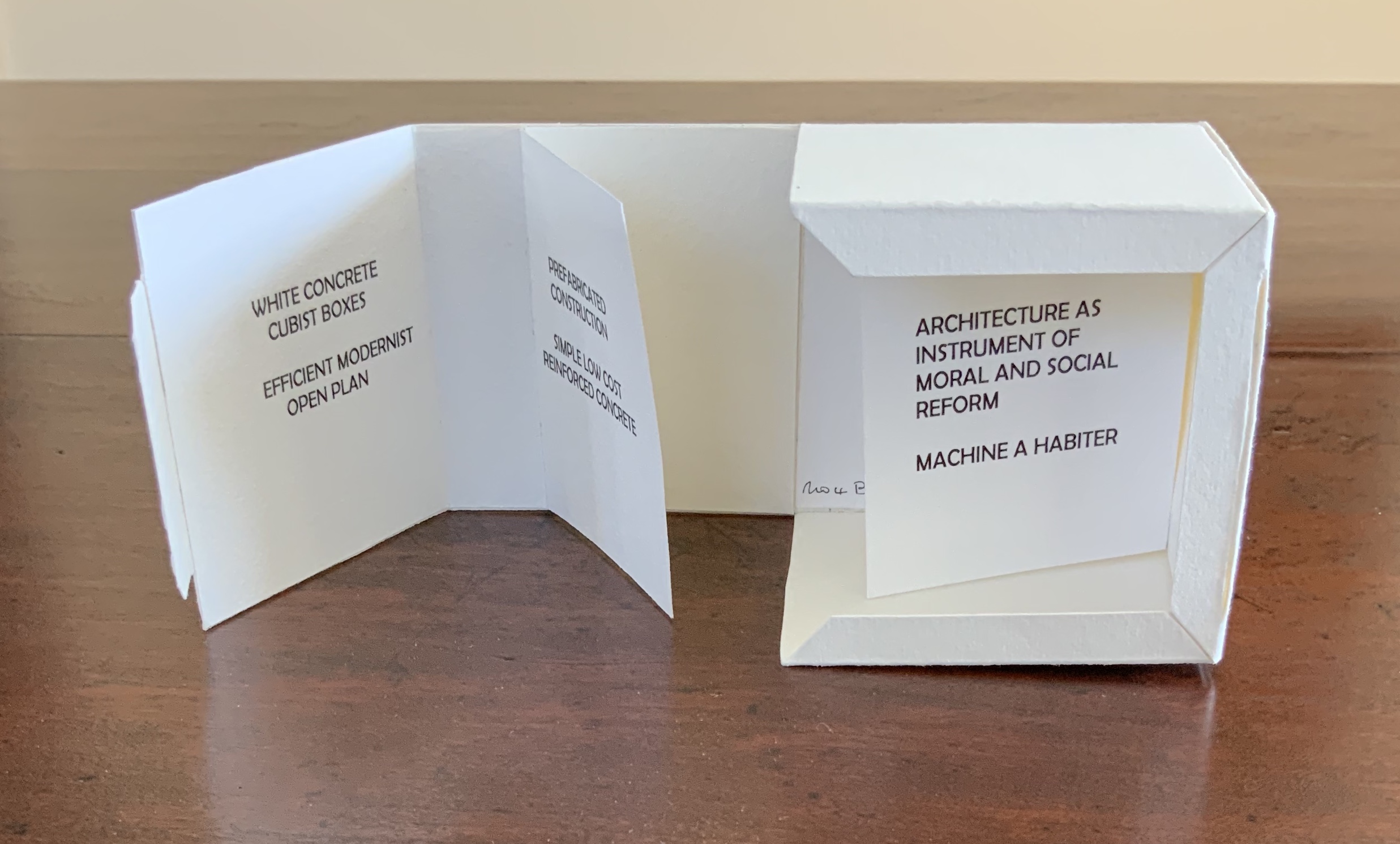
Photo: Books On Books Collection
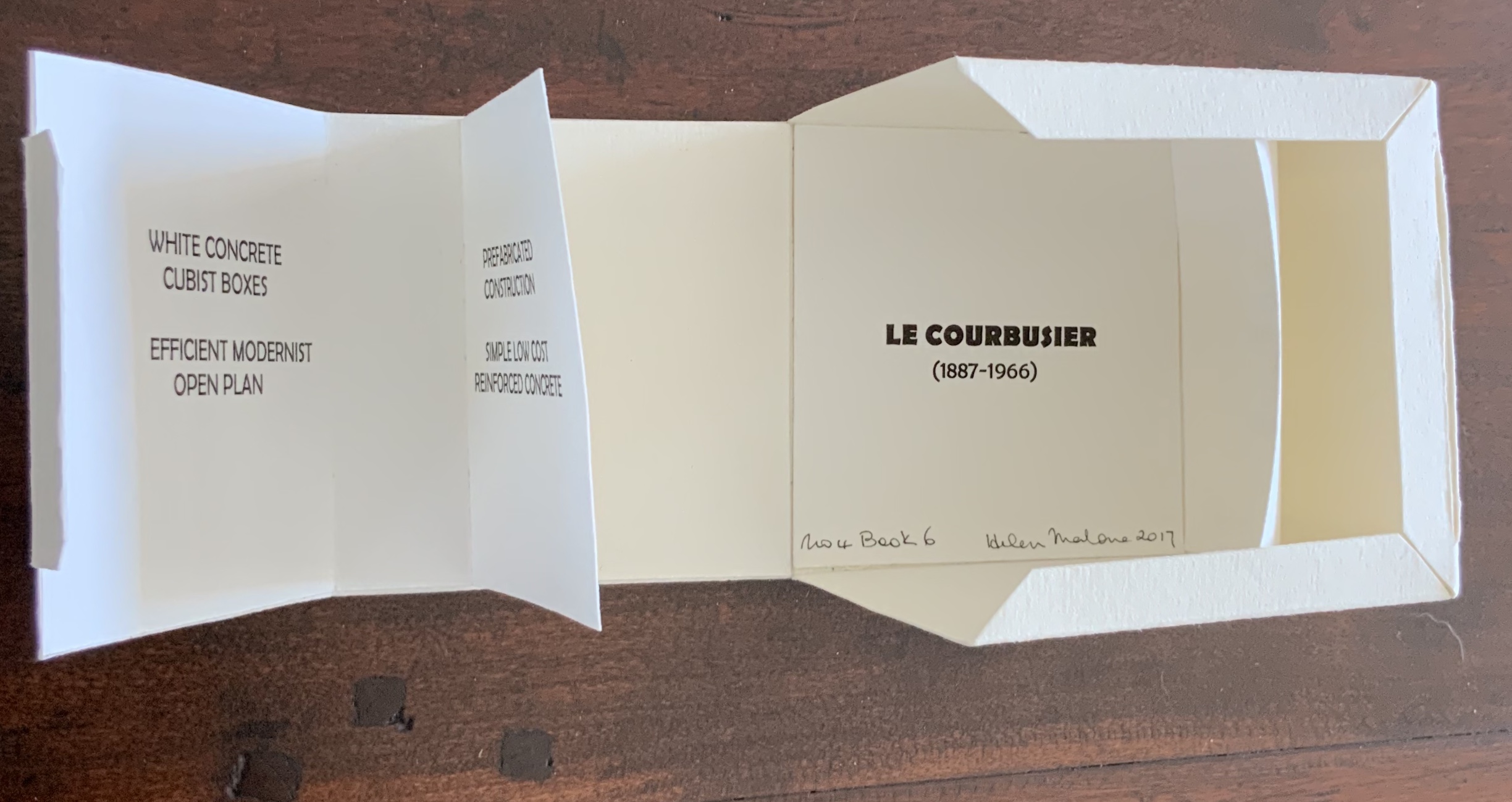
Photo: Books On Books Collection
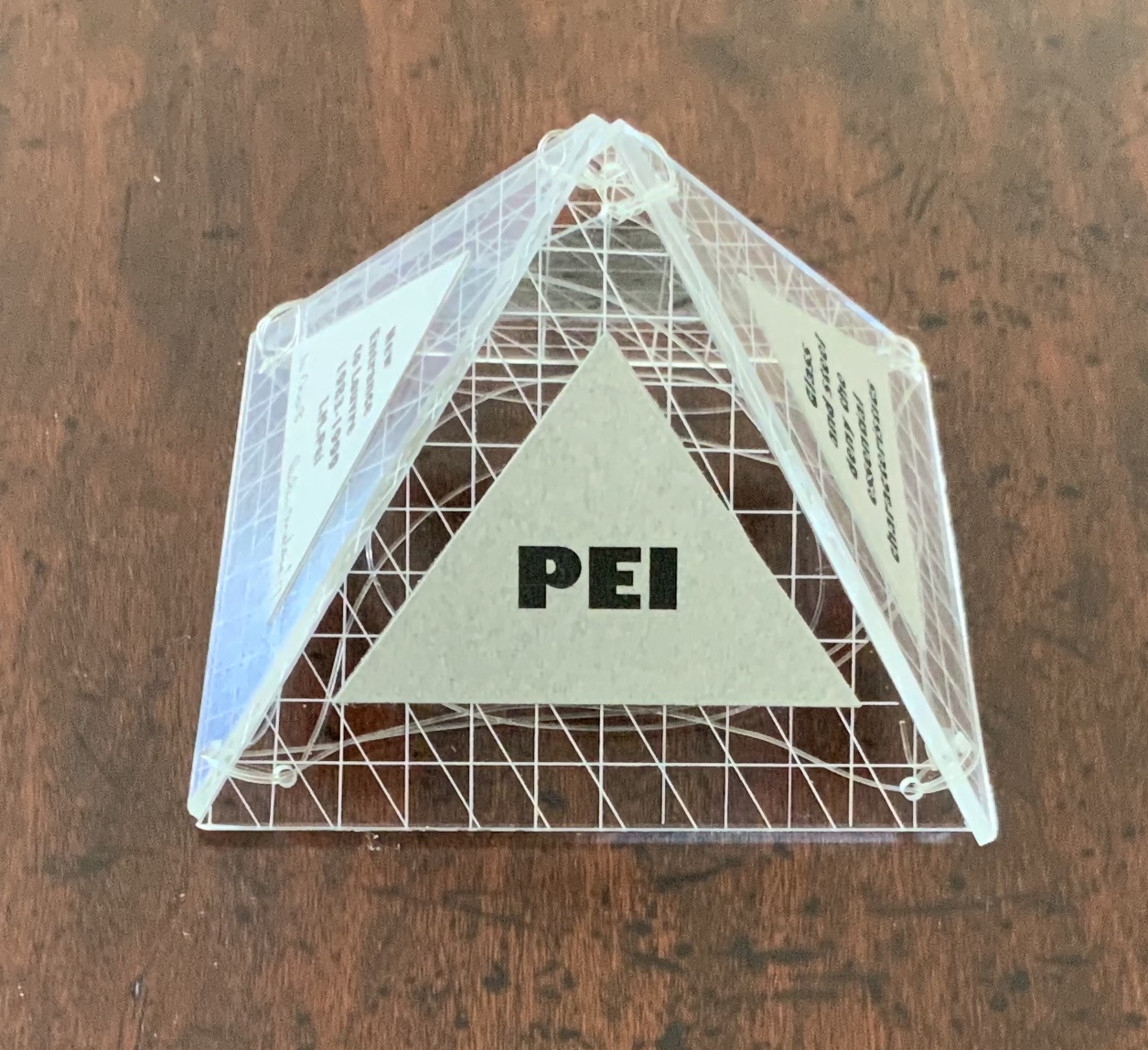
I.M. Pei


A short trip around this small pyramid as a reminder of the entrances that were always on the far side of museums you visited
Photos: Books On Books Collection

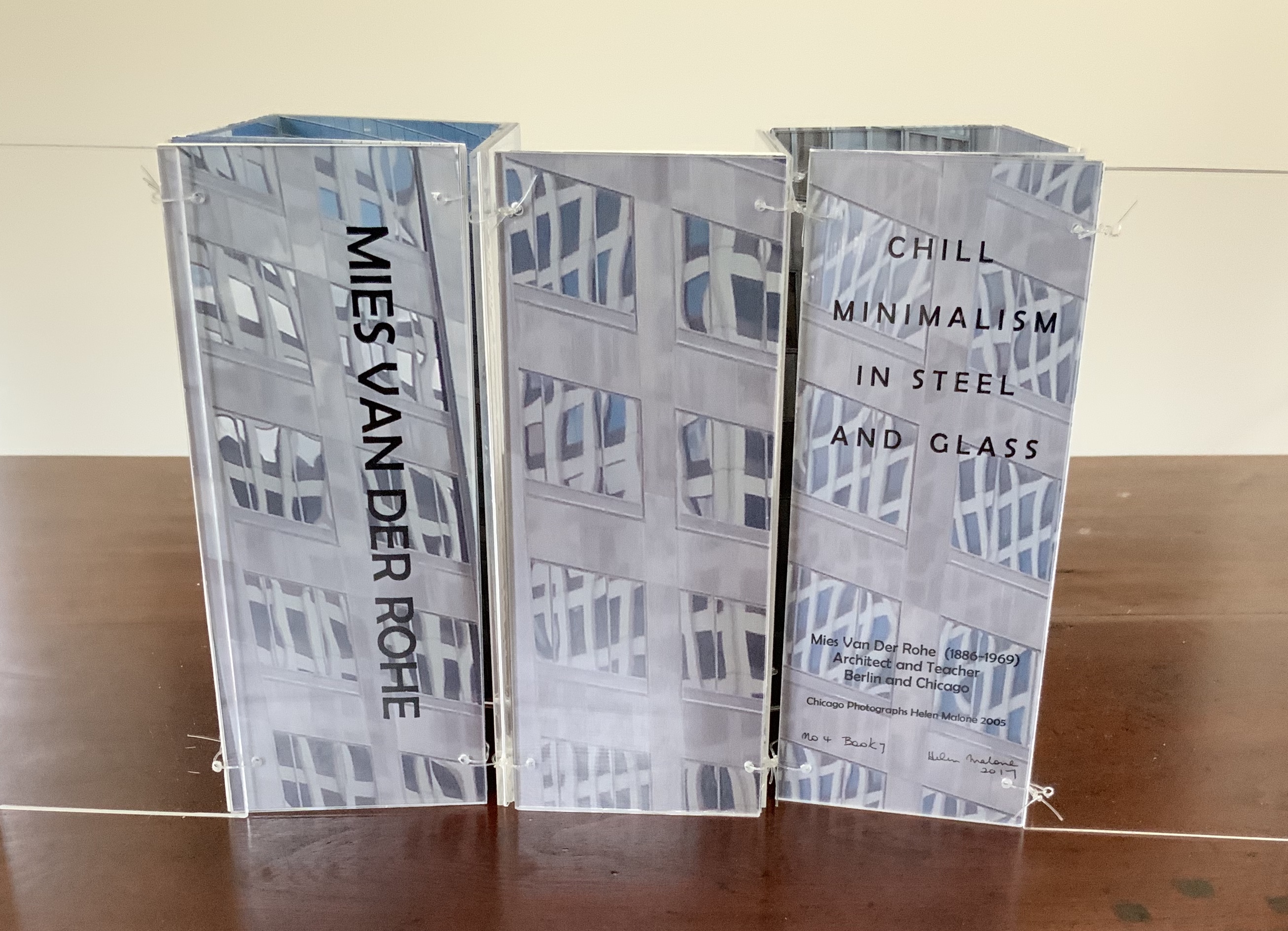
Ludwig Mies van der Rohe

Photo: Books On Books Collection


“Reading” the perspex accordion invites reconfiguring your own hi-rise and skyline.
Photo: Books On Books Collection

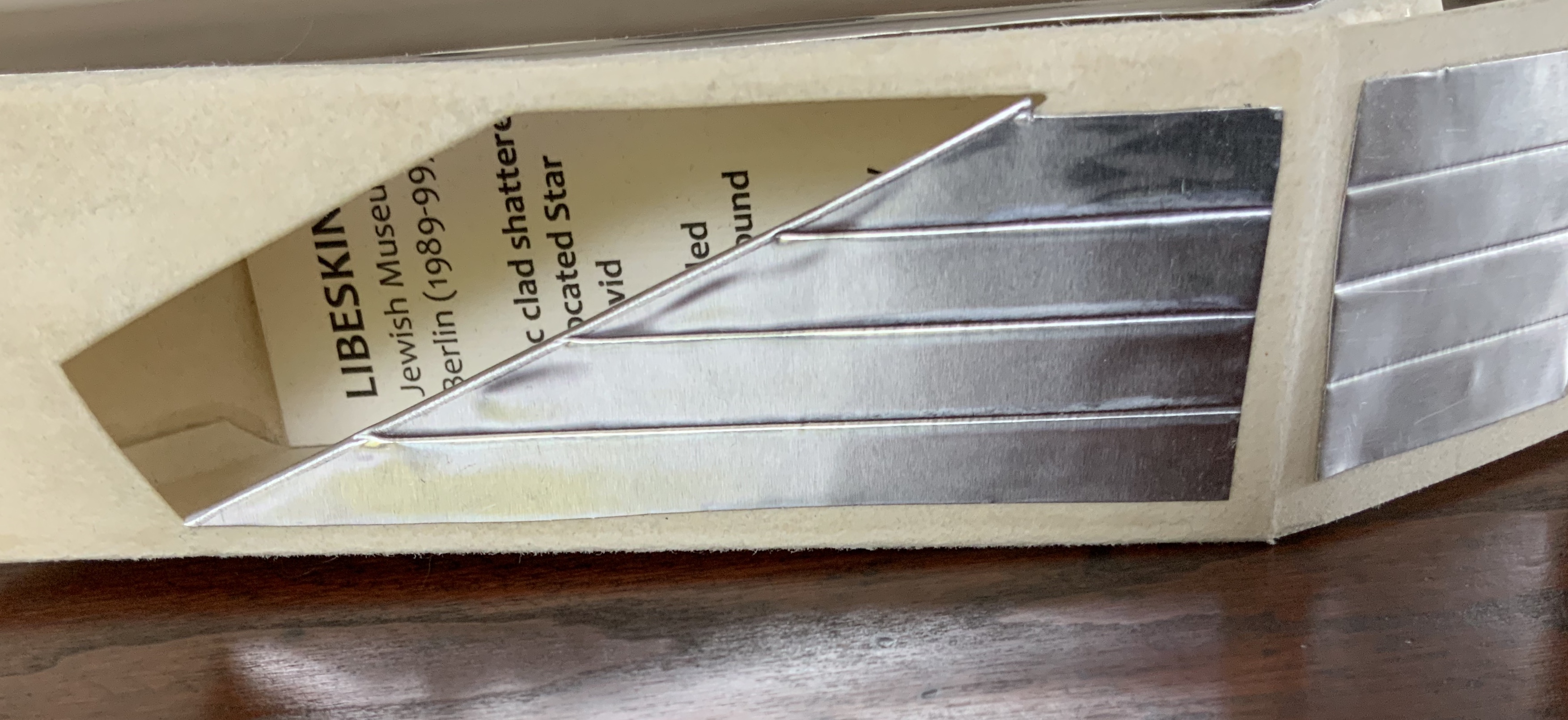
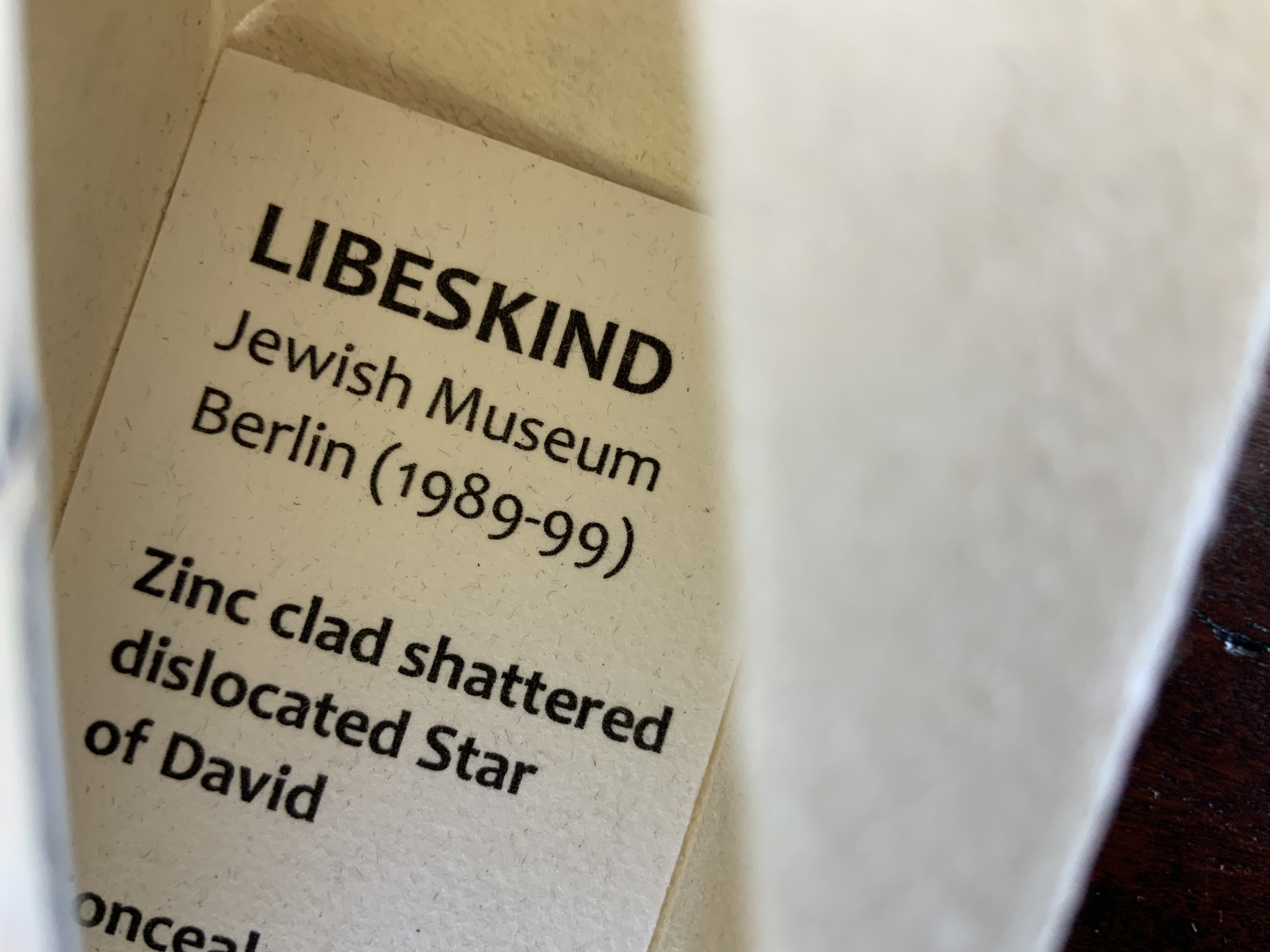
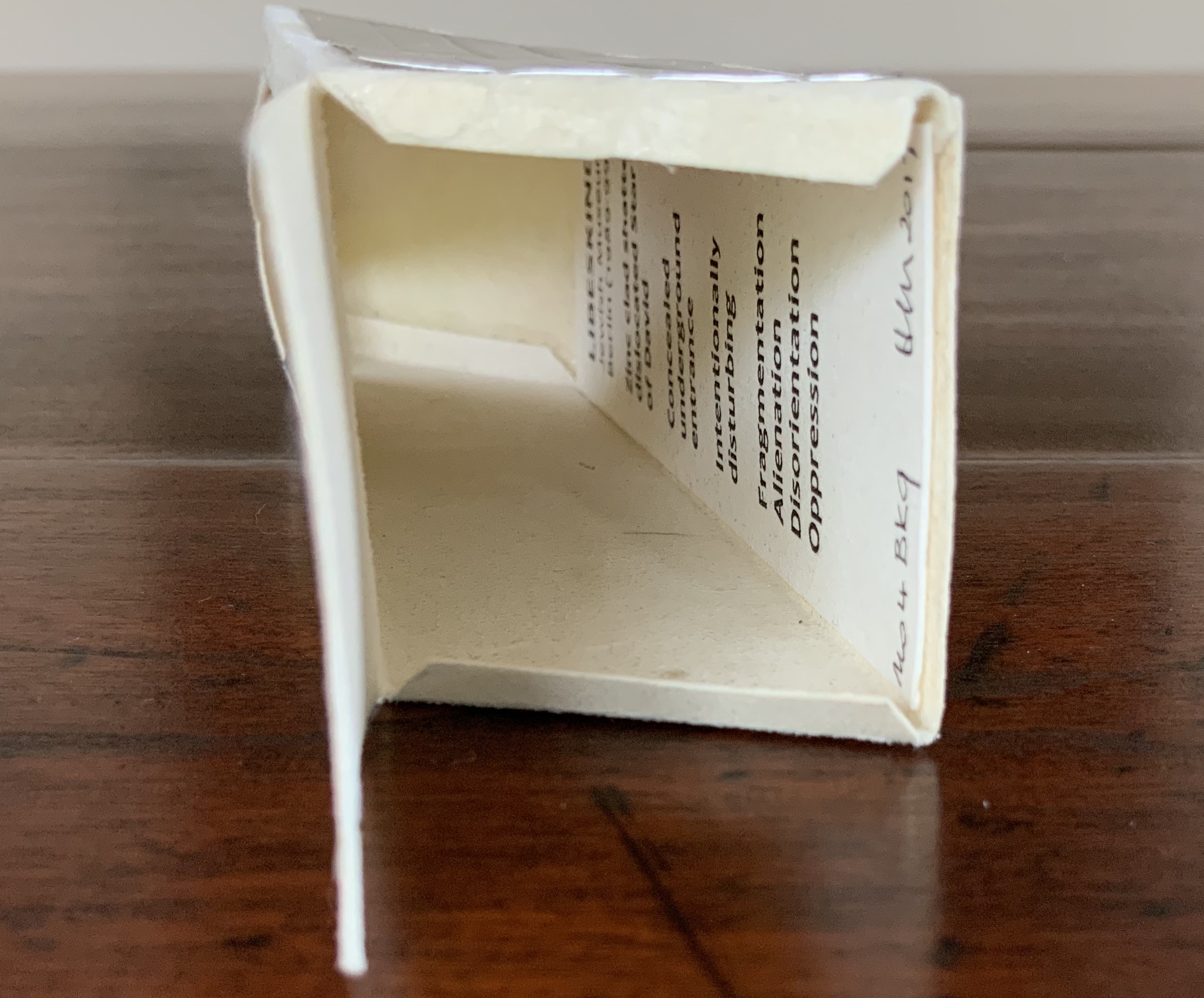
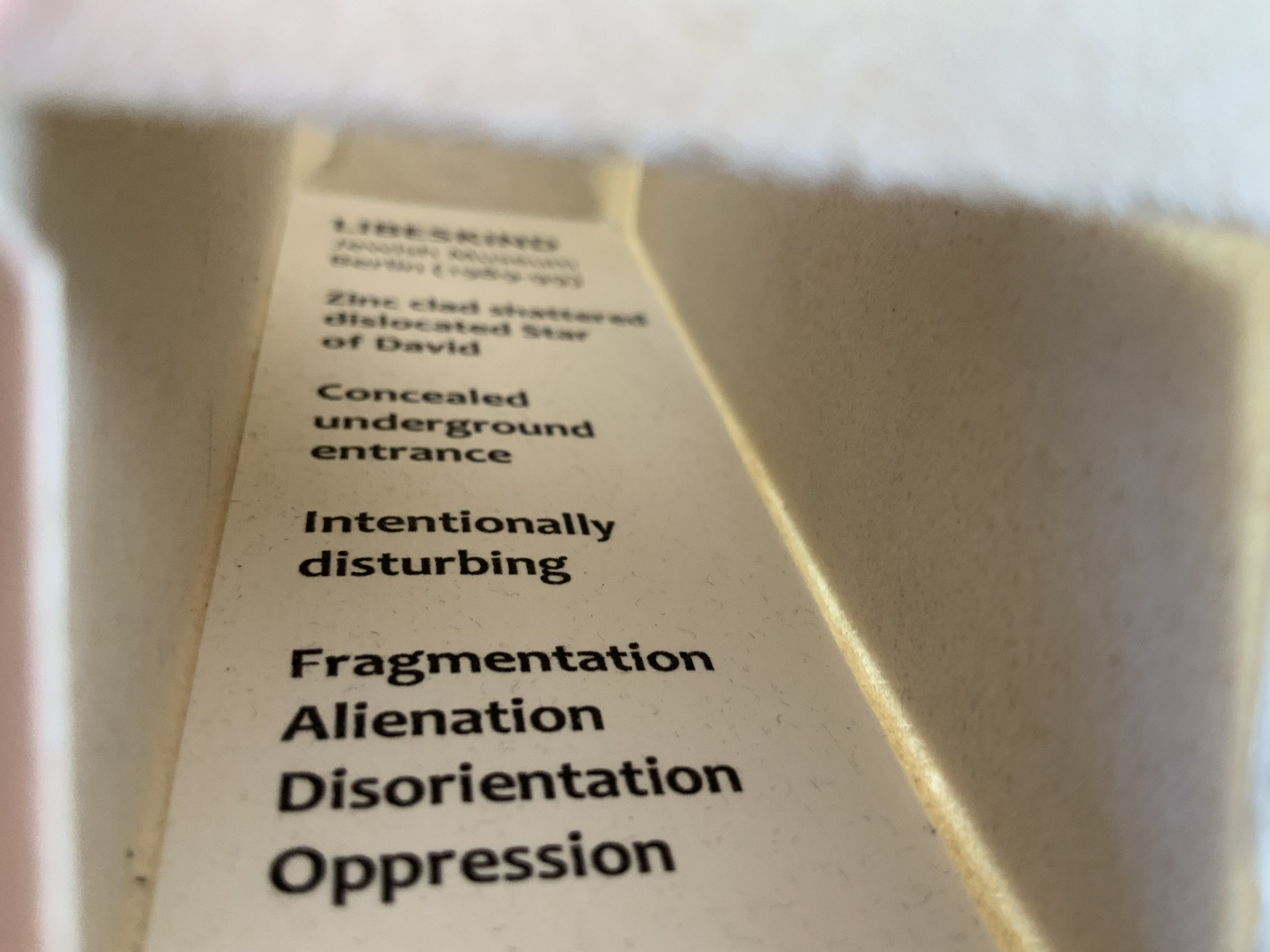
Daniel Libeskind

It is no surprise that Pallasmaa has written extensively on Libeskind.
Photo: Books On Books Collection

Photo: Books On Books Collection

Photo: Books On Books Collection

Photo: Books On Books Collection
Zaha Hadid

This edition of Malone’s Ten Books is unique in its inclusion of Hadid, who is not mentioned in either of Pallasmaa’s books but whose artistry and turn to the organic and curves of nature certainly fit with their spirit.
Photo: Books On Books Collection

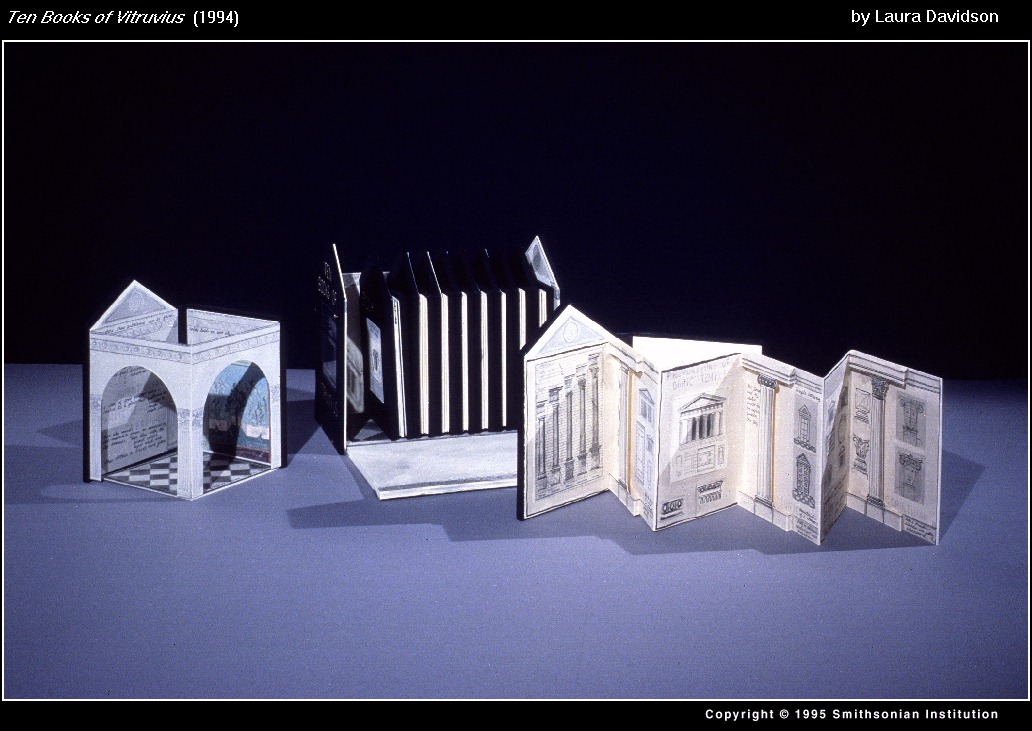
Malone’s Ten Books has a predecessor in Laura Davidson’s contribution to the 1994 Smithsonian show on book art inspired by its collection of rare science books (see section below). Although there is also Karen Wirth’s sculptural take on the Ten Books as well as Ron Keller’s take (see section below) on Palladio’s Fours Books of Architecture, which is Palladio’s take on Vitruvius, I have not found any other Vitruvian-inspired works of book art. (Pointers welcome.)

Mandy Brannan

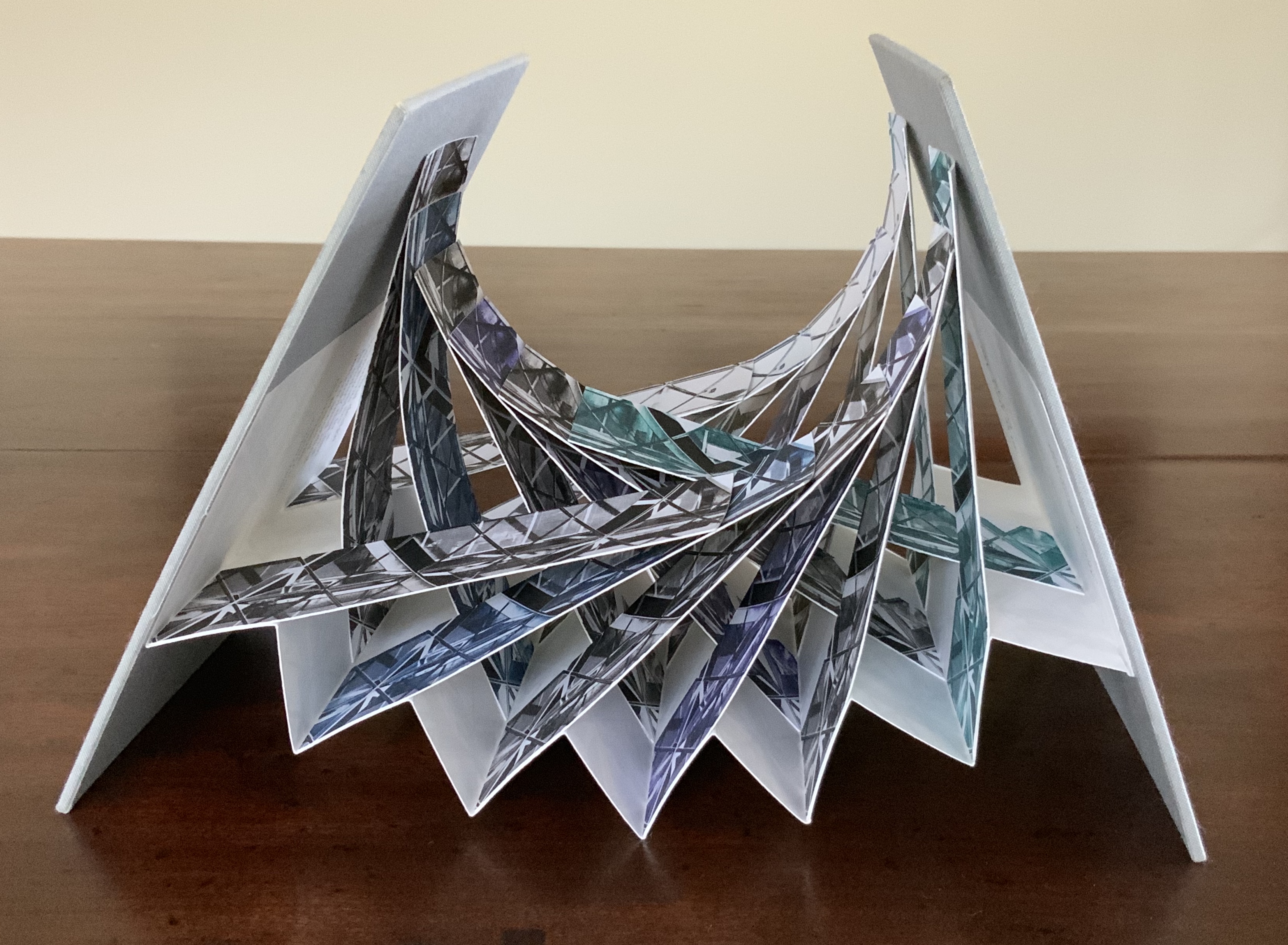
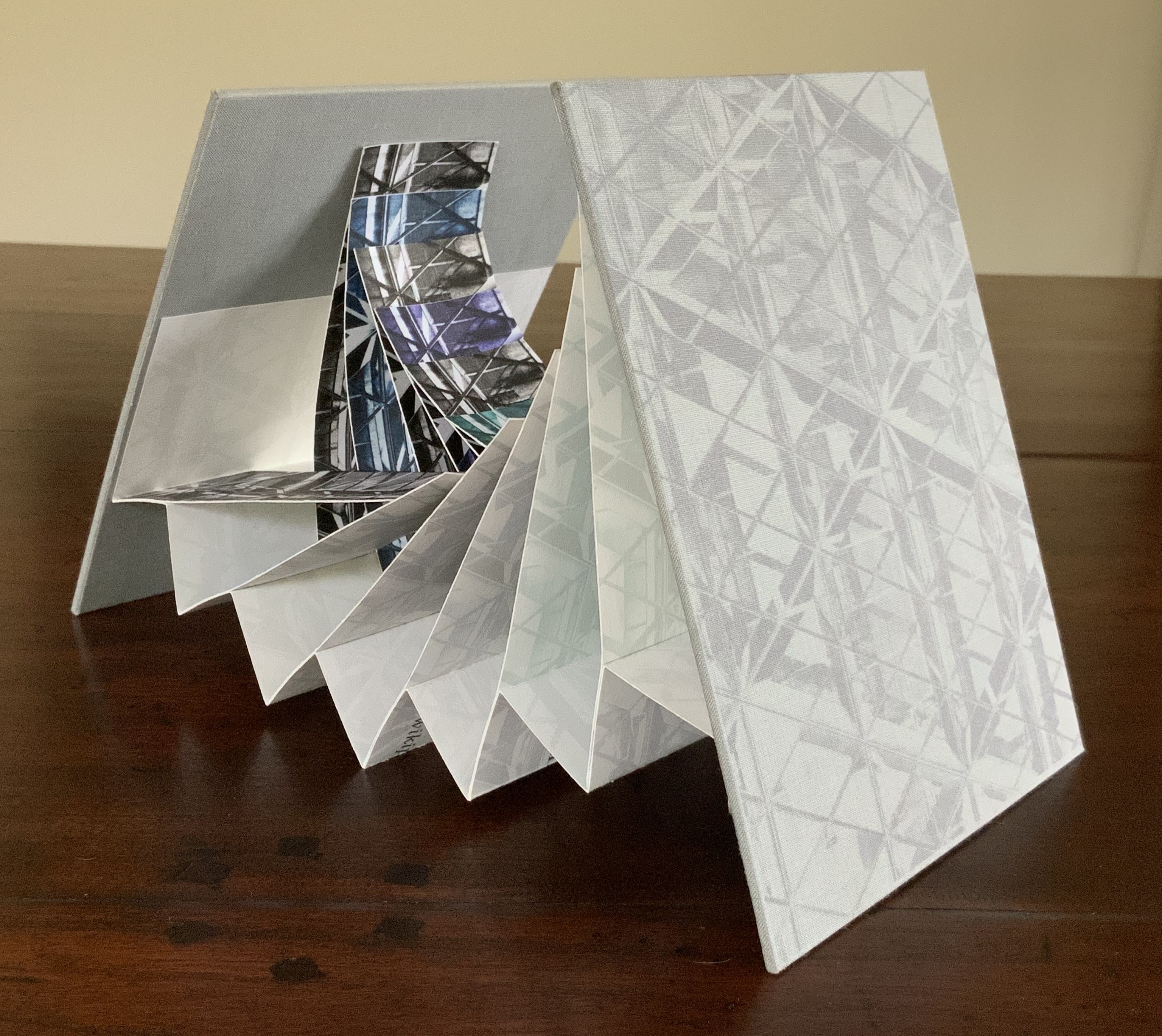
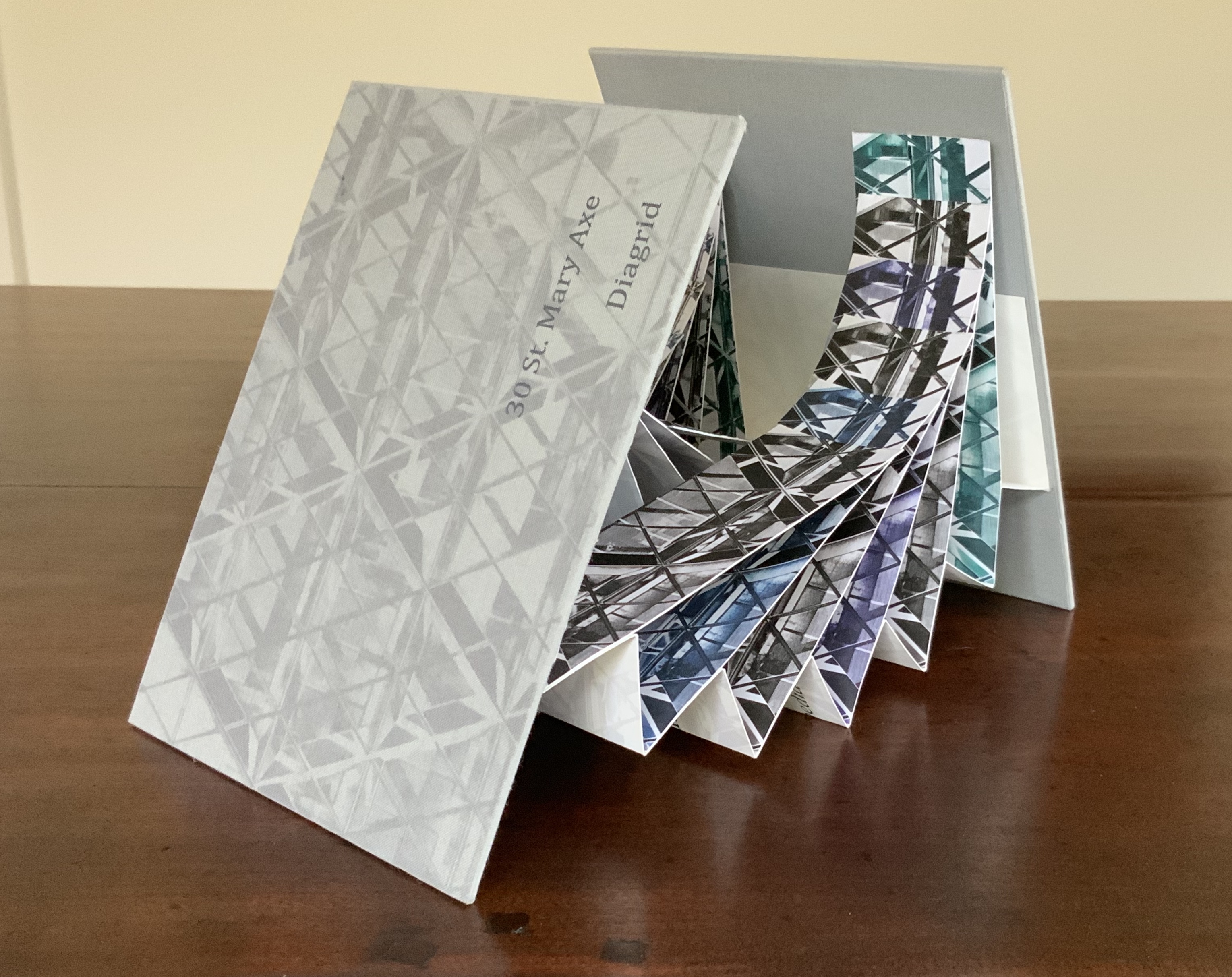
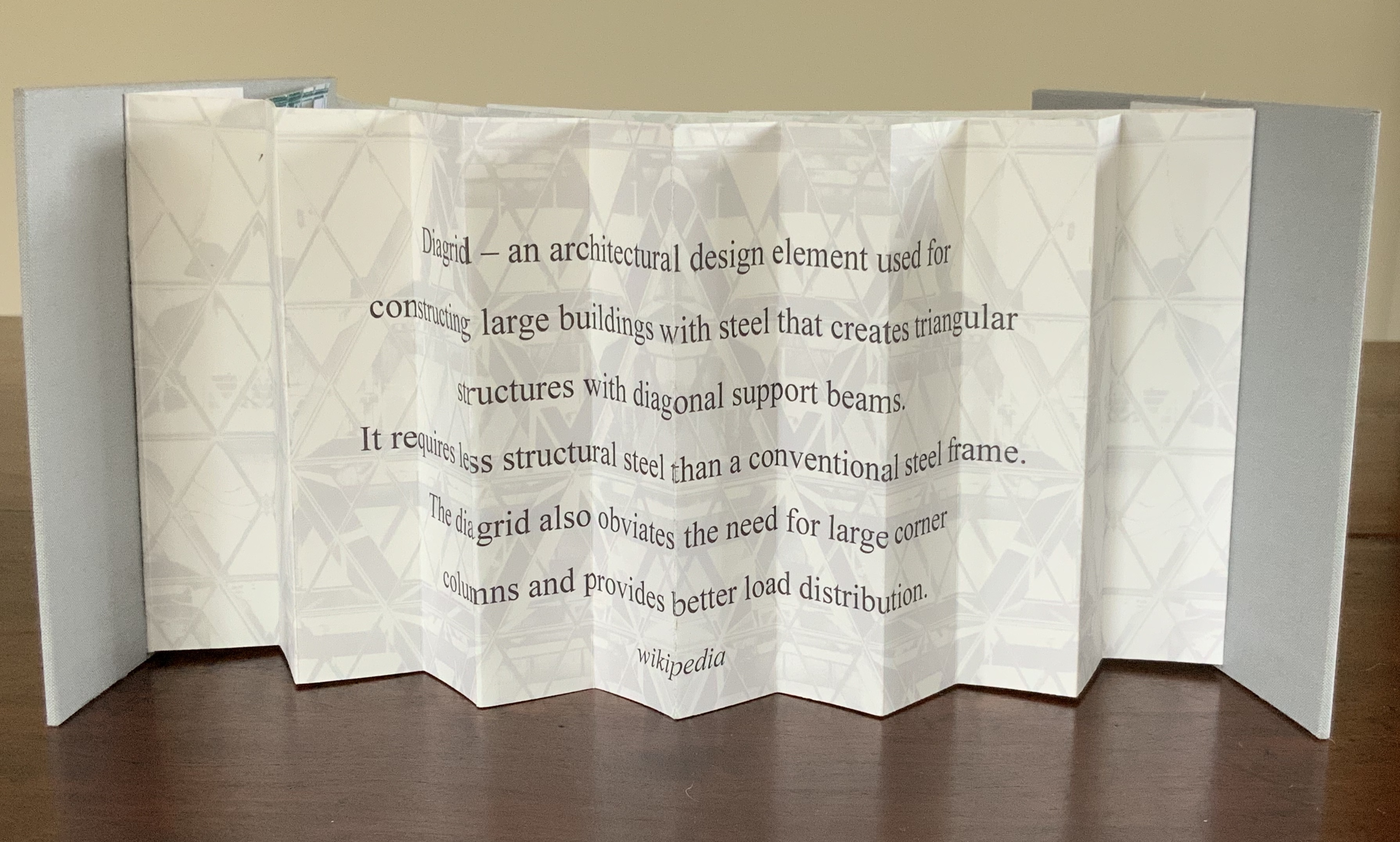
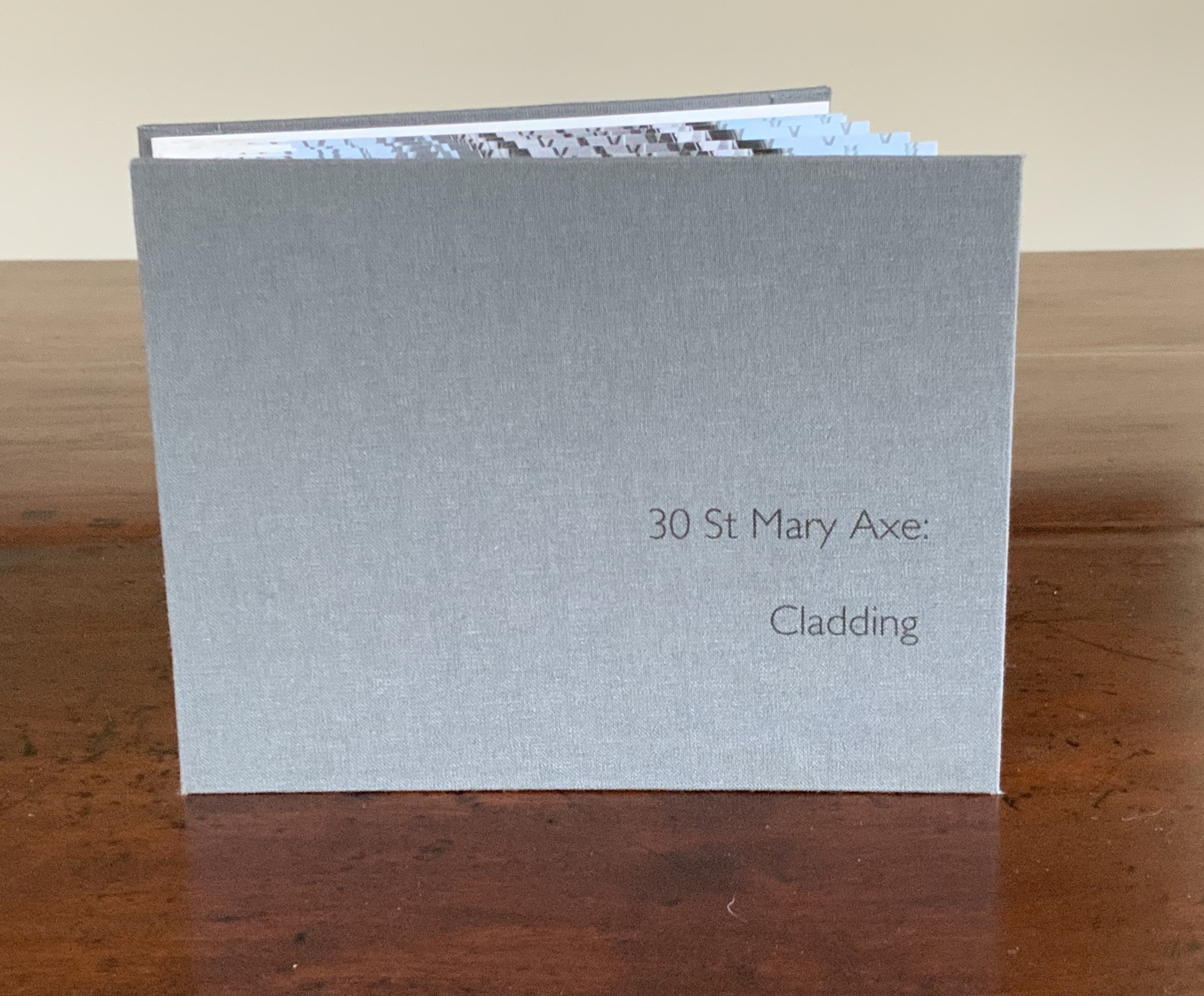
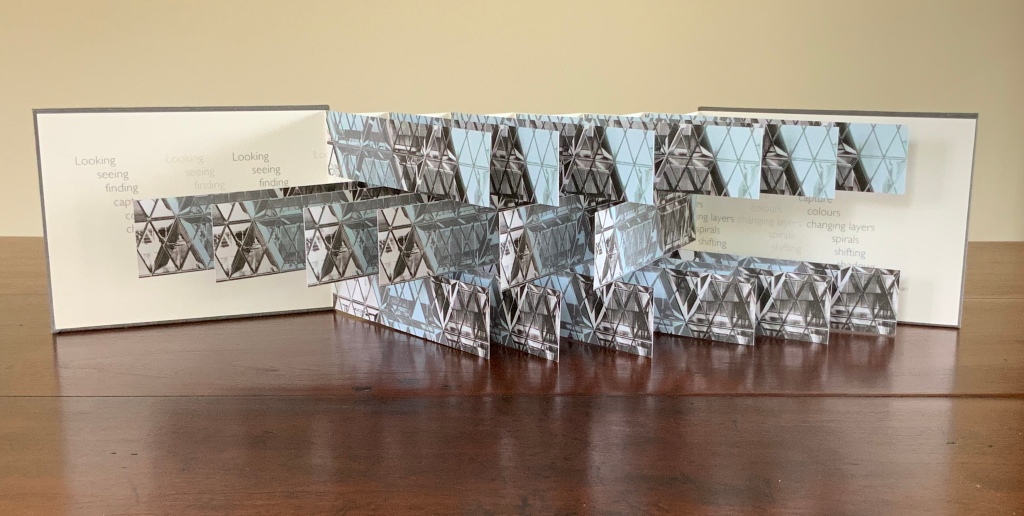
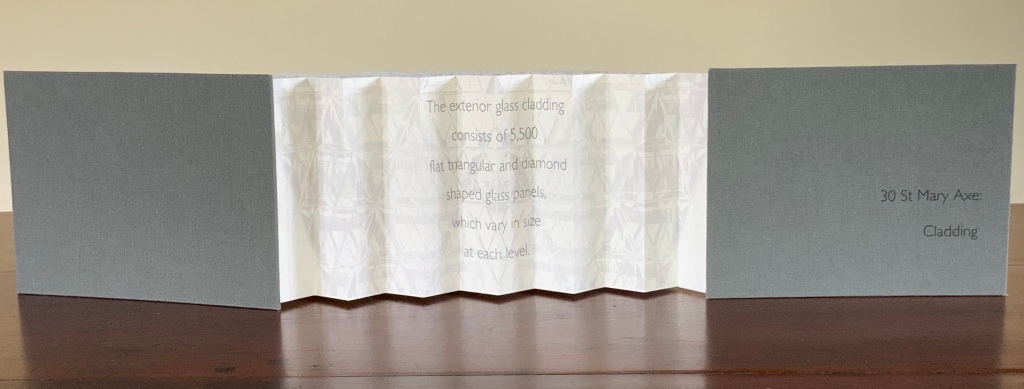
These two works — 30 St Mary Axe: Diagrid (2009) and 30 St. Mary Axe: Cladding (2009) — are among several architecture-inspired works of book art that Brannan has created. The text in one of those several — Situated — could have come straight from Pallasmaa, Bachelard or Merleau-Ponty:

Being situated is generally considered to be part of being embodied, but it is useful to consider each perspective individually. The situated perspective emphasizes that intelligent behaviour derives from the environment and the agent’s interactions with it.

30 St Mary Axe: Diagrid (2009)
Mandy Brannan
London has nicknamed the building at 30 St. Mary Axe “the Gherkin”.
Photo: Books On Books Collection

Photo: Books On Books Collection
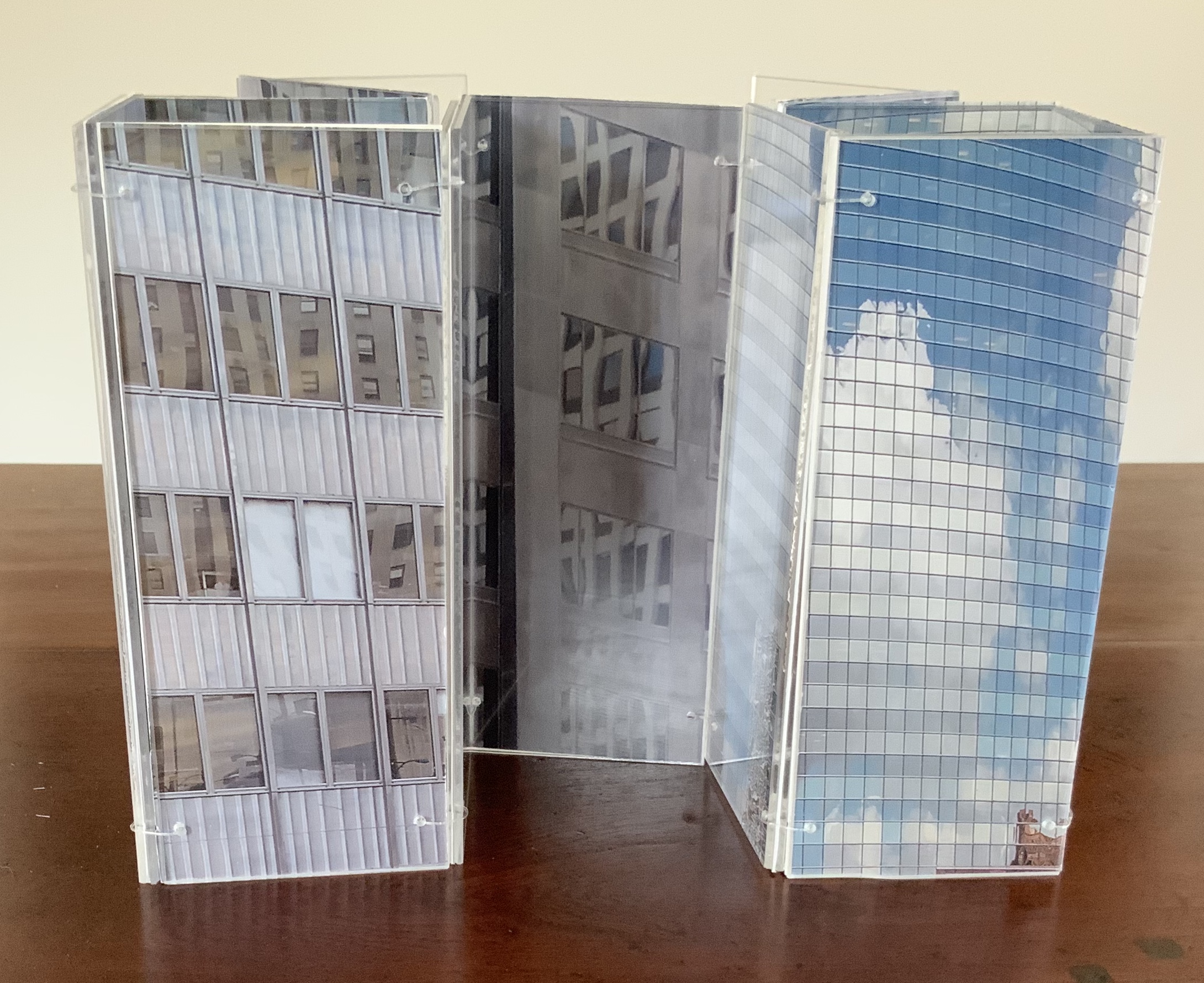
30 St. Mary Axe: Cladding (2009)
Mandy Brannan
Photo: Books On Books Collection

By integration of image, colour and structure, Brannan situates the “Gherkin’s” architecture in your hands.

Sarah Bryant

The Radiant Republic (2019)
Sarah Bryant
Photo: Books On Books Collection

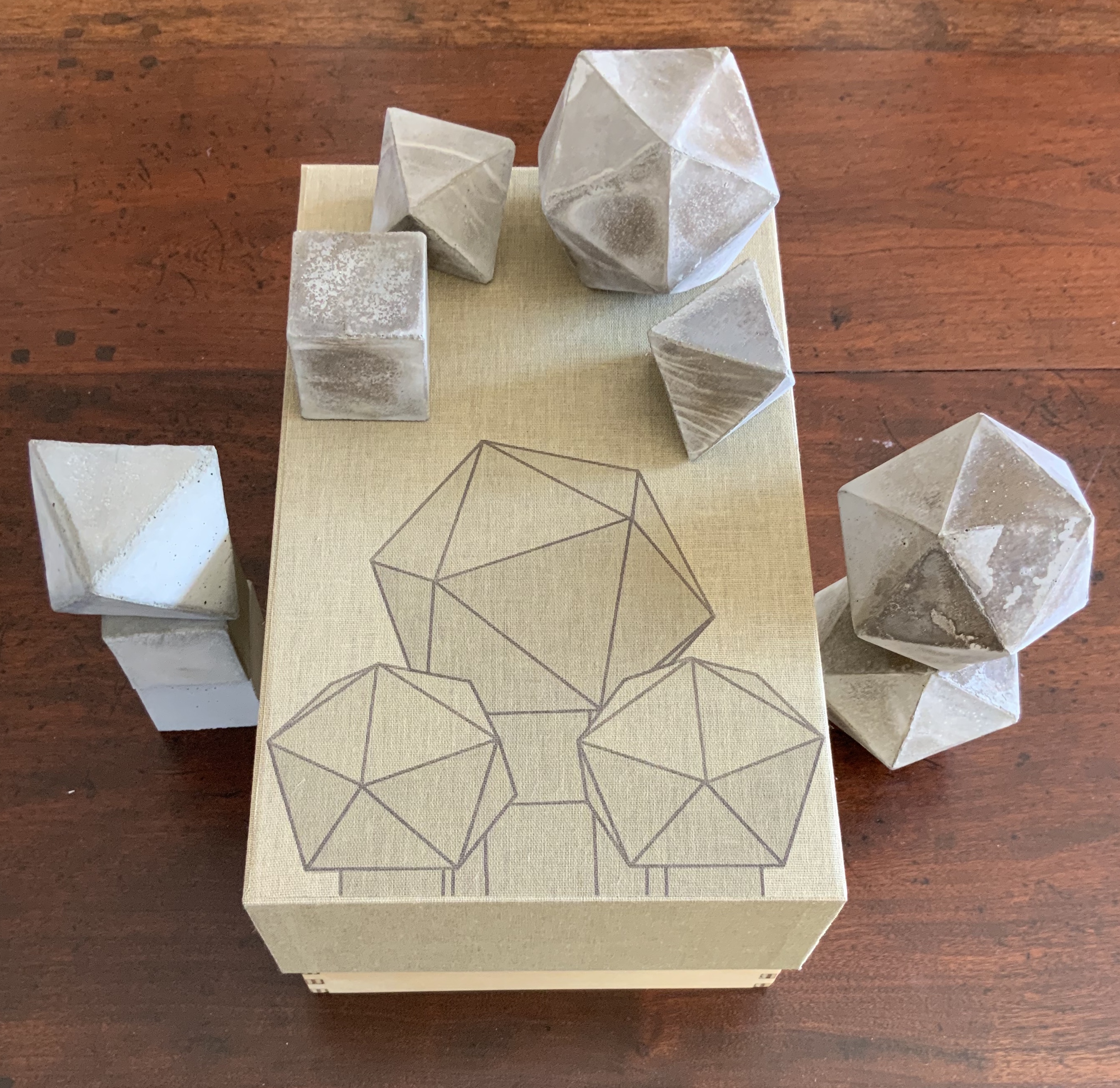
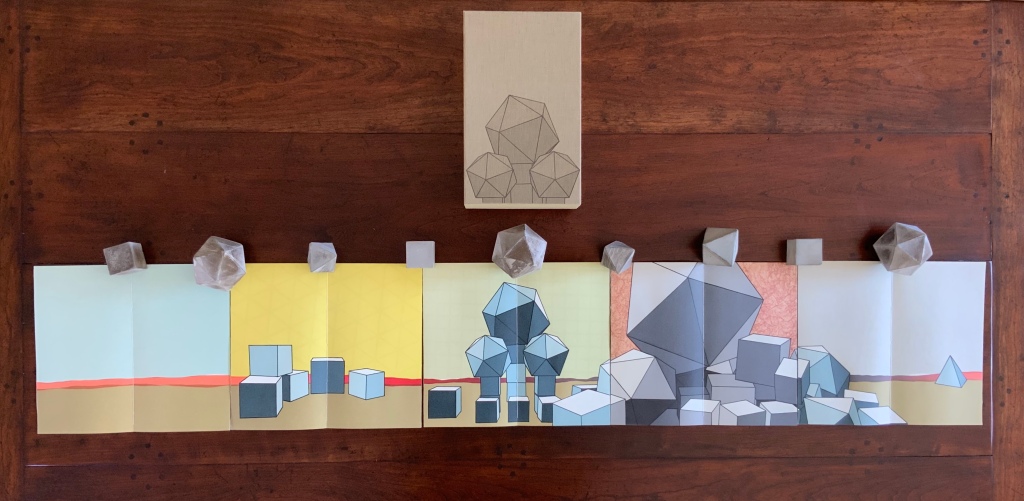
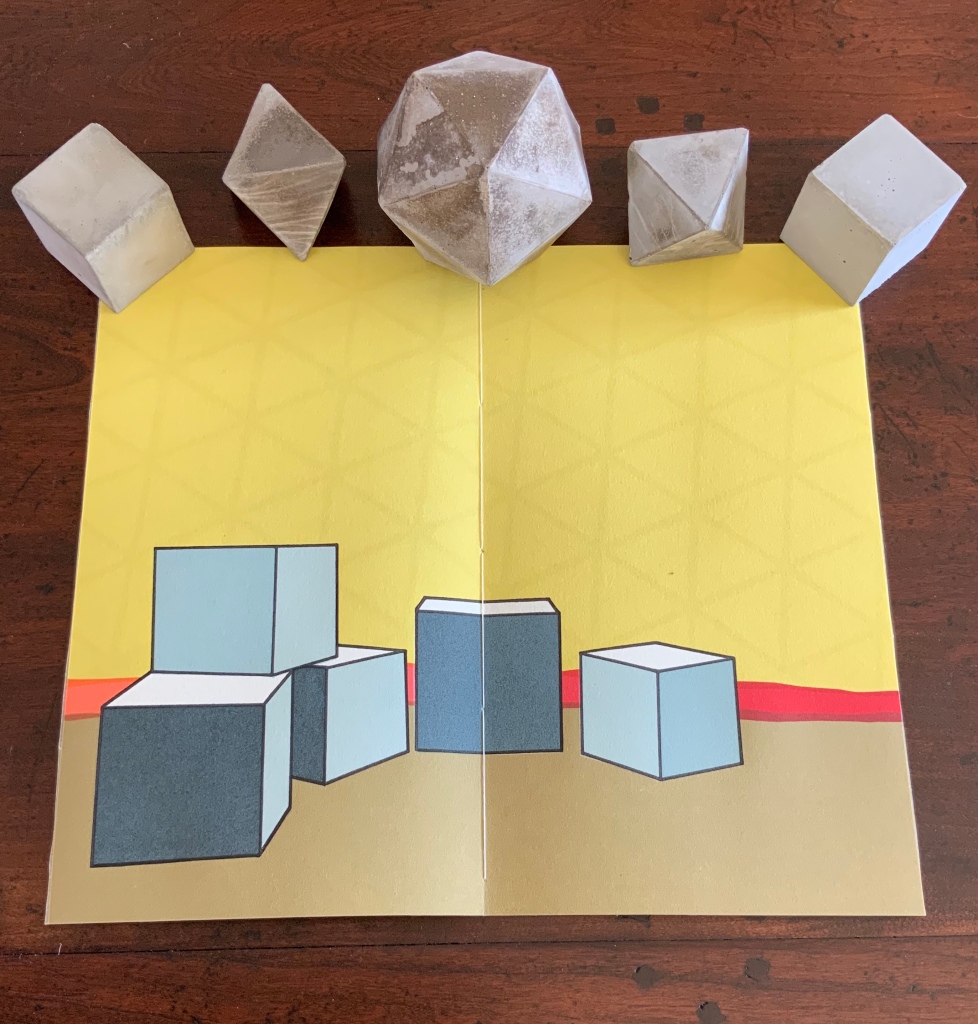
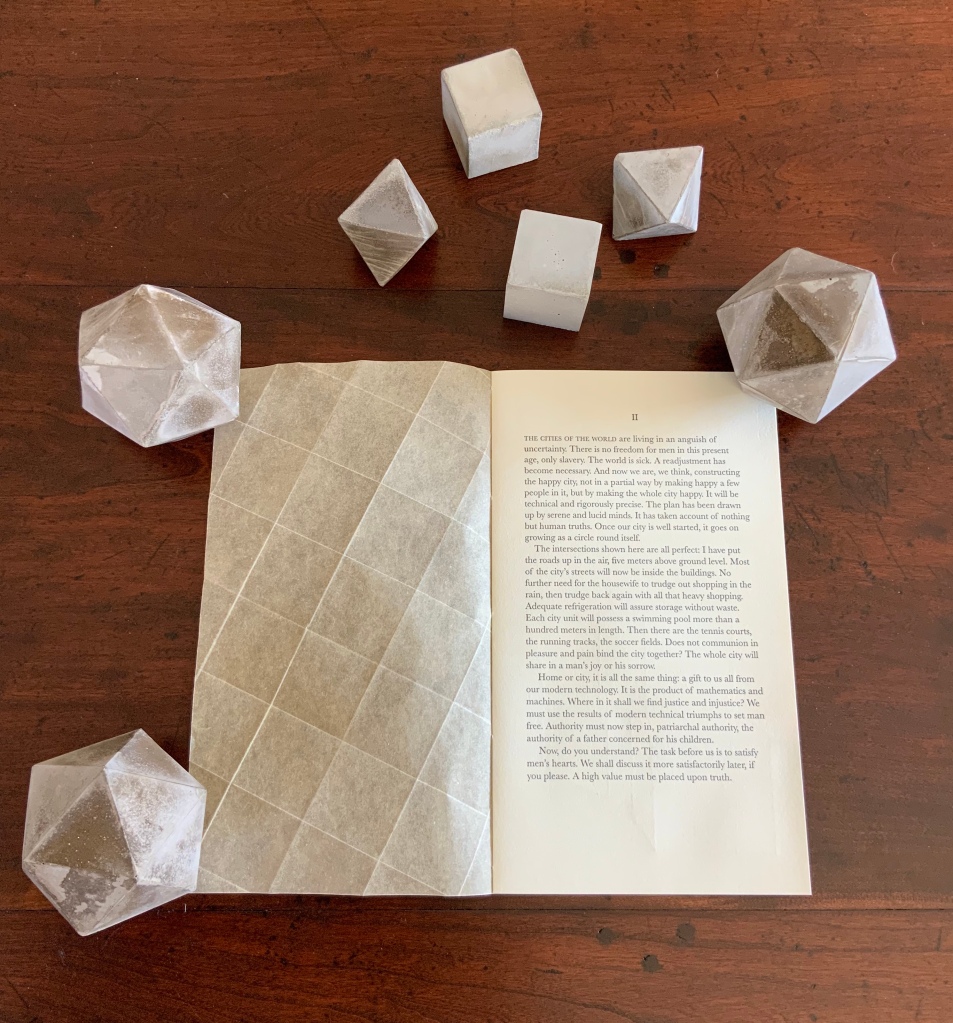
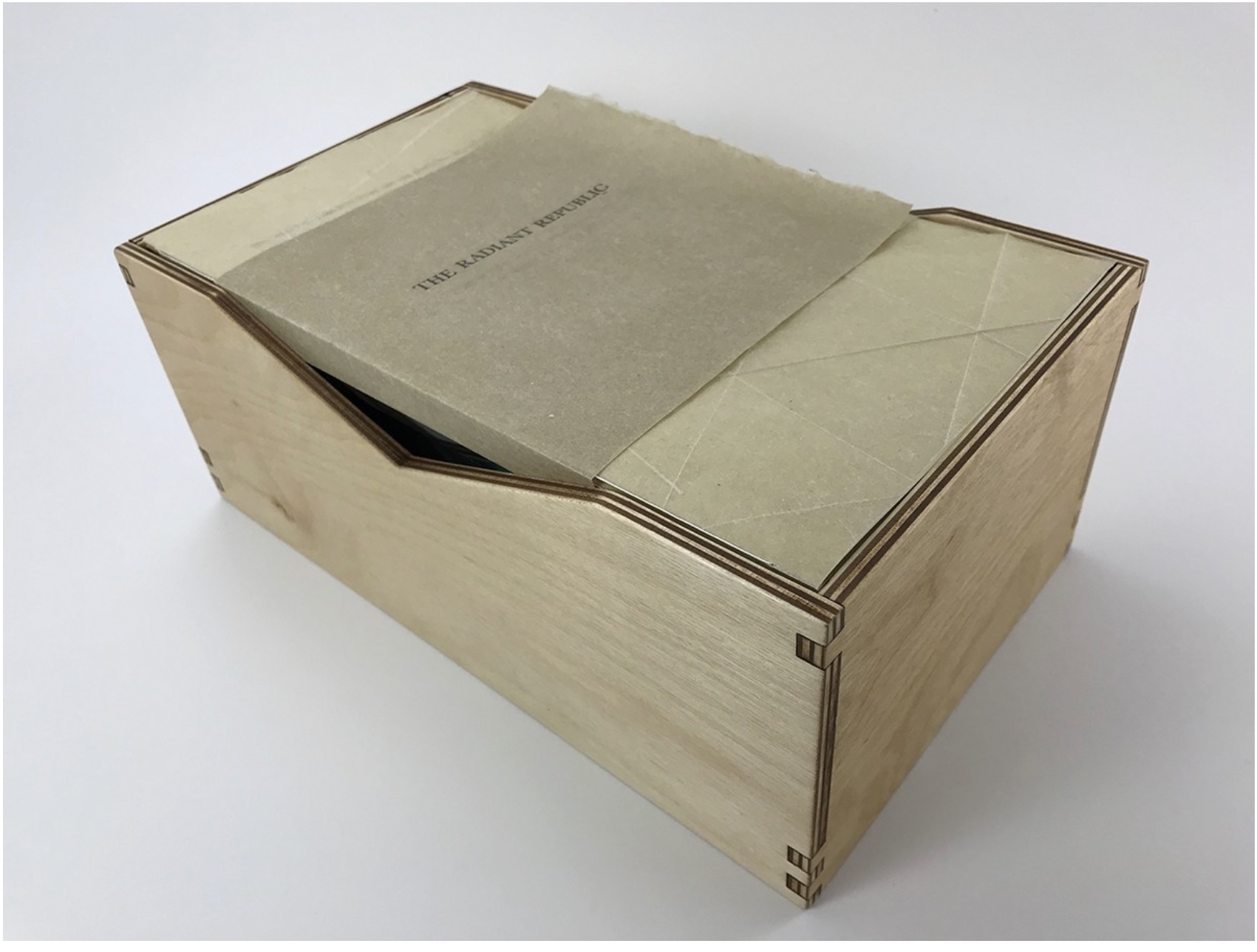
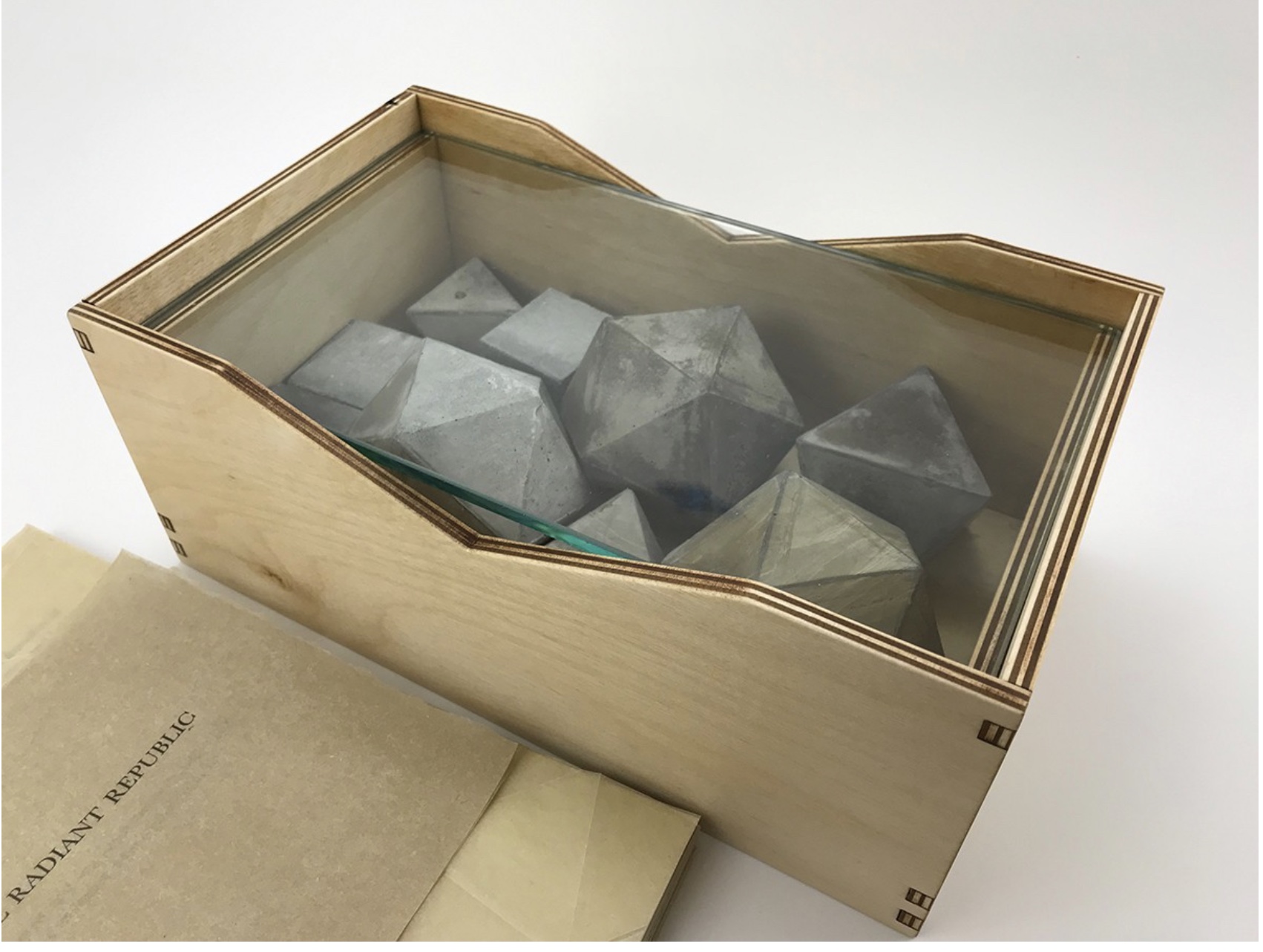
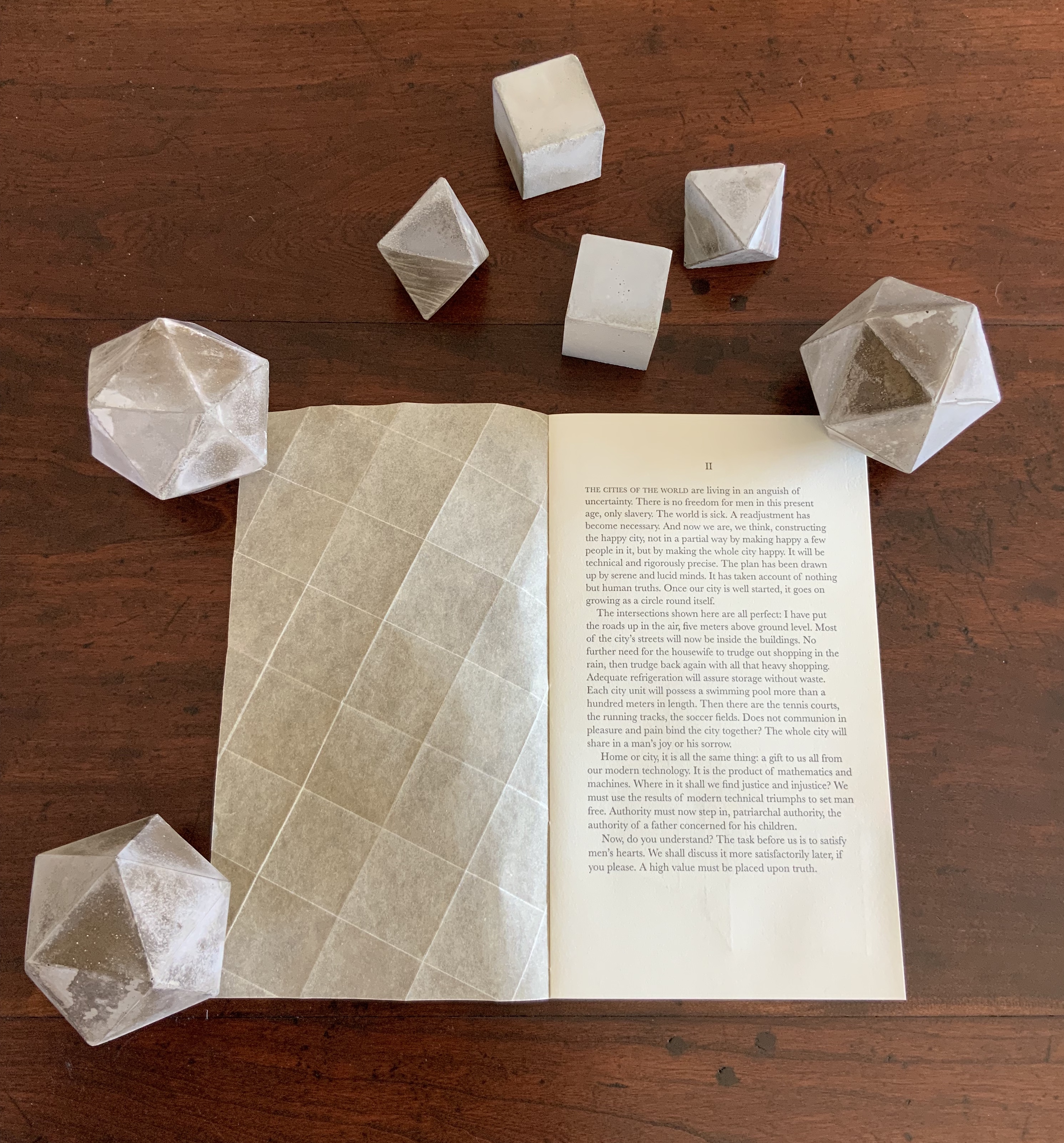
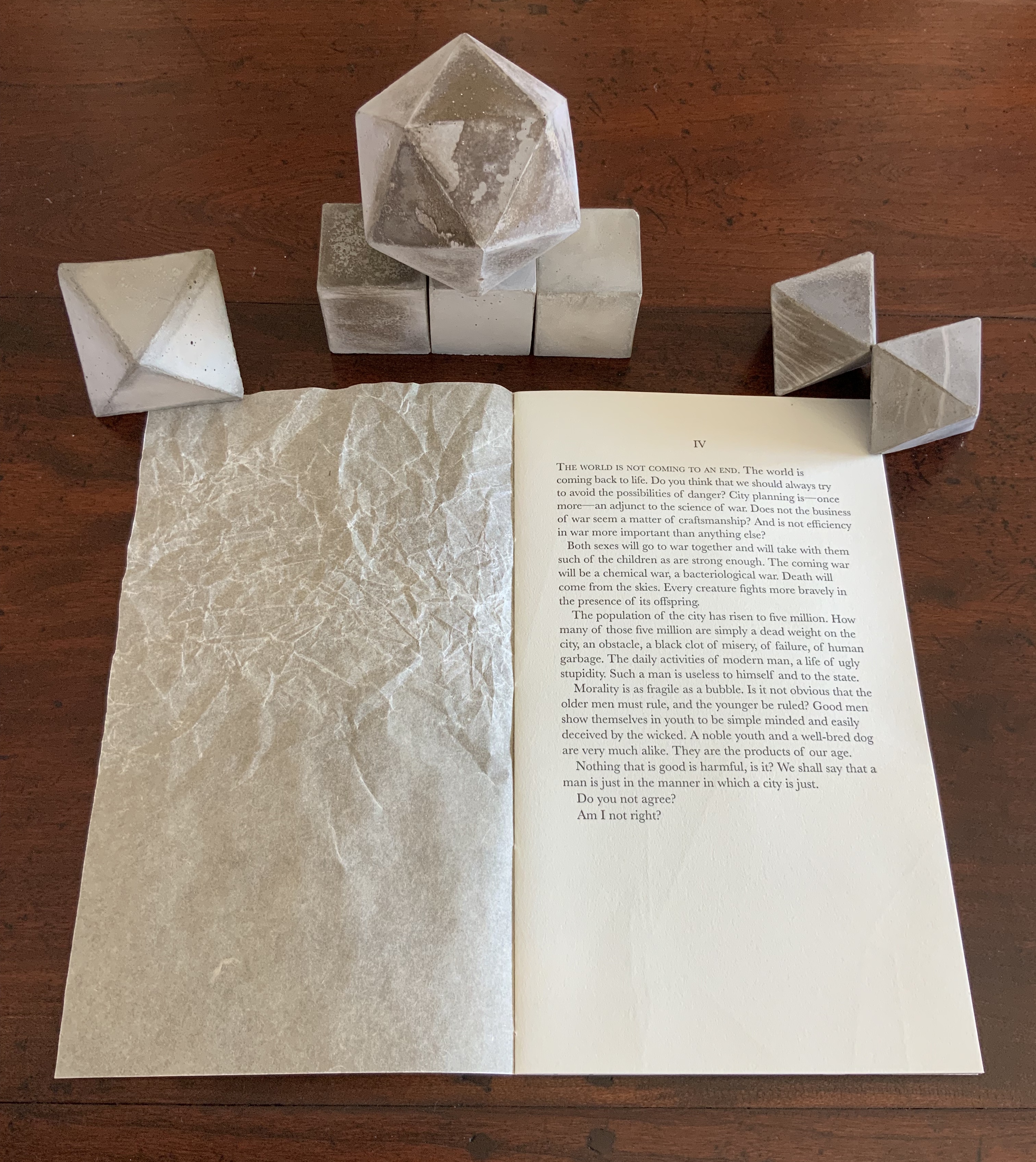
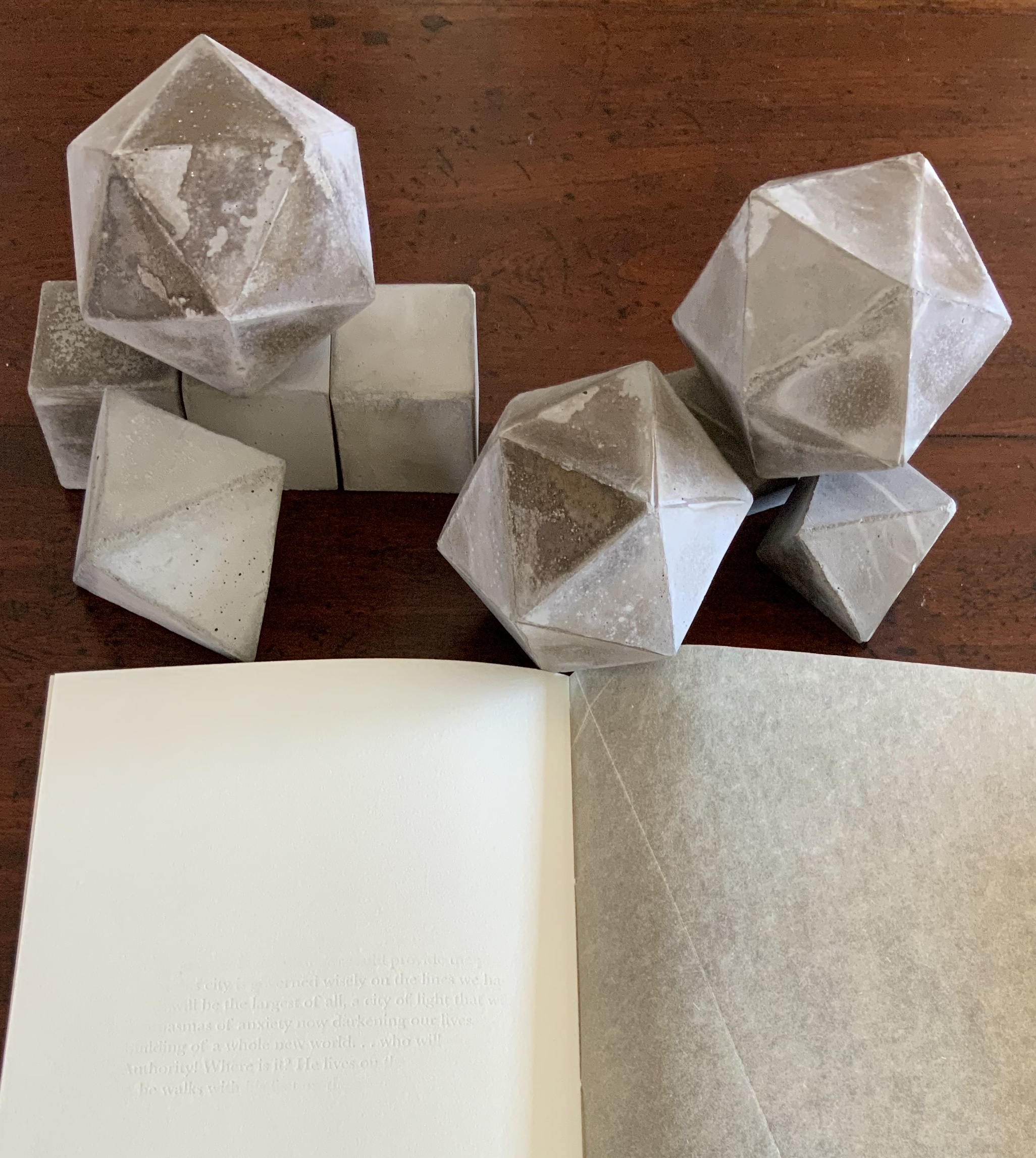
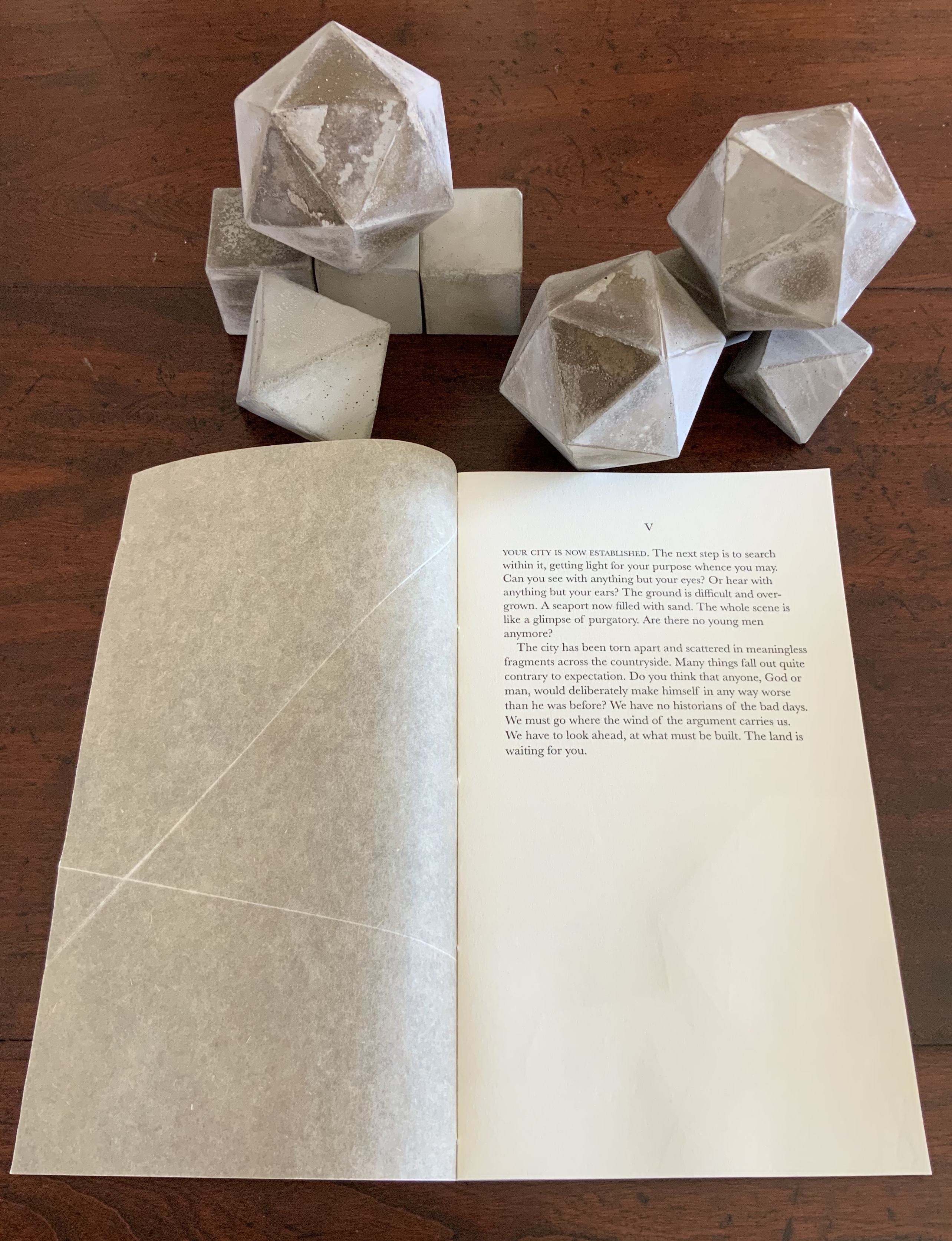
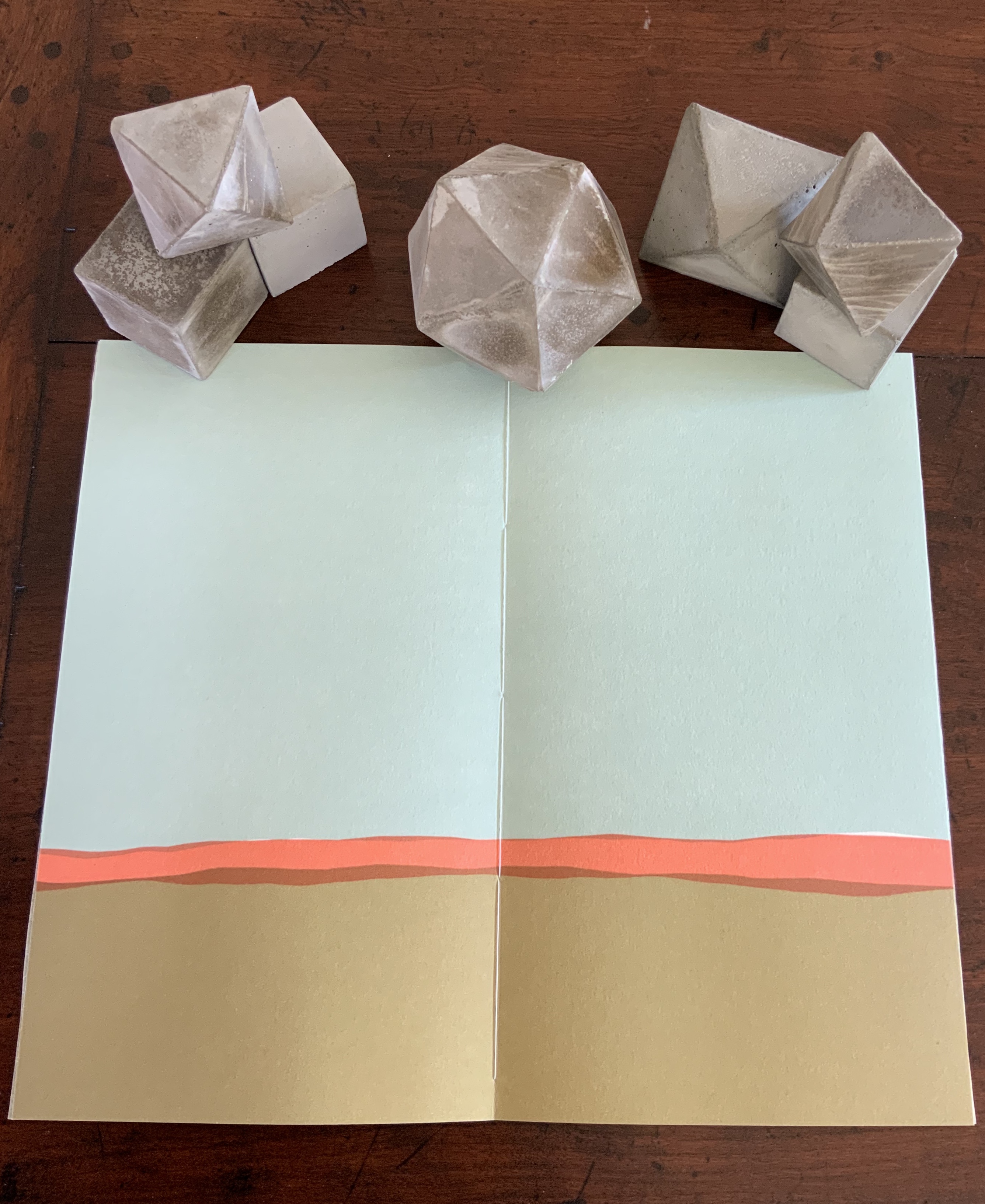
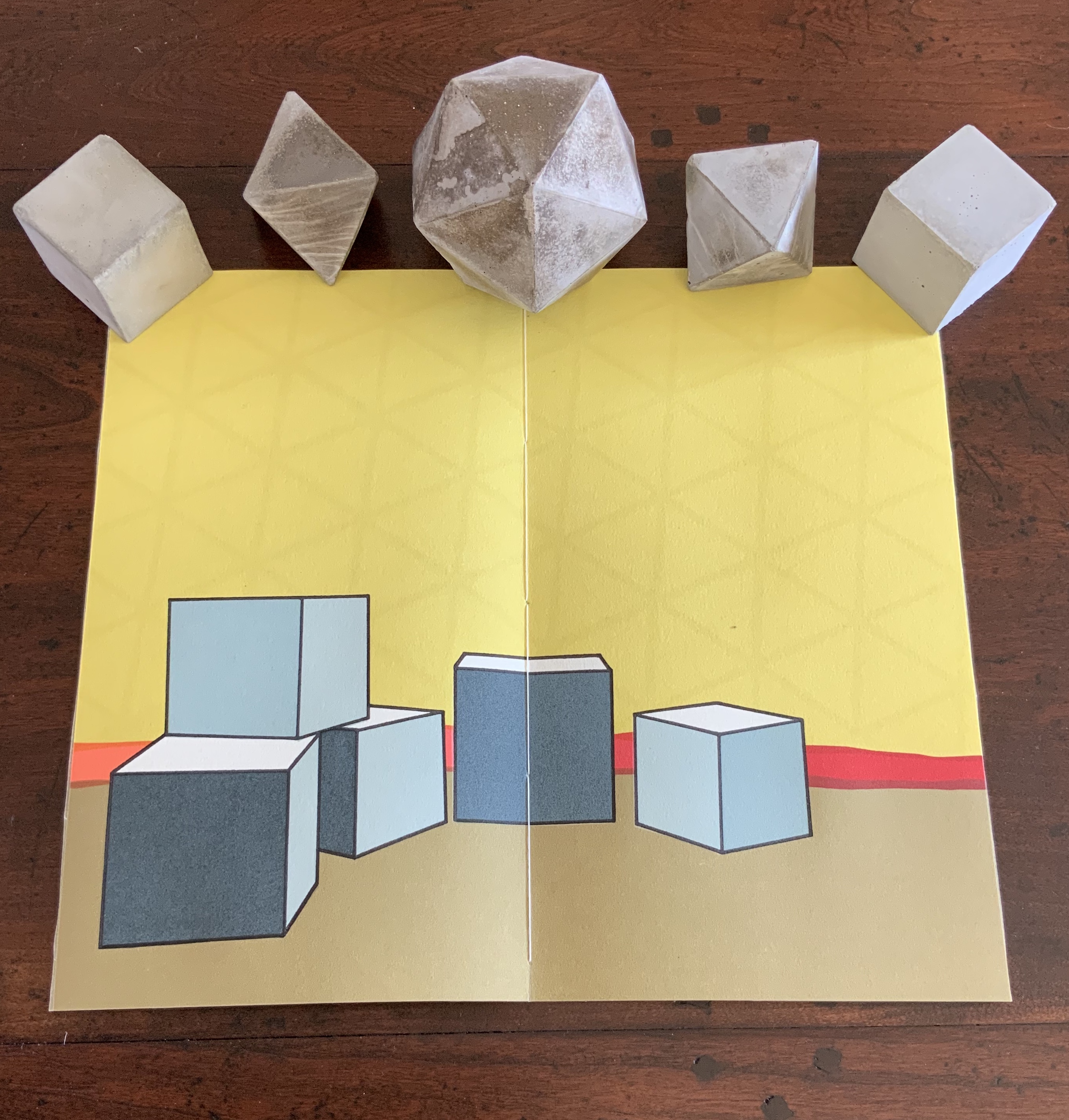
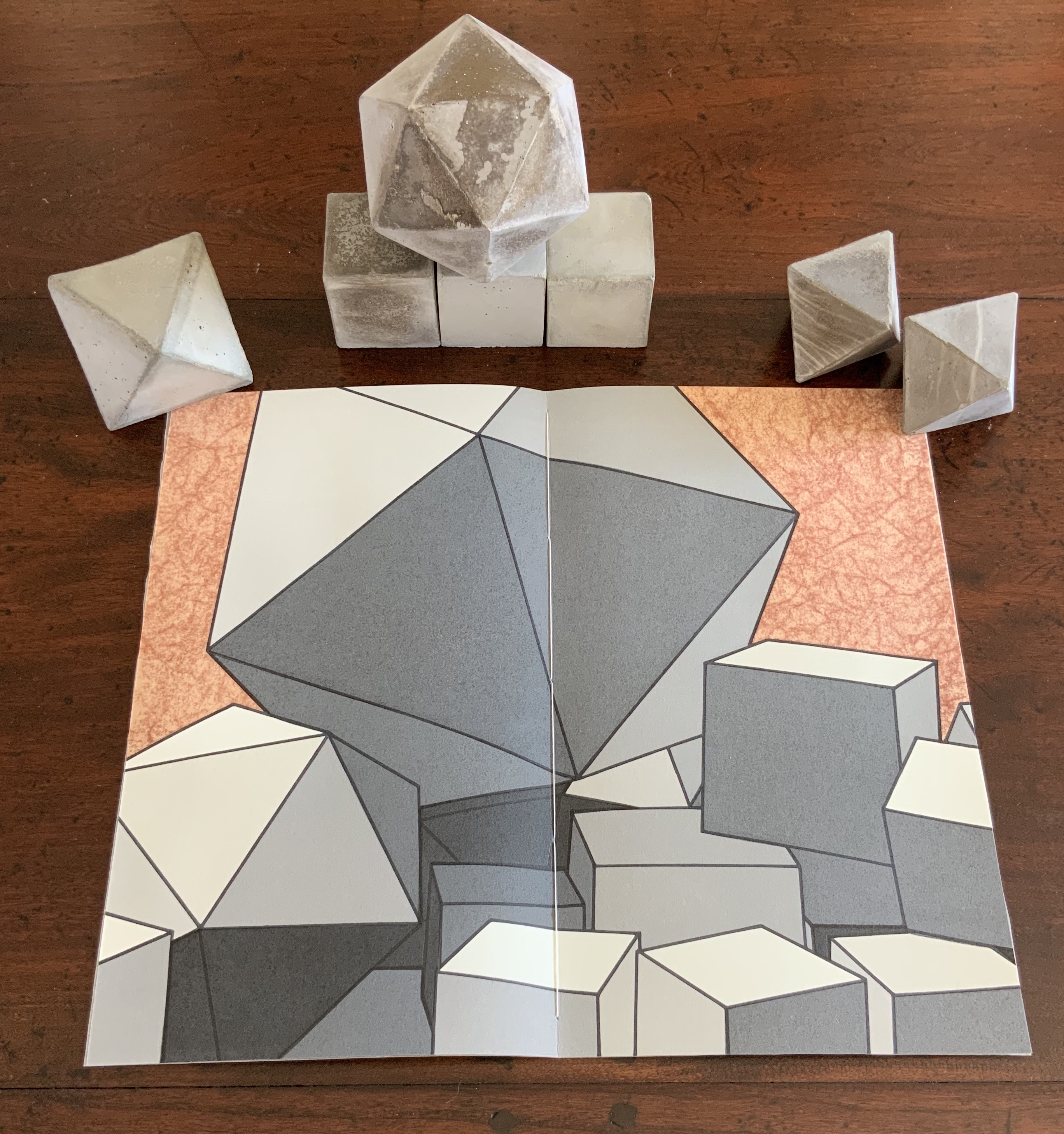
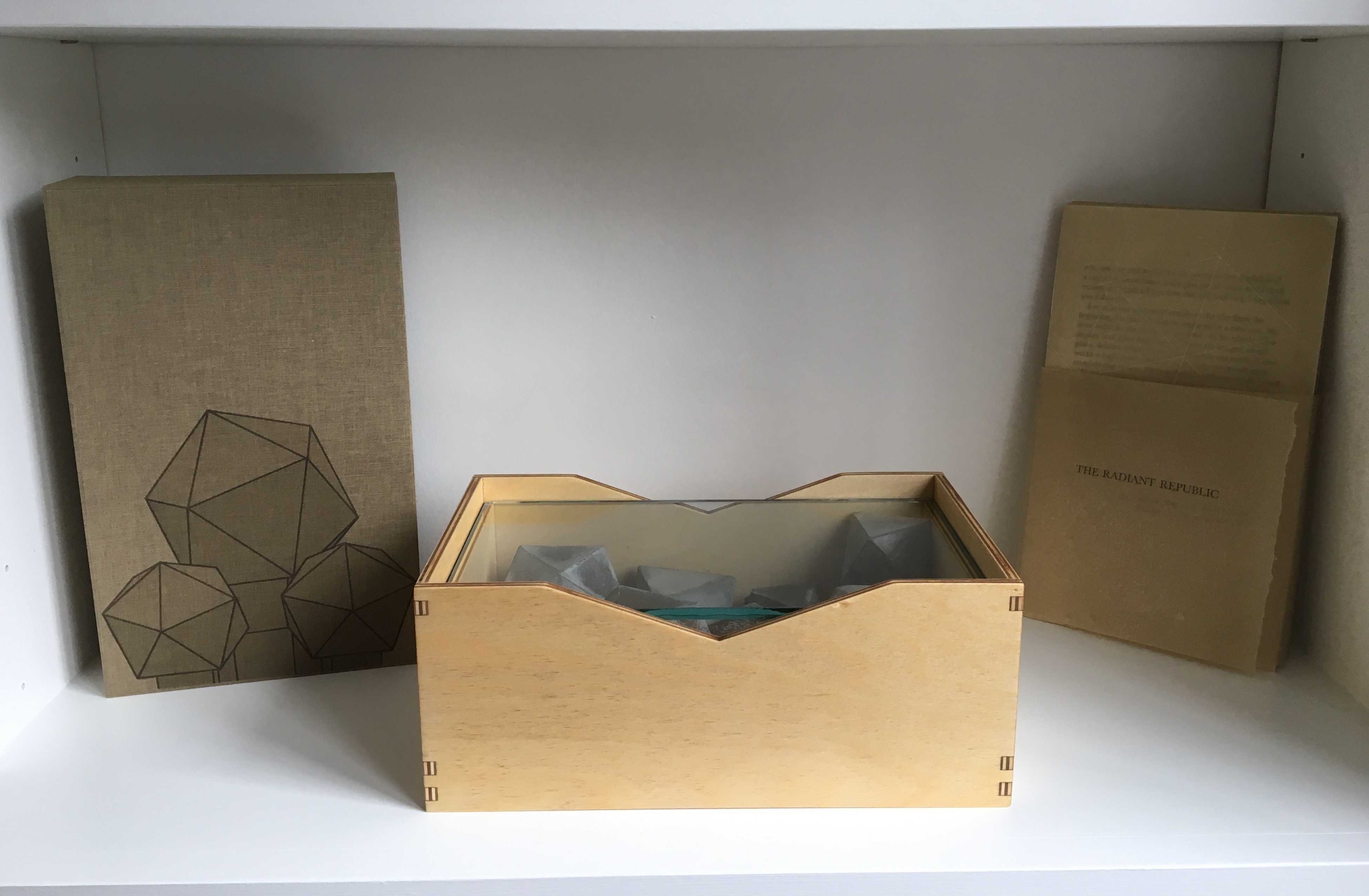
In the The Radiant Republic (2019), Sarah Bryant (Big Jump Press) brings together concrete, wood, glass, paper, ink and embossed printing, sewn binding, box container and texts from Plato and Le Corbusier.


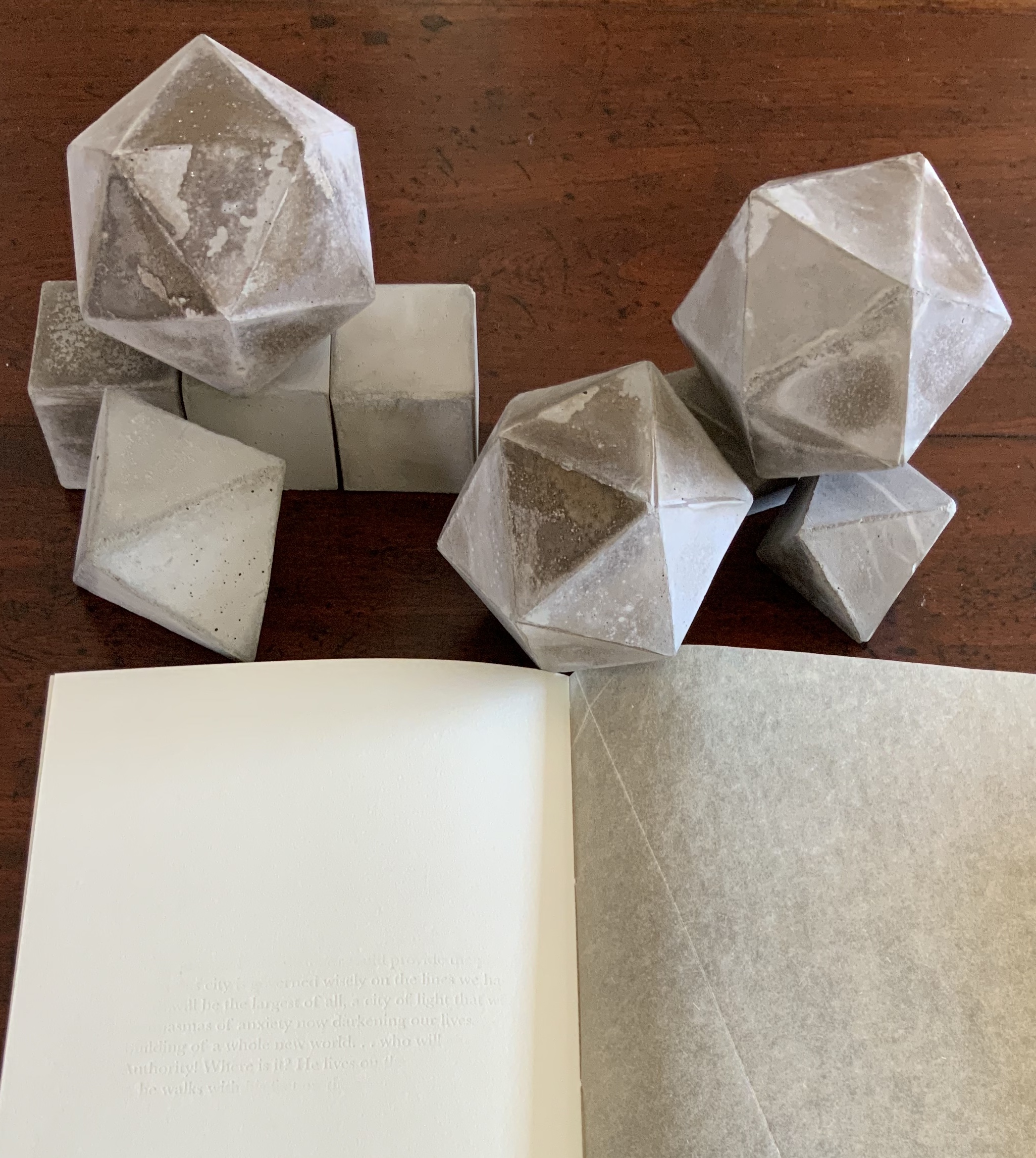
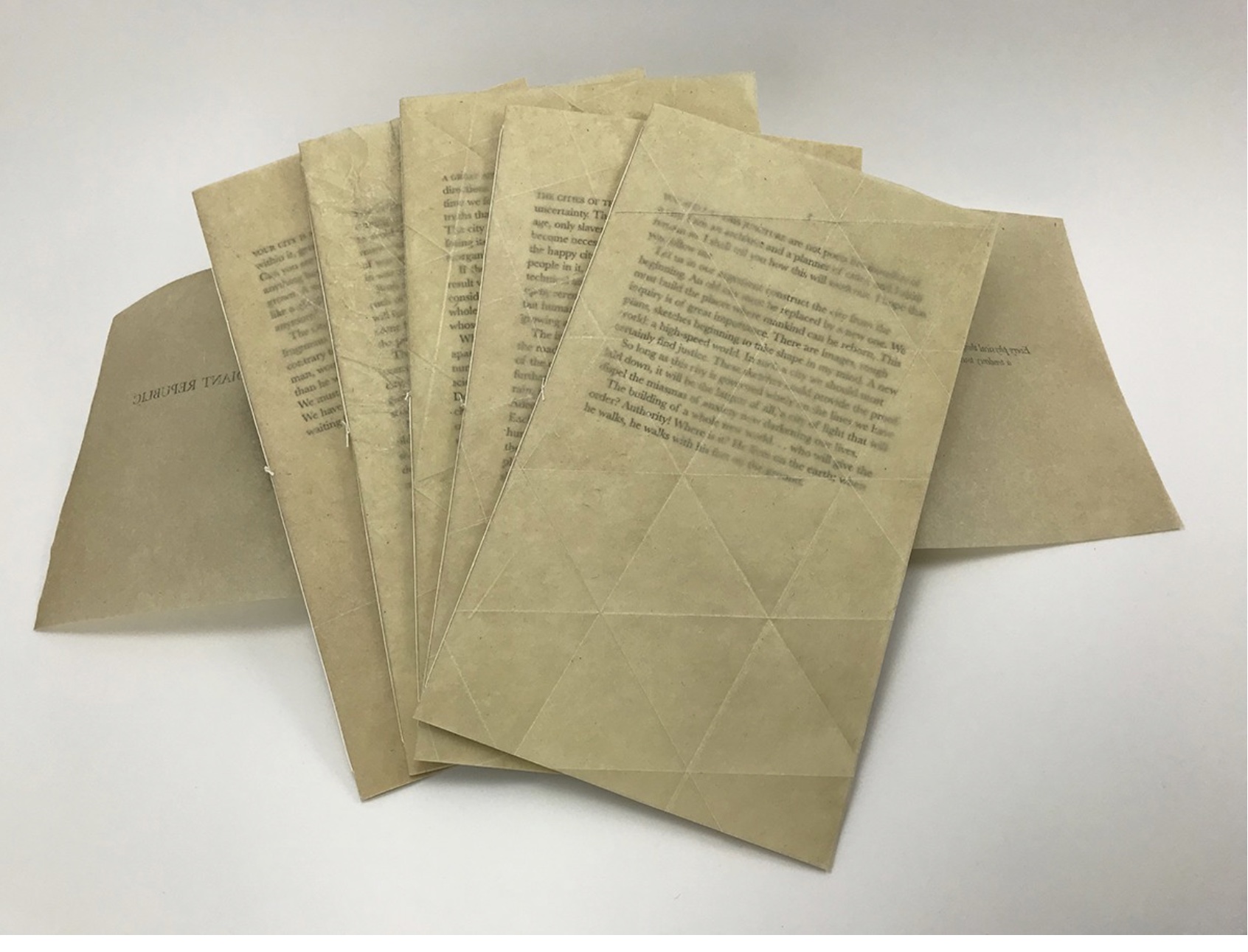
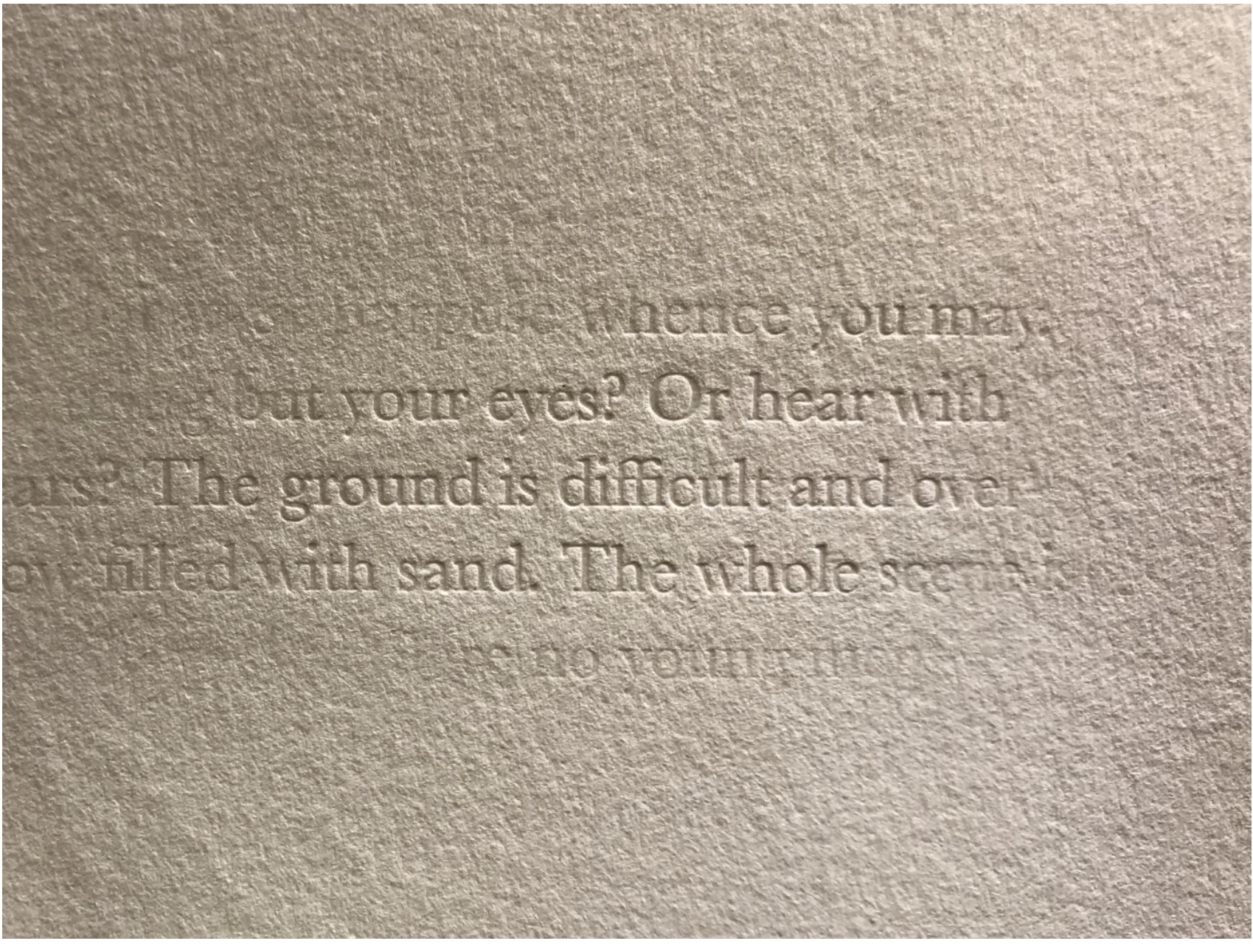
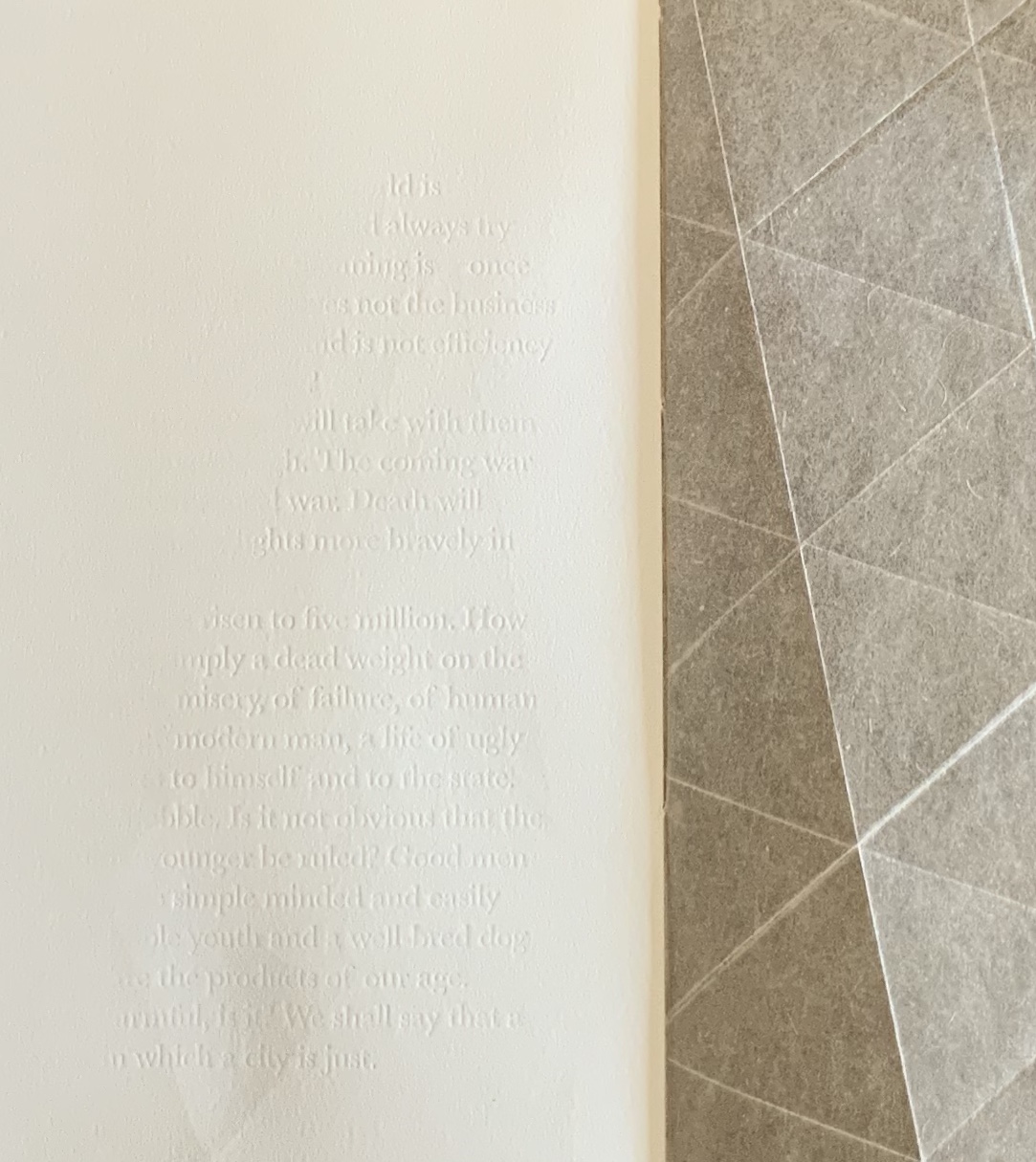
Note the embossed text on the verso. Across the five volumes, the embossed text is the same as that printed in ink, but it runs in fragments backwards from this last page of the last volume to the last page of the first volume.
Photo: Books On Books Collection

Bryant’s insightful integration of Plato’s and Le Corbusier’s texts and ideas and her setting them in the physicality of the blond wood, linen cover, embossed type and sewn papers could easily be a response to Pallasmaa’s comment in The Eyes of the Skin: “The current overemphasis on the intellectual and conceptual dimensions of architecture contributes to the disappearance of its physical, sensual and embodied essence.” (p. 35)

Helen Douglas and Telfer Stokes

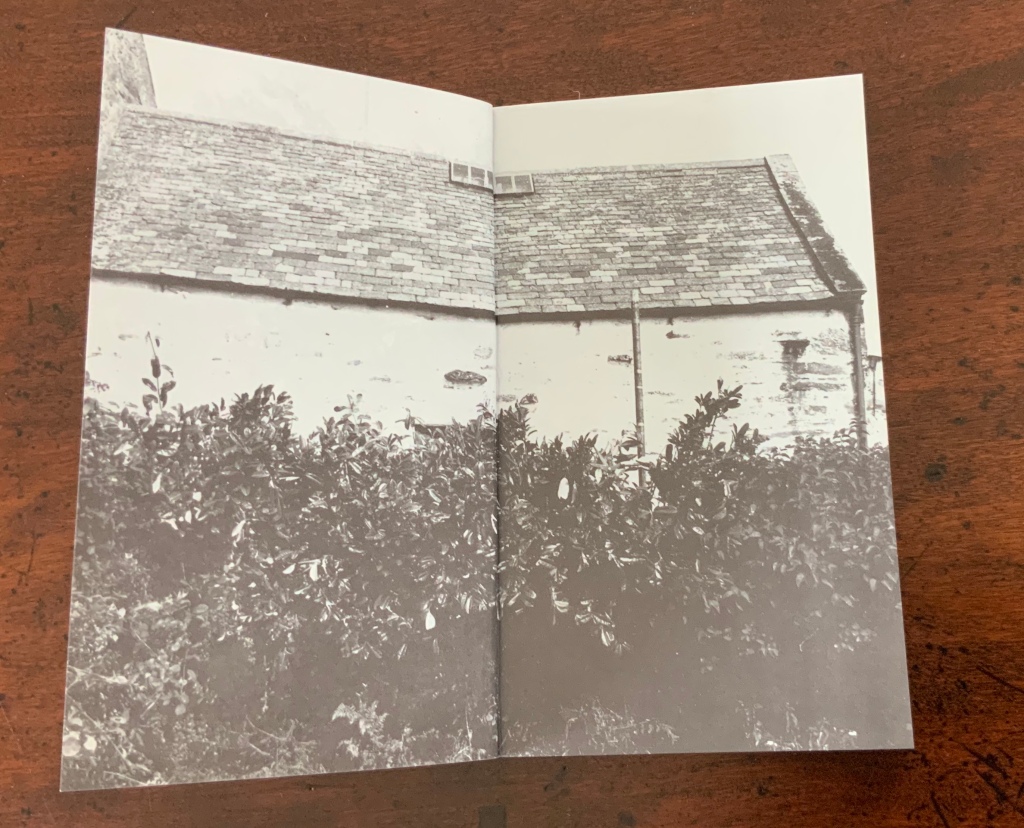
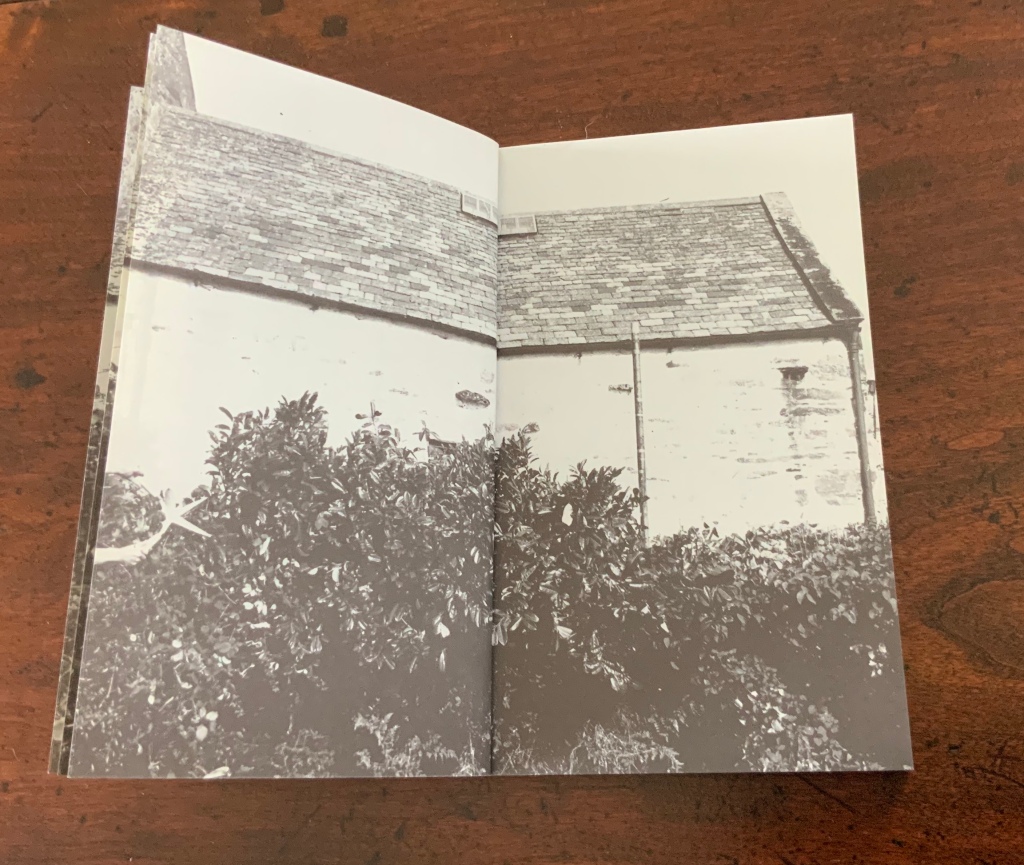
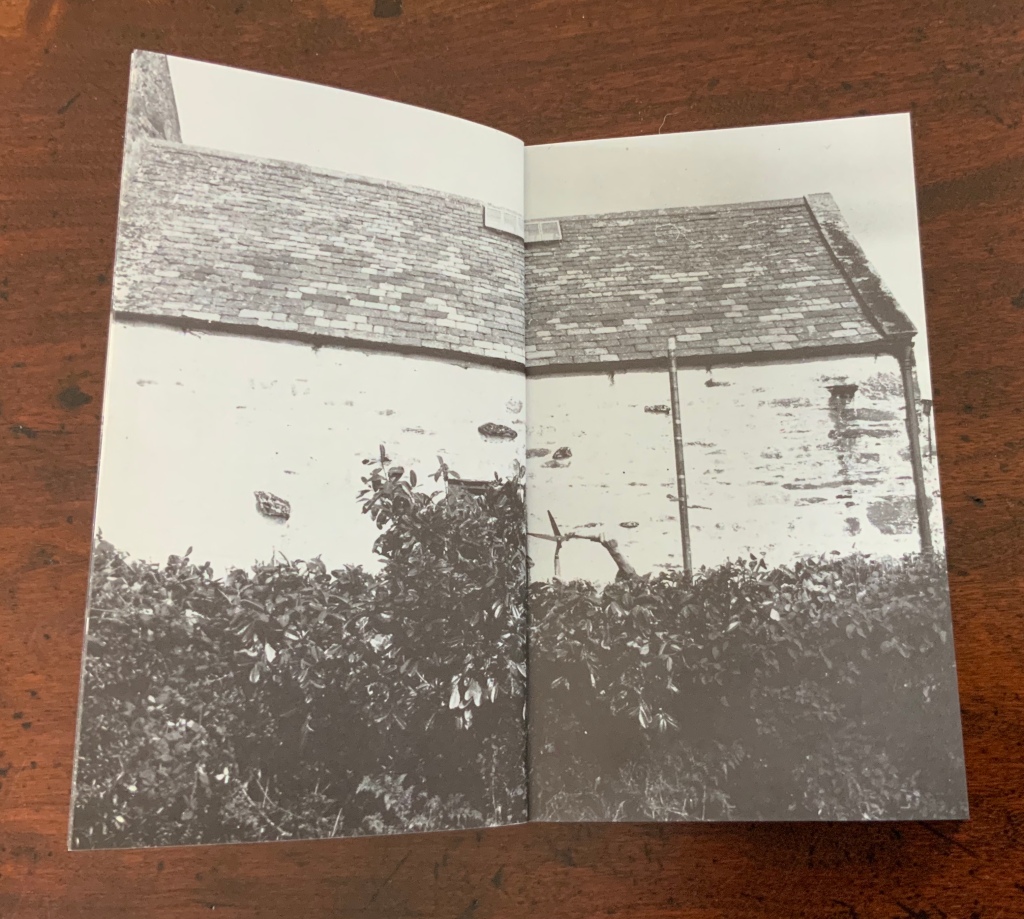
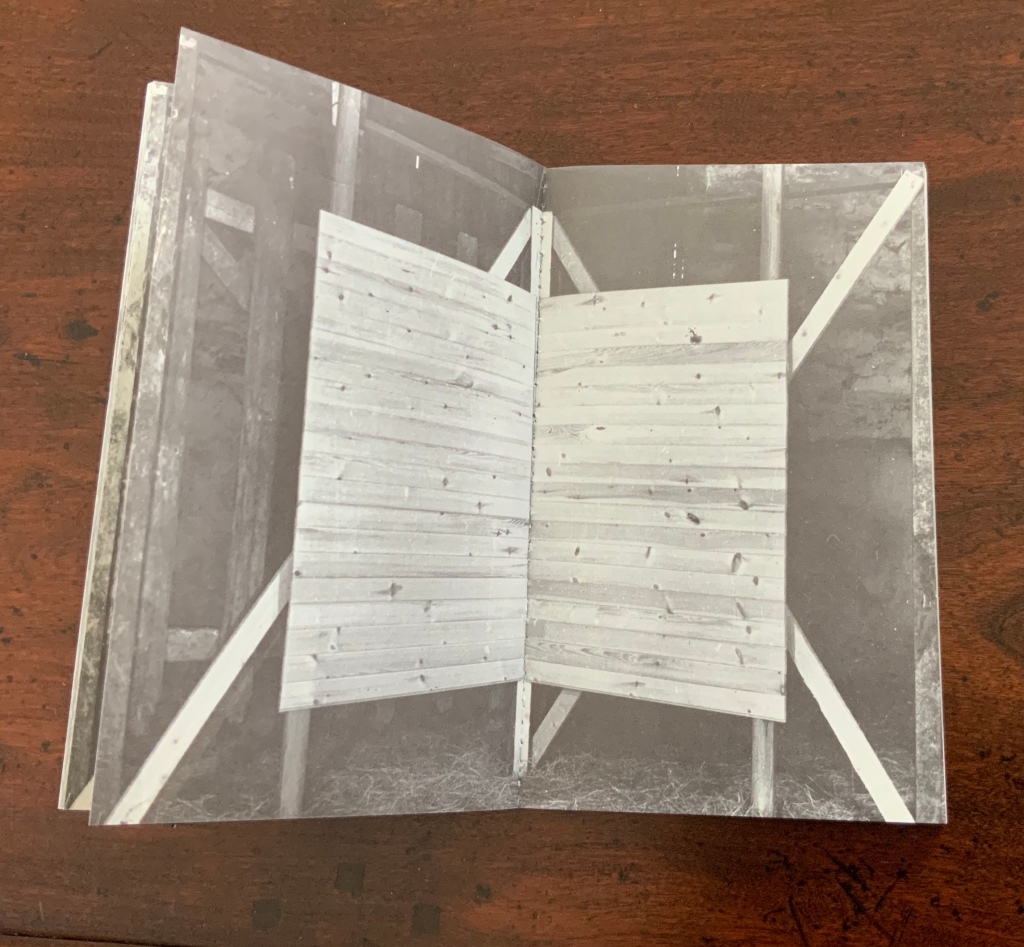
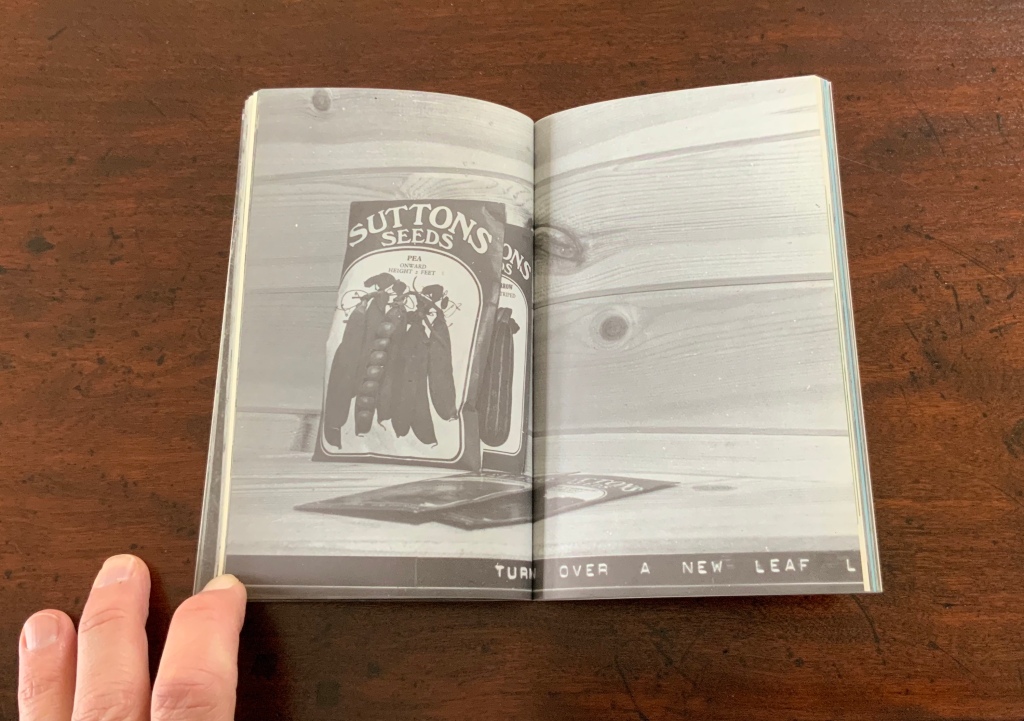
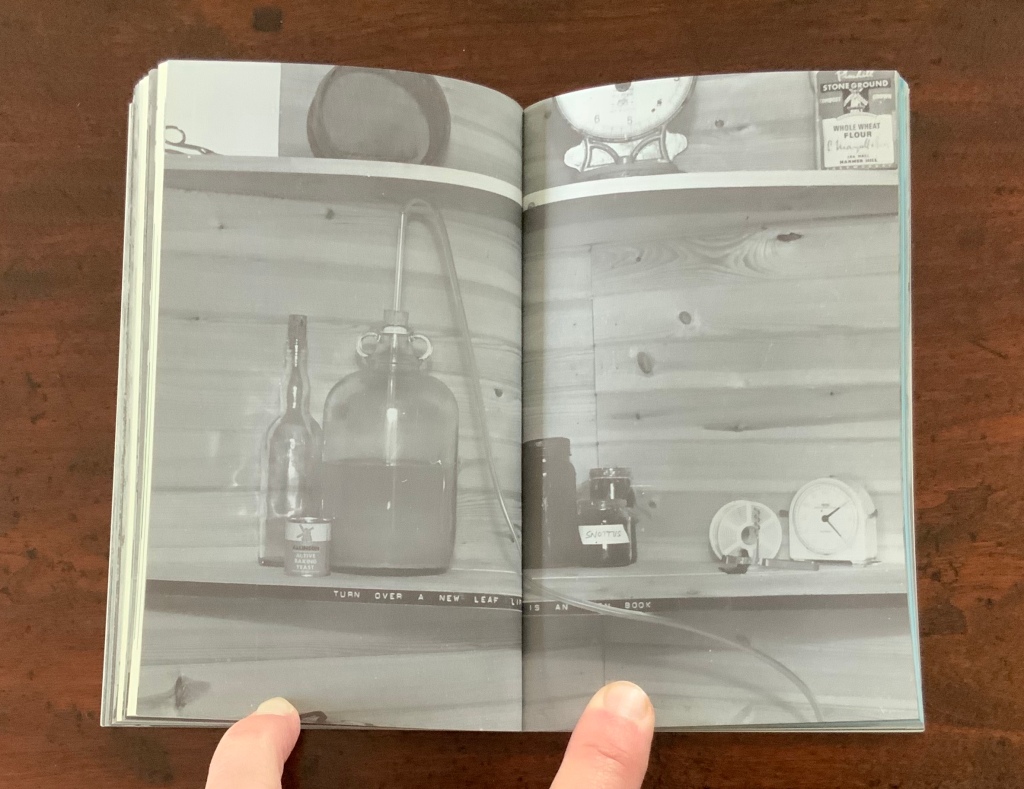
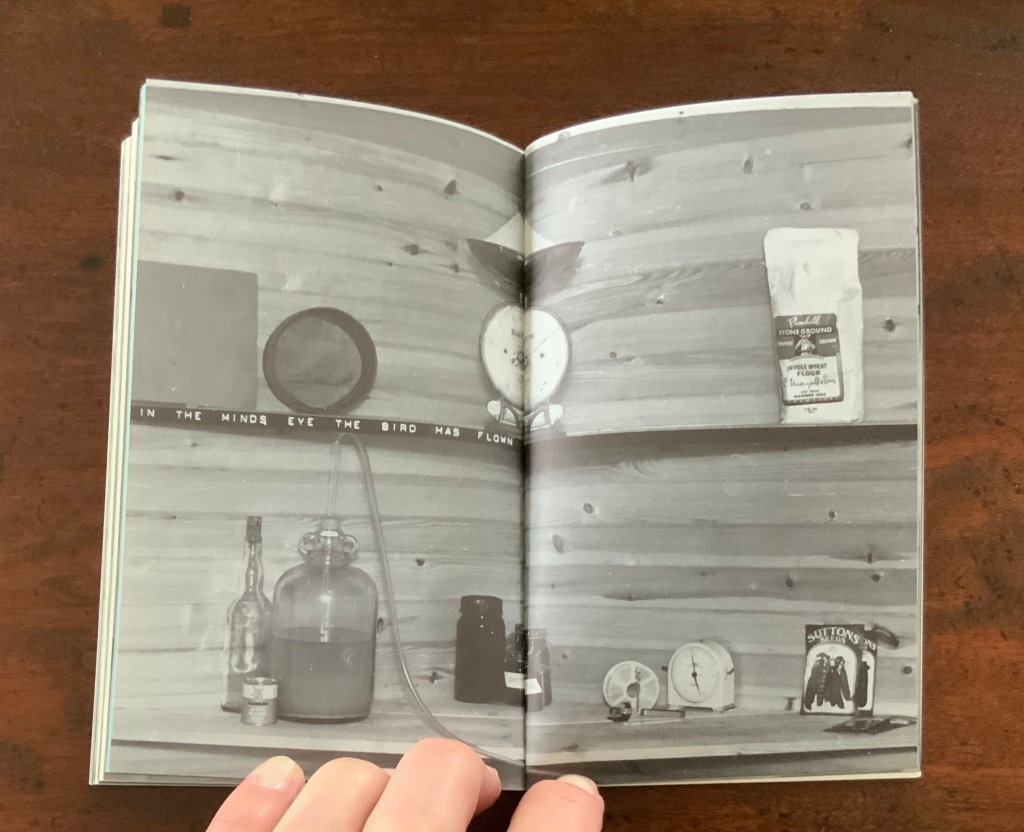
Chinese Whispers (1975) is conceptual, visual and spatial narrative that takes the reader into a “game of embedded games”: a game of Chinese Whispers used by the artists to combine the process of making a book with the process of recovering an old cottage, making a corner cupboard, making jam, making ideas and making an exit.

Chinese Whispers (1975)
Helen Douglas and Telfer Stokes
Photo: Books On Books Collection

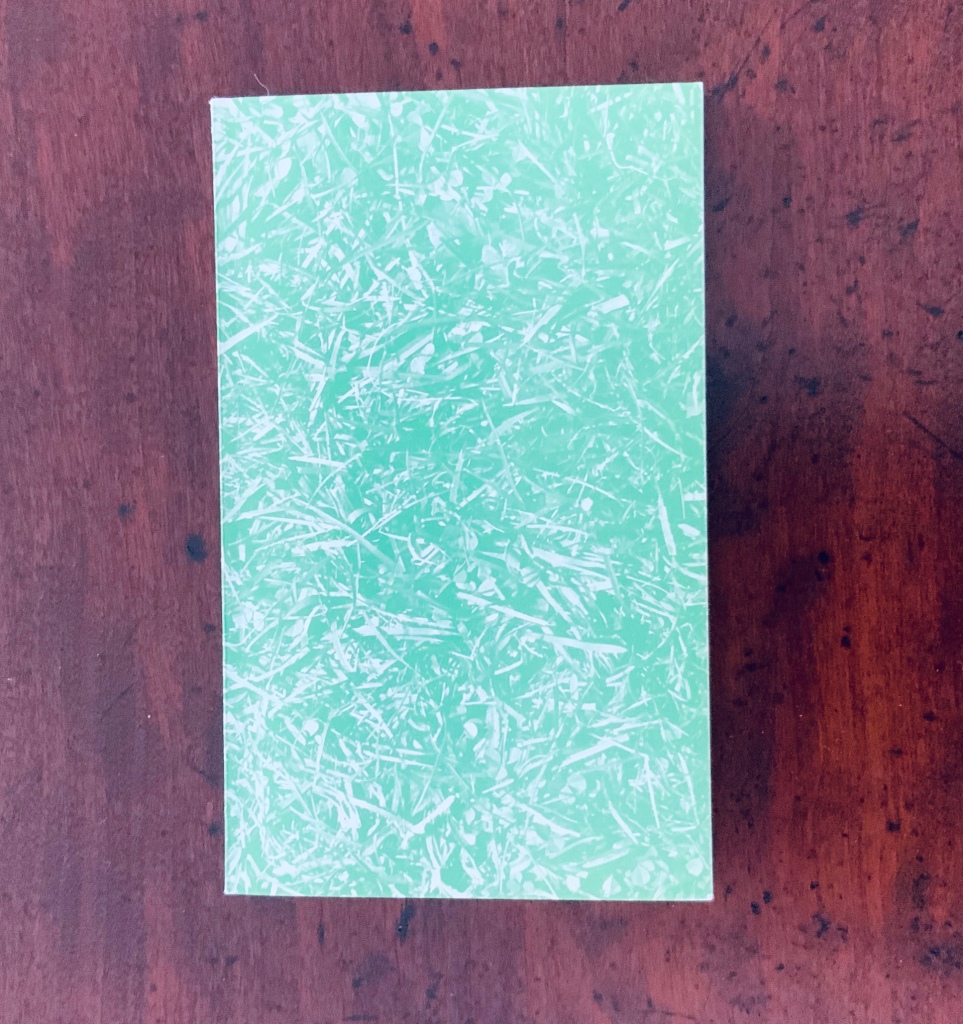
The selection of images above begins with the front cover’s photo of a patch of grass outside an abandoned farm building and ends with the back cover’s photo of the underside of the patch of grass. In between, the pages take the viewer through the trimmed hedge and the doorway into the room, through the building, the stocking of the shelves, using of the stock and closing of the shed cupboard, and so back to the other side of the patch of grass. As Stokes explained in the Journal of Artist’s Books (Vol. 12, 1999):

We started with the corner cupboard, that was the part that occupied our thinking most, that and the two colour vignettes (as we called them) printed on different stock. But then we started to think backward to what might be before the cupboard’s construction. To the thing before that, and the thing before that, and the thing before that which was cutting of the hedge and before that which was the boot brush which we called the hedgehog- that was where the book started. Then we started to photograph from that point forward, through the book.

The work blends the features of book structure, collage and montage to create something that resonates uncannily with Pallasmaa’s approving citations of Bachelard’s central idea of the hearth and domicile as central to our time-bound “being-in-the-world”.

Olafur Eliasson

Your House is a laser-cut model of Olafur Eliasson’s residence in Copenhagen at a scale of 1:85, which means that each page equates to a 220 mm section of the actual house. How do you read a work like this — physically? At the 22″ mark in this video, the pages fall in a cascade like a flipbook, but for the most part, their size, accumulated bulk and weight — and delicacy — defy that handling. As in the video below, they must be turned slowly and carefully. Your House heeds the task of the arts as posed by the architect Juhani Pallasmaa, “in our age of speed, …to defend the comprehensibility of time, its experiential plasticity, tactility and slowness” (The Embodied Image, p. 78).

Your House (2006)
Olafur Eliasson

Heather Hunter

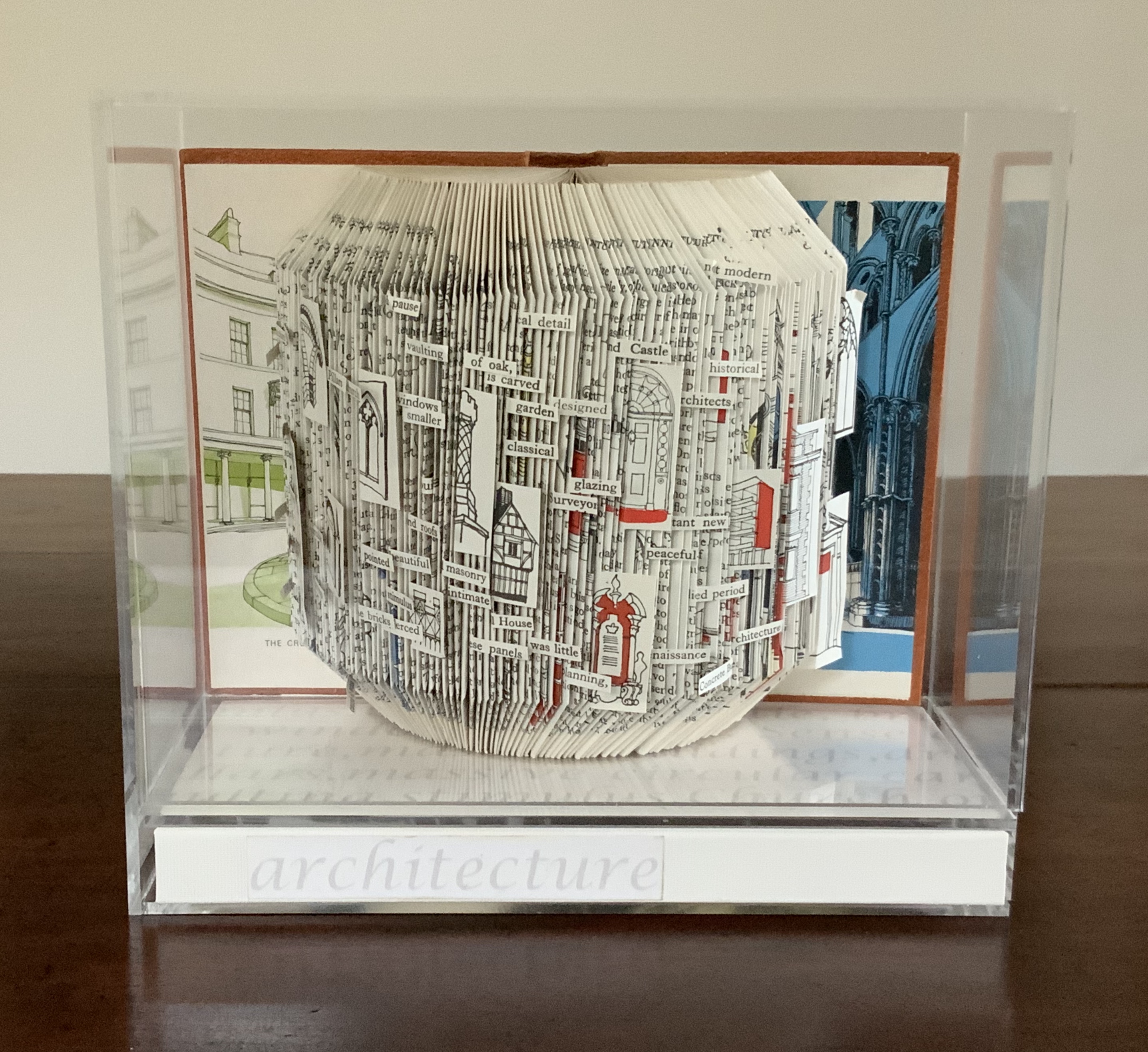
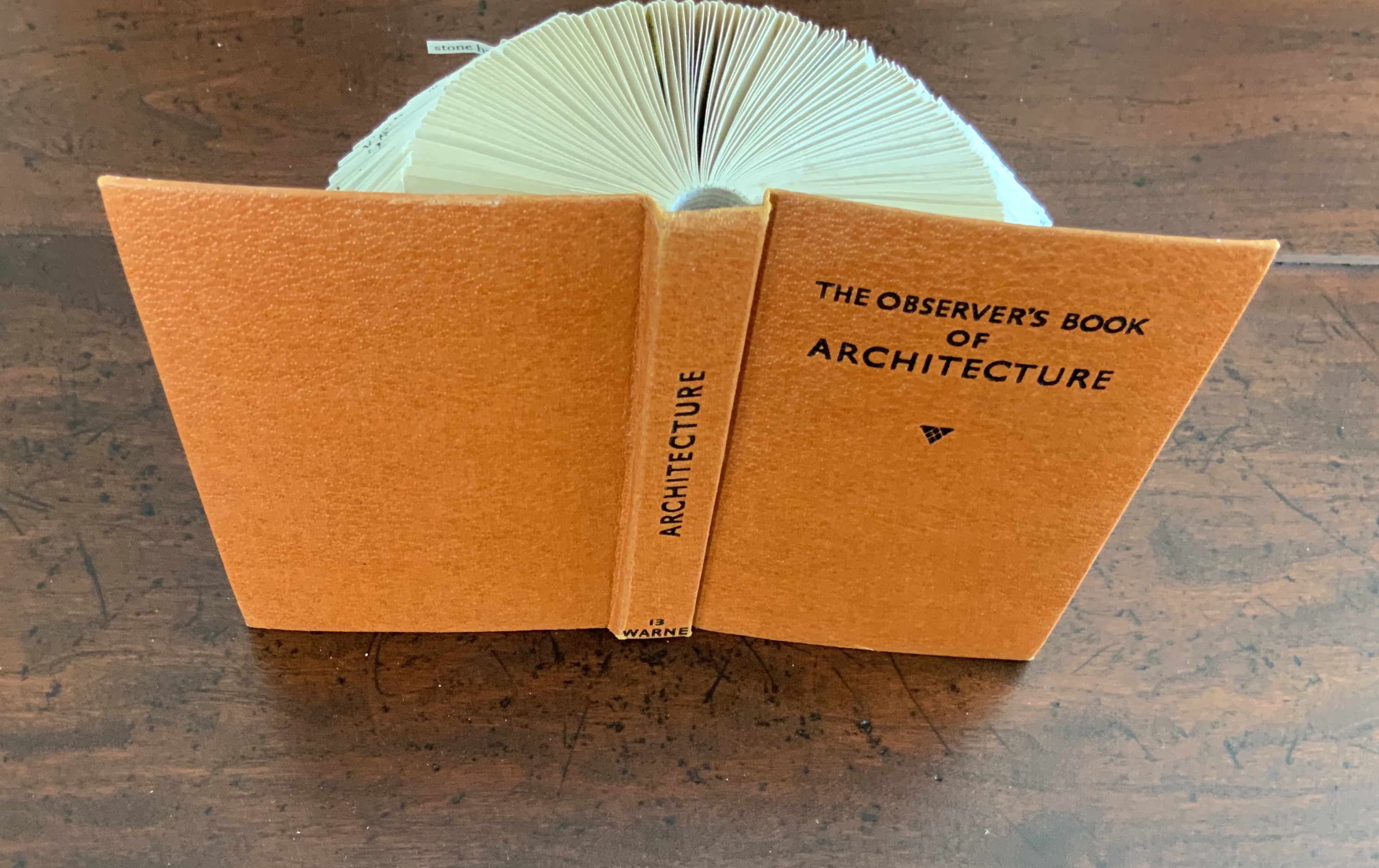
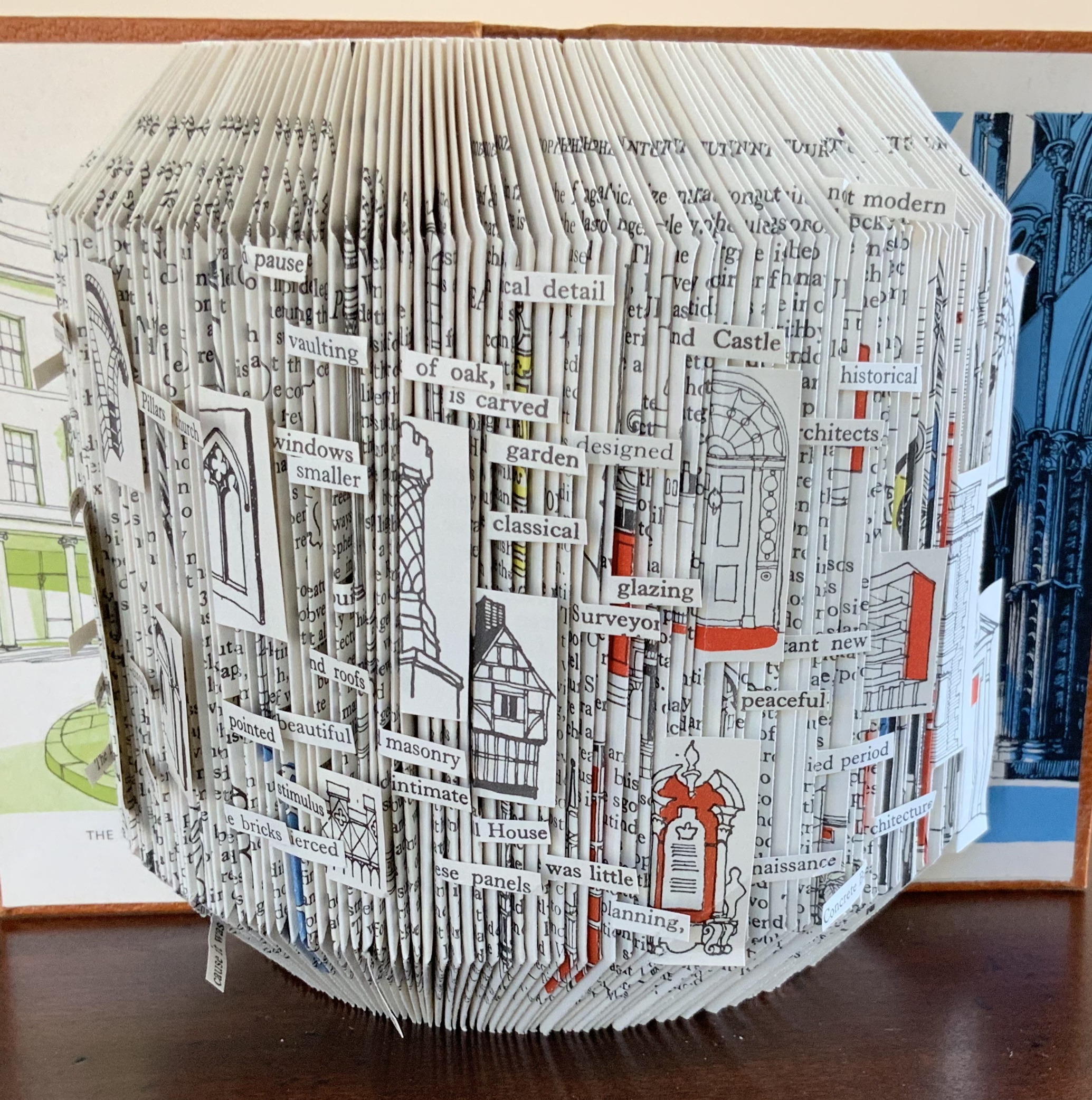
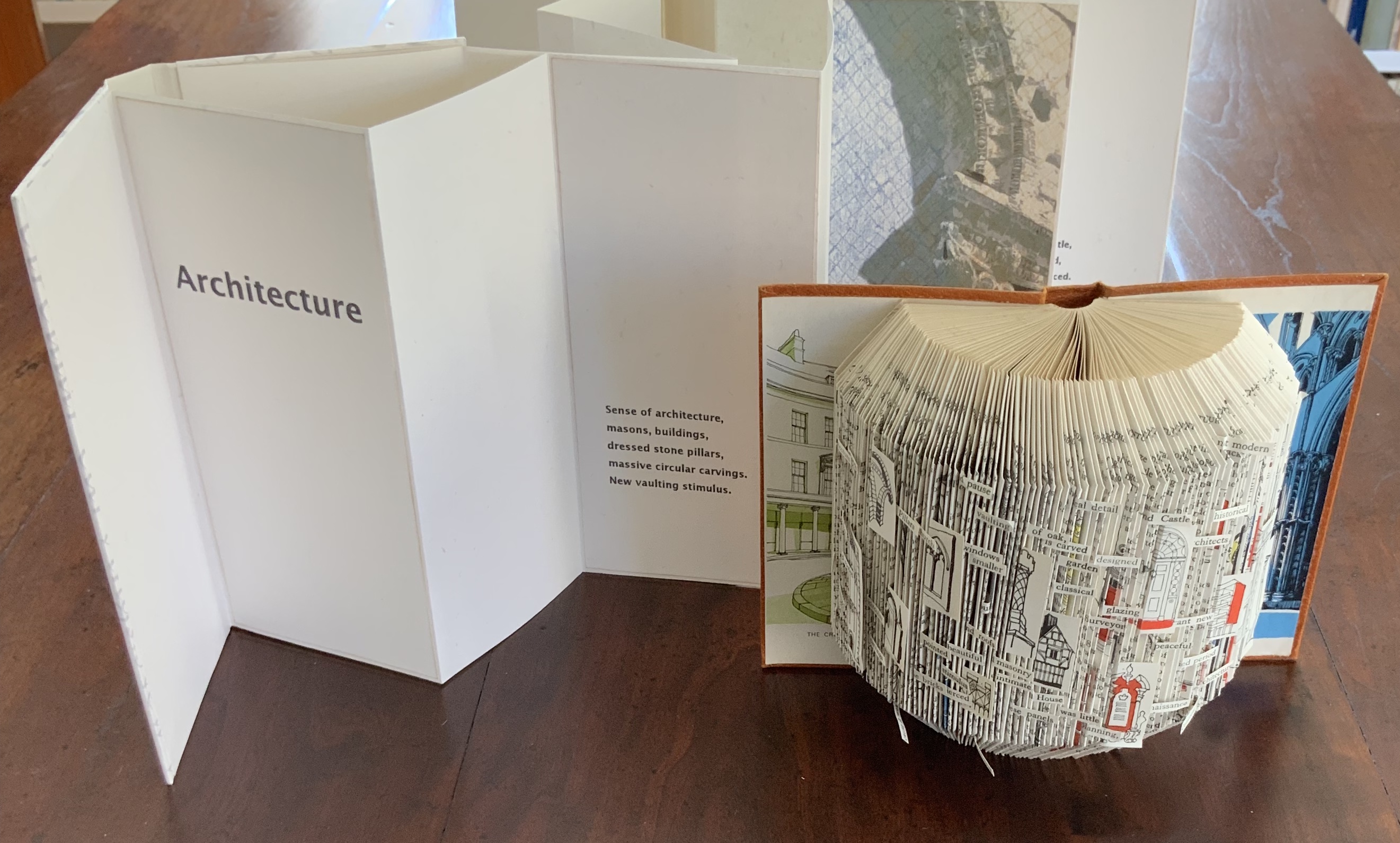
Folded book pages rarely generate a work that rises above mere craft. Heather Hunter’s Observer Series: Architecture (2009) achieves the necessary height. It combines the altered book with an accordion book that incorporates a found poem composed of the words excised and folded outwards from the folded pages of The Observer’s Book of Architecture.

Observer Series: Architecture (2009)
Heather Hunter
Photo: Books On Books Collection

Photo: Books On Books Collection
The very fact of a found poem made of excised words that happen to fall at the folds shaping a column from a book on architecture chimes with the title of Bachelard’s The Poetics of Space.

Marlene MacCallum

Chicago Octet (2014) by Marlene MacCallum embodies the collaborative creative approach often taken in architects’ practices. Collaborative working arises almost as frequently in book art. Think of Blaise Cendrars and Sonia Delaunay, Helen Malone and Jack Oudyn, Julie Chen and Clifton Meador, Robin Price and Daniel Kelm. Many more can be added. As described by MacCallum:

From May 19 – 26, 2014 a group of eight gathered at the Columbia College Center for Book and Paper Arts for a final collaborative project. This event was organized by Clifton Meador and myself and included David Morrish, Scott McCarney, and four Grenfell Campus BFA (Visual Arts) grads, Stephen Evans, Maria Mercer, Virginia Mitford, and Meagan Musseau…. The letterpress printing consisted of a word selected by each participant printed on one of Scott’s folded structures. The images were a digital layering of every cityscape photograph that I made and then inkjet printed on top of the letterpress. The final folded structure was designed by Mary Clare Butler. The case was designed and built by Scott McCarney, the front cover embossment was by David Morrish and Clifton Meador.

Chicago Octet (2014)
Marlene MacCallum
Hand bound artist’s book with folded paper structure, letterpress and inkjet printing, 6.5 × 3 × 0.5 inches (closed dimension).
Photo: Books On Books Collection

Photo: Books On Books Collection
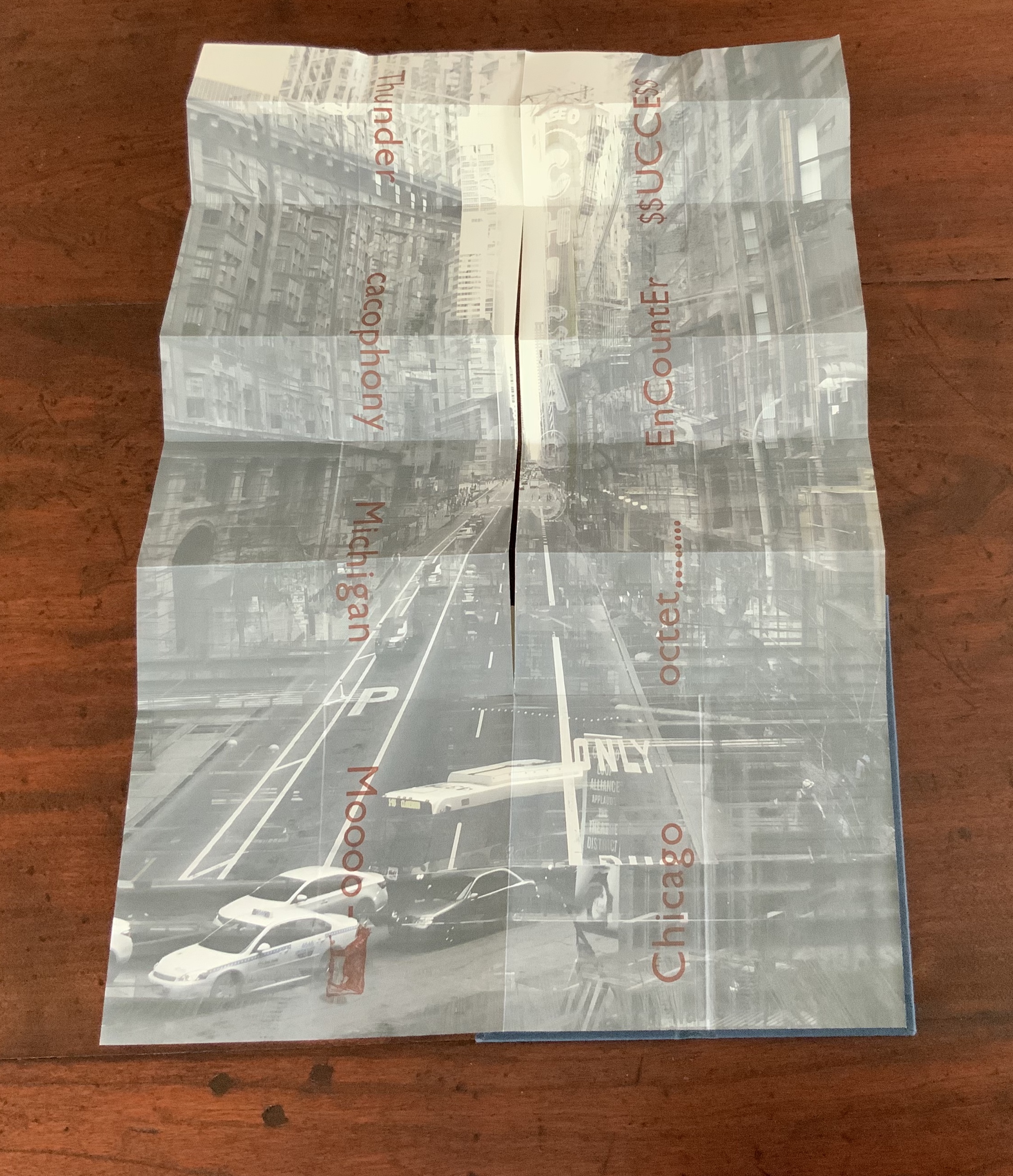
Chicago Octet fully unfolded, 17.5 × 11.5 inches
Photo: Books On Books Collection

Can you hear the traffic and sense the layers of experience? What Pallasmaa writes here of rock art in Africa and Australia reminds me of Chicago Octet (or is it vice versa?): “

At the same time that great works of art make us aware of time and the layering of culture, they halt time in images that are eternally new. … Regardless of the fact that these images may have been painted 50,000 years ago, … we can … hear the excited racket of the hunt. The Embodied Image, p. 109.

Jeffrey Morin and Steven Ferlauto

Sacred Space (2003) is an intimate monument of book art. Made intimate by the content and texture of its book, made more intimate by the viewer’s having to construct the chapel. Made monumental by the echo of typographic history, made more monumental in Galileo Galilei’s echo from its floor: Mathematics is the alphabet with which God has created the universe.
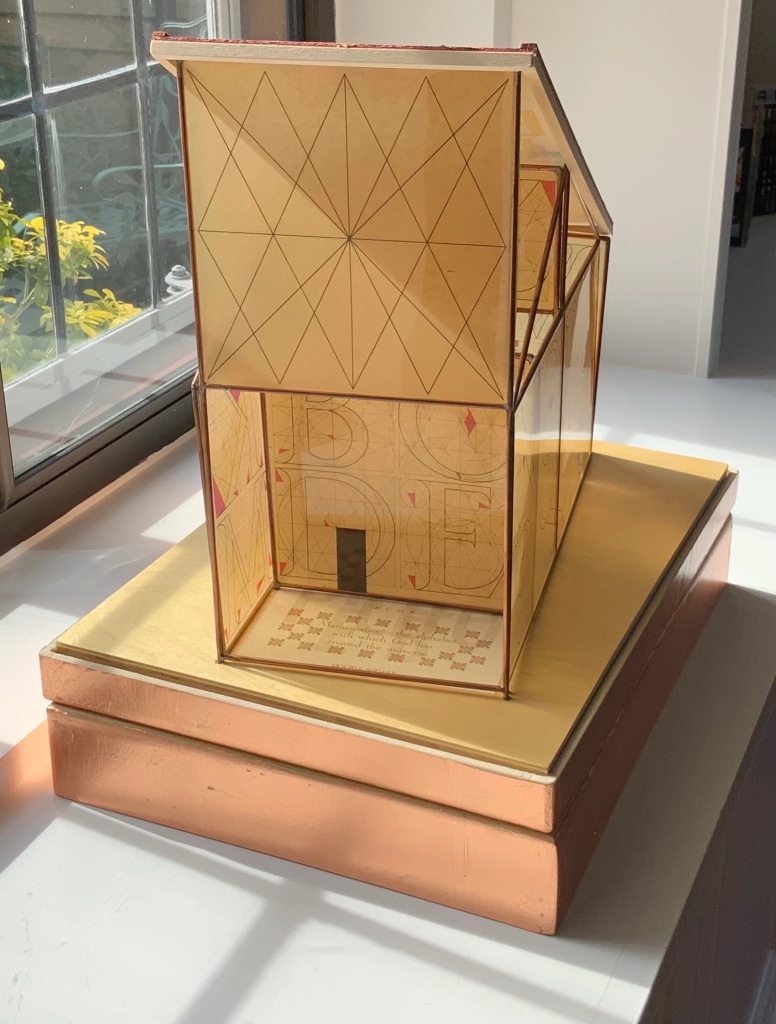
Sacred Space (2003)
Jeffrey Morin and Steven Ferlauto
Book: Reduction linoleum prints with typographic illustrations using overprinting of letterforms; open spine sewn with brown cord binding; brown cloth-covered boards; title and design on front board; endpapers of handmade paper from Nepal. Book: 6 x 14.25″; 17 leaves.
Chapel kit: Six walls, roof, base. Walls: copper rod skeleton with Okawara rice paper skin covered with a casting resin. Book and kit housed in wooden box. Roof copper-leafed Davey board. Roof forms the tray in which the book rests. Base: Box lid becomes the base for the chapel. Brass holes in the base allow the rods to fit exactly. Print pattern on the base becomes the floor pattern. Box painted with copper leaf. Sculpture base 15.75 x 11.5″, height 12″.
Edition of 35, of which this is #23.
Photo: Books On Books Collection.

Salt + Shaw (Paul Salt and Susan Shaw)

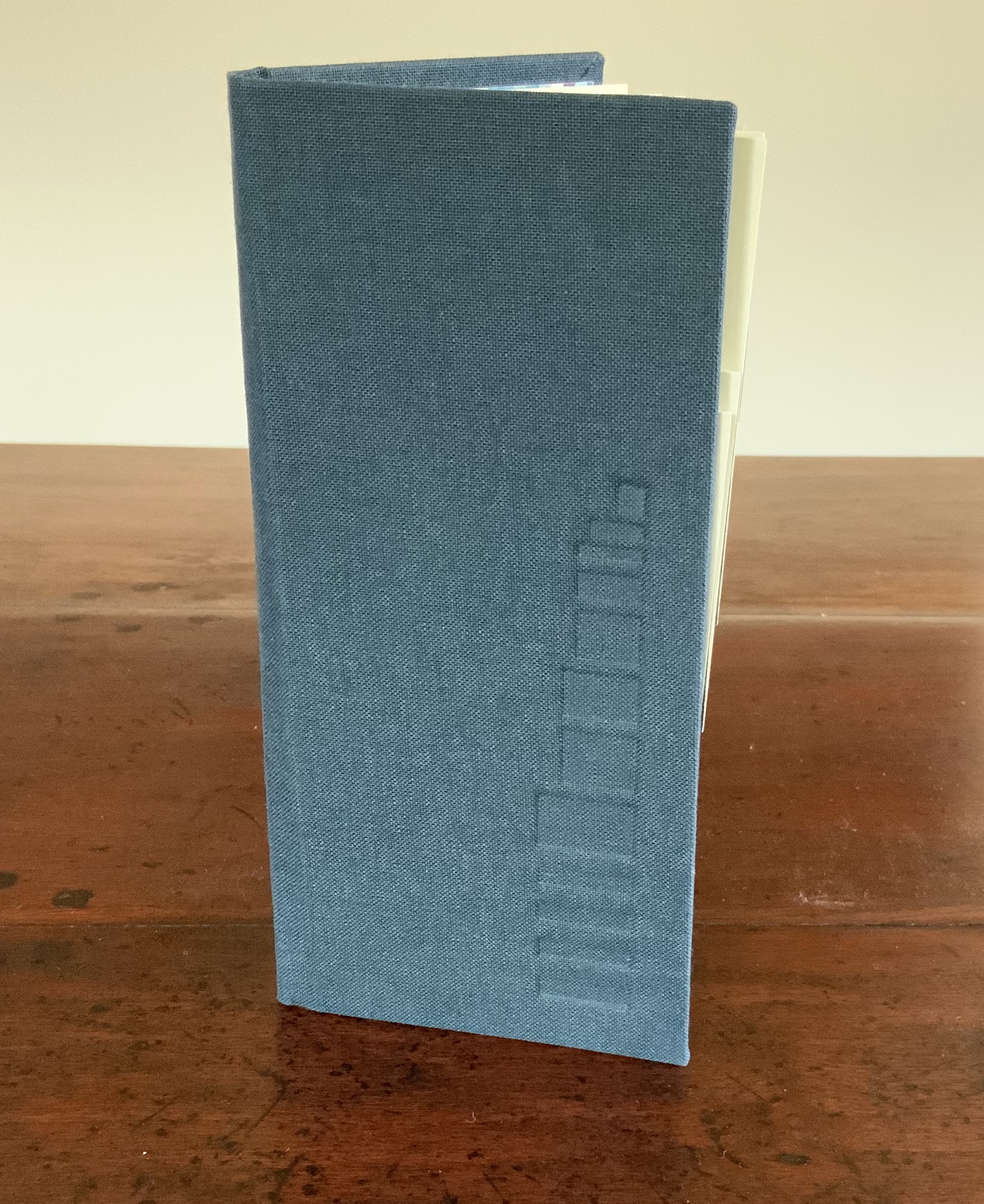
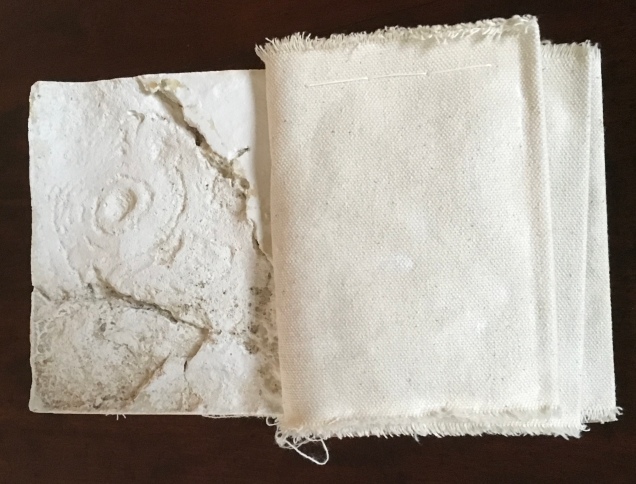
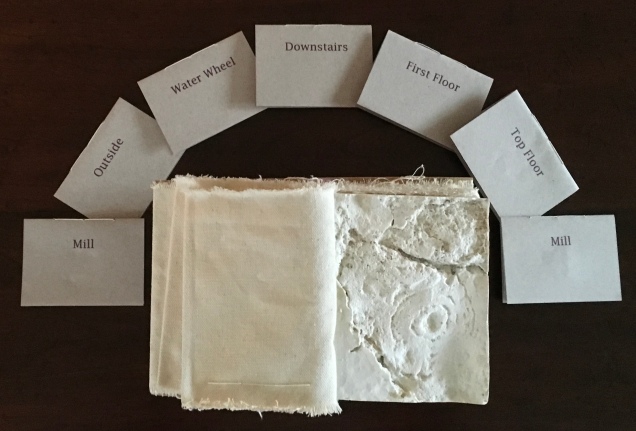
Mill: A journey around Cromford Mill, Derbyshire (2006) is the result of the artists’ exploration of Cromford Mill in Derbyshire, the first water-powered, cotton-spinning mill developed by Richard Arkwright in 1771. Solid, plaster cast blocks are held softly between calico pages containing hidden texts, bound in recycled wooden library shelf covers that indicate there is history to be found within.
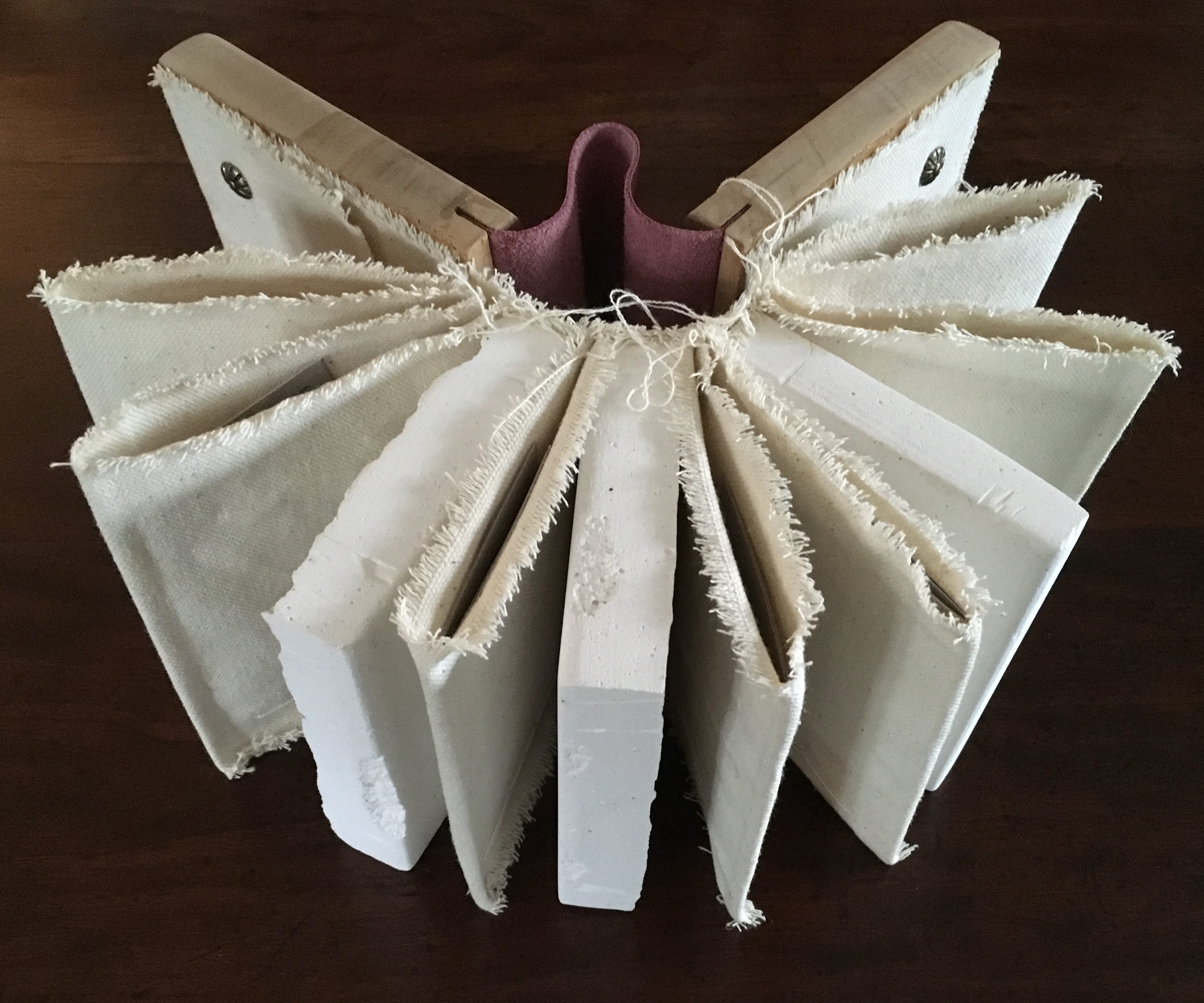
Mill: A journey around Cromford Mill, Derbyshire (2006)
Salt + Shaw (Paul Salt and Susan Shaw)
Photo: Books On Books Collection
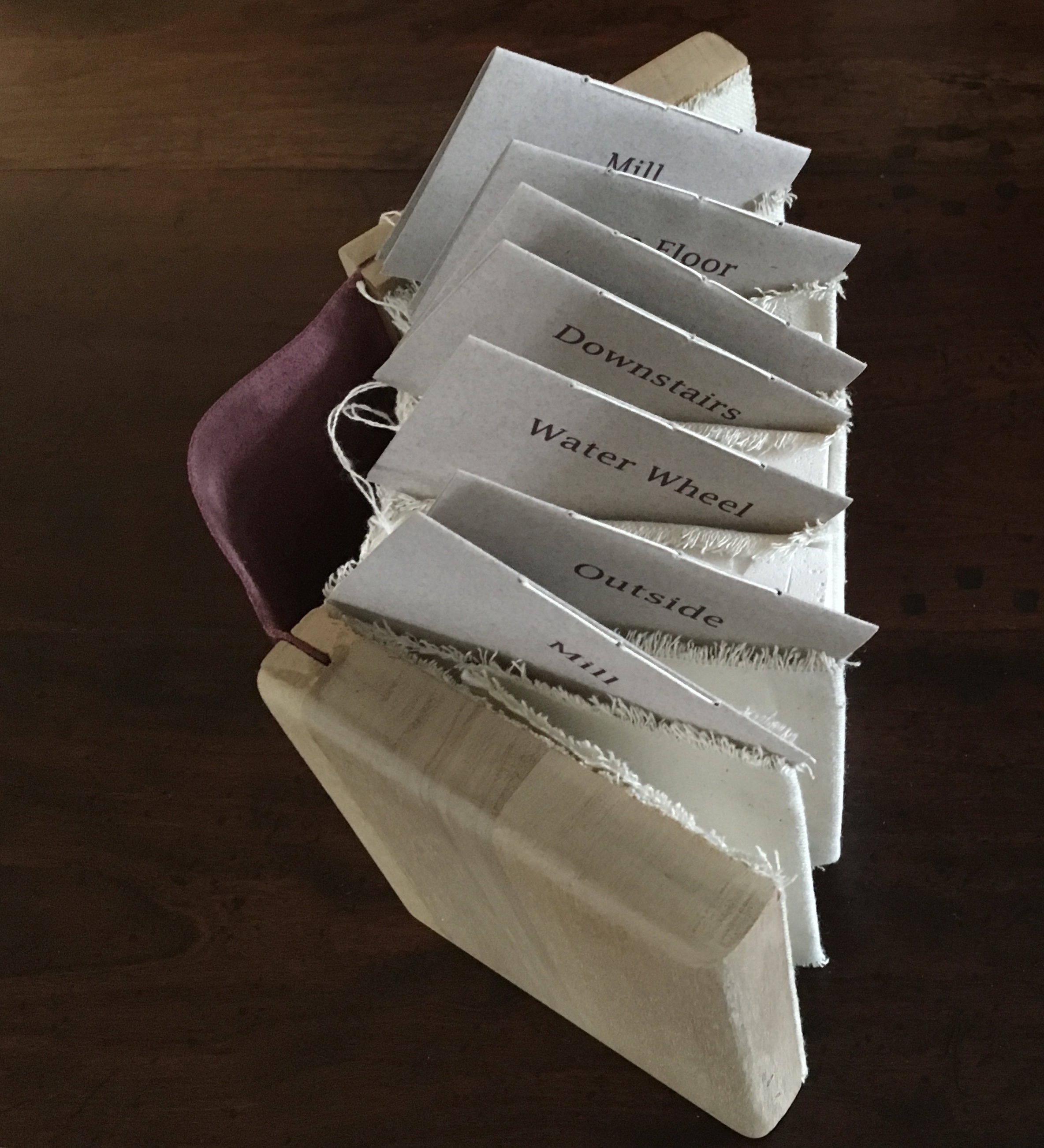
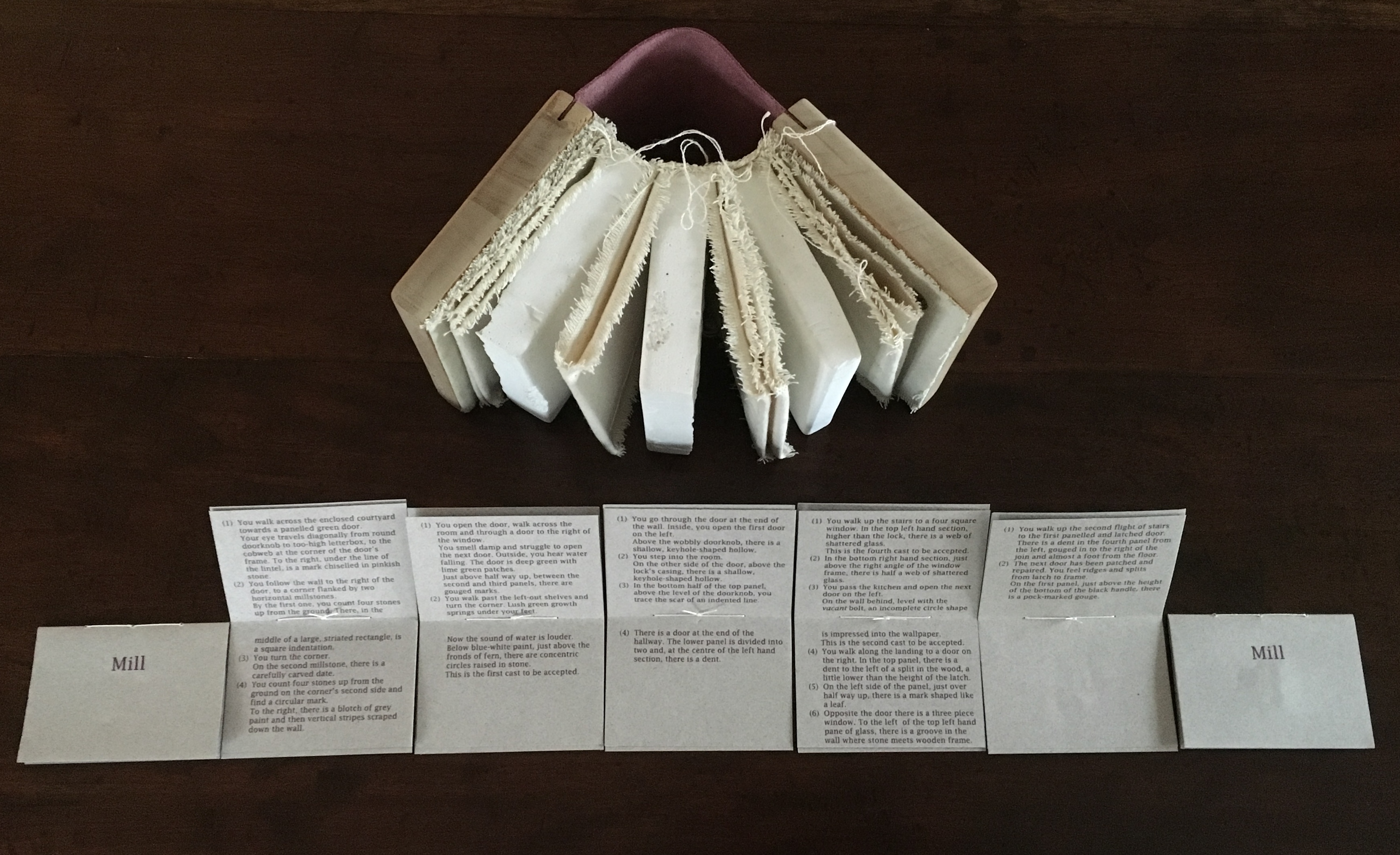
Having Mill is like having the building inside your house.

Emily Speed

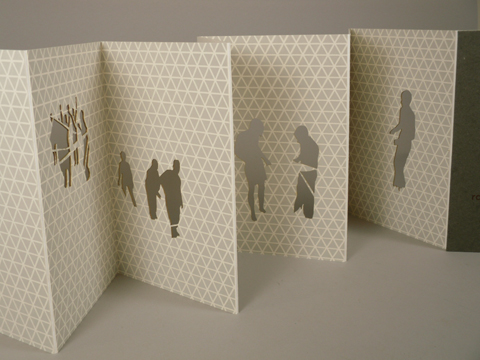
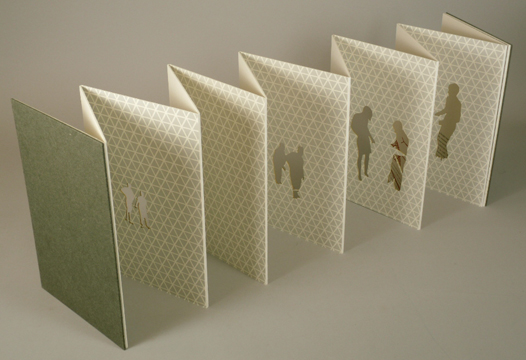
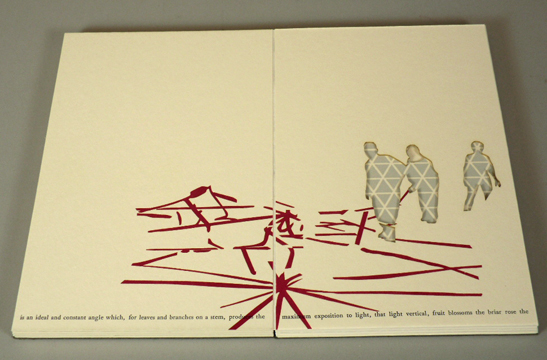
When Emily Speed is not creating architectural costumes for architectural performative art, she creates artist’s books to express her inner edifices. Unfolding Architecture (2007) coheres title, metaphor, narrative, image, technique of silk-screening, letterpress, texture of paper and wood, the workings of the accordion and box enclosure — all — into an artwork about un-cohering.
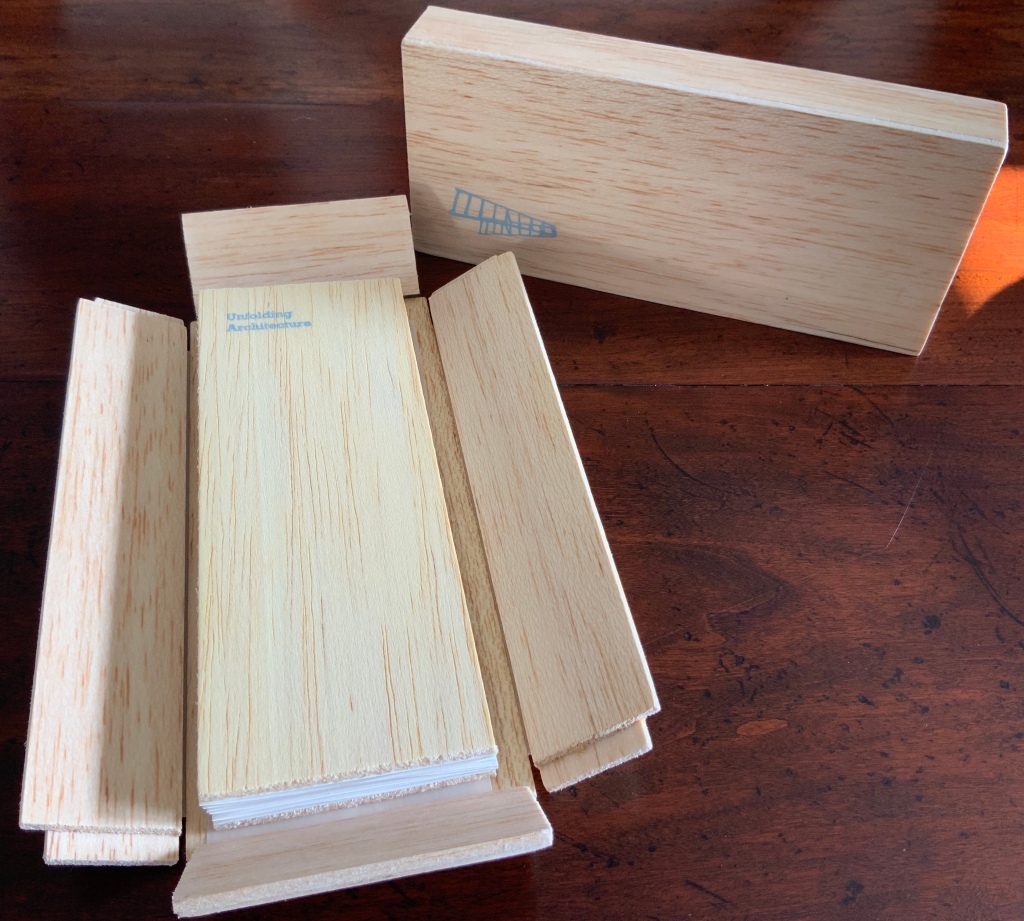
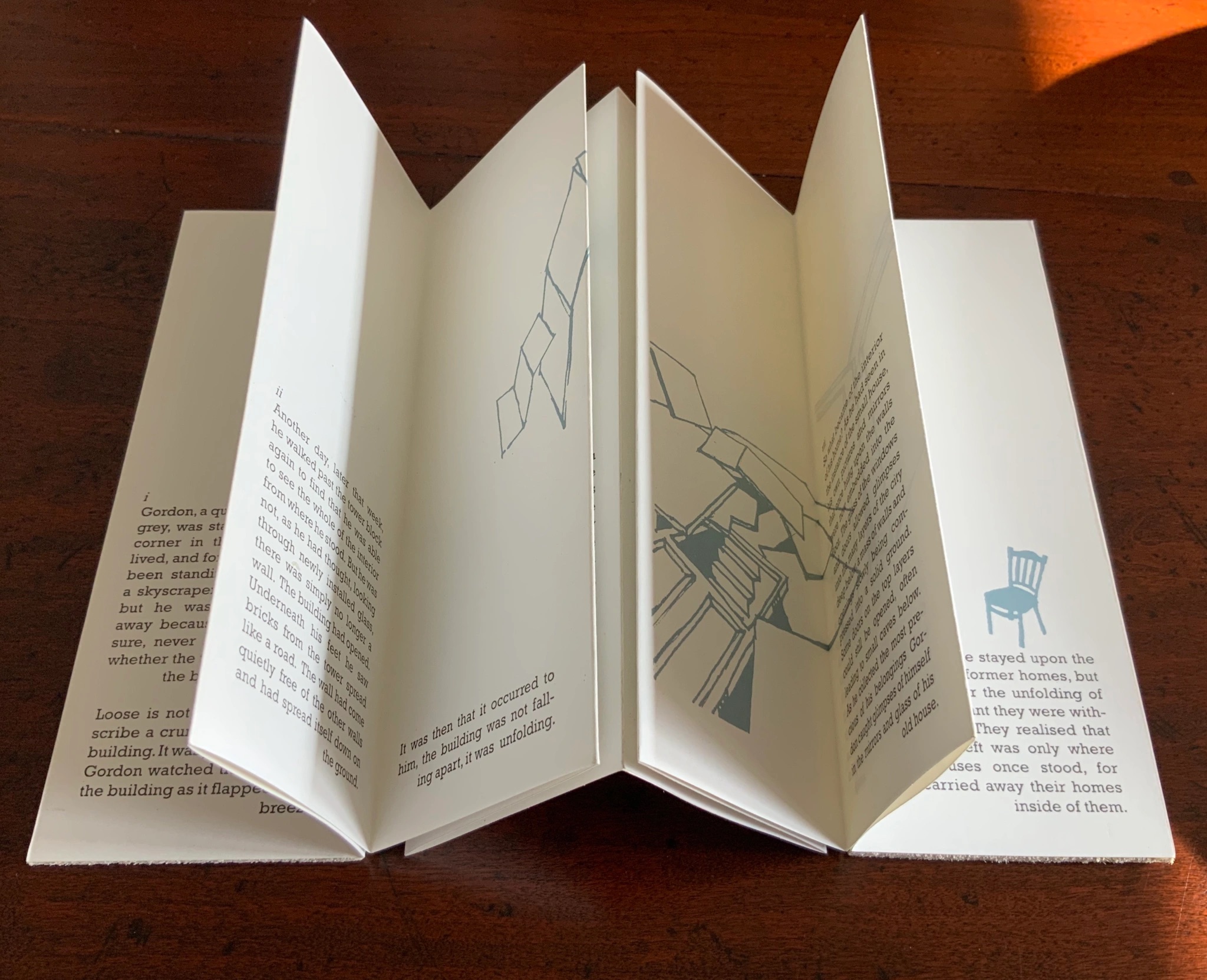
Unfolding Architecture (2007)
Emily Speed
Double-sided accordion book, attached to balsa wood covers, housed in a hinged, covered box of balsa wood. Book – H190 x W70 x D18 mm (closed), H190 x ~W2280 (open); Box – H203 x W88 x D63 mm; 24 panels, including cover panels. Edition of 90, of which this is #7. Acquired from the artist, 24 October 2020.

Karen Wirth

Architecture plays more than an inspirational role in Karen Wirth’s portfolio. As mentioned above, she has created her own take on Vitruvius’ Ten Books. She designed the Gail See Staircase at Open Book and the Hiawatha Light Rail Station, both in Minneapolis. The collage work Paper Architecture is based on an architectural installation at the Minnesota Center for Arts Design and draws on Wirth’s photos of Ayvalik, Amsterdam, Florence, Istanbul, New York City, Rome, San Diego and Venice.
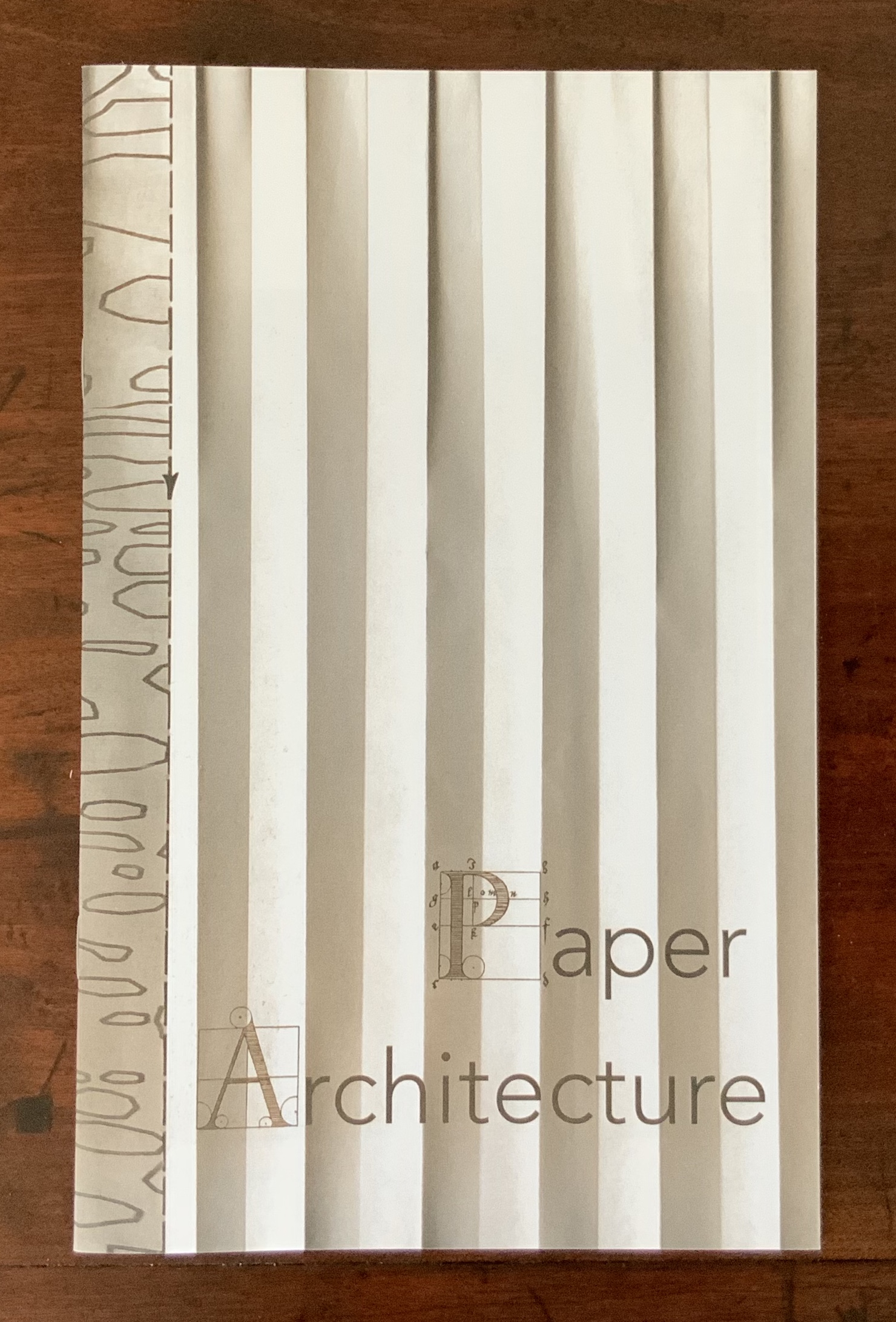
Paper Architecture (2017)
Karen Wirth
Photographs in the book © Karen Wirth
Photo: Books On Books Collection
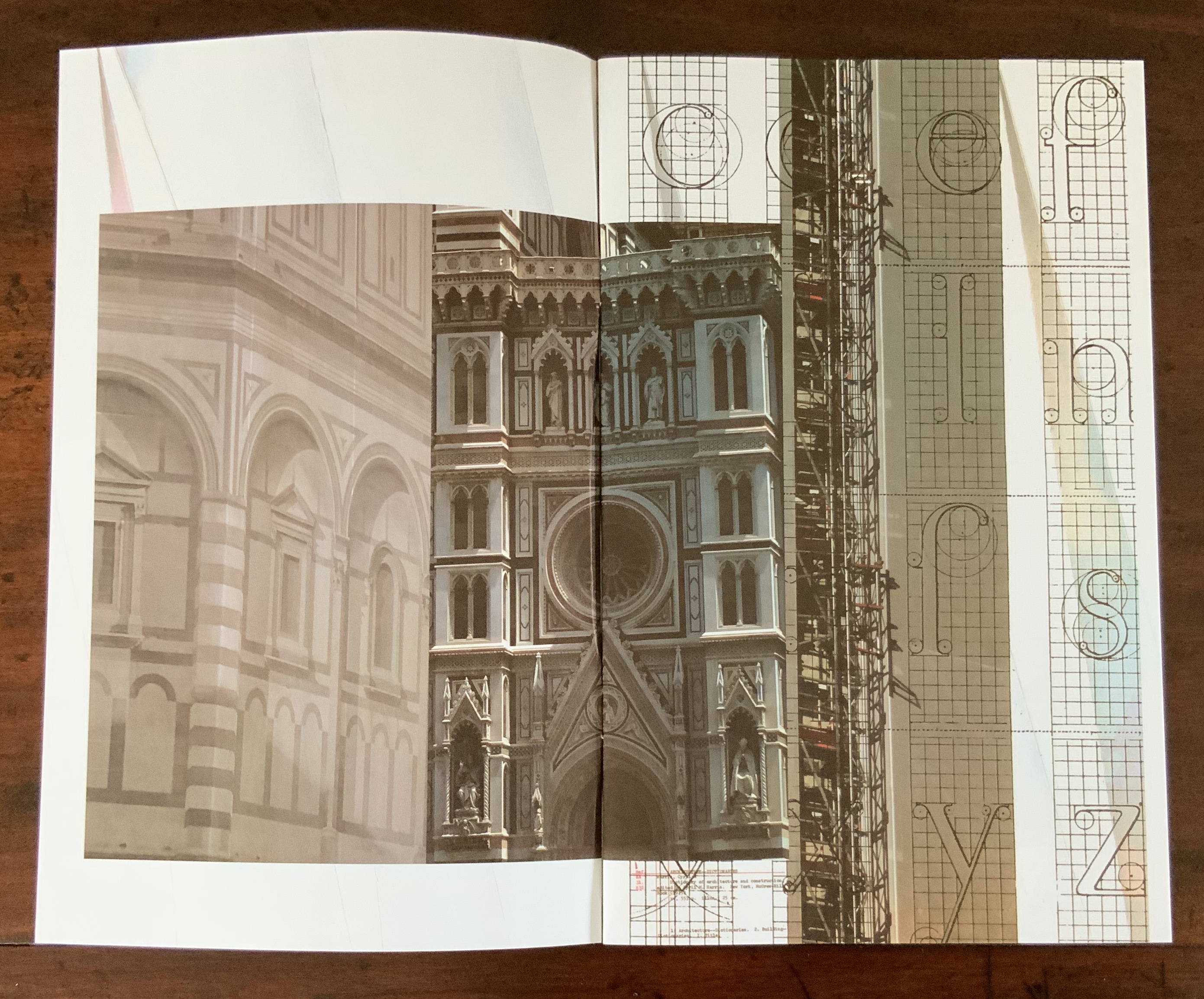
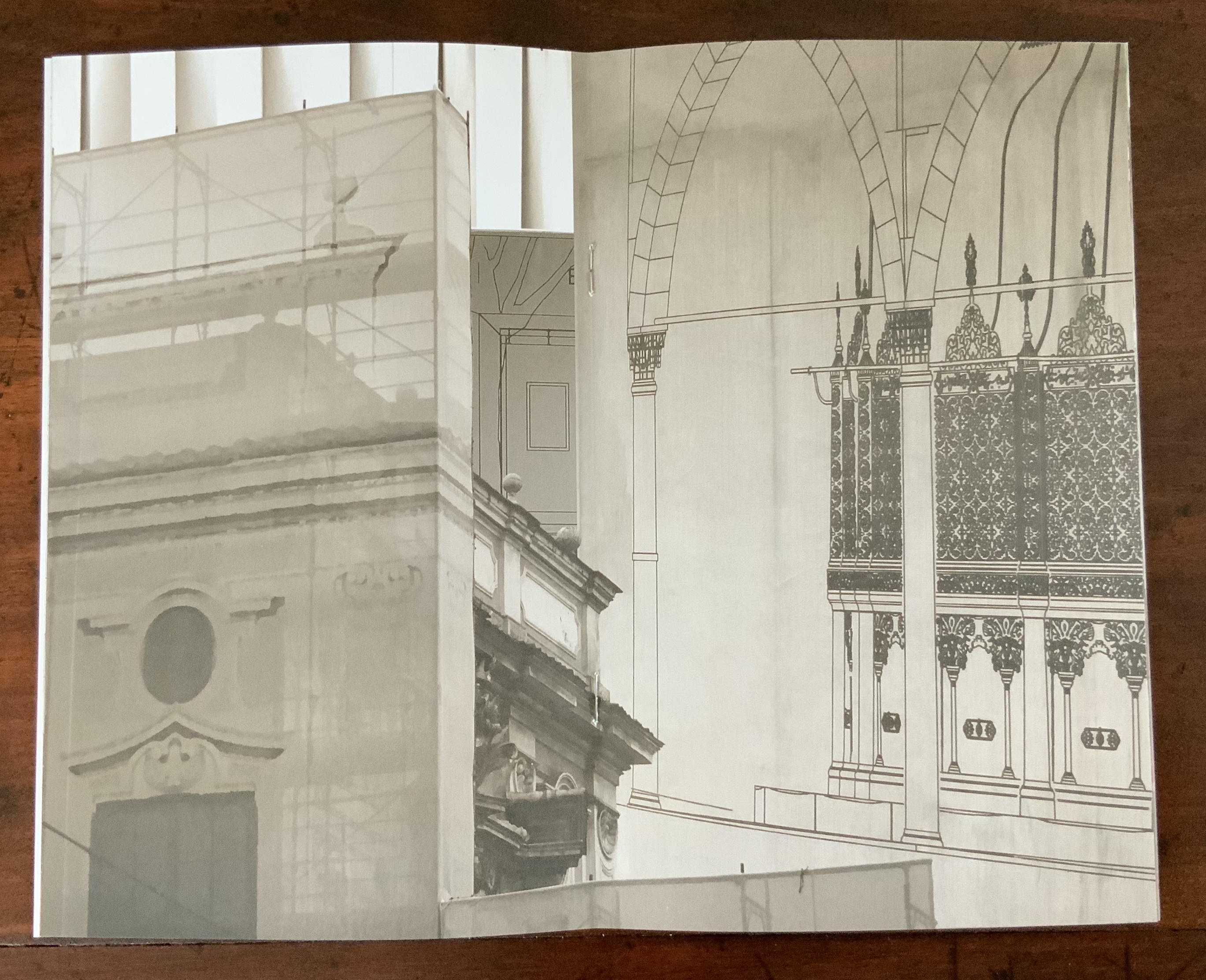
In The Embodied Image, Pallasmaa singles out “the collaged image” as creating “a dense non-linear and associative narrative field through initially unrelated aggregates, as the fragments obtain new roles and significations through the context and dialogue with other image fragments” (pp.71-72). The materially disparate words in the title of Wirth’s work imply the dialogues she creates among paper, designs of letters and architecture, buildings across time and the globe, and photos tinted, four-colour, and black-and-white in palimpsest.

For Wirth’s own comments about the intersection of book art and architecture, see her interview with Betty Bright.

J. Meejin Yoon

Former professor and head of the Department of Architecture at MIT’s School of Architecture and Planning, Yoon is now Gale and Ira Drukier Dean of the College of Architecture, Art and Planning at Cornell University. She is also cofounder of Höweler + Yoon, a design-driven architecture practice. Absence appears to be her only work of book art so far.

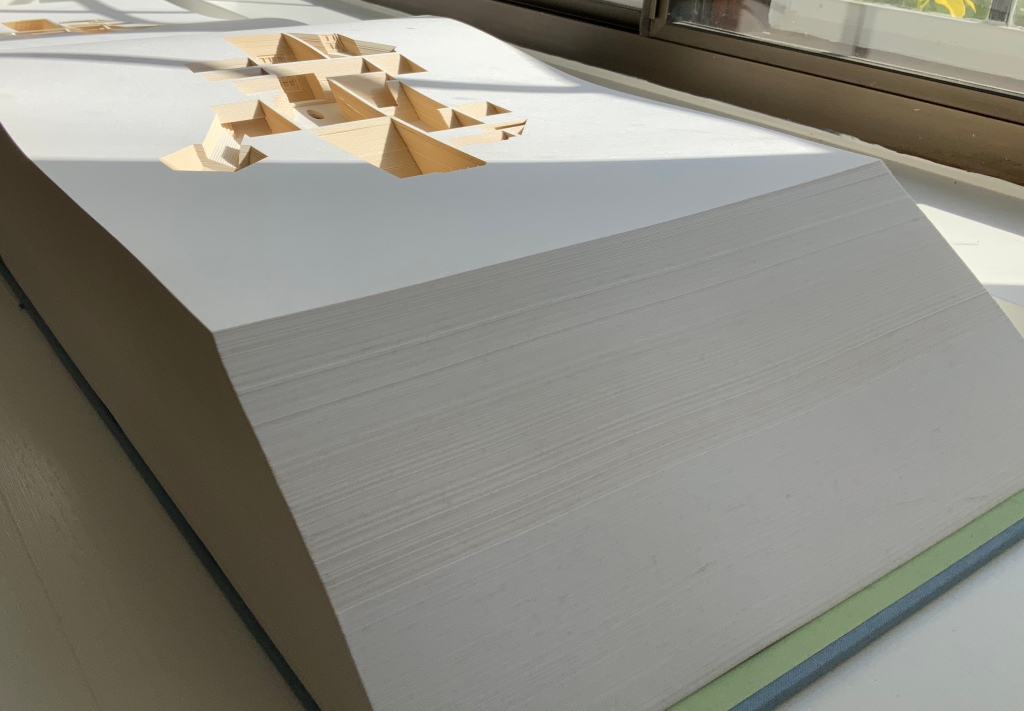
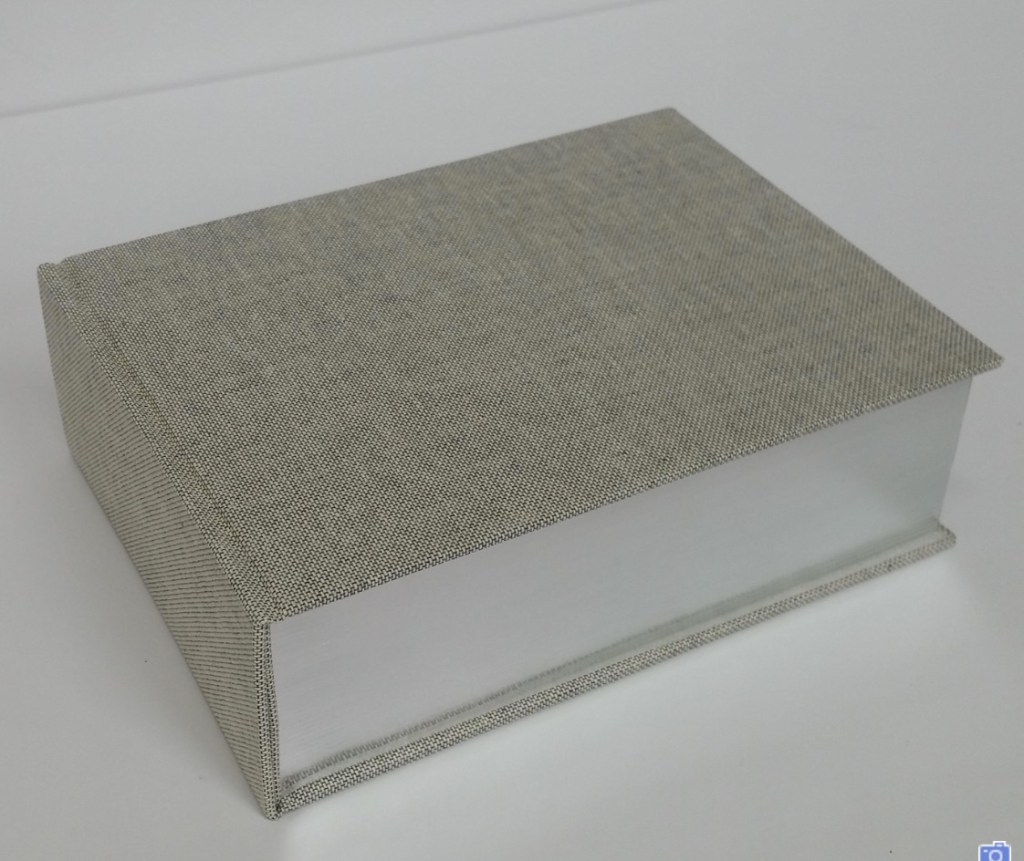
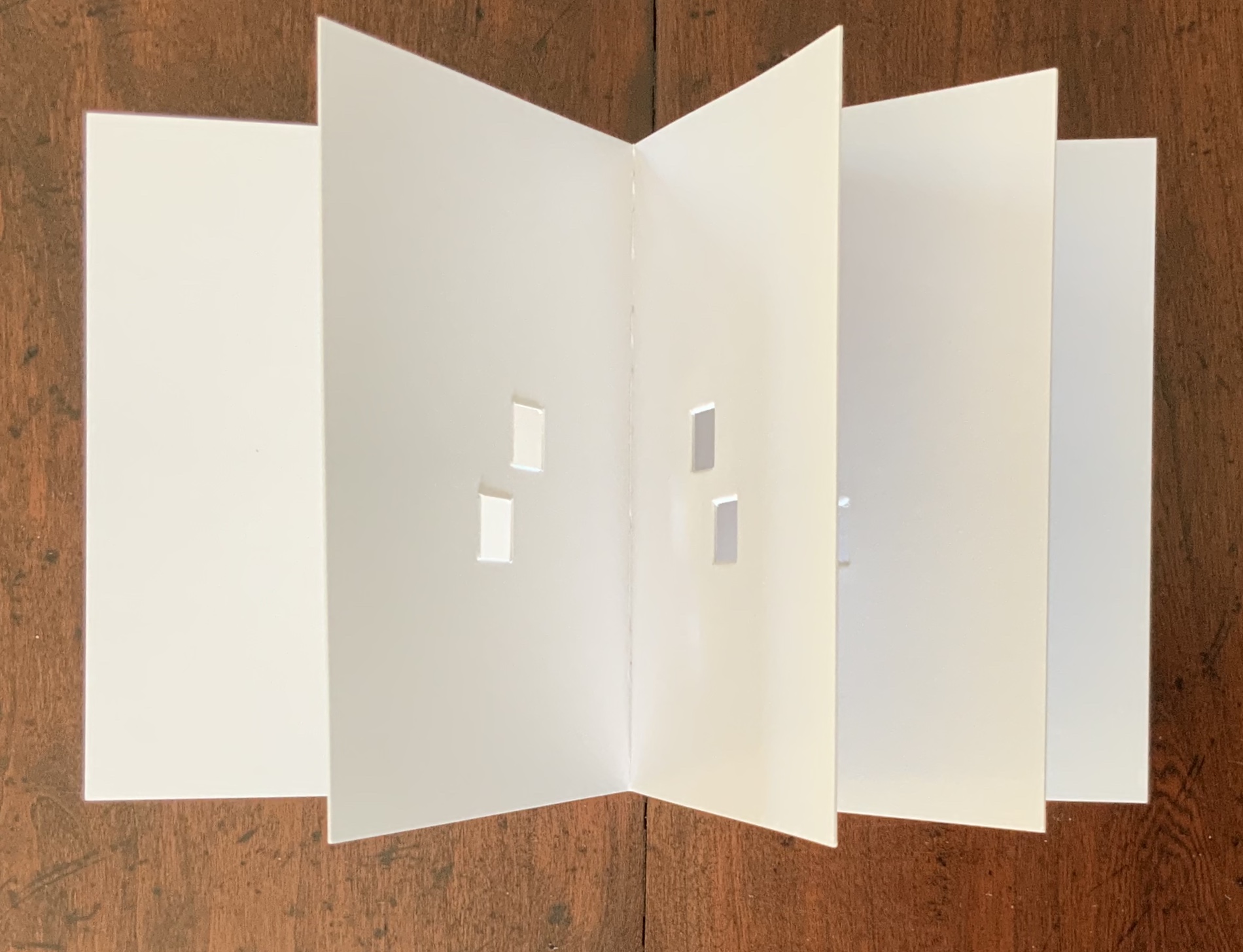
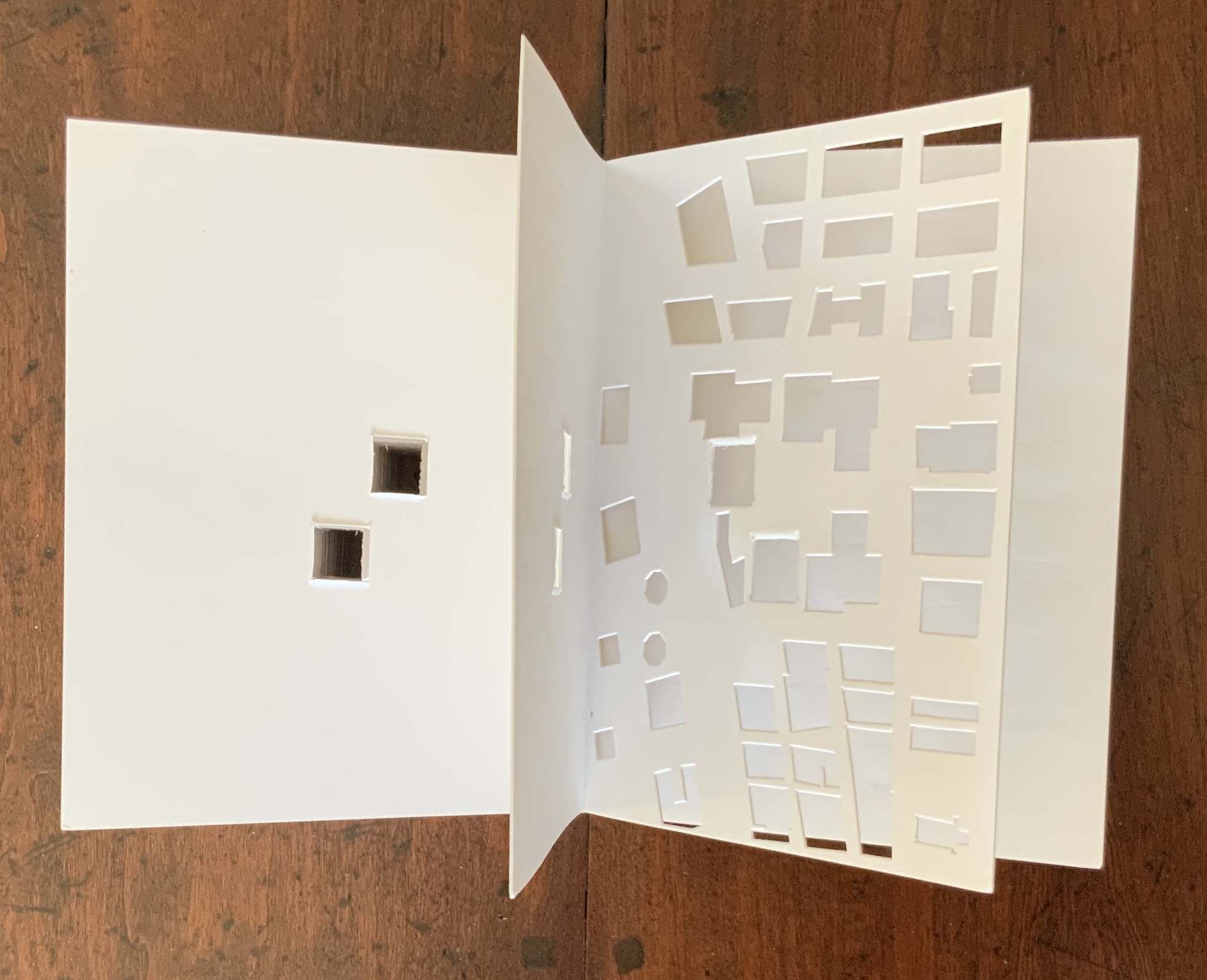
When you hold this small white brick of paper and turn its thick pages, a small pinhole appears on the page. Then two larger square holes emerge, one of which falls over the pinhole. Page after page, the two square holes repeat, creating two small dark wells in the field of white, until on the last page they take their place in the cut-out schematic footprint of the city blocks and buildings surrounding the Twin Towers of New York City. What you hold in your hands at the end is an object of art and book of memorial prayer.
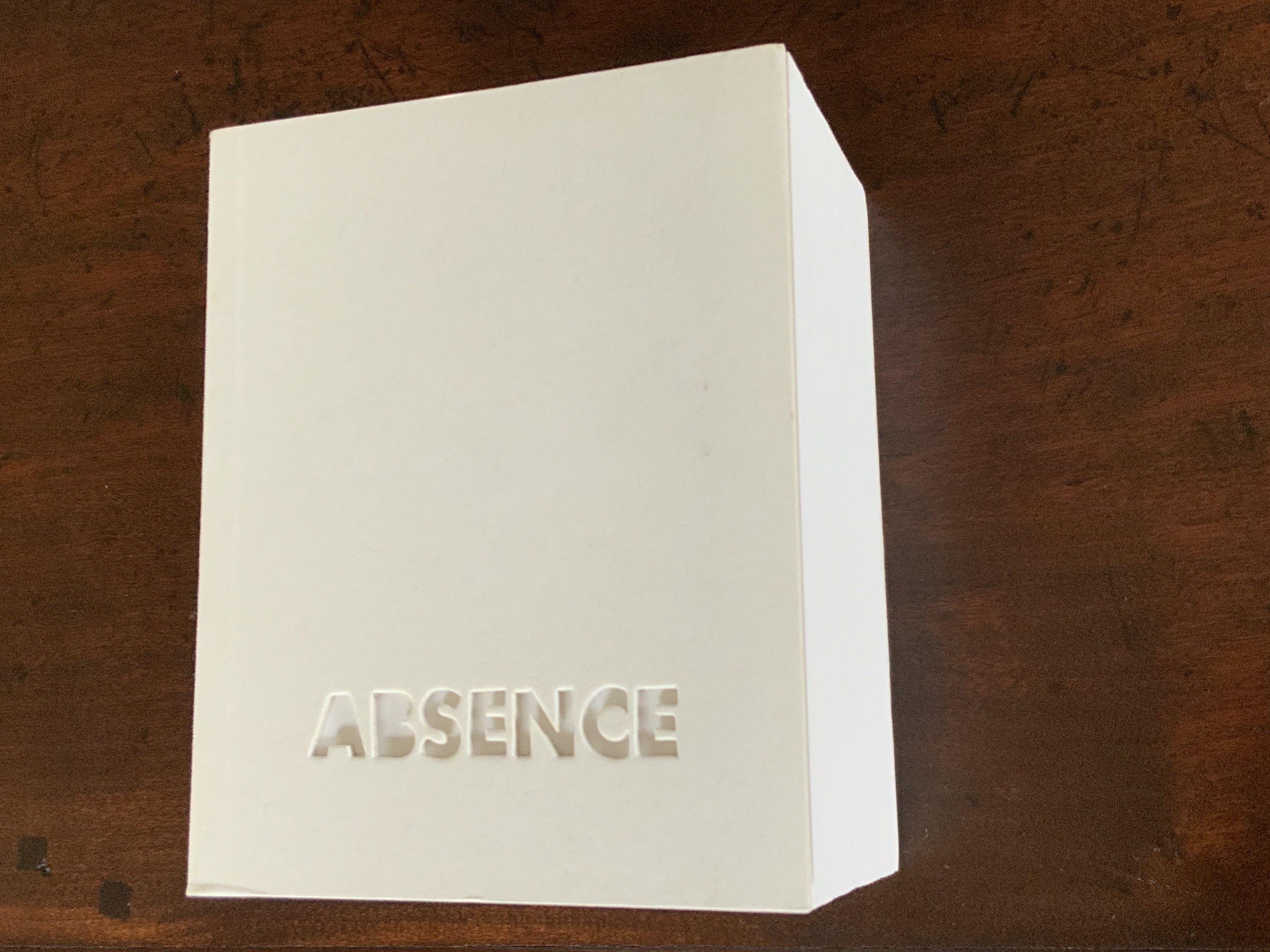
Absence (2003)
J. Meejin Yoon
Photo: Books On Books
Other sites, other works

Twice a semester, the Environmental Design Library at the University of California, Berkeley hosts “Hands On: An Evening with Artists’ Books”. In 2017, one evening’s theme was “Building on the Built”, illustrated by 25 works of book art. Organised by 23 Sandy Gallery in the same year, “BUILT“ was an international juried exhibition featuring 66 artist books by 51 artists examining the relationship between contemporary book art practices and architecture, engineering, landscape and construction.

Arranged alphabetically by artist’s name, this section provides links to works from these two exhibitions as well as other collections, exhibitions, installations and recommendations from the Book-Arts listserv members.

James Allen: The Golden Section (2016), Architectural Graphics (2018)
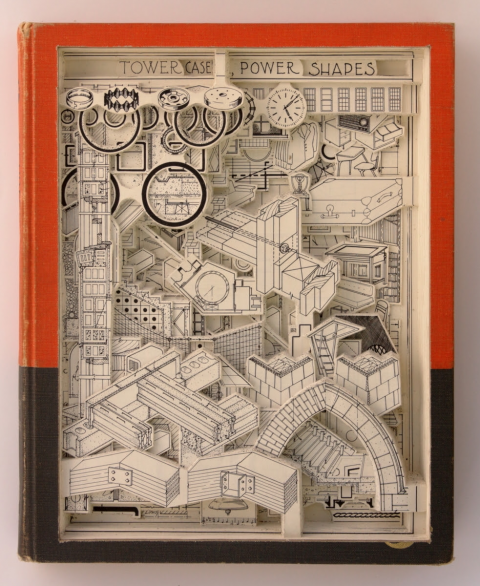
Architectural Graphics (2018)
James Allen
Photo: Courtesy of the artist

Charlene Asato: Black & White (2013)

Alicia Bailey: Cities & Eyes (2016)

Eleonora Gomez Bas: Home and Back (2021). See “One Body – Two Homes“, an episode of Artist’s Books Unshelved.

Carli Boisjolie: Places of Theirs (2016)

Amy Borezo: Raising the Supine Dome (2010)
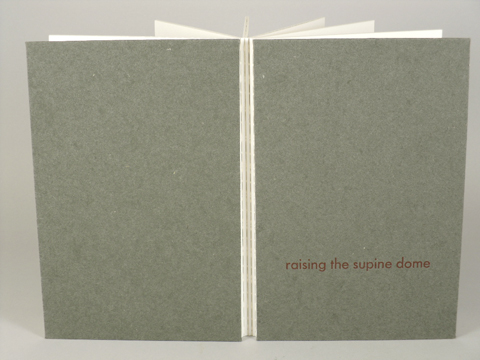
Raising the Supine Dome (2010)
Amy Borezo
Photo: Courtesy of the artist
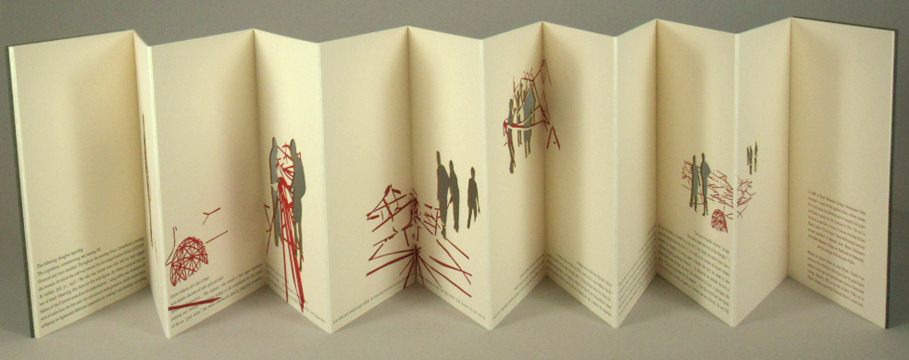
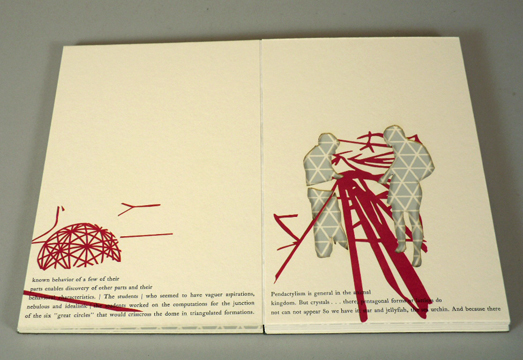
Inge Bruggeman: A Crisis Ethicist’s Directions for Use: Or How to be at Home in a Residence-cum-Laboratory (2003)
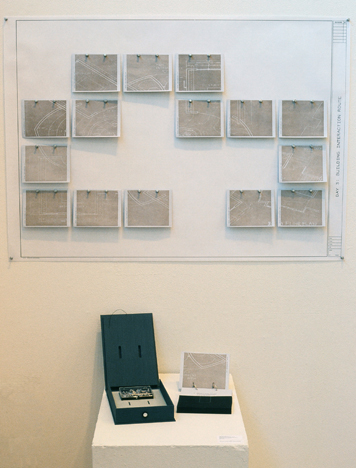
A Crisis Ethicist’s Directions for Use: Or How to be at Home in a Residence-cum-Laboratory (2003)
Inge Bruggeman
Photos: Courtesy of the artist

On her site, Bruggeman writes, “This book/box project is built around excerpts from Architectural Body by Madeline Gins and Arakawa…. incorporates a blueprint of their Bioscleave House as part of the imagery….”. Somewhat like A Clockwork Orange or perhaps more like Heideigger’s tomes, the Gins and Arakawa book is a challenge to the reader’s expectations of diction and syntax.

R D Burton: Structures II (2015)

Carol Chase Bjerke: Homage to Peter Mullin (2014)

Julie Chen and Barb Tetenbaum: Ode to a grand staircase (for four hands) (2011)

Susan Collard: Work in Great Cities (2011); Quixity (2017)

Guylaine Couture: Everyone Needs a Home (2017)

Laura Davidson: Ten Books of Vitruvius (1994), Venice : Piazza San Marco (2010)

Elsi Vassdal Ellis: Here is the church. Here is the Steeple. Here are questions for the people. (2017)

Alisa Golden: Woods in the City (2013)
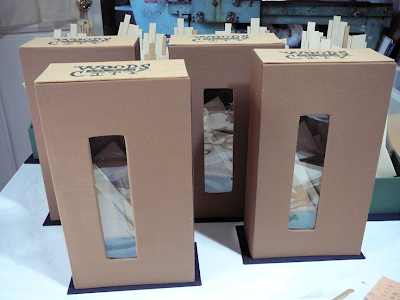
Woods in the City (2013)
Alisa Golden
Photos: Courtesy of the artist
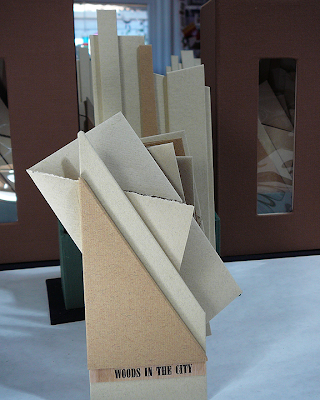
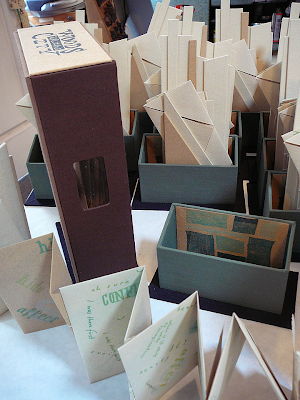
Christiane Grauert: Folding City (2016)

Karen Hanmer: The model architect: the panic of ’09 (2010)

Hongtao Zhou: Textscape-TONTSEN Eye (2019)

Textspace-TONTSEN Eye (2019)
Hongtao Zhou
Photos: Courtesy of the artist
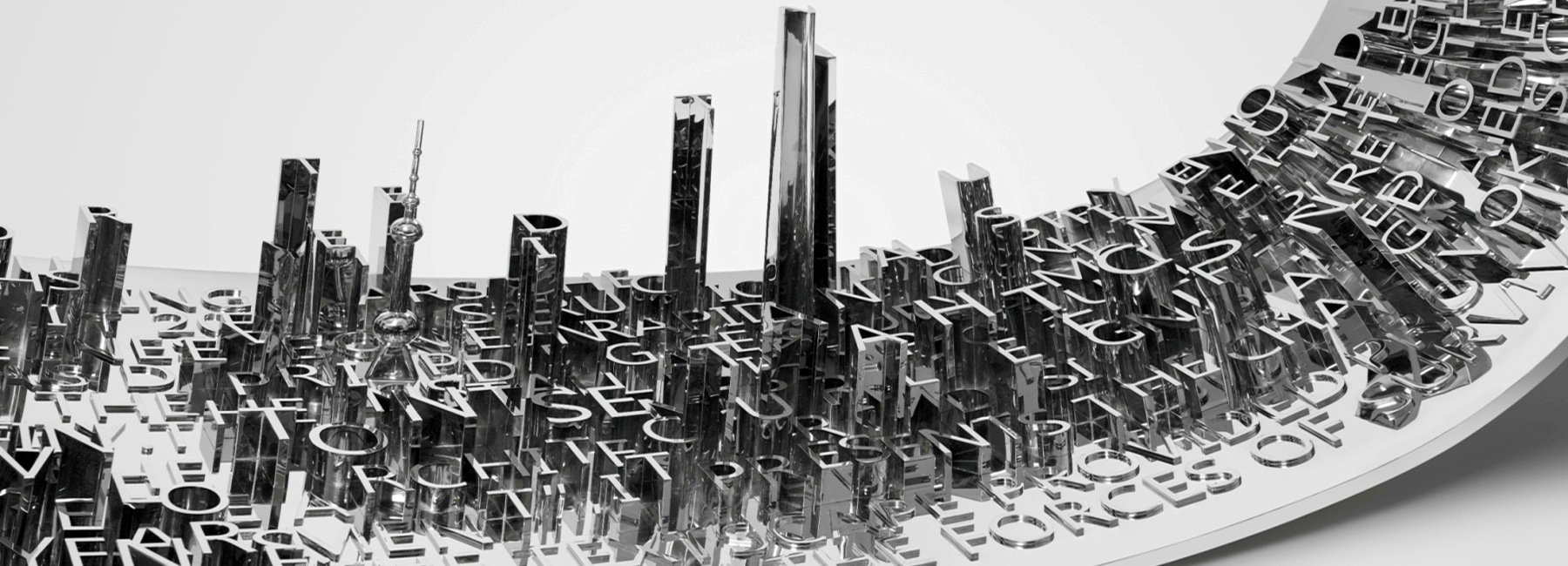
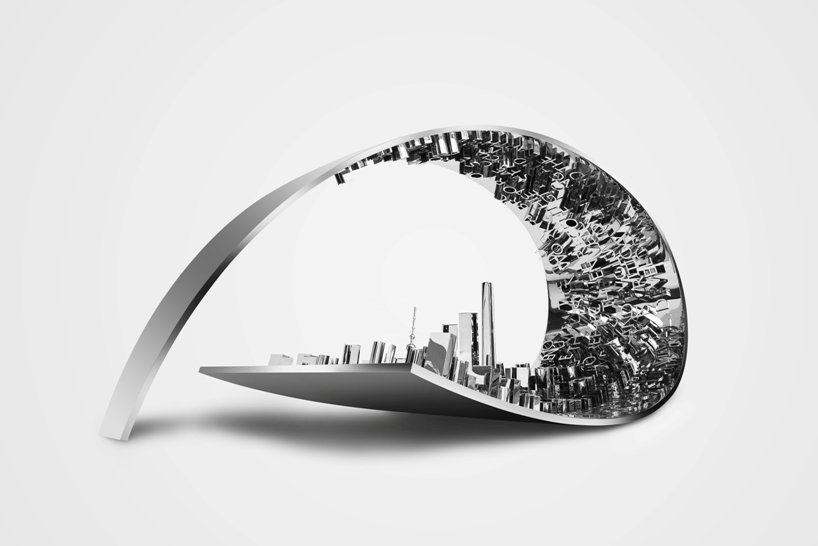
Johan Hybschmann: Book of Space (2009)

Ronald Keller: Palladio, Andrea (1508-1580): excerpts from the four books on architecture (2008)

Louise Levergneux: Finding Home (2016)

Marlene MacCallum: Townsite House Bookwork (2006). See also Gail Tuttle, The Architectural Uncanny (Newfoundland: Sir Wilfred Grenfell College of Art Gallery, 2007).

Susan Marsh: Building a Home (2022)

Richard Minsky: Model of Buckminster Fuller’s Tetrascroll (1979). See also Polly Lada-Mocarski, Richard Minsky and Peter Seidler, “Book of the Century: Fuller’s Tetrascroll“, Craft Horizons, October 1977 (Vol. 7, No. 35). For one (very helpful) reading of Tetrascroll see Jessica Prinz’s “The ‘Non-Book’: New Dimensions in the Contemporary Artist’s Book” in The Artist’s Book: The Text and its Rivals, a special two-issue volume of Visible Language, Vol. 25, Nos. 2/3, edited by Renée Riese Hubert (Providence, RI: Rhode Island School of Design, 1991), pp. 286-89.

Marta Minujín: El Partenon de Libros (1983)

Howard Munson: The Architects (2018)

Sumi Perera: Building Blocks Book XVII (2017). Further information available at Saatchi Art.
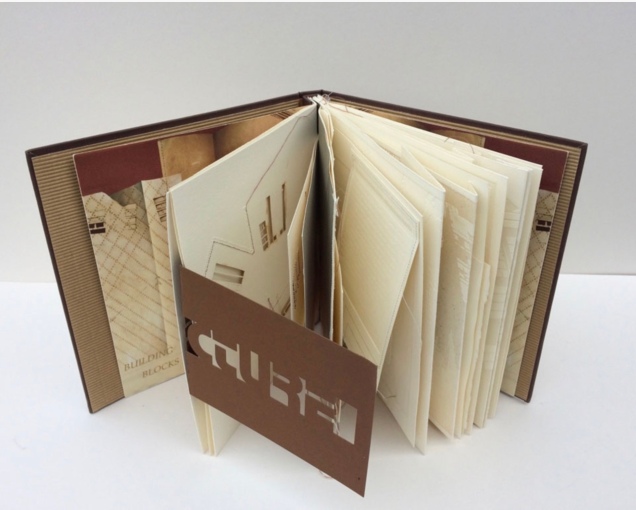
Building Blocks Book XVII (2017)
Sumi Perera
Photos by artist’s permission
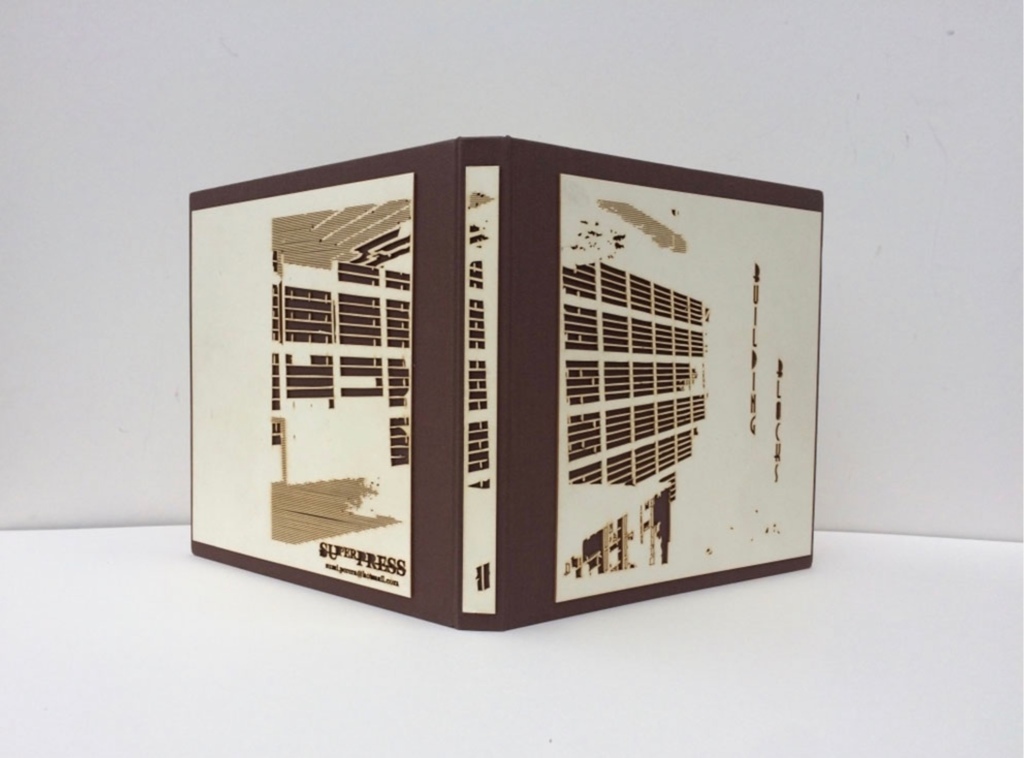
Going against the usual structure of the book, that of a beginning, a middle and an end, Perera provides a space for infinite possibilities and multiple authors, creating “modules that can be re-sequenced and re-aligned to develop variable permutations and encourage participatory involvement, to share the final editorial control with the viewer to transform the ever-evolving work”. These possibilities for variable permutations are no more evident than in her constantly evolving project, Building Blocks Book, and its numerous subsequent iterations including The Negative Space of Architecture and The House That Jack Never Built (2008). Once again we find Perera exploring human interaction, not only with the concepts and her quizzical ideas surrounding architectural and public spaces and how we build between and move within, but also the physical interaction with the artists’ books she produces – the rearrangement and reinsertion of pages which allow the audience and participants new opportunities and pathways to proceed. Through the positive and negative space of the page or the type font, the Underground versus over ground, the artist takes us on journeys that are at once fluid and at other times obstructive. In these cityscapes, the U-turn is as common as the page turn – a necessary rupture in a free-flowing narrative. Chris Taylor, From Book to Book (Leeds: Wild Pansy Press, 2008).

Chris Perry: 210 Ripples (red(tide))

Maria G. Pisano: Tunnel Vision (2004), Hecatombe 9-11 (2007)

Laura Russell: Casa Mila (2006)

Kazumi Seki: Two Homes (2018). See “One Body – Two Homes“, an episode of Artist’s Books Unshelved.

Robbin Ami Silverberg: Home Sweet Home (2006). Artist’s description — “an architectural album of an imaginary middle-class suburban house, … its plans and layout [filled] with the many proverbs I’ve found about women in the home. The book was printed to look like the almost obsolete technique of Diazo printing (blue-printing), but in fact, it is archival inkjet.”

Clarissa Sligh: What’s Happening with Momma? (1988)

Marilyn Stablein: Grids, Lines, Blocks: Basics Tools to Build Linear Habitats (2017)

Barbara Strigel: Visible Cities (2016)

Barb Tetenbaum: Portland/Living (2020).

Nikki Thompson: A Tribute to Alvar Aalto (2008)
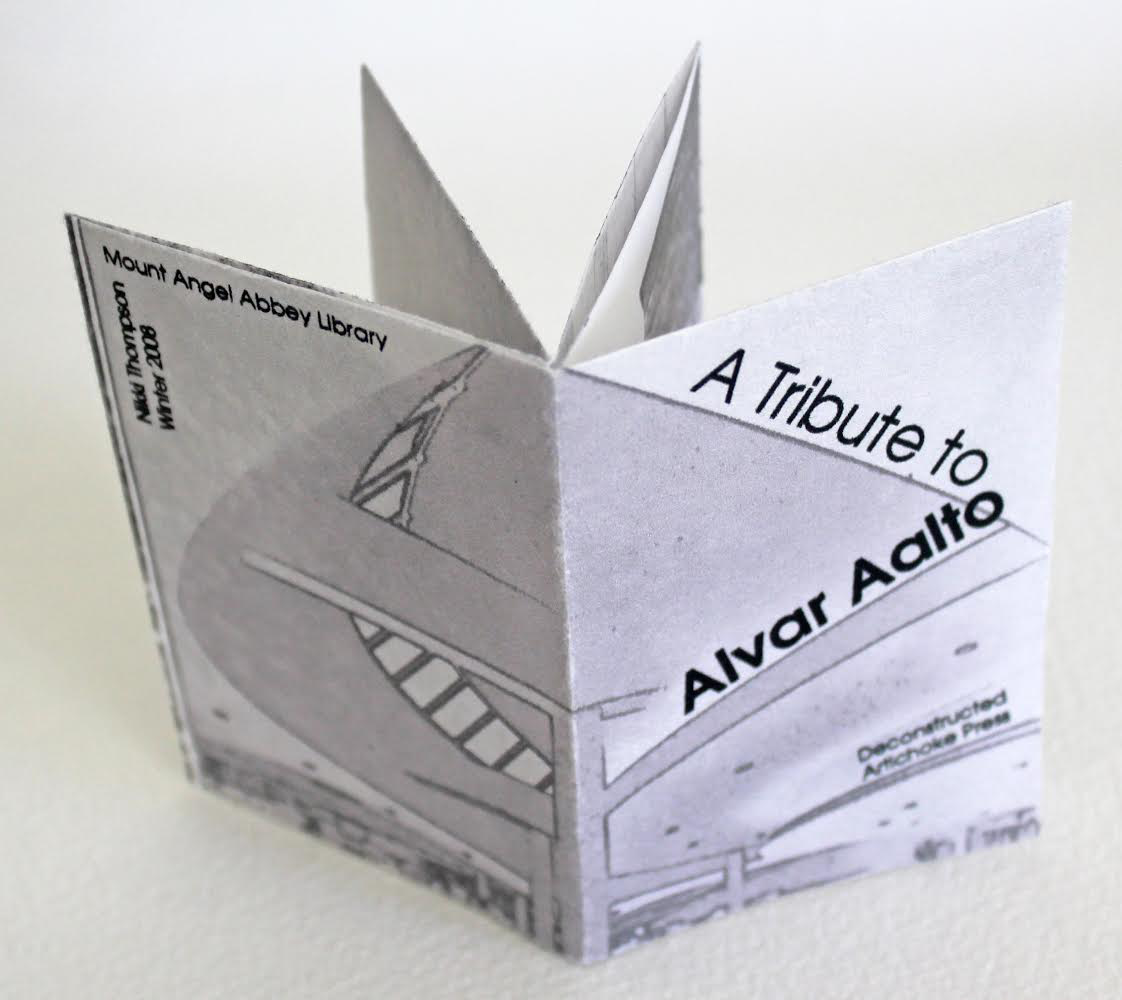
A Tribute to Alvar Aalto (2008)
Nikki Thompson
Photos: Courtesy of the artist
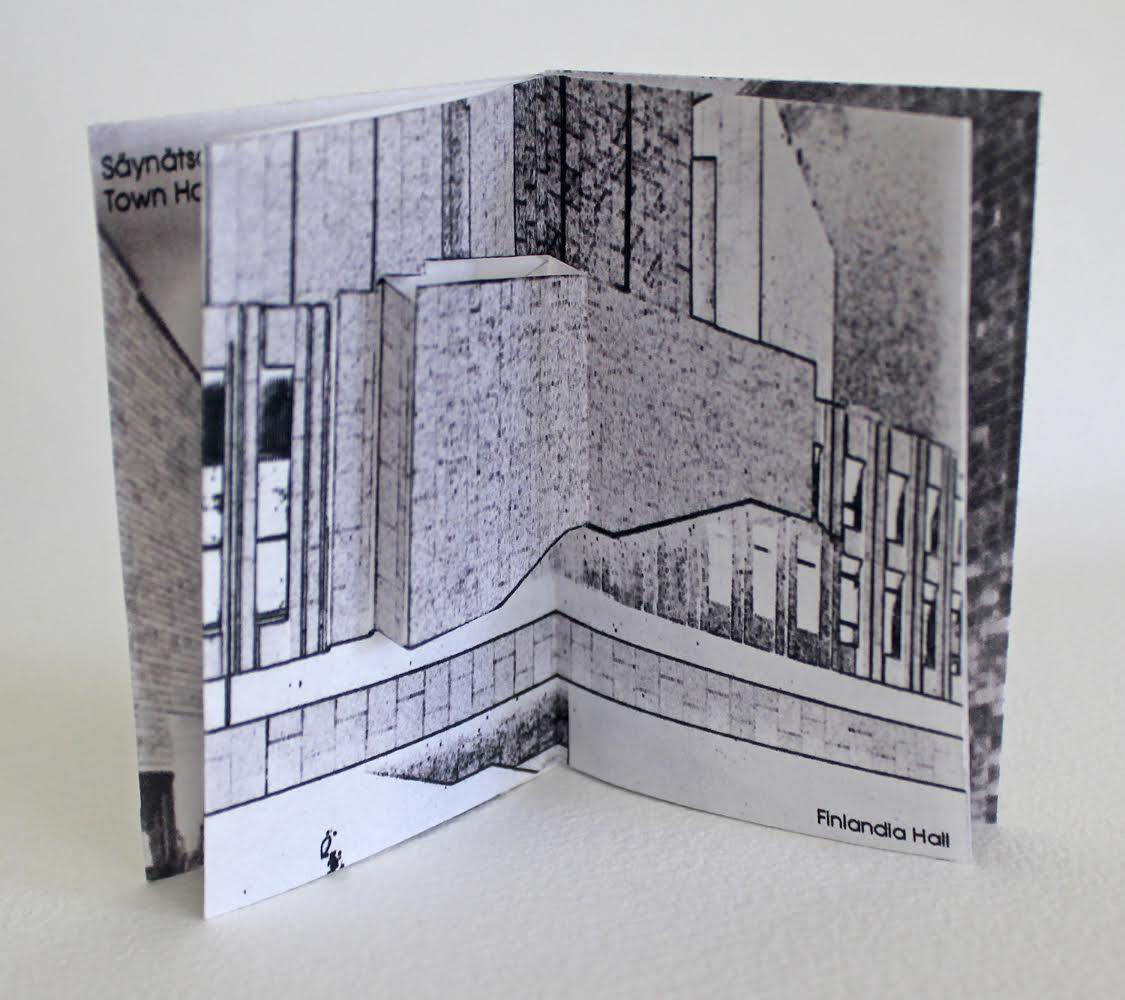
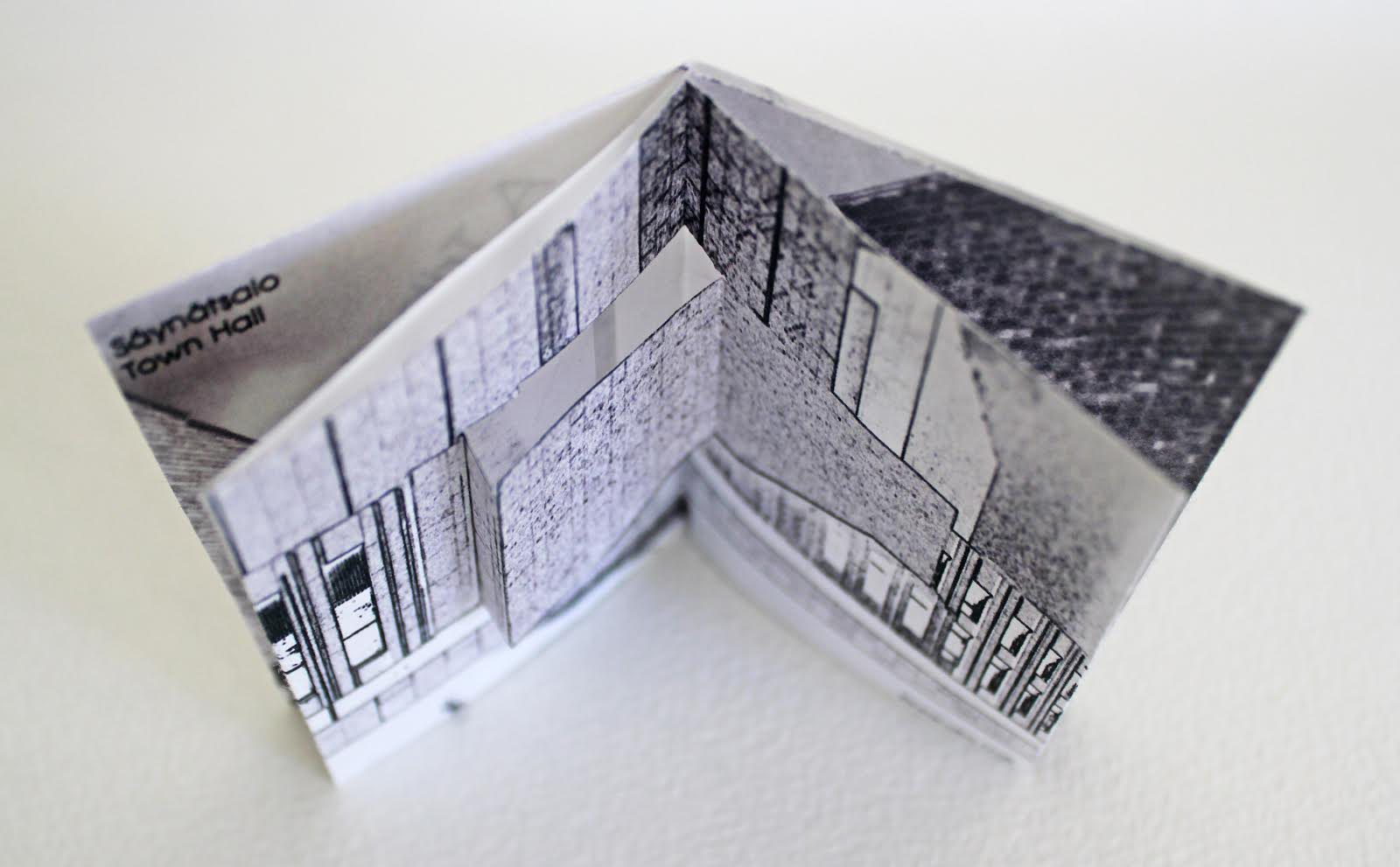
Andrew Topel: Blueprints (2012)

Delia Touché: Home Is Where the Buffalo Used to Be (2023). 

Christine Trexel: Building the Universe (2017)

Rachel Whiteread: Nameless Library (2000)

Amanda Watson-Will: The Great Library (2011)

Sara White: A Family Attic (2014), There: an archive of built places (2015) and Riverine (2016)

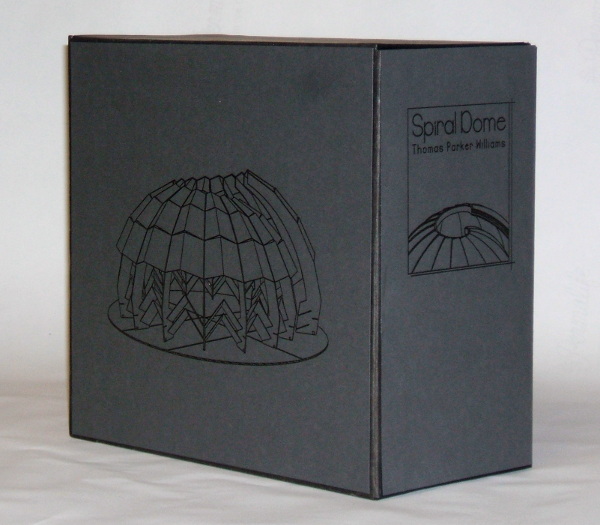
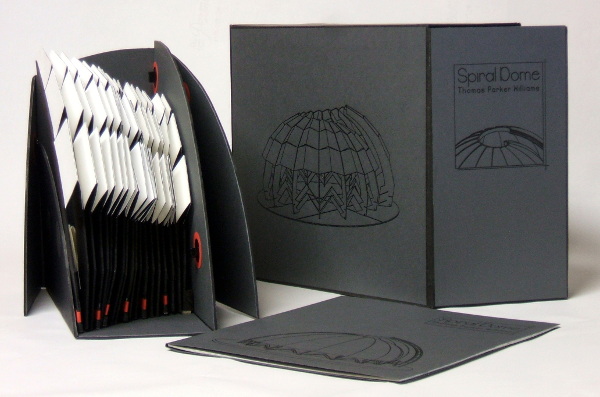
Thomas Parker Williams: Spiral Dome: Sculptures in Paper and Steel (2016)
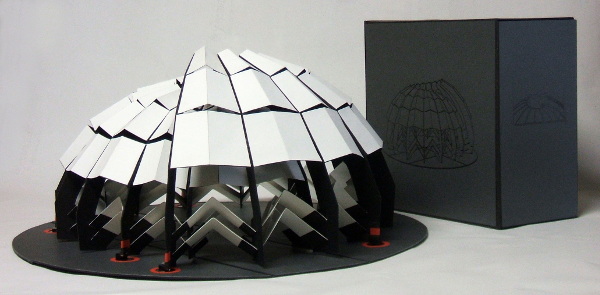
Spiral Dome: Sculptures in Paper and Steel (2016)
Thomas Parker Williams
Photos: Courtesy of the artist
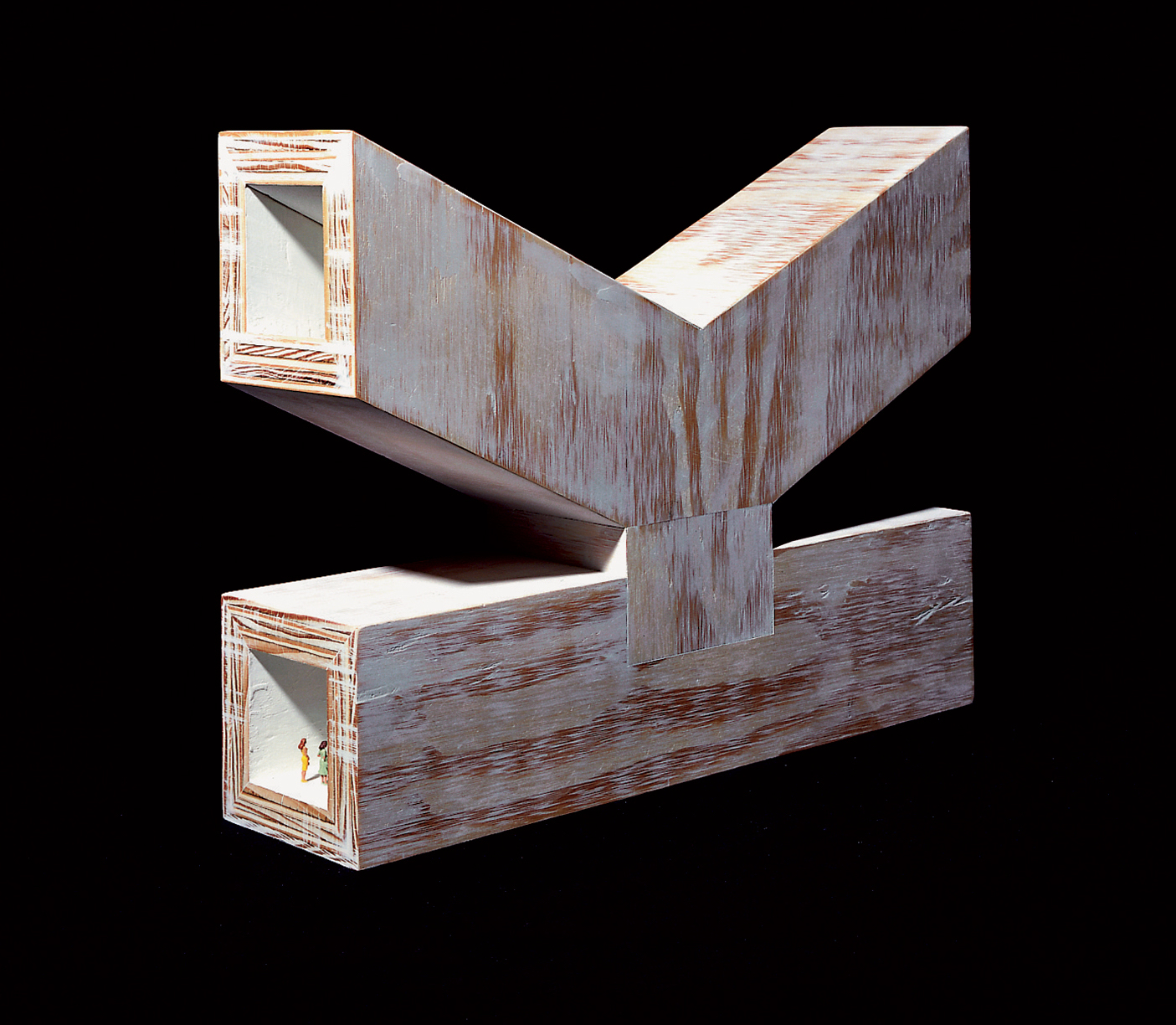
Update: With the addition of Marian Macken’s book Binding Space, mentioned above, comes the Vedute Foundation, a collection of objects/manuscripts by artists/designers/architects created within the constraint that each work has the proportion of the Gutenberg Bible and the relationship of ‘Text’ and ‘Form’ as its subject. For this essay in Books On Books and for the Books On Books Collection’s acquisition of the Merrion edition of Johann David Steingruber’s Architectural Alphabet, the most apropos and favorite work in the Vedute collection is K (1996) by Peter Wilson.
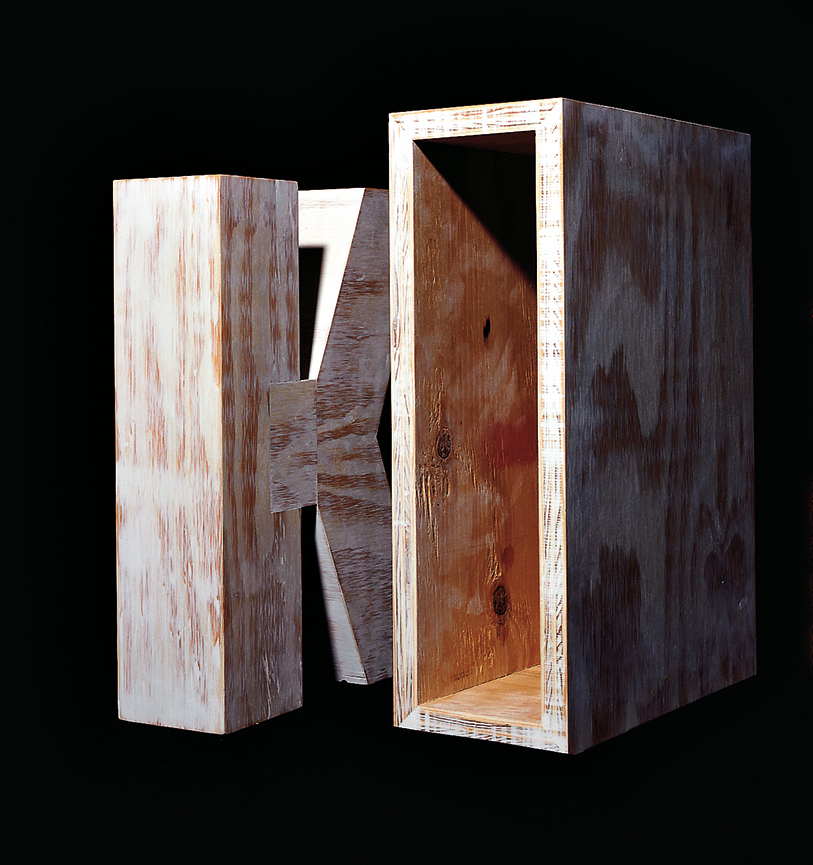
K (1996)
Peter Wilson
“This contribution (a double volume) is based on the letter ‘K’ (an atom of language), materialised within the Gutenberg proportions in sturdy plywood. It is the responsibility of an architect not only to ‘give form’ but also to explore latent interiorities, potential spatialities. Here the ‘K’ interior has its own inherent geometric agenda − a tunnel, a tube, an inverting telescope (apex mirror). Object becomes instrument (a window to the antipodes even), a trigger for multiple ‘K’ vectors (textural and spatial).” Bolles+Wilson

Further Reading

Celebrating the 250th Anniversary of Steingruber’s Architectural Alphabet“. 1 January 2023. Books On Books.

23 Sandy Gallery. 2017. Built: an international exhibition of contemporary artist books, April 7-May 27, 2017. Portland, Oregon: 23 Sandy Gallery. “… examining the relationship between contemporary book art practices and architecture, engineering, landscape and construction as form, function and structure. Book artists took this opportunity to re-image the ways we as designers, of either books or buildings can inhabit and shape the world around us. Our disciplines have a natural synergy. After all, books and buildings are both kinetic, sequential, structural and time based. BUILT examines the relationship between the built and the book. BUILT features 66 artist books by 51 artists from across the country and as far away as Canada, United Kingdom and Australia.” Publisher’s website.

Sophia Kramer, “Variations of Vitruvius: Four Centuries of Bookbinding and Design”, The Met, 22 August 2018. This essay reviews and illustrates the conservation and rehousing of ninety-five copies of De Architectura libri decem (The Ten Books of Architecture) by Marcus Pollio in the collection of the Department of Drawings and Prints. They are part of a donation of 356 publications from the architect William Gedney Beatty (1869–1941). For book artists, the section on a 1556 edition with double volvelles to display a theater design should be of interest.

Marian Macken, Binding Space: The Book as Spatial Practice (London: Taylor and Francis, 2018). A trained architect and book artist, Macken articulates and illustrates the how and why of the overlap between architecture and book art.

David Sume, The architectural nature of the illustrated books of Iliazd : (Ilia Zdanevich, 1894-1975, University of Montreal, 2019. This dissertation is a reminder that the importance of architecture to book art reaches back to the avant-garde and modernists of the early 20th century — and more important, that its importance may lie beneath the surface.

Elizabeth Williams, “Architects Books: An Investigation in Binding and Building”, The Guild of Book Workers Journal, Volume 27, Number 2, Fall 1989. This essay not only pursues the topic of architecture-inspired book art but turns it on its head. An adjunct professor at the time, Williams set her students the task of reading Ulises Carrión’s The New Art of Making Books (Nicosia: Aegean Editions, 2001) then, after touring a bindery, “to design the studio and dwelling spaces for a hand bookbinder on an urban site in Ann Arbor, Michigan”. But before producing the design, the students were asked “to assemble the pages [of the design brief and project statement] in a way that explored or challenged the concept of binding”. In other words, they had to create bookworks and then, inspired by that, create their building designs. Williams illustrates the essay with photos of the students’ bookworks. [Special thanks to Peter Verheyen for this reference.]
Bookmarking Book Art – Update: the John Jarrold Printing Museum Saved!

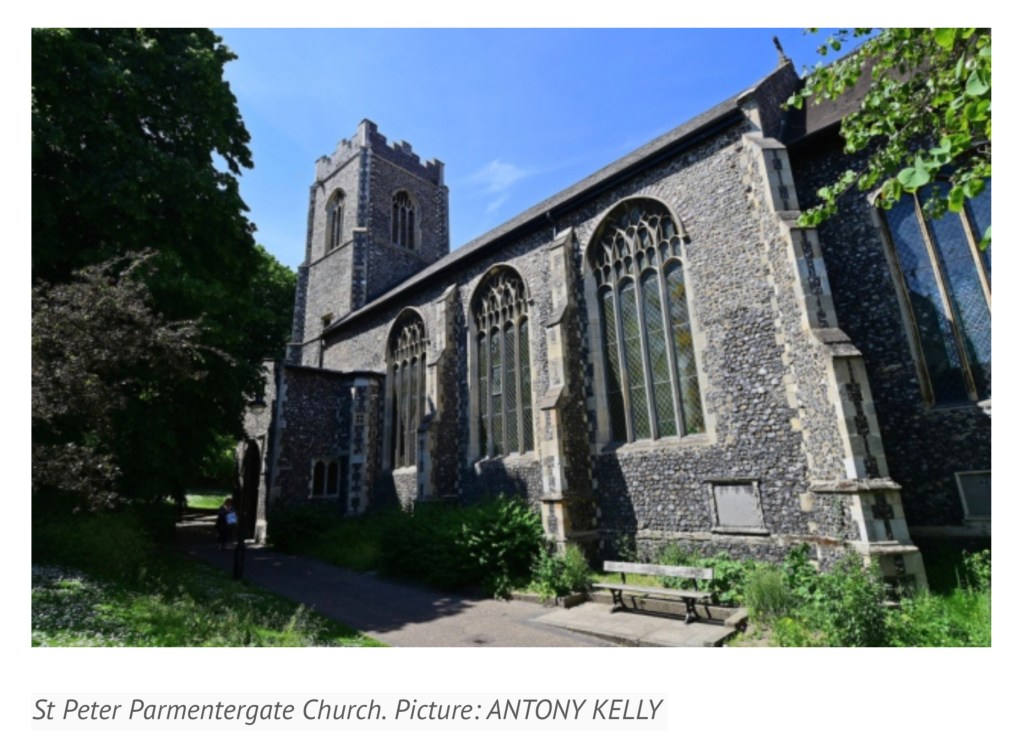
Last November, the post below appeared under the title “Saving the John Jarrold Printing Museum”. News has arrived that the museum will be renamed the “Norwich Printing Museum” and moved to St. Peter Parmentergate in King Street, Norwich. The Norwich Printing Museum’s volunteer supporters aim to open it in the summer 2020.

How fitting it would be if the organisers of the Leiden Book Arts Fair, held in St Pieterskirche, Leiden, every November, were to celebrate the event next year. The connections between The Netherlands and Norwich/Norfolk run deep. And, given that the great-great-grandson of John Folger who came to America from Norwich in 1635 and settled in Watertown, MA, was Benjamin Franklin, arguably America’s “uncle of printing”, how fitting it would be if the members of the New England chapter of the American Printing History Association played printer’s devil to the affair.

Congratulations to Jules Allen and the NPM volunteers and thanks to Caroline Jarrold for this outcome.

Posting from 8 November 2018:

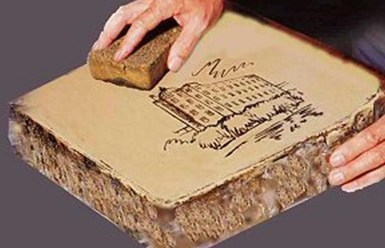
Litho stone featuring the St James Mill building in Norwich. Image: JJPM
From Print Week, 26 September 2018

The John Jarrold Printing Museum in Norwich, England, is one of the few working print museums in the world. Here’s a selection of ten from among its hundreds of holdings: 

  • Star wheel etching press. Wood & Company, West Smithfield, London. 1858. No.1250. Donated by Midlands Art Centre, Birmingham, June 2010. 
  • Albion. Hopkinson & Cope, Finsbury. 1845. No. 1900. From Mr Gott of Watts & Rowe, King’s Lynn.
  • Albion. Hopkinson. Jonathan & Jeremiah Barrett, executors of R. W. Cope, Finswbury, London. 1840. No. 1273. From William Booth, Woodbridge.
  • Columbian. Probably George Clymer. c.1845. Was purchased new by Jarrold & Sons Ltd, and was their longest serving machine. (Lent to the Norwich School of Art for the Caxton Quincentenary).
  • Stanhope. 1825. Donated by Cambridge University Press. 
  • Side-lever lithographic hand press. Hughes & Kimber. ex Norwich College of Art & Design.
  • Top lever lithographic hand press. D. & J. Greig, Lothian Road, Edinburgh. c.1840. 24 x 17 in. Presented to John Jarrold Printing Museum, May 1999 by Geoffrey Dunn, 22 Henry Drive, Leigh on Sea, Essex, SS9 3QQ.
  • Ratcliff direct lithographic press. John Ratcliff & Sons Ltd, Wortley & Leeds. 1927. Double demy. Donated by Curwen Studios, London. Thought to be the only surviving example.
  • Furnival stop-cylinder. 1984. Double demy. Donated by H. Hawes, Elmswell.
  • Heidelberg one-revolution cylinder press, c.1950. Donated by Jarrold & Sons Ltd. Heidelberg. Schnellpressenfabrik A.G. Heidelberg, Germany.

The developers aiming to tear down the building that houses the John Jarrold Printing Museum have mooted keeping some of the older printing presses now there and using them as mood or accent pieces for the café to be built as part of their residential development plans. 

Anyone caring to comment can do so on the Norwich City Council planning site.

Bookmarking Book Art – Monique Lallier

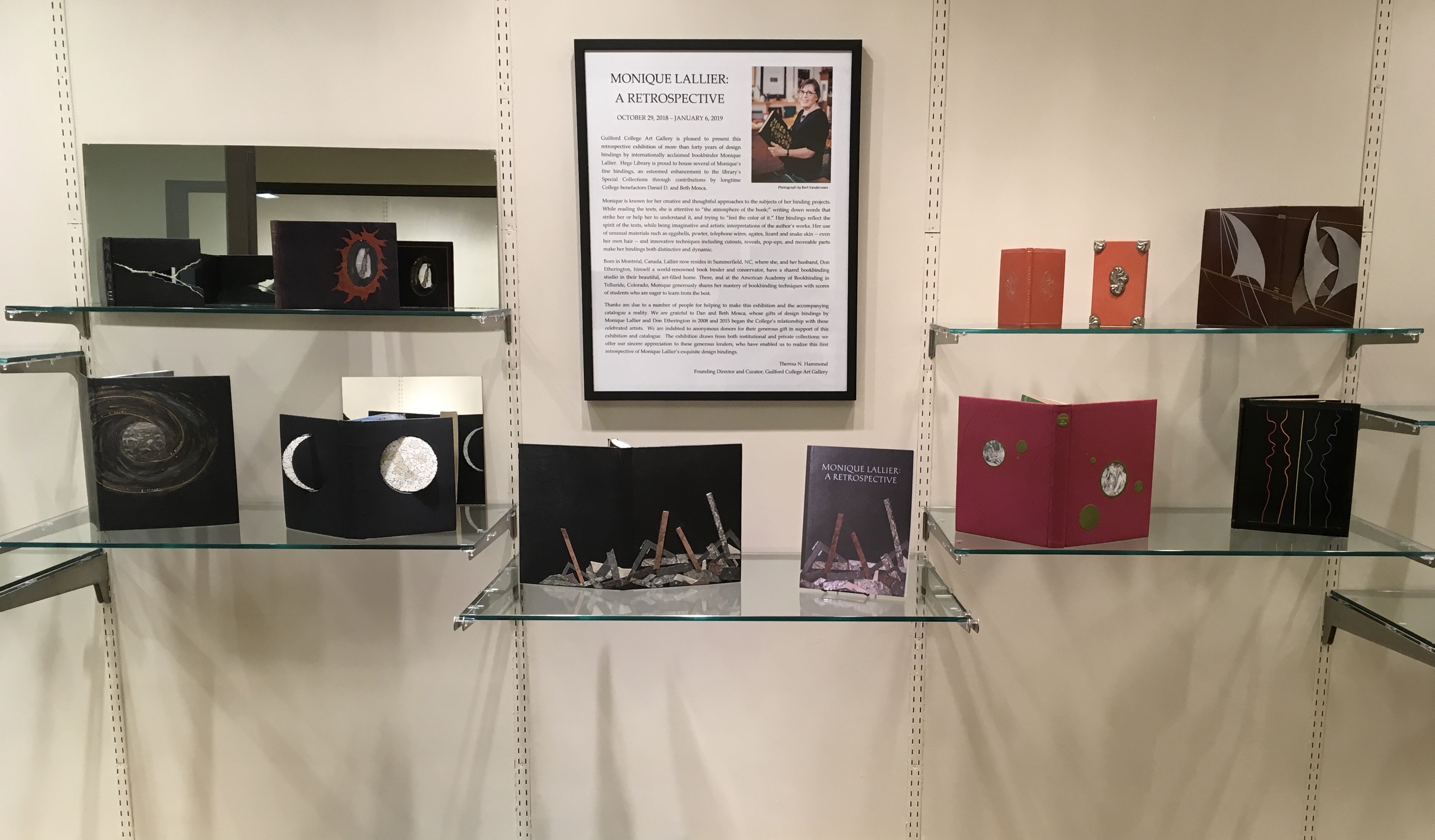
Monique Lallier: A Retrospective
Guilford College Art Gallery

North Carolina can be a quiet state of hidden gems. Particularly those of the book arts, book art and publishing variety. The art gallery fronting the library on the Quaker-founded Guilford College campus in Greensboro is one such gem. Within that gem for the next two months is another.  The Gallery’s director and curator Theresa N. Hammond has marshaled its collection of Monique Lallier’s bindings and dozens of others from around the world for a retrospective on forty-six years of work by Lallier.

Lallier’s roots are in the tradition of fine French binding, which goes back to the practice of book buyers’ purchasing unbound books and taking them to their favorite specialist binder for customized binding, most often in leather. Lallier has written here about the technique in detail. While it is true to call Lallier a bookbinder, it misses what the displayed works say she is: a sculptor and artist of the book. For anyone lucky enough to visit Guilford College Art Gallery, the comments and photos below offer a handful of pointers to details and background supporting that statement. The exhibition catalogue including an insightful essay by Karen Hanmer as well as multiple views of the works displayed and several outside the exhibition will clinch the argument.

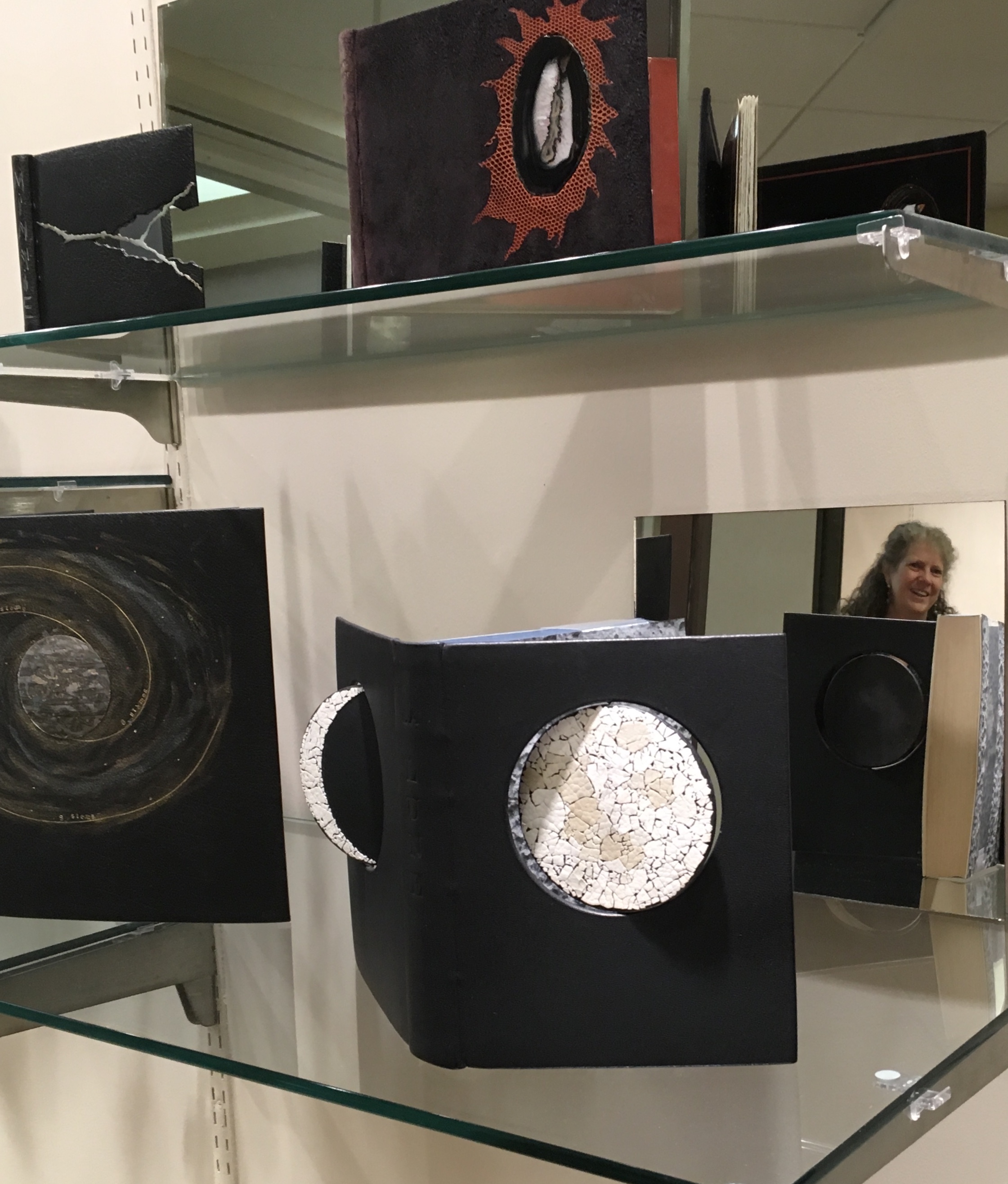
Be sure to take in all angles provided by the mirrors behind many of the works.
Theresa N. Hammond, the Gallery’s director and curator, reflected here behind La Lune (1971) and its swiveling “phases of the moon”, rounds coated in eggshells of differing colors.

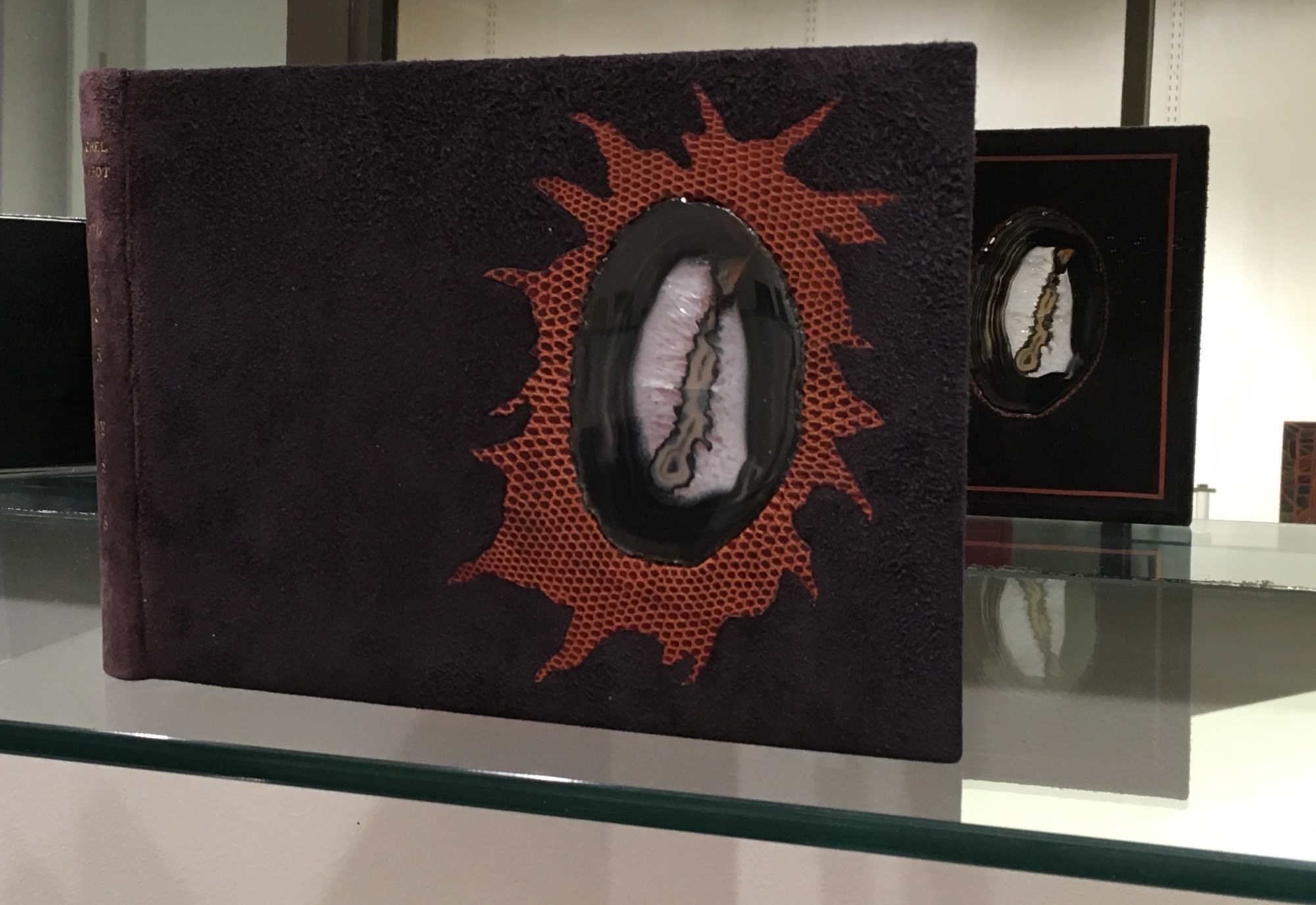
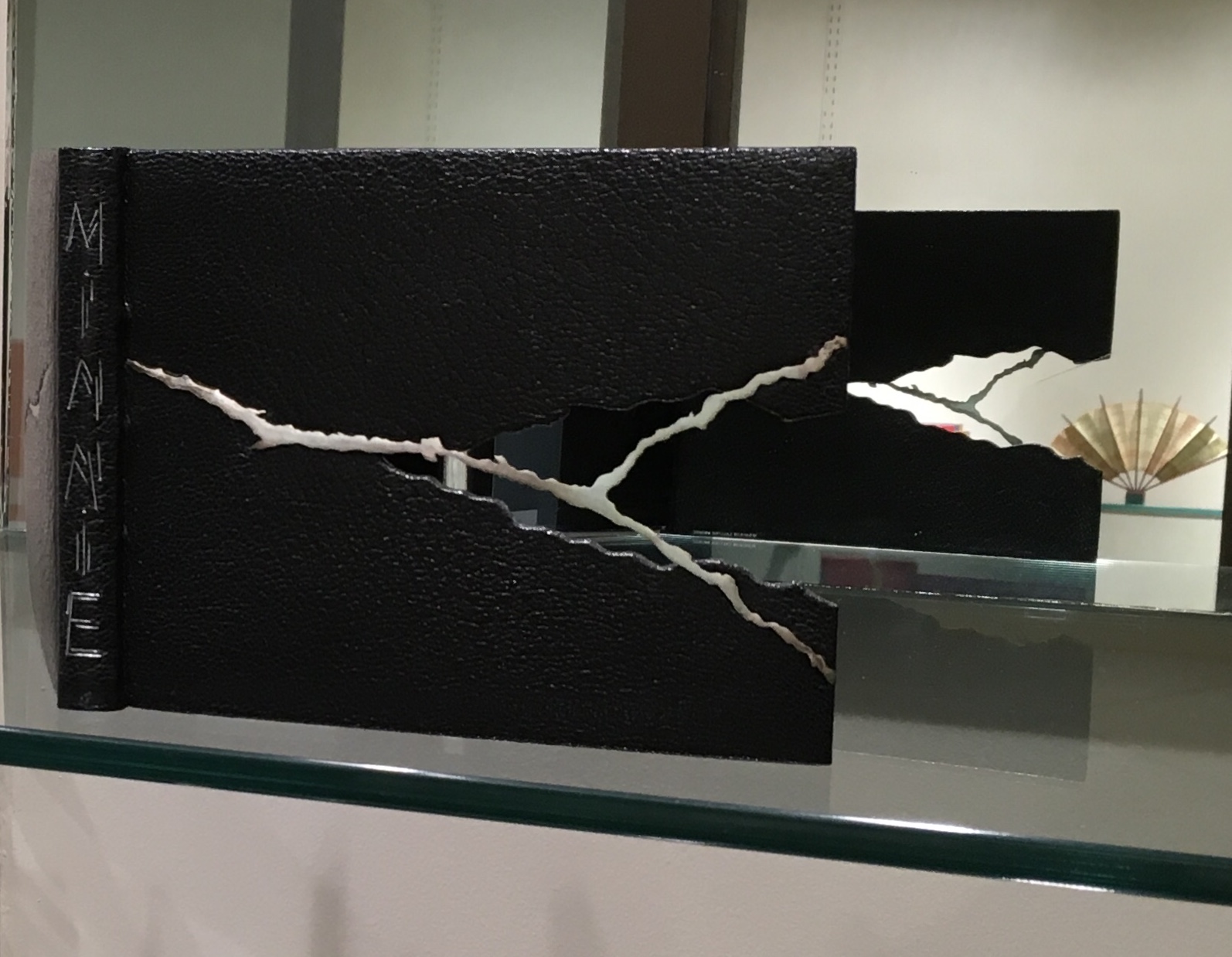
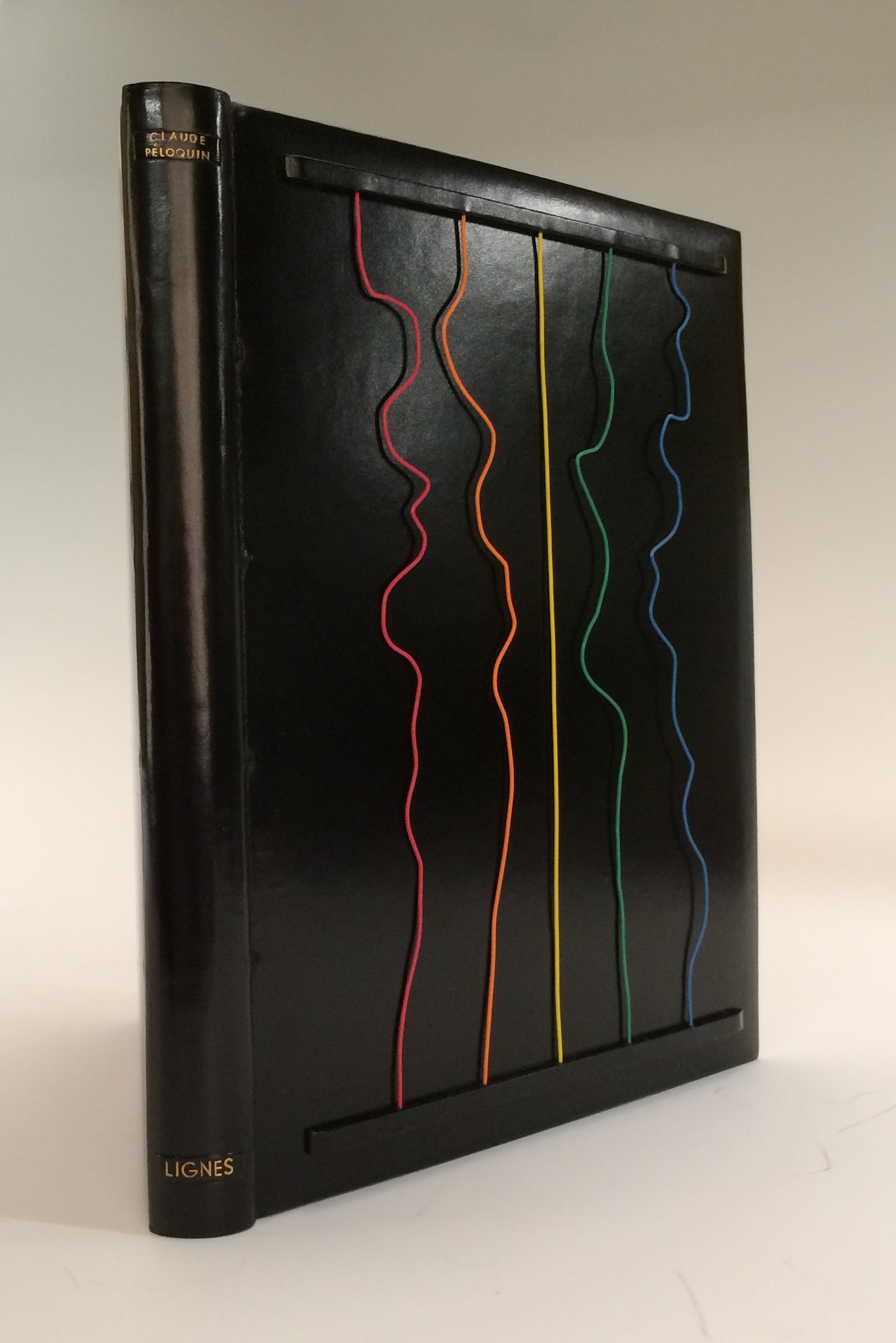
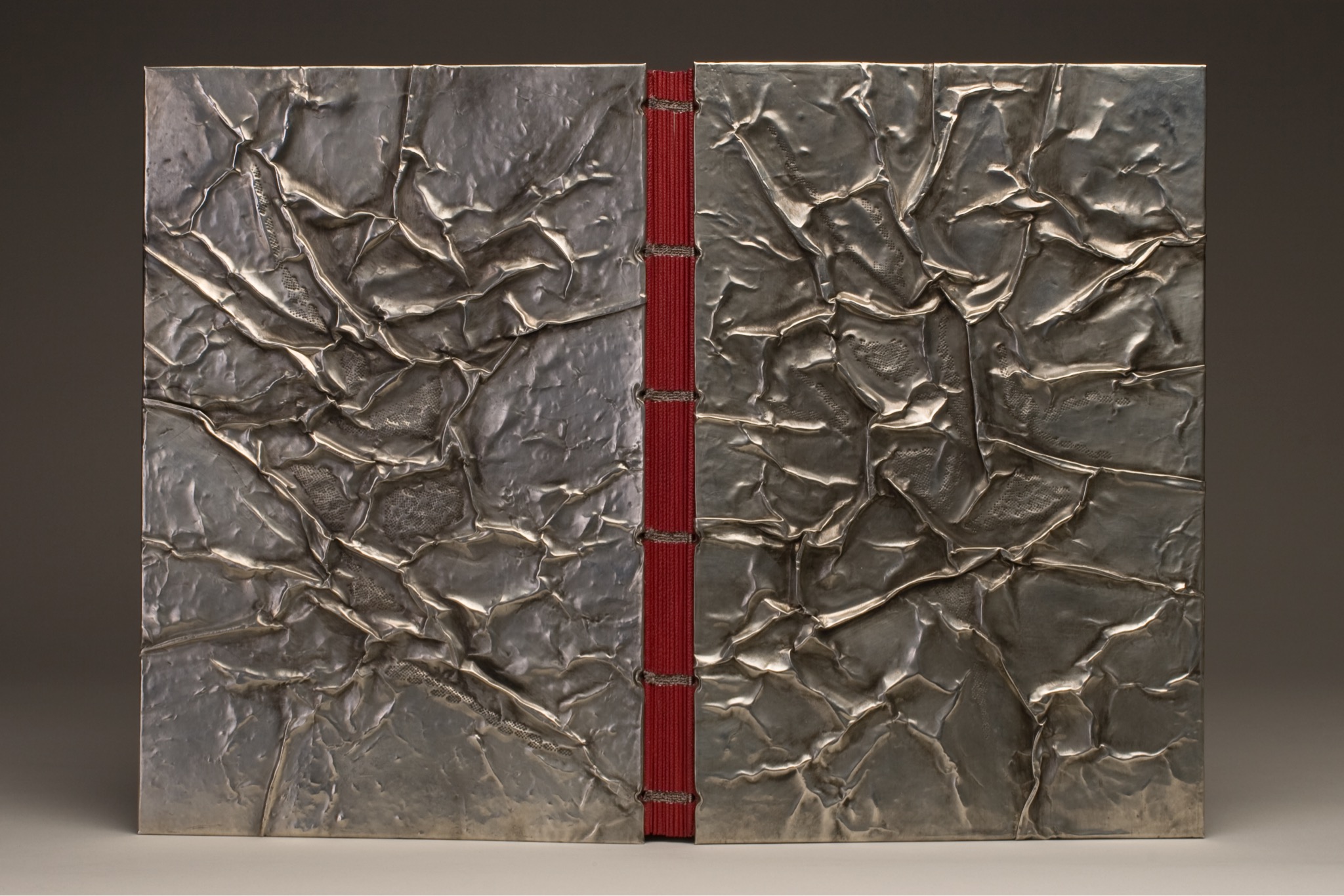
One of the distinguishing characteristics of Lallier’s artistry is her innovative use of materials: eggshells in La Lune (1971), her own hair in L’Eloge de la Folie (1974), translucent agates in Portes Sud (1979), silver in Histoire de Minnie (1982), wires from old telephones in Lignes (1986) and pewter in The Song of Songs, which is Solomon’s (2002).

L’Eloge de la Folie (1974)
Rarely does Lallier use on the cover an image from within the book at hand. Here is one of the exceptions. The cavorting monks from Erasmus’ satire come from Albert Dubout’s 1951 illustration of the classic. Lallier, however, couldn’t resist using her own hair to form their tonsures.
Portes Sud (1979)
Note in the reflection the light coming through the agate embedded in the cover.
Histoire de Minnie (1982)
In the exhibition, be sure to look at the back cover where Lallier has used the silver piece, embedded in the front cover, to stamp the back cover.
Lignes (1986)
This is Lallier’s only collaboration from scratch. For a Montréal exhibition whose organizers set the theme of “lignes” or lines, she conceived the cover design. Sharing only blank pages and not the design, she then asked Claude Péloquin to provide text and illustrations on the theme.
The “telephone wires” attached to the front cover are loose and manipulable by the reader — a tongue-in-cheek form of interactivity with lines of communication in the pre-Web age. 
The Song of Songs, which is Solomon’s (2002)
Visiting a Parisian builders’ store with a friend selecting decor items, Lallier was entranced by sheets of pewter and its varying thicknesses. She bought some. The inspired result above sits alongside another in the exhibition — The Enchiridion of Epictetus (2003); be sure to look at the reflection of The Enchiridion to spot the use of pewter in the interior.

The odd materials chosen are frequently highly apropos of the book in question. In the catalogue, take a look at Le Papier, Le Livre (2015), which has embedded pieces of a wasp’s nest, entirely in keeping scientifically and historically with the subject. In 1719, the French naturalist René Antoine Ferchault de Réaumur published an essay to the Royal Academy of Sciences on the natural history of North American wasps and hypothesized how man could adopt their natural papermaking industry.

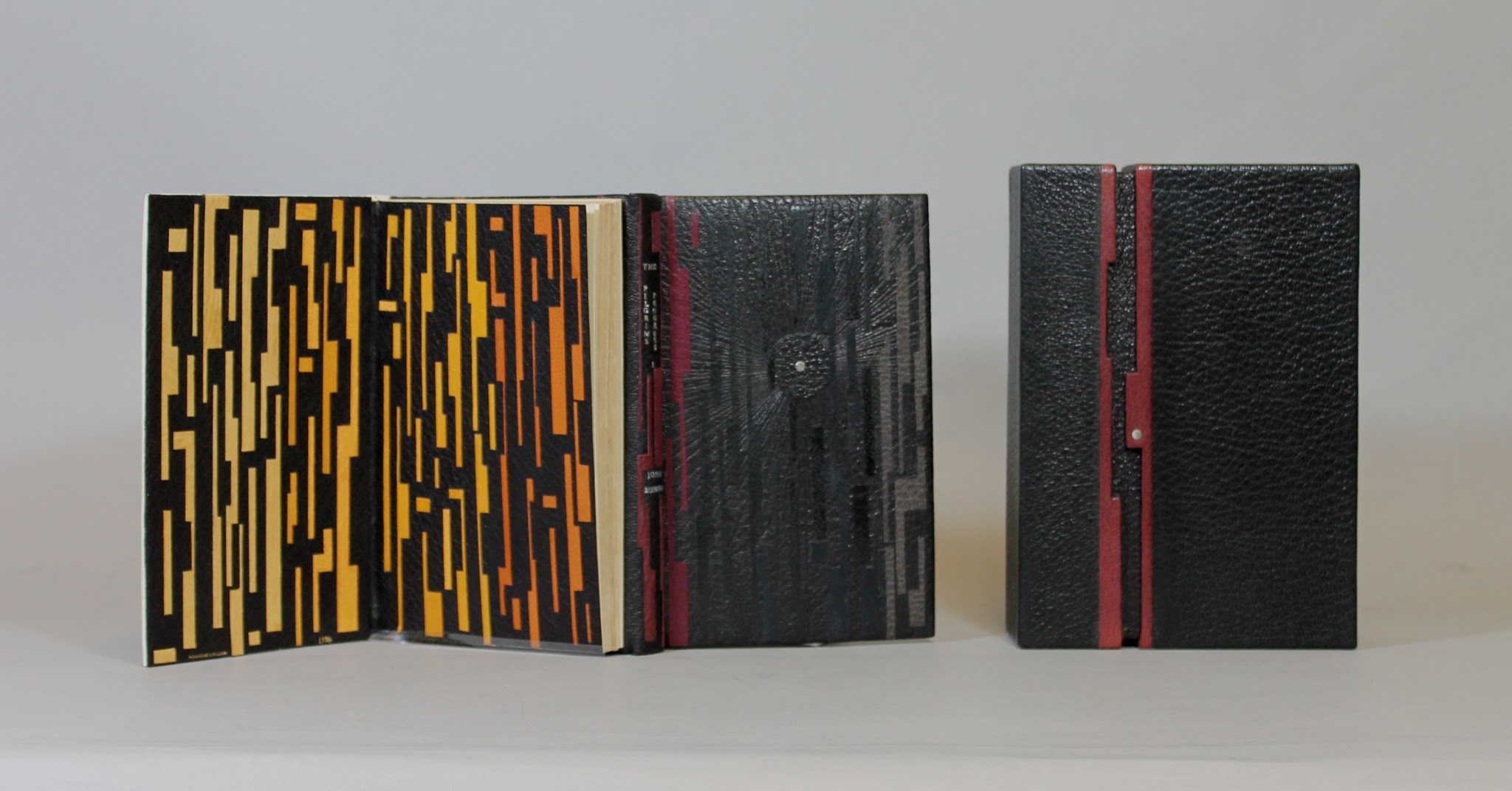
Another element of Lallier’s work to look for is the form of binding — not just the covers but the interior structure. Despite the glass cases protecting these items, it is easy to spot and enjoy the structural features, for example, the book in the form of a distinctively shaped Southern lady’s fan for The Birthday (1990). The catalogue shows a dos-à-dos (back-to-back) binding of the volumes of Pilgrim’s Progress (2003), a daring rebinding of a rare 18th century production. The Friends of the Library at University of Alberta made the courageous right decision.

Pilgrim’s Progress (2003)
Dos-à-dos binding, showing the first part of the book, in which Pilgrim sets out on his journey in darkness, which Lallier marks with a black leather circle with a palladium dot at its center. 
Photo credit: University of Alberta.
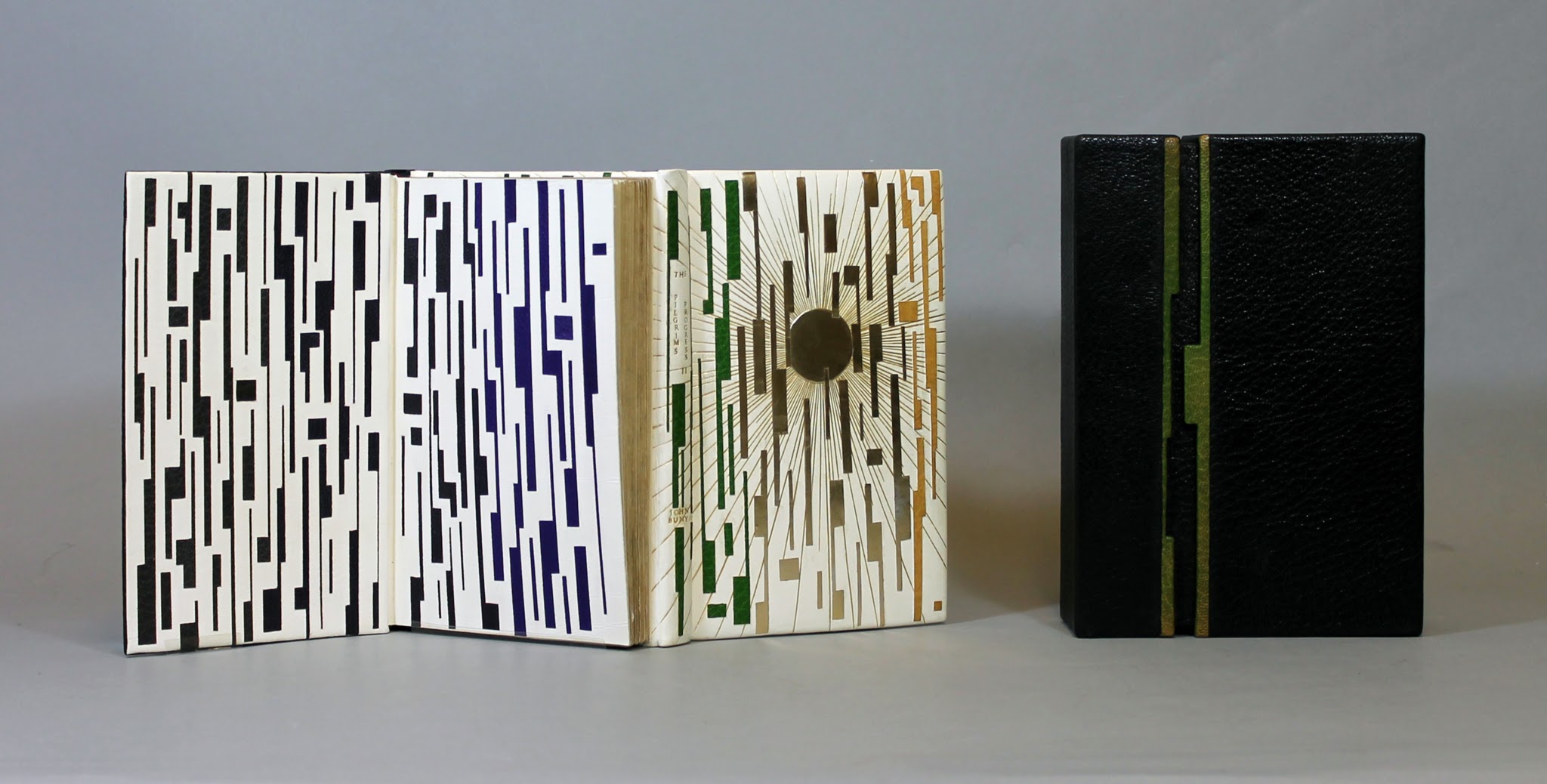
Pilgrim’s Progress (2003)
Dos-à-dos binding, showing the second part of the book, in which Pilgrim arrives at the Celestial City, which Lallier marks with a gold tooling radiating from a gold circle. 
Photo credit: University of Alberta.

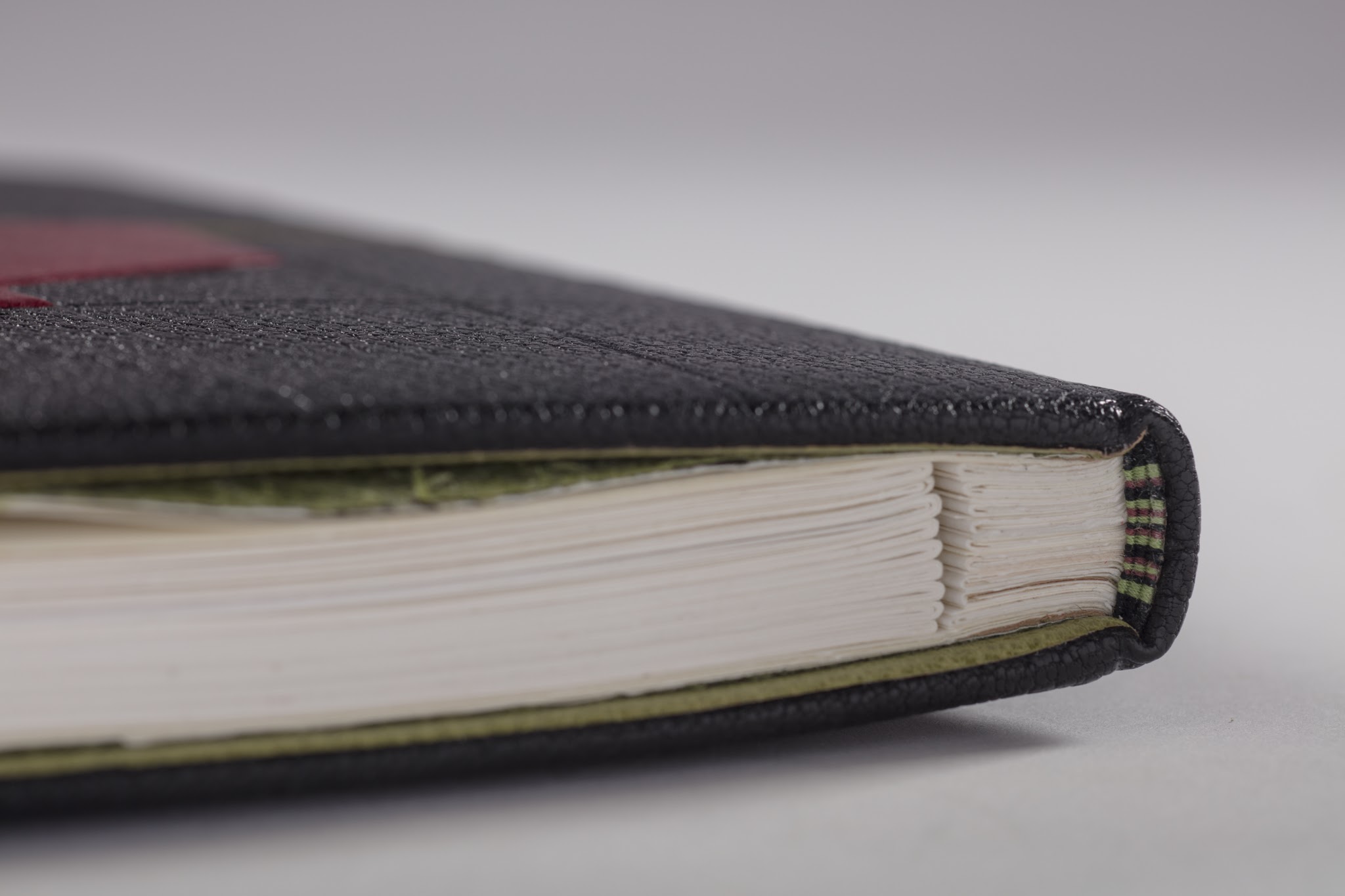
Some of the interior and exterior forms are more subtle. Lallier has made extensive use of the stub binding technique (see below), and there are several examples of cross structure binding (see below).

Look for this style of binding called montage sur onglets or stub binding that allows pages to lay flat or even be easily detached. Look for Le Chevalier Troyen (2014) and Inside the Book (2016), displayed side by side in the exhibition and showing this form of binding.
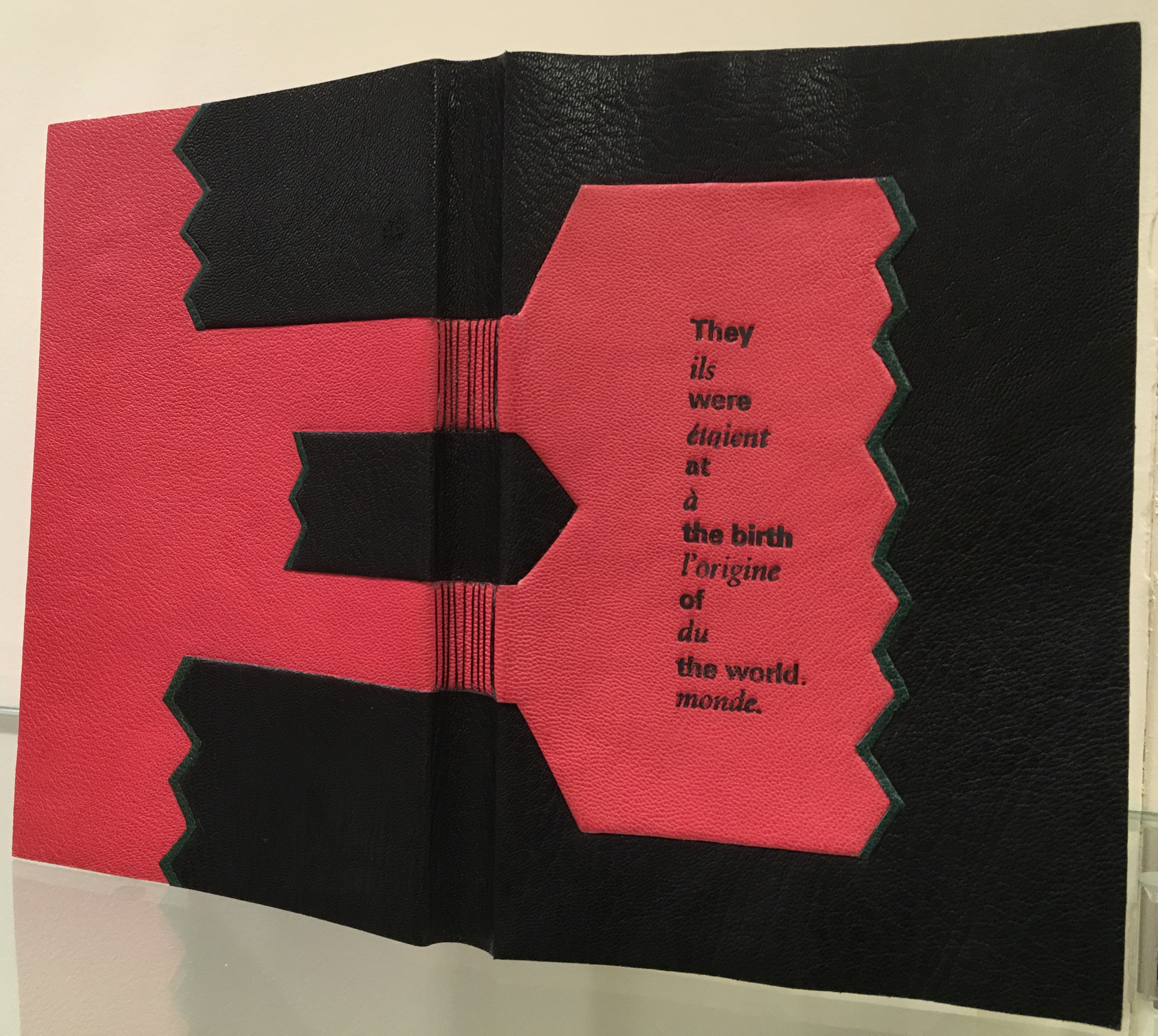
Le Livre des Origines  / The Book of Origins by André Ricard, 2005
In the exhibition, be sure to look closely at the spine’s deliberately exposed cross-structure binding in full goatskin leather. 

Le Livre des Origines is another one of those rareties where Lallier uses on the cover something from within the book. Stamped on the front, the phrase alternating in English and French comes from the text relating the Huron Nation’s creation myth as recorded in French by ethnologist Marius Barbeau, reinterpreted and rewritten by André Ricard. The alternating roman and italic presentation of languages reflects the book’s alternating pages of English and French. Note how the simple design in black and red with the diagonal onlays of green leather captures characteristic elements of the art of the Wyandot tribes, which can be explored here. A design philosophy of using imagination and craftsmanship in service to the book exemplifies itself again and again throughout the exhibition.

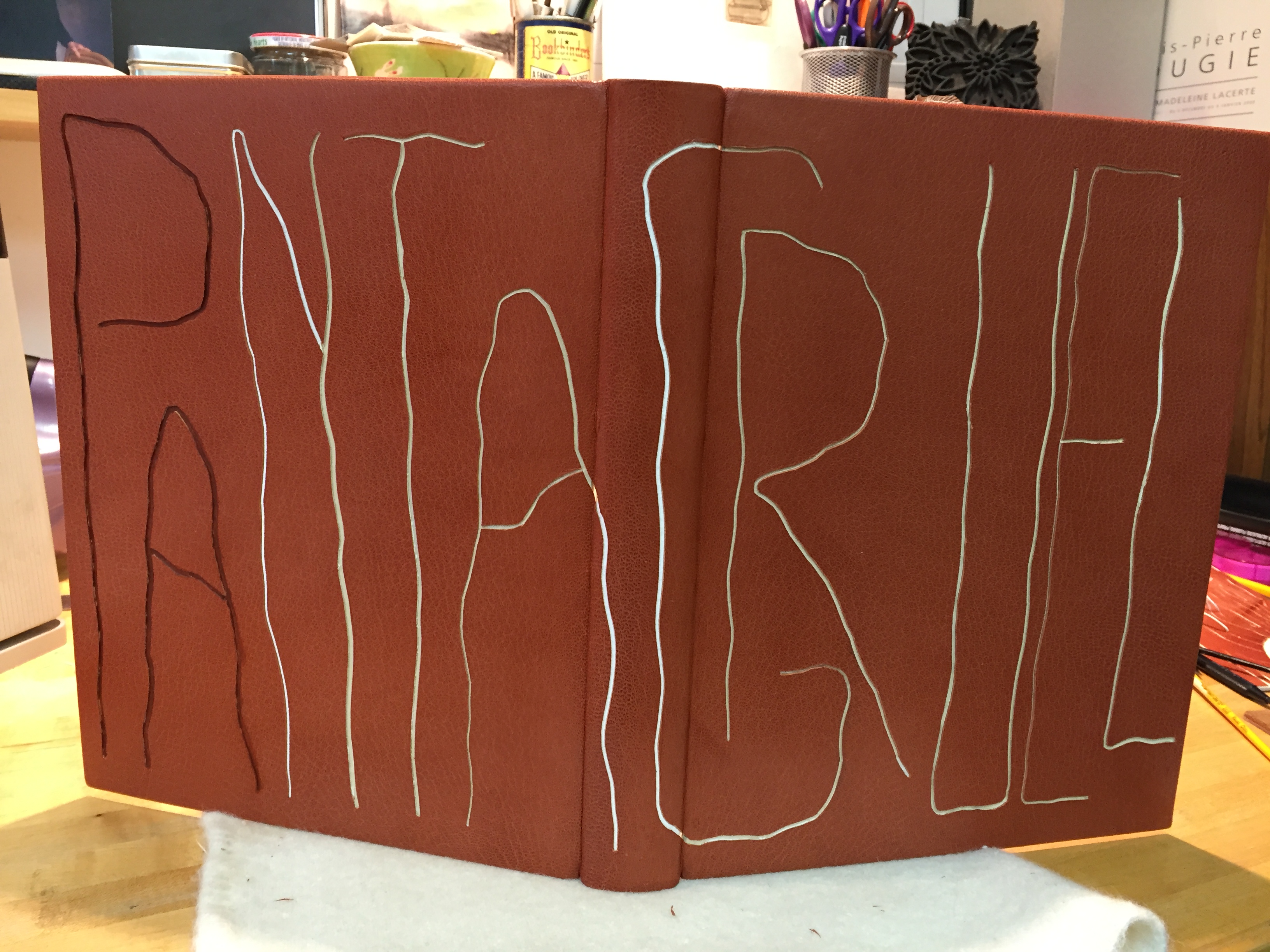
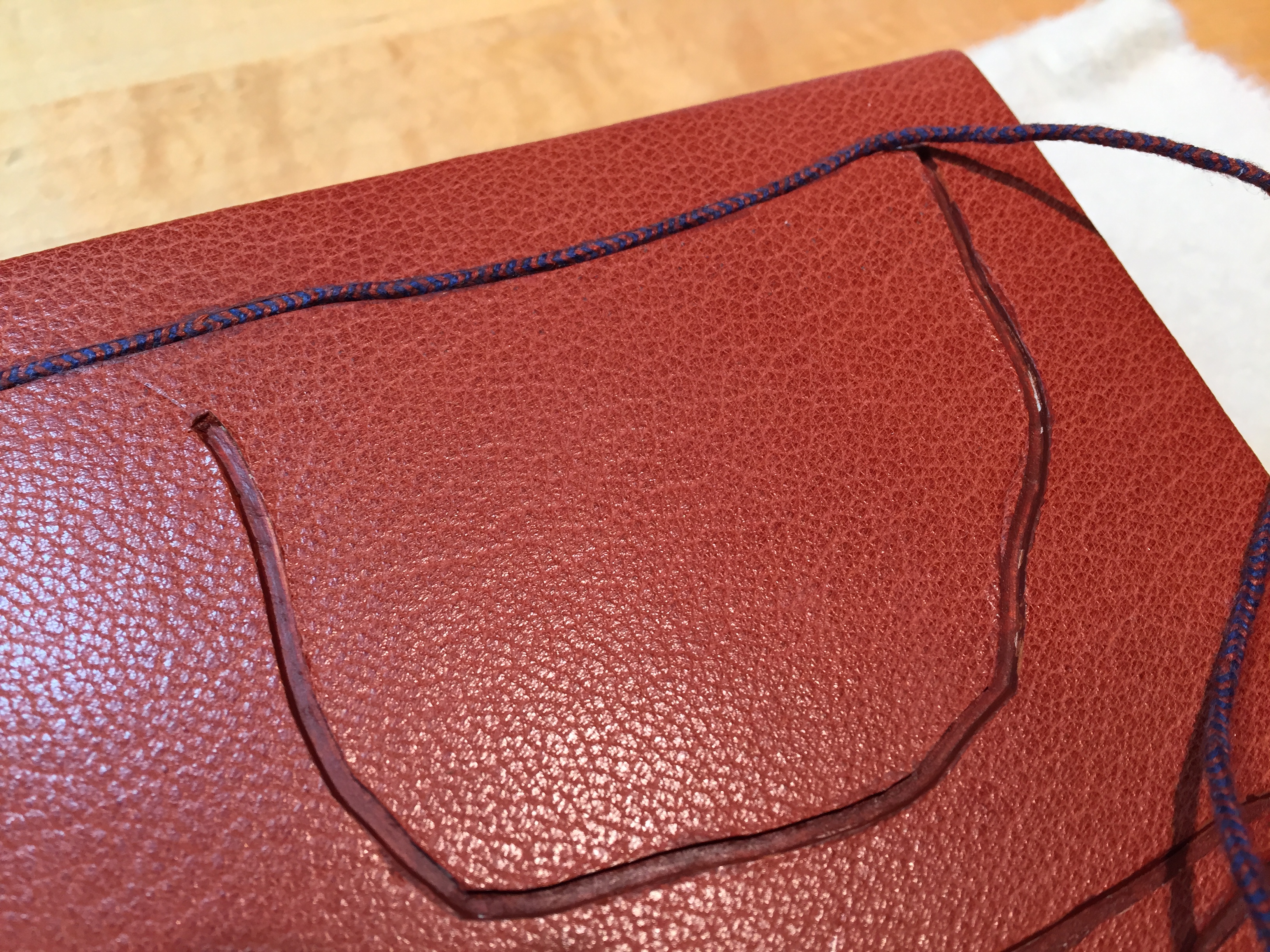
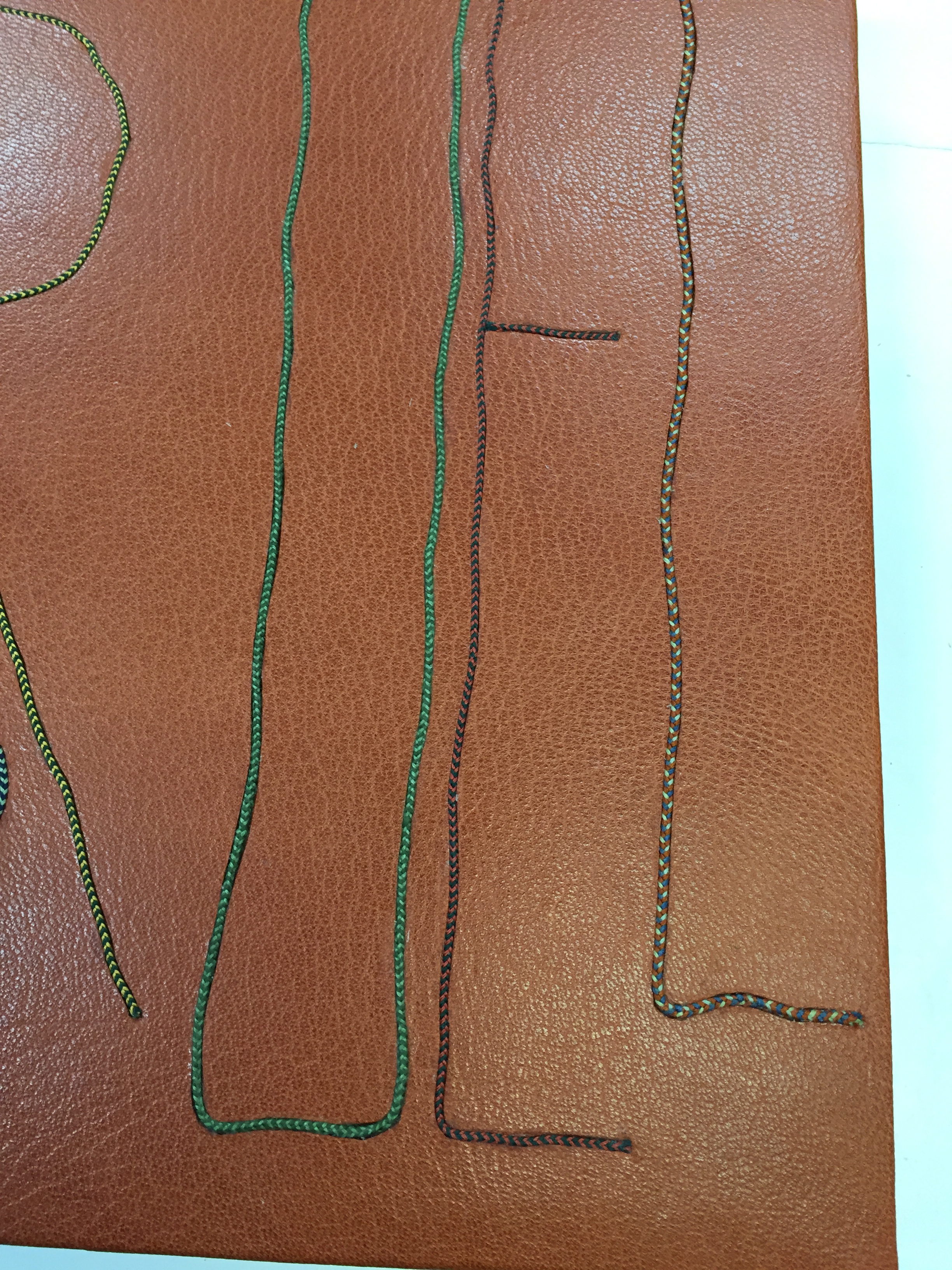
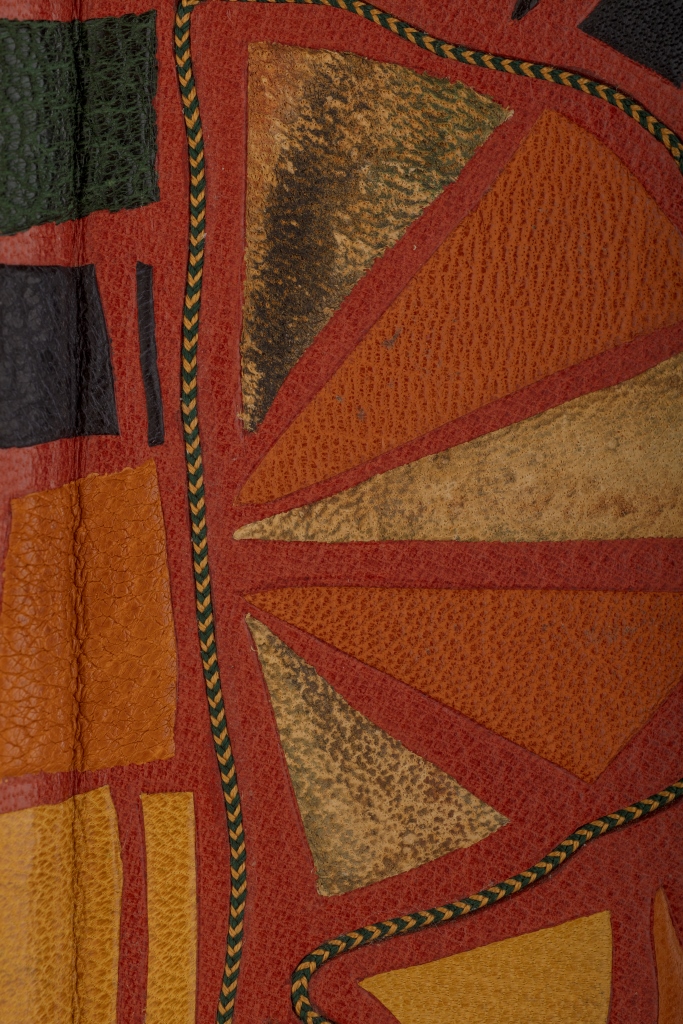
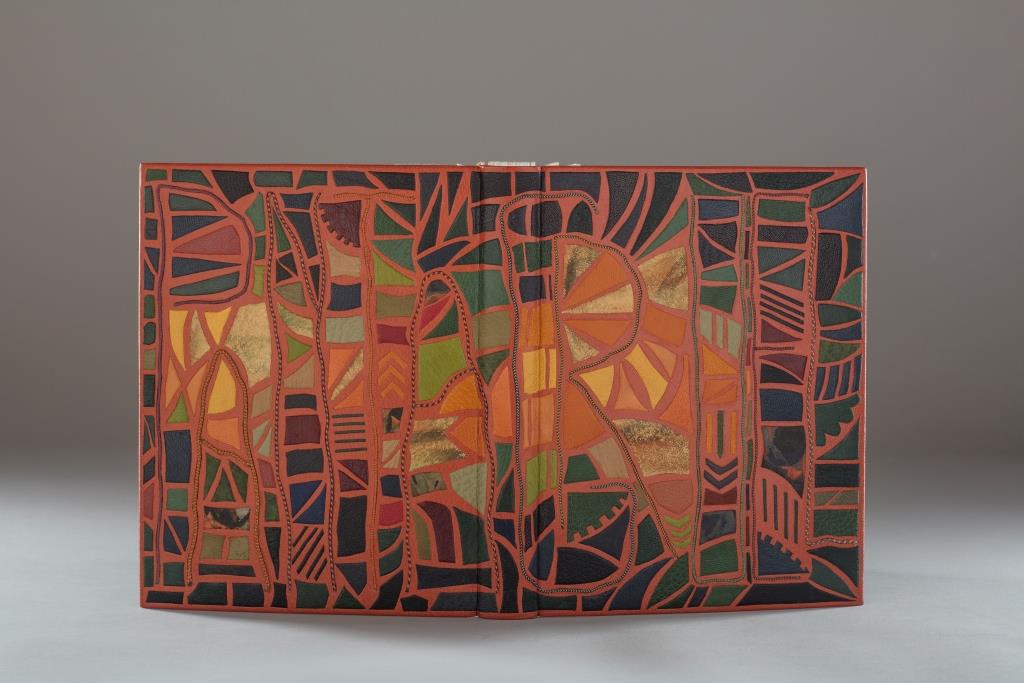
Which brings us to another characteristic of Lallier’s art to seek out: the painstaking handwork. For this, Pantagruel (2016) is worth a long look. Lallier once observed a student engaged in kumihimo braiding (the Japanese technique of using a disk to gather multiple threads of different colors into a single strand) and asked to be taught.  Inspired by André Derain’s illustrations of Rabelais’ riotous satire, she set out to use braids for the title’s letters, filled and surrounded with the colors from the illustrations. Some of the leather inlays are handpainted; all — even the smallest — are handcut, beveled, tucked in the covering leather and tooled. The series of process photos below — all courtesy of the artist — provide a look behind the scenes.

Pantagruel (2016)
Awarded one of 25 Silver Prizes at the International Competition of Designer Bookbinders (2016)

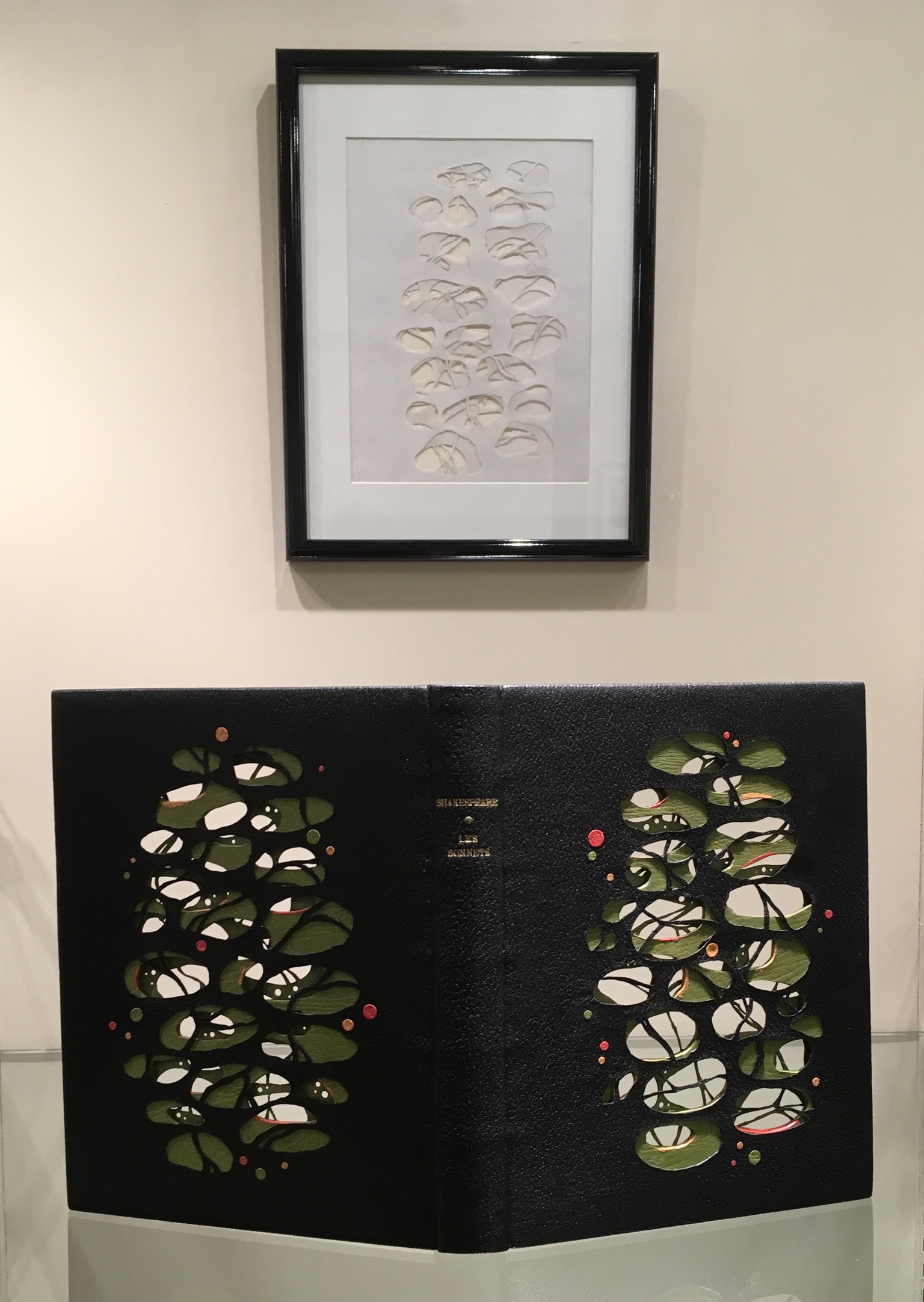
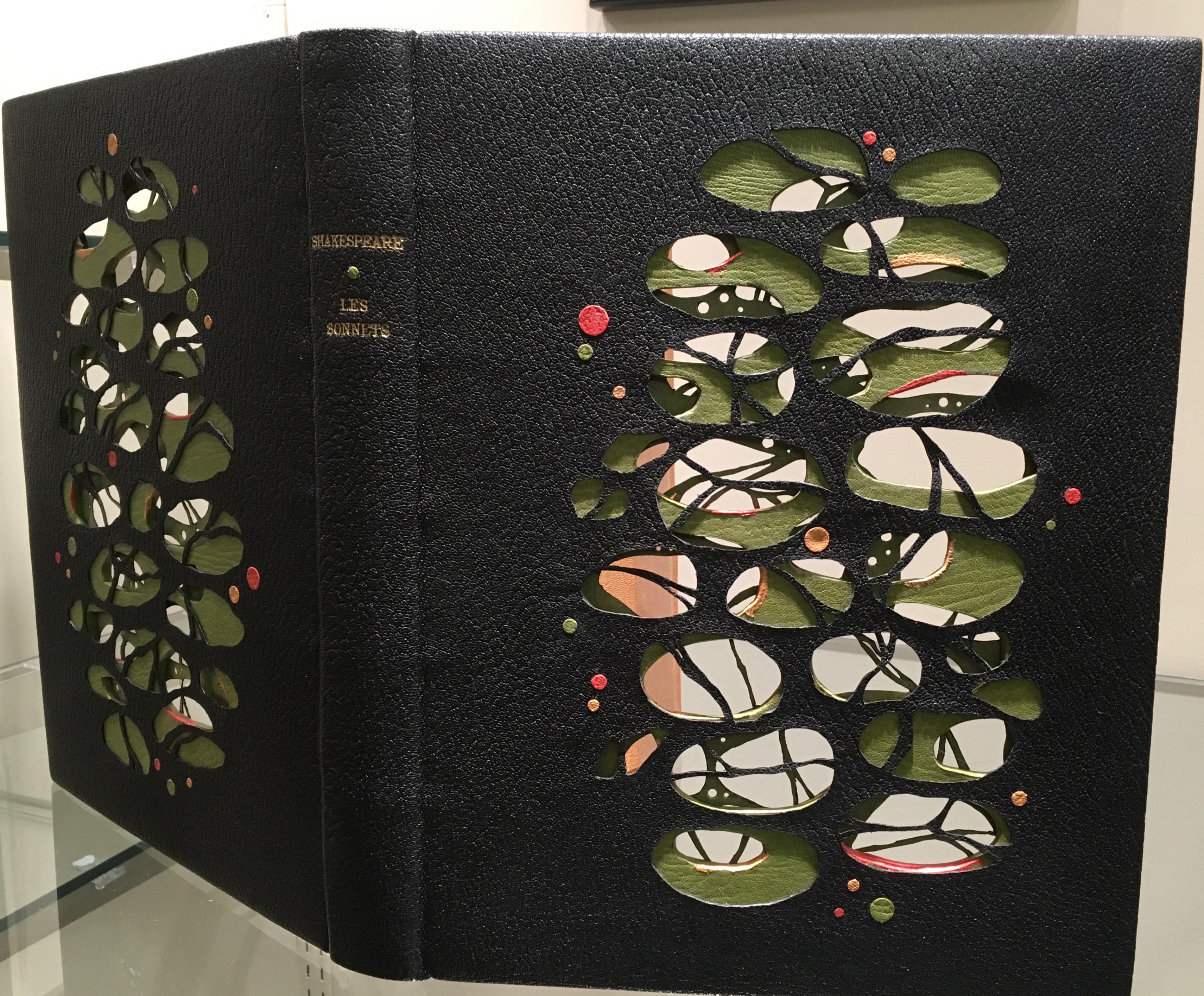
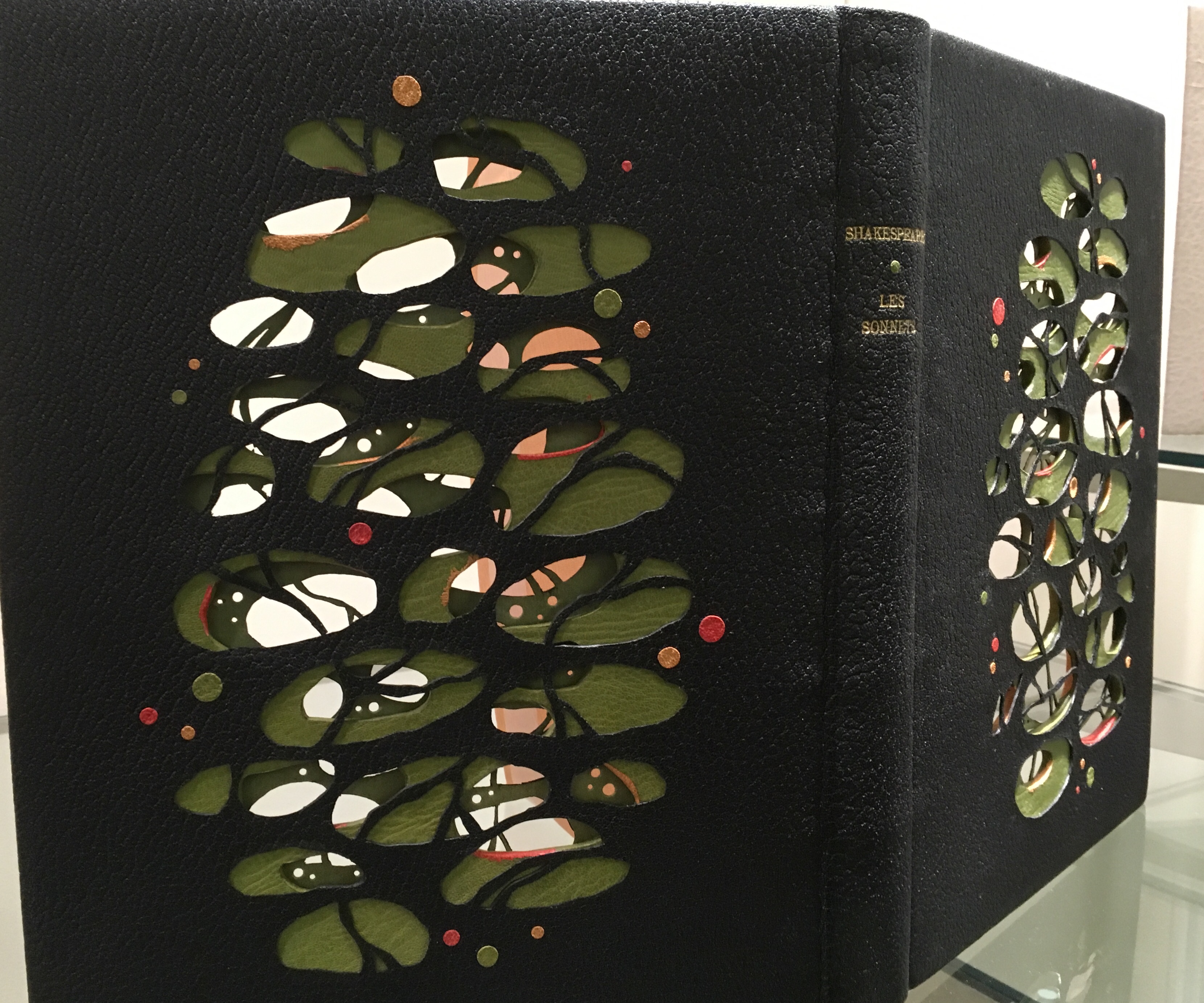
Shakespeare: Les Sonnets (2012) is another case in point of craftsmanship. Creation of this work began with a drawing (shown below) and then a maquette to enable Lallier to visualize the sculptural and aesthetic implications of multiple layers’ surfaces and edges being seen from all angles. The boards were cut out and lined with a green goat skin. The covering leather was also cut out and lined with green Japanese paper before covering. The doublures (linings of the book cover) received the same treatment before being applied to the inner boards.

Shakespeare: Les Sonnets (2012)

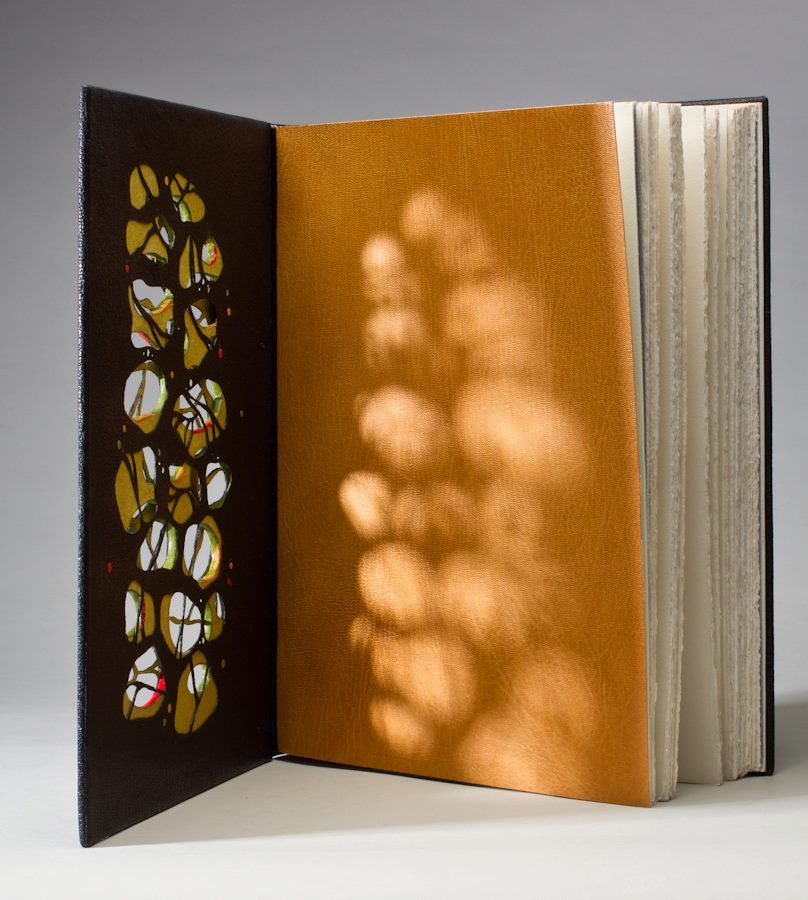
There is a sense of movement in this three-dimensional, sculptural treatment of the cover, which brings us to a final pointer for visitors. Lallier’s signature and most original technique — the front cover panel that swings open along the fore-edge to reveal a hidden design. 

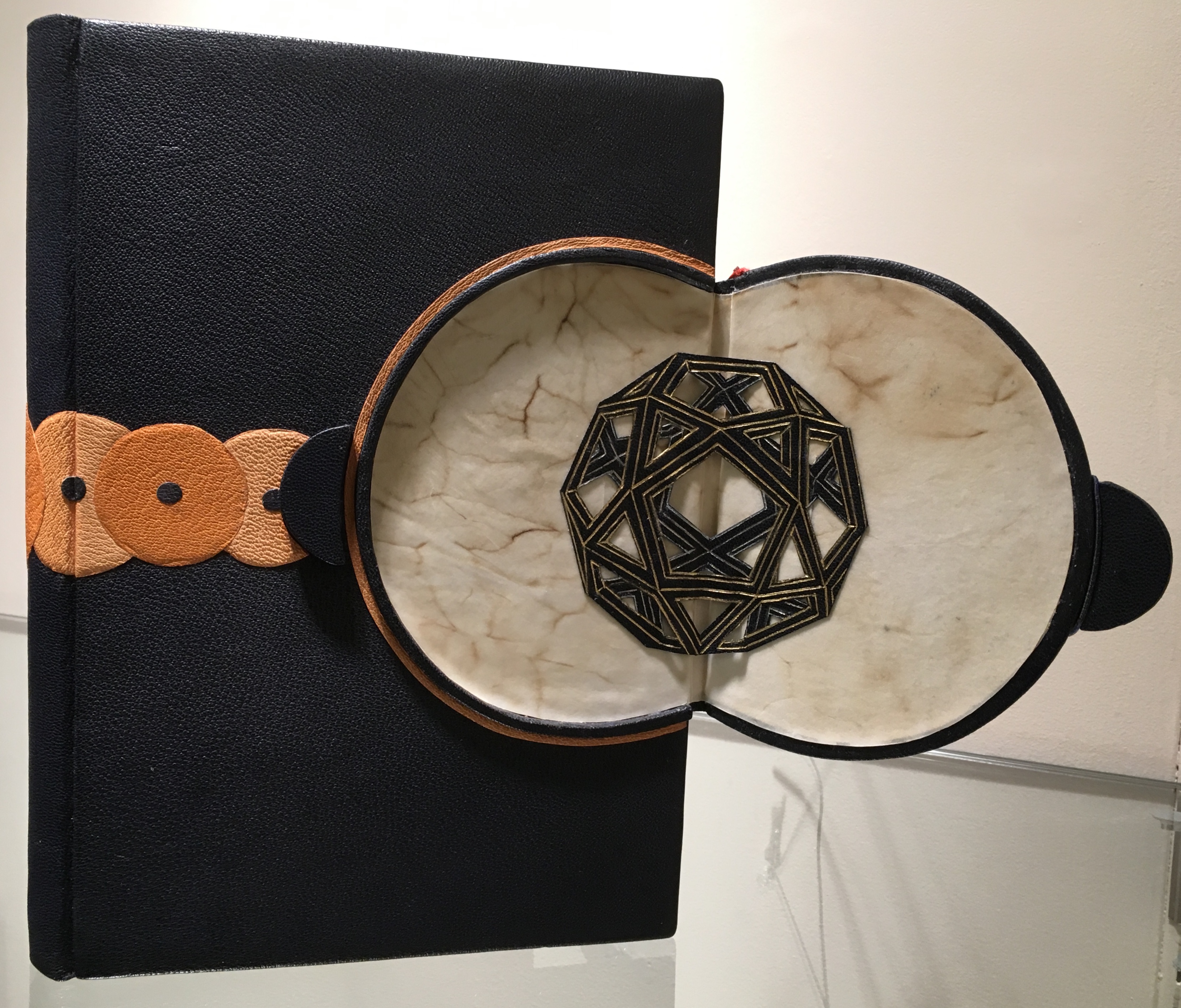
Excerpts from the Humorous Writings of Leonardo da Vinci (1996)
The open panel reveals a geodesic dome in leather with gold and palladium tooling. With the panel closed, the front cover’s design echoes a Da Vinci machine.
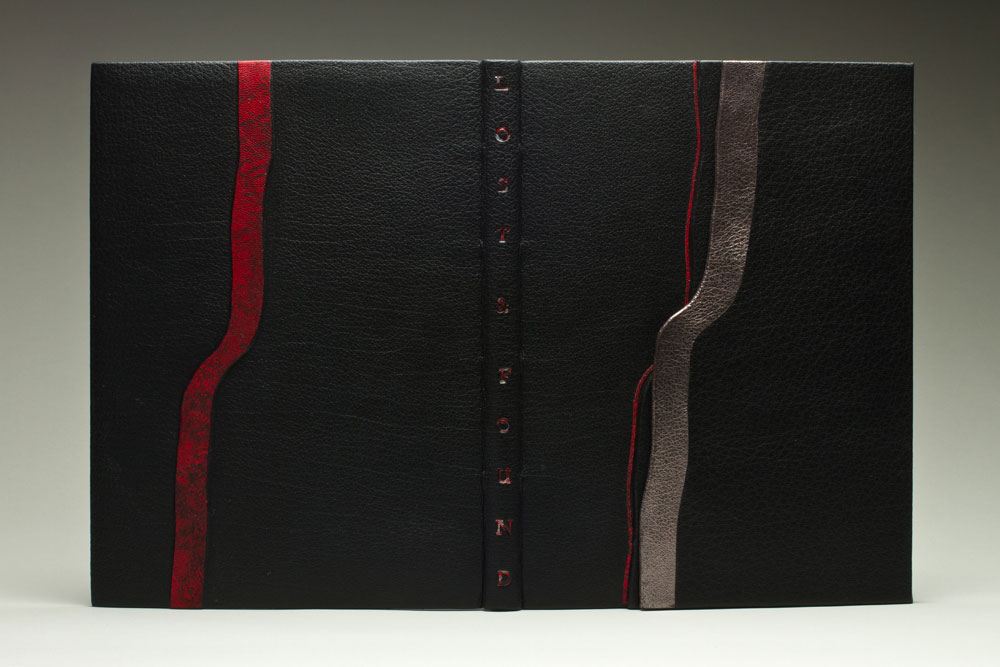
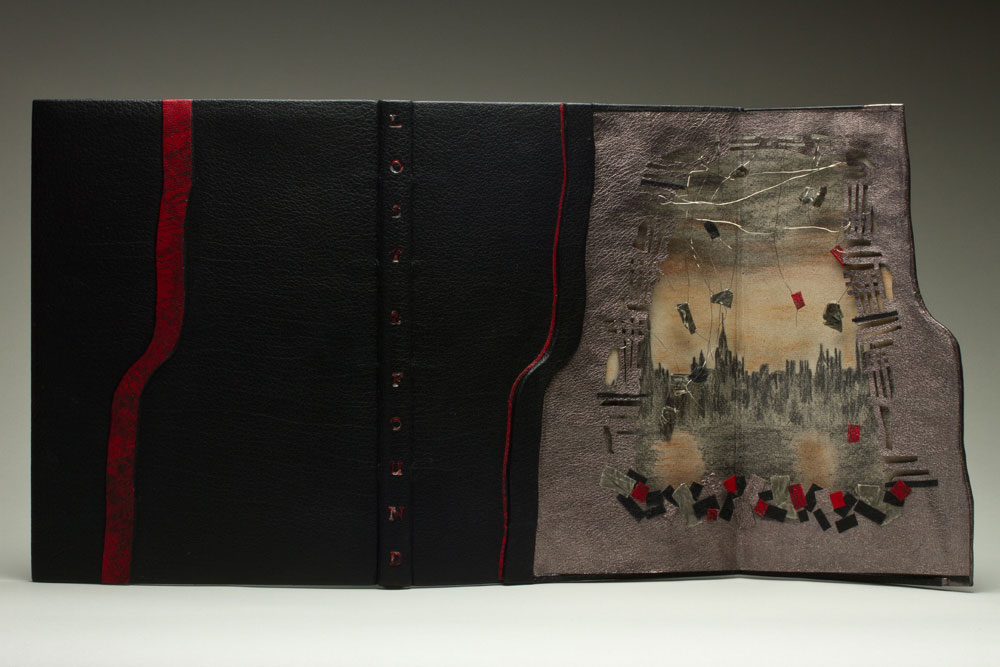
Lost and Found (2014)
The illustrations inside the book come from previously lost engravings by Rachel Reckitt, some showing the blitz of London from which Lallier has drawn the inspiration for her hidden panel.
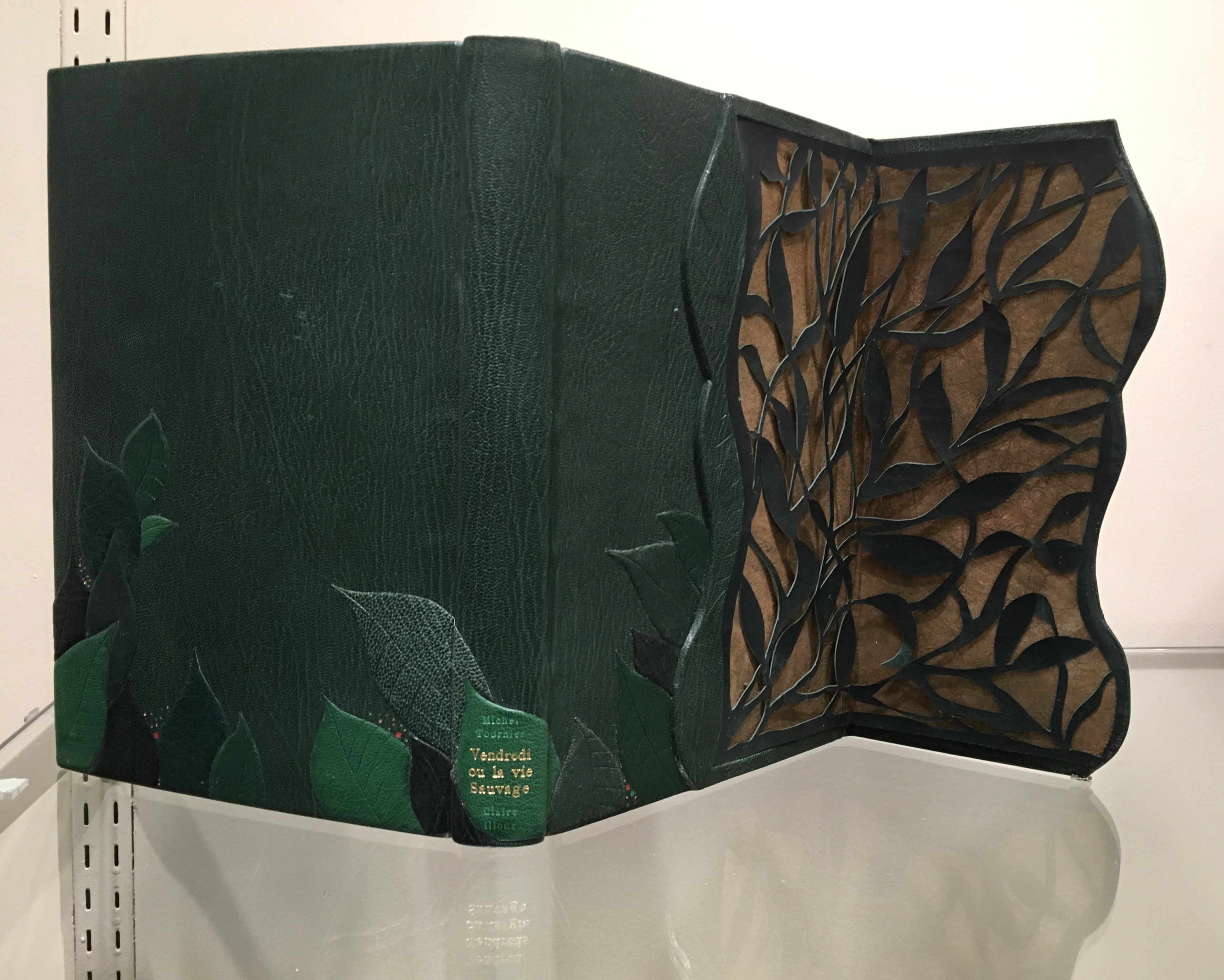
Vendredi ou la Vie Sauvage (2015)
Opening on layers on layers of carved foliage, the panel evokes the island on which Friday finds himself castaway in Michel Tournier’s version of Defoe’s Robinson Crusoe. In the exhibition, stand on tiptoe or someone’s shoulders to see the top edge’s coloring. Extraordinarily it resembles flower petals submerged in water. 
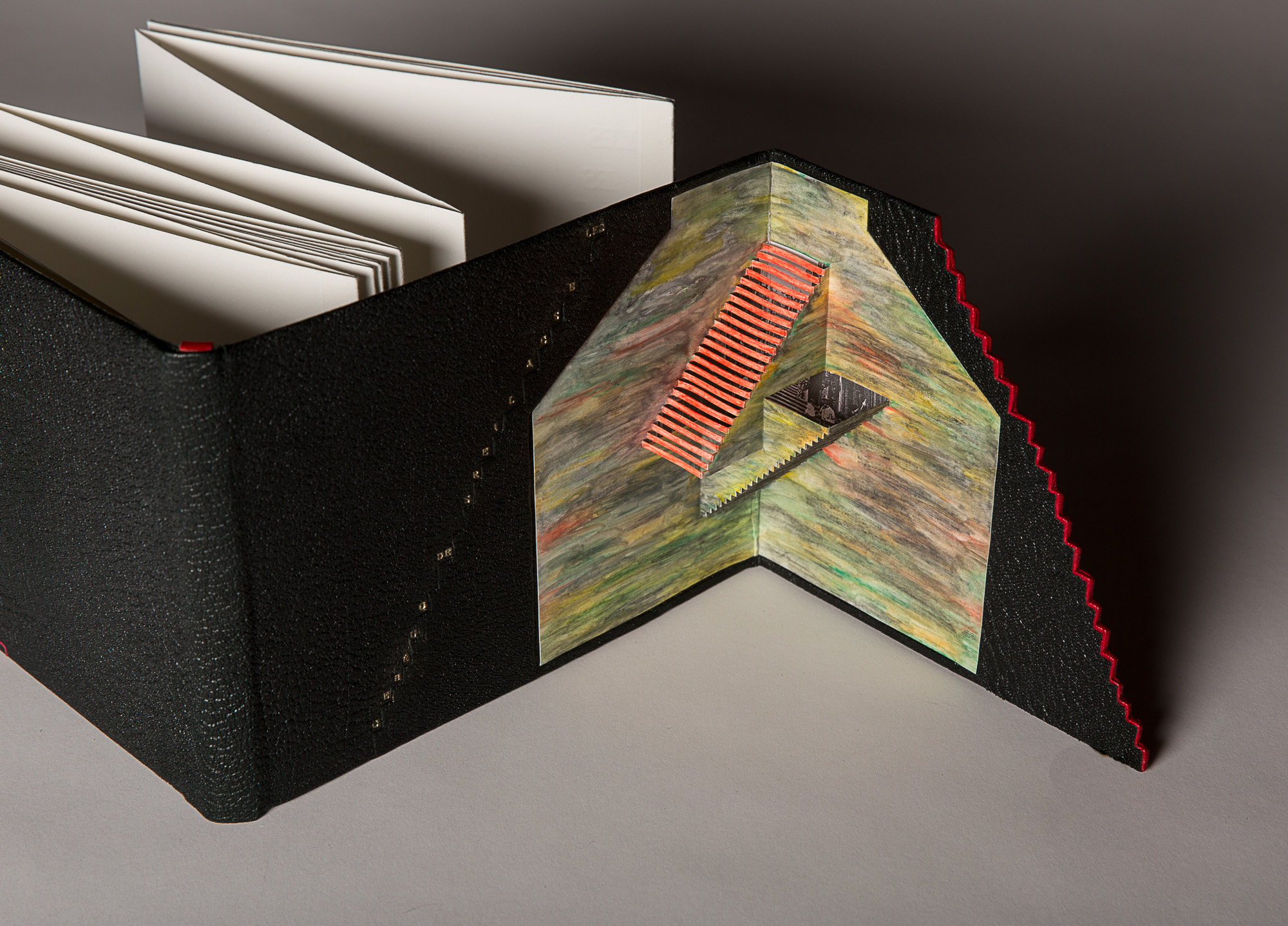
Les Escaliers de Québec (2013)
Bound in black Morocco leather in the “drop spine” technique, this work unites the stair-stepping accordion form of the text with a gold-tooled title climbing the steps of the front cover panel, which opens on a hand-colored pop-up set of Escher-like stairs.

Lallier’s unity of design with the text by Luc Bureau and illustrations by Ghislaine Bureau celebrating the famous thirty sets of stairs between the upper and lower parts of Québec can hardly be excelled.  Except that she does — again and again — with the examples on display.  This retrospective resoundingly affirms Lallier’s intention always to serve the book in front of her. Go judge for yourself.

Monique Lallier: A Retrospective runs from 29 October through 6 January 2019 at The Guilford Art Gallery on the campus of Guilford College. For more background on Lallier’s work, there is a series of interviews with Erin Fletcher of Herringbone Bindery here.

Bookmarking Book Art – Katerina Kyselica

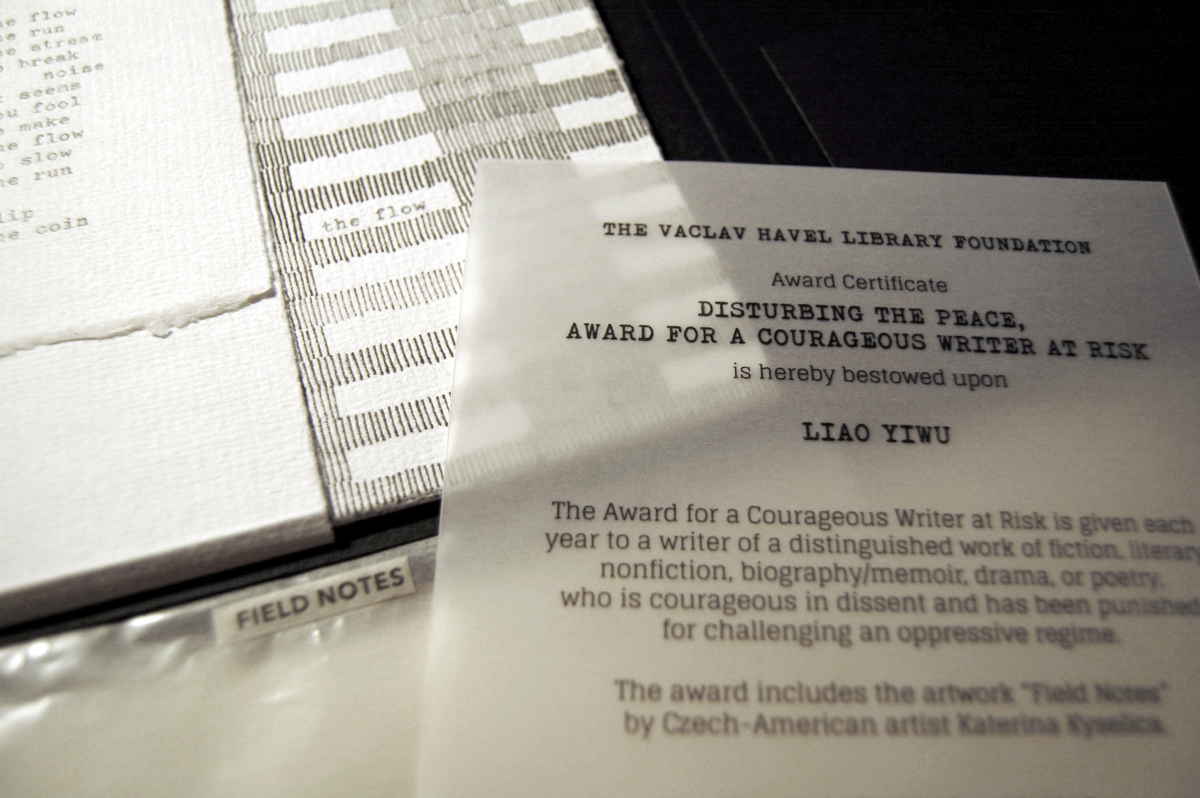
Field Notes (2018)
Katerina Kyselica
Photo credit: Katerina Kyselica

Field Notes was commissioned by the Václav Havel Library Foundation for its 2018 “Disturbing the Peace, Award for a Courageous Writer at Risk“, presented to the Chinese author, writer, musician and poet Liao Yiwu (aka Lao Wei) on 27 September 2018 at the Bohemian National Hall in New York. Across nine loose leaves, the typewritten words and lines of the poem are dispersed, arranged among fields of regimented rows of vertical strokes, drawn on handmade Losin paper. The drawings could represent anything: a field of grain, a tower block with windows, or marks on a prison wall to count the days. The loose format of the book allows readers to arrange the drawings or compose the text in an order as they see fit, although a colophon presents the full poem in its intended order. 

Kyselica’s website provides more views of Field Notes as well as views of her other artist’s books: American Colonies (2016), Code Red (Nicholas and Alexandra)(2016), News About Nothing (2015), 2×2 (2013) and untitled (2012).

What is striking about Kyselica’s works is how she combines a collage of book art techniques in each work to create a unified, unique effect.

Books On Books Collection — Ed Ruscha

I am wide awake when I see artist books. Here are people using actual ink on paper in the eventual age of total digital. For this reason I am retaining my hope and expectation of more books. — Ed Ruscha. Interview with Stephanie LaCava

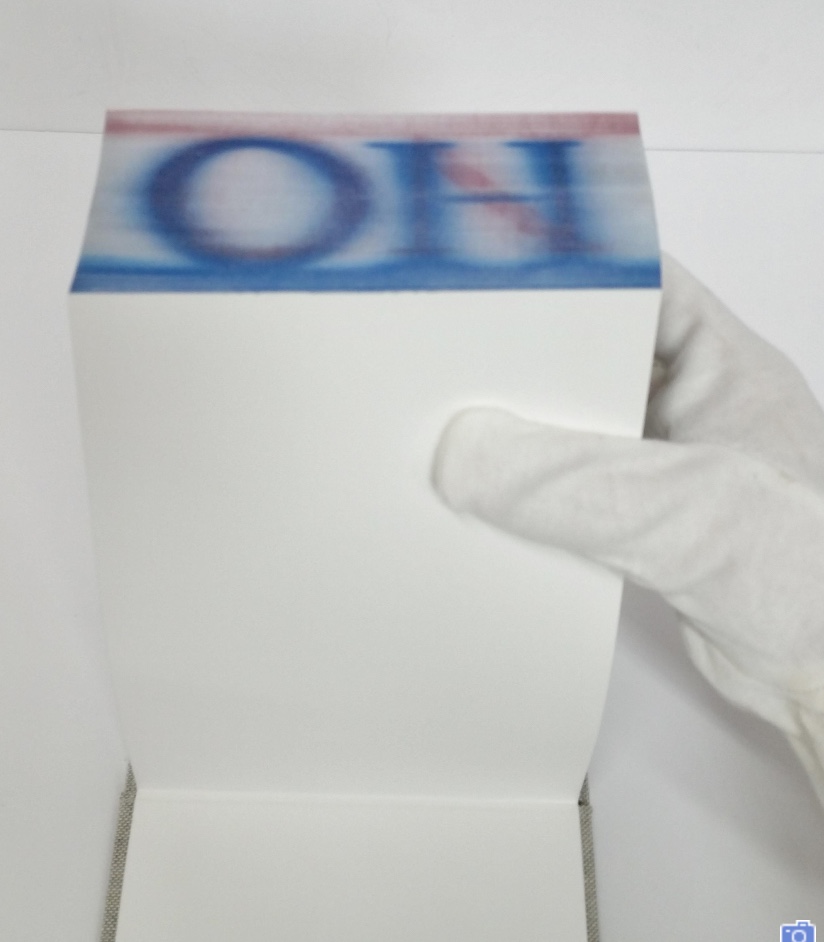
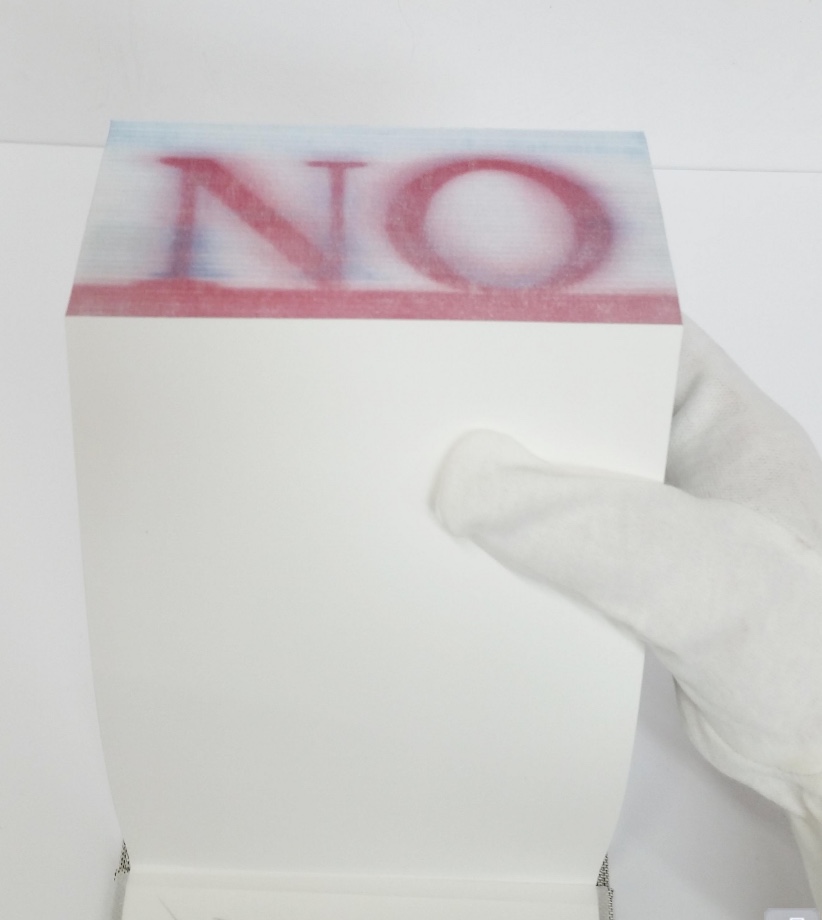
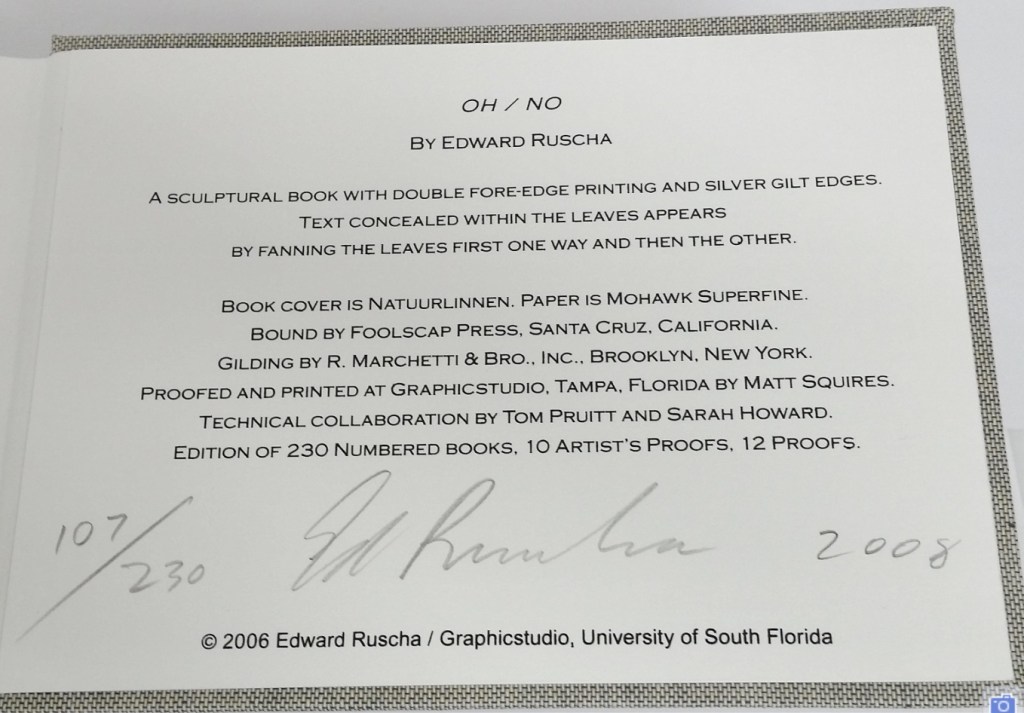
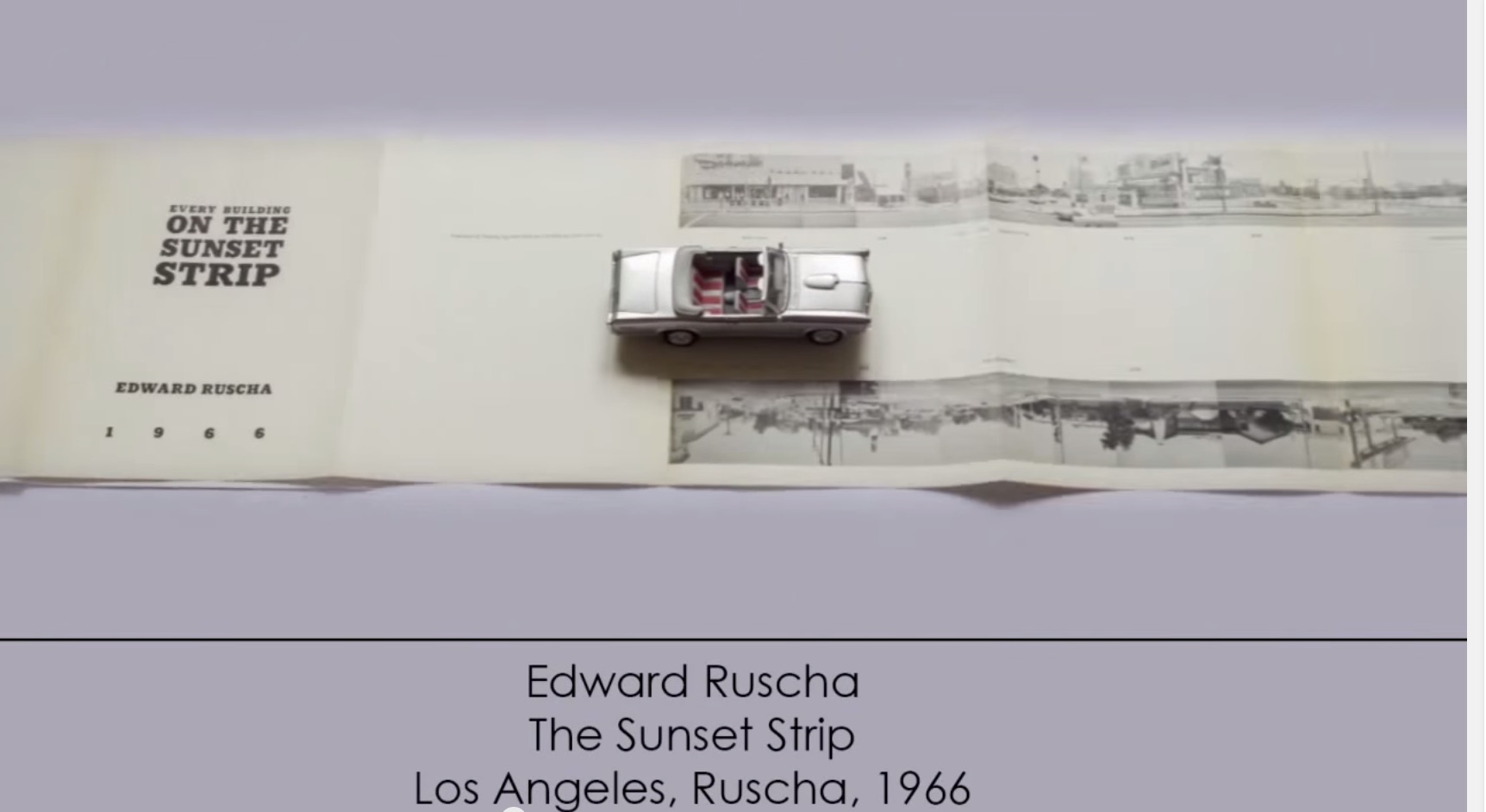
Any collection of book art must recognize the presence and contribution of Ed Ruscha’s work. For Books On Books, this has been not only a financial challenge but a thematic one. Every Building on the Sunset Strip and the elusive Dutch Details certainly speak to the collection’s representation of the accordion book structure, but so do many others in the collection. Even if one of those works in pristine condition could be afforded, it would not be the most satisfactory way of recognizing Ruscha’s work in this collection. For Ruschavian reasons, OH/NO (2008) scratches that itch.

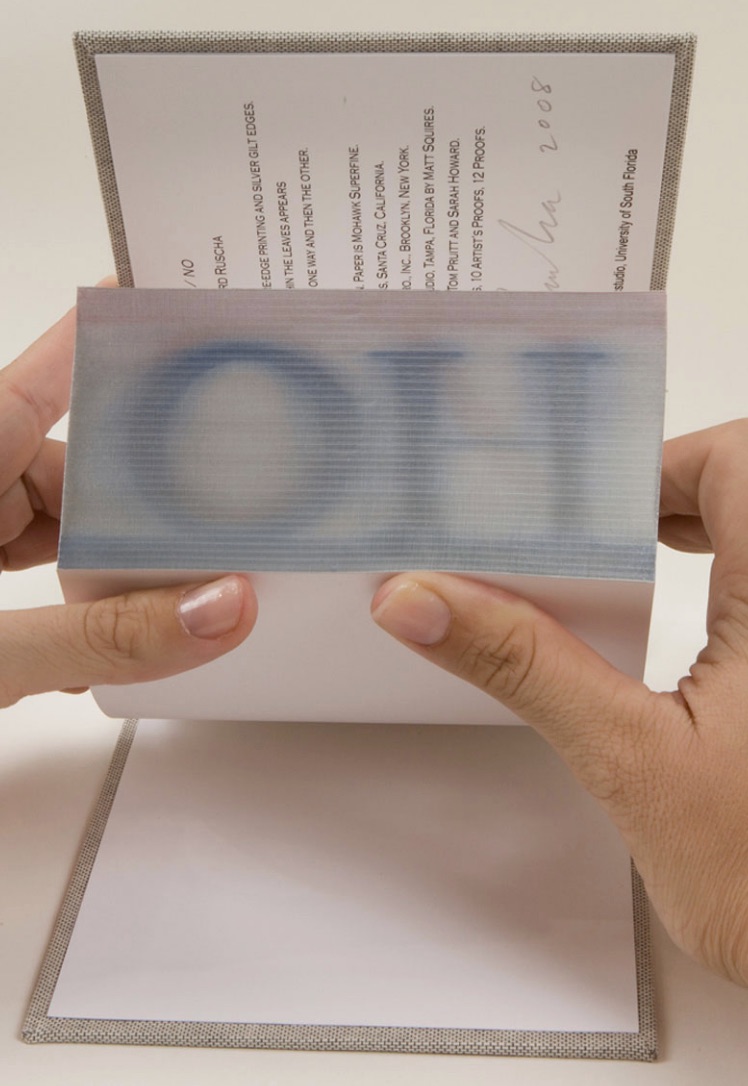
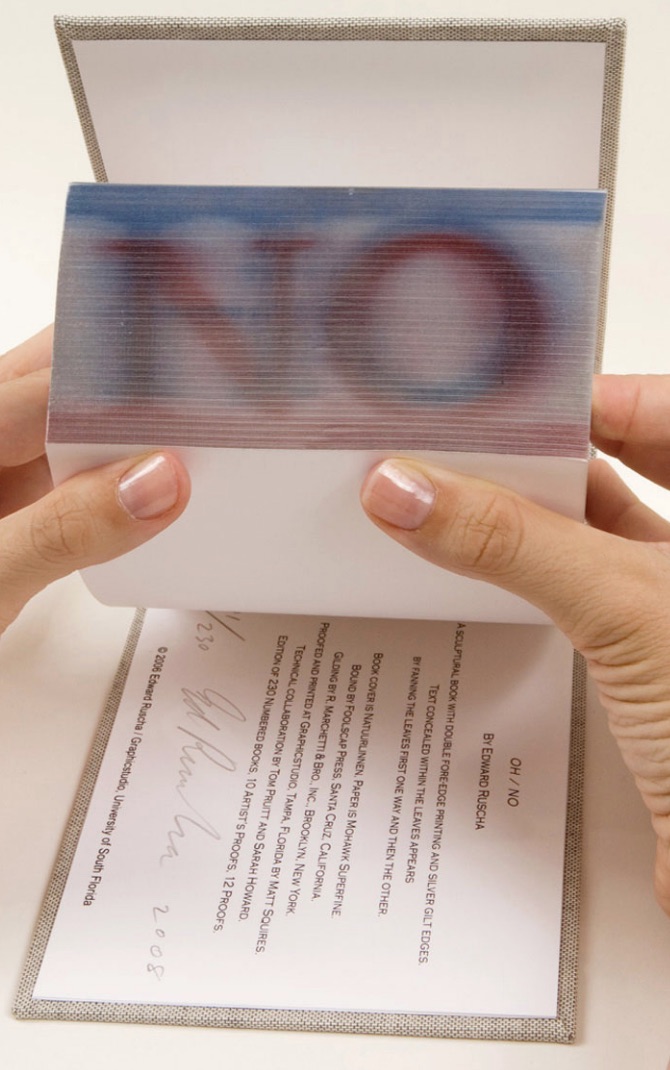
OH/NO (2008)

OH/NO (2008)
Ed Ruscha
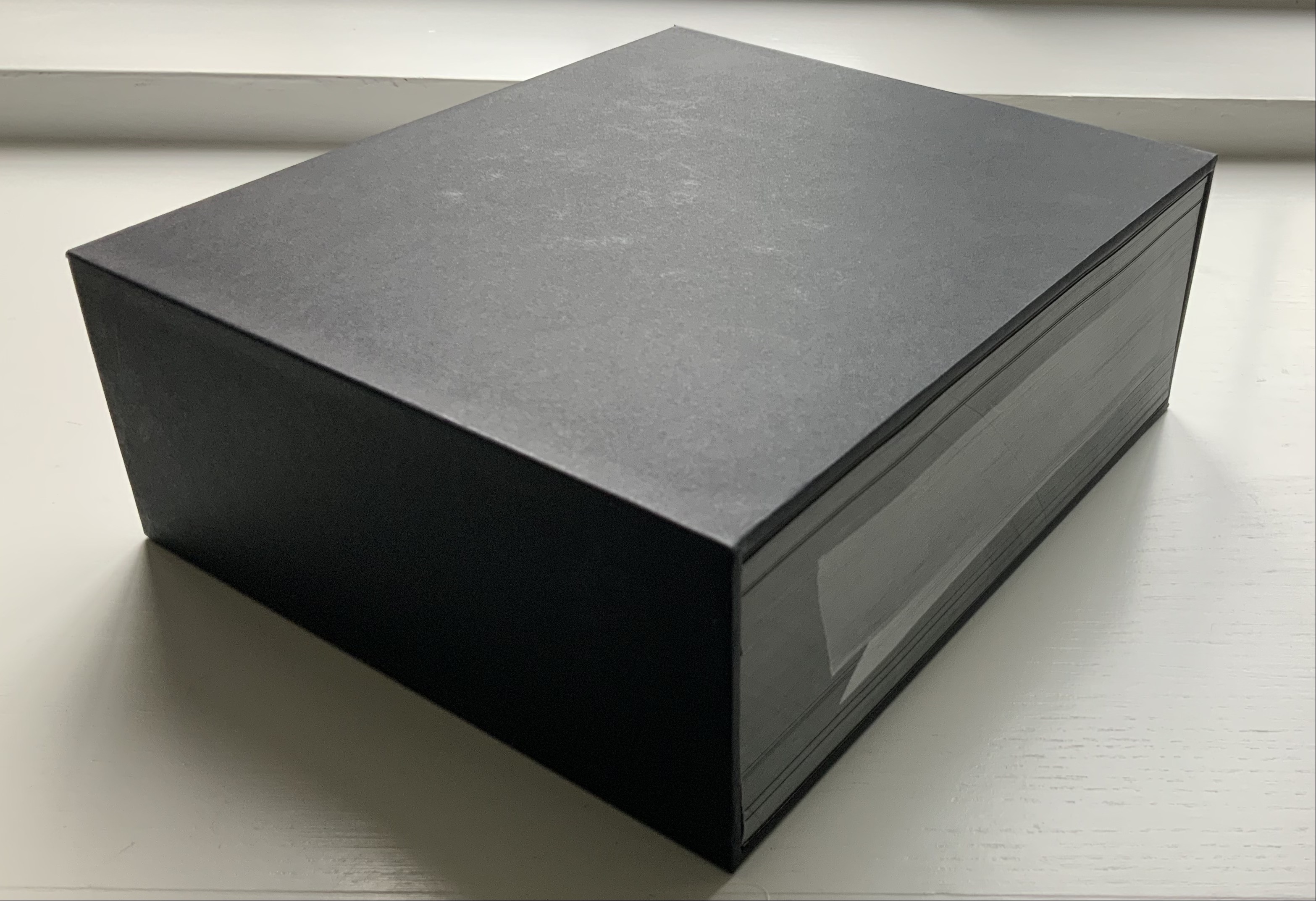
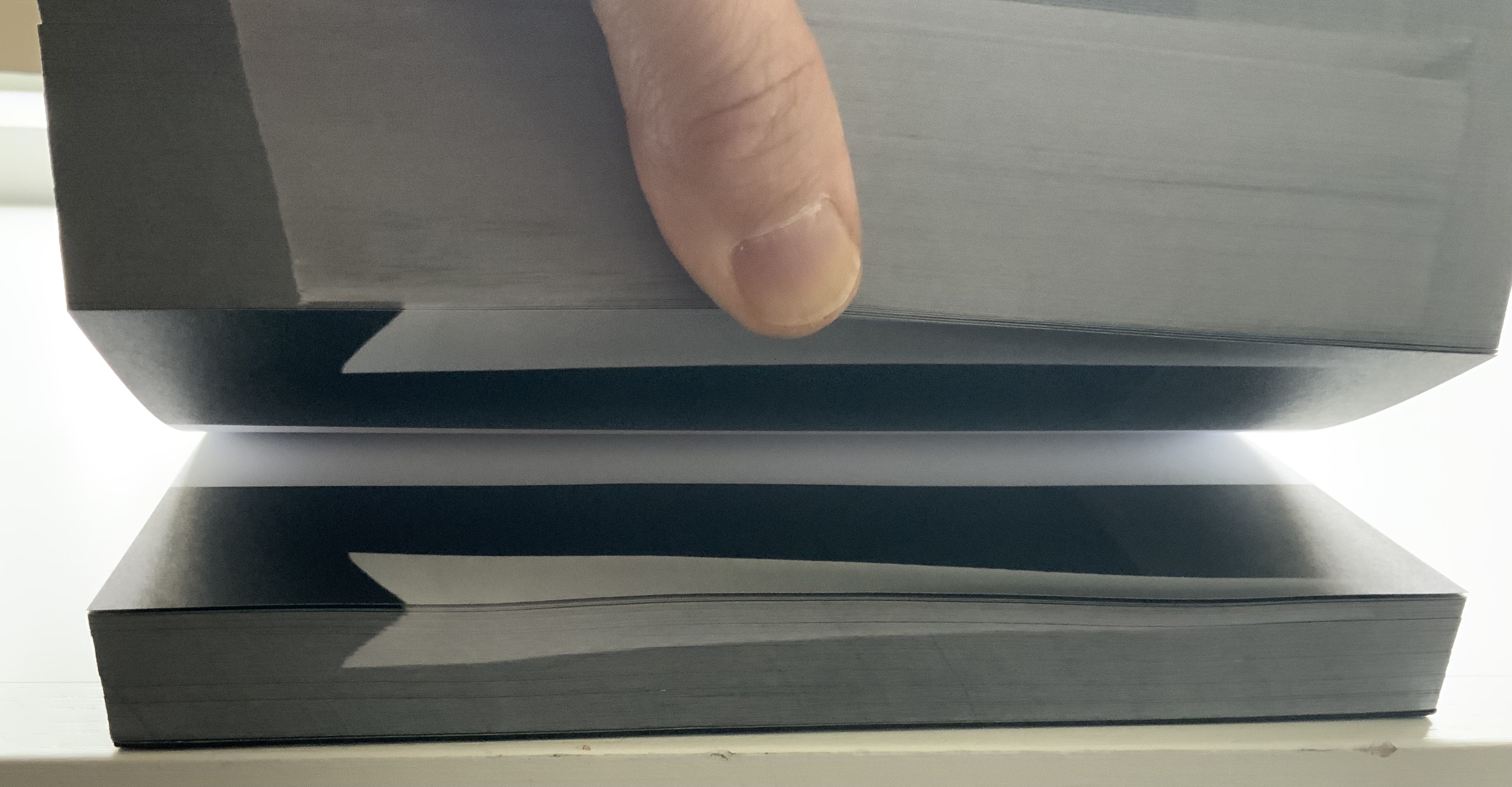
Sculptural book with silver gilt covered printed fore-edge. H5.25 x W7.25 x D2.25 in. Acquired from Hess Fine Art, 14 November 2020. Photos: Courtesy of the gallery.

In an interview in Artforum in 1965, Ed Ruscha commented, “What I am after is … a mass-produced product … none of the nuances of the hand-made and crafted limited edition book”. Well, here is OH/NO, clearly not a hand-crafted work, but nevertheless a limited edition and signed by the artist. It is a tongue-in-cheek machine-produced, if not mass-produced, product. Production and structure draw all attention to an element peculiar to the codex – its fore-edge. It applies printing in the place of hand-crafted fore-edge painting, and the interior is blank. Here is Ruscha applying his deadpan approach to a physical aspect of the book not addressed by those more famous accordion works.

OH/NO is not Ruscha’s first foray into fore-edge printing. In 2002, there was Me and The. Neither work extends the technique per se, but unlike their historical predecessors, Ruscha’s two works, whose pages are otherwise blank, focus entirely on the fore-edge of the book form and depend on its interaction with facetious text.

OH/NO provides a distinctive “other end of the spectrum” to Ximena Pérez Grobet’s Around the Corner (2020). Other than its title, Around the Corner is textless. By progressively manipulating images across all of the book structure’s planes, Pérez Grobet makes a sculpture out of the relationship of the fore-edge to the rest of the book. With OH/NO and Around the Corner side by side, we have a useful and satisfying point of comparison and contrast for considering the breadth of artists’ books.

Around the Corner (2020)
Ximena Pérez Grobet
Japanese bound in slip case open at both ends. H200 x W175 x D70 mm. Edition of 20, of which this is # 2. Acquired from the artist, 1 December 2020. Photos: Books On Books Collection.

Another aspect of artists’ books and Ruscha’s work that OH/NO addresses is production by a third party. As he happily acknowledges, not all of his photographic works are of his own hand, and production is often handed over to a third party. In the various histories and commentary on book art, though, those early works like Every Building on the Sunset Strip are heralded for their cheap one-man-band, democratic production values. But listen to Ruscha himself in the video below about Every Building, and it is clear that the concept of his artist’s books does not lie in their production. OH/NO‘s high production values could not be further from Every Building‘s. Look instead to the interaction of the text with the structure. Given Ruscha’s sense of humor, the title and sculptural object itself might be commenting on the studio approach of high-concept artists as much as it might be on the absence of text in the pages.

Various

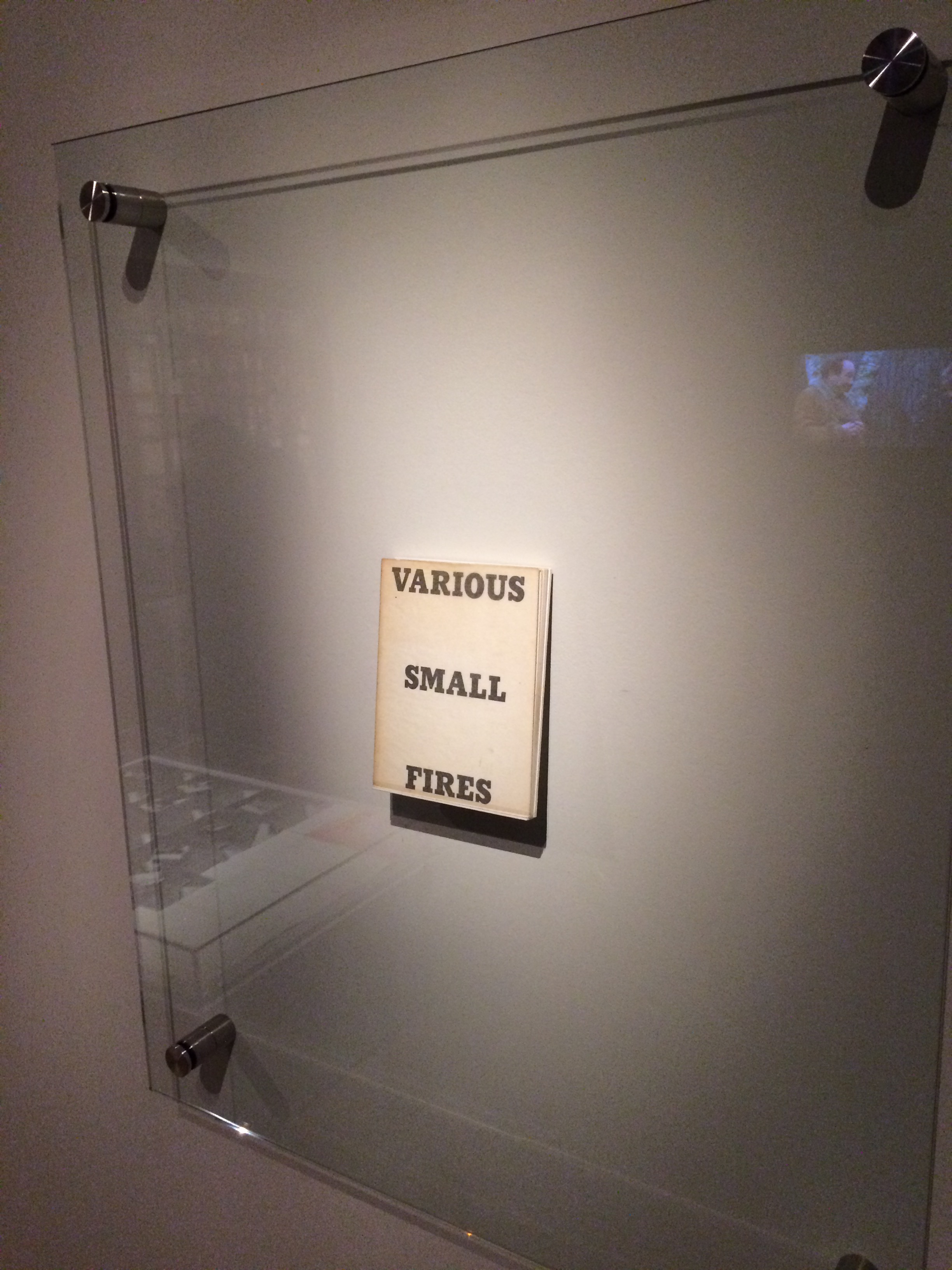
Even though they are not works of appropriation themselves, Every Building and Ruscha’s Various Small Fires have engendered a small industry of appropriation in book art. Various Small Fires lent itself to a Gulbenkian/Calouste exhibition’s placing it as a high-concept centerpiece “reflecting on” Bruce Naumann’s appropriation Burning Small Fires.

Display of Ed Ruscha’s Various Small Fires and Milk (1964) at “Pliure: La Part du Feu”, 2 February – 12 April 2015, Paris. Photo credit: Books On Books Collection.
Reflected in the lower left hand corner is the display of Bruce Nauman’s Burning Small Fires; in the upper right corner, the film clip of Truffaut’s 1966 Fahrenheit 451; and in the upper left, Maria Helena Vieira da Silva’s La bibliotheque en feu (1974).

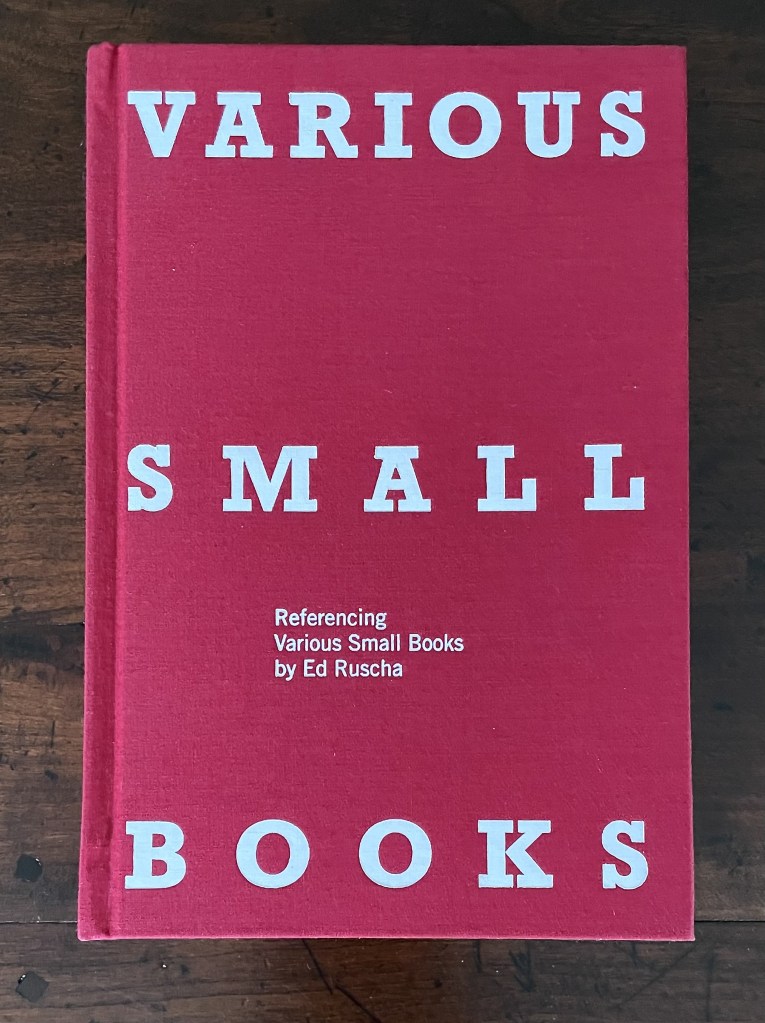
There is even an entire book devoted to the appropriation of Ruscha’s works.

Various Small Books : Referencing Various Small Books by Ed Ruscha (2013) 
Edited by Jeffrey T. Brouws, Wendy Burton, and Hermann Zschiegner
Casebound, printed cloth over boards. H236 x W160 mm. 288 pages.
Photos: Books On Books Collection

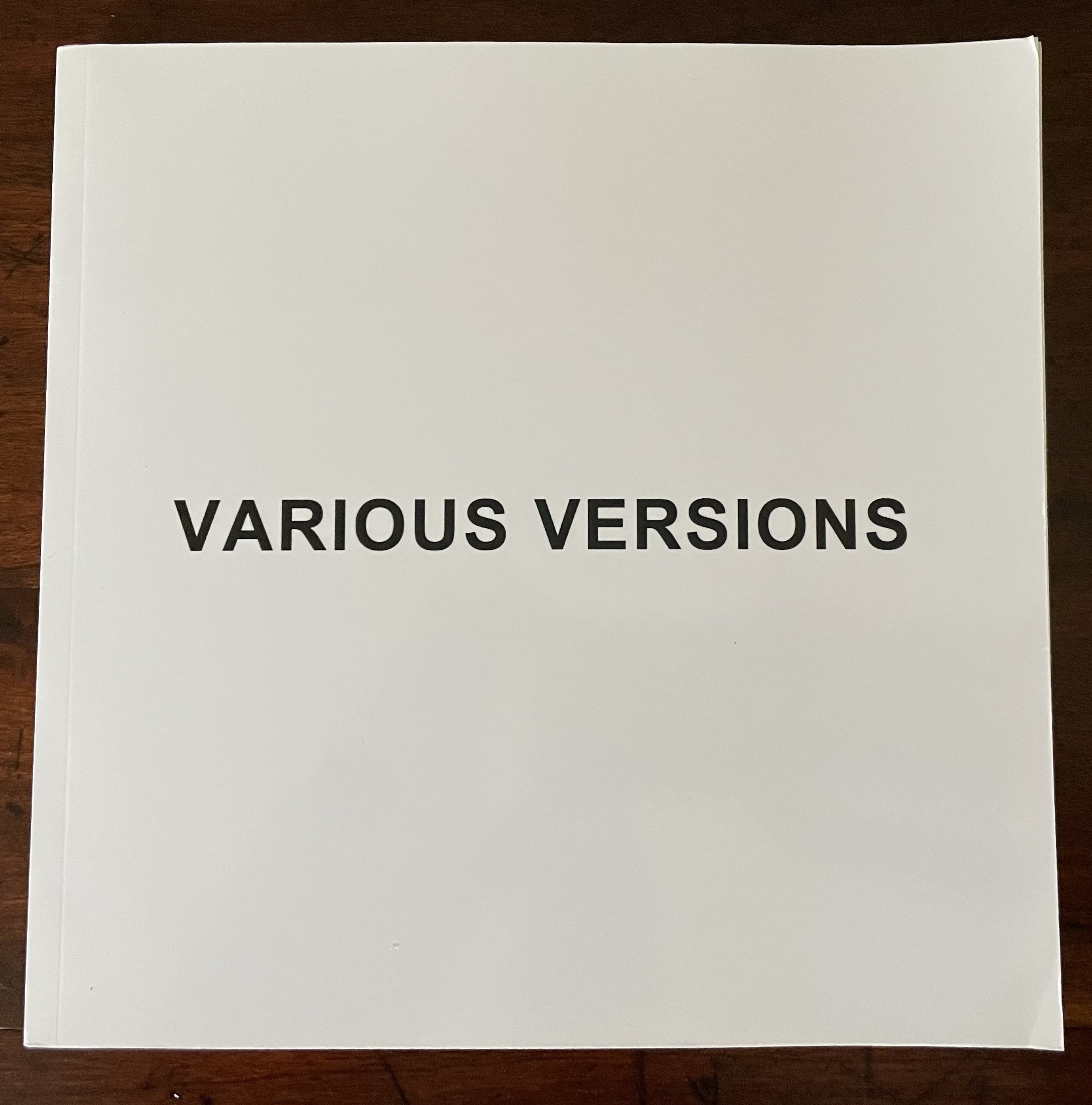
Beyond this brilliant collection of examples and commentary, additional appropriative works have appeared — so many that a second edition may be required.

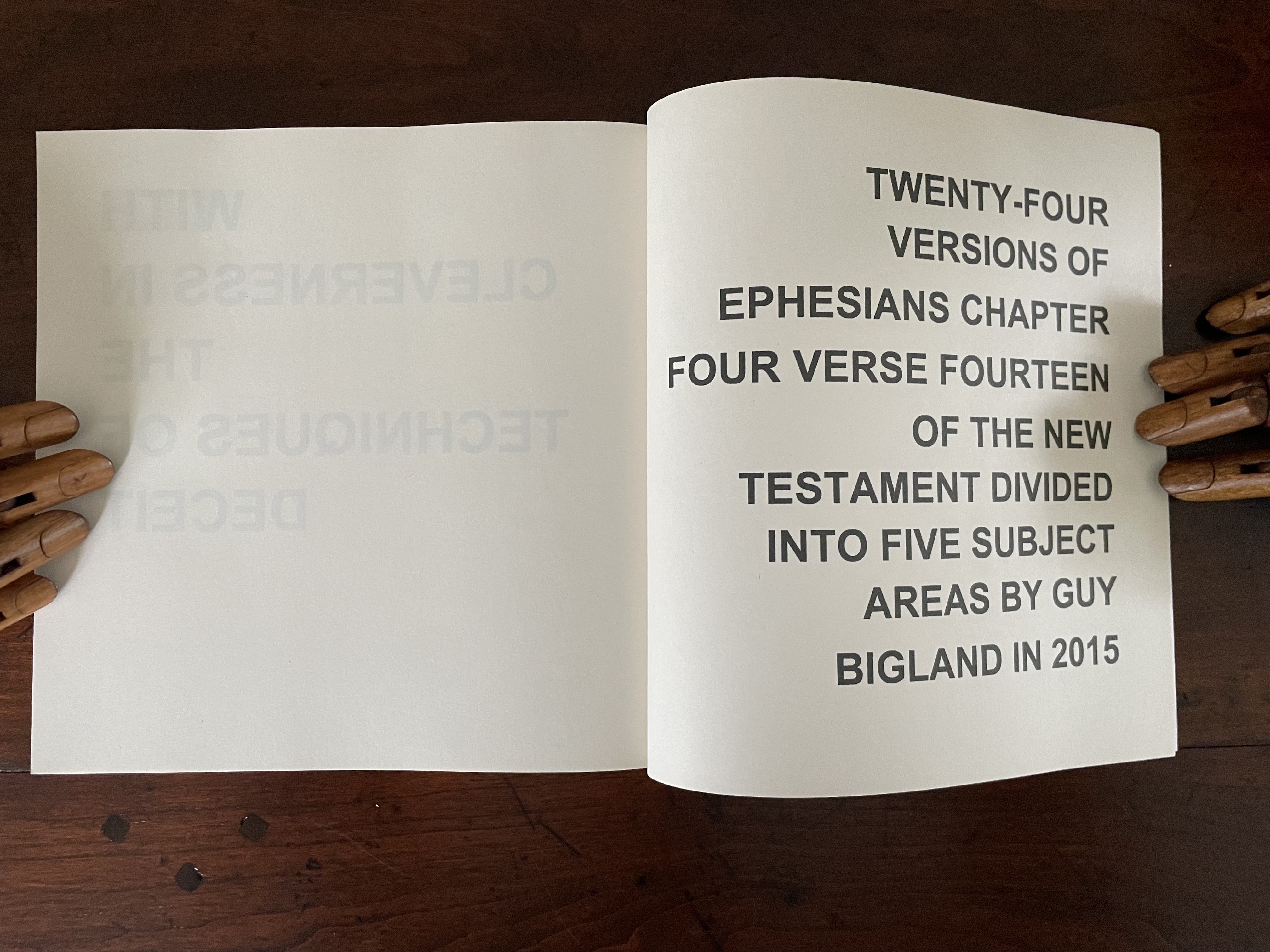
Various Versions (2015)
Guy Bigland
Perfect bound soft cover. H190 x W190 mm. [158] pages. Acquired from the artist, 12 October 2023.
Photos: Books On Books Collection.

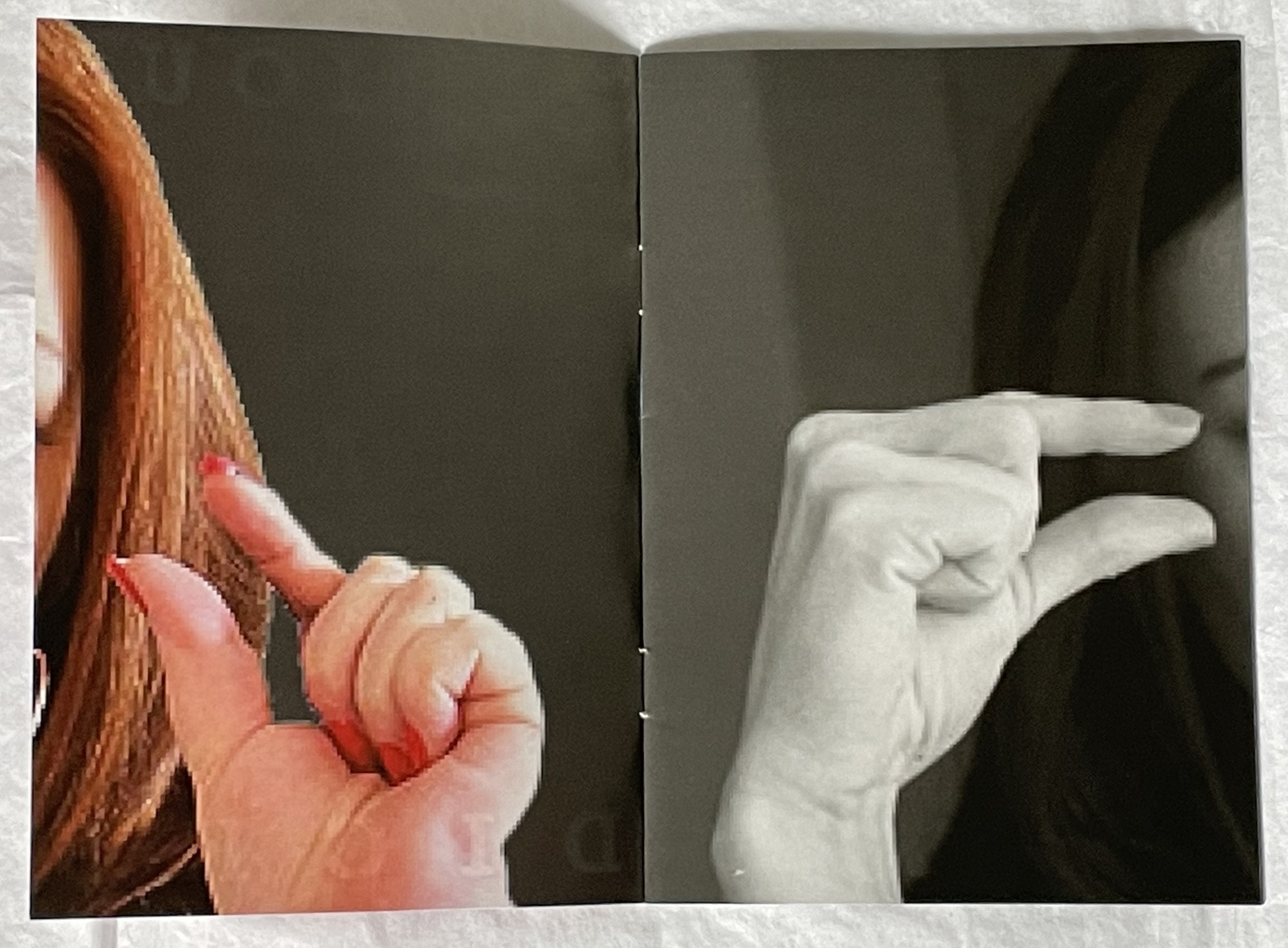
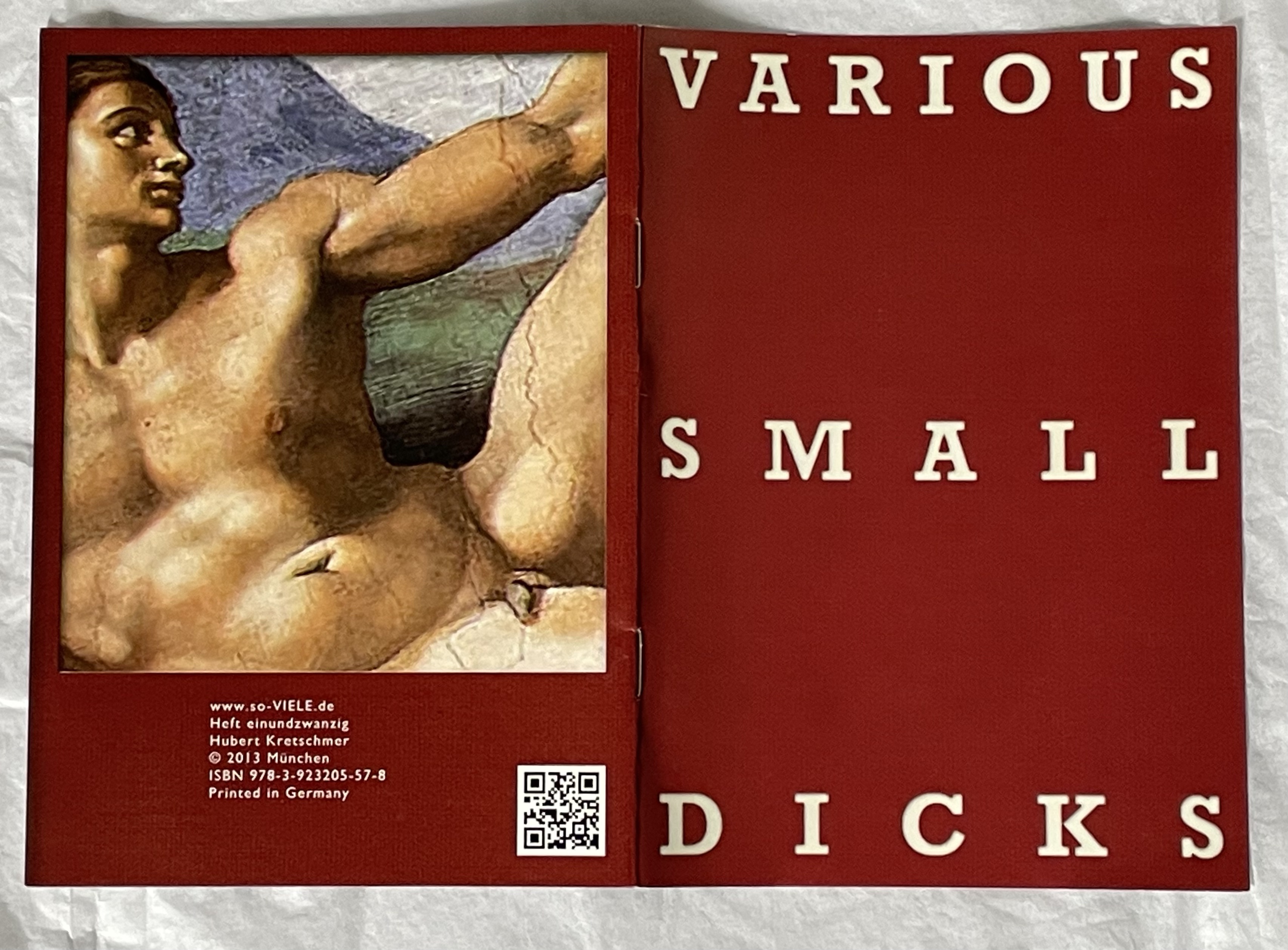
Various Small Dicks (2013)
Hubert Kretschmer
Saddle stitched booklet. H149 x W105 mm. [8] pages. Acquired from the artist, 11 July 2019.
Photo: Books On Books Collection.

It is fun to place OH/NO as an expression of mock horror in response to all that.

Further Reading/Viewing

Fore-edge Printing and Painting: Book Art and the Book Arts Revealed“. 12 May 2013. Bookmarking Book Art.

Guy Bigland“. 31 August 2023. Books On Books Collection. Updated 8 November 2024.

Hubert Kretschmer“. 7 November 2024. Books On Books Collection.

Ximena Pérez Grobet“. 7 July 2021. Books On Books Collection.

Cain, Abigail. 27 September 2018. “Unpacking Ed Ruscha“, Aperture. This is Cain’s review of the Harry Ransom Center’s 2018 exhibition Ed Ruscha: Archaeology and Romance, which used 150 displayed items to focus on 16 of Ruscha’s books. It contextualizes Various Small Fires neatly. Quoting the Center’s photography curator Jessica S. Macdonald, Cain writes: “… lack of artistry is one of the hallmarks of Ruscha’s artist books. ‘The photographs of gas stations are bad photographs on purpose,’ McDonald noted. ‘He’s trying to do the opposite of what a photographer trying to make an artistic photograph would be doing.’ In a 1965 Artforum interview concerning his second book, Various Small Fires and Milk (1964), Ruscha explained that it didn’t even matter to him who took the photographs. ‘In fact, one of them was taken by someone else,’ he said. ‘I went to a stock photograph place and looked for pictures of fires, there were none.'” 

Coplans, John. February 1965. “Concerning ‘Various Small Fires’: Edward Ruscha Discusses His Perplexing Publications”. Artforum. 3:5, 25.

Hoyle, Ben. 25 February 2017. “Ed Ruscha, the pop painter with ‘the coolest gaze in American art’“. The Times. London. Ben Hoyle’s easygoing interview with Ed Ruscha introduces his work as the heart of the British Museum’s exhibition “The American Dream: pop to the present” (9 March 9 to 18 June 2017).  That is a bold assertion as the show included Claes Oldenburg, Jasper Johns, Andy Warhol, Roy Lichtenstein, Cy Twombly, Louise Bourgeois, Robert Rauschenberg and others recognizable to anyone who was briefly awake in a college art history class — even as long ago as the 70s. But, back then, not so much “Ed Ruscha”. Hoyle’s article – with its paragraphs’ casual packing in of news, telling descriptive detail and sharp observations (whether his or others’) of Ruscha’s art – makes a persuasive case.   

LaCava, Stephanie. 20 February 2017. “Artist Books/Artist’s Novels (Vol. 5): Ed Ruscha”, The Believer.

Every Building on the Sunset Strip described by Ed Ruscha, courtesy of the V&A Dundee.

Giulio Maffei, Edward Ruscha's The Sunset Strip, 1966, 2015

From his series Le Vite dei Libri (The Lives of Books), Giulio Maffei provides a clever catalog entry on the Sunset Strip.

Bookmarking Book Art – Hanne Stochholm Exe

Danish artist Hanne Stochholm Exe‘s “assemblages”, which garnered first prize in the 7th International Artist’s Book Triennial Vilnius 2015, have cousins far afield — geographically and chronologically.

Remake (2015) 
Hanne Stochholm Exe
Reproduced with permission of the artist
Talks (2005) 
Hanne Stochholm Exe
Reproduced with permission of the artist
Small Talk (2005)
Hanne Stochholm Exe
Reproduced with permission of the artist

Geographically, this merging of book and metal finds common cause in the US (see Andrew Hayes’ works) and Israel (see the work of Neil Nenner and Avihai Mizrahi, represented — as is Hayes — by the Seager/Gray Gallery).

Offset (2013)
Andrew Hayes
Cover Story #4 (2017)
Neil Nenner and Avihai Mizrahi

Chronologically, the hold that books and metal have had on one another reaches far past the moveable type of Gutenberg’s Bible and Master Baegun‘s earlier Jikji.

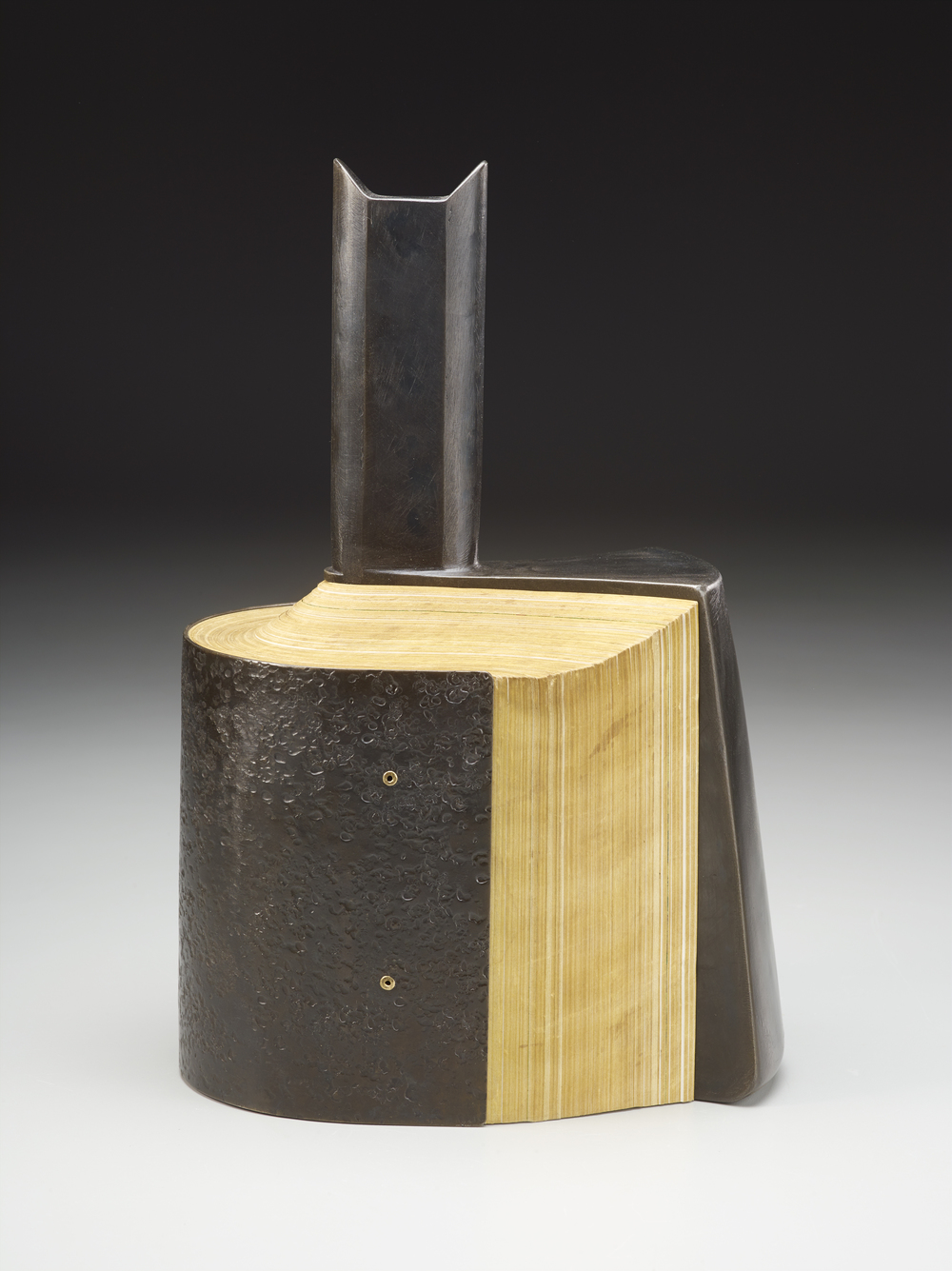
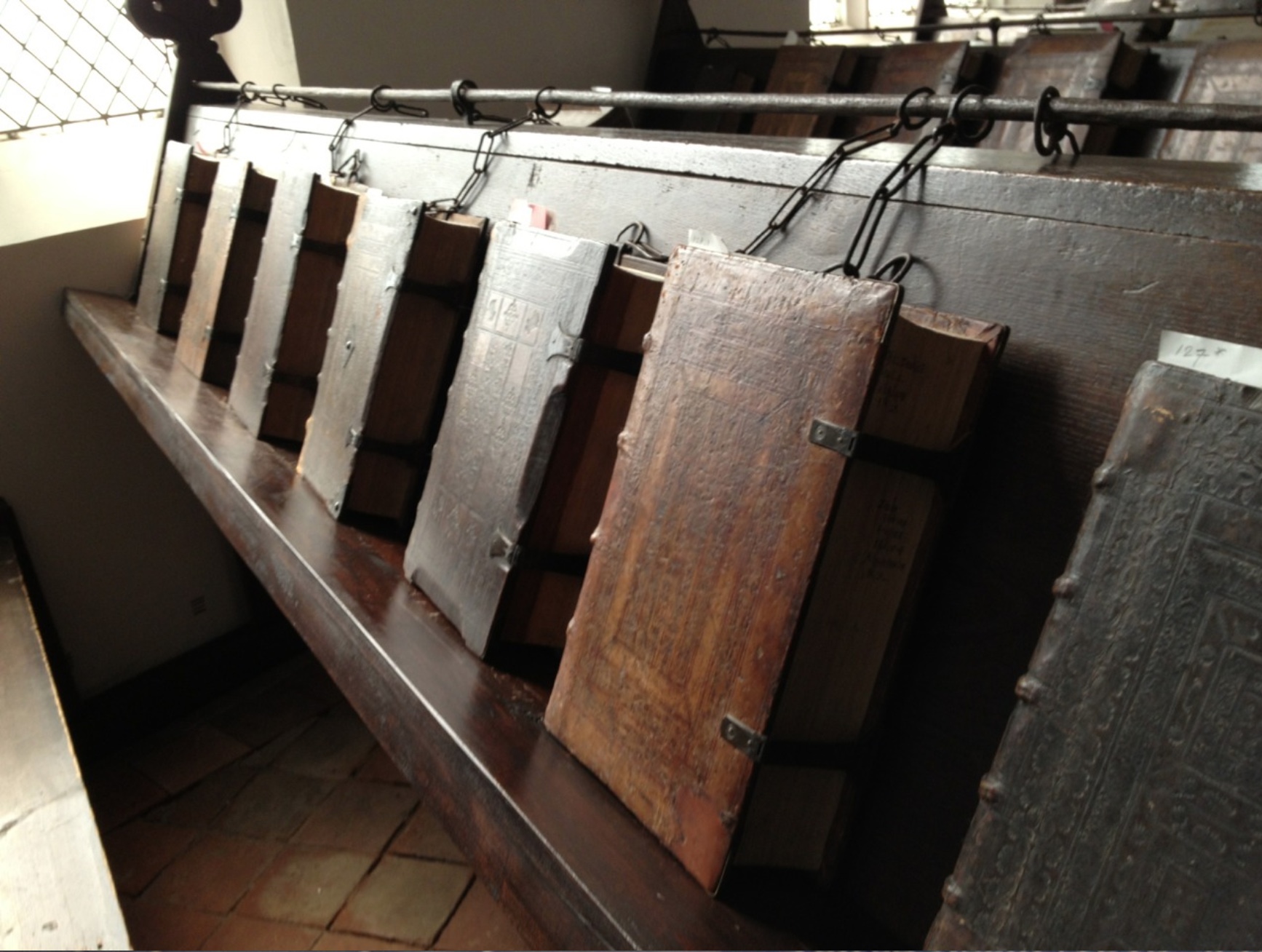
Those metal “feet” embedded in the front and back covers kept the bottom edges of upright books chained in lectern libraries from wearing out.

Of course, those 11th century metal fittings probably passed unnoticed by studious readers. Not so with these studious artists in the 21st century whose imaginations have seized on the contrast of materials to recast the book object as an art object.

Bookmarking Book Art – Irma Boom on the future of the book

Fore-edge of Shelia Hicks: Weaving as Metaphor  by Nina Stritzler–levin and Arthur C. Danto
(Yale University Press, 2006)
Designed by Irma Boom

“AM: How would you sketch the future of the book?

IB: The book has a great future. In the statement in my little red book [Irma Boom: The Architecture of the Book] I talk about the renaissance of the book. It is already happening now. … 

At a recent event, Massimo Vignelli claimed ‘The book is dead’. …

I was shocked when Massimo repeated that sentence, I read it everywhere. But the printed book does not need any defender. It has survived 600 years or so. The way information spreads depends on the inventions of that time; paintings have survived, photos, and the book is another form.

Anne Miltenburg, “Reputations: Irma Boom“, Eye Magazine (Summer 2014). From 

Bookmarking Book Art – Kim Anno

From www.kimanno.com. Accessed 23 September 2018

The Albertine Workout is a collaboration between artist Kim Anno and poet Anne Carson. 

Albertine is Albertine Simonet, the central love interest in Proust’s In Search of Lost Time. The Workout explores her character in text and image.  The illustration above touches the biographical note that, according to Proust, the Albertine character was based on Alfred Agostinelli, sometime chauffeur and typist for Proust.

The images resting in the burgundy Solander box on Anno’s website are well worth a look. (Carson’s text not seen.)

Bookmarking Book Art – Leonardo Ulian

Atlas 004 – Vertical Space Order (2015)
Leonardo Ulian
Books, microchips, copper wire
190 × 36 × 41 cm

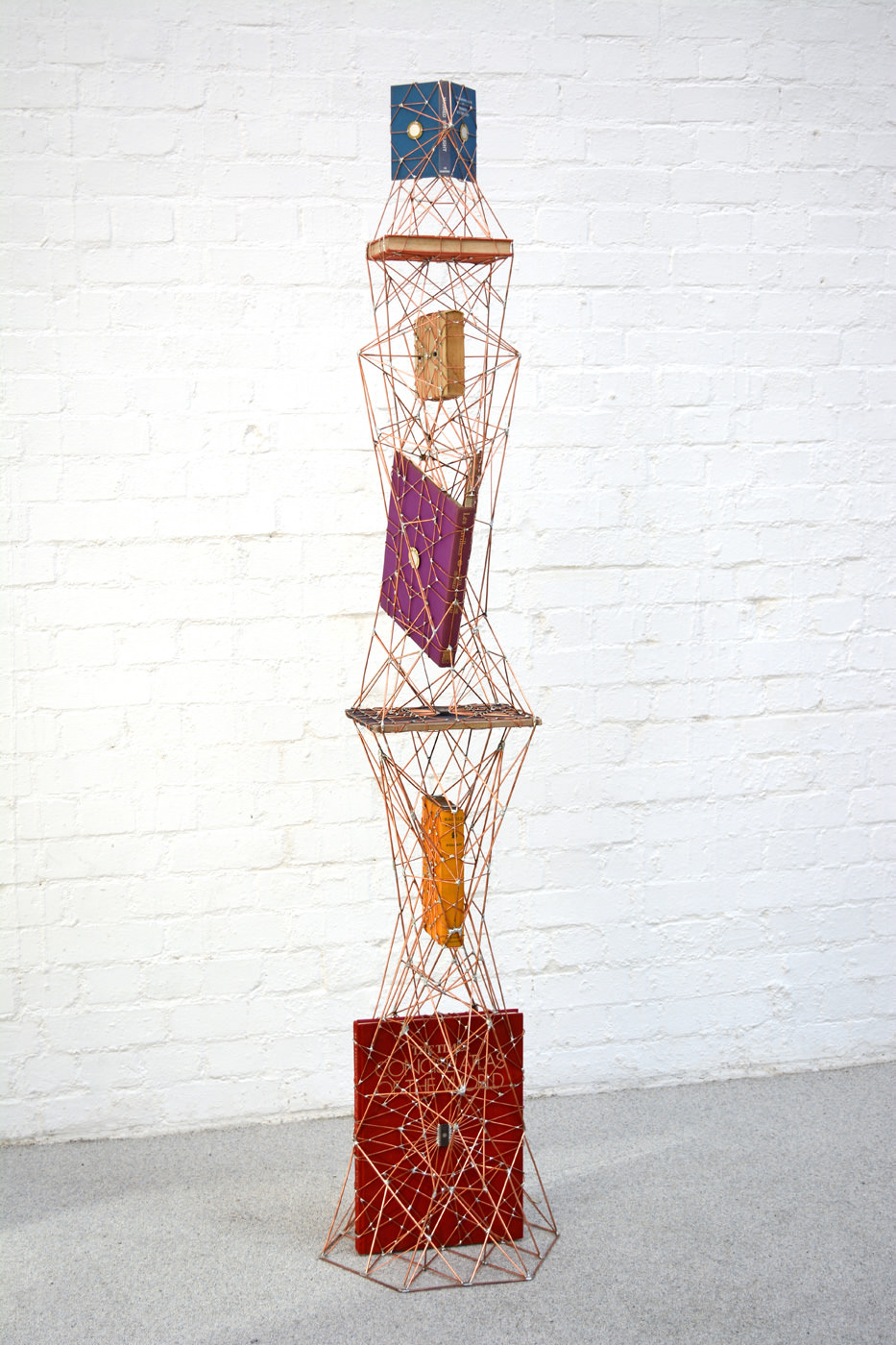
At the base of this sculpture is The Times Concise Atlas of the World, and at its top, The Observer’s Book of Manned Space Flight (No. 48). These two elements of the piece resonate with its rocket-like thrust, metallic gantry-like frame and micro-chip nodes, as does the textbook on projective geometry. Euclidean geometry describes shapes “as they are” while projective geometry describes them “as they appear”.

It is hard to suss what Walter Starkie’s picaresque travelogue about life with the Roma (Raggle Taggle) or Cyril Connolly and Jerome Zerbe’s picture book on 18th century French “pavillons” or Yehiel Dinur’s autobiographical novel of his post-holocaust life in Israel (Ka-Tzetnik 135633, House of Love) have to do with the rest of it.

Art composed of found elements is like that, I suppose. Just enough connectedness to suggest order and intentionality, just enough disconnectedness to suggest disorder and randomness. Ulian’s other works, incorporating electronic parts soldered together in “microchip synapses” and “technological mandalas”, however, imply other tensions — between technology and the human, the digital and the spiritual.  Or in the case of his Contrived Objects (wooden tennis rackets, microchips and copper wire), between the physical and the artificially cerebral.

Ulian’s more recent work has changed from that of 2010-11 (A fragile forest and From zero to one).  Even though some of the themes, materials and techniques are the same, the more recent works (those noted above) are more focused, self-contained, polished, static and perhaps decorative. I suspect there may be another cycle and even more engaging art coming from this artist.

Books On Books Collection – Sarah Bryant

In 1995, the Smithsonian Institute Libraries’ exhibition Science and the Artist’s Book explored “how science can serve as a springboard for artistic creation” and showed how “aspects of creativity … are common to science as well as to art”. The exhibition juxtaposed twenty-five rare books from the Heralds of Science collection at the Dibner Library with twenty-five bookworks commissioned as responses to them. For example,

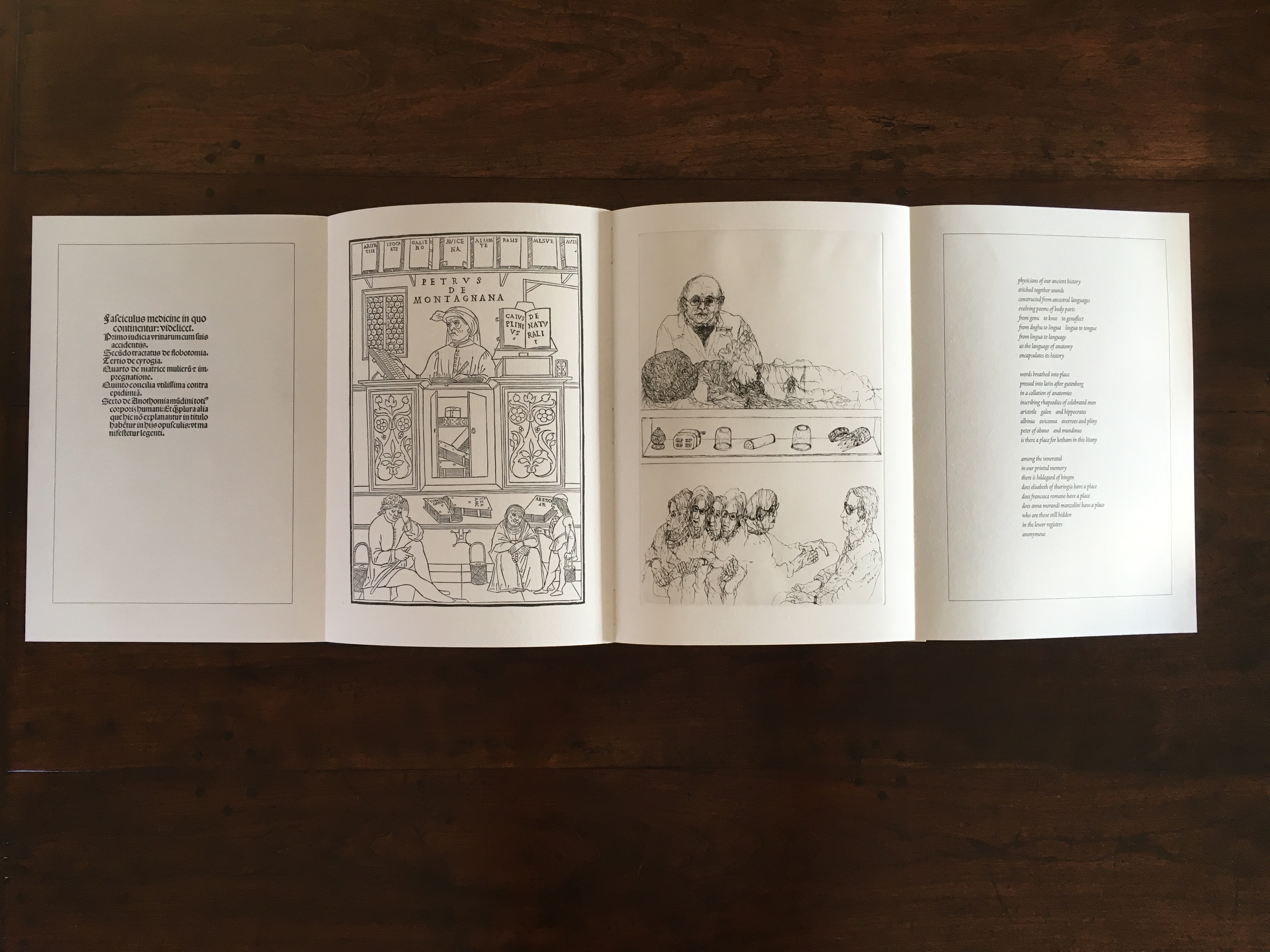
Joyce Cutler-Shaw responded to Johannes de Ketham’s Fasciculus Medicinae (Venice: Impressus per Ioannes [et] Gregorius de Gregorijs fratres, 1495) with The Anatomy Lesson (Middletown, CT: Robin Price, Publisher, 1995);

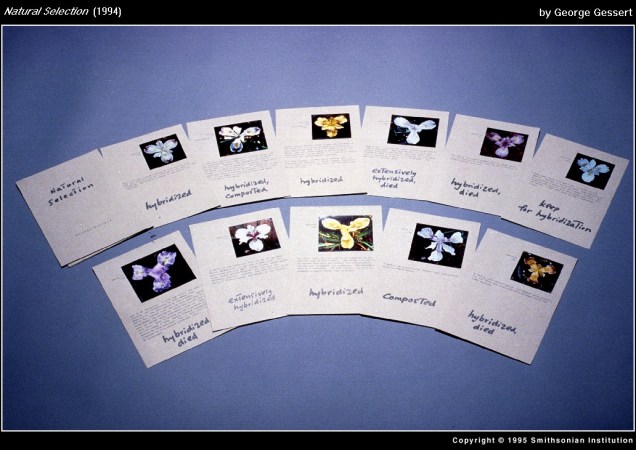
George Gessert responded to Darwin’s On the Origin of Species (London: John Murray, 1859) with Natural Selection (Eugene, OR: self-published, 1994);

and Laura Davidson responded to Vitruvius Pollio’s’ De Architectura libri Dece [The Ten Books on Architecture] (Como, Italy: Gottardo de Ponte, 1521) with Ten Books of Vitruvius (Boston, MA: self-published, 1994).

As the exhibition demonstrated, the overlay of the dual traditions — those of art and those of the book — on the domains of science creates a rich soil for ingenuity and genius. Since that exhibition, science- and maths-driven book art has yielded harvest after harvest of outstanding book artists. Sarah Bryant is one of them. Bryant won the MCBA Prize in 2011 with Biography (2010) and was a finalist in 2015 with Figure Study (2015).

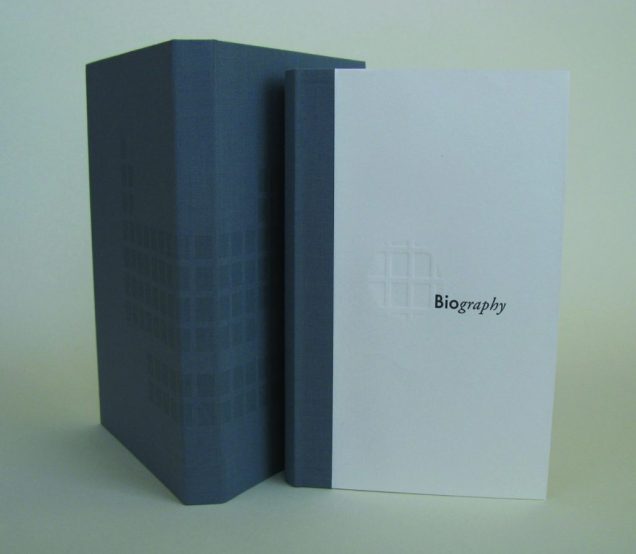
Biography (2010)
Sarah Bryant

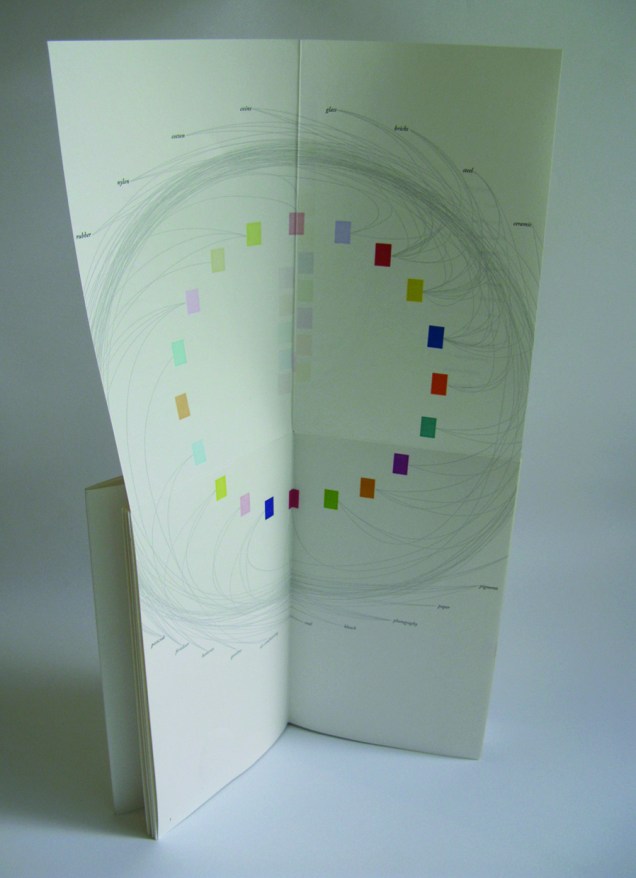
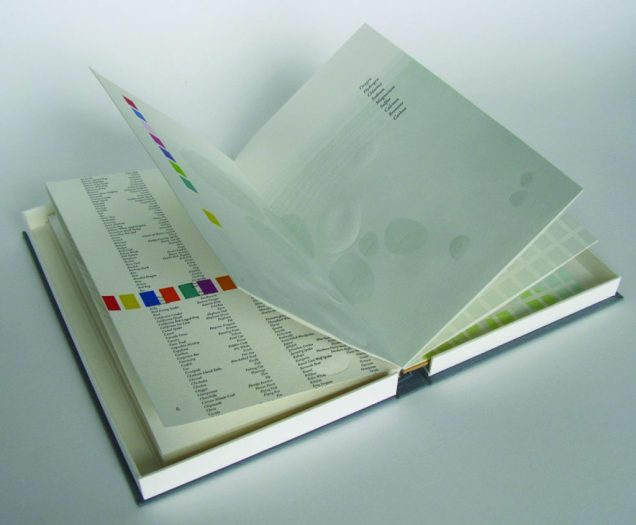
“[A]n exploration of the chemical elements in the human body and the roles they play elsewhere in the world”, Biography (2010) is bound as a hard cover drumleaf and enclosed in a clamshell box. It begins with the periodic table and assigns a coloured square to each of the chemical elements found in the human body. Using those coloured squares, the six subsequent diagrams show the presence of the body’s chemical elements in the earth’s crust, man-made weapons, medicines, sea water, etc. The flip-up folio (above right) displays their presence in various man-made tools and building materials. Bryant’s inventive handling of colour, the flip-up folio and blind embossed printing foreshadow developments in her later work.

Figure Study (2015)
Sarah Bryant and David Allen

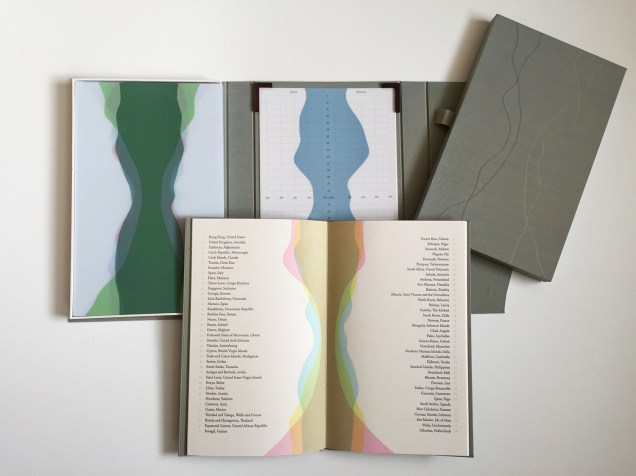
Collaborating with David Allen, a professor at Middlebury College in Vermont, Bryant created Figure Study (2015), a graphical “comparison of population data for every region on earth”. In this work, Bryant takes her handling of shape and colour to a new level.

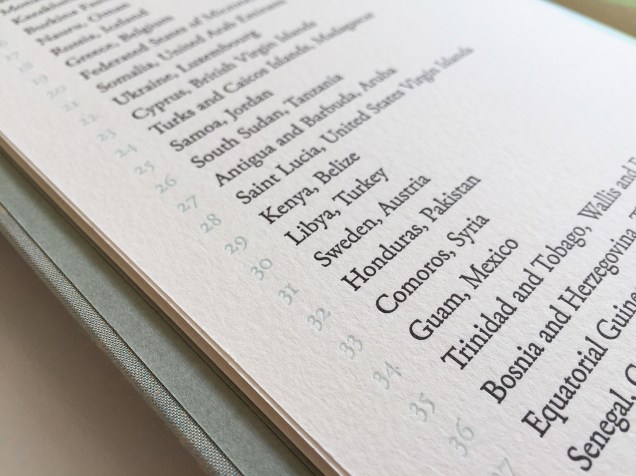
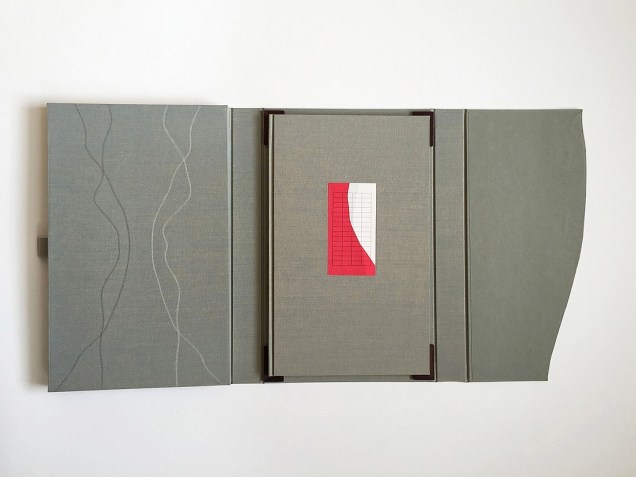
All 114 of these figures have been printed from linoleum onto drafting film and are housed together alongside a grid. The figures are each numbered and can be interpreted using a booklet containing an alphabetical and numerical index, as well as a short essay by David Allen about our process and the source of the data. The design of the enclosure encourages the viewer to layer the forms to create different combinations of shape and color. This process and the resulting imagery is initially reminiscent of elaborate dresses, paper dolls, and dissection plates, but the source of the data gives a different picture, laying bare the vast and critical differences between the basic equations of life in different parts of the world. 2015 MCBA Prize Finalists

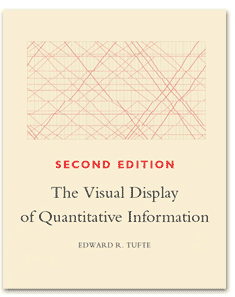
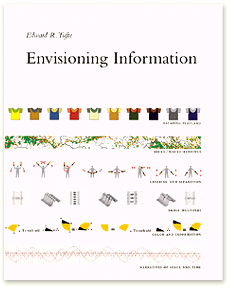
In correspondence with Books On Books, Bryant has noted the influence of Edward R. Tufte. Figure Study particularly may remind the reader/viewer of Tufte’s The Visual Display of Quantitative Information (1983) and Envisioning Information (1990). In his books and lectures, Tufte champions the connection of art and science as well as information display that is interactive, which Bryant’s statement above echoes.

As her two bookworks above and those below associated with the collective Shift_Lab demonstrate, she has the gift of transforming analytical data, diagrammatic imagery , text derived from reference materials as well as personal experience and taking them beyond “visual display” and into art.

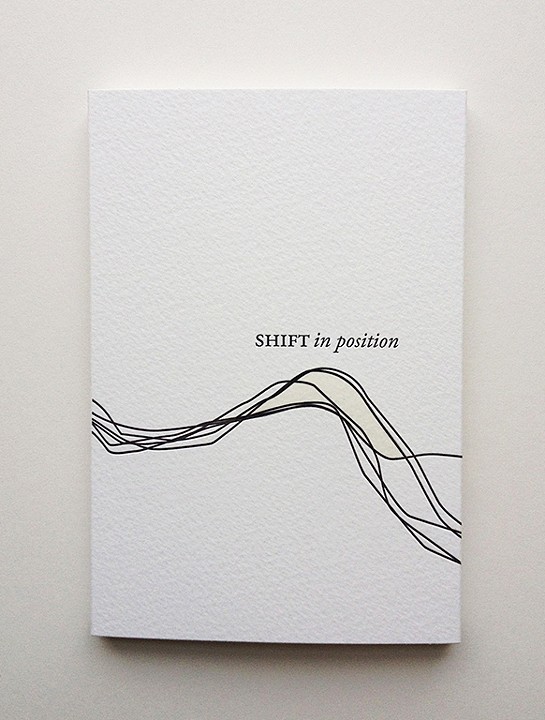
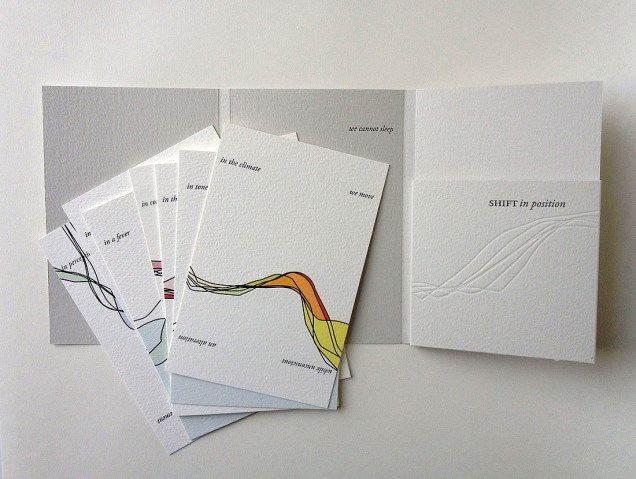
Shift in Position (2014)
Sarah Bryant

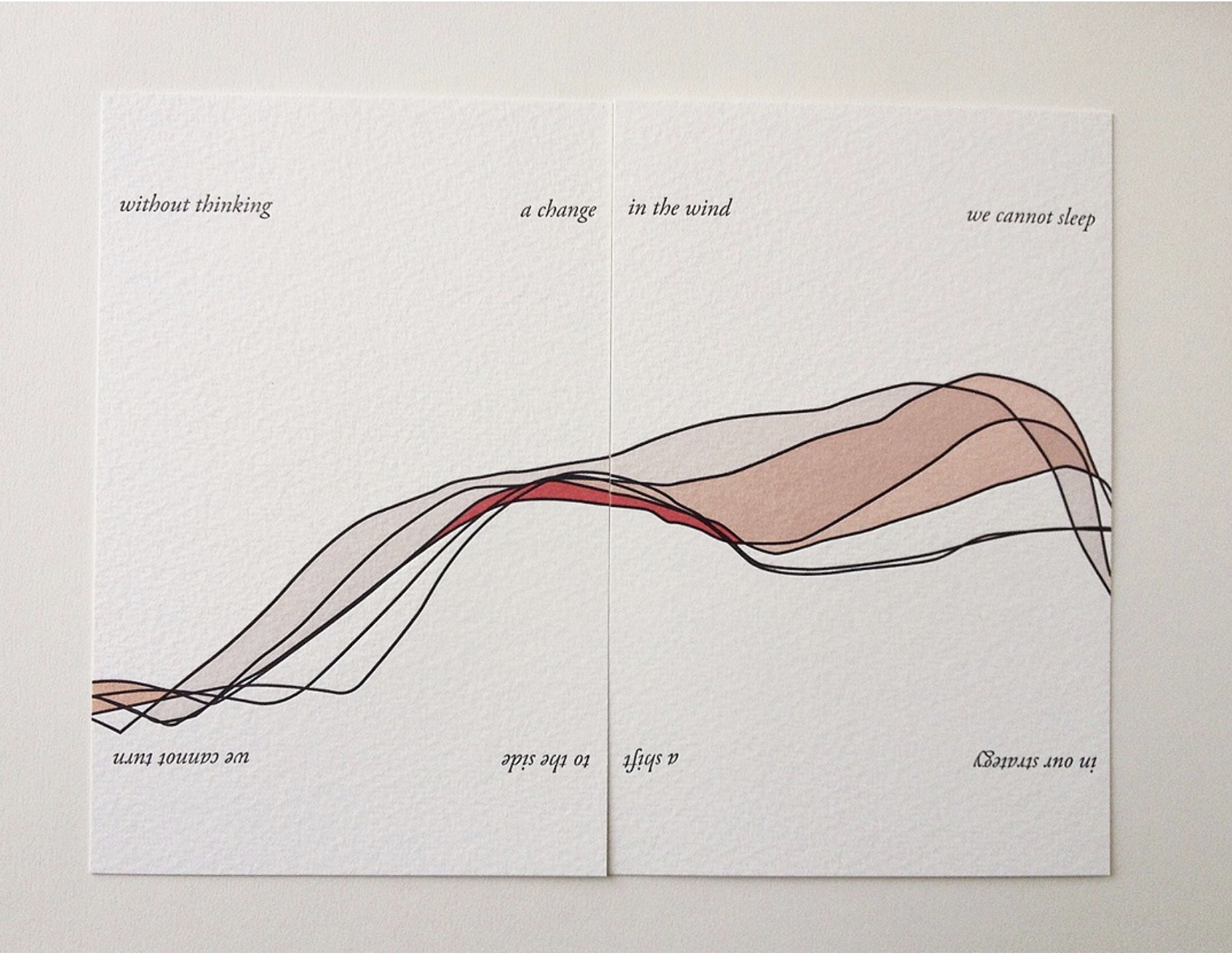
In Shift in Position (2014), Bryant draws on her own sleep patterns and movements. Extraordinary how, in Shift in Position, she manipulates the elements of the book to embody the “message” of the work. Note how she plays with layout, in particular, by running text syntactically over the loose folios (“a change/ in the wind” and ensuring the alignment of the graphical image. The work invites the reader/viewer to turn the two folios 180º — like a restless sleeper — to read/see the additional run-on text (“a shift/ to the side”) and the aligned image from another perspective. This use of the material and form draw the reader/viewer into a kind of creative act — negotiating the act of close reading with that of close looking.

Listen Out for a Bell which Rings Continuously (2015)

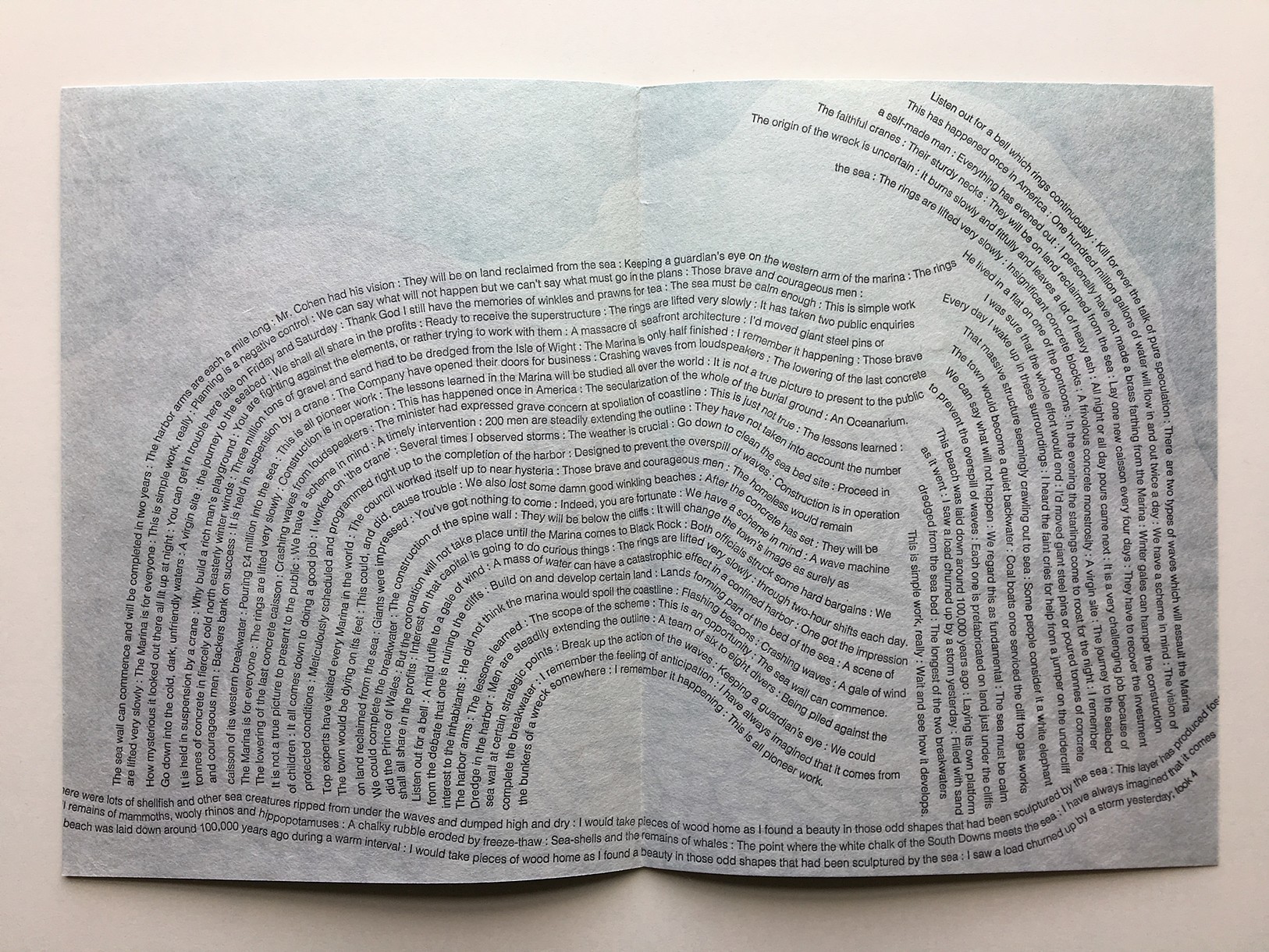
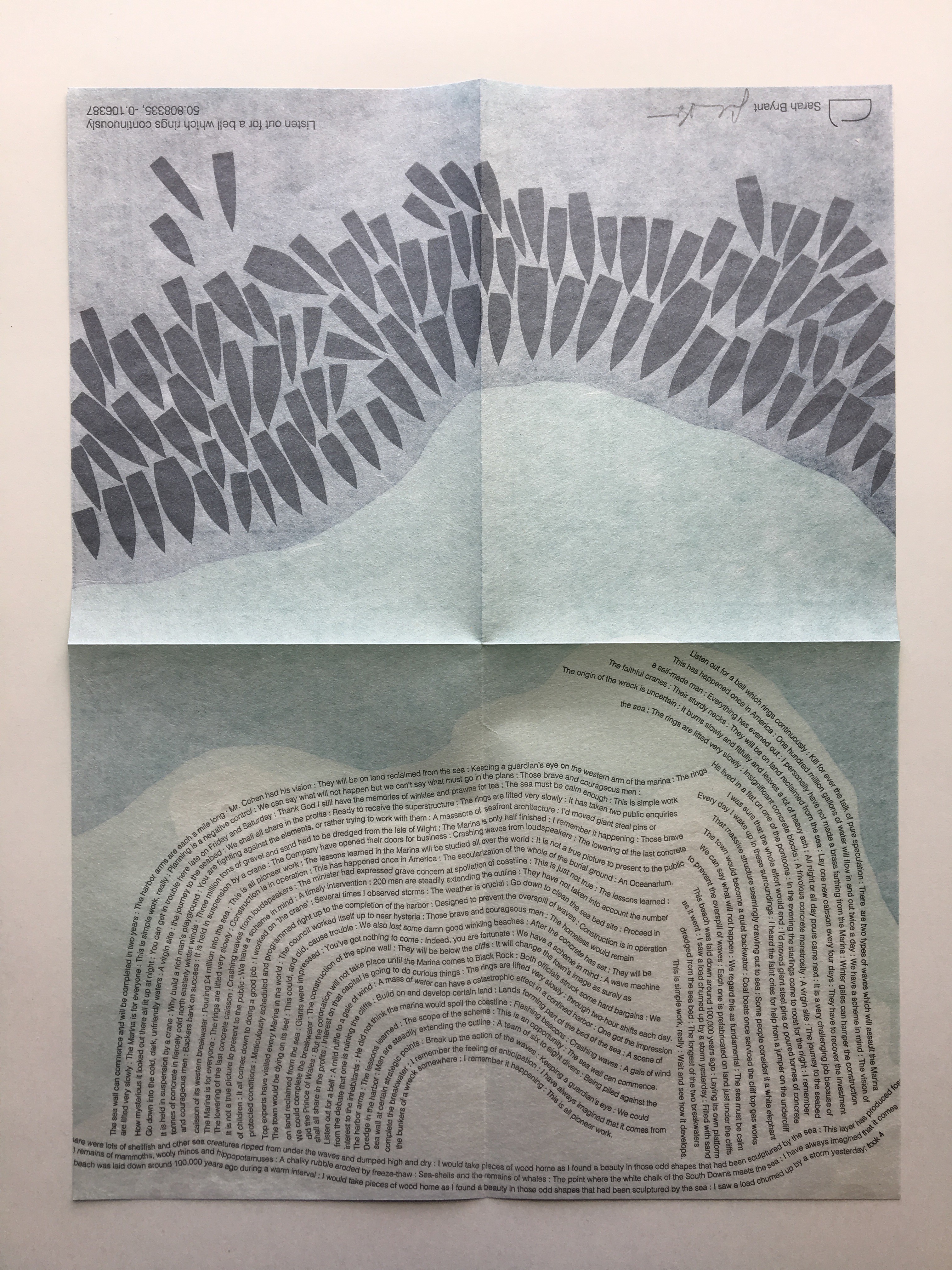
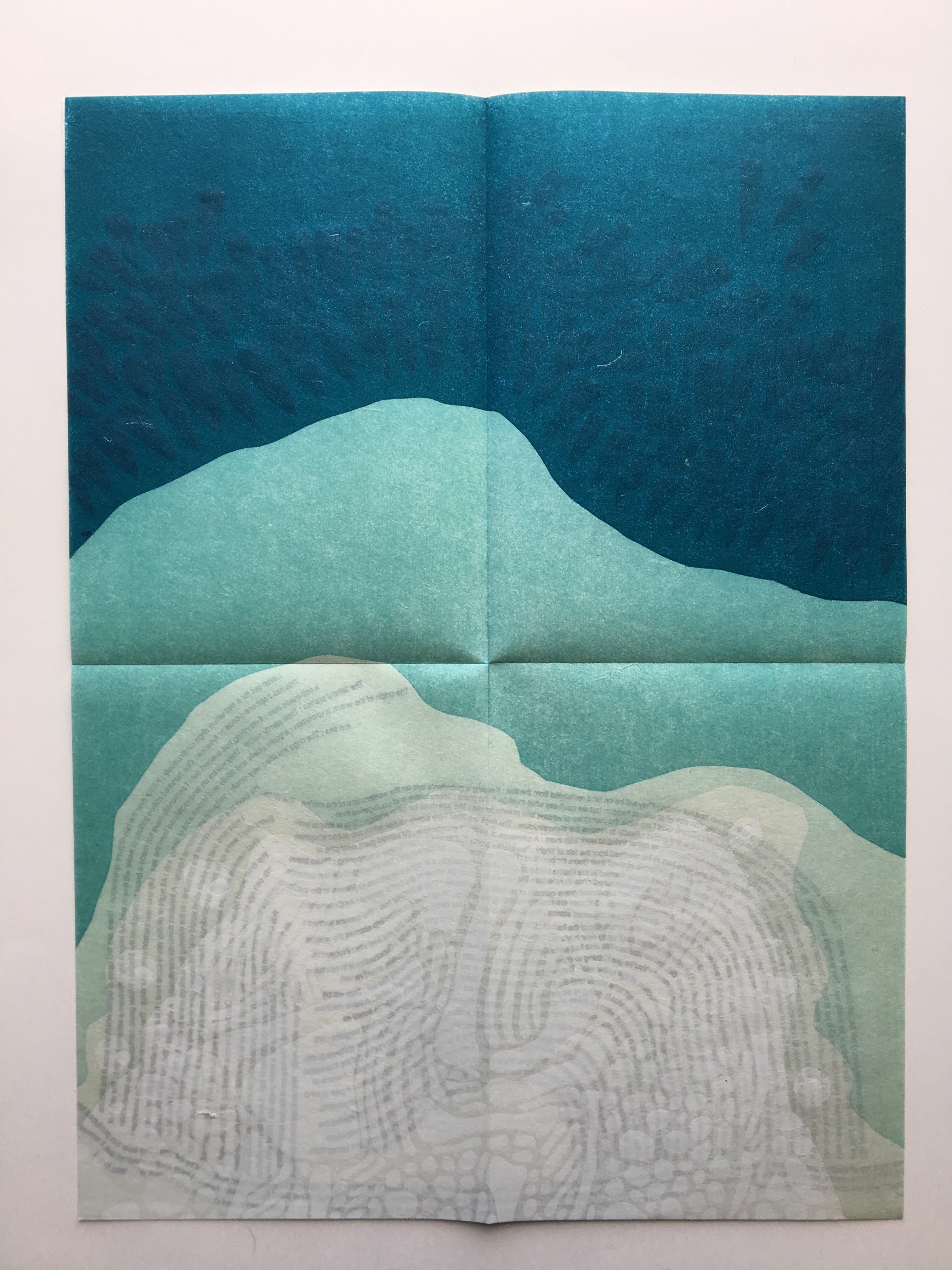
Another collective work from Shift_Lab is Trace (2015). Bryant’s contribution is Listen Out for a Bell which Rings Continuously, which draws on sound and coastal mapping. It is based on her residence at the Brighton Marina, “a strange space between land and sea” where she immersed herself “in the quiet rhythm of the place”. In the first image above from Listen Out, it is obvious how the typography mimics the tide’s ebb and flow, perhaps less obvious how the overlapping texts’ rhythm and syntax surge, overlap, peter out. Look even more closely at the two lower images, two sides of the same sheet: note how the colours on the two sides of the sheet register against one another to create the kind of topographical mapping found in marine maps. Beyond that effect, the two pages challenge one’s sense of place in the world. On the left hand side, one is looking down on the boats crowding in on the marina; on the right, one is below the water and looking up at the hulls. To achieve a further infusion of place with the work, the work is even printed using chalk from the surrounding cliffs.

The Radiant Republic (2019) is one of Bryant’s more recent solo works. In her own words:

The Radiant Republic [is] built entirely out of language found in Plato’s Republic and Le Corbusier’s The Radiant City. In these texts, separated by more than two thousand years, Plato and Le Corbusier each describe a city plan designed to provide a framework for morality and ethics. These works are revered, but they are also deeply troubling. In The Radiant Republic, language from Plato and Le Corbusier has been combined to create a narrative in five parts. Big Jump Press/Portfolio/Artist Books/The Radiant Republic

When Bryant writes “combined”, she means it as the work’s title performs it. Paragraphs in each of the five volumes merge sentences from Plato with those of Le Corbusier. In its combination of the titles of Le Corbusier’s and Plato’s works, respectively, The Radiant Republic signals its textual ambition: to merge the two different texts. The disconcerting oracular tone and coherence of the narrative underscore the revered yet troubling nature of the two works, which is reflected in the epigraph to The Radiant Republic:

Every physical thing carries within its deepest layers a tendency towards its own destruction.

— Moshen Mostafavi and David Leatherbarrow, On Weathering: The Life of Buildings in Time (MIT Press, 1993)

But we are getting ahead of ourselves.

In The Radiant Republic, Bryant uses techniques and materials old and new to her in an aim for new heights of art and depths of thought. The box enclosure itself is the first new technical feature we encounter.

The Radiant Republic (2019)
Sarah Bryant
Box, glass, cement blocks, pamphlets. Edition of 50, of which this is #5. Acquired from the artist, 20 February 2019.
Photos: Courtesy of the artist; Books On Books Collection.

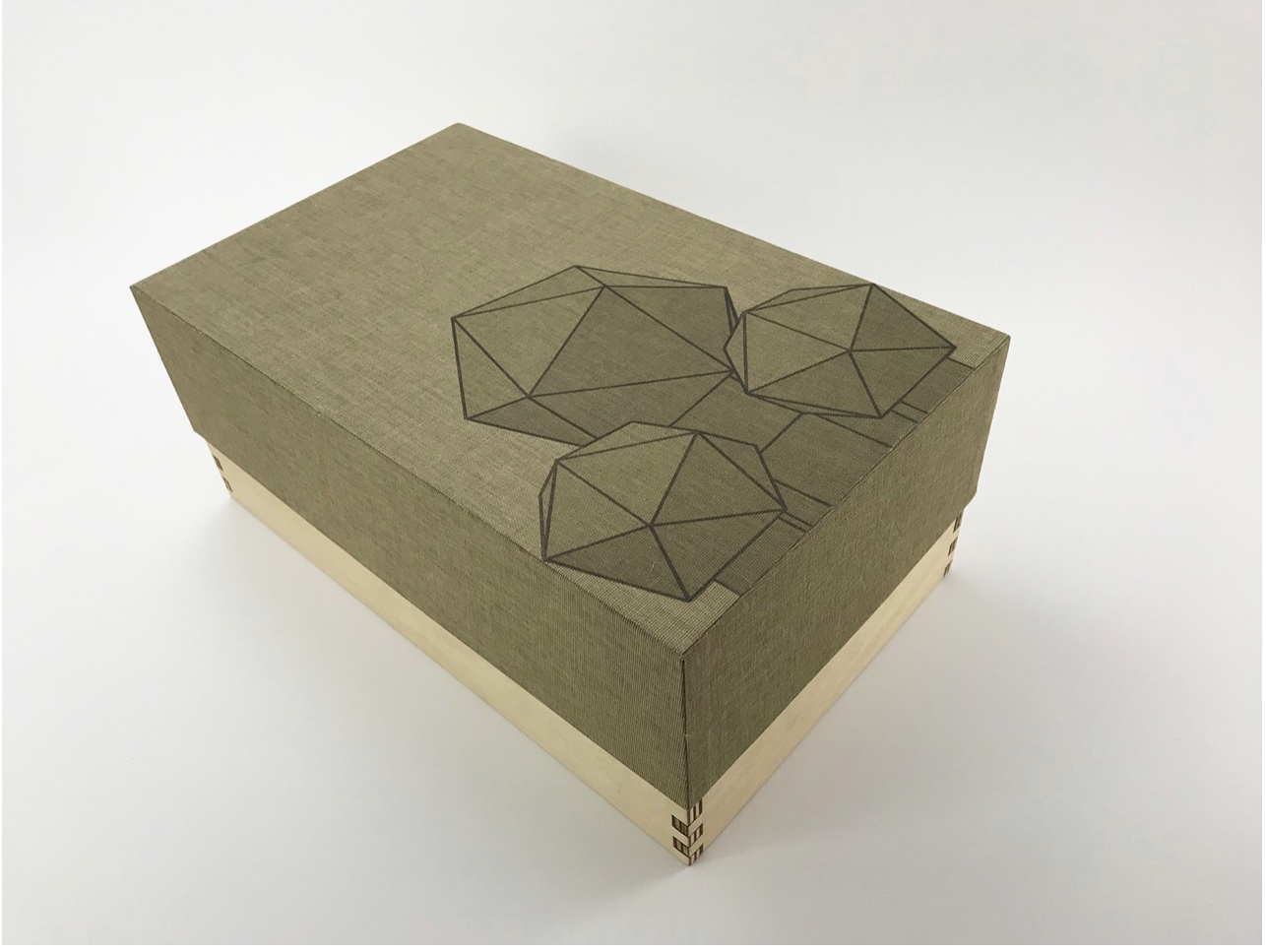
Although the collective works comprising Trace are housed in a box, this one is more elaborate in material and media. It is made of laser-cut Baltic Birch plywood, lightly treated with Tung oil. The lid is covered in Dubletta book cloth, which has been printed letterpress with polymer plates and linoleum. Lifting off the cover reveals yet further new materials and techniques. Five pamphlets each consisting of Rives Heavyweight paper sewn to a lightweight cover made of handmade Belgian Flax, produced at the Morgan Conservatory in Cleveland, and held together with a wrapper rest on a sheet of glass.

In several ways, the book component shows the encounter of previous techniques/media with the new. The precise fold work and registration to be found in Biography and Listen Out reappear, as does the meaningful integration of separate parts in Figure Study. Here, it is the geometric fold patterns in the covers echoing the geometric solids. Flax paper is a new element in Bryant’s repertoire.

The blind embossed printing from Figure Study moves from the cover there to the interior of the book component here and with substantive, non-decorative intent. Across the five volumes, the embossed text is the same as that printed in ink and always appears on the last folio. But here is the catch: the text that appears comes from the succeeding volume’s inked text, and it appears in fragments. When the last page of the fifth volume appears, the embossed text on its folio’s last page is a fragment of the inked text in the first volume. The fragmentation of the embossed printed version and its variation in depth mime the weathering of structures and ideas.

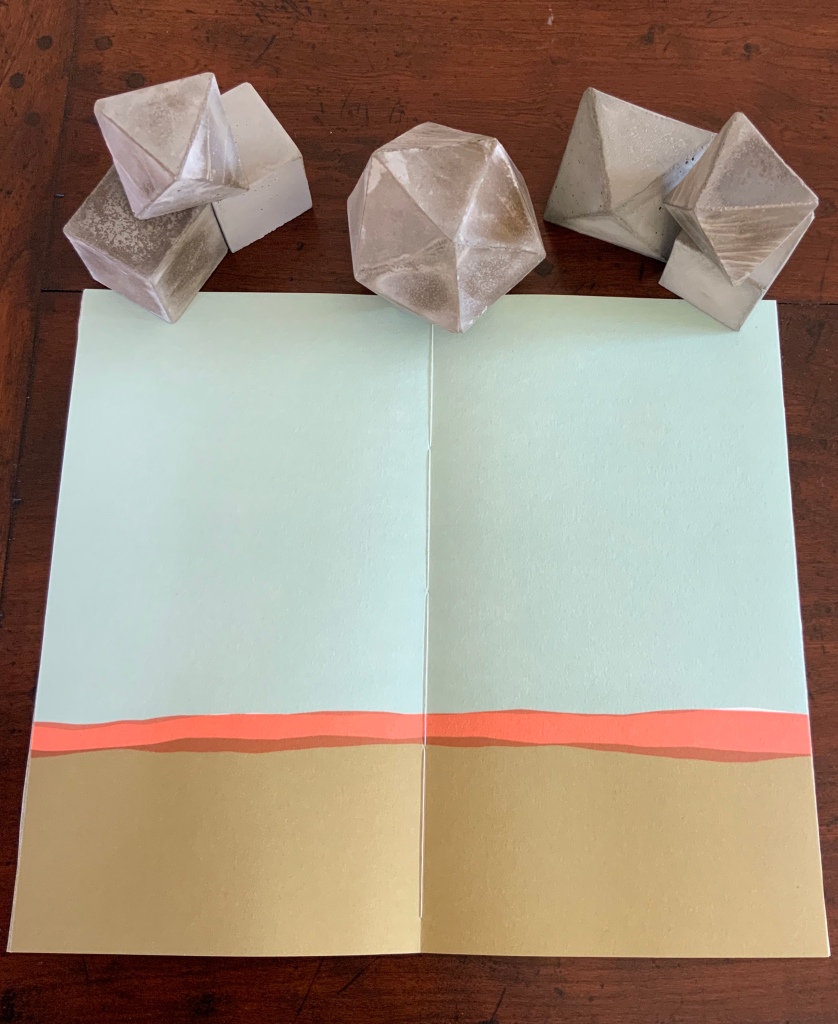
The circular movement and fusion of the past and present are also reflected in the double-page prints centered in each volume. Note how the technique of prints interlocking across folios in Shift in Position replays here in the prints interlocking across the five volumes to assert a narrative thrust but in a landscape with no fixed beginning or end.

The contrast of materials — cloth, wood, flax paper, Rives paper and concrete — plays out in the concrete solids. Some edges are sharp, others blunted; some surfaces are smooth, others rough. This happens also with the covers to the five volumes according to the absence or presence (and density) of folds and, in one case, of crumpling or no crumpling. It happens in the prints, where the backgrounds include faint images mirroring the structures in the other media. This technique of contrasting materials/media and that of recapitulating the contrast within one or more of the materials/media seems to be a new development in Bryant’s art or, at least, an intensified one.

The multiple materials and techniques and their many-sided interactions pose a pleasurable dilemma for the work’s display. As soon as one is in place, another beckons.

No surprise then that the first pamphlet’s opening words are “You and I at this juncture are not poets but founders of a city”. This self-reflexive invitation to creativity is like that invitation to negotiate reading with looking — an invitation to participate and to recognise our participation as part of the creative act. An increasingly characteristic aspect of book art.

Sarah Bryant runs Big Jump Press, works with the collective Shift_Lab and teaches at the University of Alabama Book Arts Program.

Further Reading

Chen, Julie. 2013. 500 Handmade Books. Volume 2. New York: Lark. P. 146 (Biography).