Bookmarking Book Art – Learning to read Shirley Sharoff’s “La grande muraille”

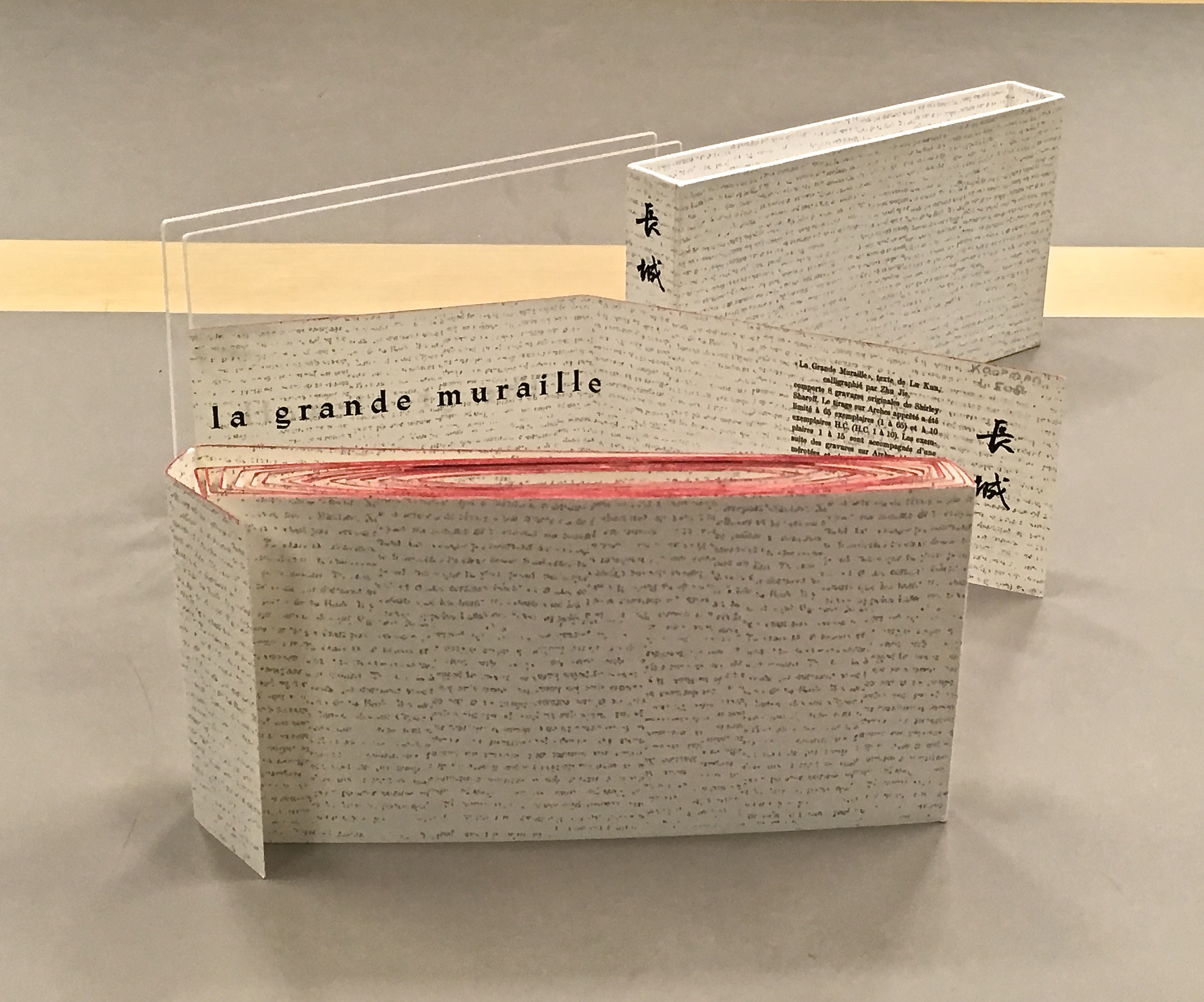
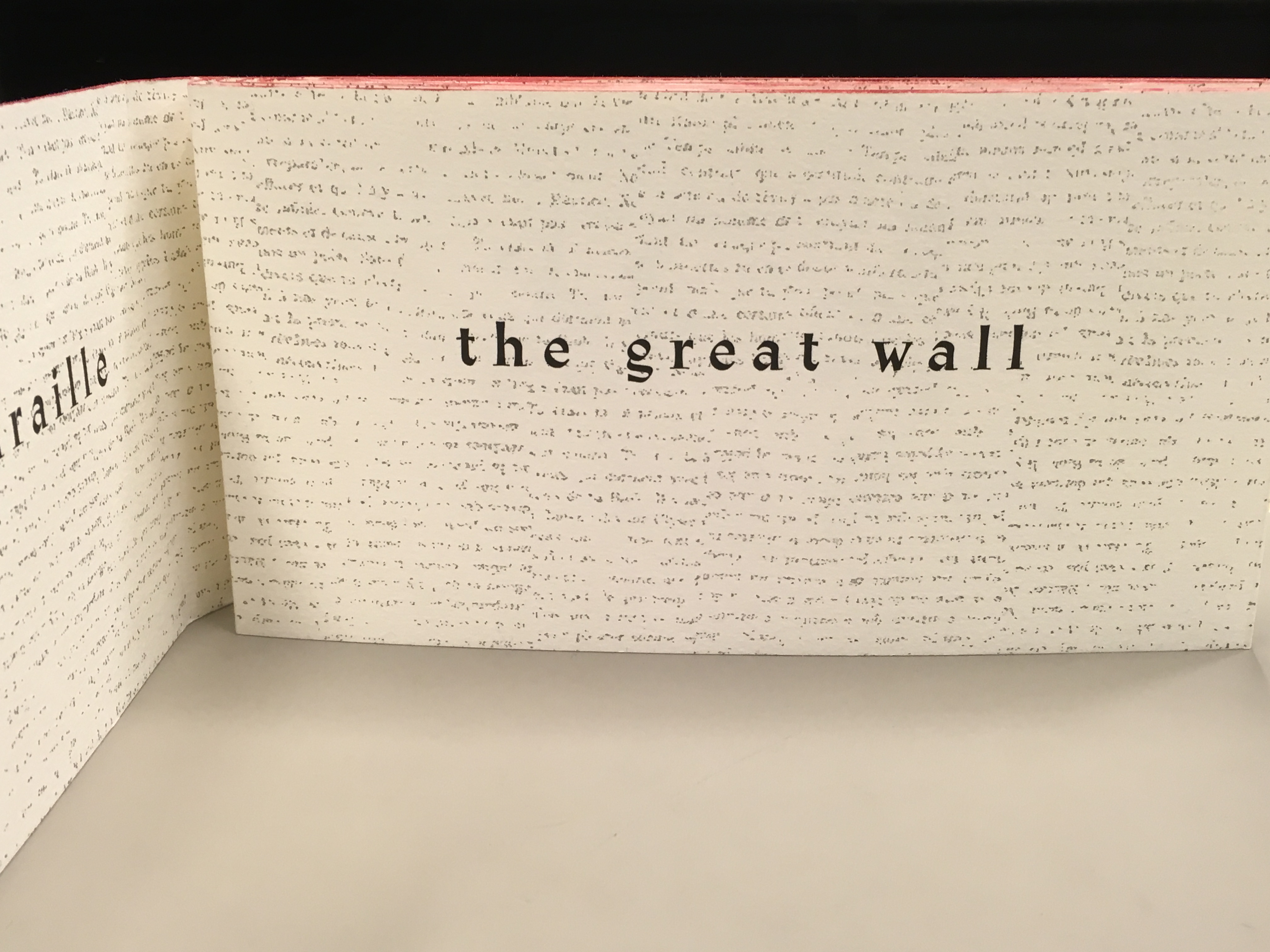
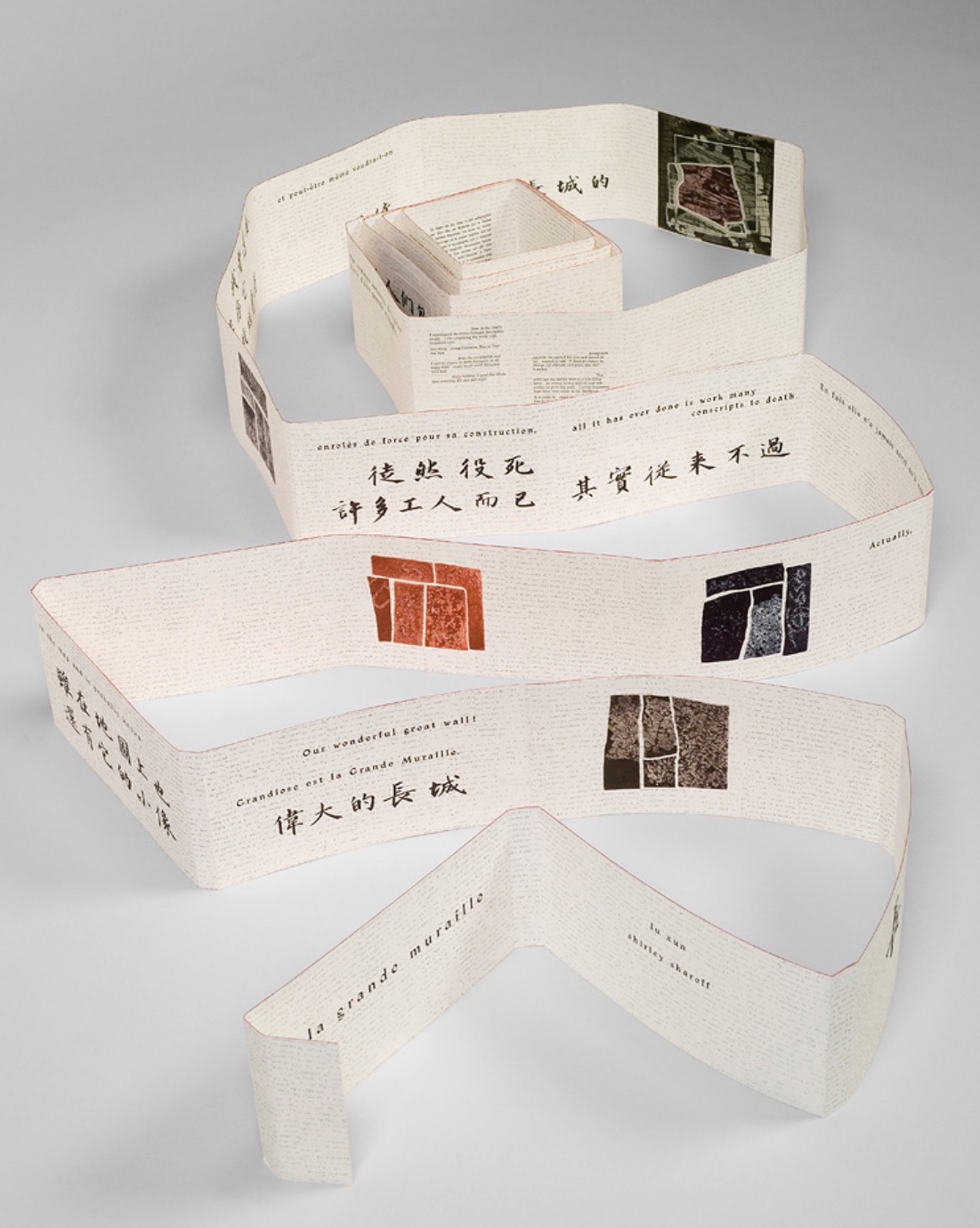
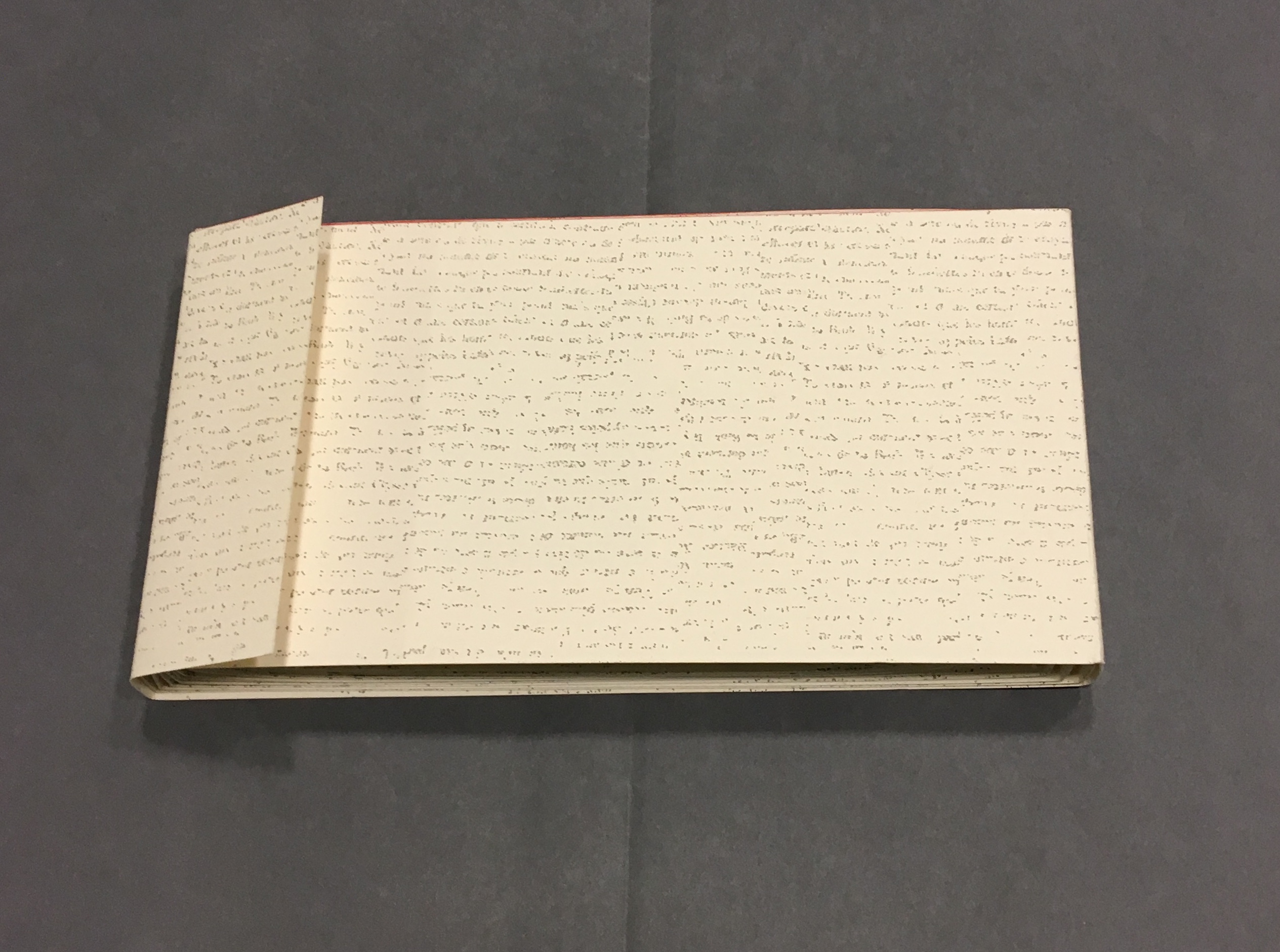
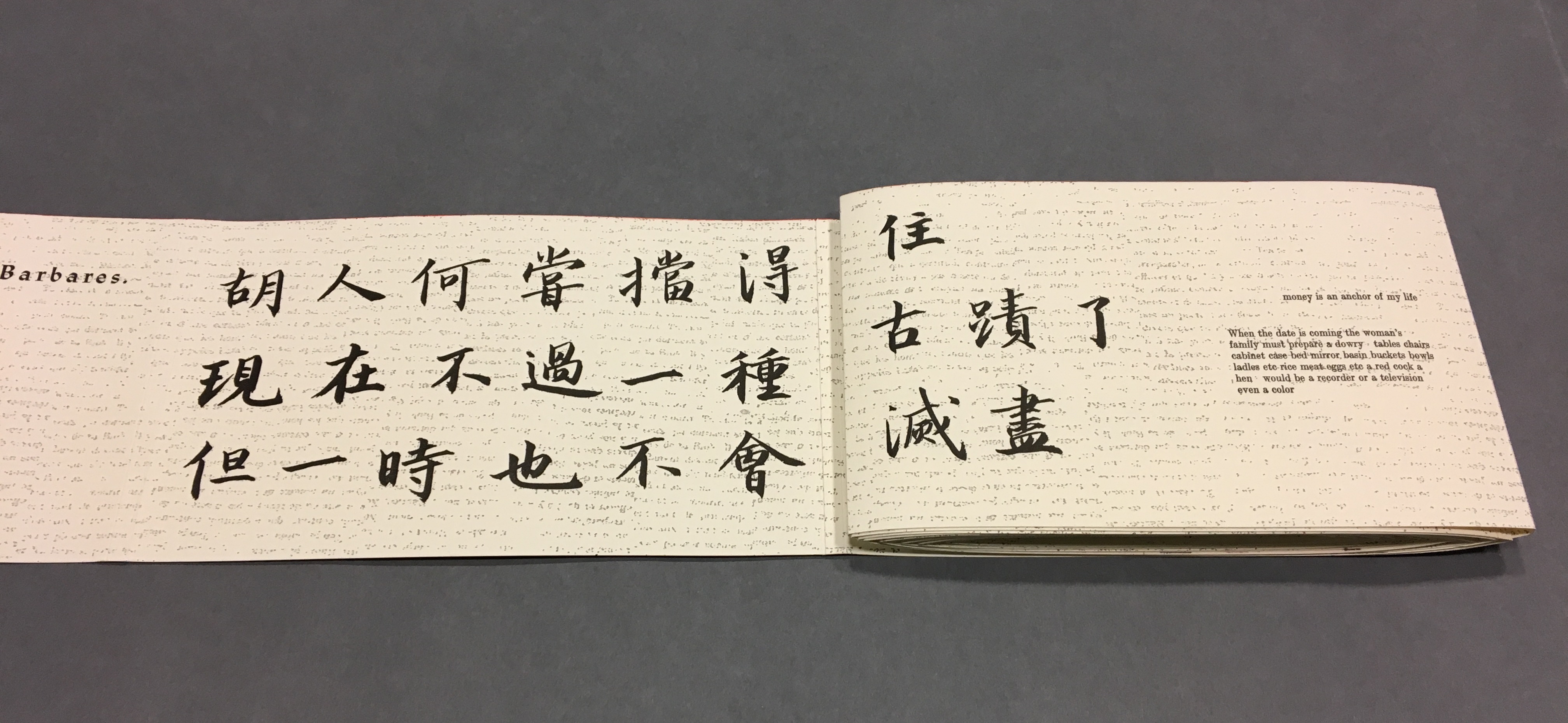
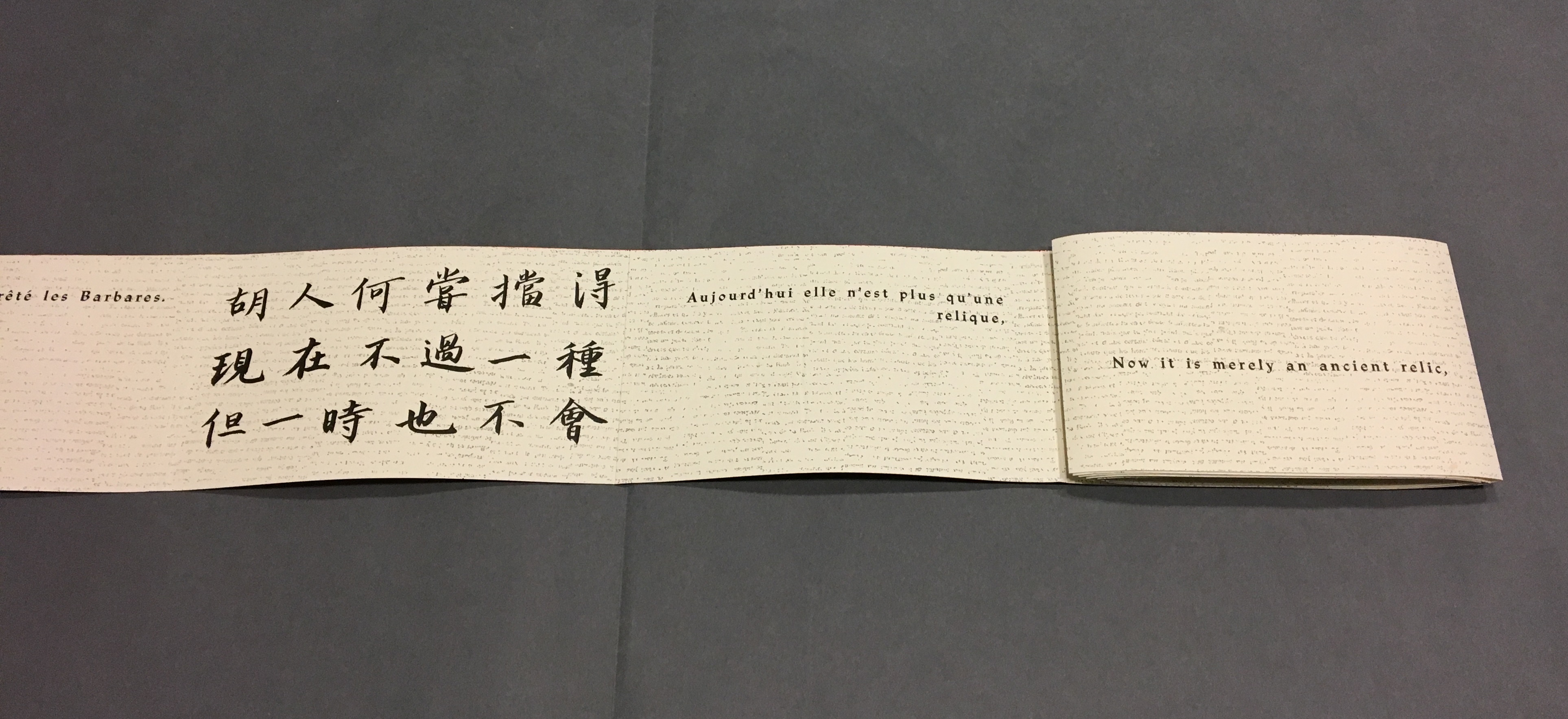
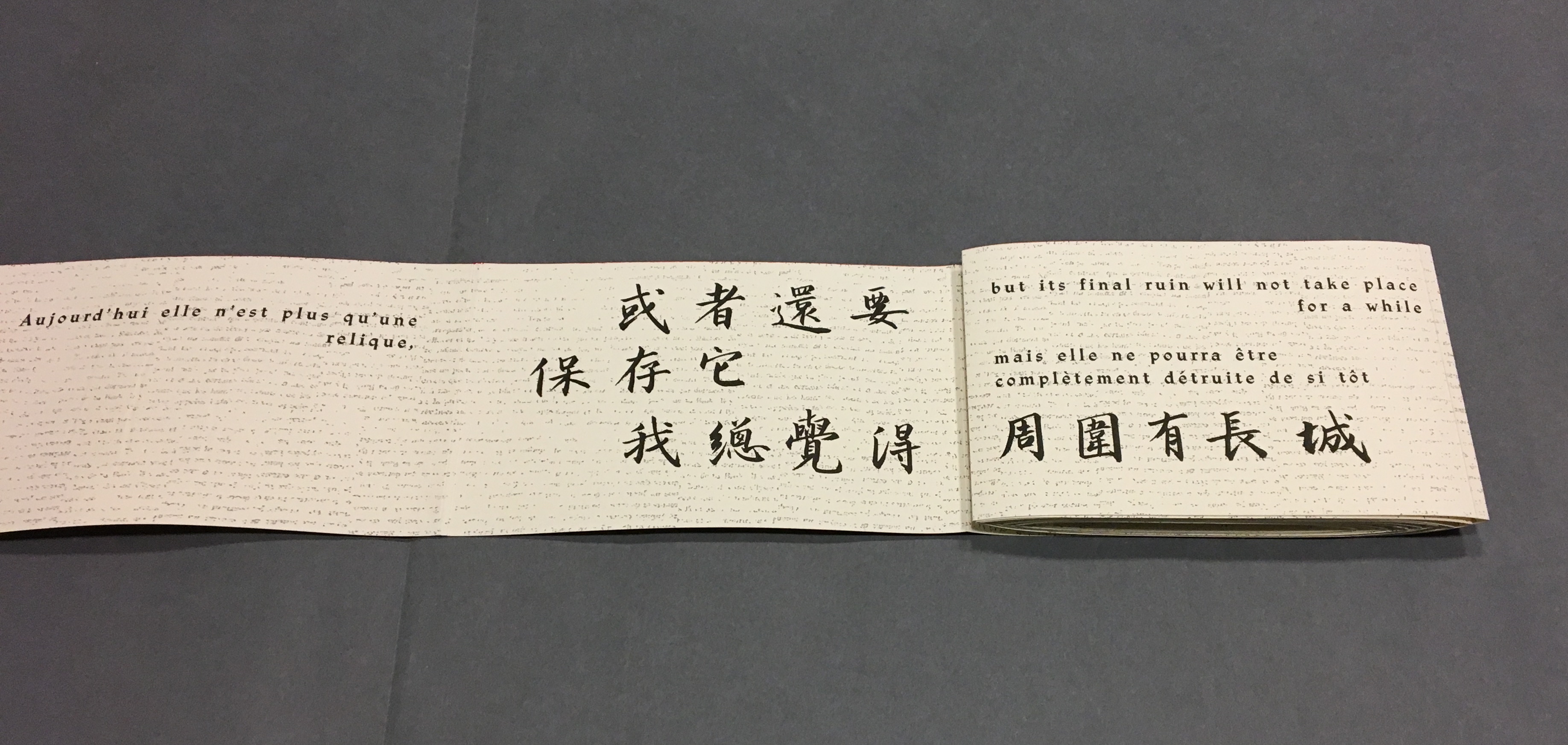
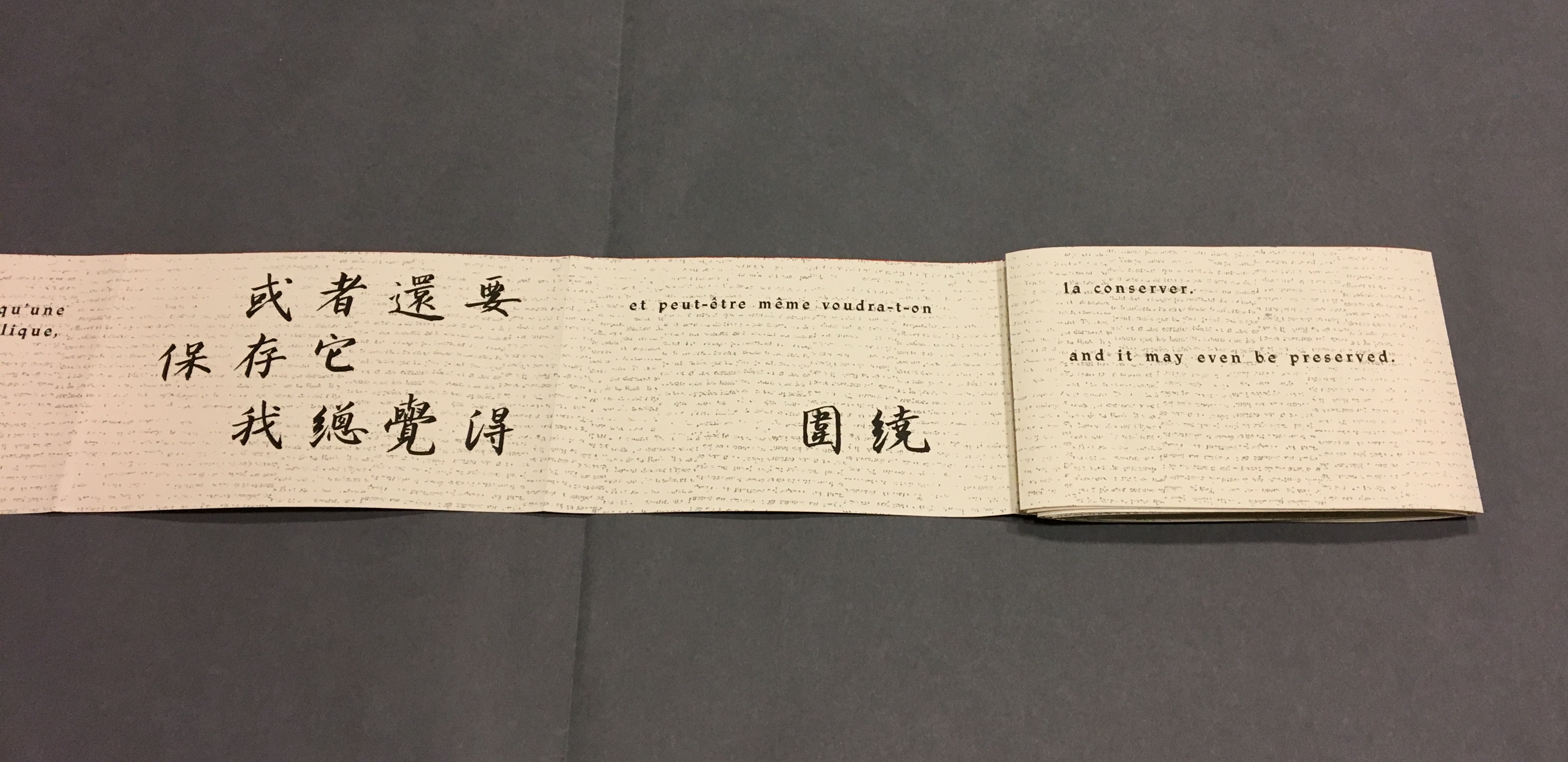
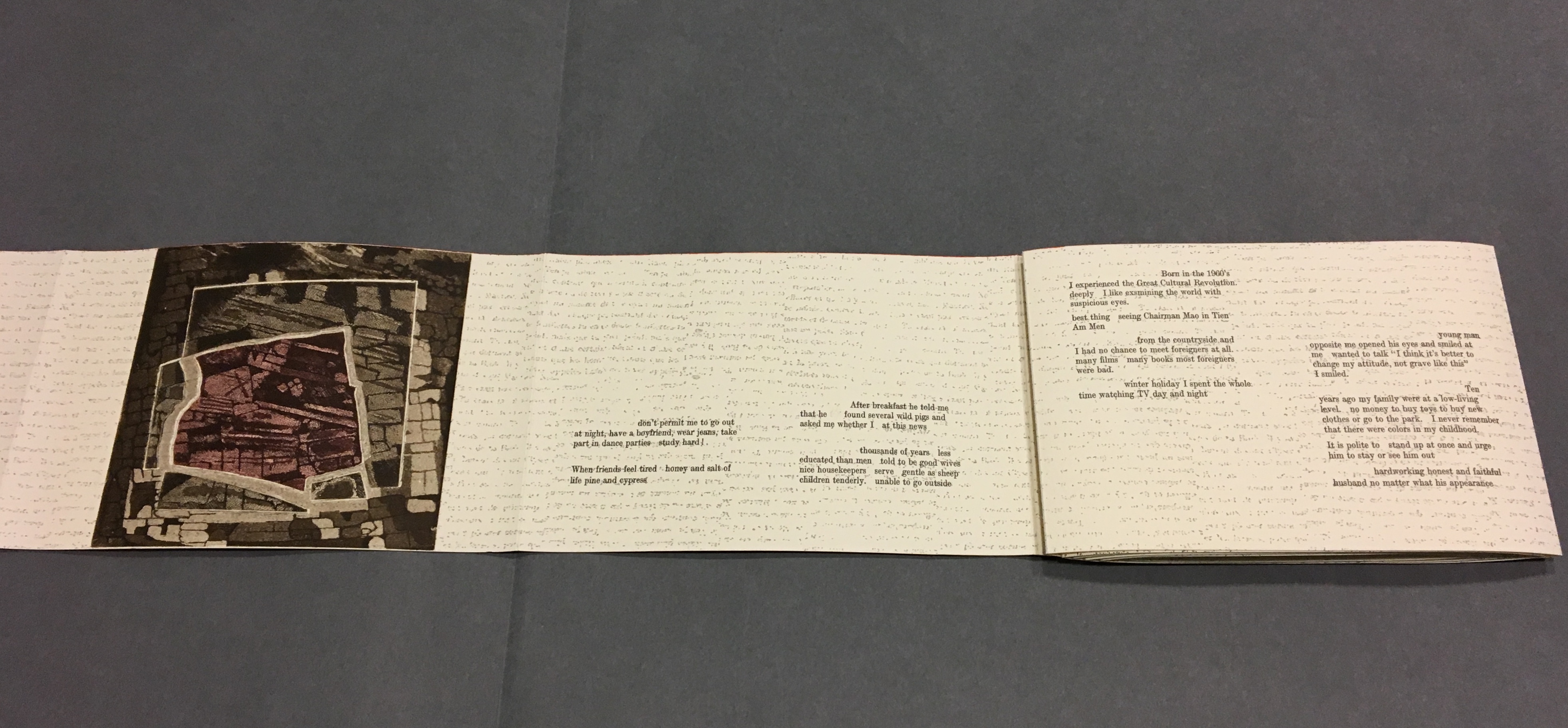
La grande muraille/The Great Wall (1991), Shirley Sharoff
All Books On Books photos are reproduced here with permission of the artist.
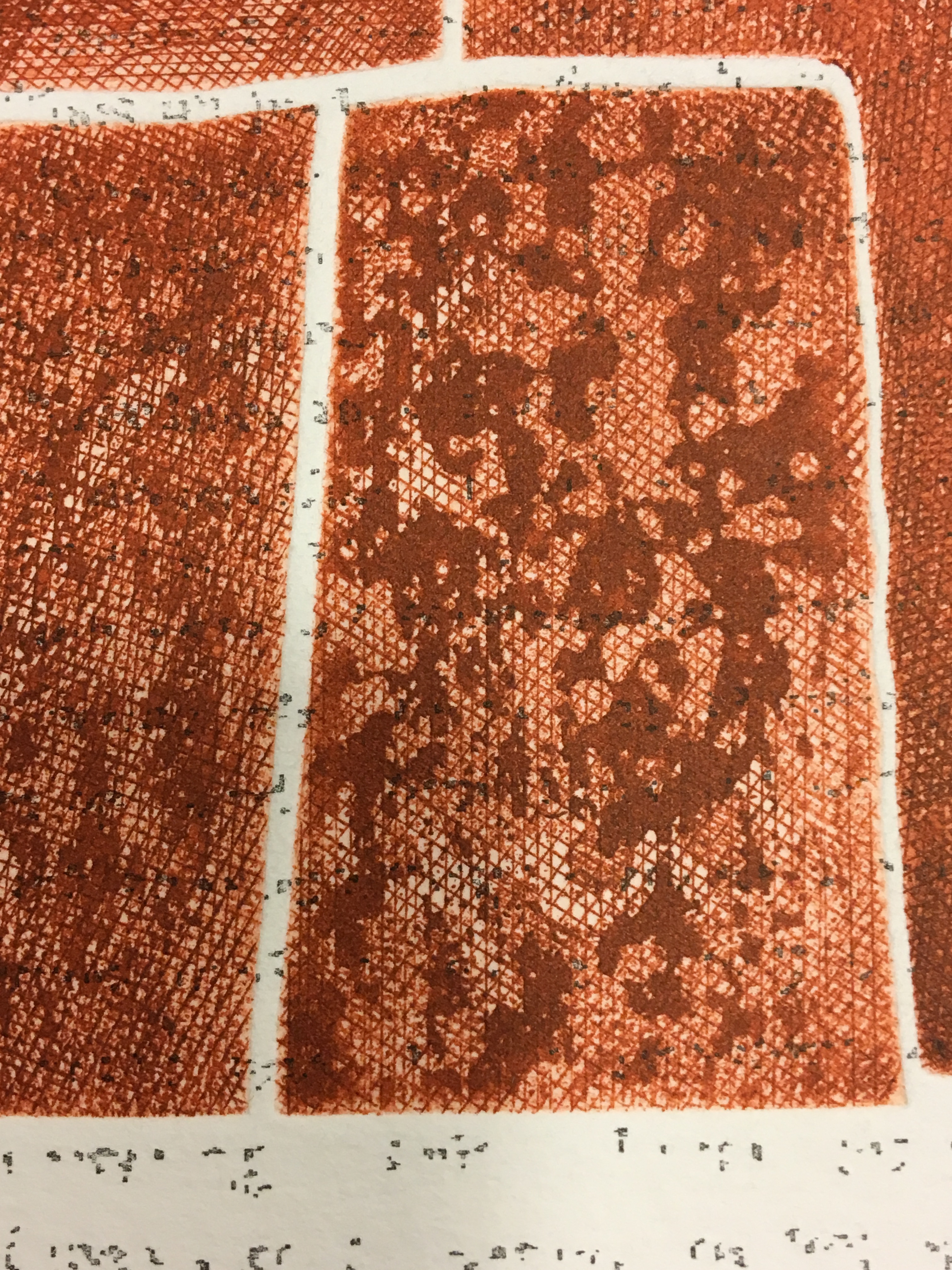
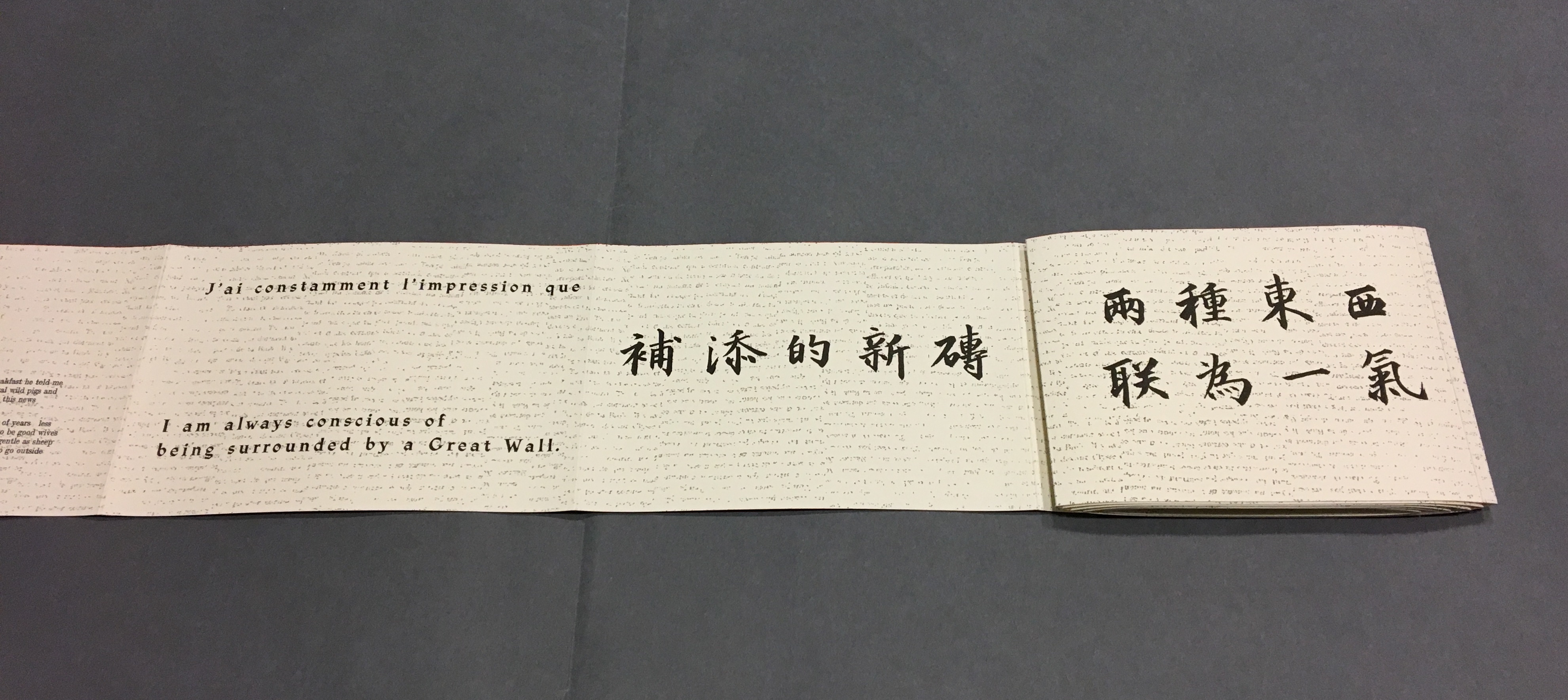
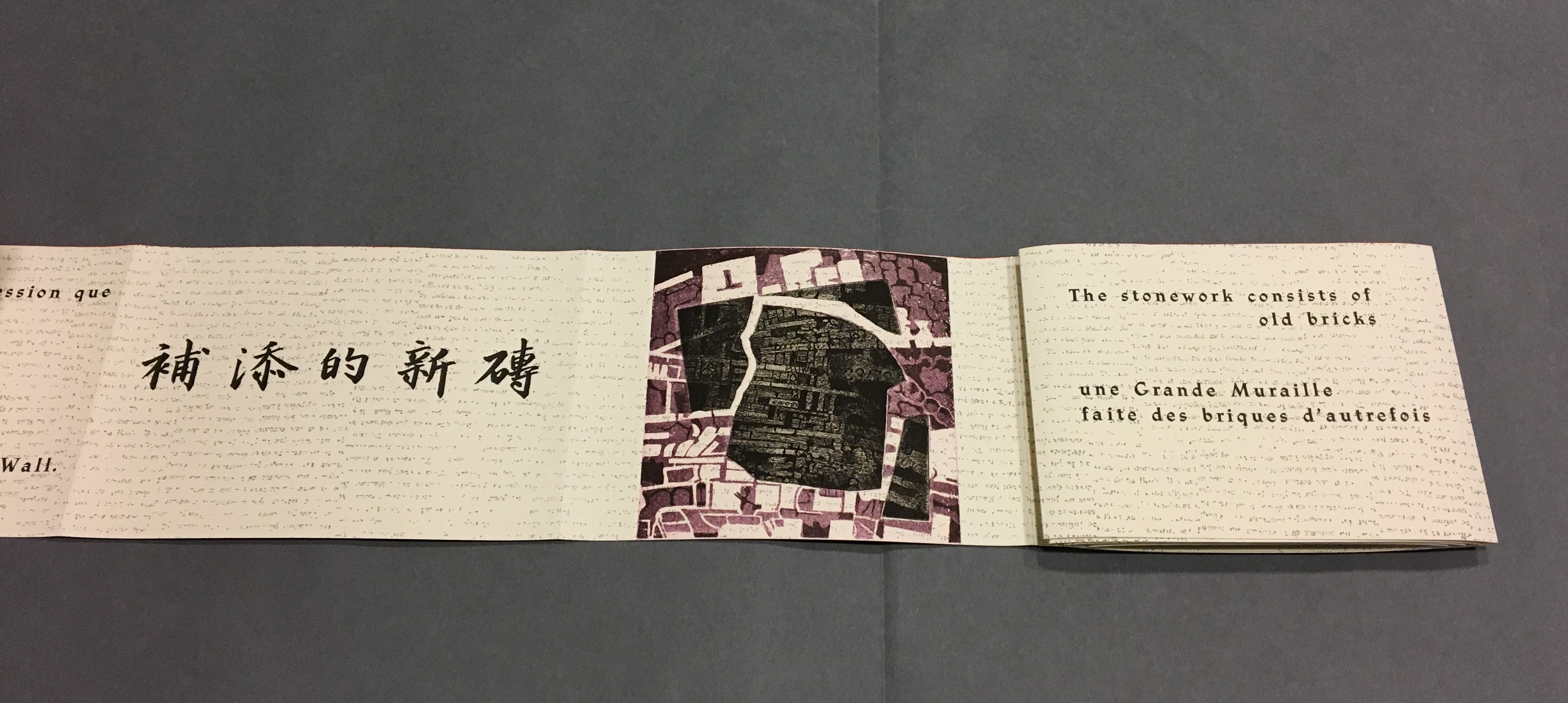
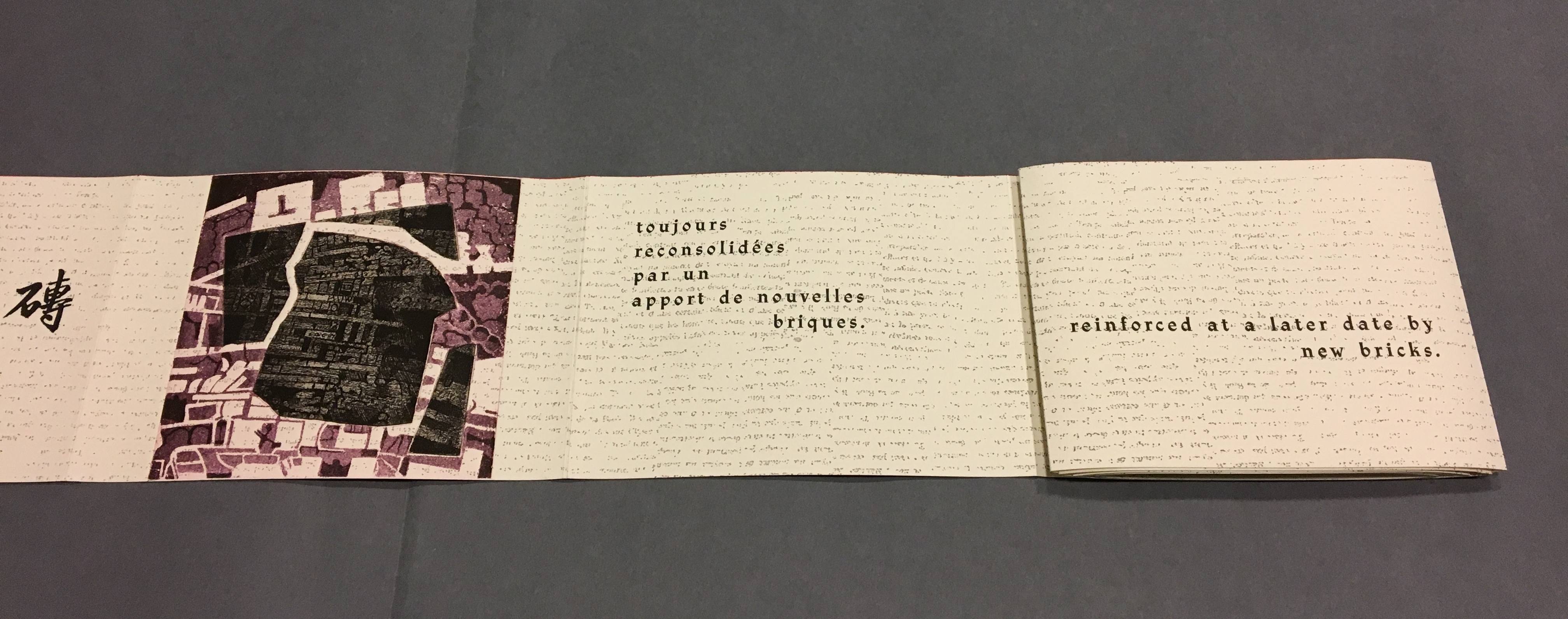
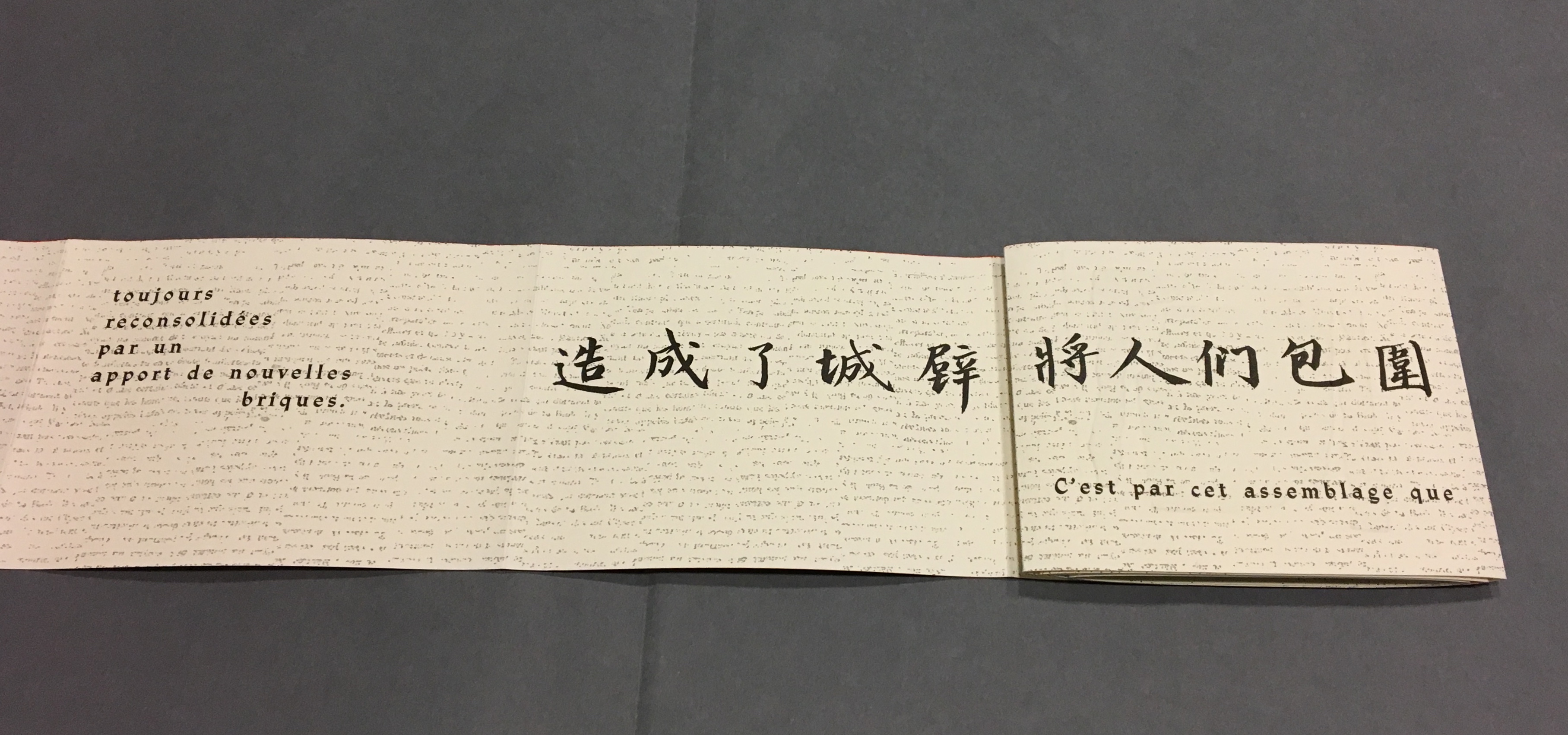
Detail, La grande muraille/The Great Wall (1991)
Typeface: Athenaeum, designed by Alessandro Butti and Aldo Novarese in 1945

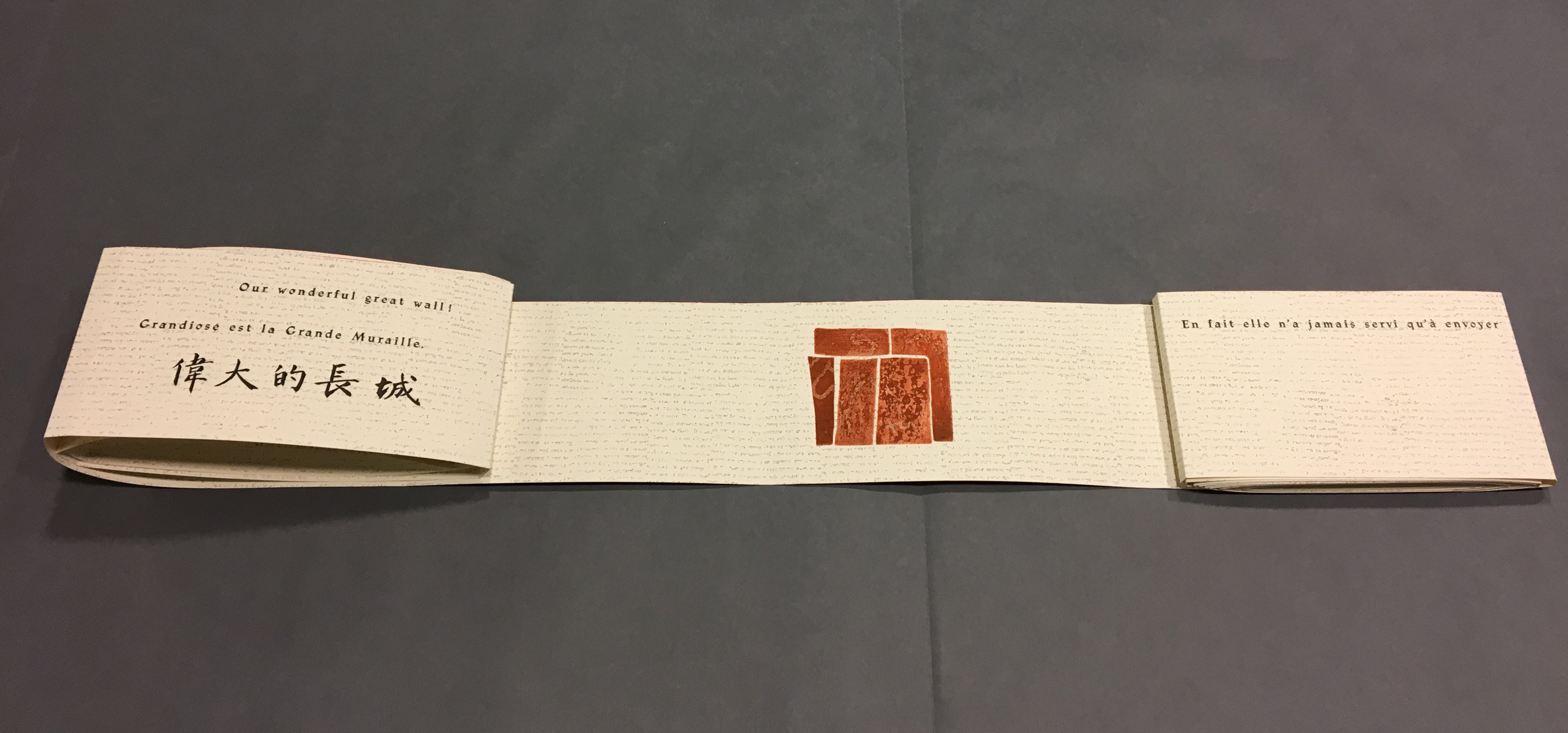
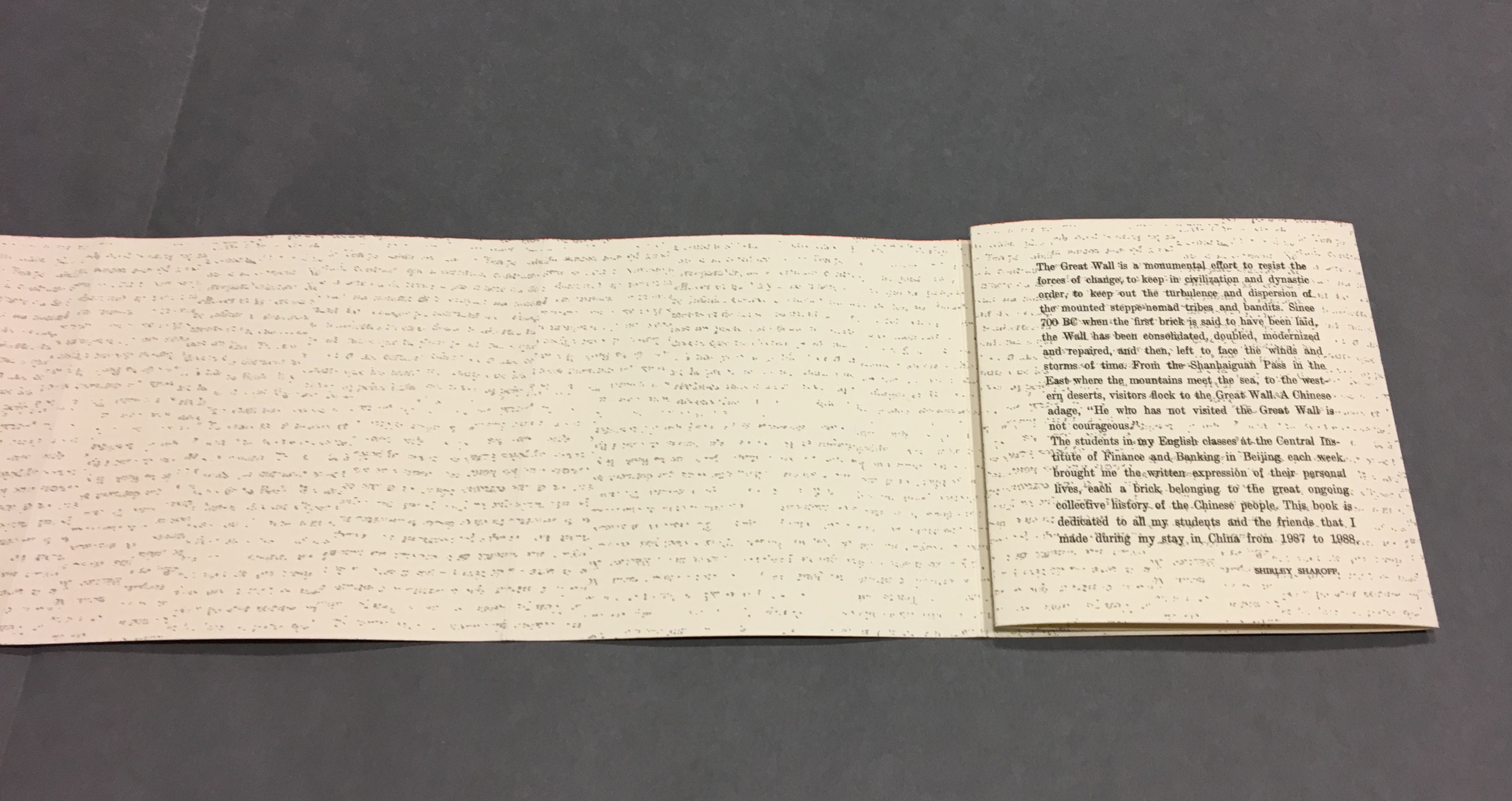
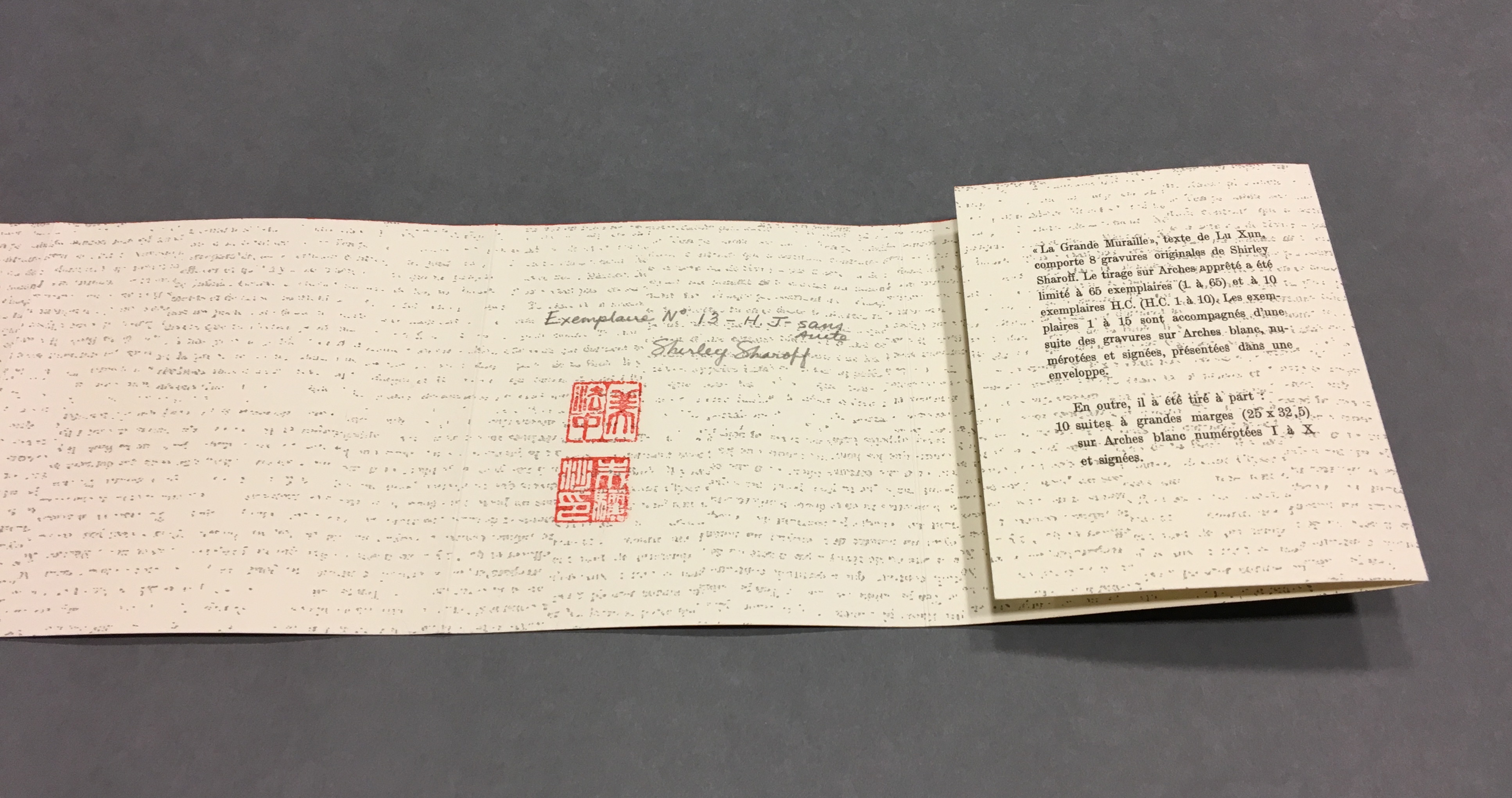
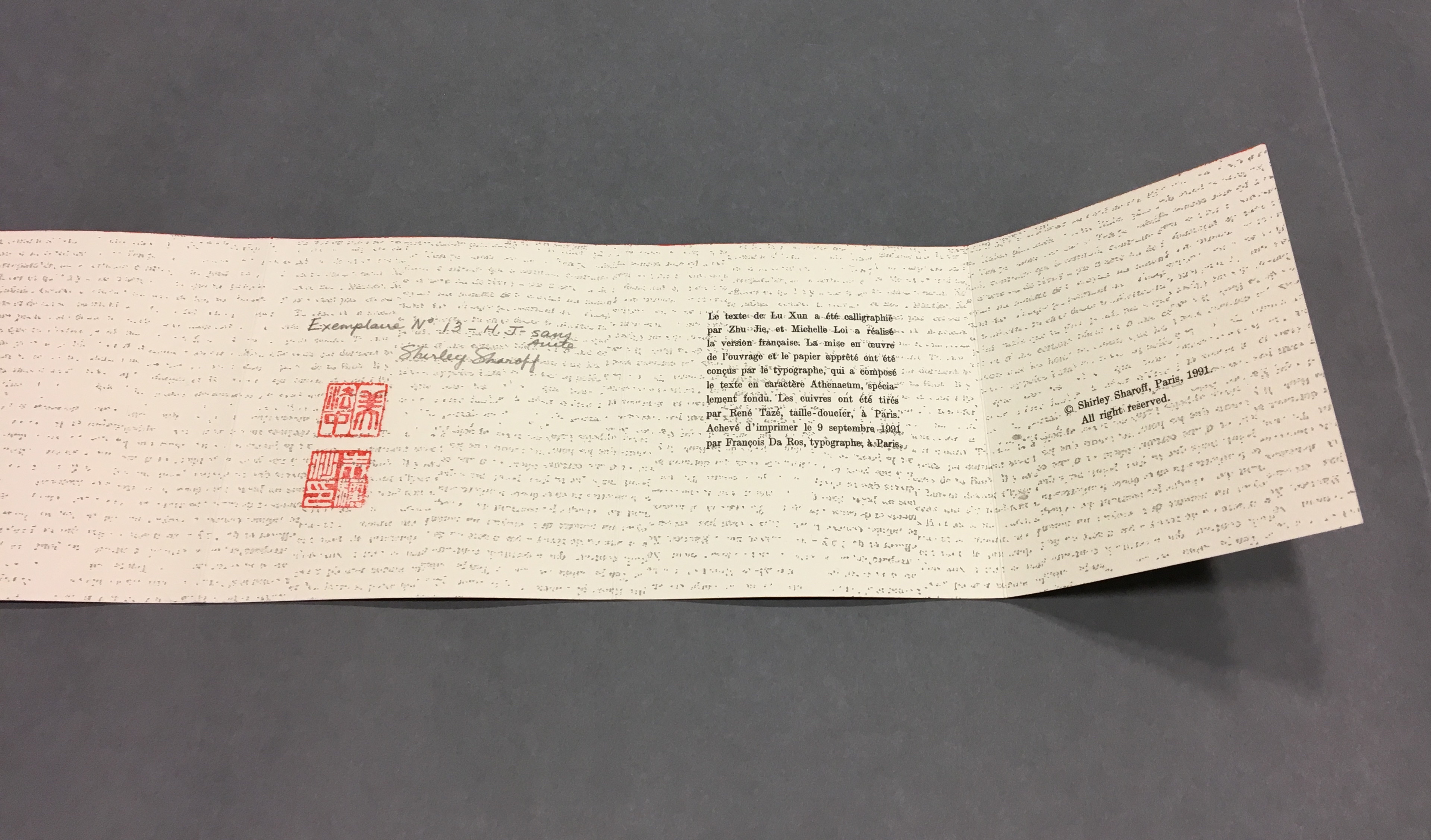
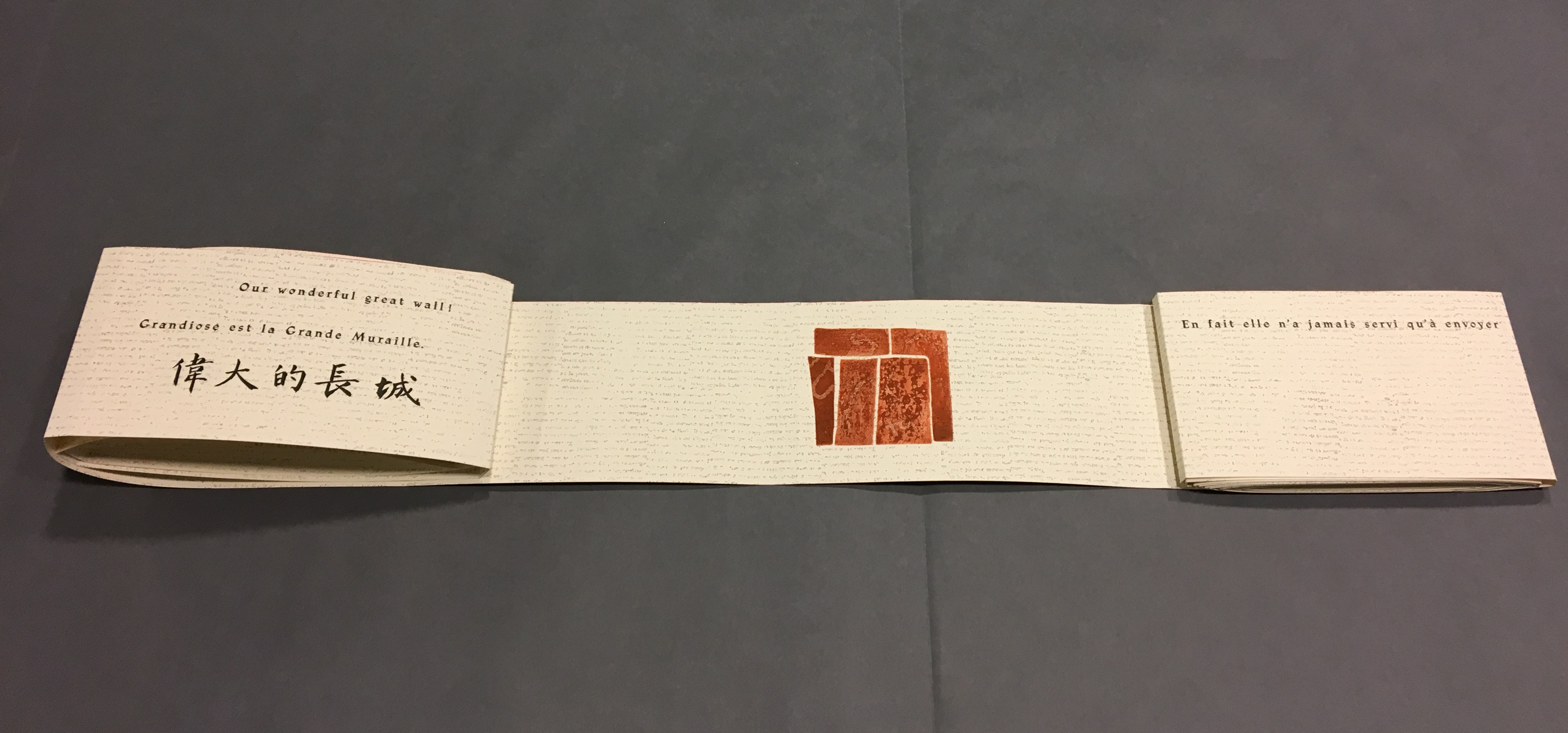
The National Library of the Netherlands advises, “for [Shirley Sharoff’s La grande muraille/The Great Wall (1991)] to be read, the book first must be rolled out”.  And that is what I did, using the large table in the Special Collection’s seminar room. 

Enjoyable as that was, enjoying it again with the video afterward, something seemed awry. As the Chinese poem by Lu Xun, its French and English translations and text from Sharoff’s language students unrolled, interpersed with her prints, the text seemed to have gaps, or so I thought. So I returned a second time. Perhaps if I re-shot the video. Perhaps if I took more stills and close-ups. Perhaps if I shot the rolling up as well as the unrolling.

No doubt, the second effort added to the pleasure. Looking at the videos and stills, I can again feel between my fingers the Arches paper and engravings’ impressions on it. But still I detected gaps, seeming mismatches between the French and English. I wondered to what degree they

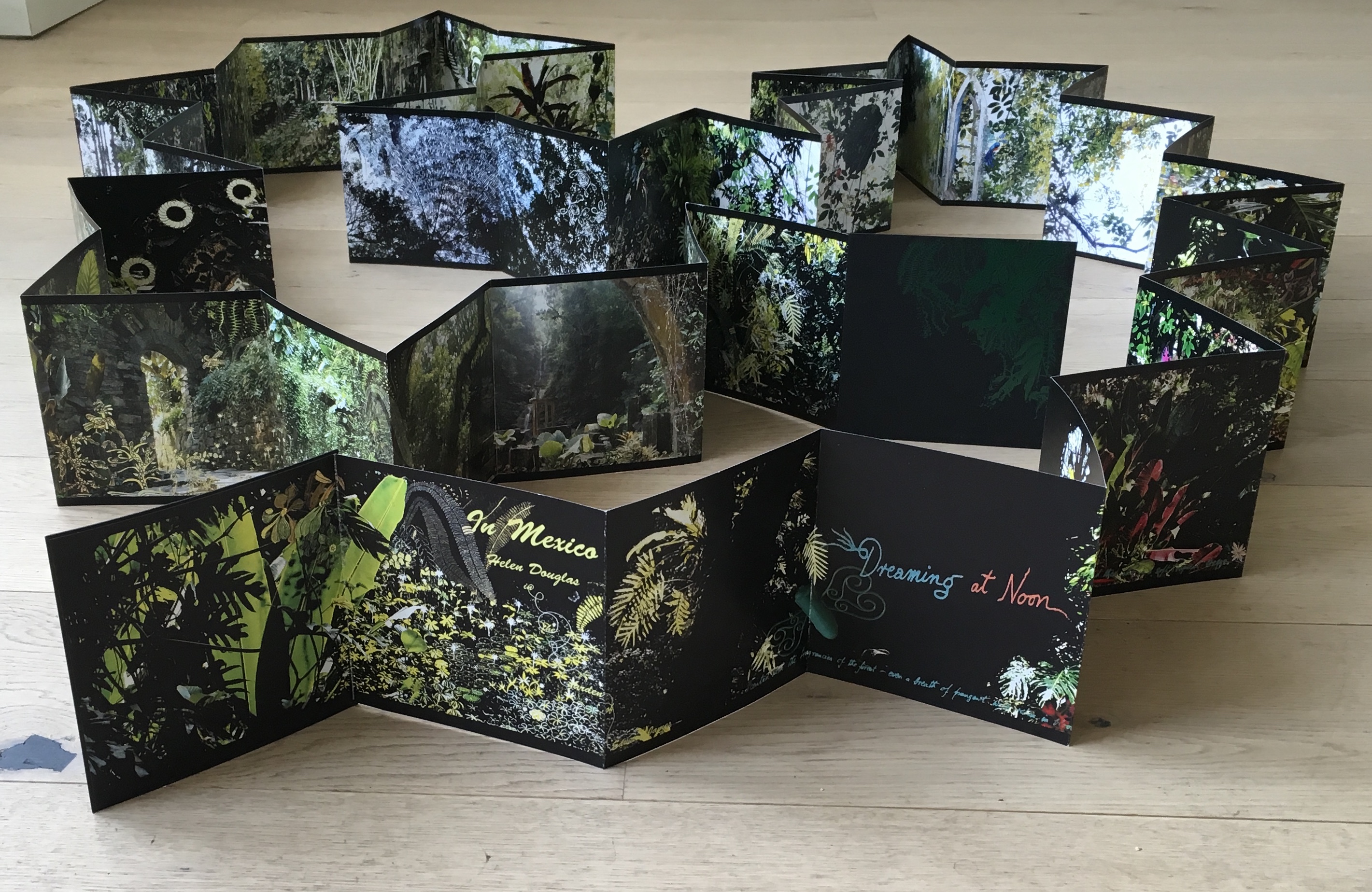
followed the Chinese text or whether some of Lu’s text had been omitted.  So, I returned a third time, and then came my “ah hah” moment. Unrolled, La grande muraille looks like a double-sided leporello or accordion book like this one: In Mexico by Helen Douglas.

In Mexico: in the garden of Edward James (2014)
Helen Douglas
La grande muraille/The Great Wall (1991)
Shirley Sharoff
Photo credit: © Koopman Collection. National Library of the Netherlands/Jos Uljee

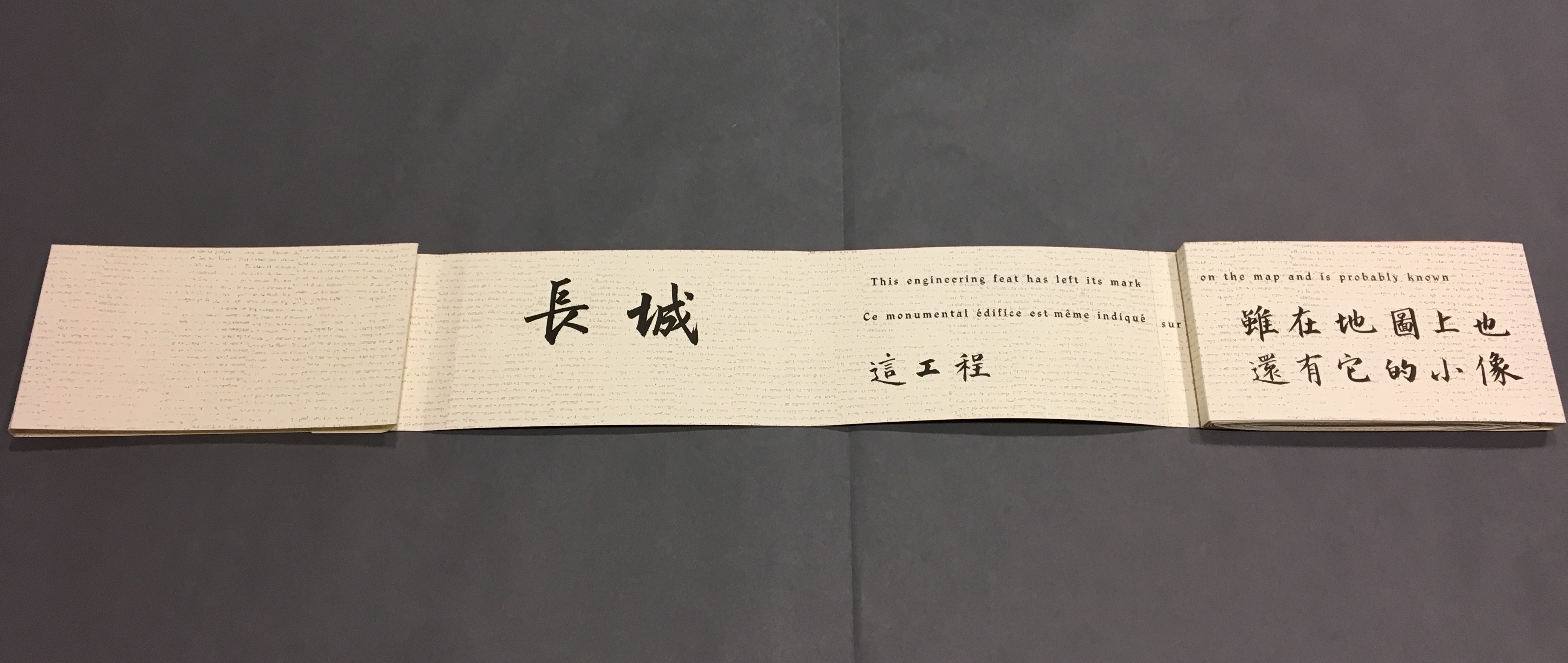
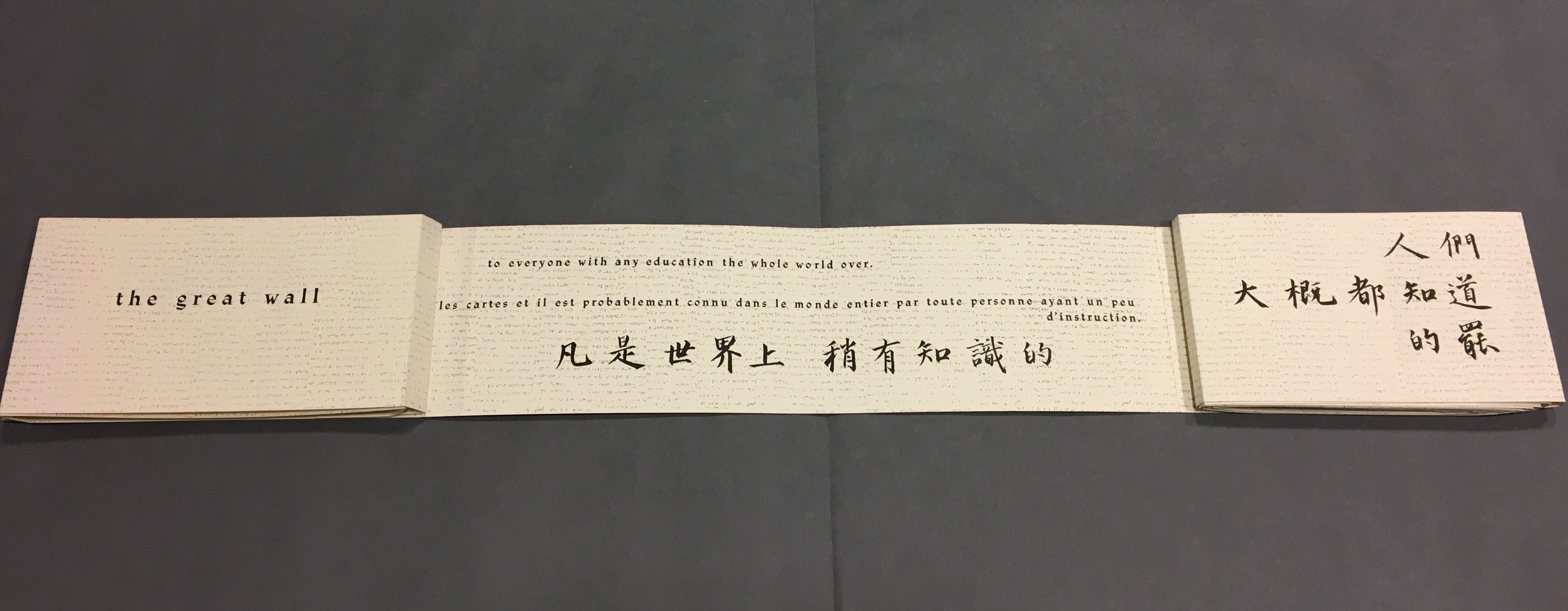
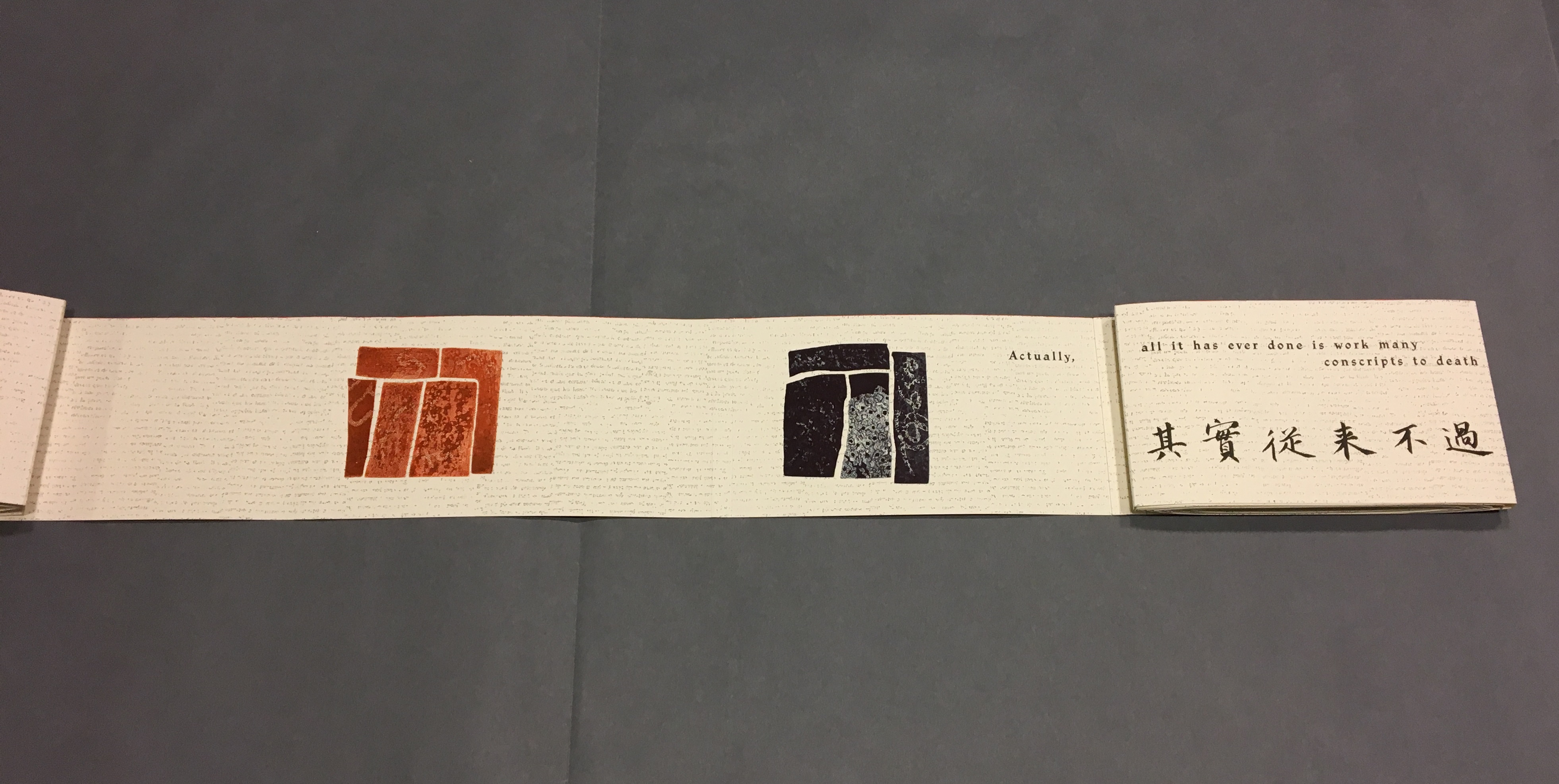
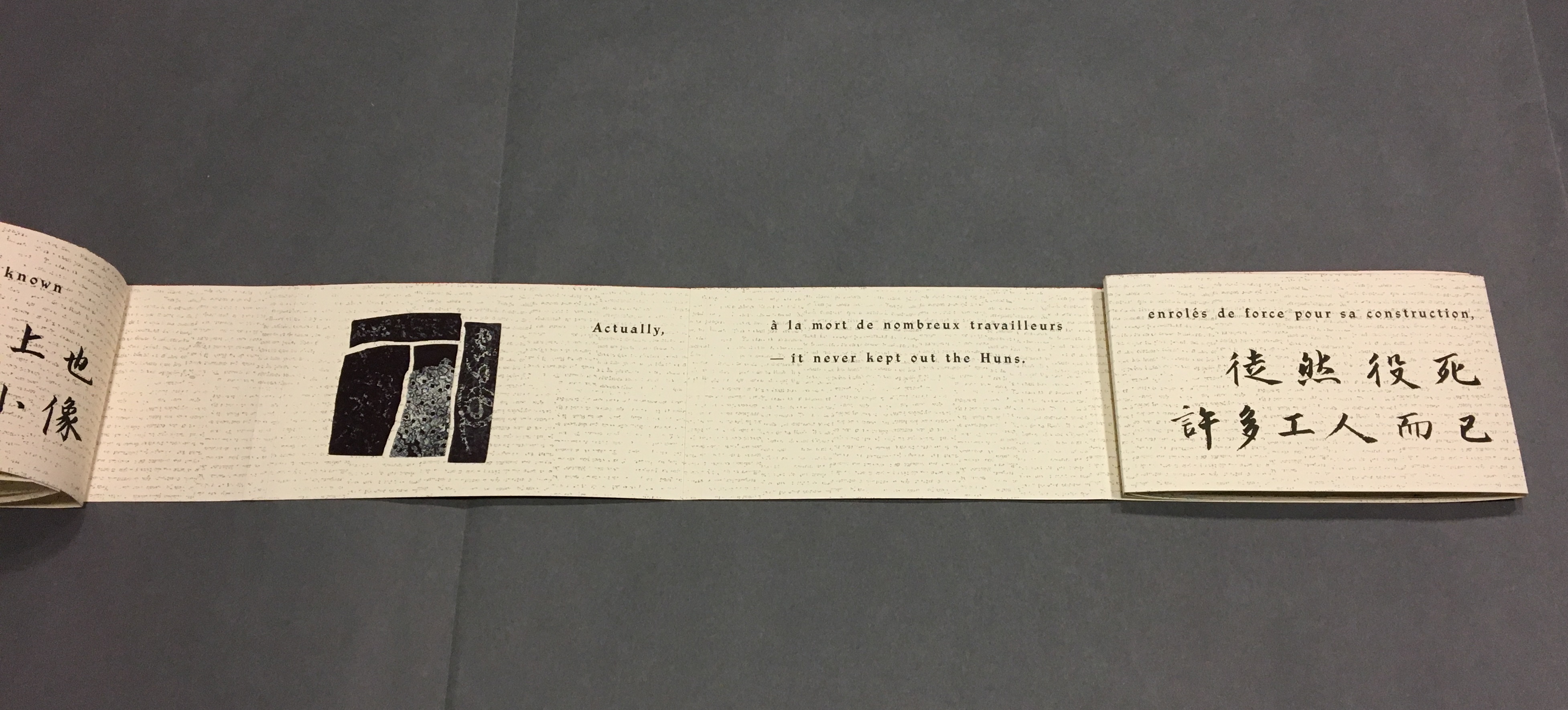
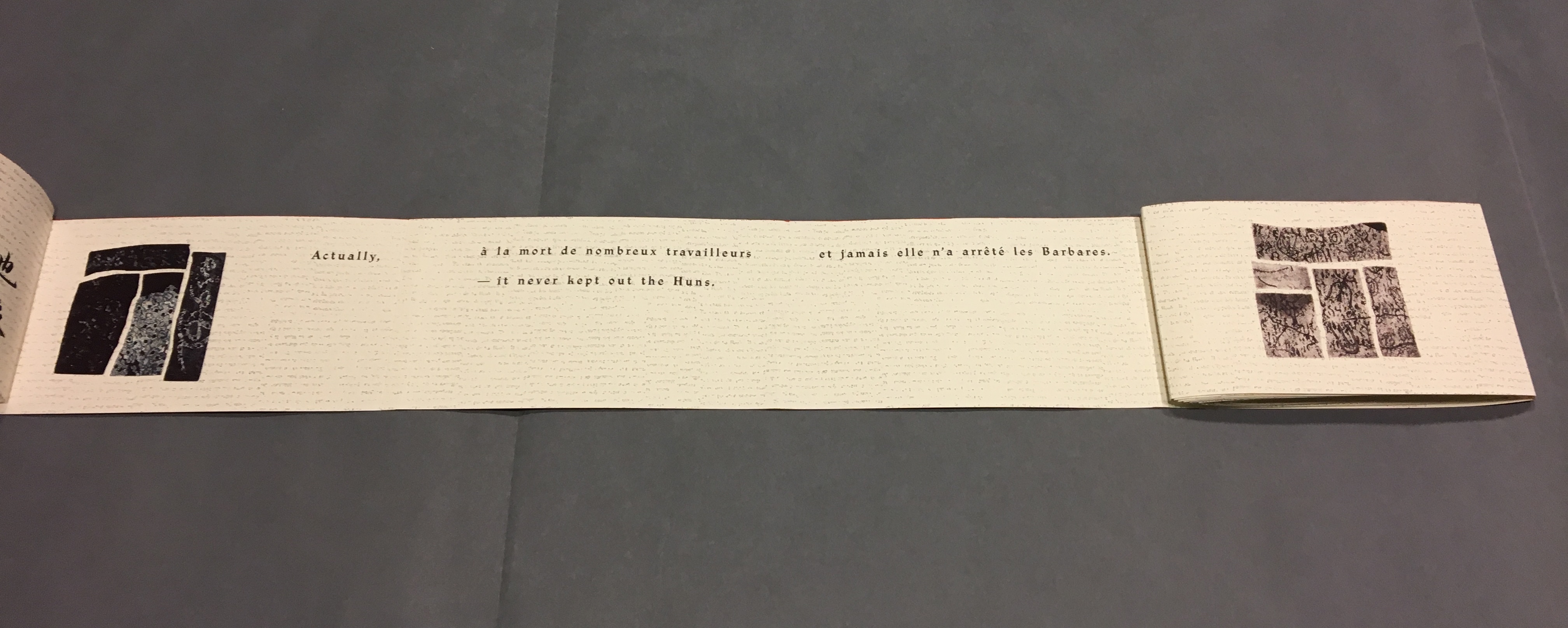
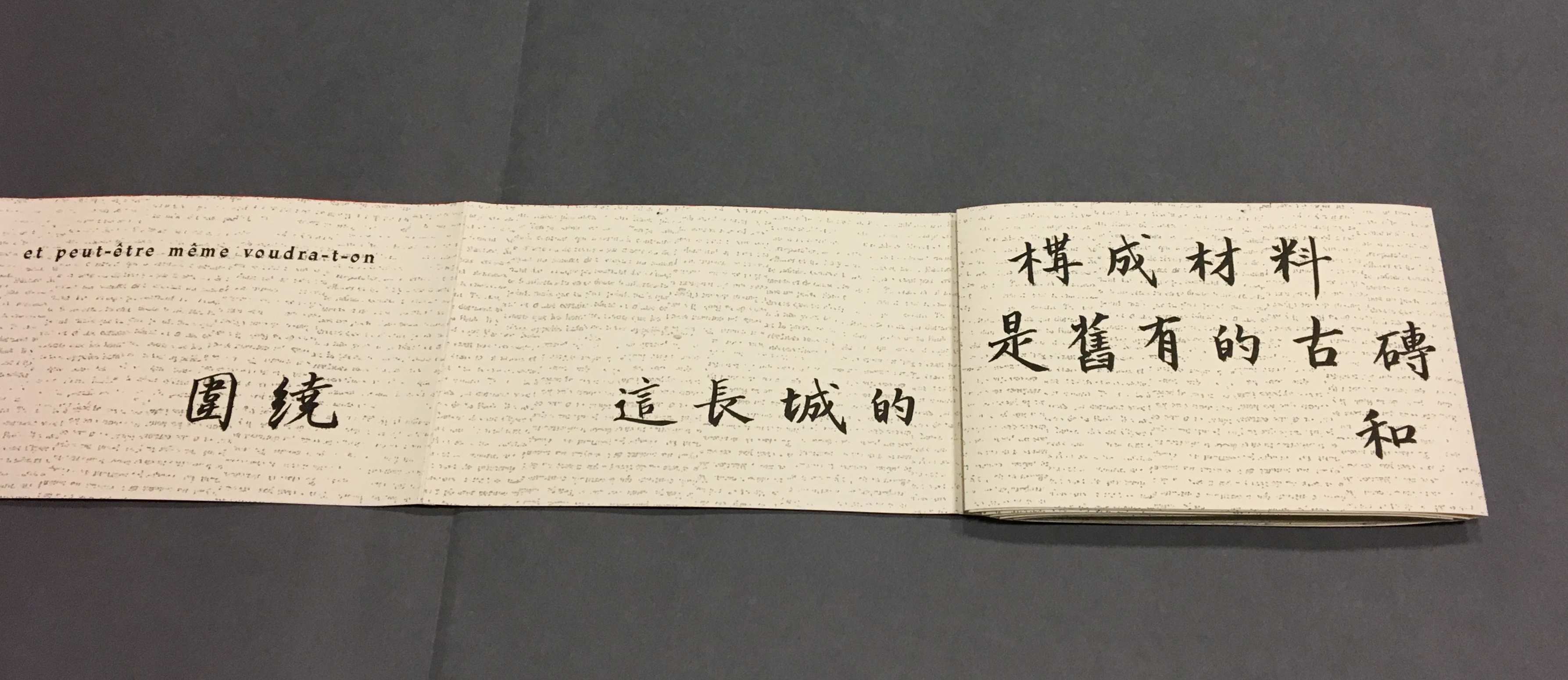
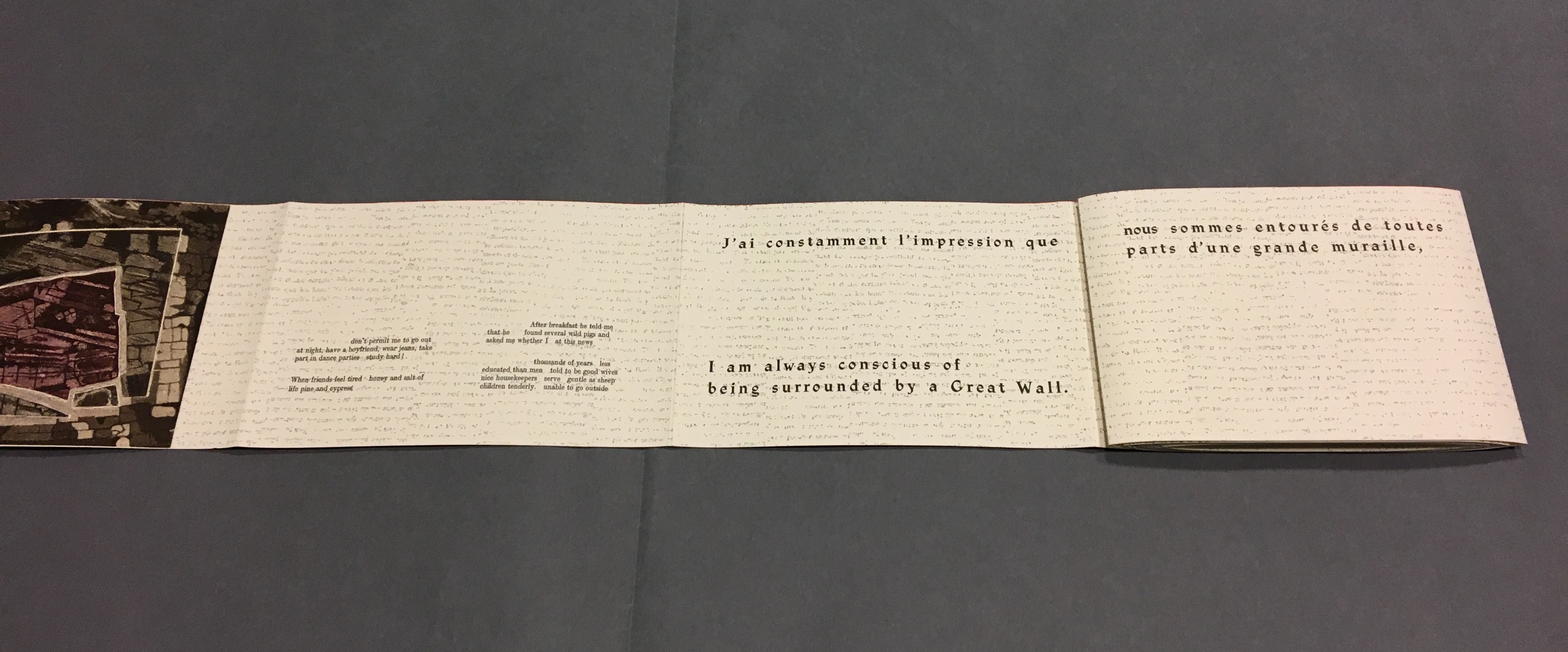
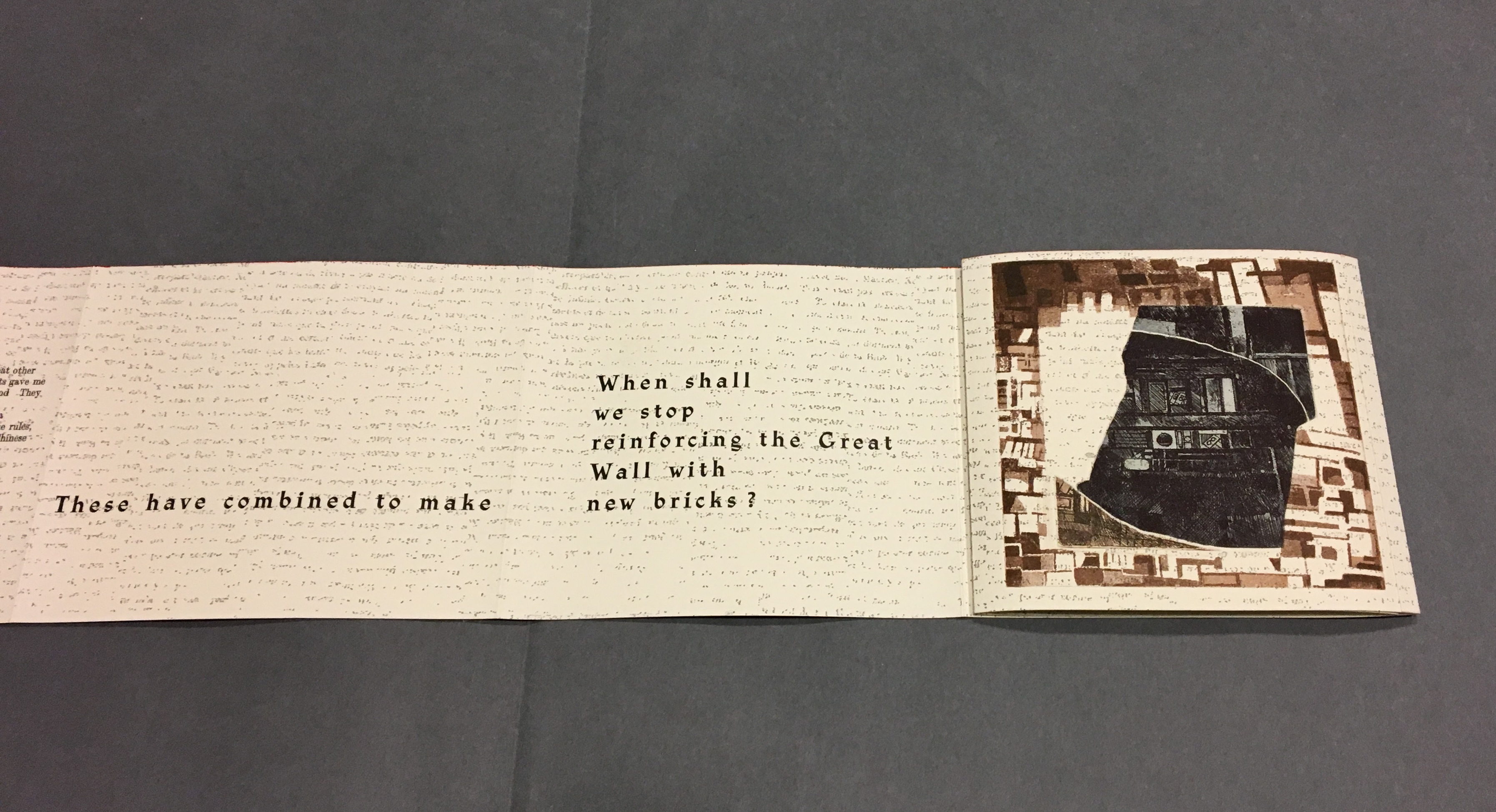
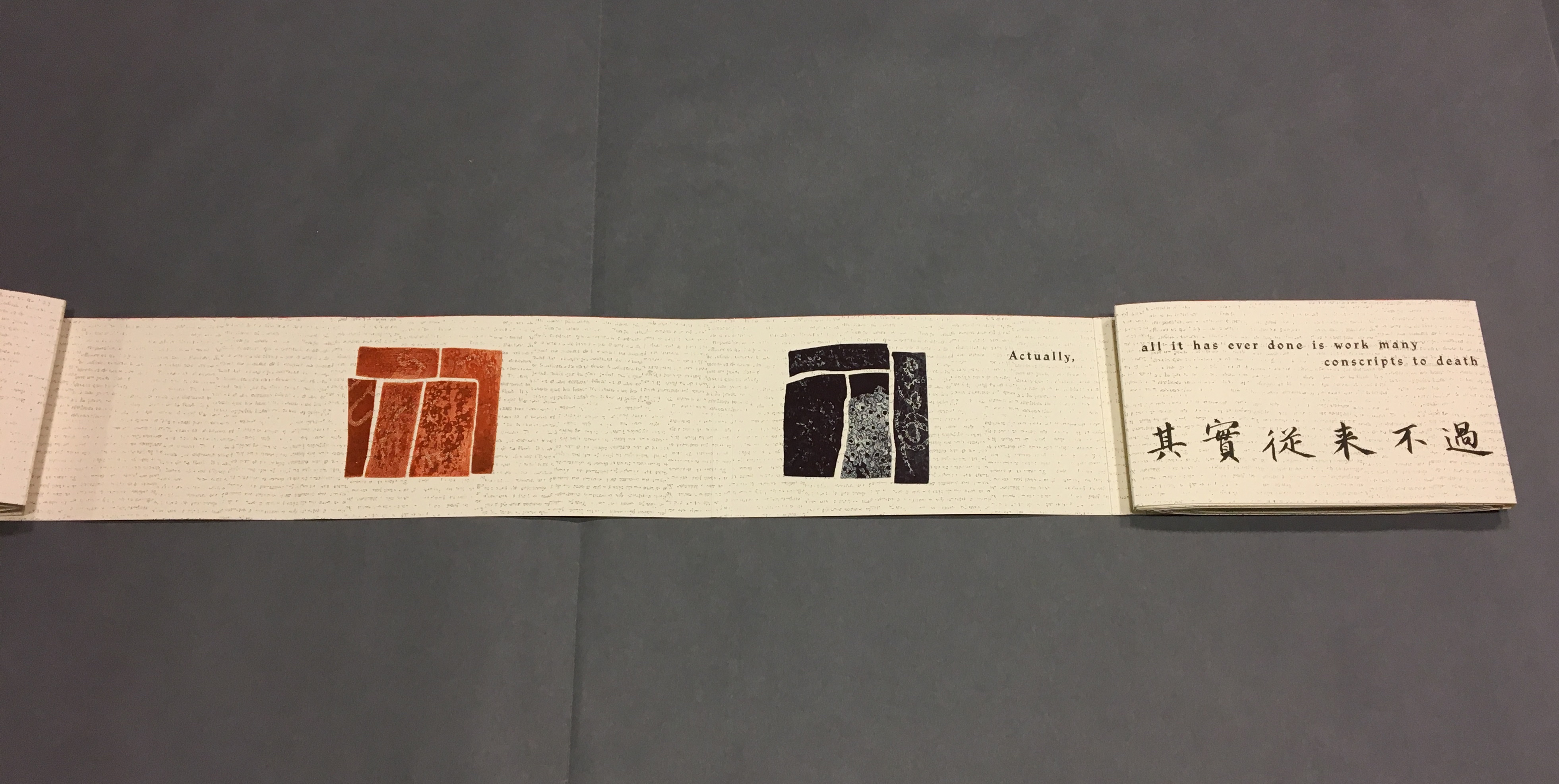
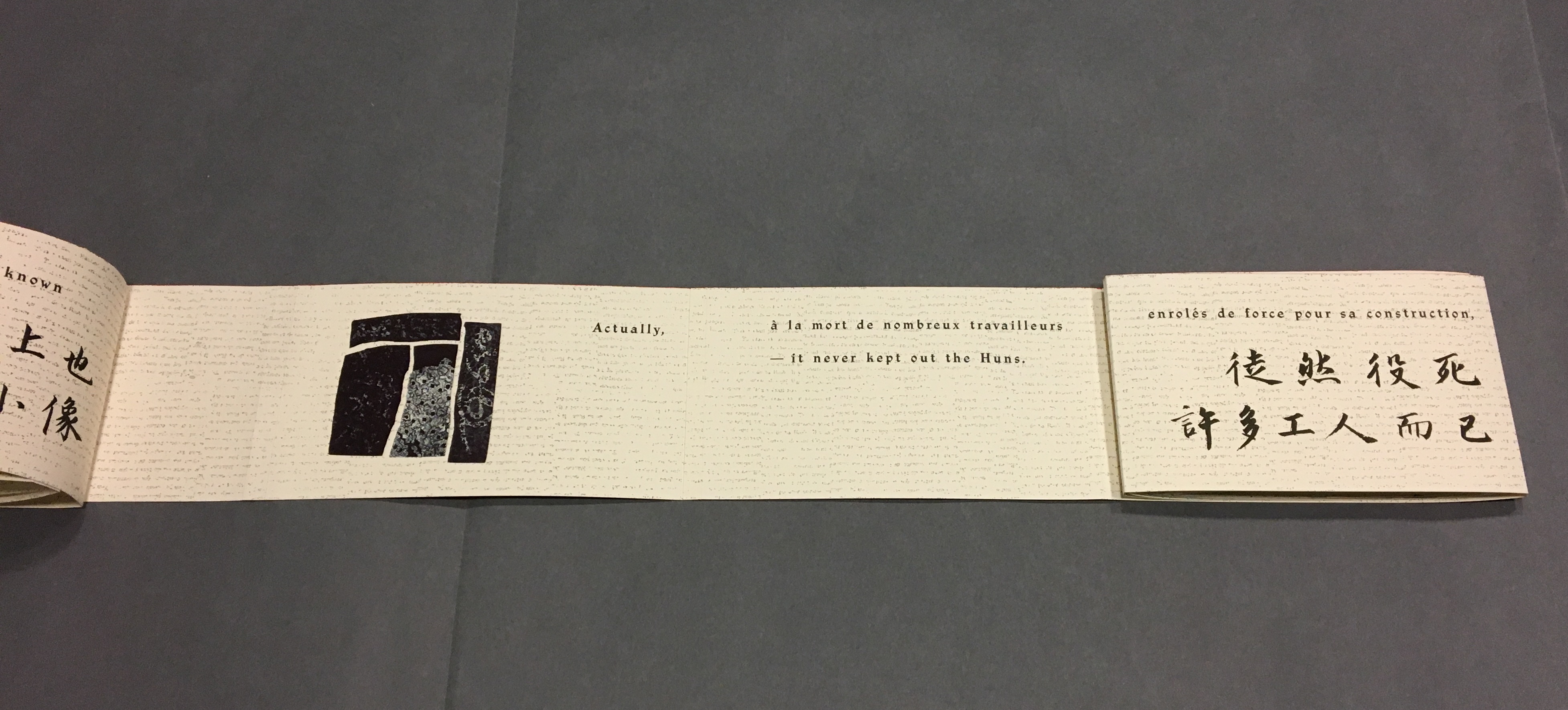
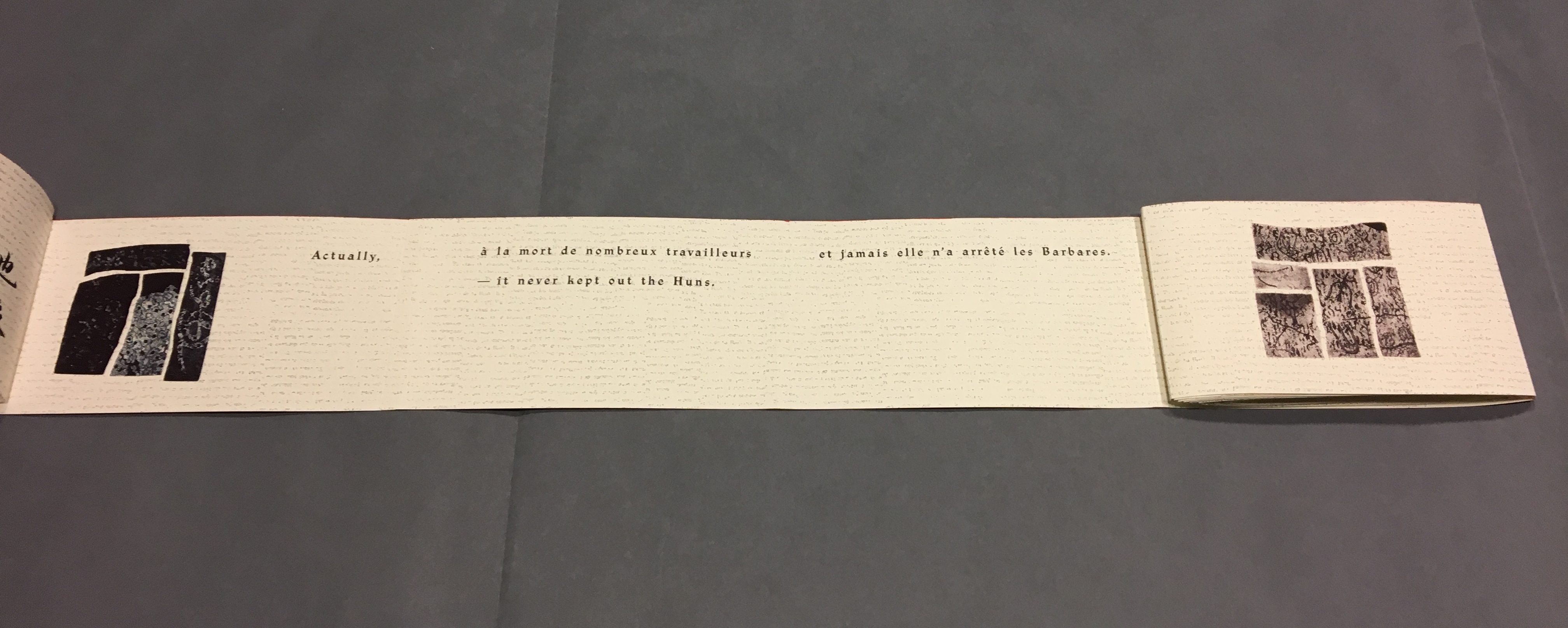
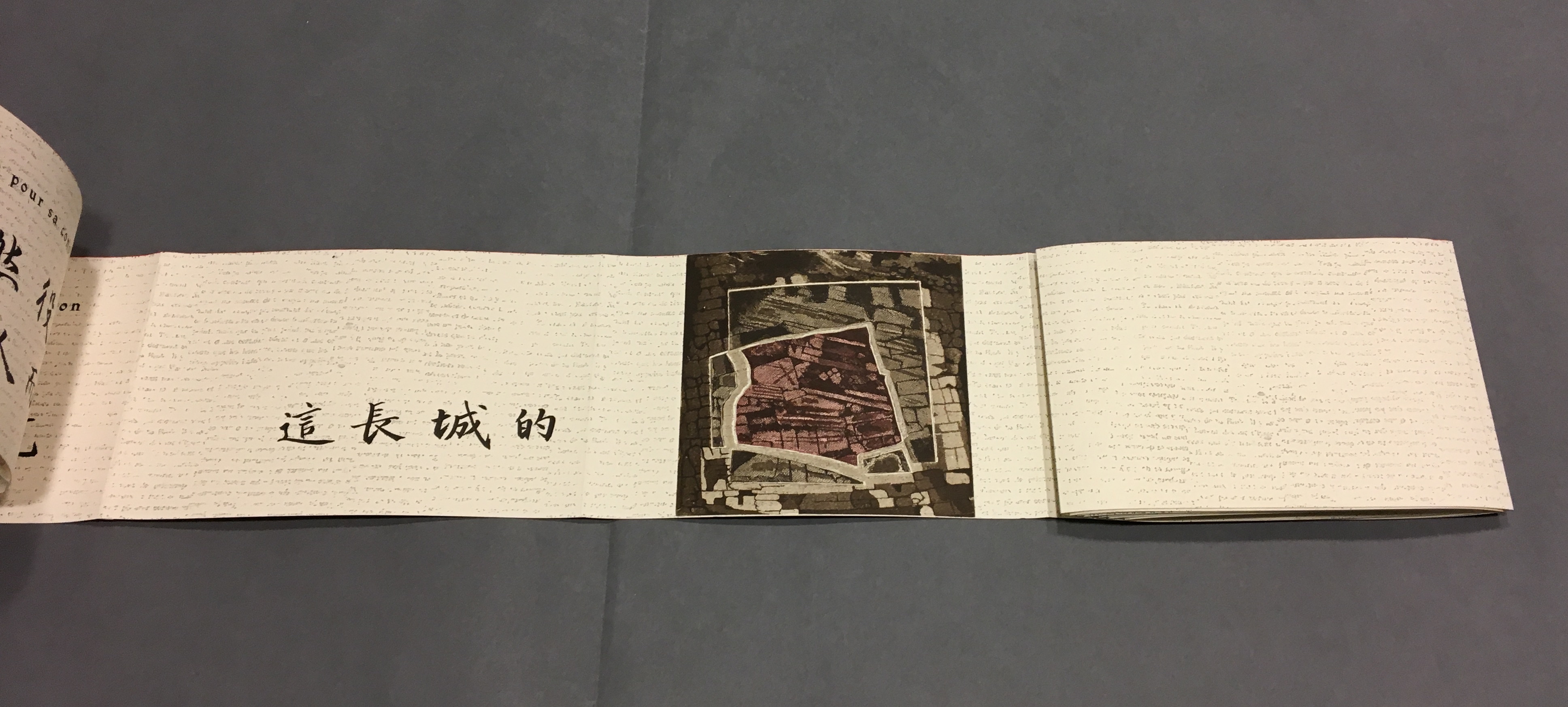
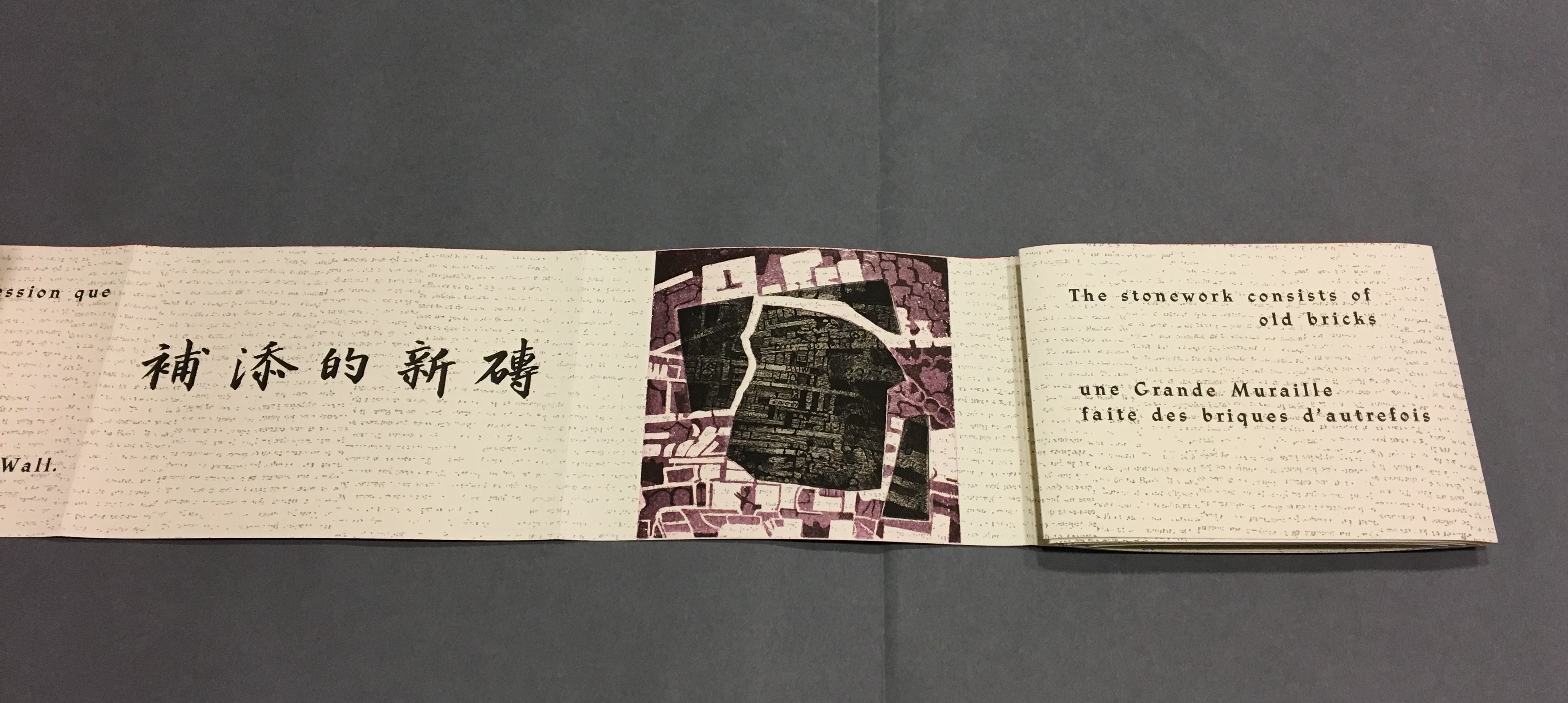
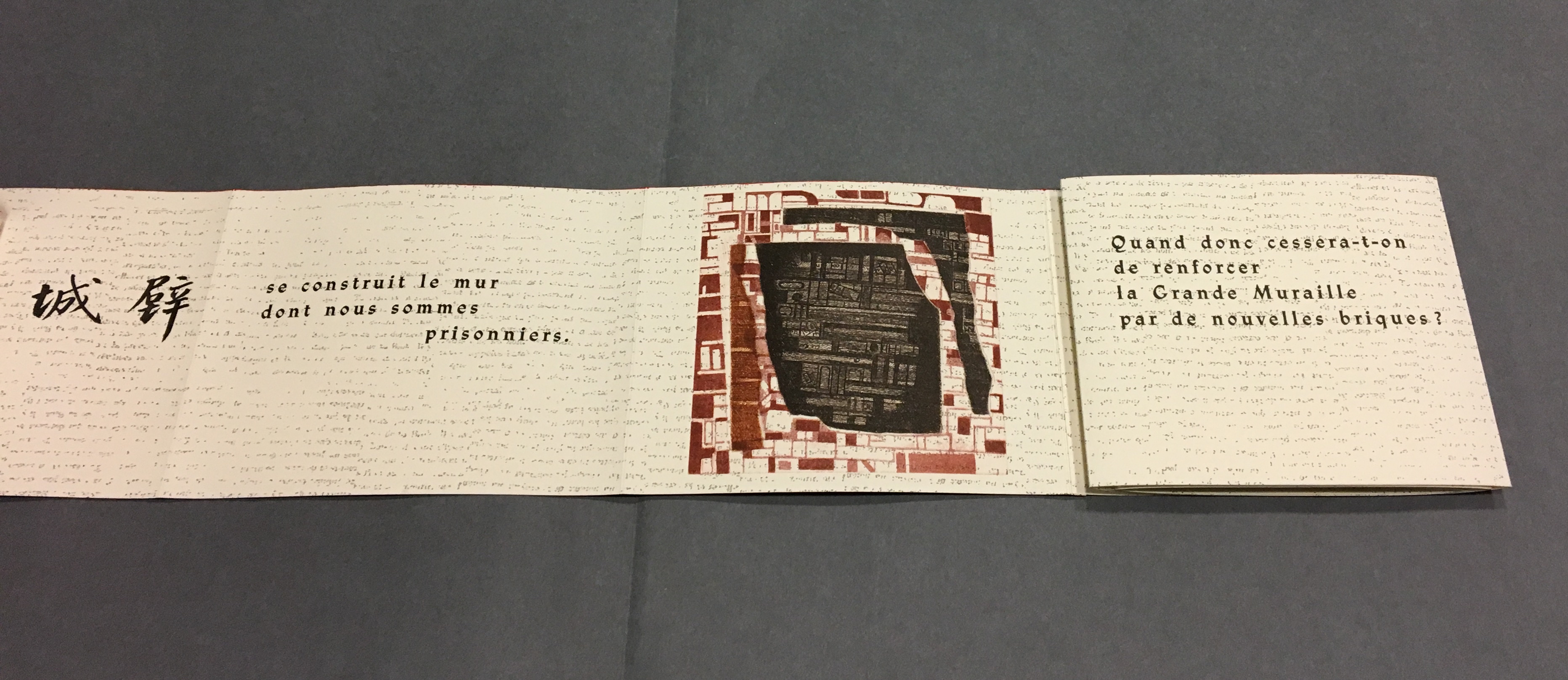
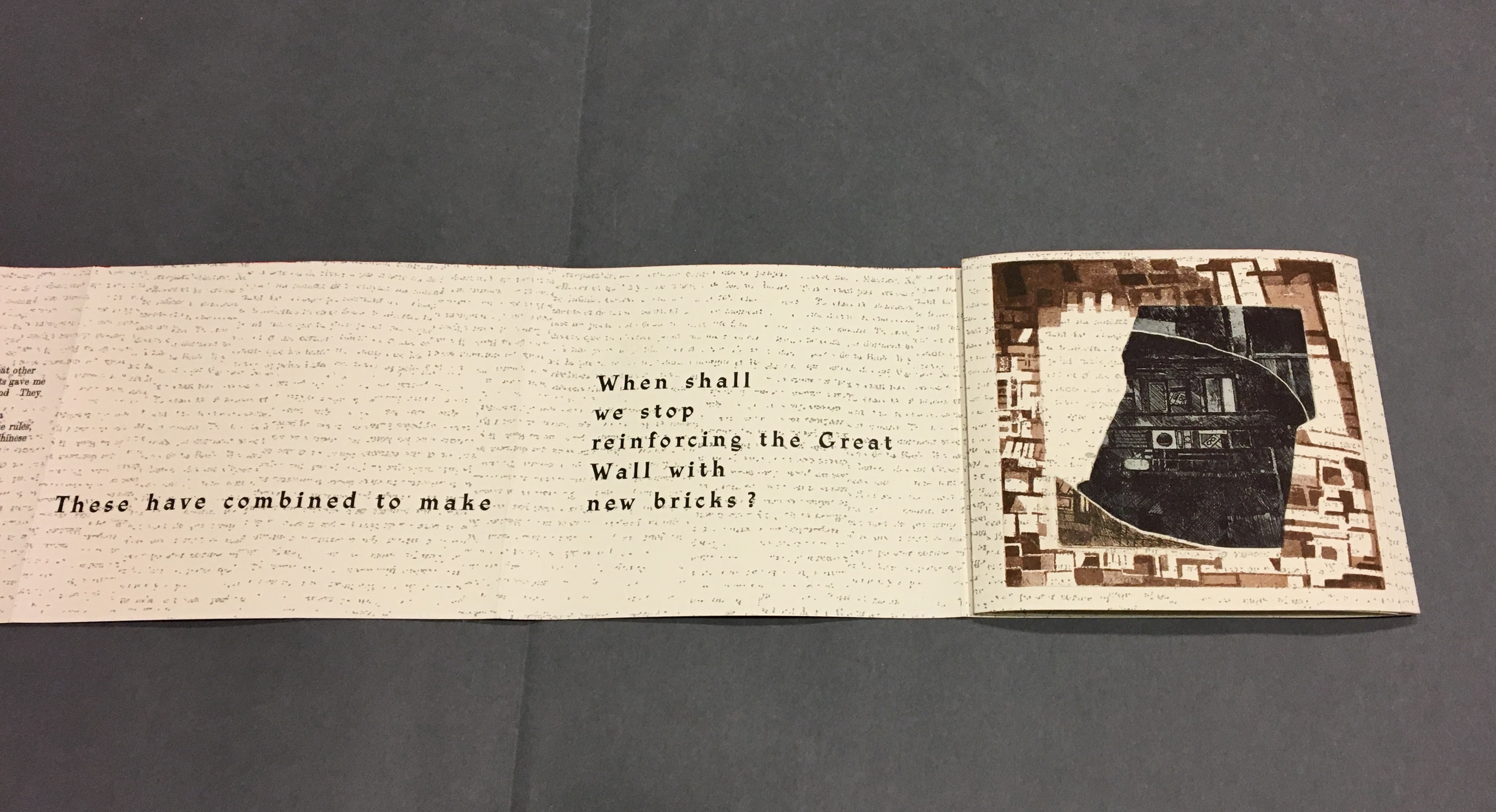
To read La grande muraille as the double-sided leporello it appears to be, however, is to overlook the multi-page spreads that Sharoff conceived with François Da Ros (her typography and print collaborator) in putting together this forme en escargot (snail-shell form as she calls it). The snail-shell form, its multi-page spreads and the text demand that you read La grande muraille as you unroll it, or rather, as you unfold it.

With the book laid flat, the “page spreads” are easier to recognize, the text is easier to read, and the forethought needed for the “imposition” of text and images to deliver the sequential text, easier to marvel at. As each recto page is turned to the right, two new pages appear to the right. This unfolding approach to reading the book offers several intriguing “double- and multi-page spreads” and an experience of the texts and eight prints in the sequence driven by the text. When you have finished reading in this sequence, you will have read both sides of the scroll. 

Reading the text

Front cover
La grande muraille/The Great Wall (1991), Shirley Sharoff
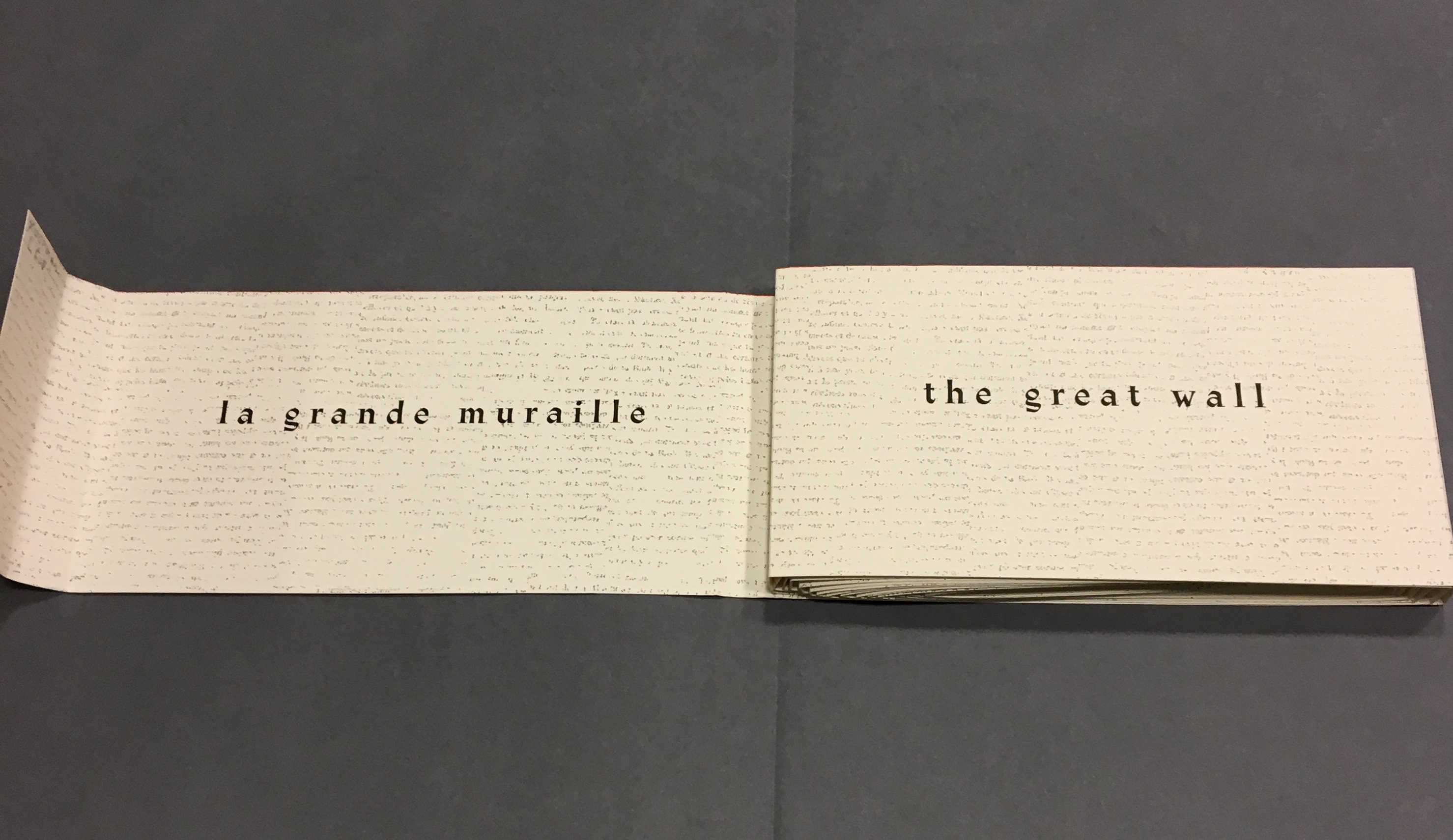
“Pages 1 and 2”
As “page 2” is turned to the right and the English title of the work disappears, “pages 3 and 4” come into view.
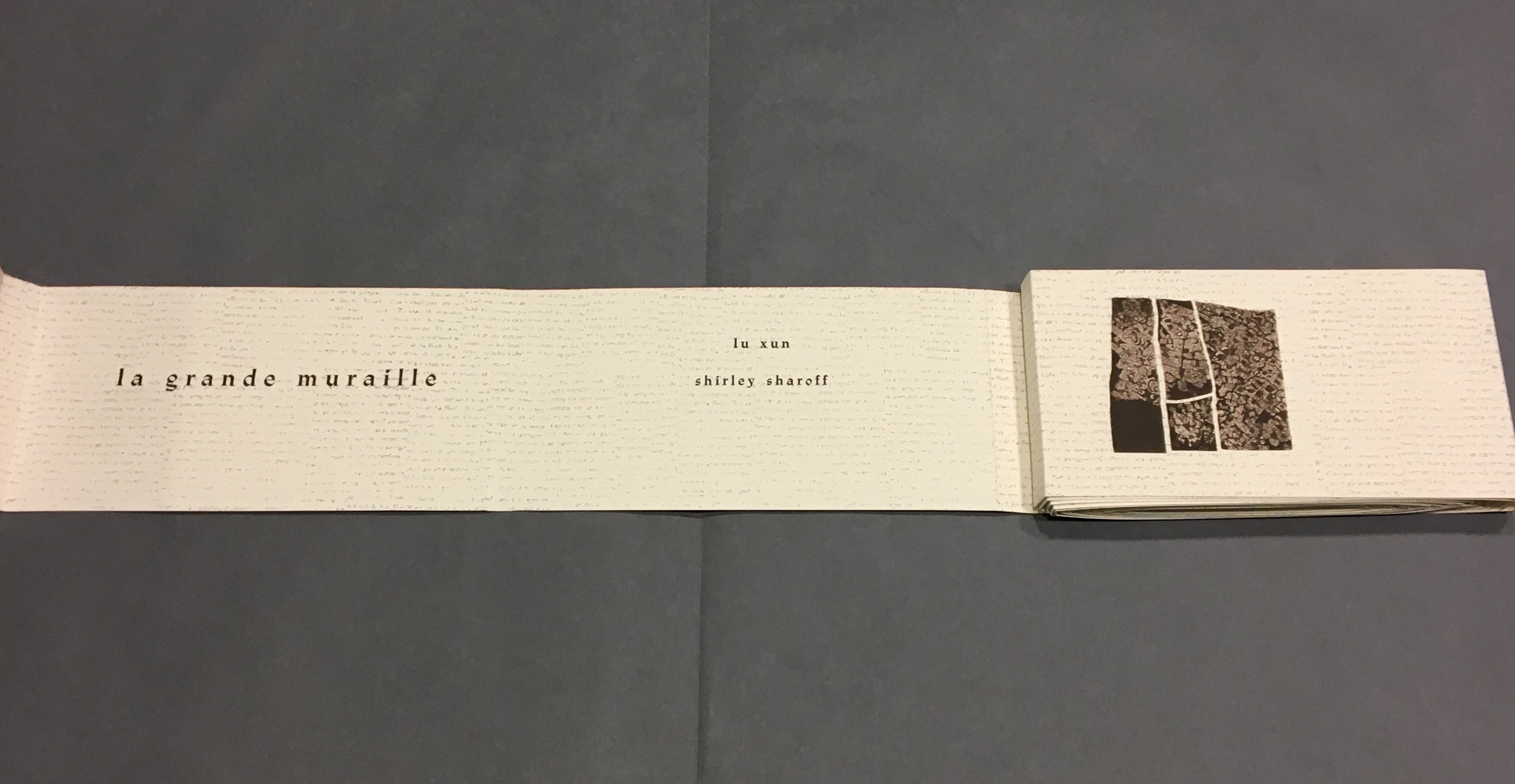
“Pages 1, 3 and 4”
“Page 3” displays the authors names, and “page 4” displays the first of eight prints in the book. As “page 4” is turned to the right and disappears, “pages 5 and 6” appear.
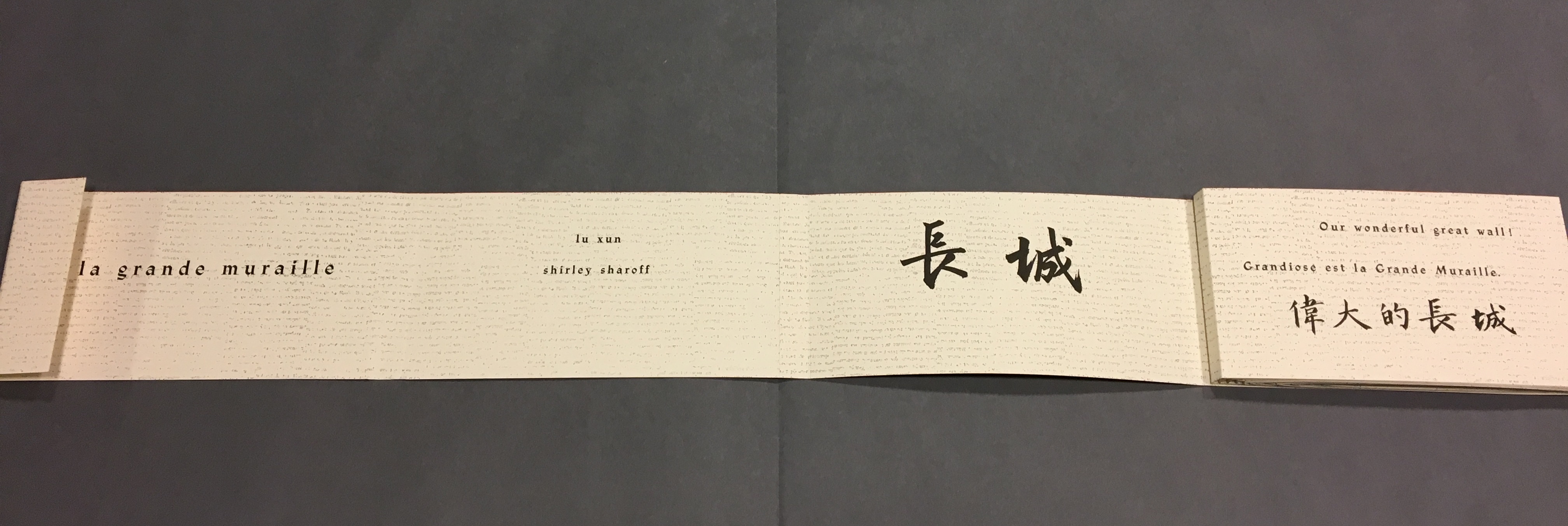
“Pages 1, 3, 5 and 6”
“Page 5” gives the title of the book in Chinese calligraphy. On “page 6”,  the opening line of Lu Xun’s text appears in English, French and Chinese.
Turning “page 1” to the right will cover the authors’ names on “page 3”, and turning “page 6” to the right will yield the next four-page view.
“Back cover, pages 5, 7 -8”
The next lines of Lu Xun’s disquisition run in English, French and Chinese across “pages 7-8”.
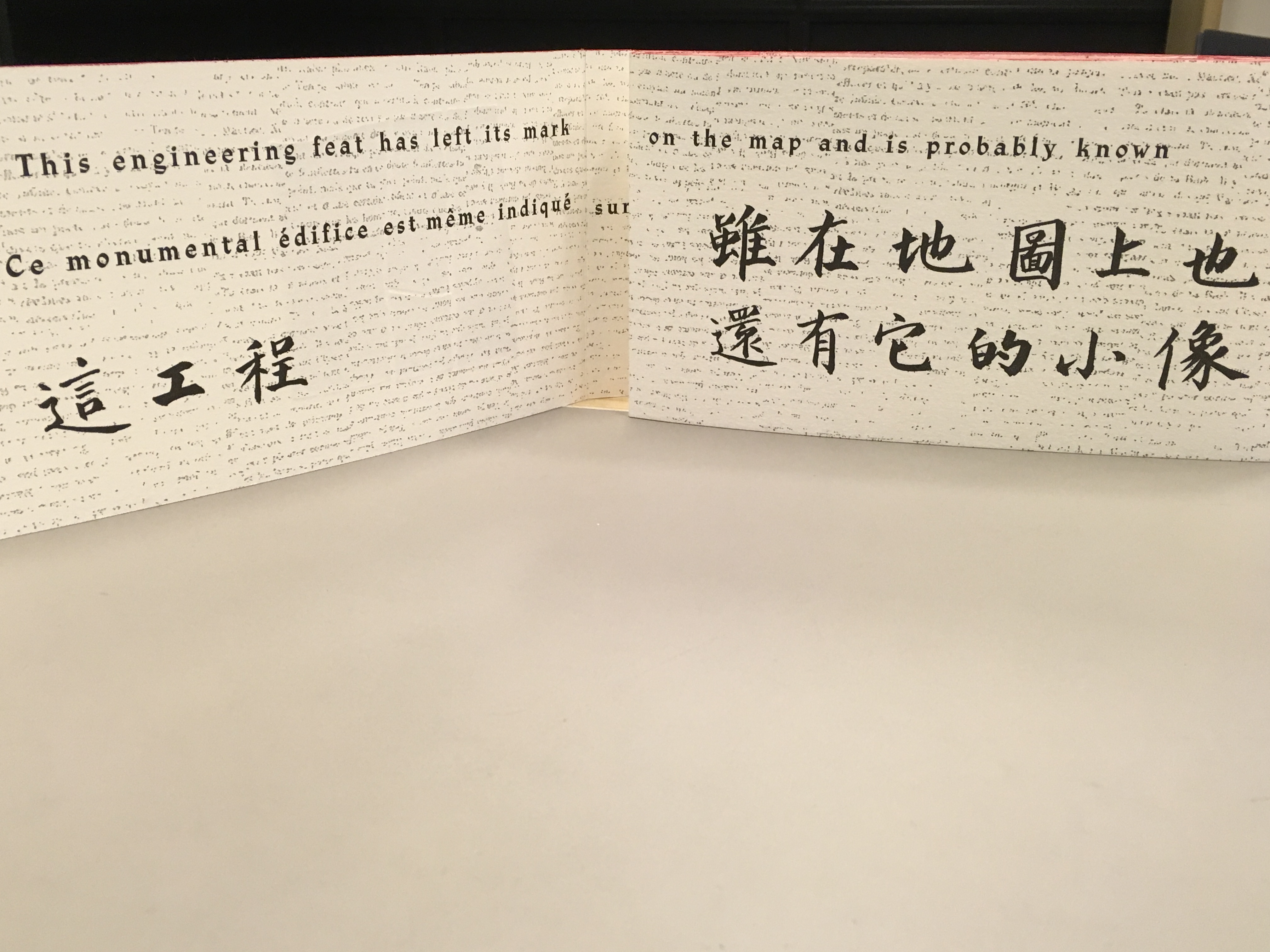
Detail, “Pages 7 and 8”.
Notice how the English text on “page 7” runs across to “page 8”, but the French text disappears under “page 8”, effectively running on to what will be revealed as “page 9” in the next view.
“Pages 2, 9-11”
This view results from two page turns inward on the left and two outward on the right. “Page 2” has come back into view on the left.  The English text on pages 9-10 completes the sentence interrupted on “page 8”. The French text on “pages 9 and 10” completes the sentence that began on “page 7” and ran behind “page 8”.
Pages 9-10, 12-13
Pages 6, 12, 14-15
Pages 12, 14, 16-17
Pages 16, 18-19
Pages 16, 18, 20-21
Pages 20, 22-23
Pages 20, 22, 24-25
Pages 24, 26-27
Pages 24, 26, 28-29
Pages 28, 30-31
Pages 30, 32-33
Pages 32, 34-35
Pages 32, 34, 36-37
Pages 34, 38-39
Pages 38, 40-41
Pages 40, 42-43
Pages 42, 44-45
Pages 44, 46-47
Pages 44, 46, 48-49
Pages 46, 48, 50-51
Pages 48, 50, 52-53
Pages 50, 54-55
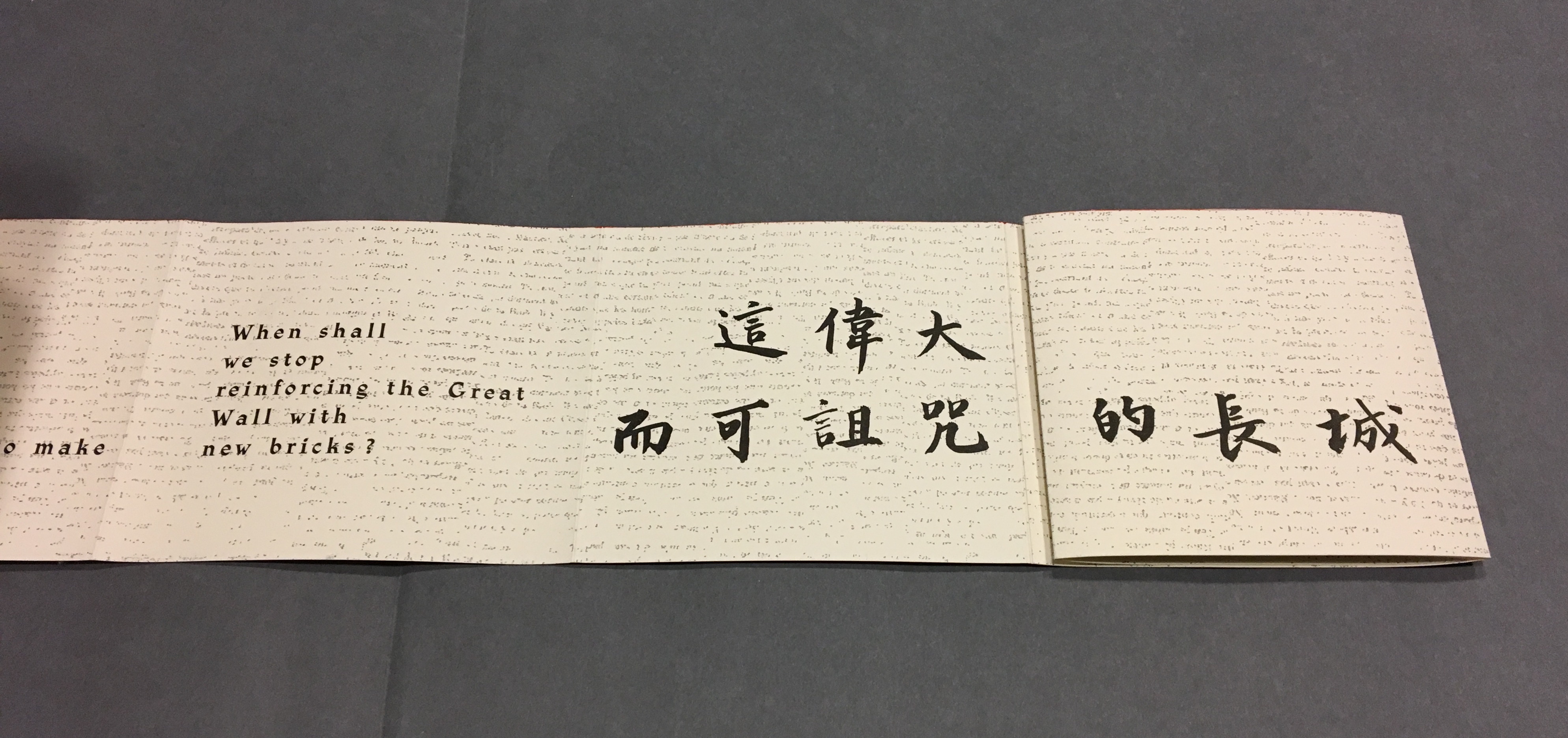
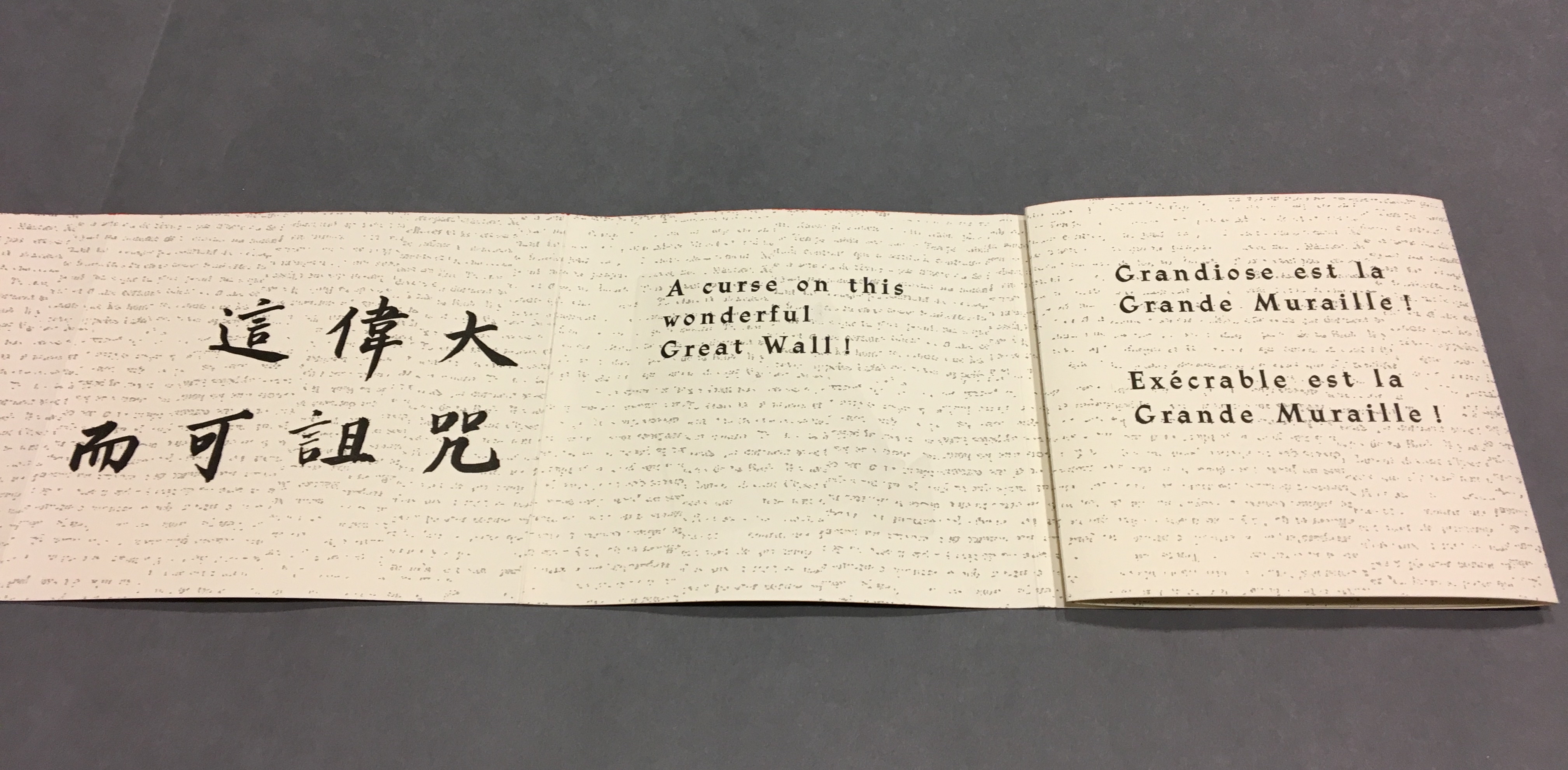
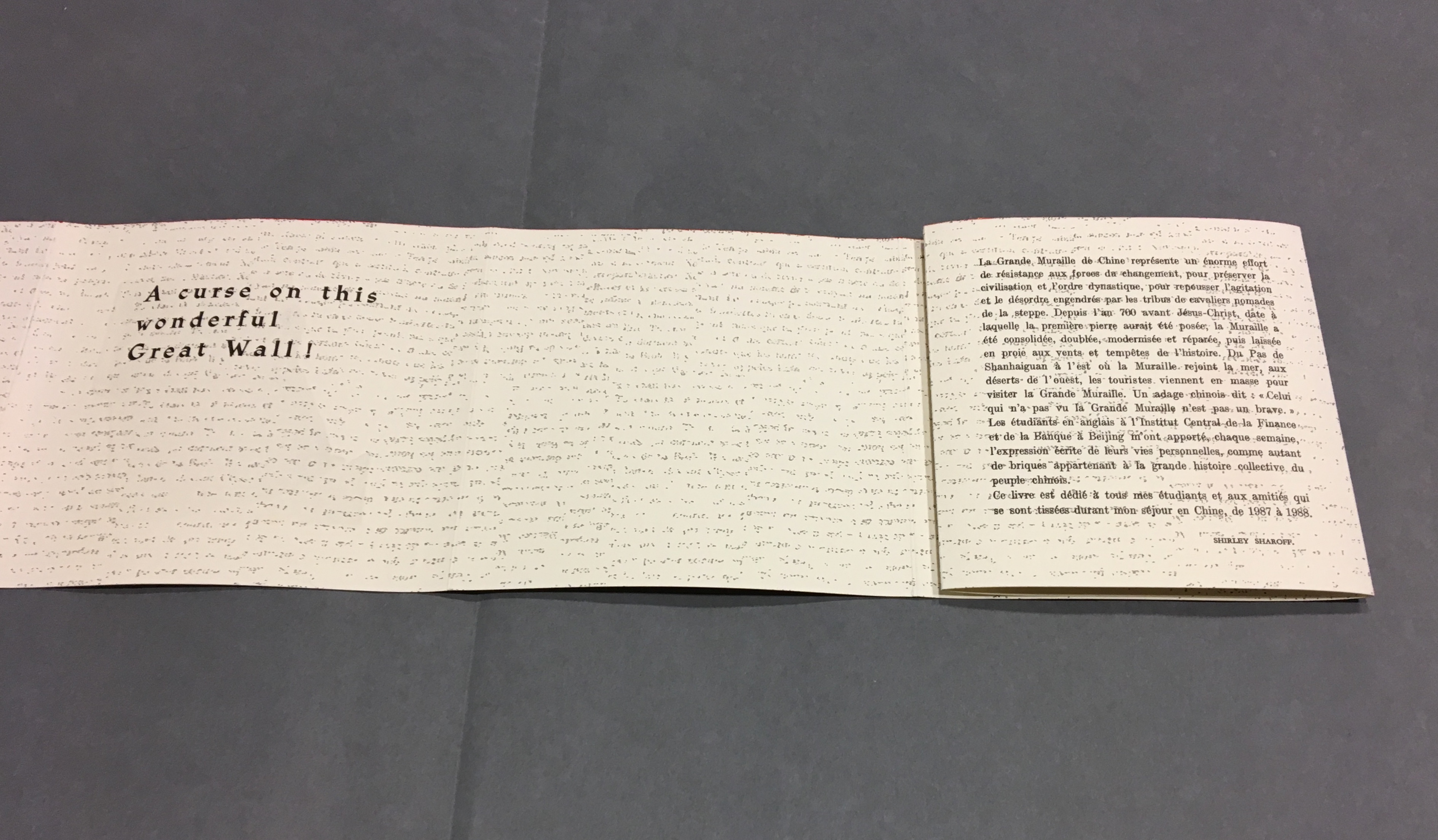
Pages 54, 56-57, the latter displaying the last ten characters of Lu Xun’s text.

這偉大而可詛咒的長城)

Pages 56, 58-59
Pages 58, 60-61
Pages 60, 62-63
Pages 62, 64-65
pages 64, 66-67

Now that the so-called gaps in the English and French texts were resolved, I wanted to understand how the English and French matched up to the Chinese text. For that, I asked help from two acquaintances in The Hague: Bee Leng Bee and Yingxian Song.  They obtained a copy of Lu Xun’s text, traced it through the photos I had taken and found that the three languages run almost in parallel as the work unfolds.

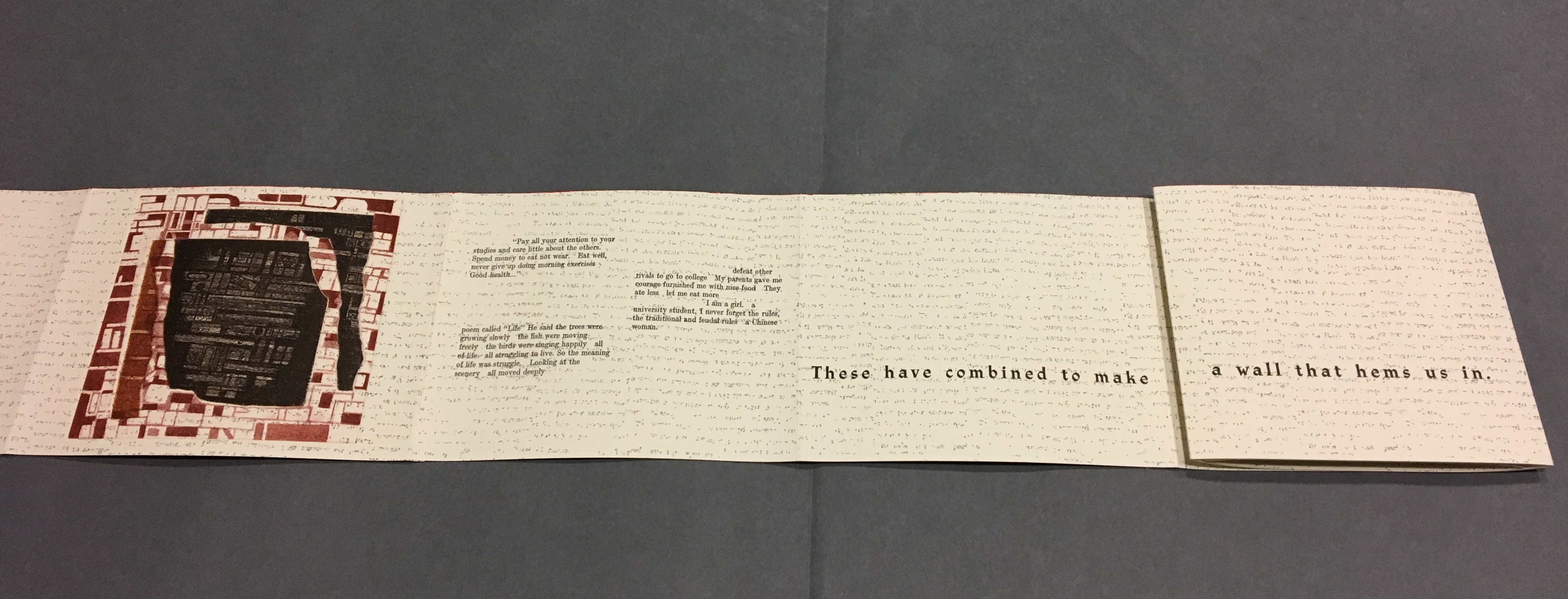
“Almost” because the order of the languages is not alway the same. On pages one and two, we see the French and English titles but must wait until page five before the Chinese title appears. Then, on page six the order changes: English first, then French, then the corresponding ten Chinese characters. On pages seven and eight, this order is maintained. Later, with the turning of page fifteen, the French comes before the English and Chinese; the first Chinese character aligning to the French and English (其) appears on page seventeen. Then, as page seventeen is turned to the right, the order changes back to French then English on page eighteen, but on page nineteen, it moves to French first then Chinese. The book’s textual conclusion on pages fifty-six through fifty-nine runs Chinese, English, then French. 

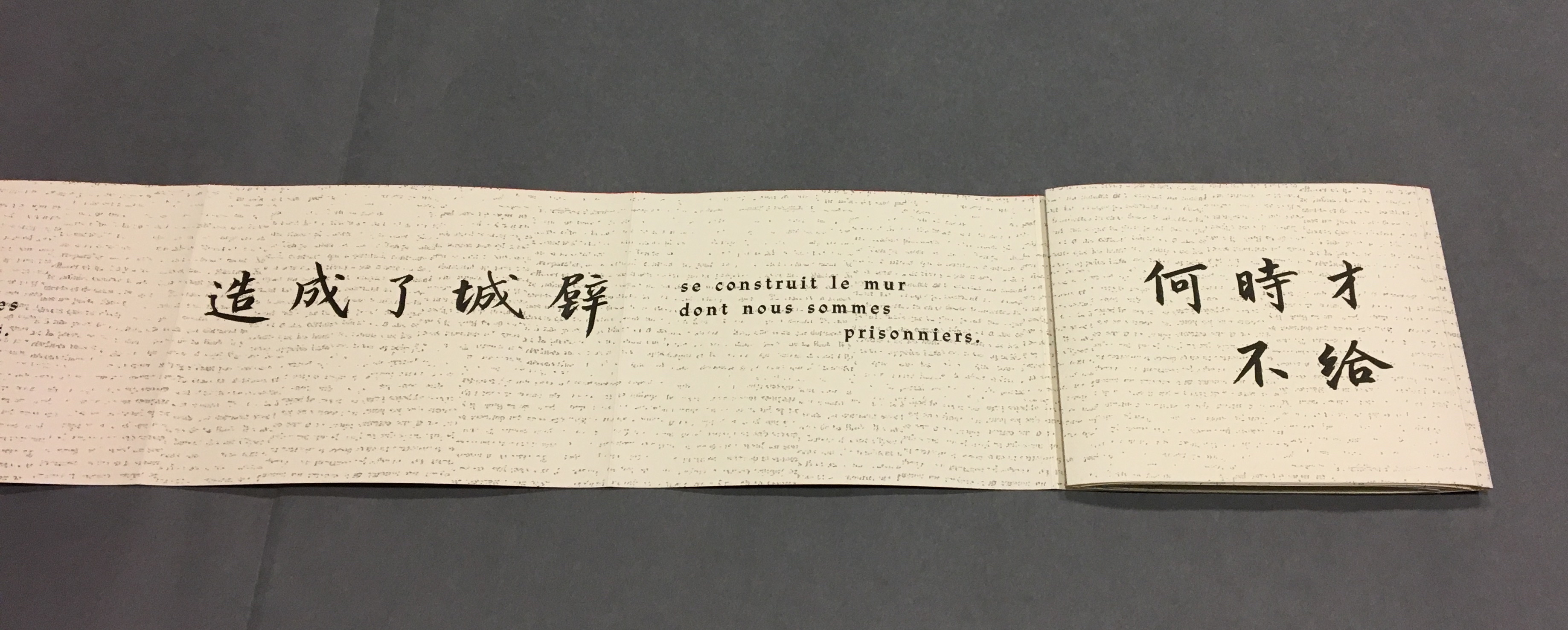
The juxtaposition and weaving of the three languages often seems painterly as if intended to evoke the layering of the bricks and the intertwining vines and foliage along stretches of The Great Wall. Here is the uninterrupted Chinese text:

偉大的長城!

這工程,雖在地圖上也還有它的小像,凡是世界上稍有知識的人們,大概都知道的罷。

其實,從來不過徒然役死許多工人而已,胡人何嘗擋得住。現在不過一種古跡了,但一時也不會滅盡,或者還要保存它。

我總覺得周圍有長城圍繞。這長城的構成材料,是舊有的古磚和補添的新磚。兩種東西聯為一氣造成了城壁,將人們包圍。

何時才不給長城添新磚呢?

這偉大而可詛咒的長城!

Reading the images

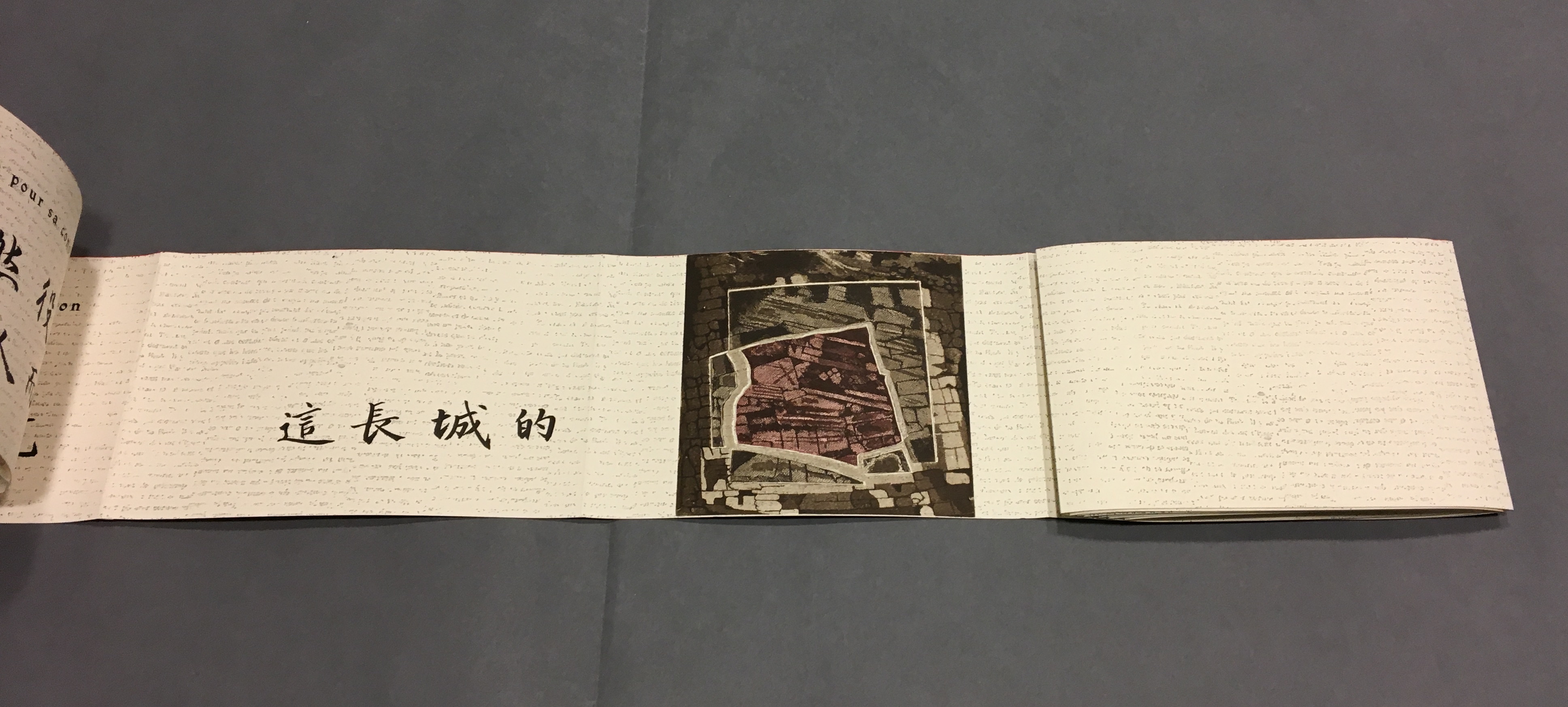
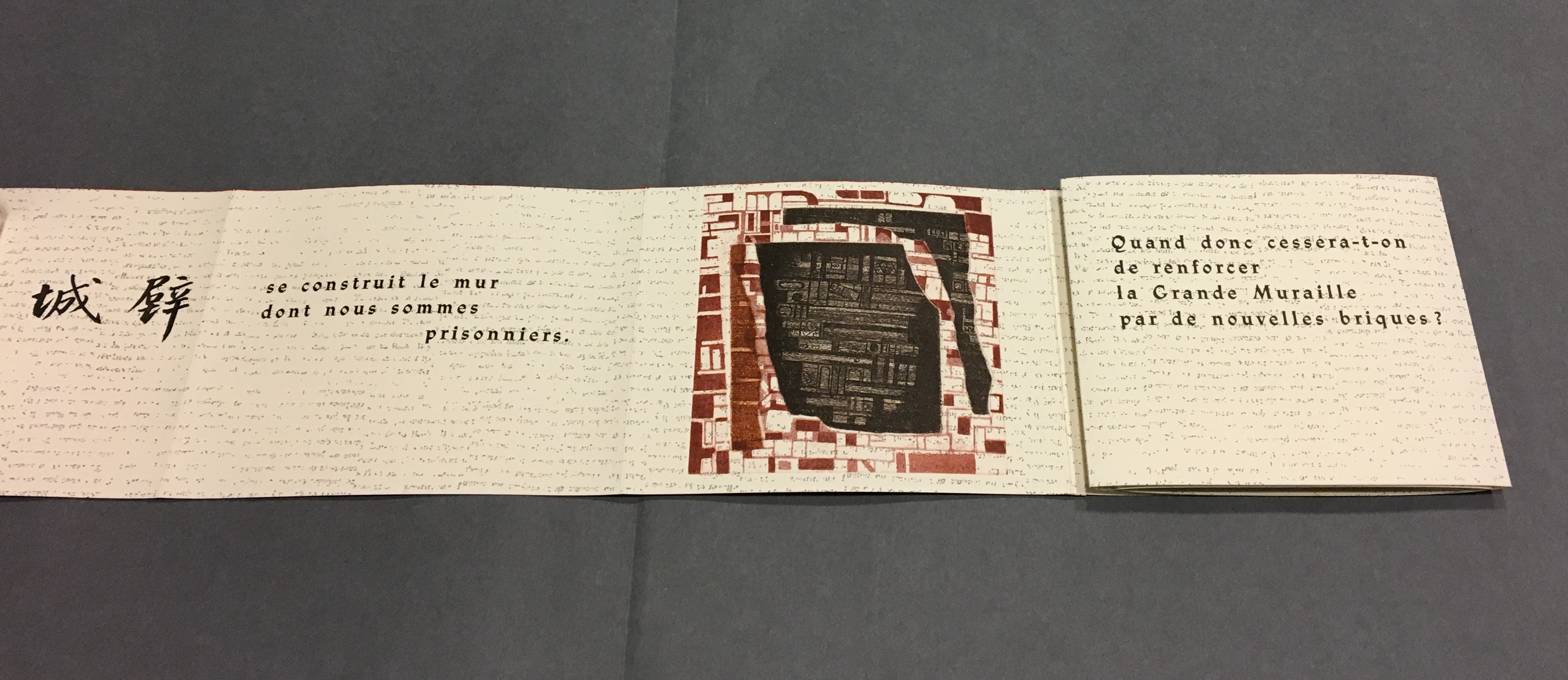
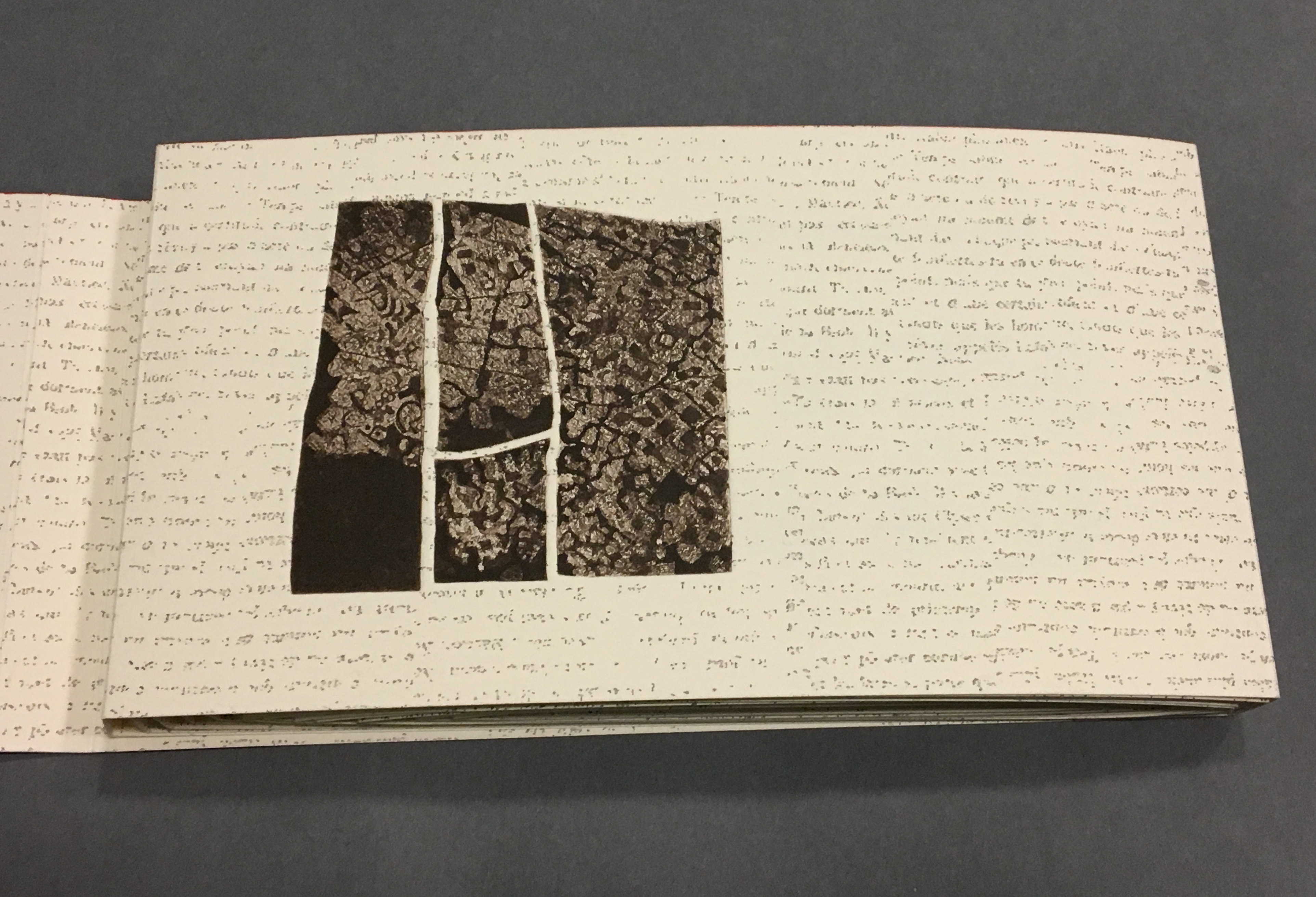
Even though following the forme en escargot results in having reading both sides of the scroll in the end, Sharoff also uses it to play with the notion of intended sequence. Completely unrolled and standing on its edge, the work echoes the Great Wall.  The tint of red along the top edge recalls the blood spilled in the Great Wall’s construction. The prints echo the Great Wall’s bricks, the vegetation in its crumbling gaps, even the gates. The completely unrolled work is an intended sequence, also — an invitation to walk the wall. Coming upon each of the eight copperplate engravings in the unfolding sequence is a different experience than walking up and down the “outer wall” and then the “inner wall” to see them. Five are on the outer wall, three on the inner.

The print first to be seen as the book unfolds, but one of the three on the “inner wall” with the book unrolled.

The second print comes into view on “page 14”, the second of Lu Xun’s statements begins in French on “page 15”,
and with the rolling up on the left, “page 4” has reappeared.
With the turning of “page 15”, the third print comes into view on “page 16”, and the sentence begun with “Actually” on “page 16” continues on “page 17” above the Chinese.
“Pages 16, 18-19”
The French at the top of “pages 18-19” is continuing the sentence from “page 15”, and the English beneath on “page 18” is continuing the sentence from “page 17”.
With this spread — “pages 16, 18, 20-21” — the fourth print comes into view on the right, and the French and English sentences conclude together in the middle.
“Pages 30, 32-33” and the fifth print comes into view.
“Pages 38, 40-41” and the sixth print comes into view.
“Pages 44, 46, 48-49” and the seventh print comes into view.
Pages 50, 54-55 and the eighth and final print comes into view.

Reading the form “in time”

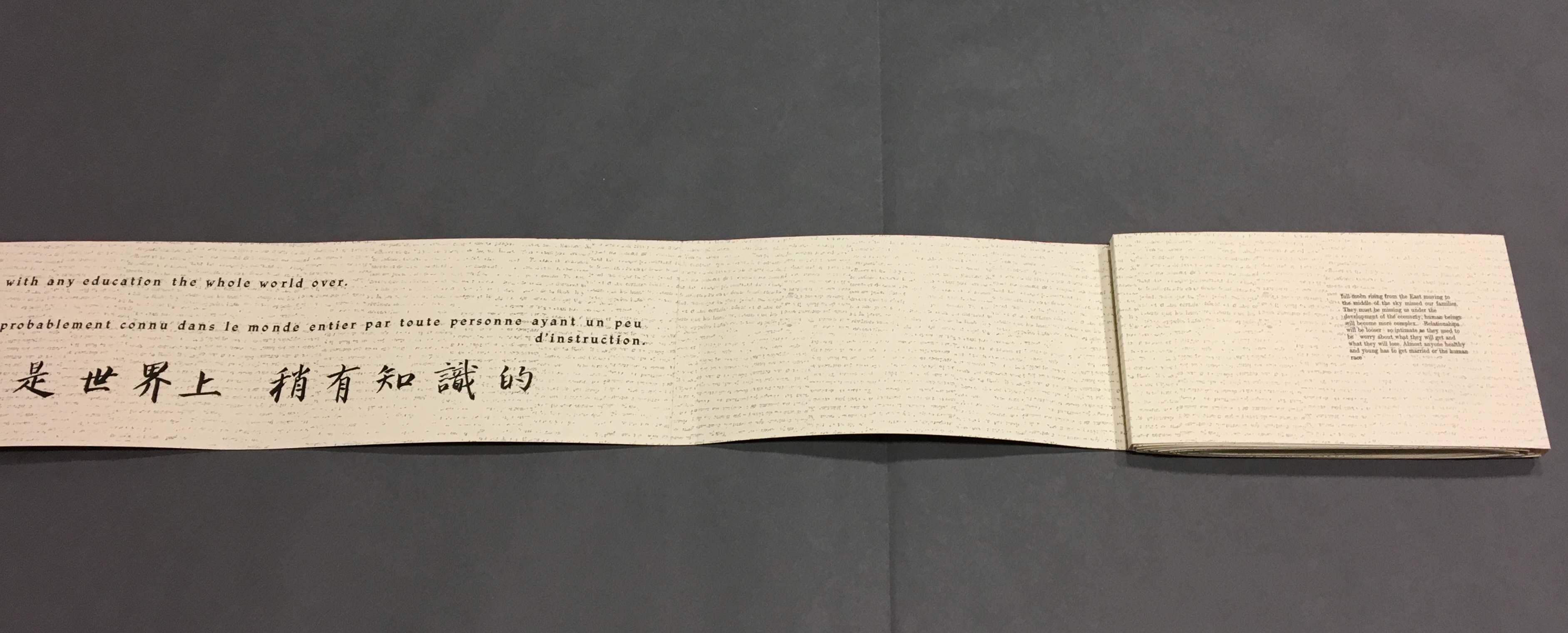
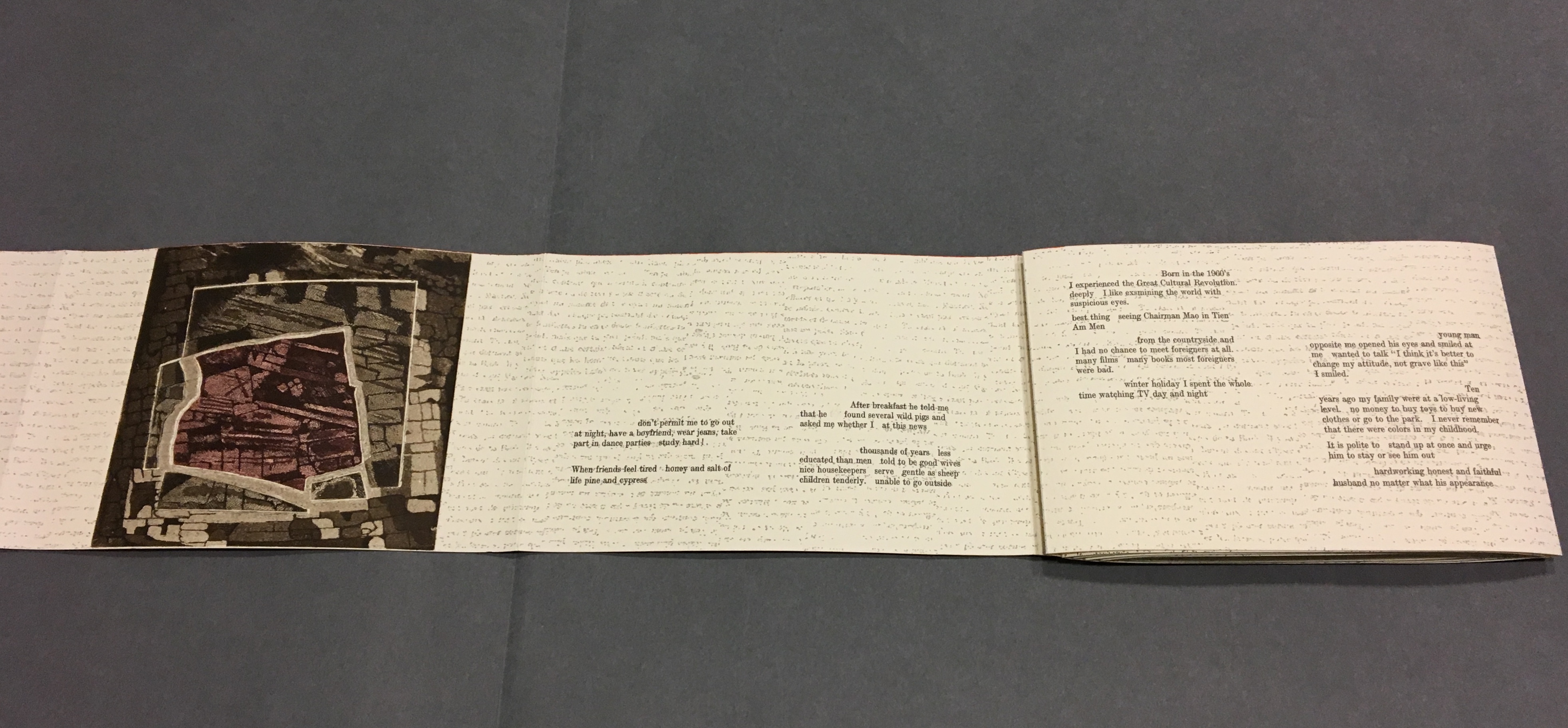
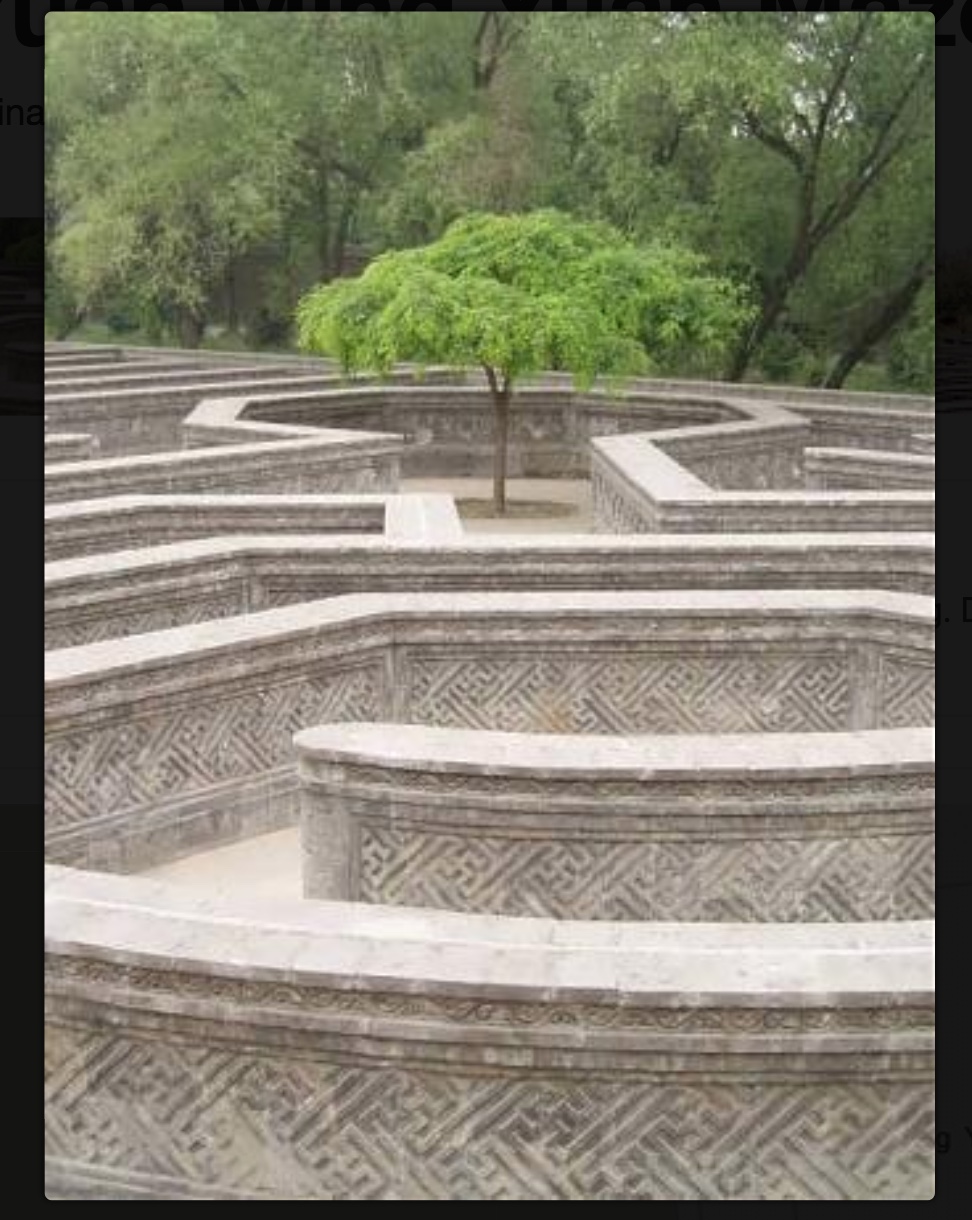
As the force of the snail-shell binding resists the unscrolling and pulls the standing pages inward, the work has another echo: the eroding maze in the Ancient Summer Palace (Yuan Ming Yuan) outside Beijing. The faint markings on the paper, created by printing the results of repeated photocopies of a manuscript, amplify the echo.

La grande muraille/The Great Wall (1991)
Shirley Sharoff
Photo credit: © Koopman Collection. National Library of the Netherlands/Jos Uljee
Arches paper printed with the results of multiple photocopies of a manuscript.

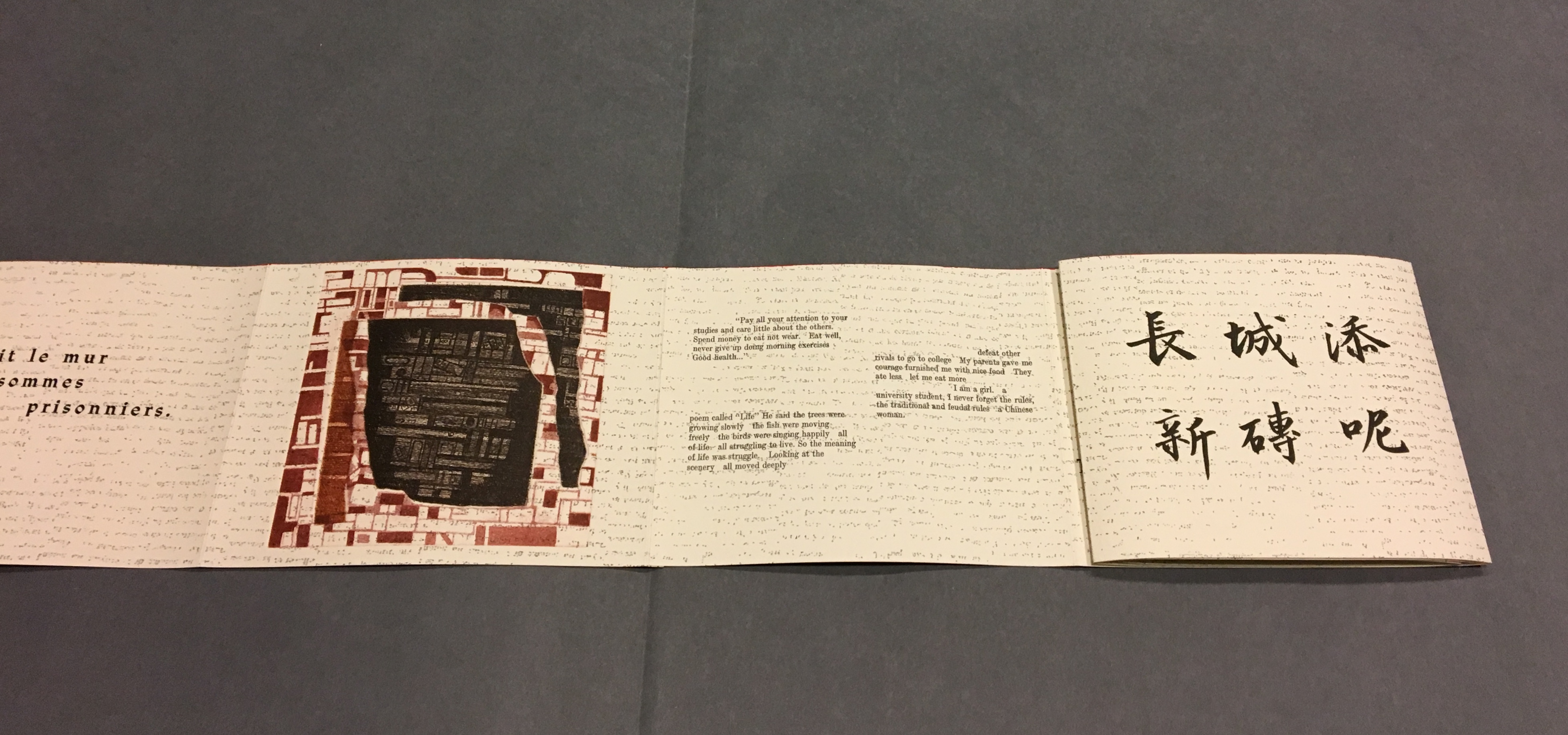
Although Lu’s text does not mention the maze, Sharoff introduces contemporary text that, alongside the interweaving Chinese, English and French of Lu’s text, evokes a maze-like, time-travelling effect. The autobiographical texts from the English-language students she taught at the Central Institute of Finance and Banking (1987-88) reflect on their childhood and adolescence in the Maoist era and their recollection of representations of  foreigners in books and television. These “new bricks” in their modernness and fracturedness interrupt the flow of Lu’s prose praising and cursing the Great Wall.  Yet, in their segmentation and placement, they also physically echo the prints and reinforce Lu’s expression of the paradox in the construction, fragmentation, reconstruction and erosion of the real Wall.

“Pages 32, 34-35”

Sharoff’s La grande muraille is a treasure that rewards repeated visits and contemplation: not only for itself but also as a parallel or forerunner.

La grande muraille’s physical impetus (The Great Wall), the seemingly decipherable/indecipherable characters on the Arches paper, the wry paradox of Lu Xun’s observations, the socio-political-cultural implications of the “new bricks”, the work’s innovative form and the pulling of past and present together parallels the work of Xu Bing and his play with language across East and West. His Book from the Sky first appeared in 1988.

Sharoff’s use of Lu’s contemplation on The Great Wall also foreshadows Jorge Méndez Blake‘s Capítulo XXXVIII: Un mensaje del emperador / A Message from the Emperor (2017?). The title refers to an anecdote in the story “The Great Wall of China” by Franz Kafka, a contemporary of Lu Xun.  The narrator tells the reader how the emperor has dispatched from his deathbed a message to the reader, entrusted to a herald who, struggling as he might, cannot escape from the confines of the palace to deliver the message — yet which we the reader await hopelessly and with hope.

What more should we expect from art?

____________________________

*For help and permissions, thanks to Paul van Capelleveen and the staff at Koninklijke Bibliotheek, Den Haag, and Shirley Sharoff, Paris. For help with the Chinese and calligraphy, thanks to Bee Leng Bee and Yingxian Song.

Further Reading

Hubert, Renée Riese, and Judd David Hubert. 1999. The Cutting Edge of Reading : Artists’ Books. New York City: Granary Books. See pp. 24-27 for the Huberts’ reading La grande muraille.

Bookmarking Book Art – “Bhutan: A Visual Odyssey Across the Last Himalayan Kingdom”

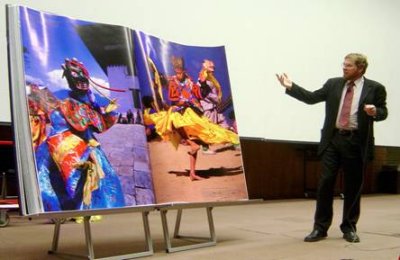
Standing open at 7 foot by 5 foot, is it the world’s largest bound book? The result of Michael Hawley‘s research and field expeditions out of the Media Lab at the Massachusetts Institute of Technology, it is certainly the iMax of books.

Bhutan book presentation
Book Arts Collection, University of Washington Libraries

News coverage:

Compare and contrast:

  • Yale’s Beinecke Library’s double elephant folio of Audubon’s Birds of America.
  • The Marble Books at Kuthodaw and Sandamuni, Mandalay, Myanmar.
Dhammapada Page 1/4, Kuthodaw (1868)
Photographs by Anandajoti Bhikkhu
  • Other forms of large-scale book art can be found here.

Bookmarking Book Art – Ioana Stoian

It took a long look at the development of Ioana Stoian’s work to show me the relationship of trompe l’oeil to book art — and to appreciate how an artist can invent herself.

Stoian’s apprenticeship as an artist began with the decorative arts in 2004 in Lower Normandy, France, and has taken her to New York (MoMA), Cologne, Vienna, Salzburg, Minneapolis, Ostende (Belgium), Kadoide (Japan), Amsterdam (the Stedlijk) and, as of 2015, back to Minneapolis, where she is a Jerome Foundation fellow at the Minnesota Center for the Book Arts.

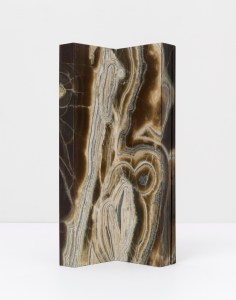
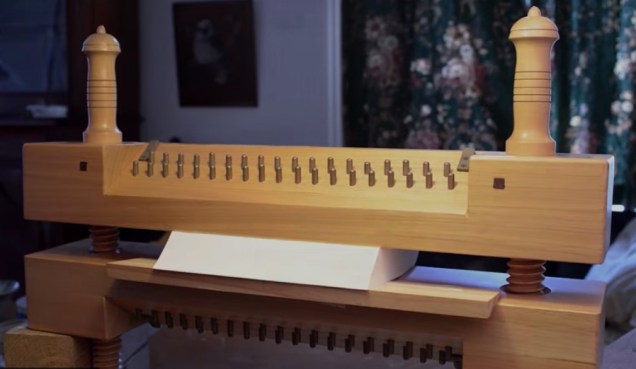
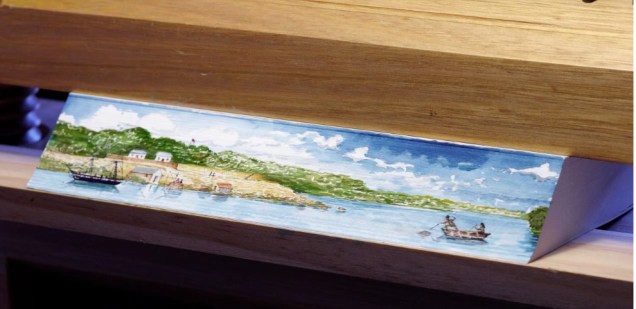
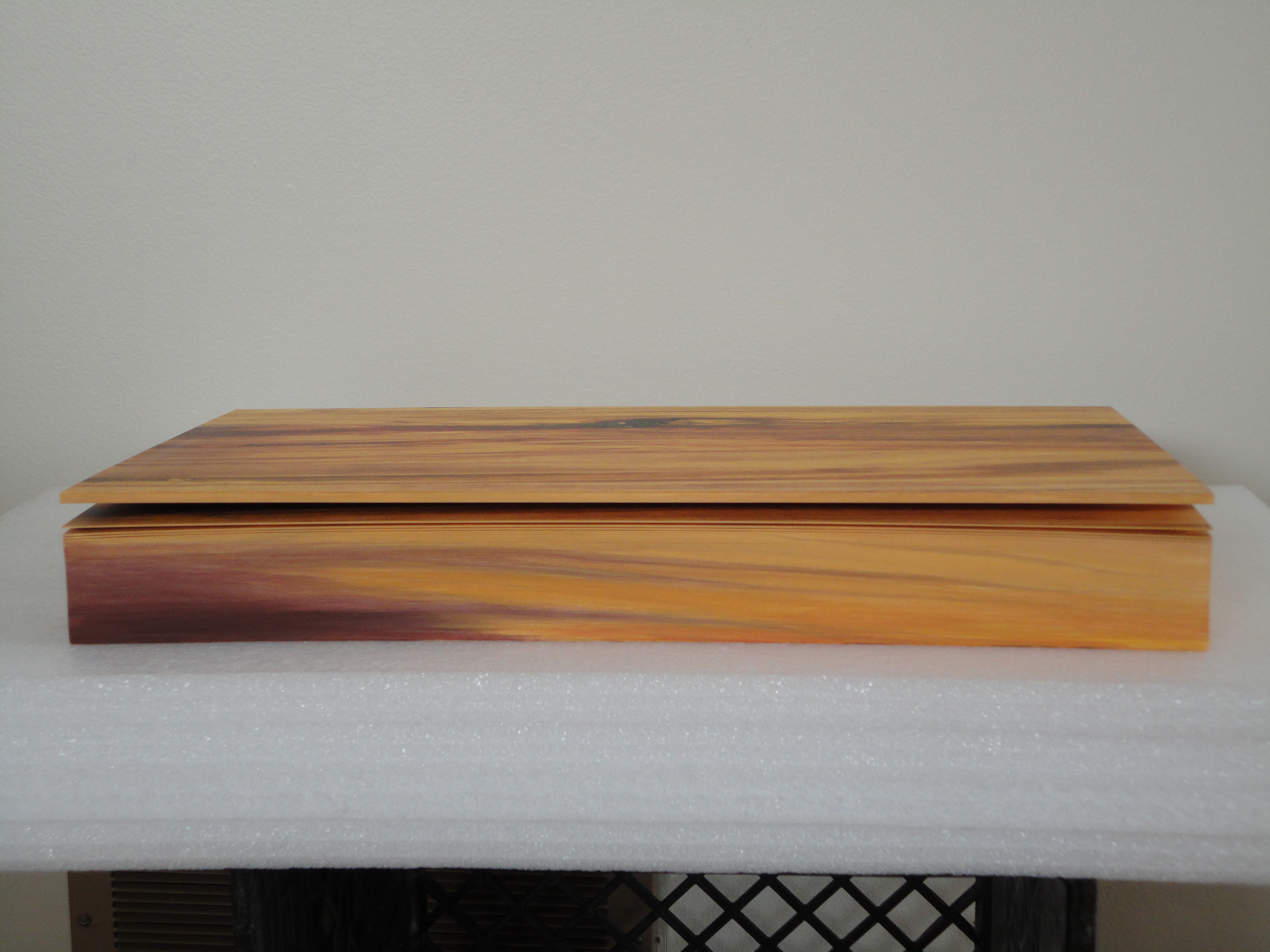
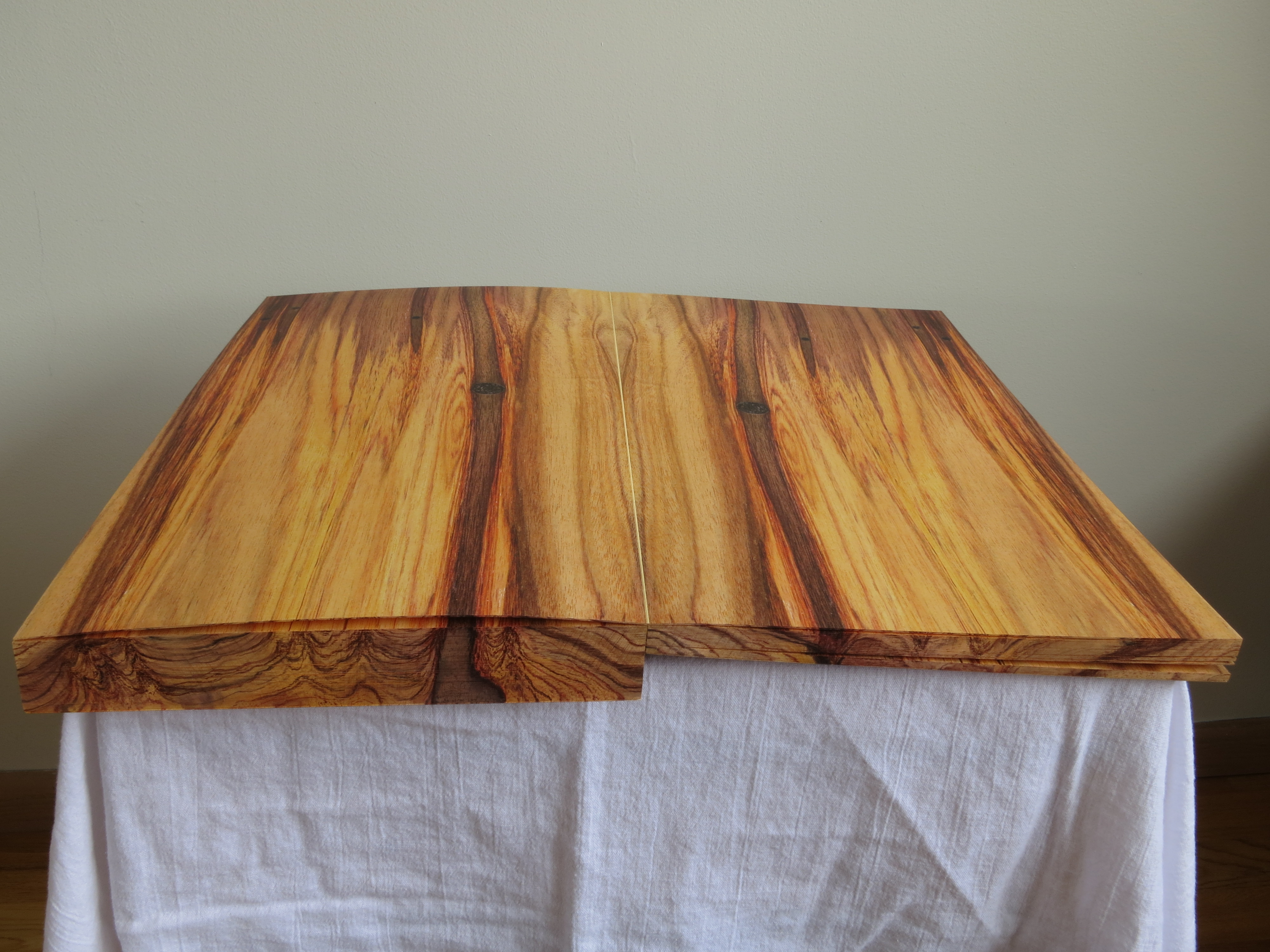
Stoian’s time as an assistant artist with the Scottish painter Lucy McKenzie, starting in 2008, honed her skills in deceiving the eye with faux woodgrain and faux marbling. For example, see McKenzie’s 2008 installation at MoMA, 2009 installation at the Ludwig (Cologne), 2011 installation at the Galerie Buchholz and 2013 installation at the Stedelijk. One may wonder whether Daniel Buchholz’s roots in antiquarian books or the Stedelijk’s in artists’ books prepared the ground for Stoian’s artistic direction toward book art and paper art, but book art and trompe l’oeil joined spectacularly in 2014 when Stoian had the chance to work with Tauba Auerbach in 2014 on the completion of Auerbach’s Wood and Bent Onyx. Stoian handpainted the fore, top and bottom edges of the book blocks in watercolor pencil and paints to match the color and grain of the prints of wood and marble digitally offset on pages of Mohawk superfine paper. As a technique, fore edge painting dates to the 16th century, and the “vanishing” variety, where the painting appears only when the pages are pressed and fanned out, dates to the 17th century. Over time, a standard type of press developed to hold the “canvas” of page edges evenly fanned to accept the painting.

Wood (2011)
Tauba Auerbach
Digital offset printing, Mohawk superfine paper, 55 pages,
hand painted edges 
closed: 43.2 x 24.1 x 5.1 cm
© Tauba Auerbach. Courtesy Paula Cooper Gallery, New York.
Photo: Steve Probert
Bent Onyx (2012)
Tauba Auerbach
Digital offset printing, Mohawk superfine paper, Japanese tissue,
hand painted edges
closed: 43.2 x 16.5 x 16.5 cm
© Tauba Auerbach. Courtesy Paula Cooper Gallery, New York.
Photo: Steven Probert.
Still from “Fantastically Fast Fore-edge Painting by Stephen Bowers
Friends of the State Library of Australia
18 February 2013
Stephen Bowers’ fore-edge painting on a copy of A Narrative of a Survey of the Inter-tropical and Western Coasts of Australia by Phillip Parker King, son of the third governor of New South Wales
Still from “Fantastically Fast Fore-edge Painting by Stephen Bowers
Friends of the State Library of Australia, 18 February 2013

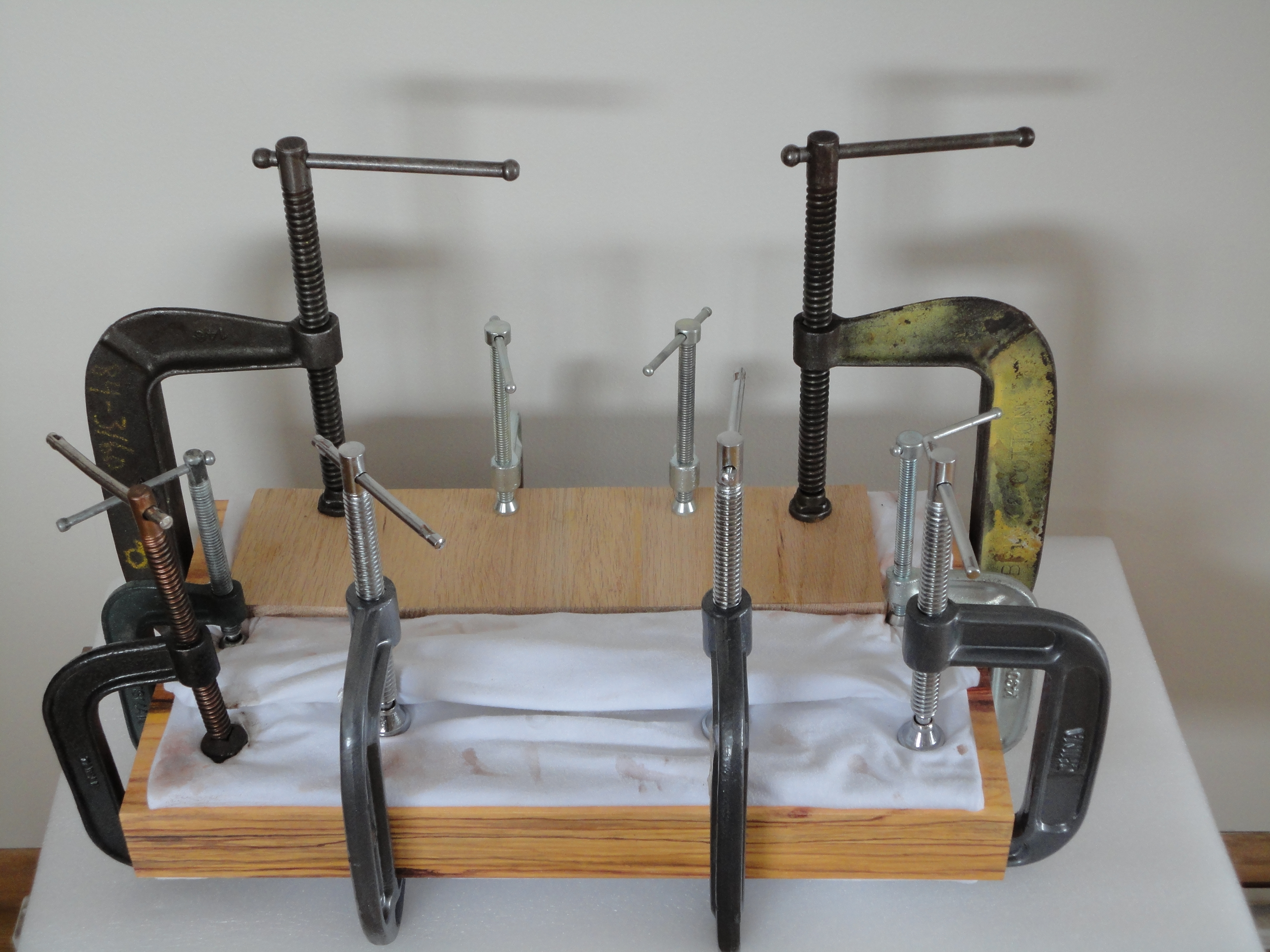
Despite this established history of fore-edge painting, Stoian had to fall back on a mastery and technique that come from her apprenticeship work, inventiveness and meticulousness. These books were very heavy and the pages were very thick …. There was absolutely no way to fan the pages.  I went through the book, page by page, and made marks of where the wood/ marble veins were located.

Before Stoian started work on Wood

Then I clamped the book so that water wouldn’t seep in and using my ‘map’, I recreated the wood/ marble. As you can imagine, it was challenging to match the inside spreads. I had to constantly unclamp, verify that I was matching the spreads, re-clamp, paint, wait…

I used both watercolour pencils and paints. Needless to say, it’s very hard to erase watercolour without using lots of water and saturating the page. I had to be careful with every single brush stroke I made.  

Finished

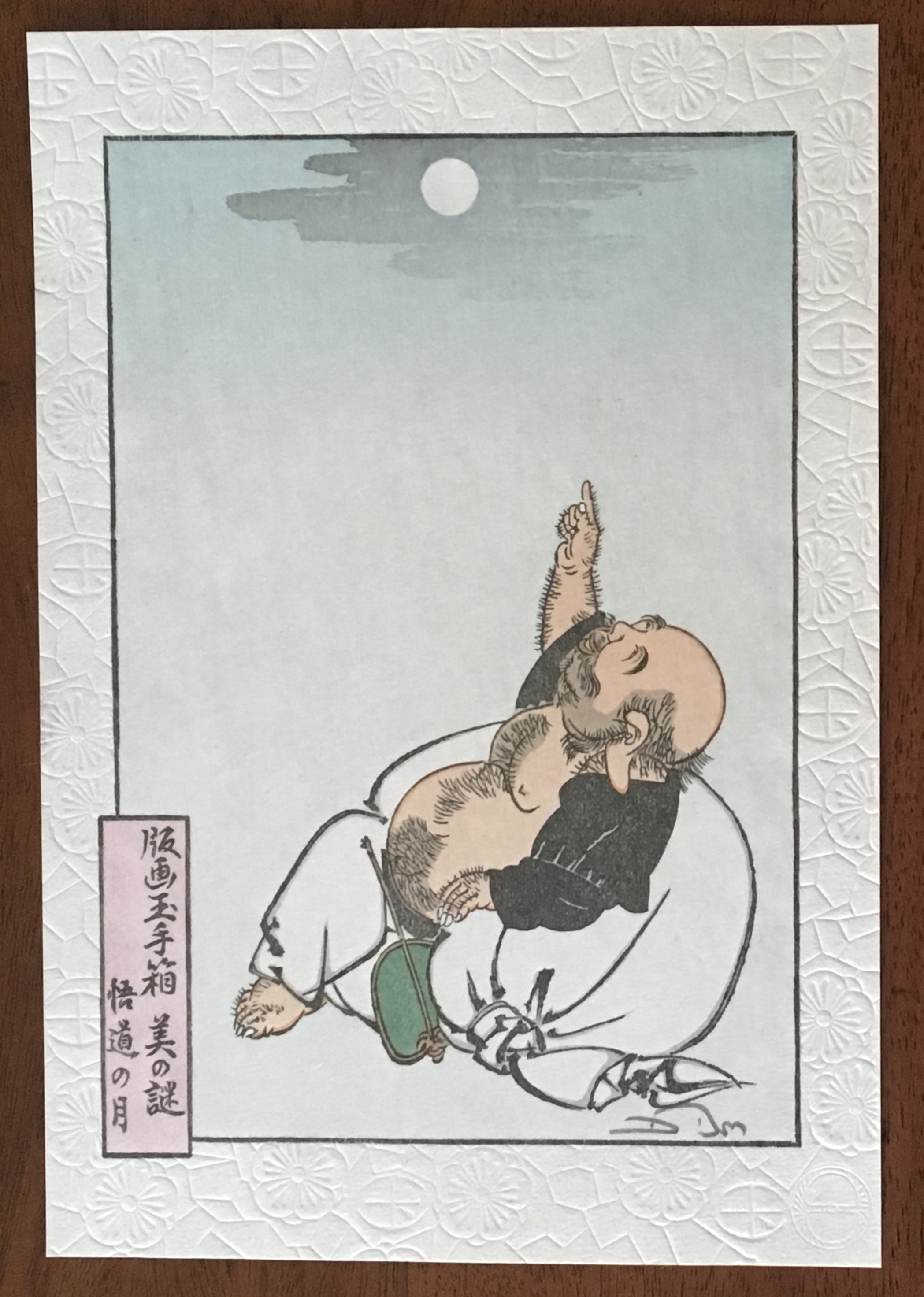
There is something Zen-like about trompe l’oeil in the attentiveness to detail, to material, to execution.  But there is more. To mangle a Zen saying:  Trompe l’oeil is more than a pointing at the moon; those who gaze only at the pointing will never see beyond — never see the beauty of the moon, never see the beauty of the pointing. With the best of trompe l’oeil, that moment in which the eye is fooled recurs again and again for the attentive viewer. In its recurrence, the work of art alternates between the self-referential (the mind drawn to the pointing) and the mimetic (the mind drawn to the pointed at).

Moon of Enlightenment (2010)
David Bull
From a design by Tsukioka Yoshitoshi (1839-92) in his series “One Hundred Aspects of the Moon”.
The Zen saying is “All instruction is but a finger pointing to the moon; and those whose gaze is fixed upon the pointer will never see beyond. Even let him catch sight of the moon, and still he cannot see its beauty.”

So it is not surprising that Stoian has “always been interested in Japanese art and culture”. As early as 2008, origami appears in her commercial decorative work. She is the author of two books: Origami for All with her partner Eric Gjerde (2013) and The Origami Garden (2016). In reviewing both books for The Fold , Jane Rosemarin commented:

… as I paged through her first book, “Origami for All,” I eventually began to understand that Stoian is an artist who has chosen origami as her medium. Her work is not hard to fold, but it has a consistency of style and a real beauty.

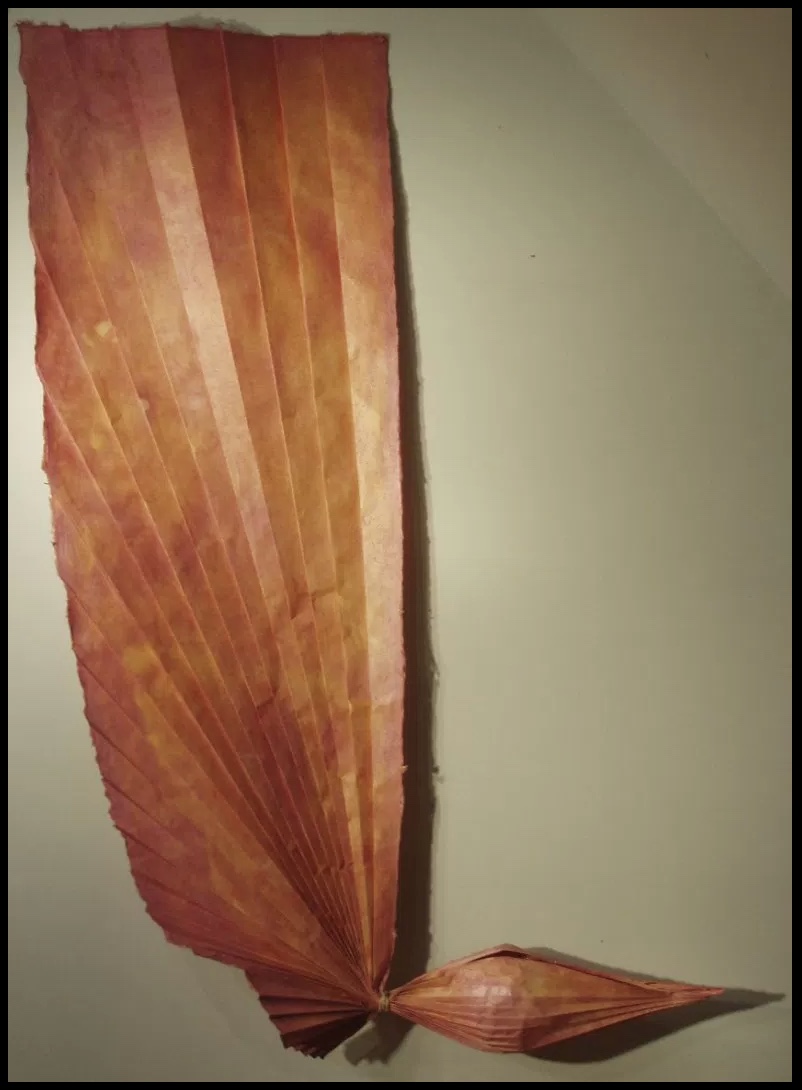
Recognized not only for their origami, Stoian and Gjerde were invited in 2013 to exhibit their paper art at the prestigious Salon des Artisans et Métiers d’Art, held at La Propriété Caillebotte in the village of Yerres outside Paris. While Gjerde’s folds explicitly explore the mathematical (for example, Voronoi tessellations and hyperbolic paraboloids), Stoian’s explore shapes more suggestive of the oriental: cranes and flowers as in Strelizia (2010).

Strelizia (2010)
Ioana Stoian
Pigment on handmade flax and abaca paper
165cm x 59cm
Strelizia (Strelitzia reginae) is a South African plant, known as the “bird of paradise” or “crane” flower.

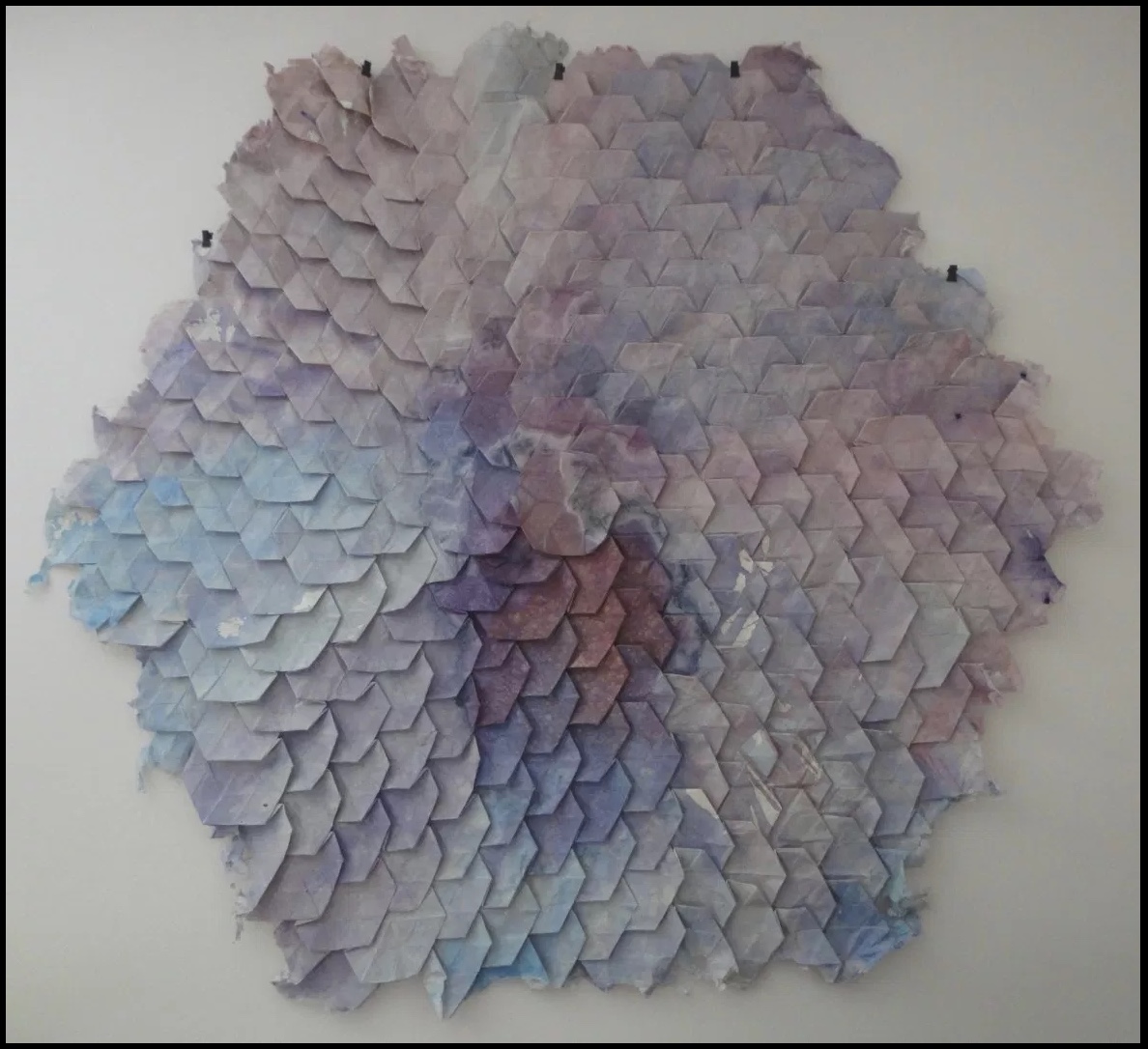
Where Gjerde’s interest in his material has led him to bio-art (paper grown from bacterial cellulose), Stoian’s has hewed to traditional papermaking, which figures consistently in her work: for example, Hidden Within (2010). In 2012, that interest in traditional

Hidden Within (2010)
Ioana Stoian
Hand-made flax and abaca paper
1.3m x 1.3m

western papermaking had turned eastward:

After discovering western papermaking, I became fascinated with thin, strong sheets, which obviously led me to washi – the Japanese paper made from mulberry. I naturally had the desire to go to Japan and see how this paper was made.

It so happens that a friend of mine, Tomoko Fuse (a very talented and well-known female origami artist and perhaps the most published origami author in the world), was at a paper folding event in France. I casually mentioned that I wanted to go to Japan to learn papermaking. Next thing I know, she had very kindly organised for me to spend a month with Yasuo Kobayashi, master paper maker and owner of Kadoide Washi – an offer I could not refuse.

I spent a magical month in the mountains, during the Kozo harvest (December) and had an amazing time learning from a great master.

Yasuo Kobayashi is a fifth-generation papermaker but also a writer and philosopher, whose unique views on papermaking warranted his inclusion in the American Folklore Society’s sponsored report on apprenticeship and papermaking. Yasuo Kobayashi told the report’s author, Aimee Lee: “I wanted the kozo to tell me what kind of paper it wants to become, not to force it to be what I want. This is not typical for papermakers. I want kozo to be my teacher.” When asked to elaborate,

… Kobayashi compared bunka (culture) and bunmei (civilization). “Bunka is what you think from your heart.” In contrast, bunmei’s goal is to develop constantly, exemplified by the western desire for progress: people do not want today and tomorrow to be the same—they want things to be less difficult and more convenient. This mindset cannot translate to making real paper. His grandfather’s and father’s lives were not very different. His father’s and his lives were a little different. But his son’s and his lives are so different that it is hard to relate across that rift. He sees two roots for the future of paper: growers and makers. Real kozo goes with the heart but is inconvenient and does not follow progress. Kigami [paper] comes from the root “to be born,” and this word also relates to breathing. When born, paper is like a child: weak, but growing stronger over time until it dies. He knows that his point of view is rare, but also said people must balance bunka and bunmei, rather than to go absolutely one way or another. Today, the balance is too heavy on the professional side, so he tries to balance this by leaning towards the growing side.

Stoian’s jump at the chance to learn from him is consonant with her “journeyman’s” approach to her artistic development. Note that the visit to Kadoide Washi precedes the work on Wood and Bent Onyx for Tauba Auerbach in 2014. The methodical diligence required in making washi and the resulting appreciation of the properties of paper re-present themselves in Stoian’s mapping of the grain and perceiving what the works and the paper “wanted”. The impressive fore-edge work with Wood and Bent Onyx now seems inevitable, rising from a combination of technique and deep appreciation of color, material, form and structure in the service of illusion. In her own work, Stoian strives toward bunka, which is evident in works like Strelizia and Hidden Within, where the form and color her handmade paper takes combine to convey feeling — or “heart” as Kobayashi might put it. Her aim has become even clearer during the Jerome Foundation stage of her “journeyman’s” journey.

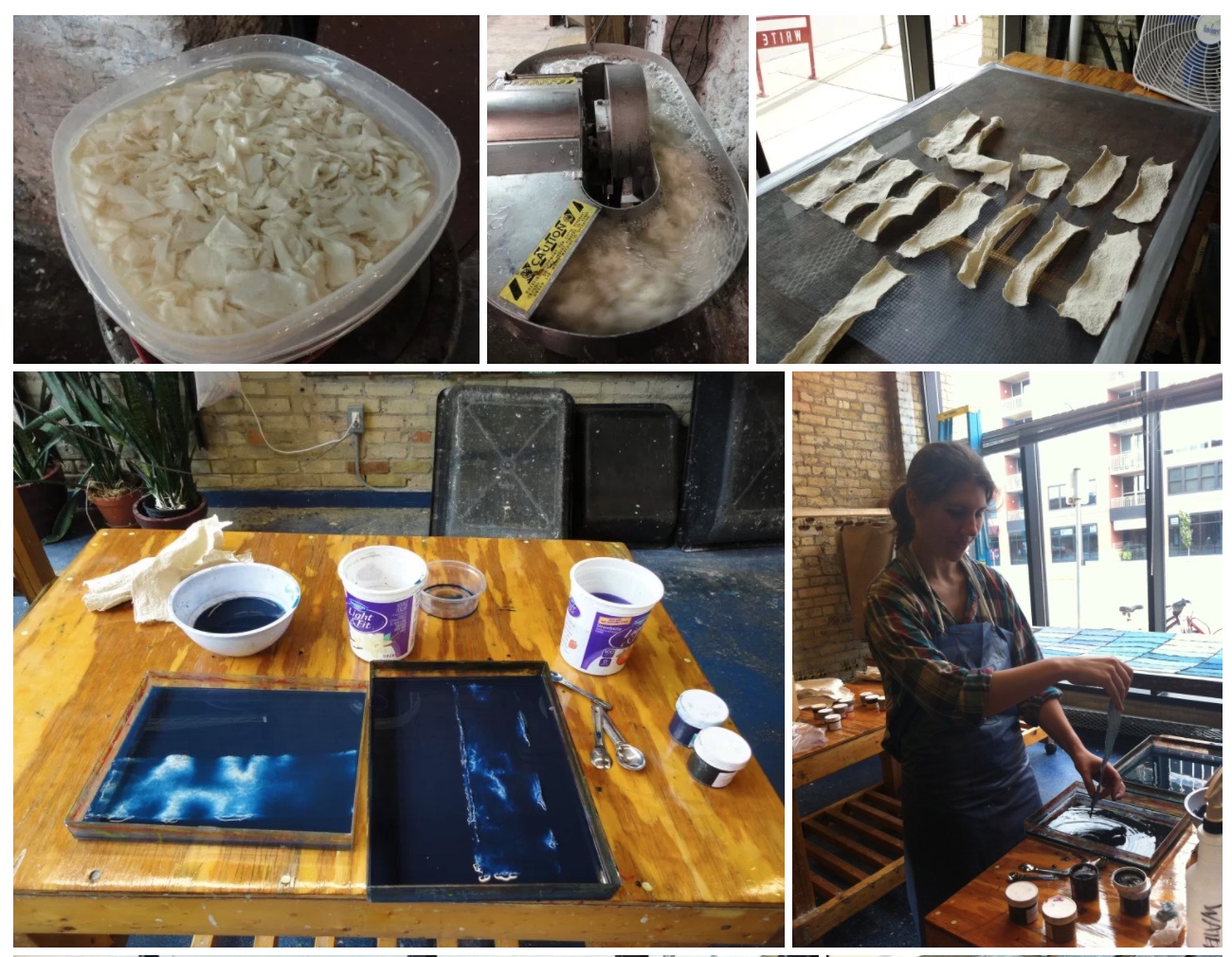
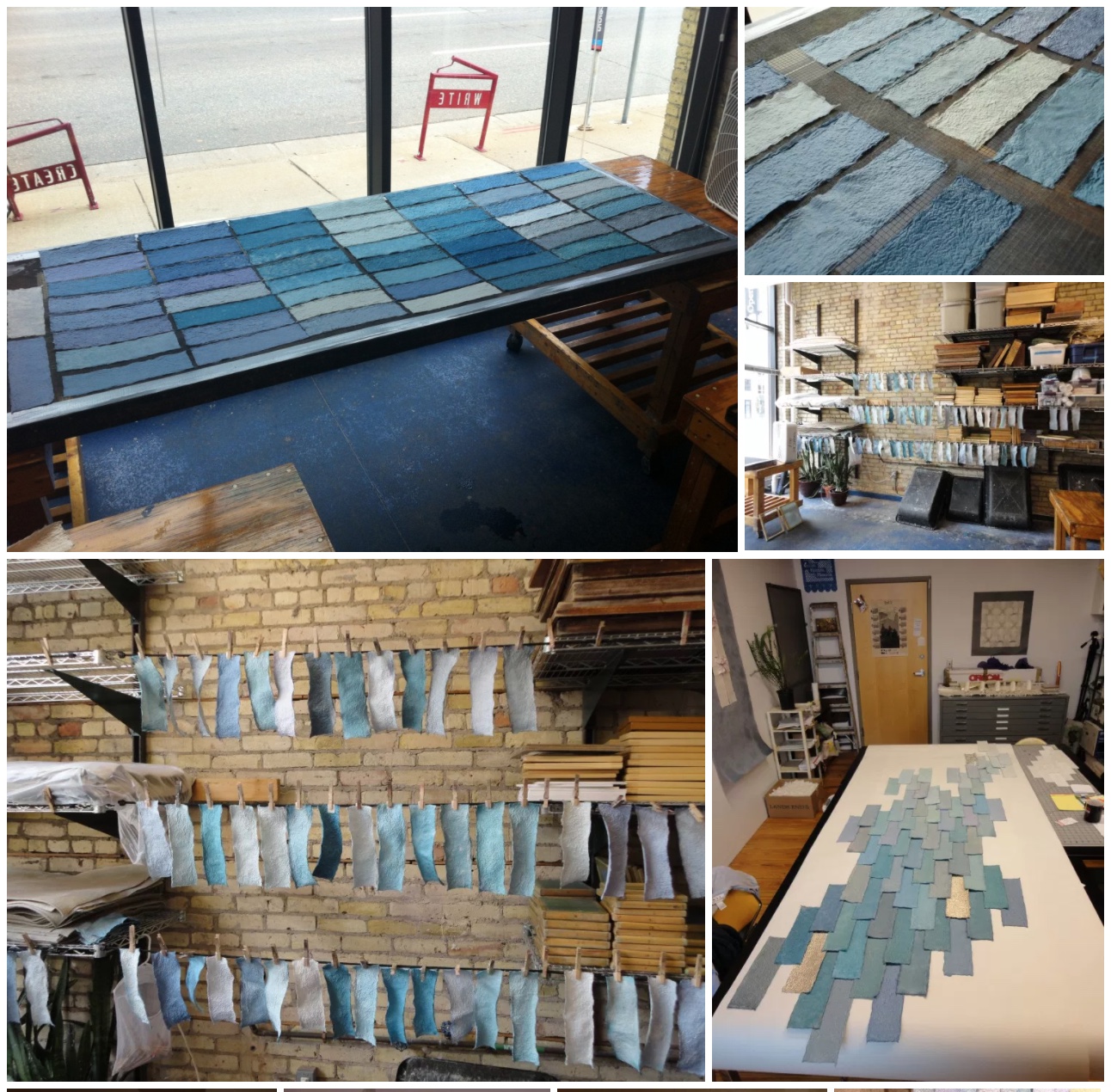
Stoian received the Jerome Foundation Mentorship grant for 2014/15 at the Minnesota Center for Book Arts to create an artist book — an extraordinary artist book. The mentorship program  offers emerging artists the resources to create a book, fusing together newly acquired skills with aspects of their own artistic practice. The grant provided one year of 24-hour access to the Center’s facilities, a mentor, and a series of introductory workshops on paper making, letterpress printing, and book binding.

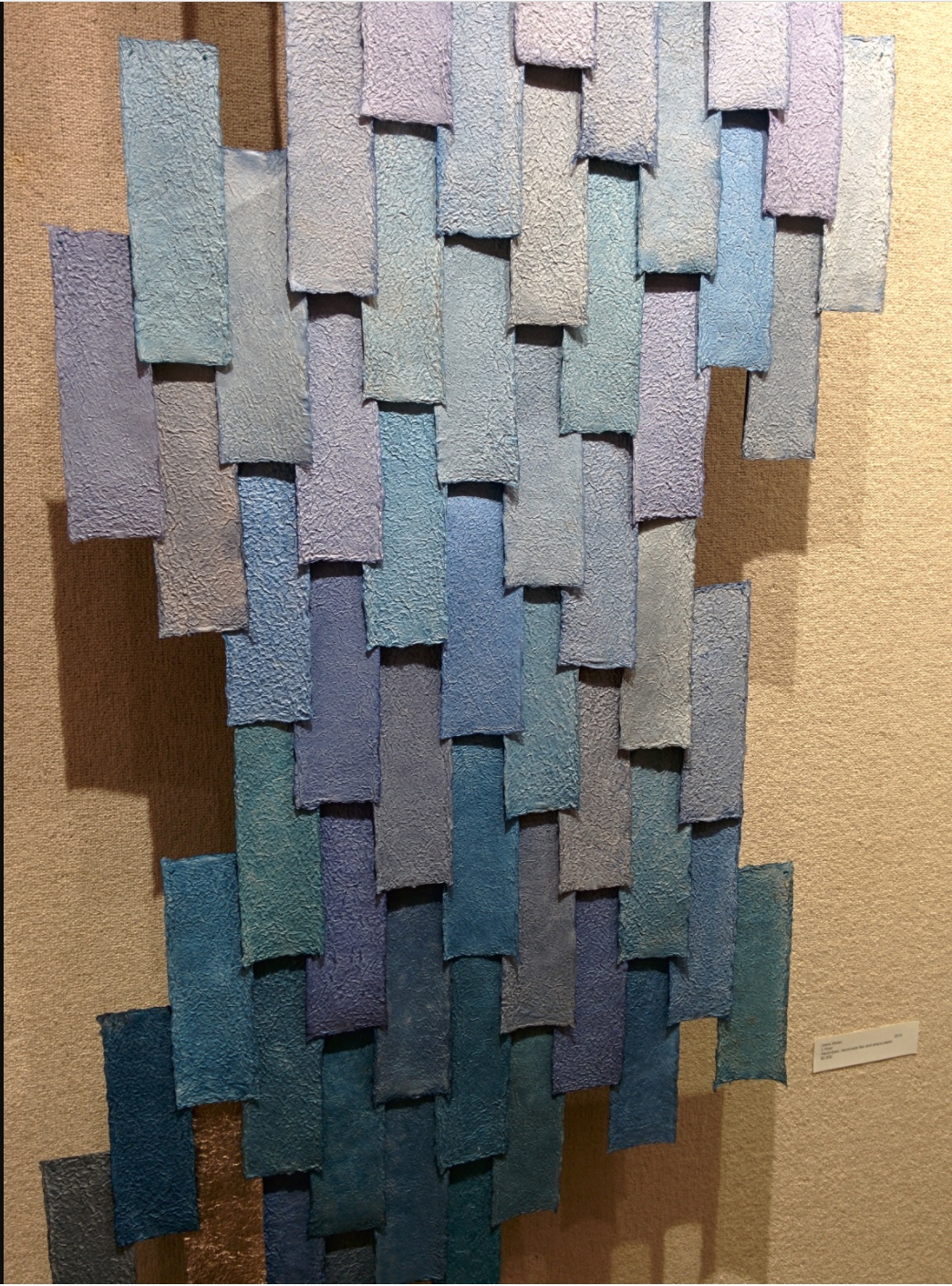
Responding to her new wintry environment, Stoian embarked on l’hiver (2014), a new work consisting of 80+ individually hand-made and dyed pieces of paper. L’hiver is reminiscent of Hidden Within (2010) in its pursuit of a harmony of color, structure, and form. The former is perhaps more open than the latter and lets each part’s snowflake-like uniqueness assert itself.

l’hiver (2104)
Ioana Stoian
Hand dyed, handmade flax and abaca paper
3m x 1m

The congruence and continuity of those two works do nothing to prepare the viewer for Nous Sommes (2015), the artist’s book that follows them. While Nous Sommes continues Stoian’s aim of harmony among color, structure and form, while its intensity of colors harks back to the stencil work for Lucy McKenzie’s Stedelijk exhibition in 2013, the structure and form Stoian chose marks a bold departure.

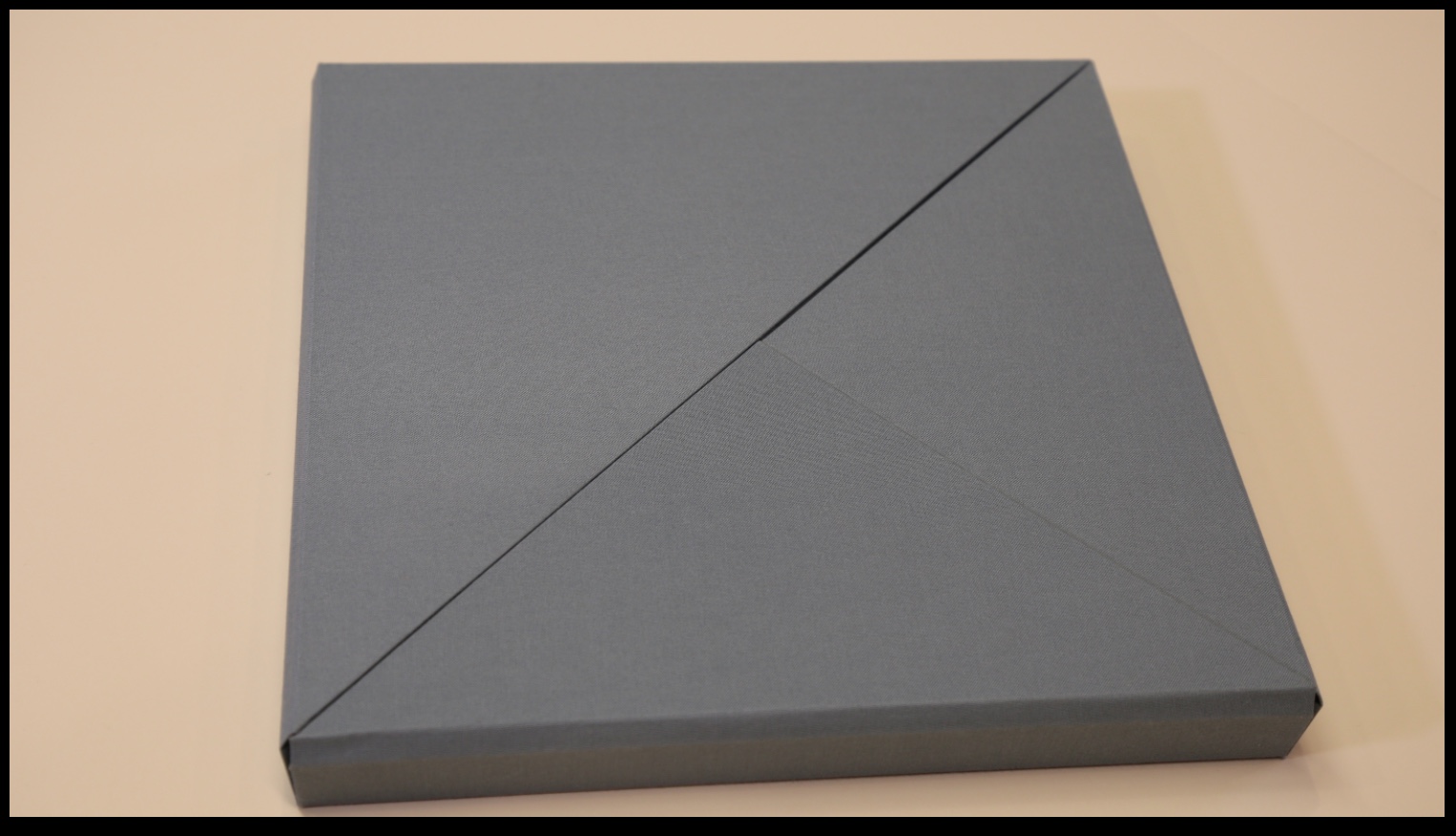
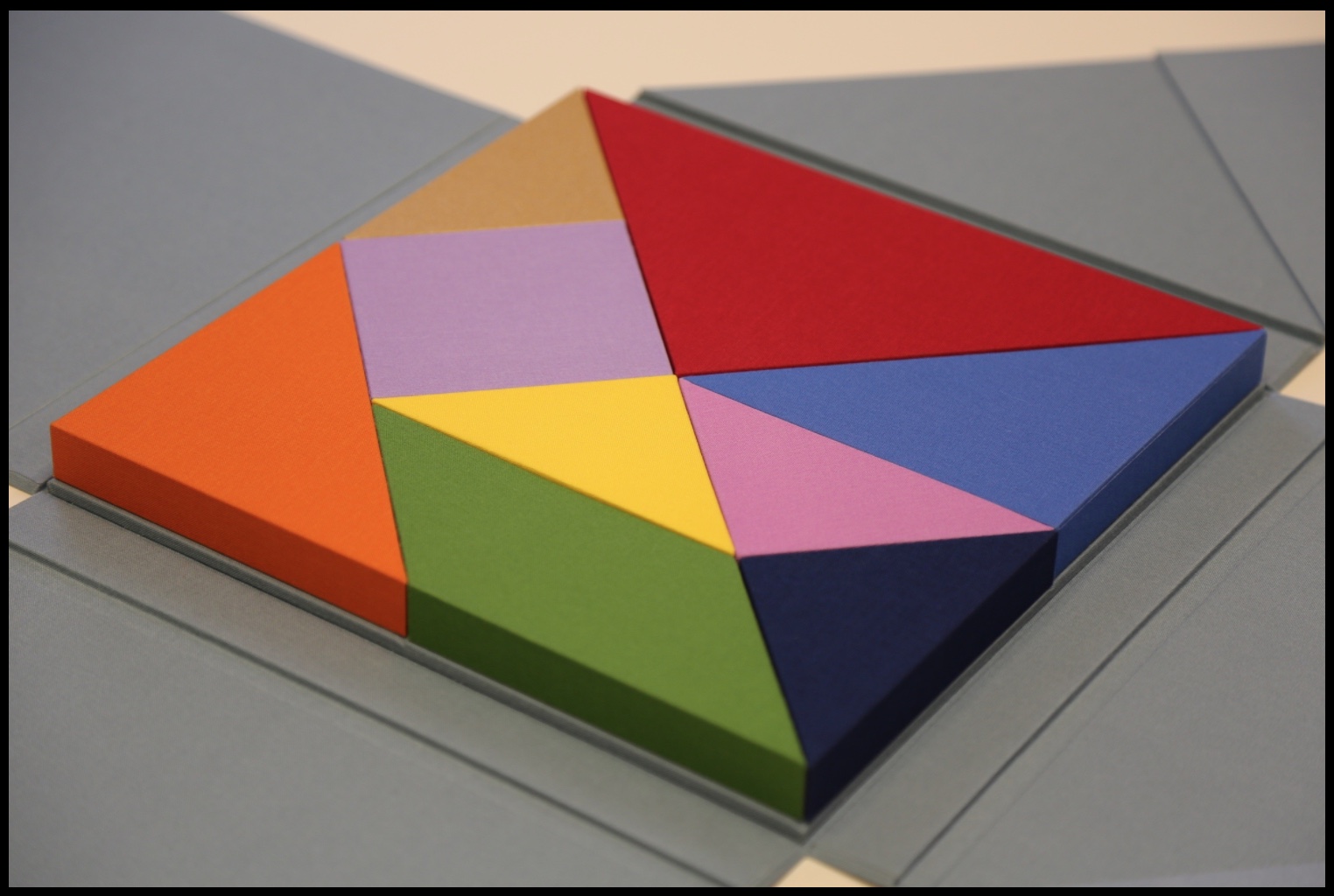
The cover and binding of Nous Sommes has the feel of a Solander box.  The book opens in a particular order of lifting the triangular flaps, one of which displays the “Table of Contents” and another the colophon. 

Nous Sommes (2015)
Ioana Stoian

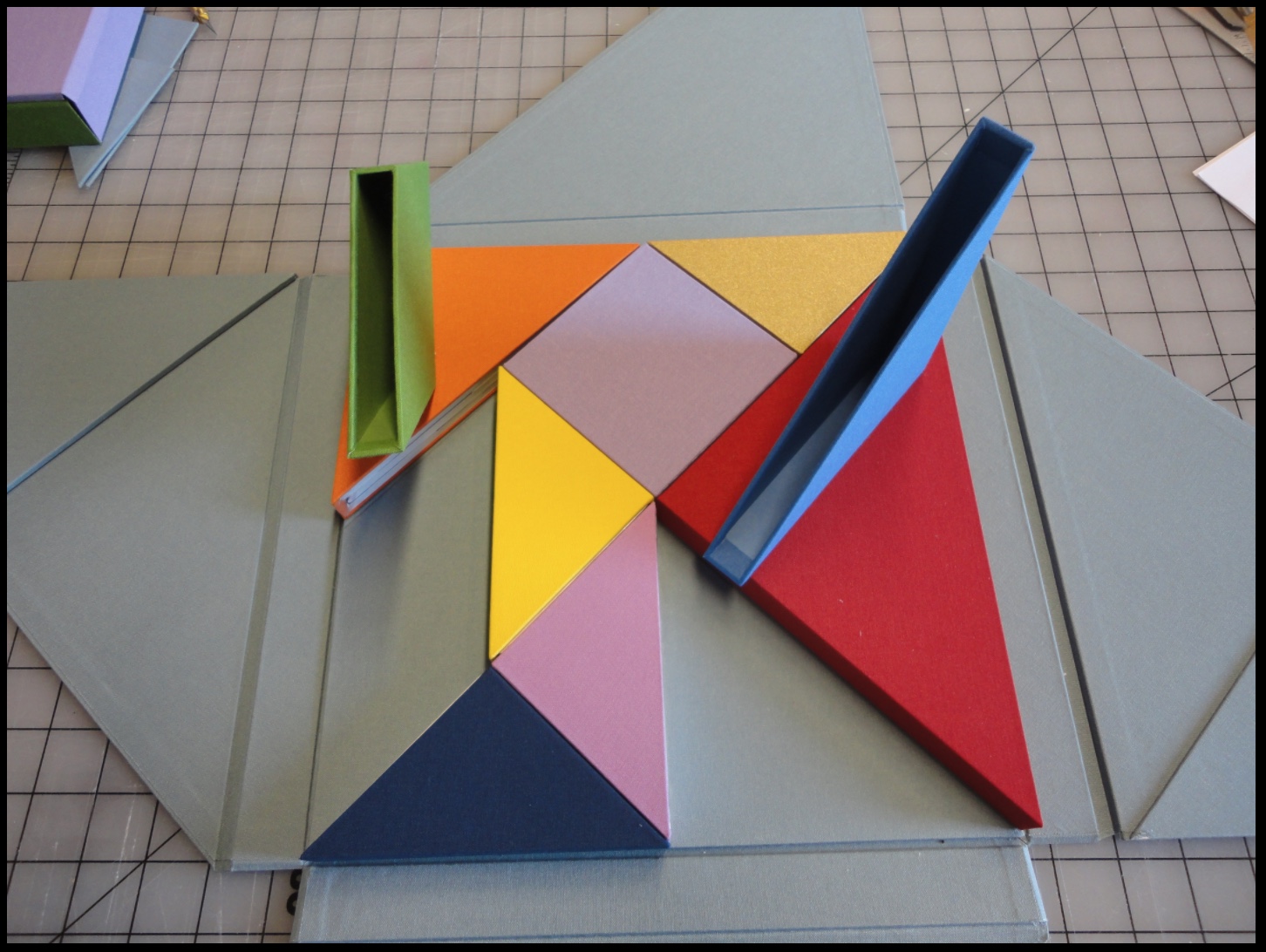
Nous Sommes has nine “chapters” or differently sized, shaped and colored slipcases whose material matches that of the cover and binding. The chapters fit precisely together (tangram-like), but the order of their reading lies with the reader’s choice of color, shape or size. The video provided by Stoian and Gjerde offers one of many readings of the work.

Nous Sommes (2015)
Ioana Stoian
Empty “chapters”
Nous Sommes (2015)
Ioana Stoian

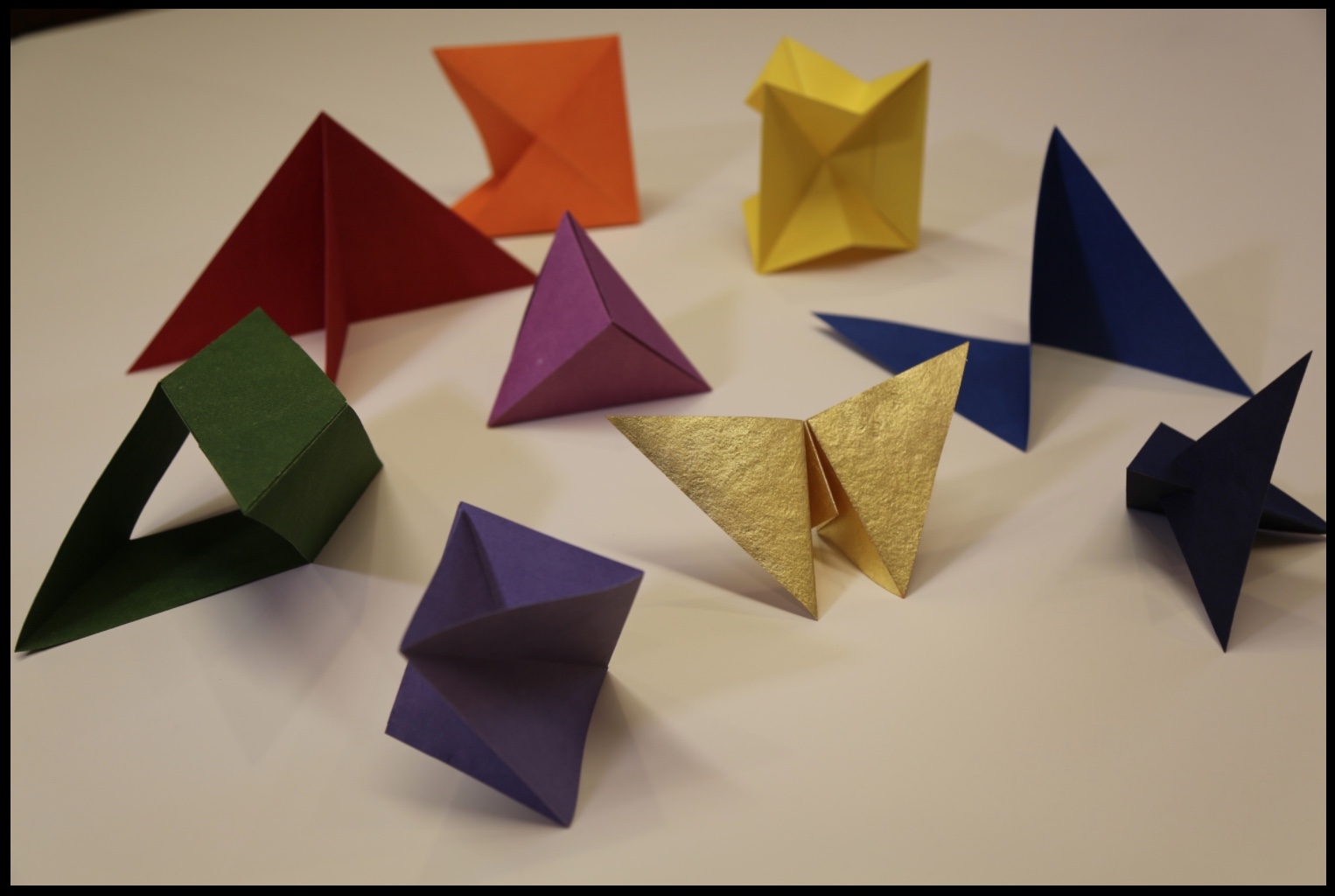
Within each chapter is a precisely fitted paper structure to be “read” by unfolding, positioning, displaying, contemplating and, in conclusion, returning it to its chapter/slipcase.

“Contents” of nine chapters/slipcases
Nous Sommes (2015)
Ioana Stoian 

Commenting on Strelizia, shown earlier, Stoian writes,

I am interested in intuitive color experiments; this work represents the flow from mood to colour, with the final form of the paper manifesting itself from these captured emotions.

In Kandinsky’s footsteps, perhaps, this artist finds and aims to offer the spiritual in art. The title Nous Sommes suggests so. Whether the expression “we are” applies to the art object (self-referentially) or to its audience (individually or collectively), form, structure and colors assert community, inclusion and a fitting together. 

We can look forward to Stoian’s next chapter as she has received a follow-on appointment from the Minnesota Center for the Book Arts: the 2017/18 Jerome Foundation Fellowship.

Bookmarking Book Art – Eric Gjerde

Specimens, 2016 Close-up of finished pressed page. Laser cut text pressed within 5 layers of bio-paper to form one large single sheet. © Eric Gjerde
Specimens, 2016
Close-up of finished pressed page. Laser cut text pressed within 5 layers of bio-paper to form one large single sheet.
© Eric Gjerde

Specimens is the first of its kind: a book created with a new bio-paper medium made entirely from bacterial cellulose. Its pages were once alive.

The quality of this new paper, which I developed over the past seven years, is its unparalleled strength and transparency. Each sheet is grown in a vat and harvested after several weeks. After processing, many layers — five or more — are laid on top of one another with the text block carefully placed within. Then the entire stack is pressed. The act of pressing these sheets is what gives them their strength.

Trapped forever within the thin lamina of Specimens’ pages is the poetry of e.e. cummings. The challenge of retaining the poet’s complex typographic wordplay required a new approach for placing text. Drawing upon my fascination with Voronoi tessellations — the natural pattern of cell structures in all living things — I created custom software to generate a Voronoi framework that would hold the text in place. The text block was then laser-cut from Korean hanji.

I would like to thank the Jerome Foundation and Minnesota Center for Book Arts for the opportunity and support to explore this exciting new medium. (Artist’s statement)

Gjerde’s Specimens exhibition — November 2016 through February 2017 —  continues in the new tradition of bio art.  One of the earliest and abiding proponents has been George Gessert. Since the 1980s, Gessert and artists/theorists such as Suzanne Anker, Eduardo Kac, Marta De Menezes, the Harrisons and Sonya Rapoport have constituted the bio art and eco art movements.  A collection of his essays appeared as Green Light: Toward an Art of Evolution in the Leonardo Book Series, published by The MIT Press in 2010.

More recently Dr. Simon F. Park’s  The Origin of Species was touted as  perhaps “the first book to be grown and produced using just bacteria”. Presented at the Edinburgh International Science Festival, the small book has pages made of bacterial cellulose, produced by the bacterium Gluconoacetobacter xylinus (GXCELL). Its cover is even printed with naturally pigmented bacteria.

Artist: Dr. Simon F Park The Origin of Species "The small book shown here was grown from and made entirely from bacteria. Not only is the fabric of its pages (GXCELL) produced by bacteria, but the book is also printed and illustrated with naturally pigmented bacteria. " Posted 27 March 2016 Photo credit: Dr. Simon F. Park
The Origin of Species
Posted 27 March 2016
Photo credit: Dr. Simon F. Park

The process underlying Gjerde’s work and its material inspiration — the bio-paper, e.e.cummings’ poetry, Voronoi tessellations and the software-driven Voronoi framework to hold the text block in place — are beautifully explored on his site.

The Voronoi framework is evocative of traditional papermaking technology. Here instead of the “deckle” — the wooden frame holding the mesh on which fibers are caught up from the soupy mash to form a sheet of paper — the Voronoi framework holds the text block between the laminations of the bio-paper.

The union of concept, process and the quality of the work make Specimens an outstanding work.

Bookmarking Book Art – Wilber Schilling

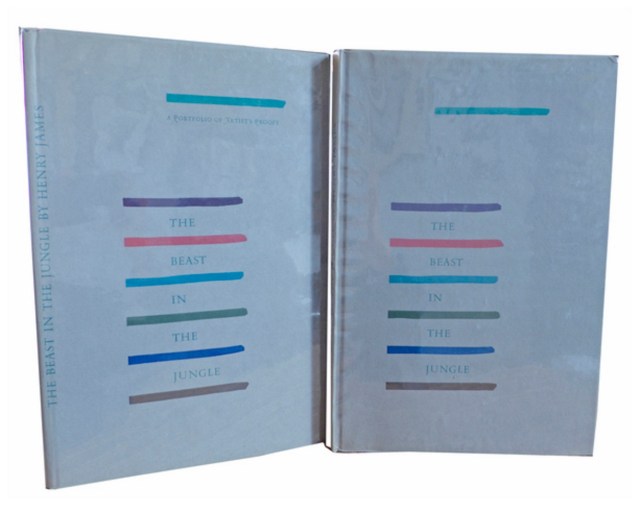
Henry James, The Beast in the Jungle, 1903. Allen Press, 1963. The copy shown is one of only 15 copies with an extra suite of 16 artist’s proofs, each titled, numbered 9/15 and signed by the artist in a separate portfolio.  Displayed online at Sophie Schneideman – Rare Books and Prints.

In his Books and Vines essays, Chris T. Adamson provides fresh, personal and insightful comments on fine book productions and their content such as Henry James’ “The Beast in the Jungle” from the Lewis and Dorothy Allen Press in 1963, pictured above.  An oenophile, as the title of his series suggests, Adamson also occasionally offers tips on the best wines with which to decant and read these works.

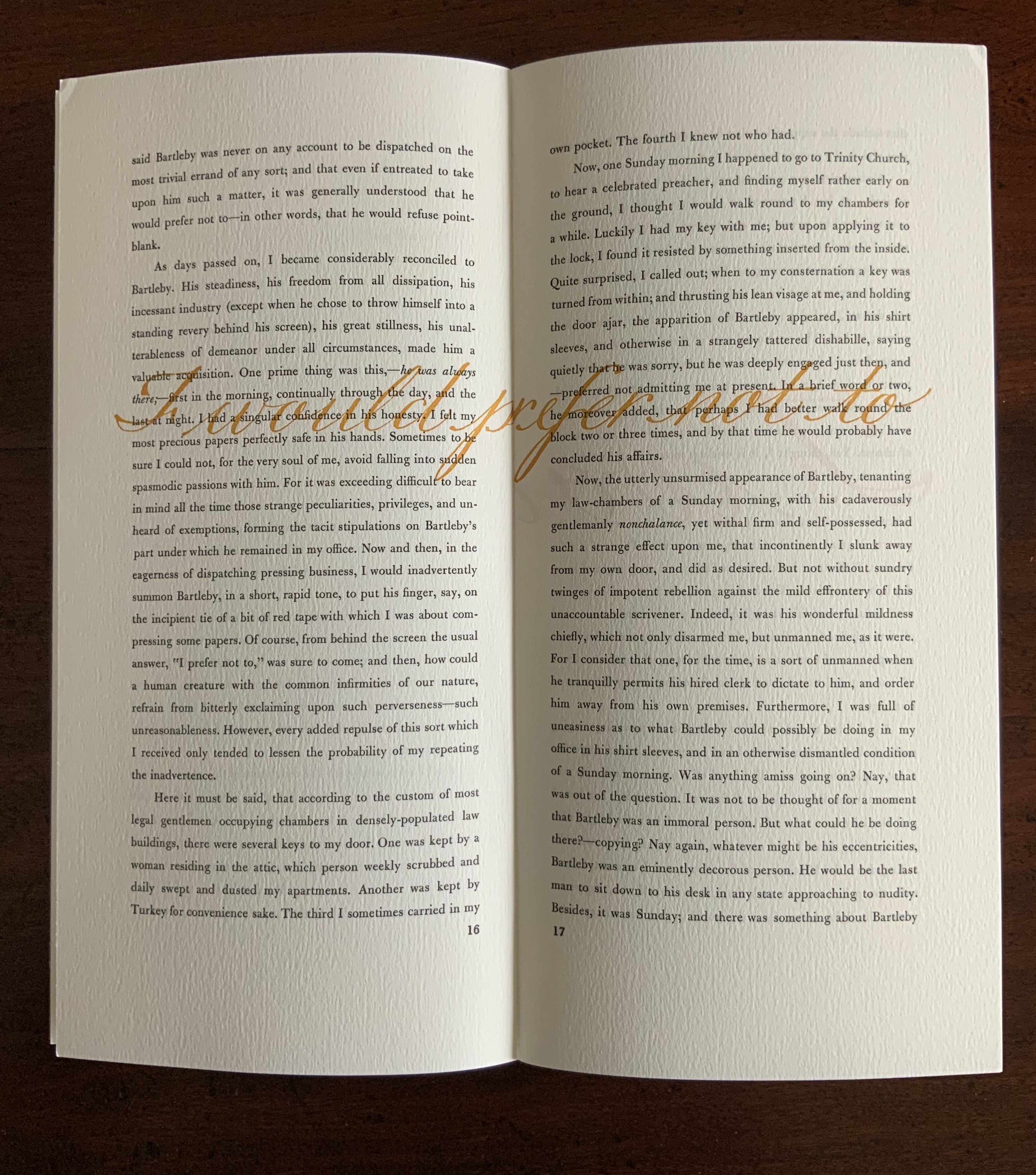
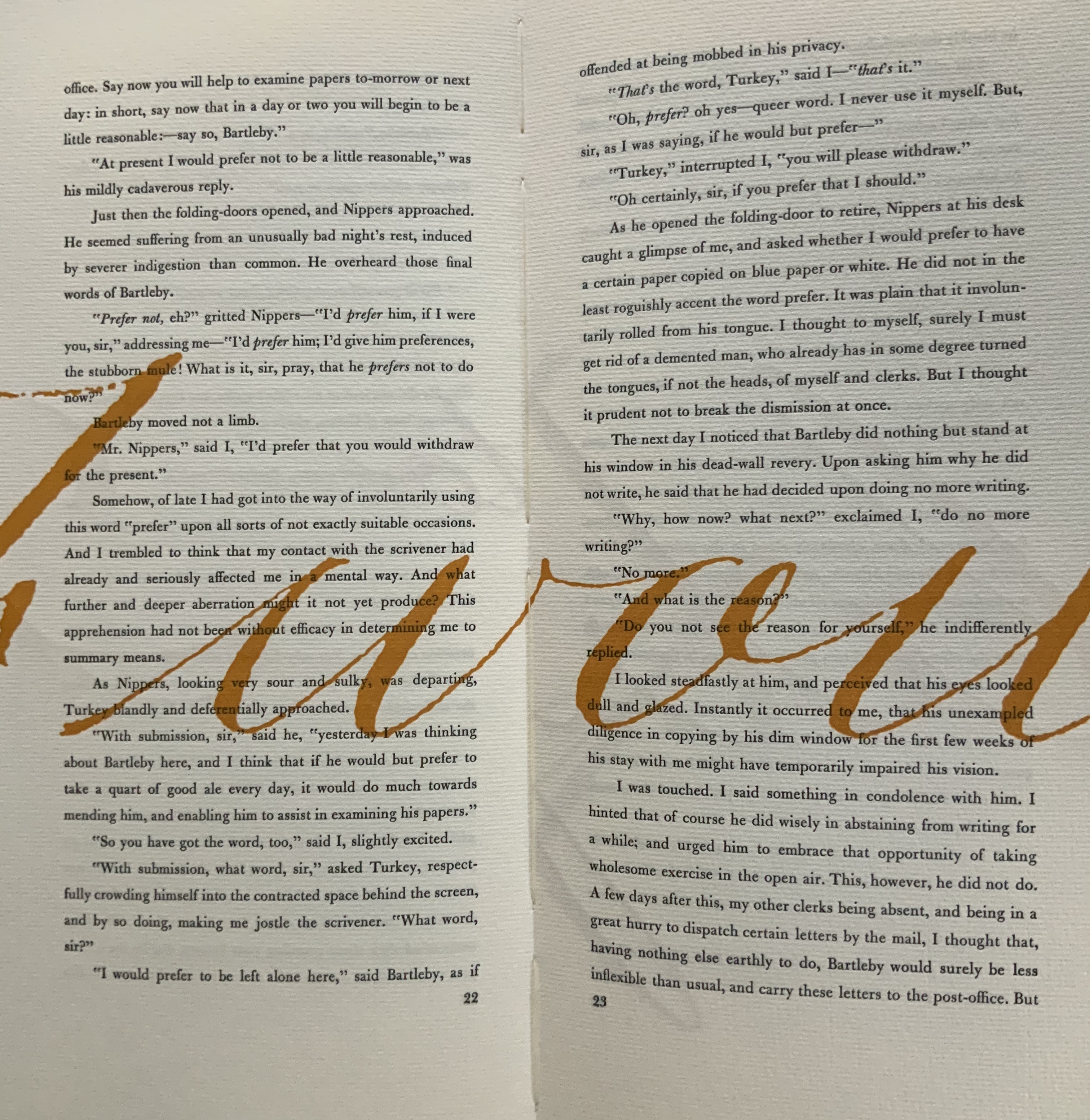
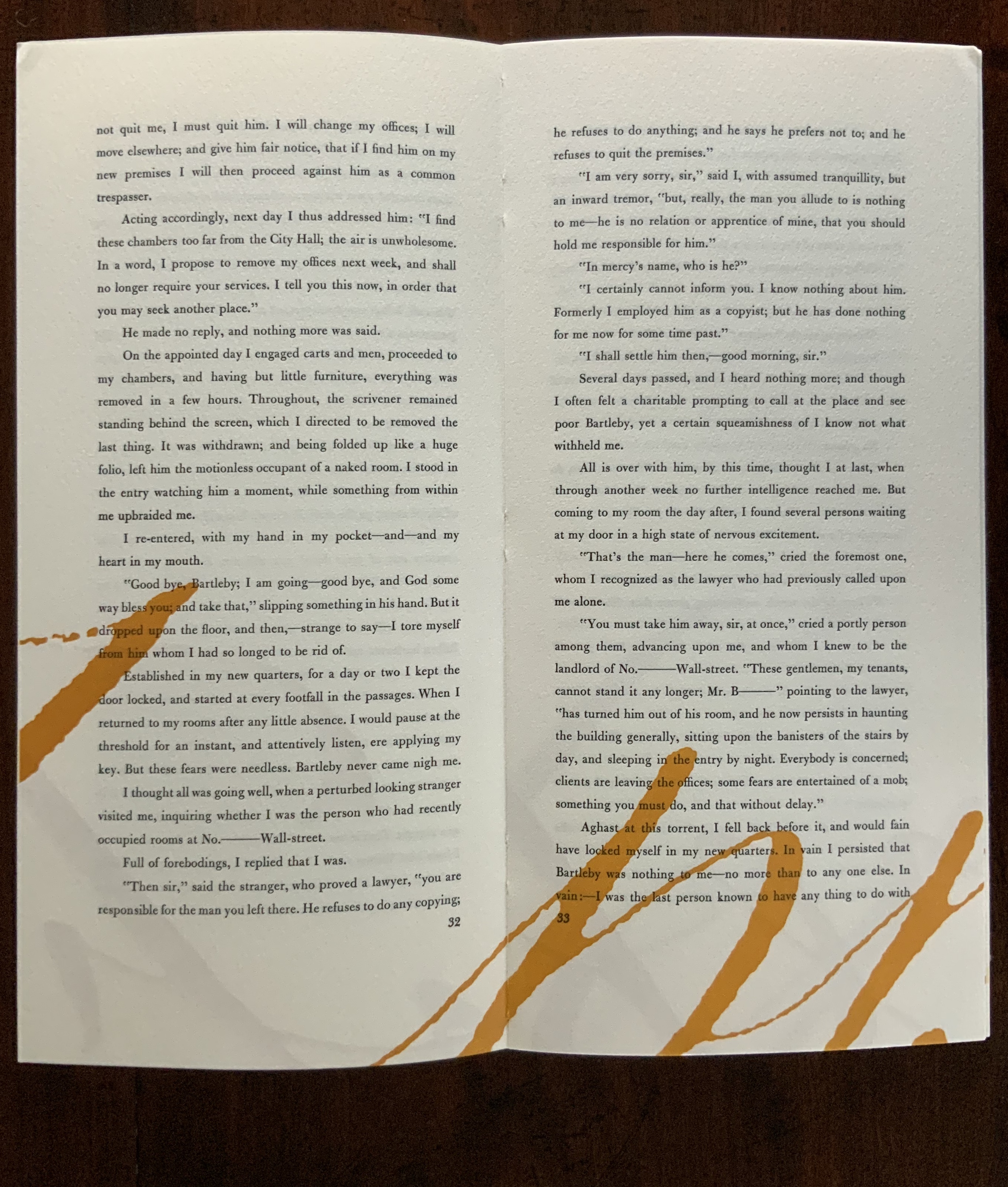
James is a favorite author at Books On Books as is Herman Melville. Indulge the punning coincidence of Adamson’s introducing us to Wilber Schilling’s Indulgence Press and his edition of Melville’s “Bartleby the Scrivener: A Story of Wall Street“.  Schilling’s edition of “Bartleby” – with Suzanne Moore’s original hand lettering of Bartleby’s classic statement “I would prefer not to” first appearing fully legible then becoming larger until it literally falls off the bottom of the final page – was an early career statement of an interest in more than fine press work but in book art as well.

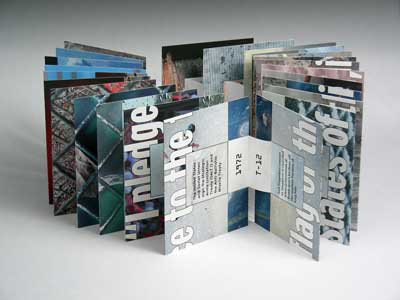
Consider Schilling’s Half-Life/Full-Life and its binding a variation on the accordion/flag structure of Hedi Kyle and Claire Van Vliet.  The complexity of the form marries well with that of the intertwining, interleaving text and photos along the timelines of the Doomsday Clock and global warming.

Half Life/Full Life Wilber Schilling, 2009 ISBN: 0-9742191-5-0 Cover
Half Life/Full Life
Wilber Schilling, 2009
ISBN: 0-9742191-5-0
Cover

Schilling’s photography in Half Life/Full Life speaks to the importance of that craft in his overall portfolio. His photos of aging, decayed and unbound books are haunting and remind me of the found art of M.L Van Nice.

Natural History Multi-layered gum bichromate print 30" x 22" on Rives BFK 2004 Copyright © Wilber H. Schilling
Natural History
Multi-layered gum bichromate print
30″ x 22″ on Rives BFK
2004
Copyright © Wilber H. Schilling

Schilling has collaborated with Thomas Rose (visual artist and professor at the University of Minnesota),   Michael Dennis Browne (poet and librettist), Rick Moody (author of The Ice Storm) and Patricia Hampl (MacArthur Fellow poet and novelist). He has collaborated with Daniel E. Kelm (book artist, founder of the Garage Annex School for Book Arts and a collaborator with Suzanne Moore).

Given the influence of Marcel Duchamp and Joseph Cornell on works such as Arthur & Barbara (Arthur Danto and Barbara Westman) or Surplus Value Books: Catalog Number 13, you might say that Schilling has attempted to collaborate with them as well. The danger in that, of course, is highly derivative artwork. That early-career whiff of genius in commissioning the now famous calligrapher Suzanne Moore to hand letter “I would prefer not to” and spreading it in ever larger size across the pages might be what takes Schilling’s work beyond the derivative. His work is worth examining with that anticipation.

Postscript

The Books On Books Collection now holds a copy of Schilling’s edition of Bartleby as well as works by Suzanne Moore.

Bookmarking Book Art – Mending Pages

M4qPagG - Imgur
R6fTbxT
mpG4XVO - Imgur
Dreamcatcher
Kintsugi

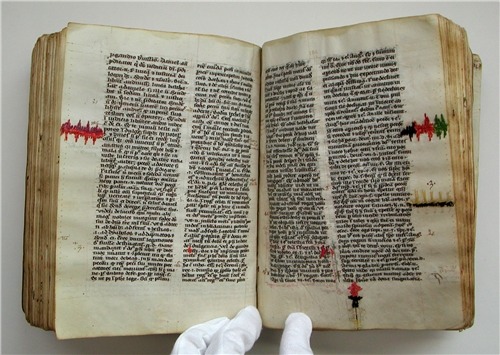
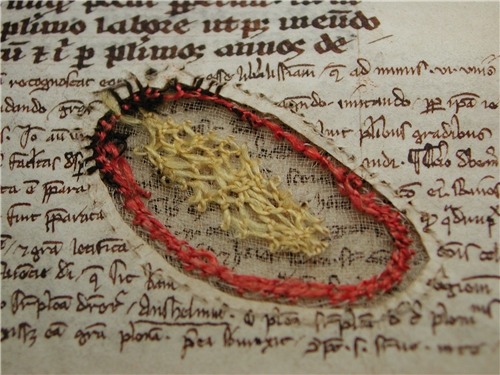
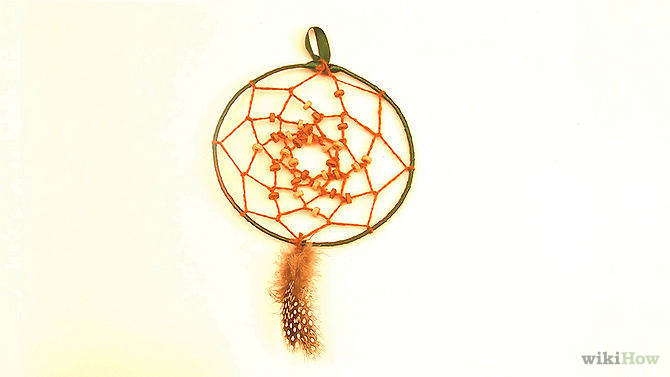
William Dean Minter, Senior Book Conservator in the Digitization and Preservation Department at Pennsylvania State University drew my attention to these images. At first, they reminded me of passages in Annie Tremmel Wilcox’s A Degree of Mastery, in which she describes mending rare books with kozo paper under the hawkeye of the late Bill Anthony. Then, dreamcatchers sprang to mind. What were the images, sounds and thoughts caught in words now missing on these pages, words slipped from the dreamcatching pages? But book artist Esther Kibby, who teaches photography, graphic design and web design at the Art Institute of Dallas in Texas, came up with the most telling association: kintsugi

Kintsugi (or kintsukuroi) is a Japanese method for repairing broken ceramics with a special lacquer mixed with gold, silver, or platinum. The philosophy behind the technique is to recognize the history of the object and to visibly incorporate the repair into the new piece instead of disguising it. The mastery of the book restorer is to invisibly repair the book. Our “dreamcatcher” restorer seems to have in mind the kintsugi philosophy and lets the repair draw attention to itself and creates “a new piece”.

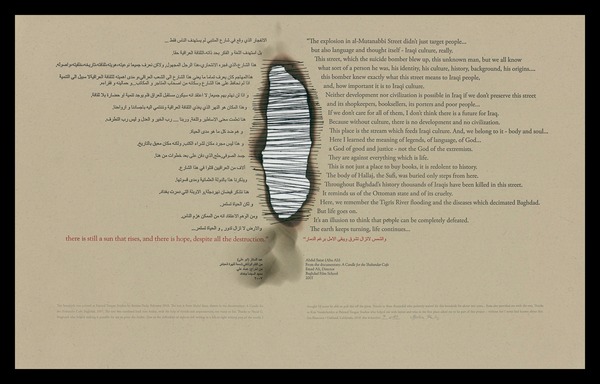
In the hands of a book artist, such a technique could generate ironic expressions of biblioclasm: the restored book that is no longer a book? Or echoes of Walter Benjamin’s presumption of and preoccupation with the modern world’s fragmentary nature? Or the pain and sorrow of Al-Mutanabbi Street?

Bettina Pauly, The Sun that Rises, 2013
Bettina Pauly, The Sun that Rises, 2013 Bettina Pauly, The Sun that Rises, 2013.  Made for An Inventory of Al-Mutanabbi Street.

Or a tongue-in-cheek answer to those horrified by the destruction of “the book”?

When the Japanese mend broken objects, they aggrandize the damage by filling the cracks with gold. They believe that when something’s suffered damage and has a history it becomes more beautiful. —Barbara Bloom

Bookmarking Book Art – Aldus Manutius, 6 February 1515 – 6 February 2015

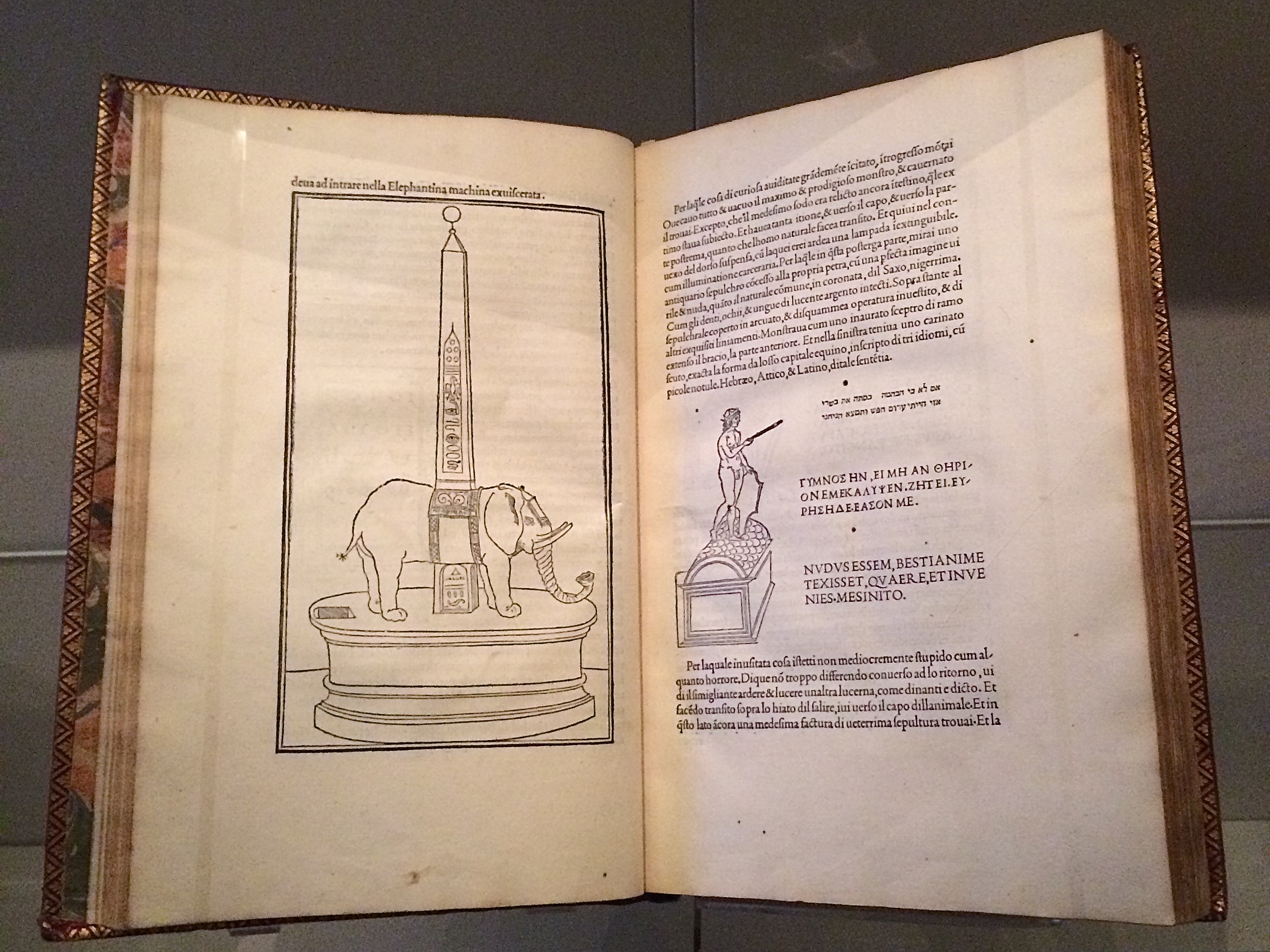
Hypnerotomachia Poliphili, Venice: Aldine Press, 1499.
Hypnerotomachia Poliphili. Venice: Aldine Press, 1499.

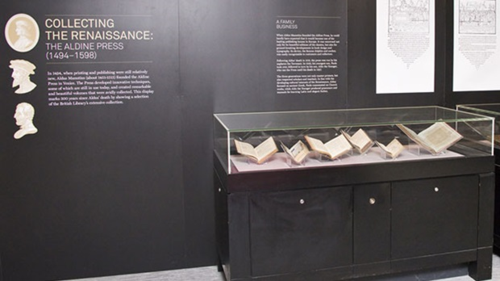
Late afternoon before the long worn wooden benches in the Bodleian’s Convocation Hall, 500 years after the death of Aldus Manutius, Oren Margolis served his audience well, providing them with a richer appreciation of the “finest printed book of the entire Renaissance”* – the Hypnerotomachia Poliphili – and of its publisher Aldus Manutius.

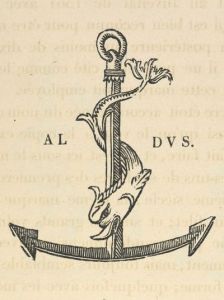
Drawing our attention to the more sculptural qualities of Venetian Renaissance printed books over the Florentine and to the  evidence of the humanist agenda that drove Manutius, he led us to the page where Poliphilo (lover of all things, but in particular Polia, the ideal woman pursued to the end of the book) stands before a carving that foreshadows the Aldine Press device: a dolphin entwined around the shank of an anchor. The Aldine Press device was inspired by a similar image on an ancient Roman coin given by Pietro Bembo to Aldus, who wrongly associated it with Augustus and his proverb Festina lente (“Make haste slowly”) and adopted both for his printing and publishing business.

Erasmus praised Aldus, saying that he was “building a library which knows no walls save those of the world itself”.

For all of 2015, the world enjoyed a multitude of celebrations of the contribution of Aldus Manutius to publishing, printing and the book. After Gutenberg, Fust and Schoeffer, Aldus Manutius was perhaps the most important printer of the Renaissance. His portable books are still here, although locked away or displayed under glass, no longer so portable. Until now.

The Manutius Network 2015 provides a running list, links for some of which are provided below, including the online exhibition associated with Margolis’s talk.  See also below, added in May 2016, the belated exhibition “Aldo Manutius: The Renaissance in Venice” at the Gallerie dell’Accademia in Venice.

IMG_1604

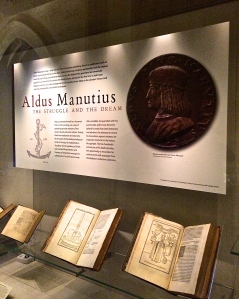
In the Proscholium, The Bodleian Library   Oxford

Invitation from the Biblioteca Nazionale Marciana

Invitation from the Biblioteca Nazionale Marciana

The British Library

The British Library

The Grolier Club exhibition. See the New York Times coverage here.

In aedibus Aldi The Brigham Young University's Harold B. Lee Library

In aedibus Aldi
The Brigham Young University’s Harold B. Lee Library

John Rylands Library University of Manchester

John Rylands Library
University of Manchester

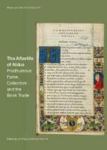
The afterlife of Aldus : posthumous fame, collectors and the book trade
Edited by Jill Kraye and Paolo Sachet.
London : The Warburg Institute, 2018.

from Hypnerotomachia Poliphili, 1499 University of Glasgow

from Hypnerotomachia Poliphili, 1499
University of Glasgow

International Conference Celebrating Aldu Manutius University of California, Los Angeles

International Conference
Celebrating Aldus Manutius
University of California, Los Angeles

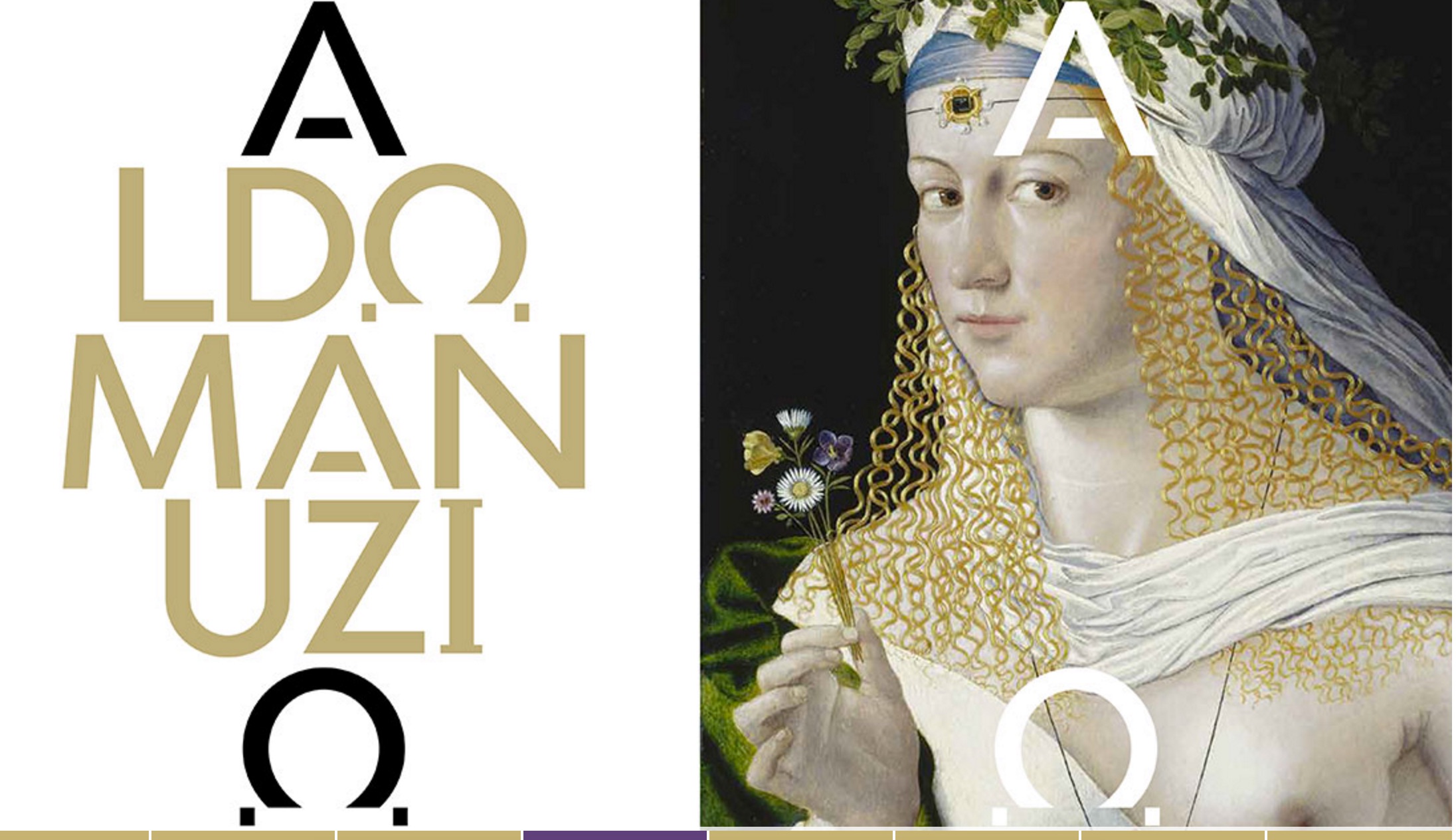
Aldo Manutius: The Renaissance in Venice http://www.mostraaldomanuzio.it/exhibition Exhibition poster containing detail of ‘Portrait of a Woman as Flora’ (c1520), by Bartolomeo Veneto © Eton College

Aldo Manutius: The Renaissance in Venice
Exhibition poster containing detail of ‘Portrait of a Woman as Flora’ (c1520), by Bartolomeo Veneto © Eton College

From Crispin Elsted’s review of the Thames & Hudson facsimile edition of the Hypnerotomachia Poliphili. Parenthesis, December 2000, No. 5:

I once spent three hours in a library with a copy of the Aldine edition of Hypnerotomachia Poliphili, and I have never known a book take my breath away so consistently. Every page is a masterpiece: the dance of text with the more than 170 woodcuts; the firm, male stature of the typeface; the crisp spring of the impression; the elegant proportion of the page — all combine to an end in which the craft of printing and design carry the text into an atmosphere not of its own making. This new edition has the appearance of a fine actor in a part lately played by a great one. Here are the signs of the grace that greatness lent the commonplace five centuries ago; and in these signs, the commonplace finds here another advocate for its small claims to our time. 

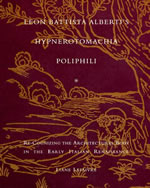
Timelines are, of course, for looking further back as well as forward.   Earlier this year, April 2012 marked the fifteenth anniversary of the publication of Liane Lefaivre’s Leon Battista Alberti’s Hypnerotomachia PoliphiliRe-Configuring the Architectural Body in the Early Italian Renaissance (Cambridge, MA: MIT Press, 1997) and the online publication of The Electronic Hypnerotomachia, which contains the facsimile text and illustrations.   The online publication of extracts from Lefaivre’s book illustrates the linking prefigured by the “card stack” approach of HyperCard.  What MIT Press and TU Delft,  Lefaivre’s affiliation, host on their servers are not ebooks or even e-incunabula of the sort we experience today, but they are clearly forerunners to them.

In twenty-eight more months, December 2014, we will see the 515th anniversary of the original work’s publication by Aldine Press (Venice, December 1499).   The founder Aldus Manutius did not normally publish heavily illustrated books.  The Hypnerotomachia Poliphili was the exception and the only commissioned work that Manutius undertook.   The exception reflects favorably on the overall success of his business and supports the view that Venice had become the capital of printing and publishing very shortly after the invention of printing by moveable type.

The book unveils an inscrutable, almost comic-book-illustrated story, glittering with made-up words in Greek, Latin, Hebrew and Arabic (including proto-Greek, -Hebrew and -Arabic fonts).  In addition to the page displays sculpted into shapes such as goblets, this one volume displayed the technological mastery of and improvement on the new Roman (as opposed to the heavy Gothic) typeface Bembo.  According to Norma Levarie in The Art & History of Books (New York, 1968), this singular volume revolutionized typography in France in less than twenty-five years.

Somewhat like software releases, though, the 1499 edition came with bugs.  The colophon to the Hypnerotomachia Poliphili falls at the end of a full page of errata.

“Venice Month December. 1499. in the house of Aldus Manutius, most accurately done.”

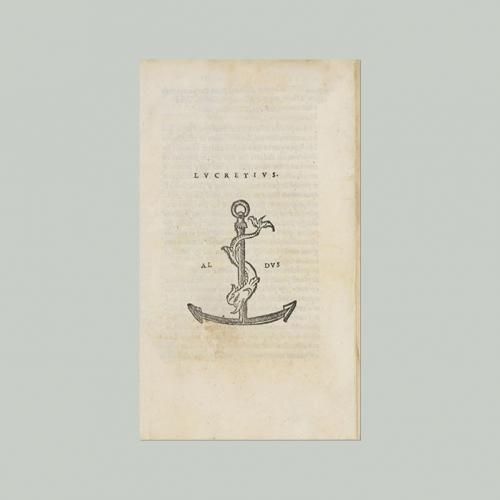
Initiated in 2015 in celebration of the anniversary and acknowledgement of the more than 100 Aldine editions in the Wosk McDonald Collection, Simon Fraser University’s Aldus@SFU is the digitization of 21 Aldine volumes published between 15011 and 1515. The image above is the edition of Lucretius’ De rerum naturam, published just after Manutius’ death in 1515.

See also “More Manutius in Manchester and More to Come“, Bookmarking Book Art, 1 June 2015.

Bookmarking Book Art – Helen Douglas

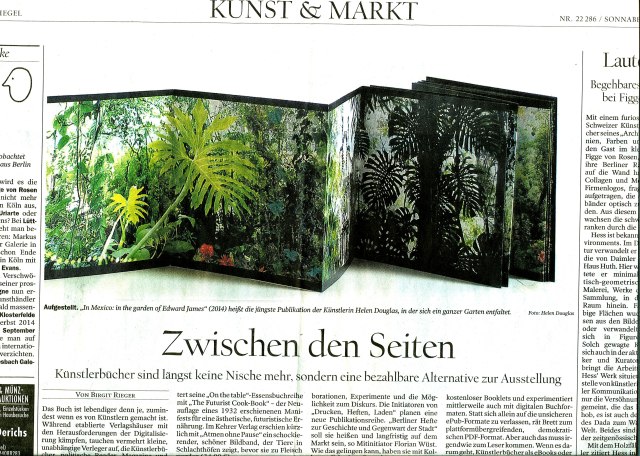
Helen Douglas, In Mexico: in the garden of Edward James (2014). Reviewed in Der Tagesspeigel

Helen Douglas has been kind enough to forward the notice above of her most recent work — In Mexico: in the garden of Edward James Based on her invited residency in Mexico City, this concertina book takes the viewer through Edward James’ jungle garden Las Pozas, its buildings and staircases, James’s surreal imagination and, best of all, Douglas’s own imaginative experience of them. See the interview at BookArtBookBlog that preceded the work’s unveiling at the London Art Book Fair at the Whitechapel Gallery and Berlin Art Book Fair.

When I go to Weproductions, the website of founding partners, Telfer Stokes and Helen Douglas, it is like taking a walk in Yarrow, Scotland, or taking the measure of paper samples between forefinger and thumb, or browsing in a bookstore, or lingering in an art gallery. Two of Helen Douglas’s works in particular elicit this: The Pond at Deuchar (2013) and A Venetian Brocade (2010).

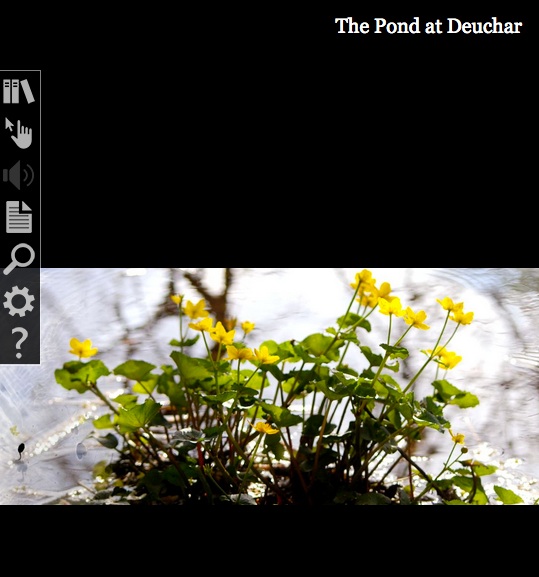
The Pond at Deuchar (2012)
“The Pond at Deuchar” E-Scroll artwork ©Helen Douglas
Application “Turning the Pages” © Armadillo Systems

Was it London Book Fair where I first saw this bookwork, appwork, scrollwork … this work of art?  What you see above leads you to the app. Clive Philpott’s postscript to this work, featured on Weproductions and published by the Tate, offers all the background and appreciation of the work you need to read. Read it, then go to The Pond at Deuchar*, lean forward and trail your fingers through its waters.

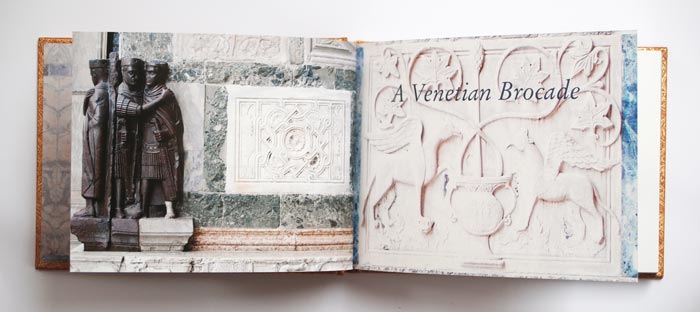
Helen Douglas and Marina Warner. A Venetian Brocade (Weproductions, 2010)

A Venetian Brocade equally makes the “act of looking” tactile and the “act of touching” insightful. The work reminds me of this passage from Joseph Brodsky’s Watermark (New York: Farrar Straus Giroux, 1992):

… bipeds go ape about shopping and dressing-up in Venice for reasons not exactly practical; they do so because the city, as it were, challenges them. We all harbor all sorts of misgivings about the flaws in our appearance, anatomy, about the imperfection of our very features. What one sees in this city at every steep, turn, perspective, and dead end worsens one’s complexes and insecurities. That’s why one—a woman especially, but a man also—hits the stores as soon as one arrives here, and with a vengeance. The surrounding beauty is such that one instantly conceives of an incoherent animal desire to match it, to be on par. This has nothing to do with vanity or with the natural surplus of mirrors here, the main one being the very water. It is simply that the city offers bipeds a notion of visual superiority absent in their natural lairs, in their habitual surroundings. That’s why furs fly here, as do suede, silk, linen, wool, and every other kind of fabric.

If you are lucky enough to buy one of the few remaining copies of A Venetian Brocade, you will see and feel how it leads to In Mexico: in the garden of Edward James. Appreciation of that double-sided leporello work’s extension of the Douglas’s concept of Visual Narrative and its kinship with James’s surrealism can only be enhanced by viewing The Secret Life of Edward JamesGeorge Melly’s documentary film from 1975.

But having indulged the surreal elements, think back to the pond at Deuchar, think back to the Tate’s association with Douglas’s work, then consider this work also held at the Tate:

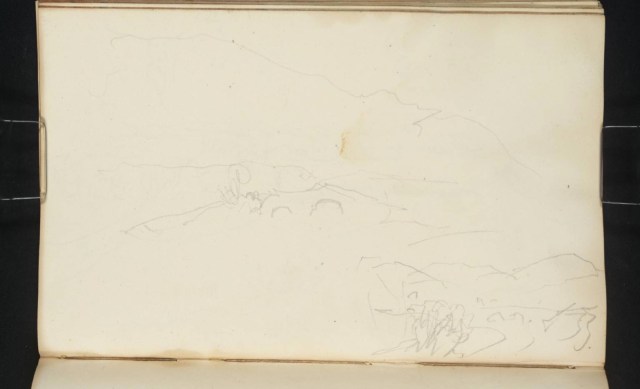
Joseph Mallard William Turner, “Deuchar Old Bridge, near Yarrow, Selkirkshire”, 1834, in The Edinburgh Sketchbook 1831-34, graphite on paper, 111×181 mm. Reference: D26161
Turner Bequest CCLXVIII 34 a

Here is a narrative of art across time and place to touch by looking and, by looking, to be touched by.

*Deuchar is pronounced “dew-ker”, the “k” as in “loch”.

Bookmarking Book Art – Margins and making objects that live forever

Craig Mod modulates on margins here in Medium (18 August 2014).

Text printed on the best paper with no margins or unbalanced margins is vile. Or, if we’re being empathetic, sad. (For no book begins life aspiring to bad margins.) I know that sounds harsh. But a book with poorly set margins is as useful as a hammer with a one inch handle. Sure, you can pound nails, but it ain’t fun. A book with crass margins will never make a reader comfortable. Such a book feels cramped, claustrophobic. It doesn’t draw you in, certainly doesn’t make you want to spend time with the text….

On the other hand, cheap, rough paper with a beautifully set textblock hanging just so on the page makes those in the know, smile (and those who don’t, feel welcome). It says: We may not have had the money to print on better paper, but man, we give a shit. Giving a shit does not require capital, simply attention and humility and diligence. Giving a shit is the best feeling you can imbue craft with. Giving a shit in book design manifests in many ways, but it manifests perhaps most in the margins.

Reiterating his point by analogy, Mod channels the late designer George Nakashima:  “in order to produce a fine piece of furniture, the spirit of the tree must live on. You give it a second life … You can make an object that lives forever, if used properly.

For the fundamentals underlying Mod’s scatologically and poetically emphatic truth, you cannot find much better than Alexander Ross Charchar’s essay on the craft and calculations of “page canons” by Villard de Honnecourt (13th century!) , J.A. Van de Graaf, Raúl Rosarivo and Jan Tschichold:  “The Secret Law of Page Harmony“. Most delightful is Charchar’s dynamic diagram “The Dance of the Four Canons” illustrating the workings of each page canon:

Copyright 2010, Alexander Ross Charchar.

The Further Reading suggested by Charchar and his commenters is excellent, and I would only add Marshall Lee’s Bookmaking. For those who are irritated with the imposition of the print paradigm on the digital reading experience, there is a useful pointer to applying the page canons to website design that will cause a rethink of that irritation and equally make the imposers think harder as well.

For those who care about the book, what it is evolving into and the role that heart, mind and design still play in that process, read Charchar’s”The Secret Law of Page Harmony” –again and again.

Bookmark – Who Owns the Findability Function?

Pompeii_300
Now where did we last see that book?

The Repository of Primary Sources has been running since 1995 at the University of Idaho. Under the wing of Terry Abraham, it lists “over 5000 websites describing holdings of manuscripts, archives, rare books, historical photographs, and other primary sources for the research scholar”, and “[all] links have been tested for correctness and appropriateness”.

So what has this to do with the evolution of the book? Well, in the world of book publishing, whose job has it been to make sure that a book is known about and can be found — not only on publication but after? Marketing, Promotion and Publicity, undoubtedly, but they would be among the first to shout if Editorial or someone had not registered the book’s metadata with Bowker or the equivalent local ISBN registry.

According to Google, there are 129,864,880 books in the entire world (as of 5 August 2010, 8:26AM), but that is a semi-statistical estimate for the modern era drawn from sources such as ISBN registrars and OCLC’s WorldCat. Bookfinder/JustBooks, launched in 1997 by Anirvan Chatterjee, claims that through its network, it searches over 150 million books for sale. With the great hoohah over Hugh Howey’s Amazonian extrapolation, we can safely assume that there are many, many more books out there probably without ISBNs, which after all only came into effect in the 1970s and, even so, now there are vociferous opponents to the ISBN calling it an offline anachronism.

There is no question to beg about the usefulness of metadata. So is there a Terry Abraham and cohort out there to whom publishers and self-publishing authors can turn to deposit metadata whose links will be “tested for correctness and appropriateness”? Of course, that begs the question of whether there should be someone or organizations out there to perform that function. Why not leave it to the power of the Internet or the power of the market? Even if a book goes unnoticed or after a time becomes an “orphan work“, the power has spoken.

Let’s leave the power politics for another bookmark. Whoever performs the function, what exactly is it? Let’s call it the “findability” function.  It goes beyond the usual social media marketing of a book or ebook that most publishers assign to Marketing.  It goes beyond the usual search engine optimization (SEO), although it is arguably a part of it.
It goes to making the book as locatable an object as it can be, endowing it with “ambient findability.” See Peter Morville’s book of that title and judge for yourself whether “endowing something with ambient findability” misconstrues what he is saying or how the Web works.  Nevertheless, …

Superfluous as they are claimed to be becoming, should publishers leave findability to the ISBN registries and librarians (until they become superfluous as well) or to the technorati?

As the book evolves, this “findability” function currently falls between the stools of Commissioning (where the editor discovers the author and pumps him or her not only for the ms but for connections leading to sales/marketing opportunities and further editorial opportunities), Editorial/Production (where the copyeditor, designer and production editor ensure that metadata is assigned and link-checks are run and the work is registered with the Library of Congress), Sales/Marketing (where marketeers scour the author’s questionnaire if it has arrived, create lists of mailing and emailing lists, compile the list of offline and online reviewers/bloggers and design the social media campaign and where a sales account manager with responsiblity for Amazon and other online accounts worries whether IT has included the work in the scheduled ONIX, EDI and customized catalog feeds) and Operations/Finance (where an accountant, analyst or inventory controller assigns the ISBN usually upon receipt of contract approval).

Who assigns and maintains the Digital Object Identifier (DOI) is a related beggarly question.

So if you are self-publishing or publishing books/ebooks, who attends to the ambient findability of what you are publishing?   As more and more books go online, isn’t this part of the new craft and art of the book?

By the way, I found Morville’s book one rainy Saturday afternoon while shelving books at the local Oxfam bookstore.   I bought it instead of shelving it.