Books On Books Collection – Geofroy Tory

Champ Fleury: Art et Science de la Vrai Proportion des Lettres (1529)

Champ Fleury by Geofroy Tory Translated into English and Annotated by George B. Ives, Designed and printed by Bruce Rogers (1529)[1927]
Slipcase, dust jacket over casebound, vellum-backed decorated paper-covered boards, gilt-stamped spine and gilt top edge. H320 x W224 mm, 234 pages. One of 390 copies. One of only ten books printed in the original foundry Centaur type by Rogers. Acquired from Donald A. Heald Rare Books, 26 May 2021.
and
Champ Fleury: Art et Science de la Vrai Proportion des Lettres (1529)[1998]
Geofroy Tory
Sewn paperback, glued to black card cover with deep flaps. H250 x W172mm, 192 pages. Acquired from Antiquariaat Schot, 19 April 2021.
Photos of the books: Books On Books Collection. Copyright in the books: © 1927 The Grolier Club. © Bibliothéque de l’Image.

The art of the alphabet seems to be a rite of passage for graphic artists. Perhaps it is that art and the alphabet find common ground in the urge to make sense of the world. Perhaps it’s that the alphabet’s invention, development and artistic treatment present a rich tradition for artists to follow or challenge. Perhaps it’s that letterforms and the alphabet offer raw material, subject and organizing principle all in one. Semic or asemic. Calligraphic, typographic or even plastic. Representational or abstract. All are options. But most often, something bookish results. From Islam Aly’s 28 Letters (2013) to Ludwig Zeller’s Alphacollage (1979), a significant part of the Books On Books Collection is taken up with artists’ books based on the ABCs and letterforms. The Collection’s two facsimiles of Geofroy Tory’s Champ Fleury provide a useful historical backdrop that throws into relief several of the Collection’s works and their performance of this rite of passage. 

It should be no surprise that Geofroy Tory de Bourges (c.1480-1533) serves up such an exemplar. In her Playful Letters, Erika Boeckler writes

An accomplished designer, typographer, printer, poet, author, translator, calligrapher, illustrator, woodcutter, and engraver, he received his education in Italy and ultimately settled in Paris, setting up a bookstore, writing his own works, running a press, and collaborating with or working for Simone de Colines, director of one of the most influential and experimental fine publishing houses of the time. Personally writing the text, designing the woodcuts, and cutting some of them, organizing the layout, perhaps even setting the type, Tory created Champ Fleury as what we might call today an artist’s book. (p. 29)

Left to right: double-page spread and cover from Aly’s 28 Letters; A from Zeller’s Alphacollage. Photos of the works: Books On Books Collection. Copyrights in the works: © Islam Aly. © Ludwig Zeller.

Tory straddles the letters of the late Middle Ages and Renaissance. Appointed by François I in 1530 as his printer, Tory operated on the Petit Pont under the sign of le Pot cassé (“the broken pot”) and was known for his workshop’s handwritten Book of Hours (1524). Rooted in the horae tradition reaching back to the 13th century, Tory’s Book of Hours is an early-to-mid-Renaissance version of its predecessors. As beautiful as his Book of Hours is, Champ Fleury (1529) became his best known work. Authored and designed by Tory, it was produced by hand typesetting and letterpress printing in Paris with Giles Gourmont. Printed less than 100 years after Gutenberg’s innovation, Champ Fleury represents the printed book toddling out of its incunabula period.

Book of Hours
Geofroy Tory (1524)
Bound in the 18th century, 113 leaves of vellum. Lessing J. Rosenwald Collection (Library of Congress). Accessed 30 May 2021.

Title page: 1529 original in the Bibliothèque national de France; 1927 translation & facsimile © 1927 The Grolier Club; 1998 facsimile © Bibliothéque de l’Image. Photos of the latter two books: Books On Books Collection.

According to Jeremy Norman’s History of Information site, the first separate printed title page appeared in 1463. Subject indices date back to the 13th century, originating at the University of Paris, and the first printed indices, to 1470. Champ Fleury‘s front matter boasts a title page, two prefaces to the reader, a statement of the King’s Privilege awarded for the book for ten years (a forerunner to the copyright page), a name index without location references and a subject index with folio references. Champ Fleury’s back matter consists of a colophon preceded by a lengthy appendix illustrating various forms of the alphabet (Hebrew, Greek, Latin, etc.).

Tory’s placement of the indices in the front matter rather than the back matter reflects the gradual development of the anatomy of the book towards the structure that would ultimately be codified in reference works like the Chicago Manual of Style. Paratextual elements like the title page, table of contents, page numbers, etc., did not spring up overnight. If, as Eric Havelock and others assert, society, the arts and culture are a superstructure erected on the foundation of the alphabet (see below), Champ Fleury and its “letterology” make for a particularly fitting exemplar of the book as an element of the superstructure arising from the alphabet.

Perhaps book artists sense this, which again leads to that alphabet art rite of passage and the elaborate variations on it. The illustration of various forms of the alphabet in the appendix also draws on another developing tradition: the typesetter/printer’s sample book advertising the firm’s fonts. Abecedaries and artist books have sprung from that tradition, too.

From left to right: Greek, Chaldaic, and Imperial Gothic letters from the 1998 facsimile. Photo of the book: Books On Books Collection. Copyright in the book: © Bibliothéque de l’Image.

Tory was not the first to propose an art and science behind the letterforms of the alphabet. Predating his efforts were Giovanninno de’ Grassi (1390-1405), Felice Feliciano (1463), the Anonymous Chicagoensis and Anonymous Monachensis (1468?), Damianus Moyllus (1480), Fra Luca Pacioli (1509), Sigismondo Fanti (1514), Francesco Torniello (1517), Ludovico Arrighi (1522), Albrecht Dürer (1525) and Giovanni Battista Verini (1527). Leading up to Champ Fleury, these earlier efforts track the development of humanism. Arguably, Tory’s effort is a capstone, combining myth, allegory, metaphysics, geometry, linguistics, calligraphy, typography and cryptography.

Book One, concerned with the mythical origins of the French language, also addresses the fabled origins of the alphabet: the story of Jove, Io and Mercury behind the letters I and O and their claim to being the first letters and also the tale of Apollo’s accidental murder of Hyacinth explaining the letters A and Y and their similar claim. Two works in the Collection built on alphabet origin stories are Francisca Prieto’s Printed Matter series (2002-2008) William Joyce’s The Numberlys (2014), but many more follow in Champ Fleury’s art and science footsteps.

Tory’s late medieval/early Renaissance perspective gives way to 20th and 21st century poetics and phenomenology in most works of the Collection. Aaron Cohick’s The New Manifesto of the NewLights Press (third iteration) (2017) offers a good example. Another — closer to Tory’s moral and geometric perspective but of a more modern spirituality — is Jeffrey Morin and Steven Ferlauto’s Sacred Space (2003).

Clockwise from upper left: B+8 from Prieto’s Printed Matter series; cover of Joyce’s The Numberlys; double-page spread from Cohick’s A New Manifesto; Morin and Ferlauto’s Sacred Space. Photos of the work: Books On Books Collection. Copyright in the works: © Francisca Prieto. © Michael Joyce and Christina Ellis. © Aaron Cohick. © Jeffrey Morin and Steven Ferlauto.

Compile all the abecedaries ever created and it would approximate the result of Adam and Eve’s task of naming all the creatures and things of the world. Leonard Baskin echoes that innocence in Hosie’s Alphabet (1972) with its words and animals supplied by his children. If Adam and Eve had had an alphabet, they might have been tempted into pareidolia, which is represented in the Collection by VUES/LUES: Un Abécédaire de Marion Bataille (2018) and Typographic Universe (2014) by Steven Heller and Gail Anderson. Heller and Anderson’s compendium extends to letters formed of natural and drawn objects from the real world, which Champ Fleury’s appendix foreshadows with its floral and fantastic alphabets.

Clockwise from upper left: Baskin, Hosie’s Alphabet letter H; Bataille’s VUES/LUES letter O & P; Ceol Ryder’s My Type of Film from Heller and Anderson’s Typographic Universe; Tory’s lettres fantastique and fleuries from 1998 facsimile.
Photos of the works: Books On Books Collection. Copyright in the works: © The Estate of Leonard Baskin; © Marion Bataille. © Ceol Ryder. © Steven Heller and Gail Anderson. © Bibliothéque de l’Image.

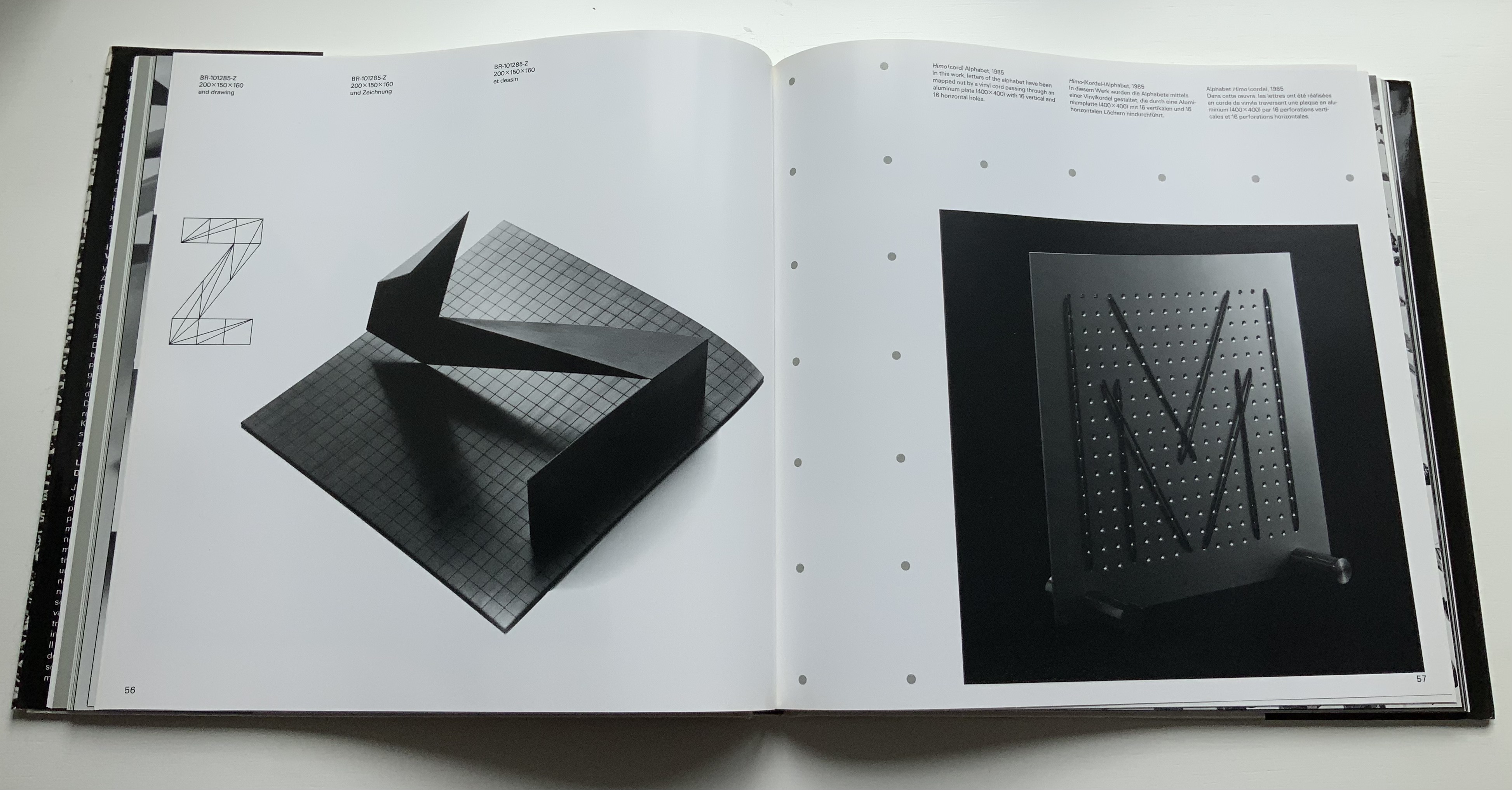
Of course, Tory’s work is not an abecedary. In Books Two and Three, it develops into a full-blown treatise on letterforms whose meaning and appearance are explained allegorically and driven by the compass, rule and geometry expressed within a 10x10x10 cell cube. It would overstate the case to call it “typographic design”. As drawn, Tory’s diagrams would serve poorly for cutting and forming punches or matrices (although it has been done). Nevertheless, his geometric approach foreshadows the grids and algorithms of Wim Crouwel’s New Alphabet (1967), Timothy Epps and Christopher Evans’ Alphabet (1970) and Ji Lee’s Univers Revolved: A Three-Dimensional Alphabet (2004).

OAHK pages showing the grid approach. 1529 original from the Bibliothèque national de France; 1927 translation & facsimile © 1927 The Grolier Club; 1998 facsimile © Bibliothéque de l’Image. Photos of the latter two books: Books On Books Collection.

Clockwise from top left: Crouwel, Lee and Epps/Evans. Photos of the works: Books On Books Collection. Copyright in the works: © Wim Crouwel. © Ji Lee. © Timothy Epps and Christopher Evans.

Before the age of computers and algorithms, though, the artist and designer Bruce Rogers did bring typographic design to bear on Champ Fleury. The Grolier Club sponsored the printing of George B. Ives’ English translation. Rogers’ design “translates” Champ Fleury just as much as Ives does, perhaps more so. The Grolier Club edition is one of only ten books to be set completely in the Centaur typeface designed by Rogers.

Bruce Roger’s typeface Centaur, as presented in Paul McNeil’s The Visual History of Type (2017), pp. 196-97. Photo: Books On Books Collection. © Paul McNeil.

Of course, the translation entails a complete resetting of the text, and Centaur naturally delivers crisper letters. Also, in redesigning with Centaur, Rogers alters the original’s layout and, therefore, the reader’s experience of it. Notice in the OAHK pages above and in the three double-page spreads below how Rogers changes Tory’s flow or jumpiness to something fixed or stately. Attention to the page and its layout offers book artists as well as book designers yet another creative avenue. For proof of that, compare the Collection’s entries for Angel, Baskin and de Cumptich.

Rogers’ change in layout (© 1927 The Grolier Club) shown between 1529 original (from the Bibliothèque national de France) and 1998 facsimile (© Bibliothéque de l’Image). Photos of the latter two books: Books On Books Collection.

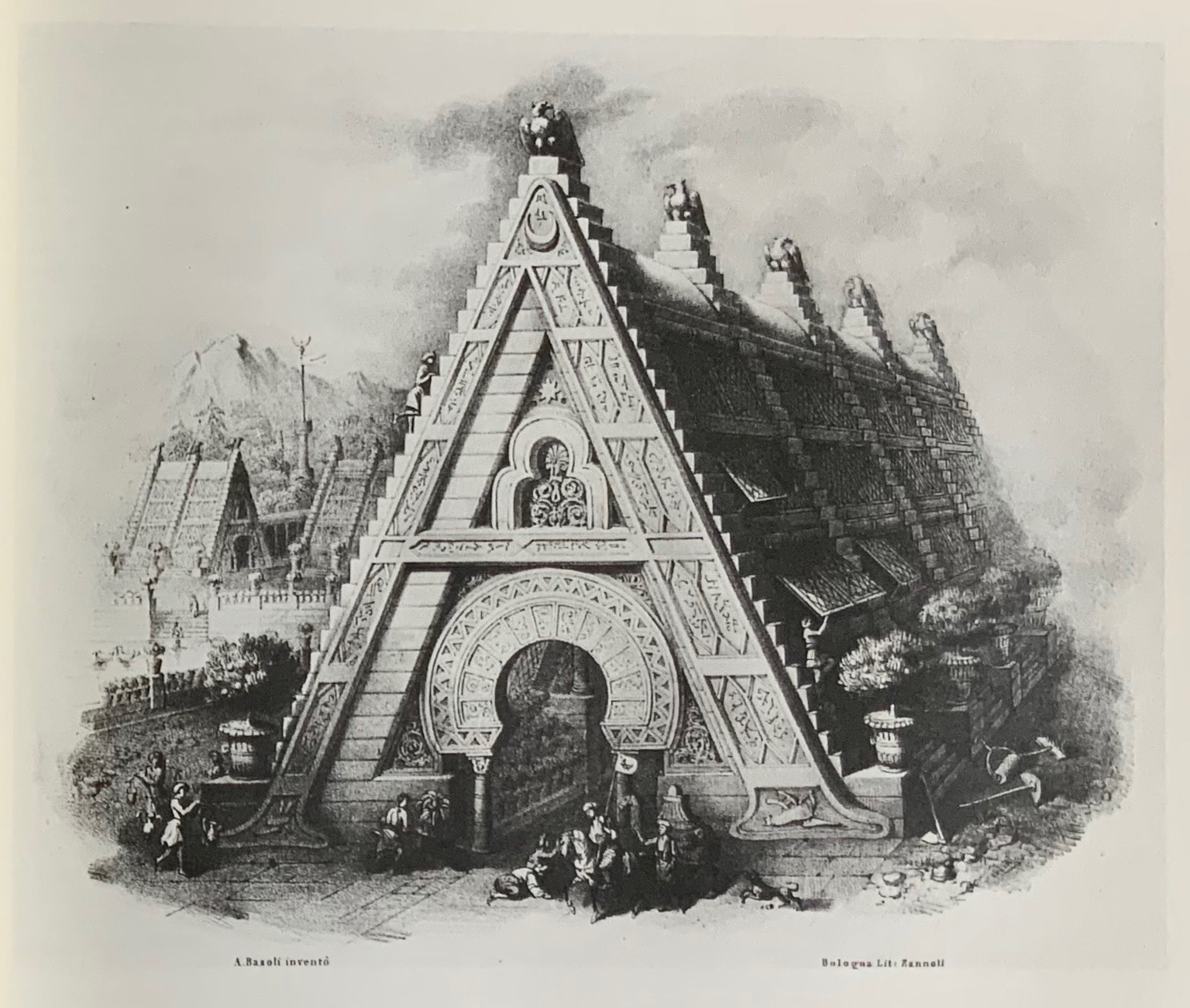
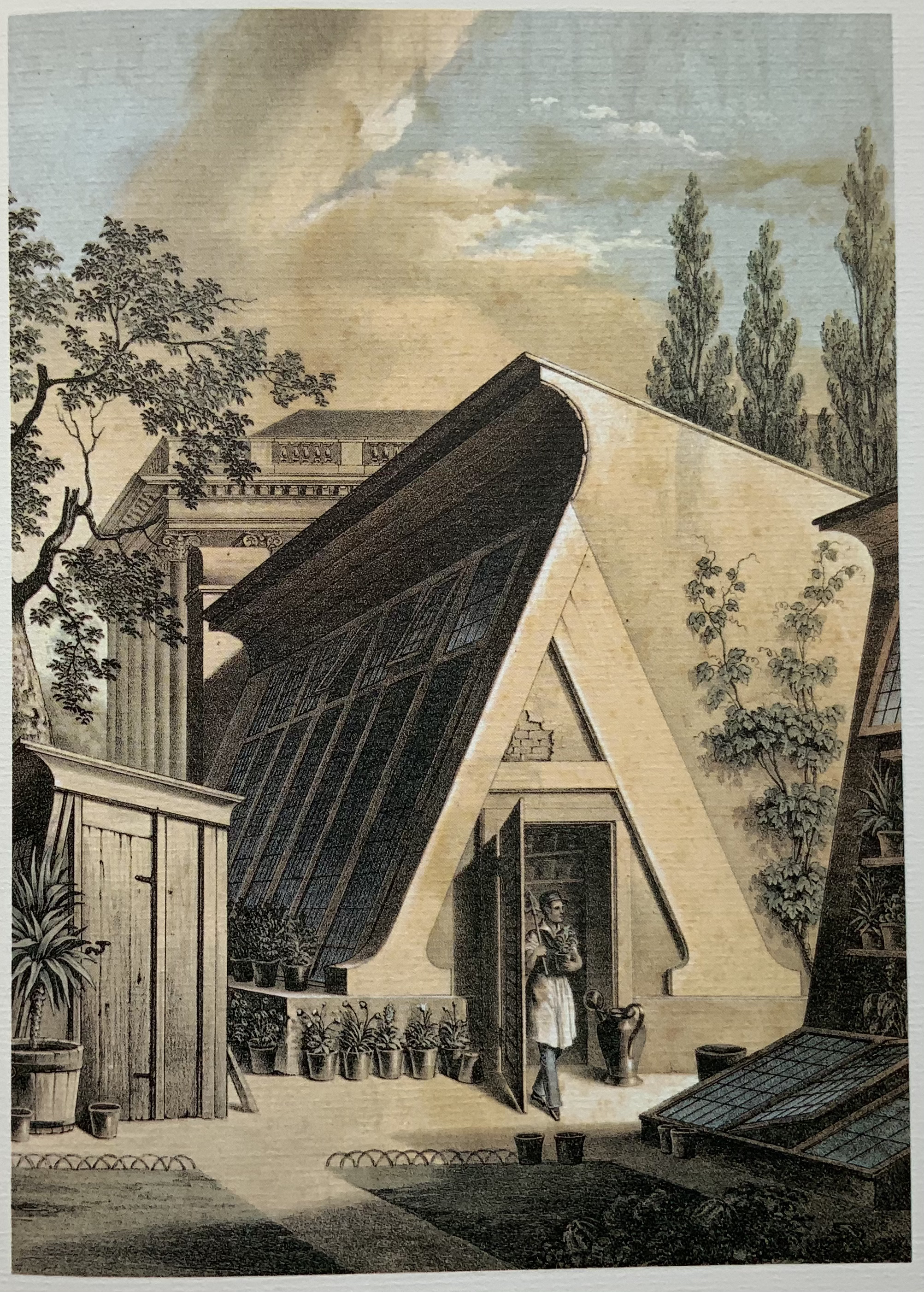
Architecture is another of Tory’s well-developed analogies and explanations of the ancients’ thinking behind the letterforms. In his drawings below, he aligns the letters AHKOIS with the parts of a building and letters IL with floor plans. He connects the circularity of the Coliseum’s exterior and the ovalness of its arena with the proper shape of the letter O. In the Collection, the analogy reappears fantastically in Johann David Steingruber’s Architectural Alphabet (1773/1972), Antonio Basoli’s Alfabeto Pittorico (1839/1998) Antonio and Giovanni Battista de Pian’s efforts in 1839 and 1842.

Architectural analogies: 1529 original in the Bibliothèque national de France; 1927 translation & facsimile © 1927 The Grolier Club; 1998 facsimile © Bibliothéque de l’Image.

Left to right: Steingruber, Basoli, Antonio de Pian and Giovanni Battista de Pian. Photos of the books: Books On Books Collection. Copyright in the books: © Ravensburger Buchverlag, Joseph Kiermeier-Debre and Fritz Franssens Vogel.

The architectural analogy provides Tory with his segue from plane to solid geometry in aligning the shapes of letters with human anatomy and virtues. His three-dimensional analysis of letterforms also finds contemporary analogues in two of Pieter Brattinga’s Kwadraat Blad series: Crouwel’s, mentioned above, and Anthon Beeke’s Alphabet (1970). Tory’s three-dimensional letterforms foreshadow Crouwel’s investigation of units based on the assembly of organic cells and his later musings on a laser-generated four-dimensional typography (Elliman, 62). And it is hard to evoke anything more humanoid and three-dimensional — albeit far less analytical or prudish — than Beeke’s alphabet formed with naked female models. (Tory comments that in a correctly drawn A, the crossbar will virtuously cover the genitals of Vitruvian man inscribed in the 10×10 grid. Modesty seems to extend to H as well but not so much to O and K.)

Following Beeke’s design, the photographer directed the models into position then took the shot from above. Photos of the work: Books On Books Collection. Images in individual folios: ©Geert Kooiman. Copyright in the work: ©Anthon Beeke Archive Foundation.

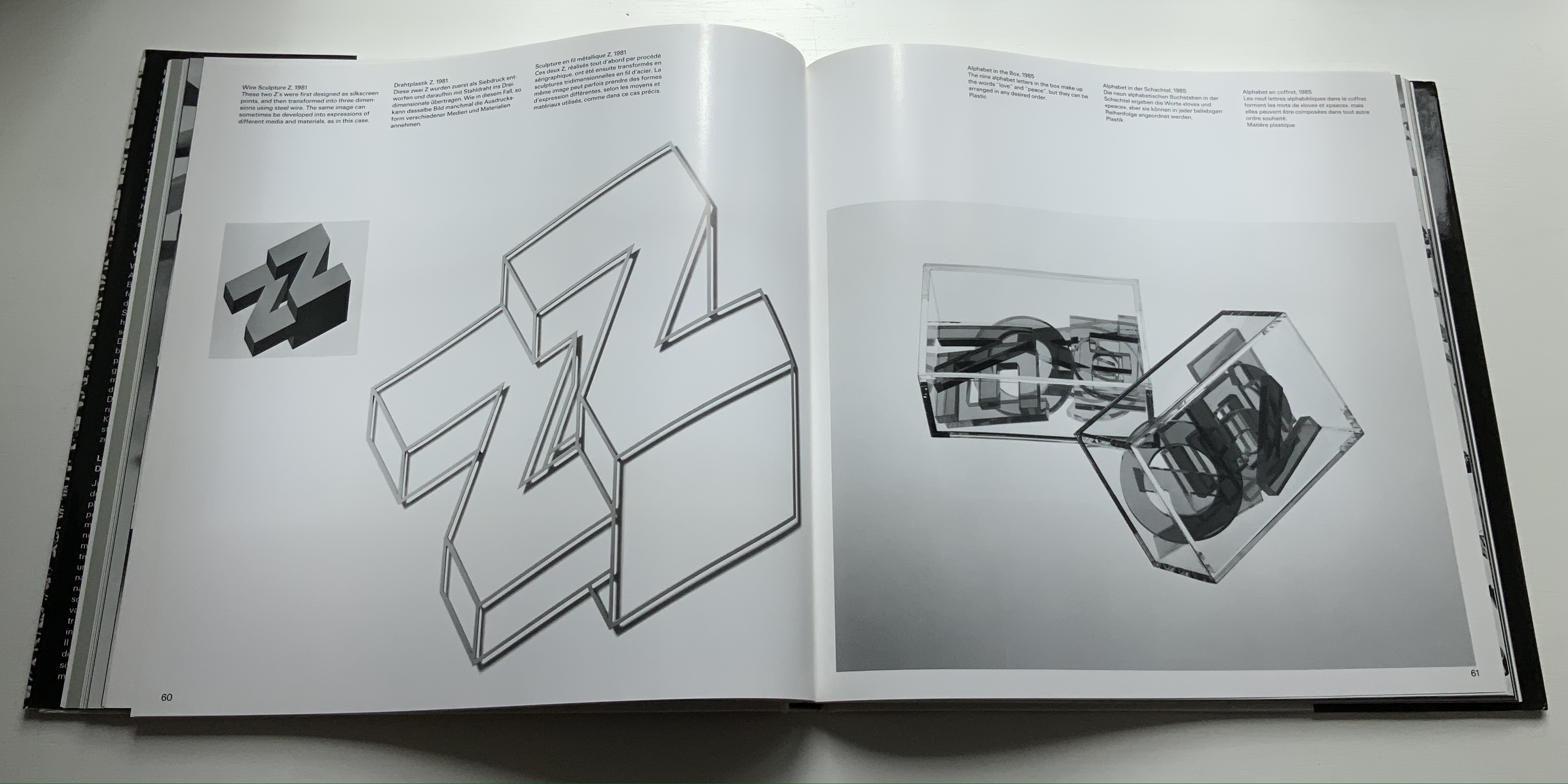
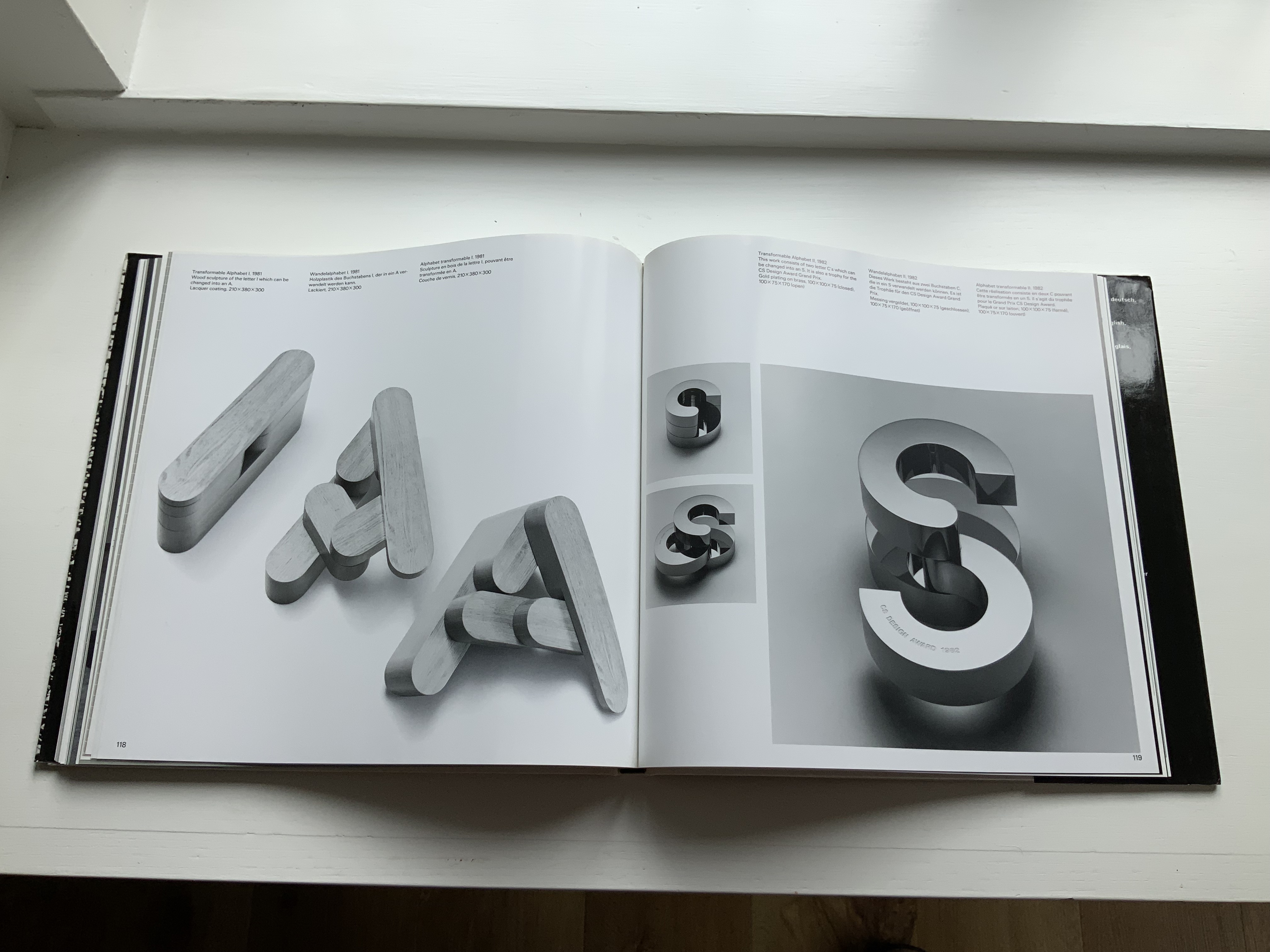
Other less humanoid but still three-dimensional analogues to Tory’s letters appears in various sculptural bookworks by Marion Bataille, Helen Hiebert, Takenobu Igarashi, Ron King, Scott McCarney, Claire Van Vliet and the 25th anniversary compendium from the Movable Books Society.

Top row from left to right: A from Bataille’s ABC3D; EFGH from Helen Hiebert Alpha Beta; b from Ron King’s Alphabeta Concertina Miniscule.
Bottom row: ABC… from Scott McCarney’s Alphabook 3; AB from Claire Van Vliet’s Tumbling Blocks for Pris and Bruce; box opening from The Movable Book Society’s 25th Anniversary.
Photos of the works: Books on Books Collection. Copyright in the works: © Marion Bataille; © Helen Hiebert; © Ron King; © Scott McCarney; © Claire Van Vliet; © The Movable Book Society.

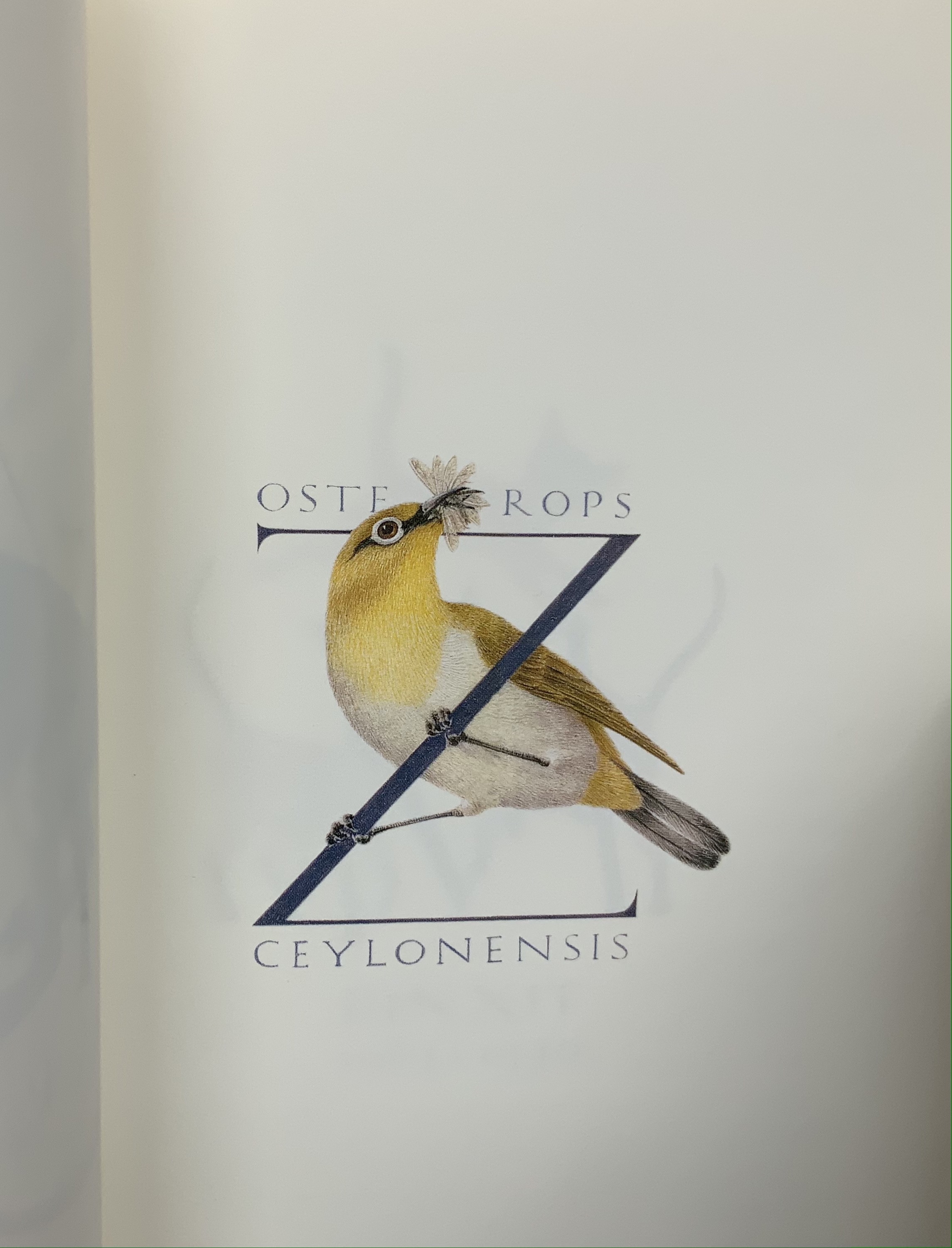
The calligraphic impulse that underlies Champ Fleury‘s typographic representations shows itself clearest in the woodcuts for the Cadeaulx alphabet in the appendix. The Books On Books Collection has its share of calligraphic abecedaries such as Marie Angel’s An Animated Alphabet (1996) and Andrew Zega and Bernd Dam’s An Architectural Alphabet (2008) as well as more purely calligraphic alphabets such as Islam Aly’s, mentioned above, and Suzanne Moore’s A Blind Alphabet (1986) .

From the appendix to Champ Fleury. Photo of the book: Books On Books Collection. 1998 facsimile © Bibliothéque de l’Image.

Clockwise from the left: A from Angel’s An Animated Alphabet; U from Zega and Dam’s An Architectural Alphabet; BC from Moore’s A Blind Alphabet. Photos of the works: Books On Books Collection. Copyright in the works: © Marie Angel; © Andrew Zega and Bernd Dam; © Suzanne Moore.

Two artists whose abecedaries blend the calligraphic and typographic are Robert de Vicq de Cumptich and Cathryn Miller. In de Cumptich’s Bembo’s Zoo (2000), letters and punctuation marks from the Bembo typeface form calligraphic animal shapes. Miller’s L is for Lettering (2011) joins up the alphabetic rite of passage, calligraphy and typography by allying each of her hand-drawn letters with the name of a typeface from “A is for Arial” to “Z is for Zapfino”.

Left: A from De Cumptich’s Bembo’s Zoo. Right: Z from Miller’s L is for Lettering. Photos of the books: Books On Books Collection. Copyright in the works: © Robert de Vicq de Cumptich; © Cathryn Miller.

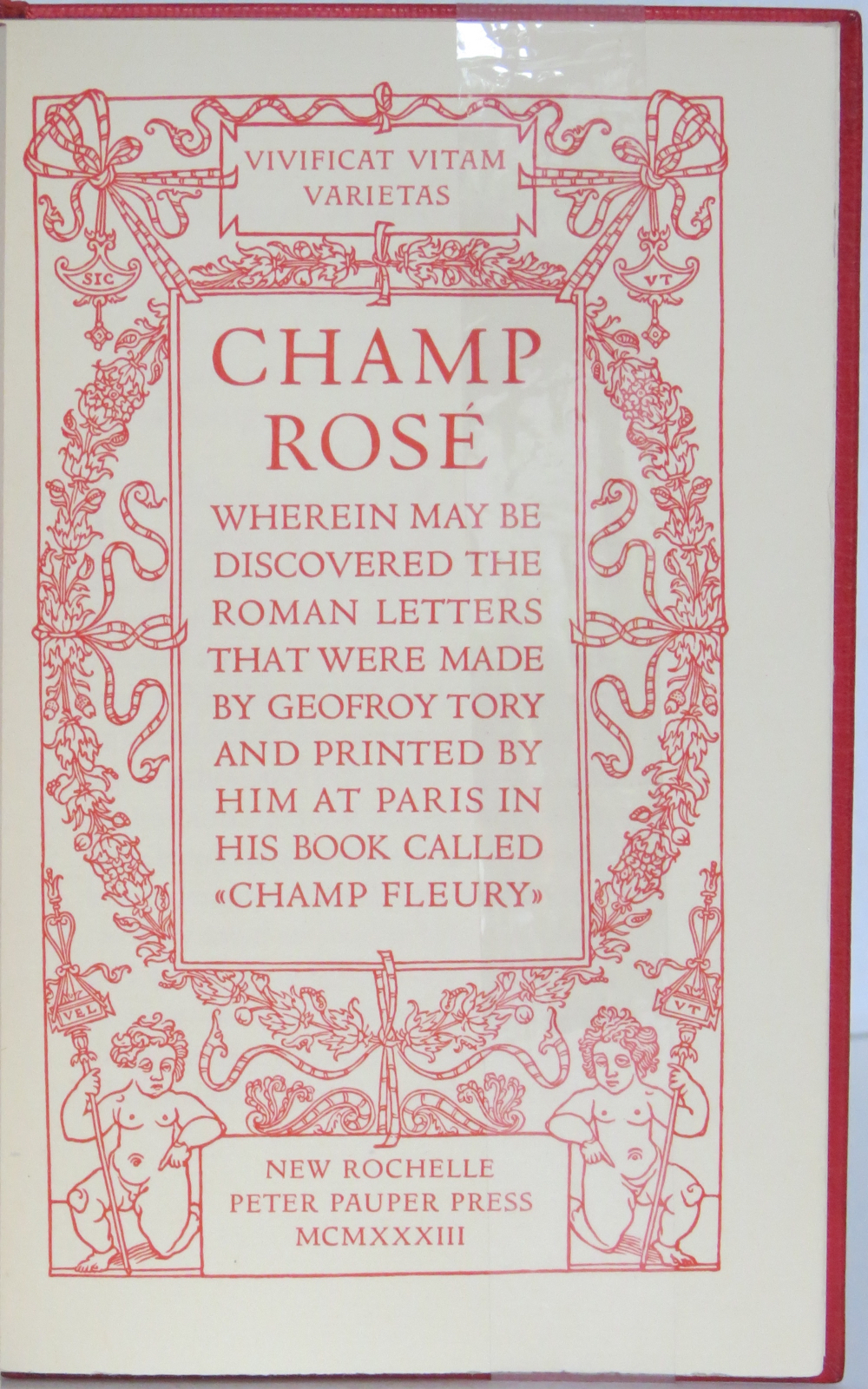
The last page of Tory’s illustration of additional alphabets is not the end of his work. The colophon plays that role. Curiously, Tory misses out the character that plays that role for the alphabet itself: the ampersand. “Curiously” because the character & appears throughout Champ Fleury — even at the end of the colophon’s fourth line in French — and it is after all the most flowery of the alphabet’s characters. Perhaps some book artist will follow Bruce Rogers’ example in his joking Depression-era homage to Tory on the back of Champ Rosé and create an homage to Tory and Rogers of three-dimensional ampersands.

Colophon: 1529 original from the Bibliothèque national de France; 1927 translation & facsimile © The Grolier Club; 1998 facsimile © Bibliothéque de l’Image. Photos of the latter two books: Books On Books Collection.

Champ Rosé (1933)
© Bruce Rogers
Photos of the book: Left, Courtesy of Veatchs; Right, Books On Books Collection.

The 1529 original of Champ Fleury can be viewed online in Gallica (BnF), de France, the Library of Congress or the British Library. The V&A’s National Art Library and a few other venues also have physical copies for inspection.

Further Reading

Abecedaries I (in progress), Books On Books Collection, 31 March 2020.

The Colophon and the Left-over ‘i’“. 23 April 2019. Books On Books Collection.

Bernard, Auguste, and Ives, George B. 1909. Geofroy Tory : Painter and Engraver: First Royal Printer: Reformer of Orthography and Typography Under François I ; an Account of His Life and Works. Boston: Houghton Mifflin.

Boeckeler, Erika Mary. 2017. Playful Letters : A Study in Early Modern Alphabetics. Iowa City: University of Iowa Press.

Bowen, Barbara C. 1979. “Geofroy Tory’s “Champ Fleury” and Its Major Sources.” Studies in Philology 76, 1: 13-27. Accessed May 28, 2021.

De Looze, Laurence. 2018. The Letter and the Cosmos: How the Alphabet Has Shaped the Western View of the World. Toronto: University of Toronto Press.

Elliman, Paul. Spring 1998. “My typographies: A personal view on the kinship of type and things“. Eye Magazine, 27: 58-63.

Gelb, Ignace J. 1974. A Study of Writing. Chicago: University of Chicago Press.

Golec, Michael. 2015. “Champ Fleury in the Machine Age”, lecture at the School of Visual Arts, NYC. Uploaded 4 June 2015. Accessed 12 May 2021. Good slides and a comparative look at Tory’s original and Rogers’ resetting.

Havelock, Eric A. 1986. The Muse Learns to Write: Reflections on Orality and Literacy from Antiquity to the Present New Haven: Yale University Press.

Ivins, William M. 1920. “Geoffroy Tory.” The Metropolitan Museum of Art Bulletin 15, 4: 79-86. Accessed May 13, 2021.

McNeil, Paul. 2017. The Visual History of Type. London: Laurence King Publishing.
Books On Books Collection – Bruce Rogers

Champ Rosé (1933)

Champ rosé: wherein may be discovered the roman letters that were made by Geofroy Tory and printed by him at Paris in his book called “Champ fleury” (1933)
© Bruce Rogers
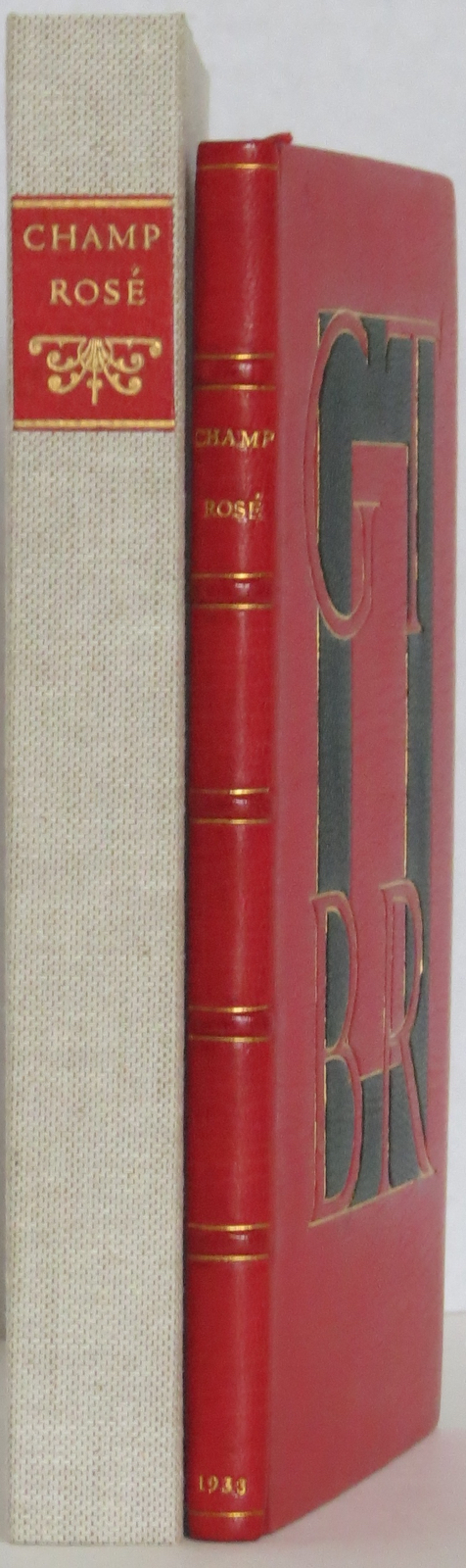
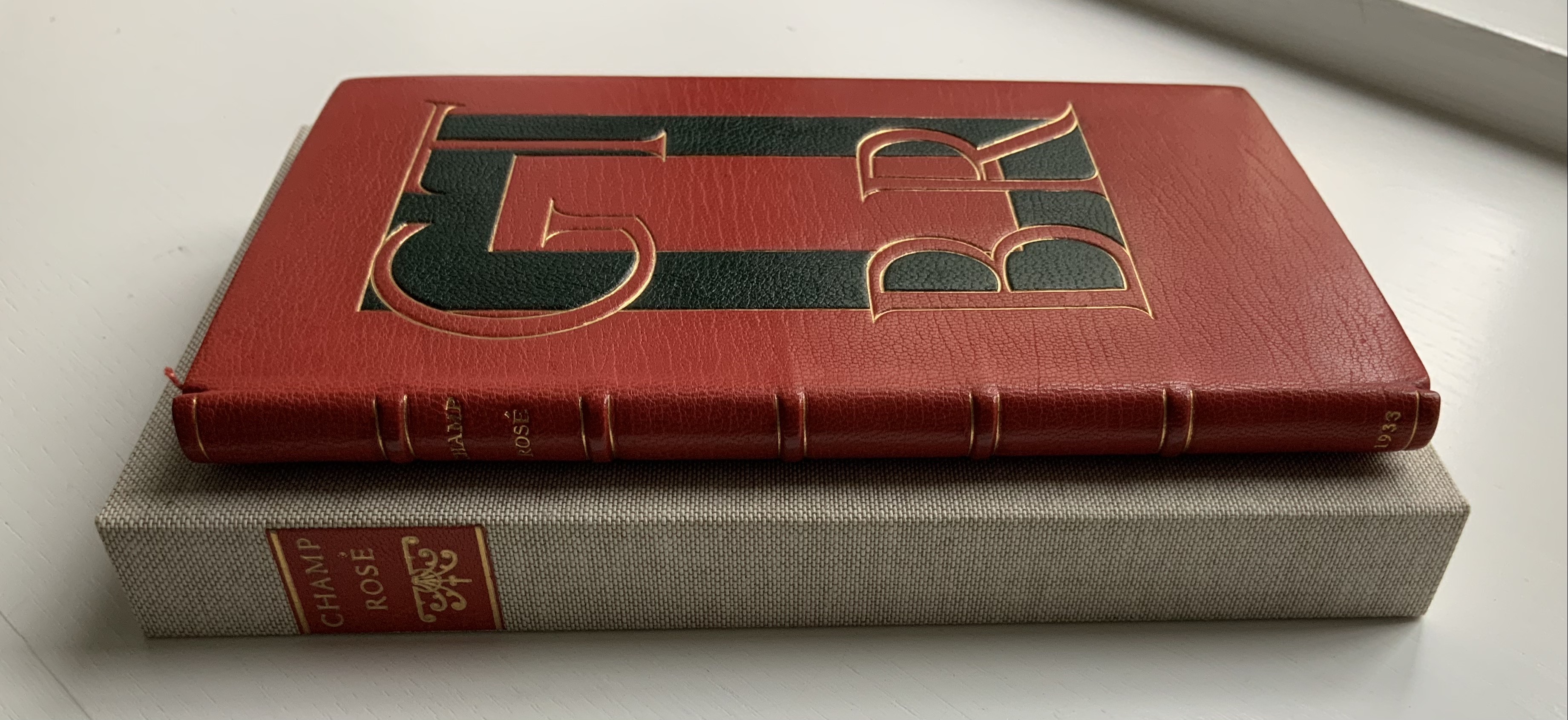
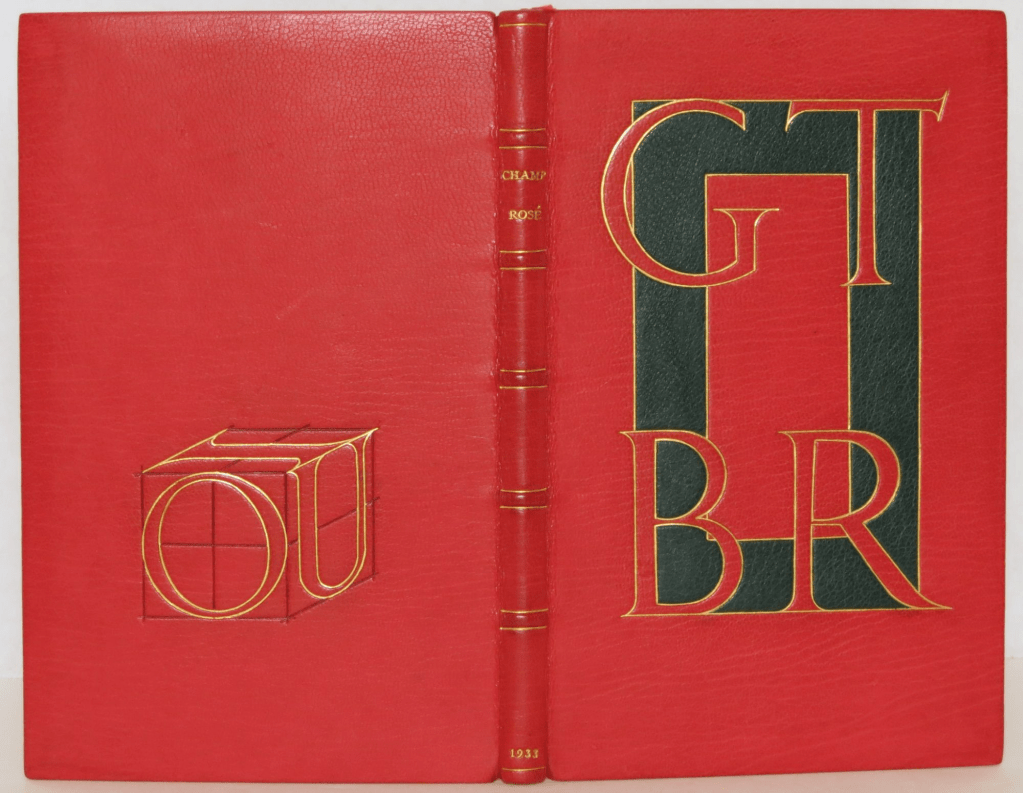
Bound by Peter Geraty at his Praxis Bindery in 1988. Red goatskin with green morocco panel gold tooled with the Roman Capitals GT (for Tory) and BR (for Rogers); BR’s IOU in a Tory-like cube is gilt on the lower cover; red & gold endpapers; cloth tray case with red leather label. Acquired from The Veatchs, 11 June 2021.
Photo: The Veatchs. Reproduced with permission.

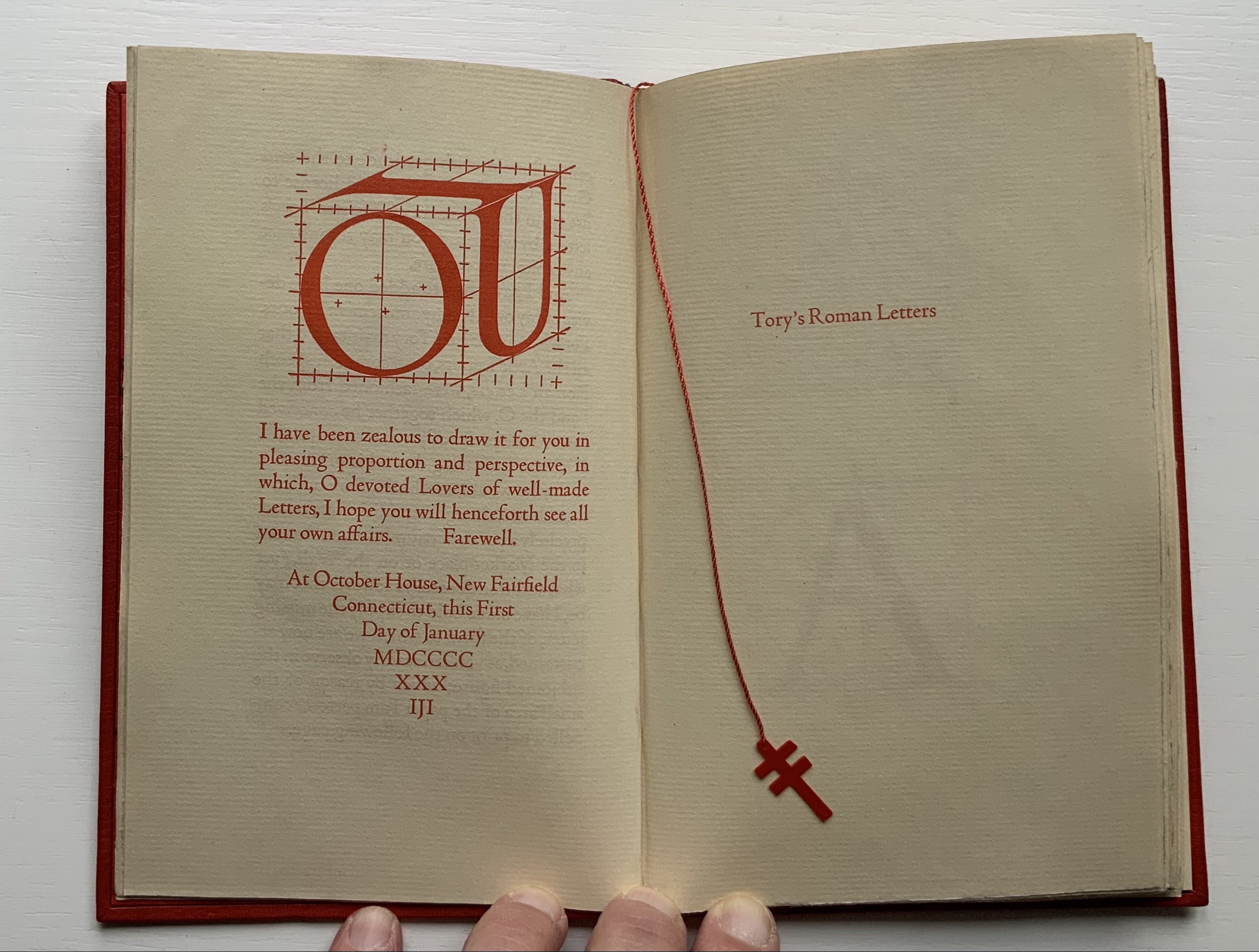
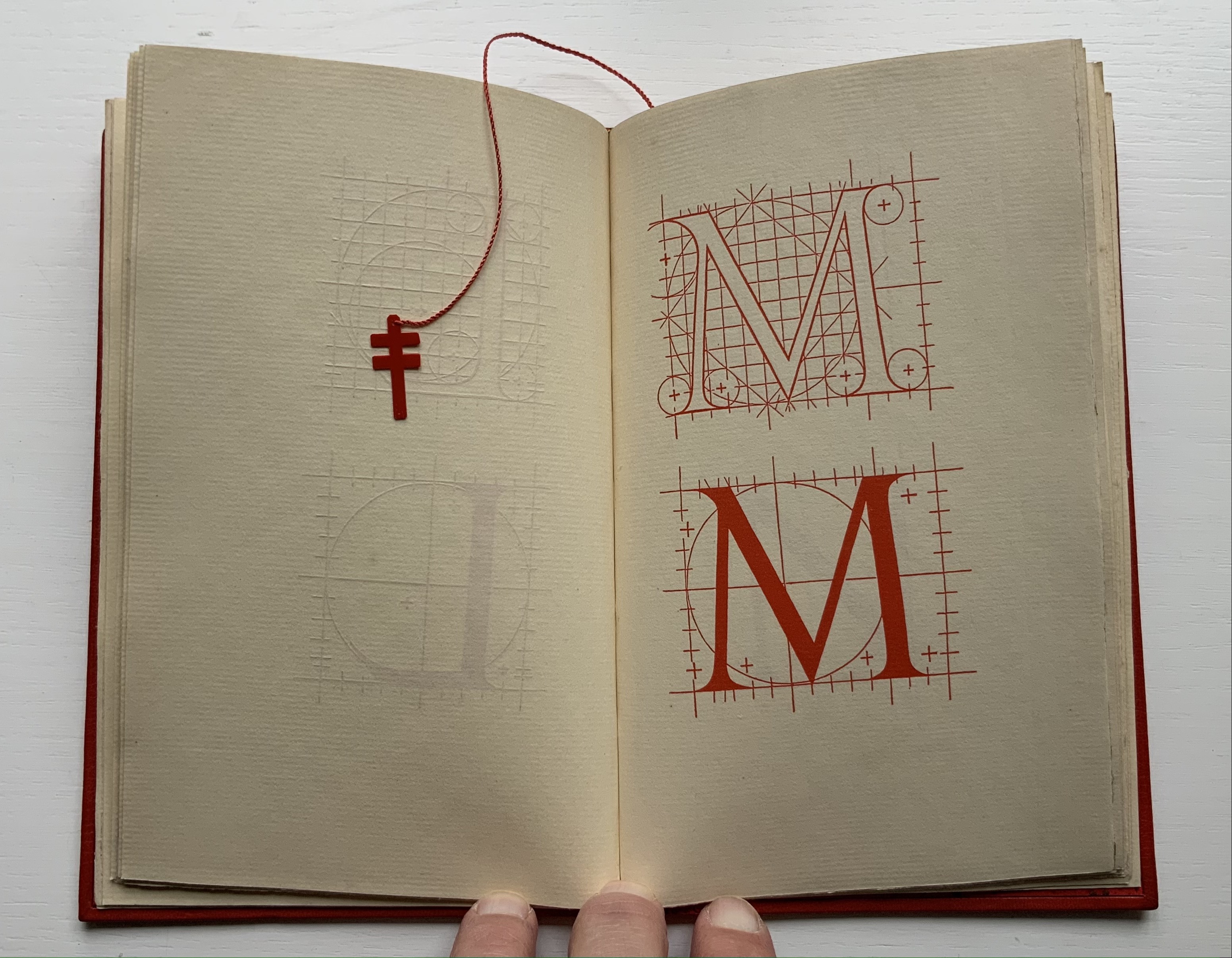
Rogers constructed the IOU device in a joking Depression-era homage to Tory. Referencing the mythological tale about Jupiter, Juno and poor IO who was turned into a cow, Tory maintained in Champ Fleury that all the Roman letters were fashioned from the “I” and the “O.” By placing Roger’s IOU on the back cover, binder Peter Geraty doubles Rogers’ pun on the debt to Tory’s “letterology”. Both Geraty and Rogers are acknowledging a debt to Tory as a book designer.

Adding to his joke, Rogers printed the whole of Champ Rosé in red, which Geraty follows. Rogers explained the red ink in his poor man’s Champ Fleury “as in these aforesaid days of hardship & depression much Book-Keeping is being written down in red…perhaps it would be better for Book-Selling too if Printing were done in that cheerful colour.…”

Geraty’s binding was part of the 1989 Guild of Book Workers exhibition.

Photos: The Veatchs.

Photos: Books On Books Collection.

The Books On Books Collection also holds a copy of George B. Ives translation of Champ Fleury, designed, typeset at printed by Rogers.

Further Reading

Abecedaries I (in progress)“, Books On Books Collection, 31 March 2020.

Geofroy Tory”. 18 June 2021. Books On Books Collection.

Bruce Rogers and His Centaur”. September-October 2006. Harvard Magazine.

The Bruce Rogers Collection”. Last updated 27 May 2021. E.H. Little Library, Davidson College.

Kelly, Jerry, and Misha Beletsky. 2016. The Noblest Roman: A History of the Centaur Types of Bruce Rogers. Boston: David R. Godine.

Updike, Daniel Berkeley. 1939. The work of Bruce Rogers: jack of all trades, master of one : a catalogue of an exhibition arranged by the American Institute of Graphic Arts and the Grolier Club of New York. New York: Oxford University Press.

Books On Books Collection – Marie Angel

An Animated Alphabet (1996)

An Animated Alphabet (1996)
Marie Angel
Paperback, perfect bound. H140 x W160 mm, 64 pages. Acquired from Redux Books, 28 April 2021.
Photos: Books On Books Collection.

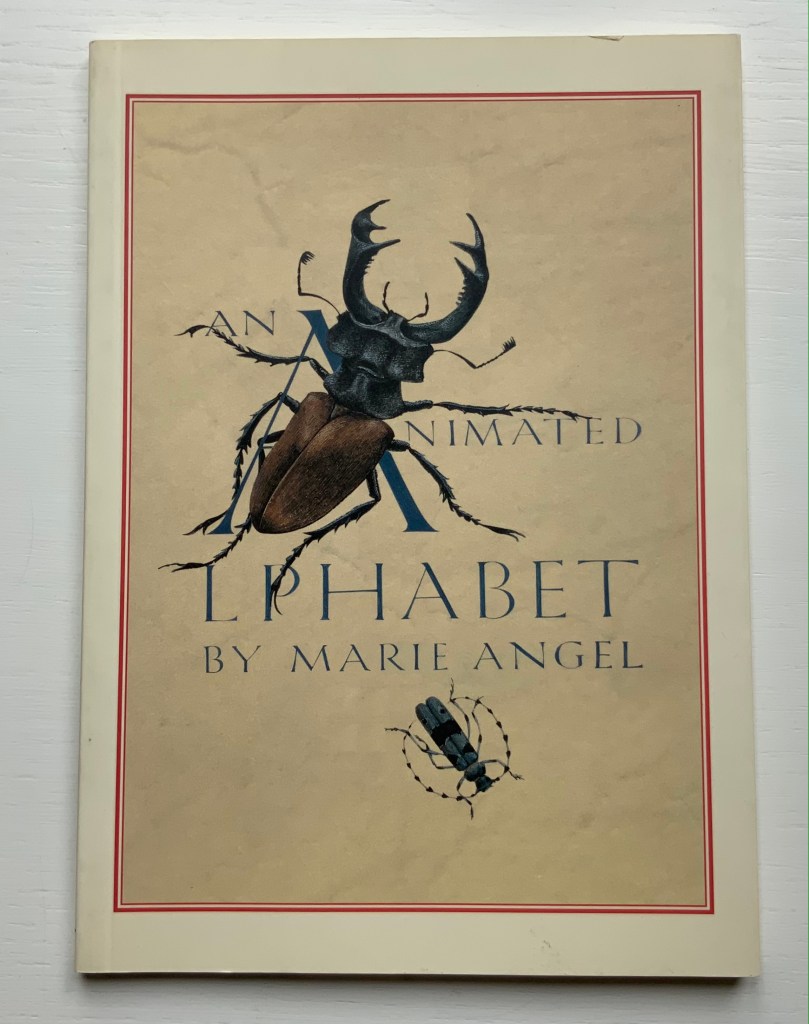
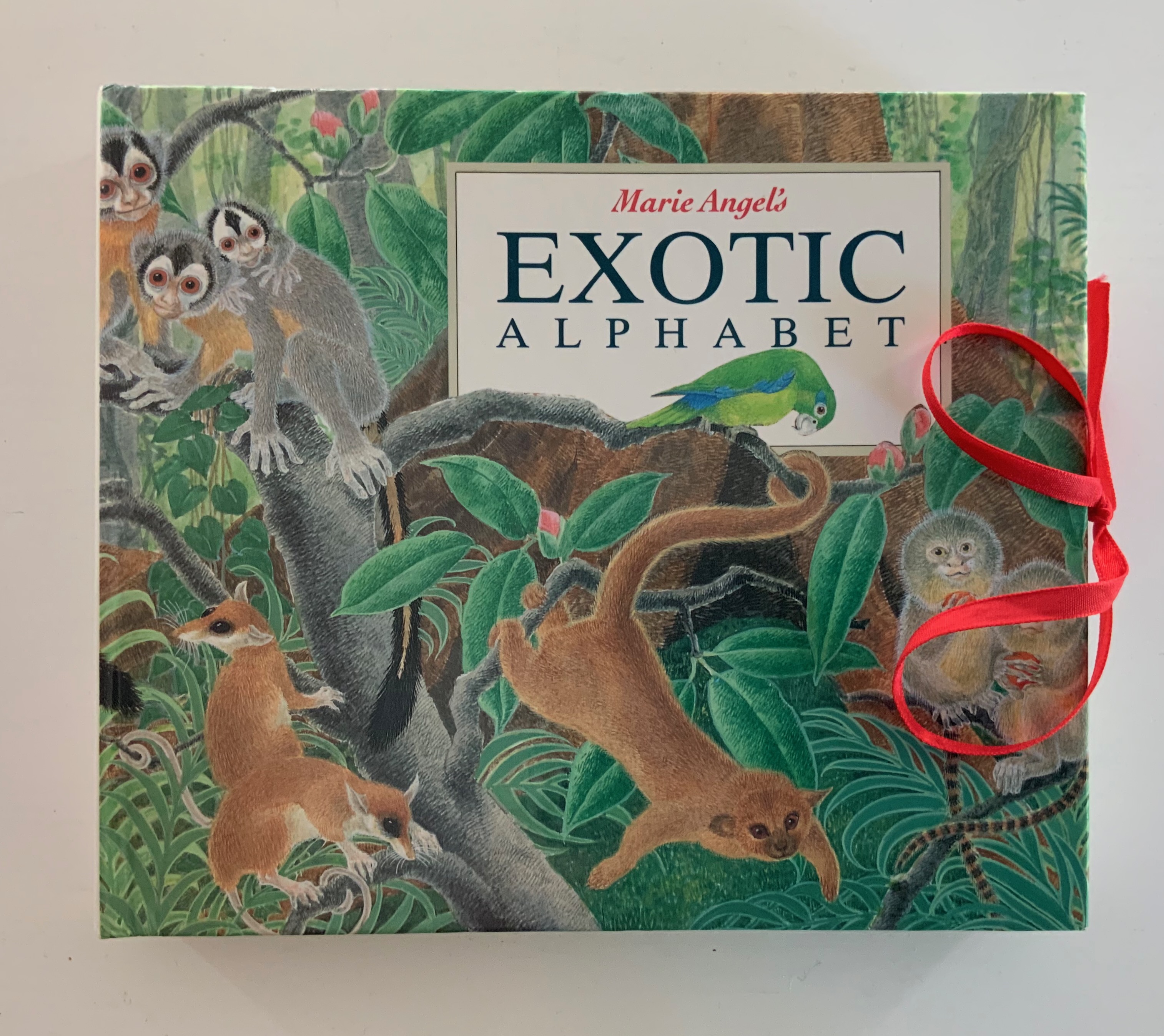
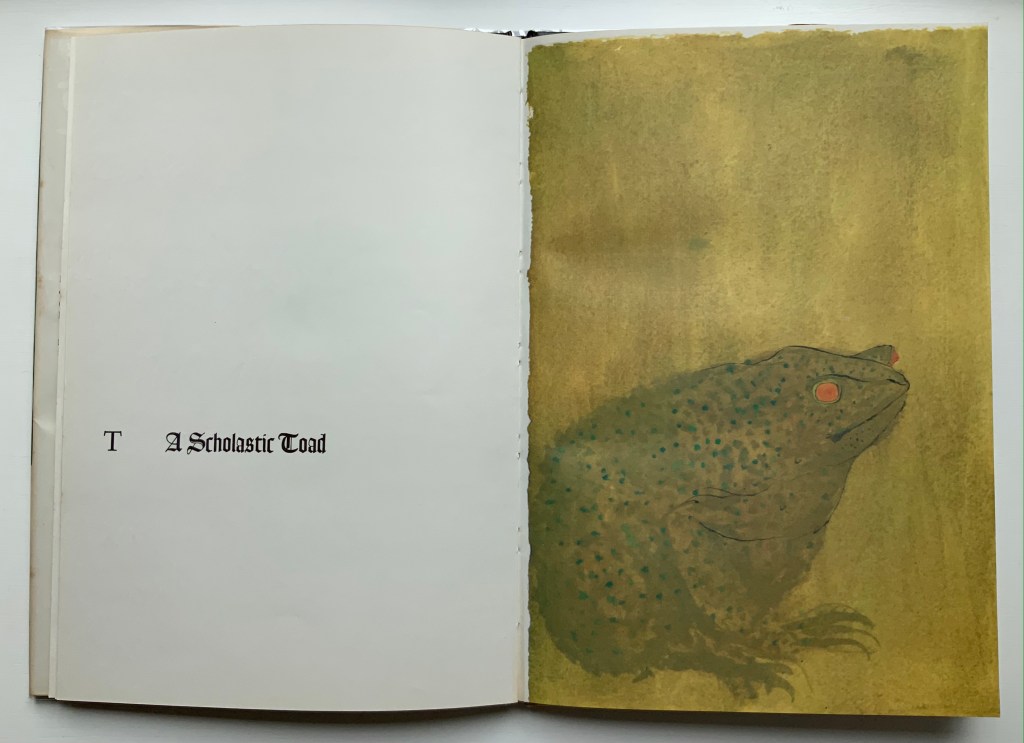
In the 1960s, Philip Hofer of Harvard’s Houghton Library commissioned the British illustrator to create a series of bestiaries. A black and white edition of An Animated Alphabet appeared in 1967. The publisher David Godine issued this full color edition in 1996. Before the Godine edition, other abecedaries appeared, including Marie Angel’s Exotic Alphabet (a lift-the-flap double-sided accordion book) in 1992, the colorful Angel’s Alphabet in 1986 and An Alphabet of Flowers in 1987.

From An Animated Alphabet

Marie Angel’s Exotic Alphabet (1992)
Marie Angel
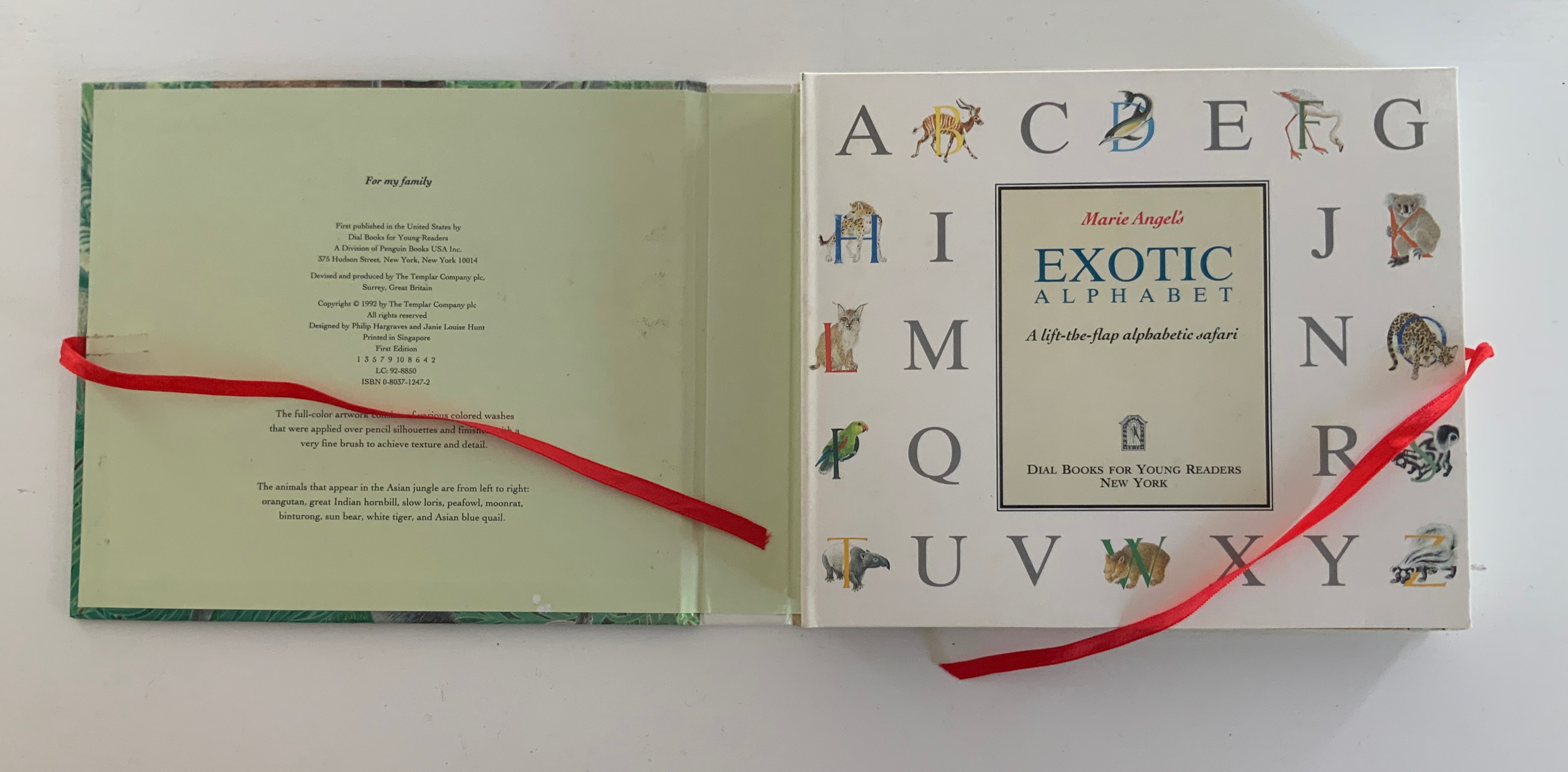
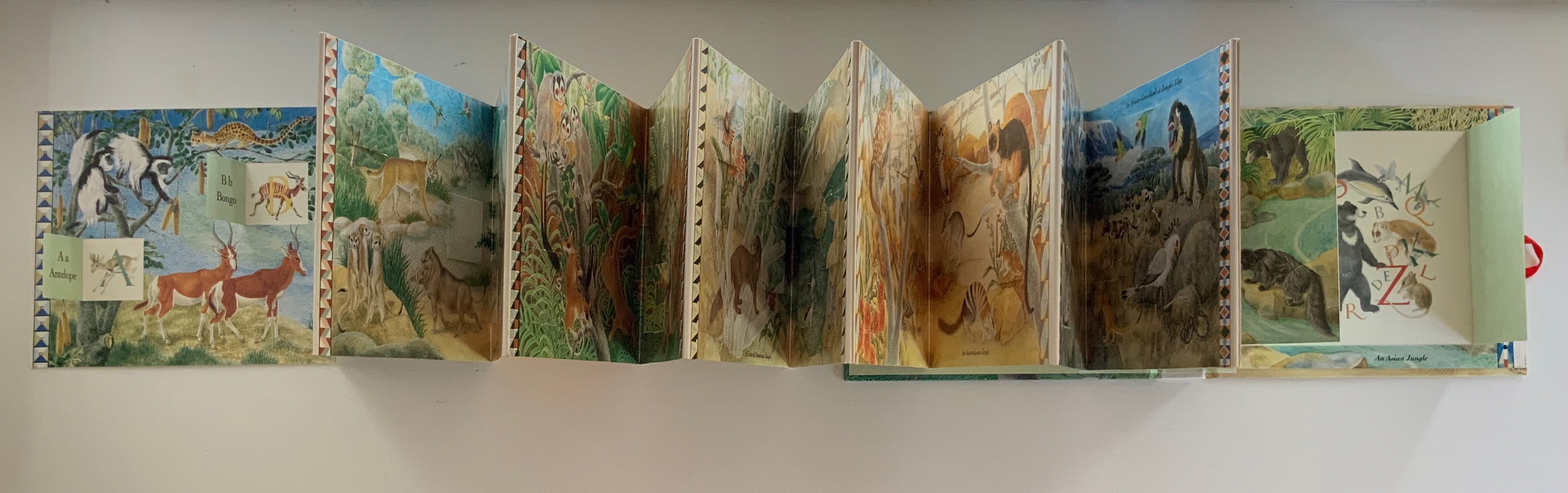
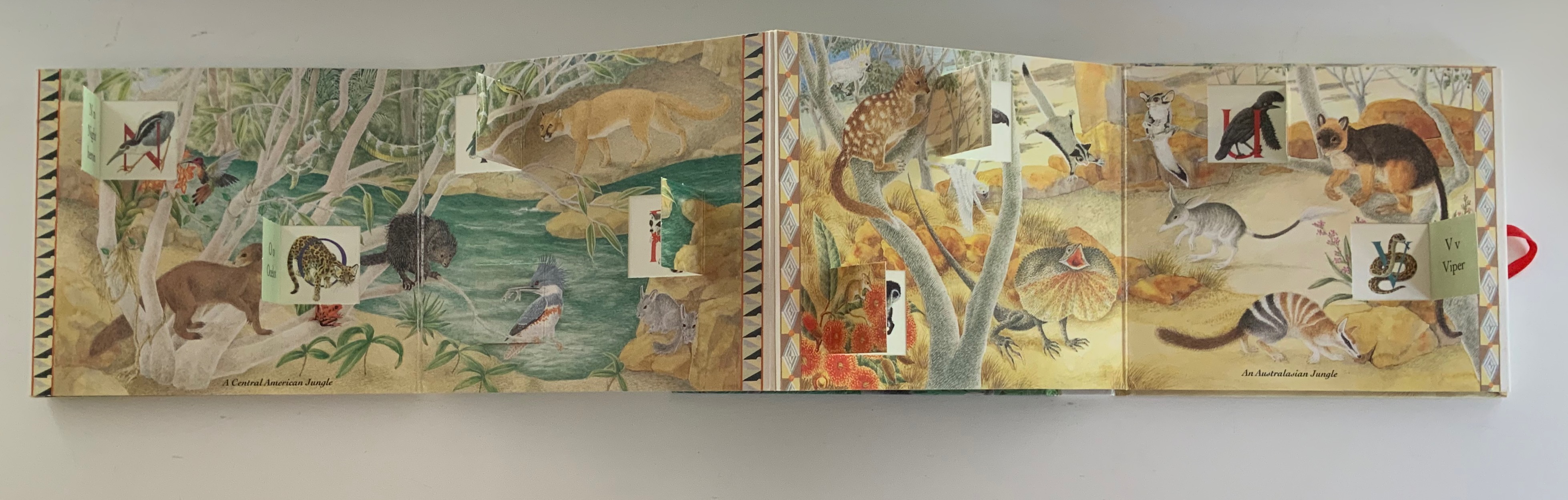
Ribbon-tied, paper on boards case, inclosing lift-the-flap double-sided accordion book. Closed: H172 x W202 x D28 mm. Open: W2730 mm, 27 panels, including title panel. Acquired from Robert Gavora, Fine and Rare Books, 7 September 2021.
Photos: Books On Books Collection.

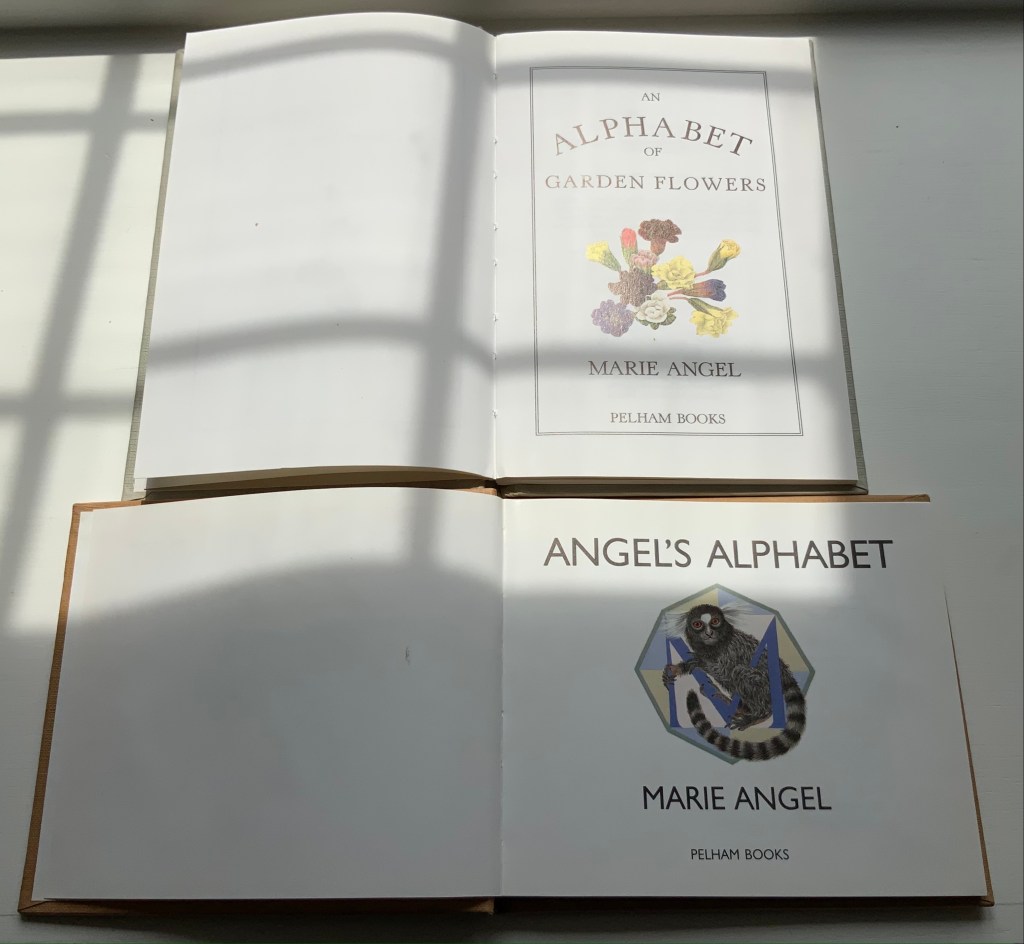
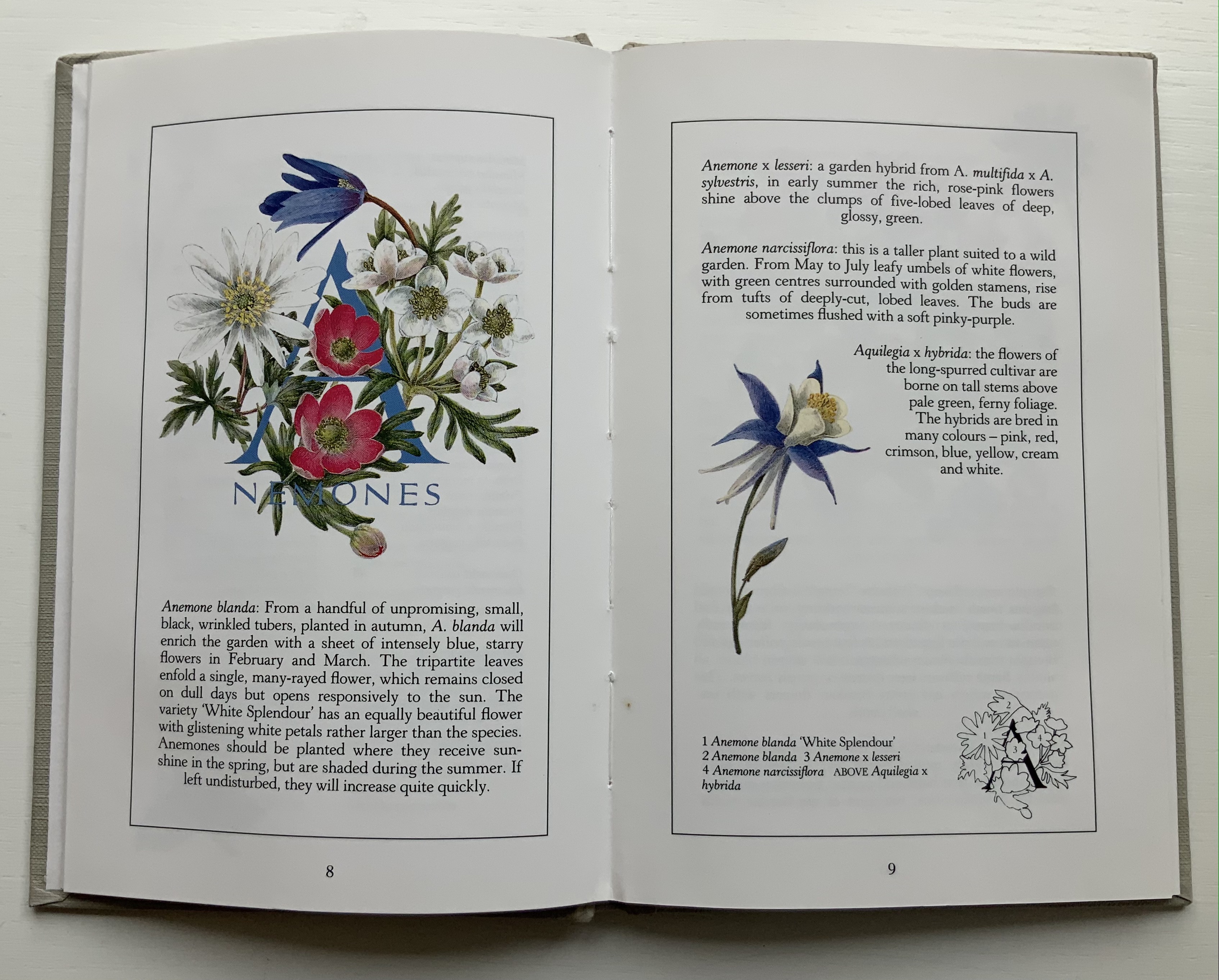
An Alphabet of Garden Flowers (1987)
Casebound with decorated endpapers. H205 x W140 mm, 66 pages.
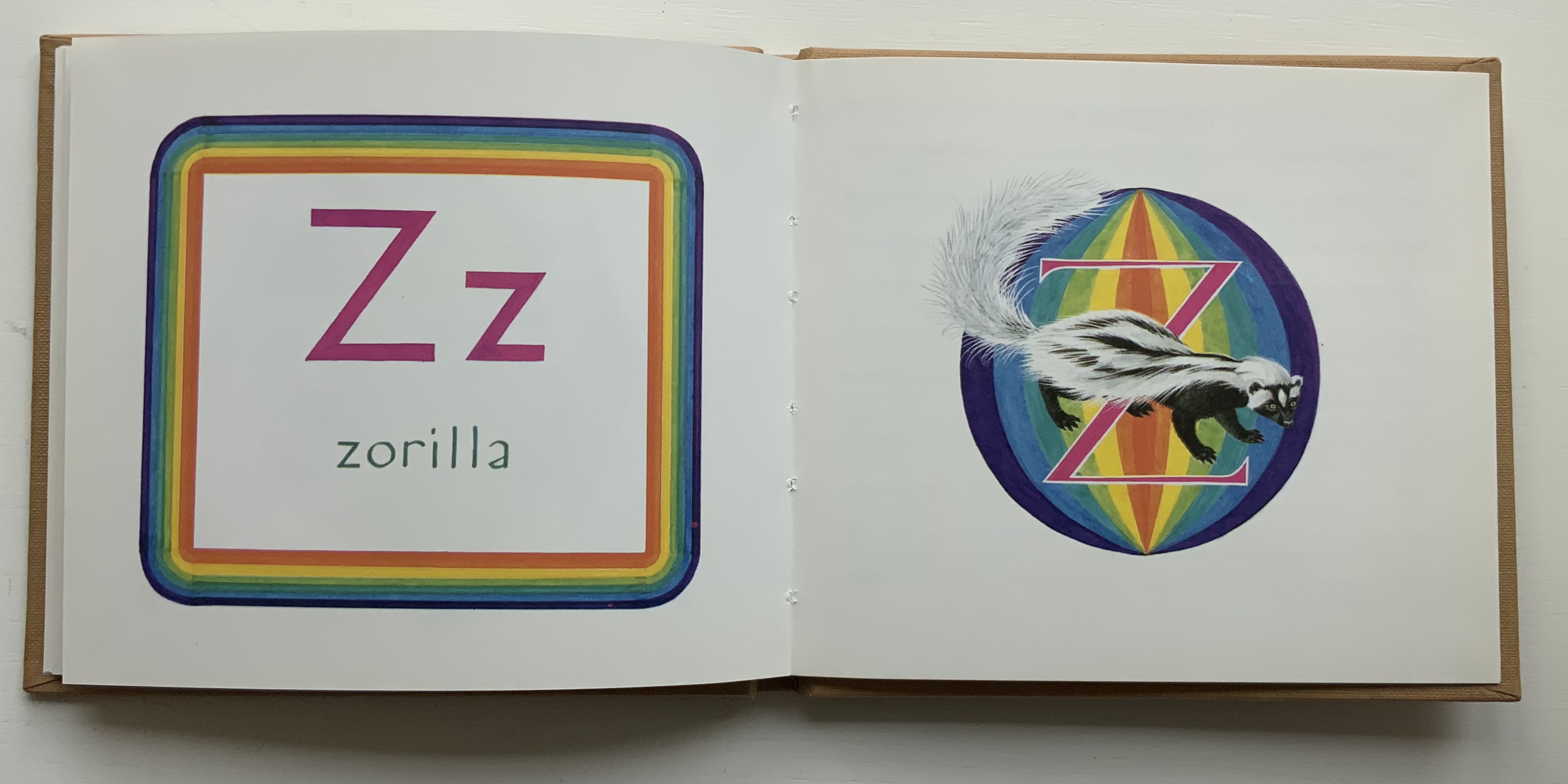
Angel’s Alphabet (1996)
Casebound with decorated endpapers. H140 x W 160 mm, 60 pages.
Acquired 7 June 2021. Photos: Books On Books Collection

Even with different audiences, Angel’s style and eye for choice show through from A to Z.

Further Reading

Abecedaries I (in progress)“, Books On Books Collection, 31 March 2020.

Mullen, Chris. n.d. “Marie Angel’s Alphabet”, in “The alphabet of illustrators and artists”, The Visual Telling of Stories. Accessed 7 June 2021.

Books On Books Collection – Wim Crouwel

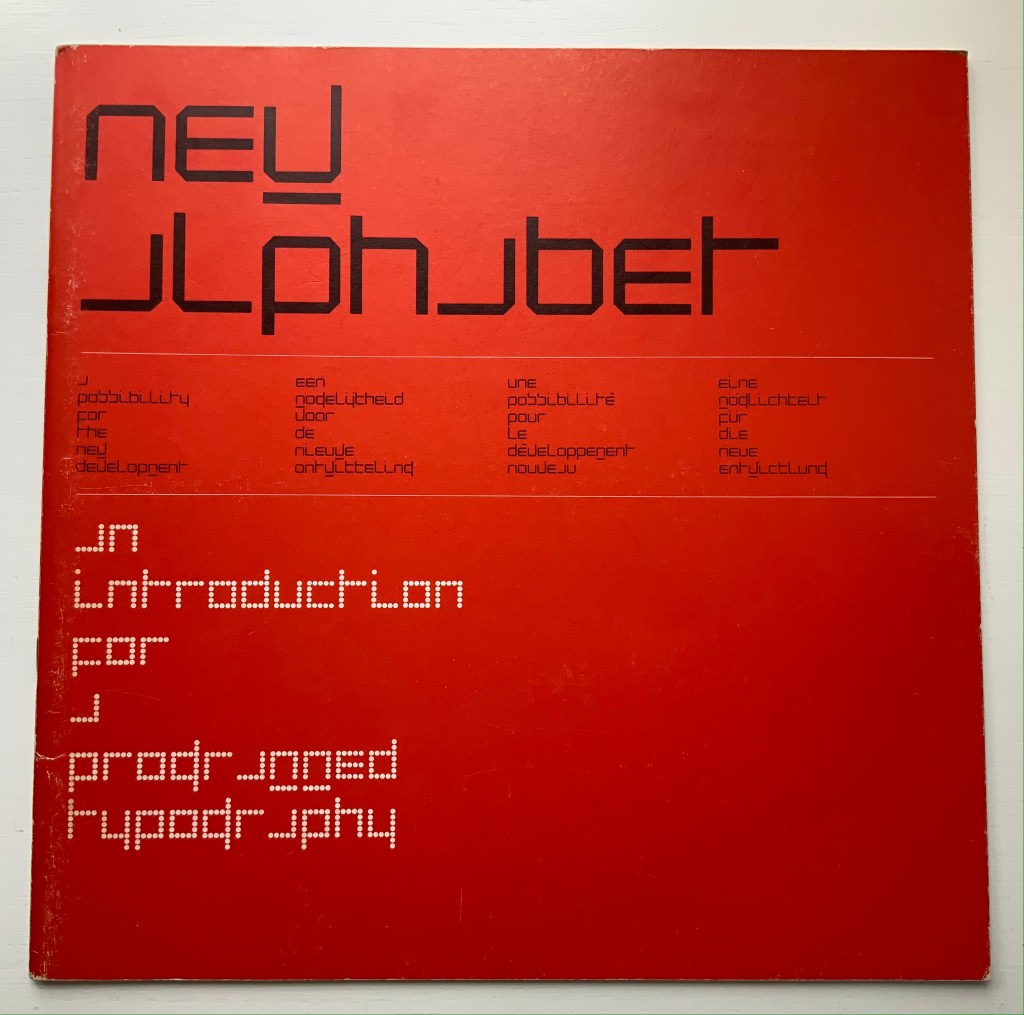
New Alphabet: an introduction for a programmed typography (1967)

New Alphabet: an introduction for a programmed typography (1967)
Wim Crouwel
Booklet, 250 x 250 mm, 20 pages. Acquired from 27 April 2021.
Photos: Books On Books Collection.

This publication by the Dutch graphic designer and series editor, Pieter Brattinga, in his Kwadraatblad/Quadrat-prints series inaugurated a subset of responses from Gerard Unger, Timothy Epps and Christopher Evans, and Anthon Beeke.

Shocked by the very low resolution output of electronic type-setting machines and sparked by the challenge to define a type that, more than traditional types, would be suited for the speed of machine output (particularly composing systems with CRT — cathode-ray tubes) and still be readable by humans, Crouwel came up with the New Alphabet.

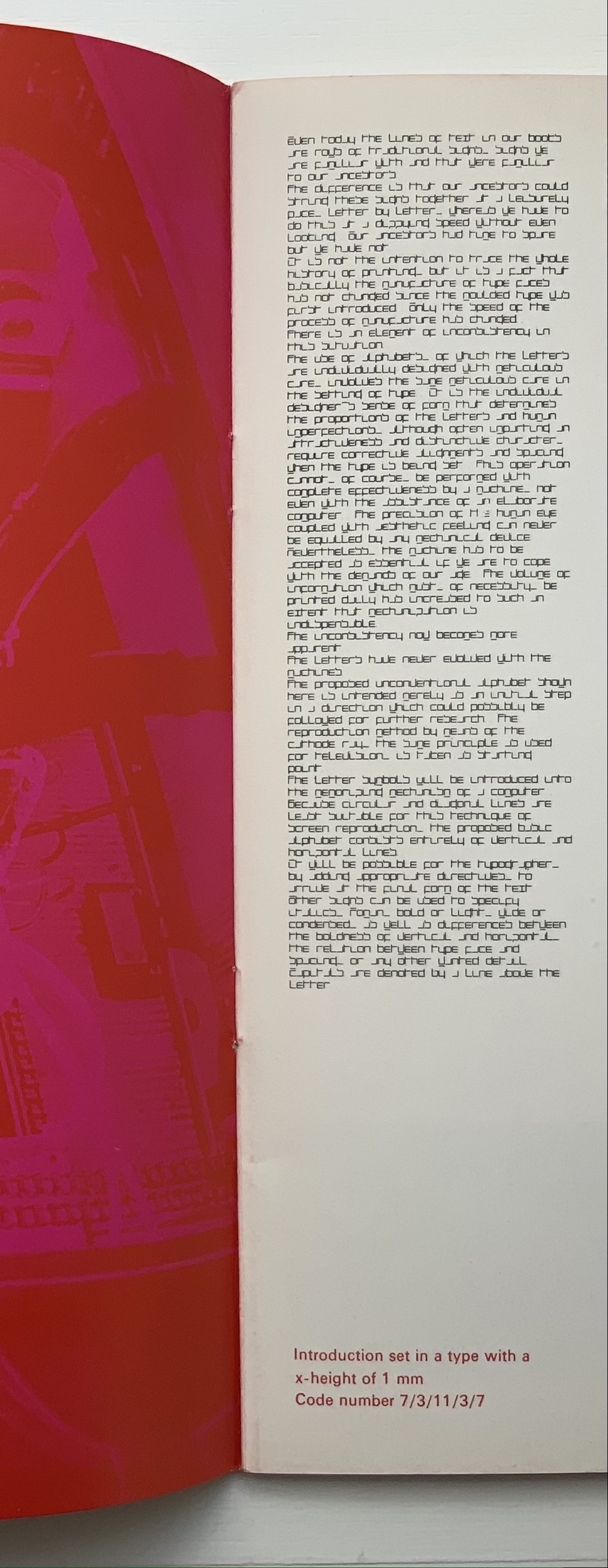
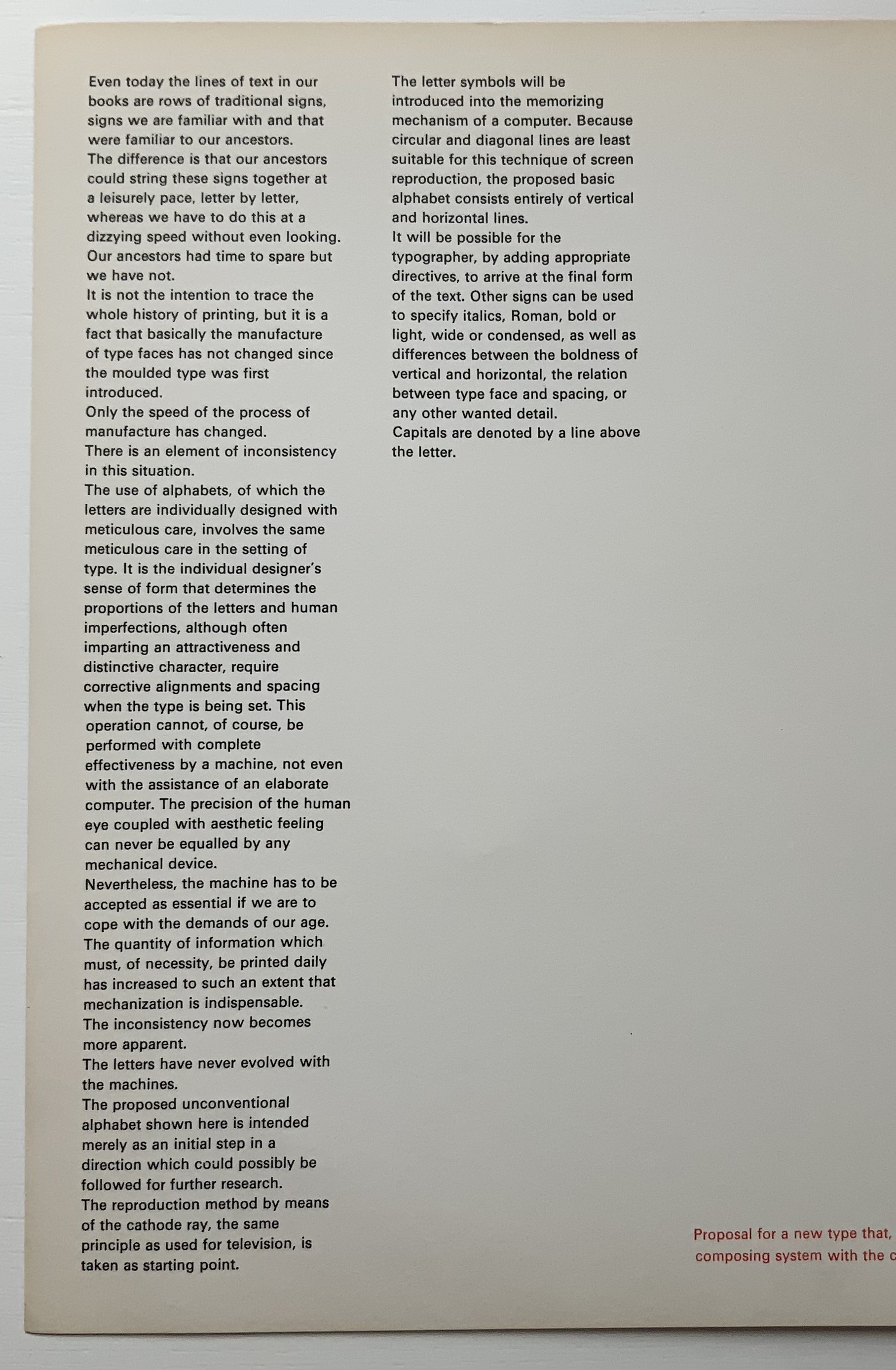
On the left, Crouwel’s introduction in New Alphabet; on the right, in Univers.

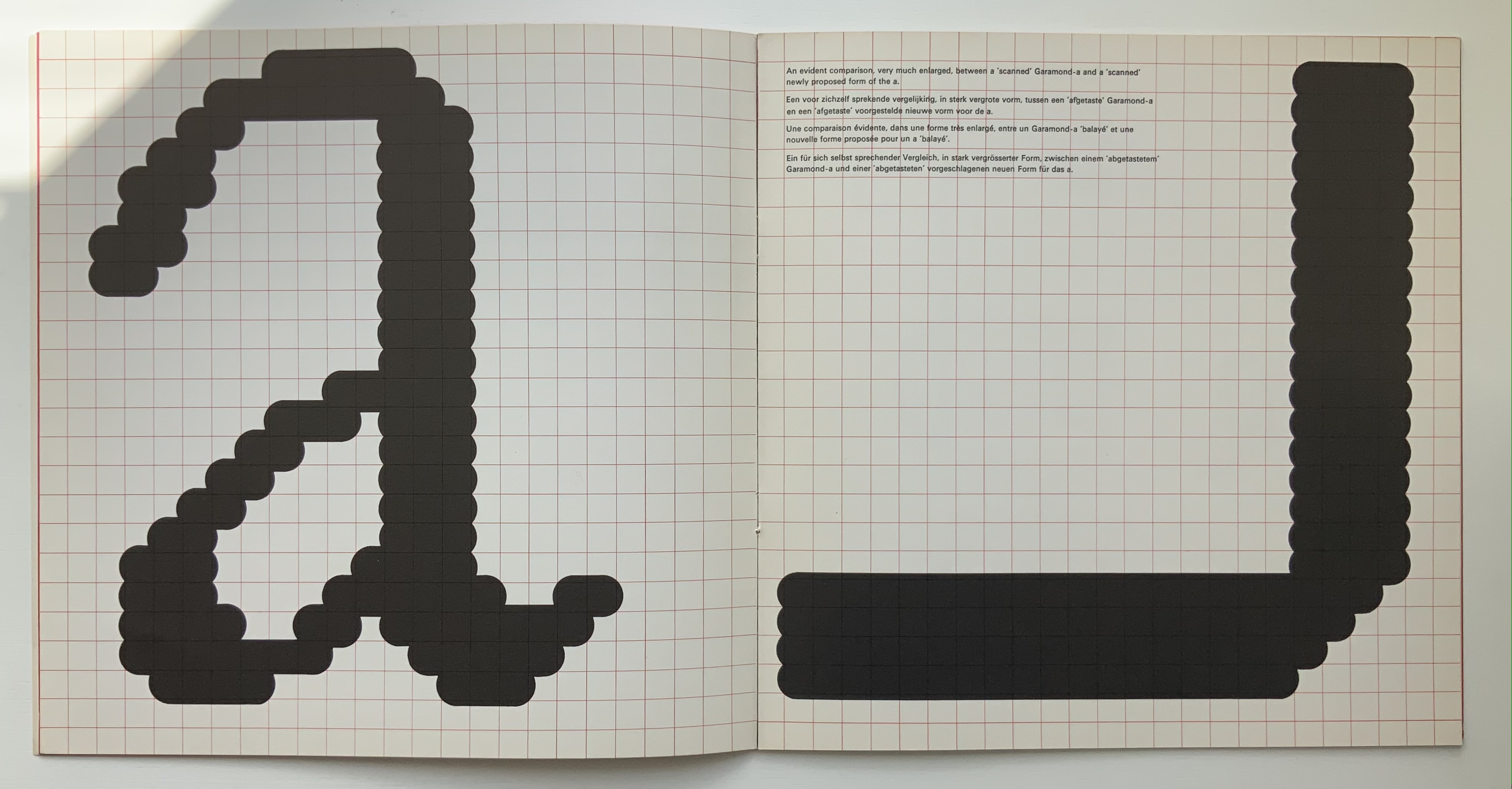
A double-page spread (not shown) explains the variables and rules for coding and resizing the letters. Clearly, from the side-by-side view of Crouwel’s introduction (above), humans would need to learn some new conventions (e.g., majuscules are designated by bars over miniscules) for the font to be readable. Some letters, such as “a” (below), would require recognition of an utterly different shape. Despite — or because of — that, the font appealed to album and magazine cover designers in the digital ’80s.

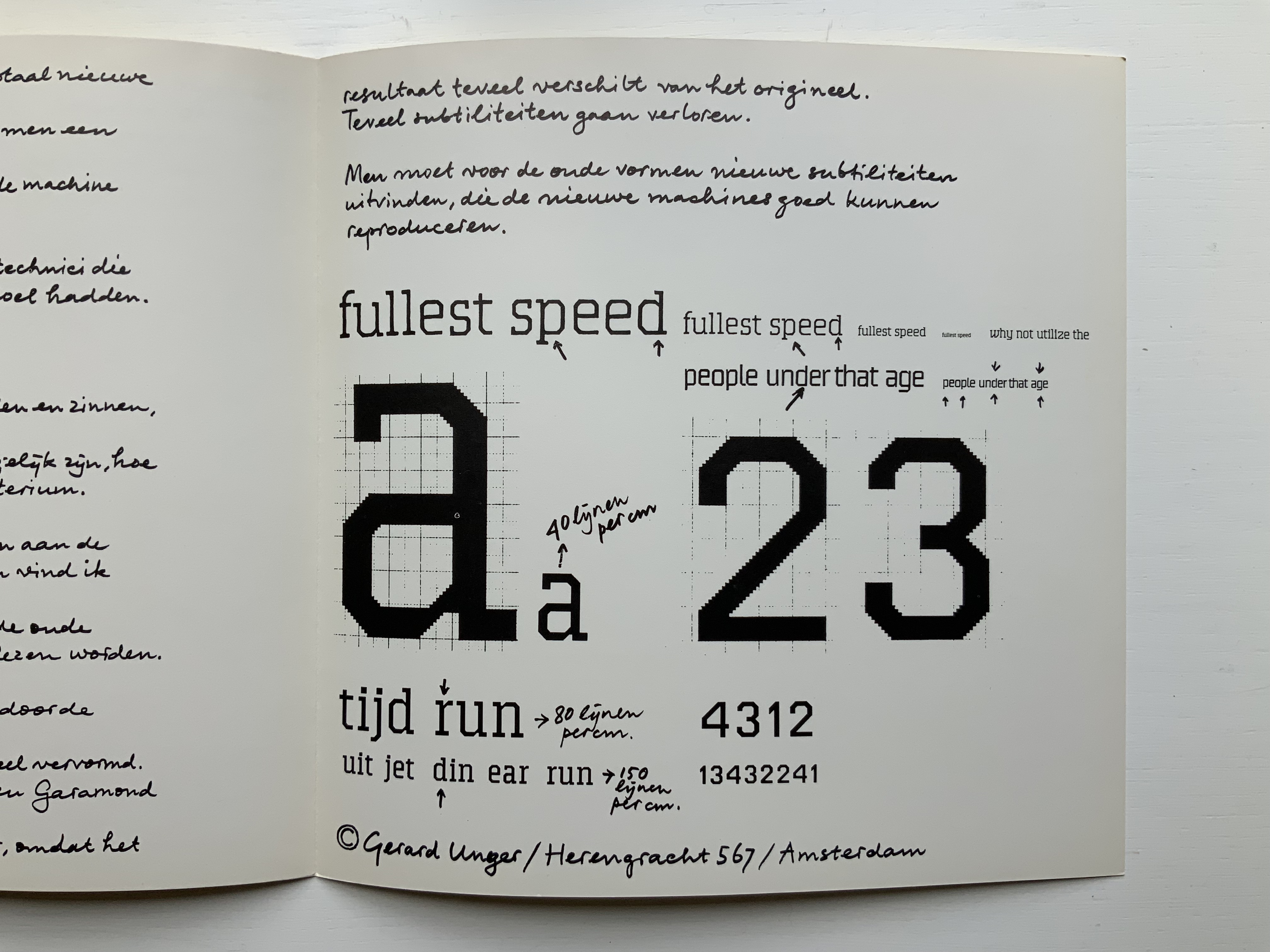
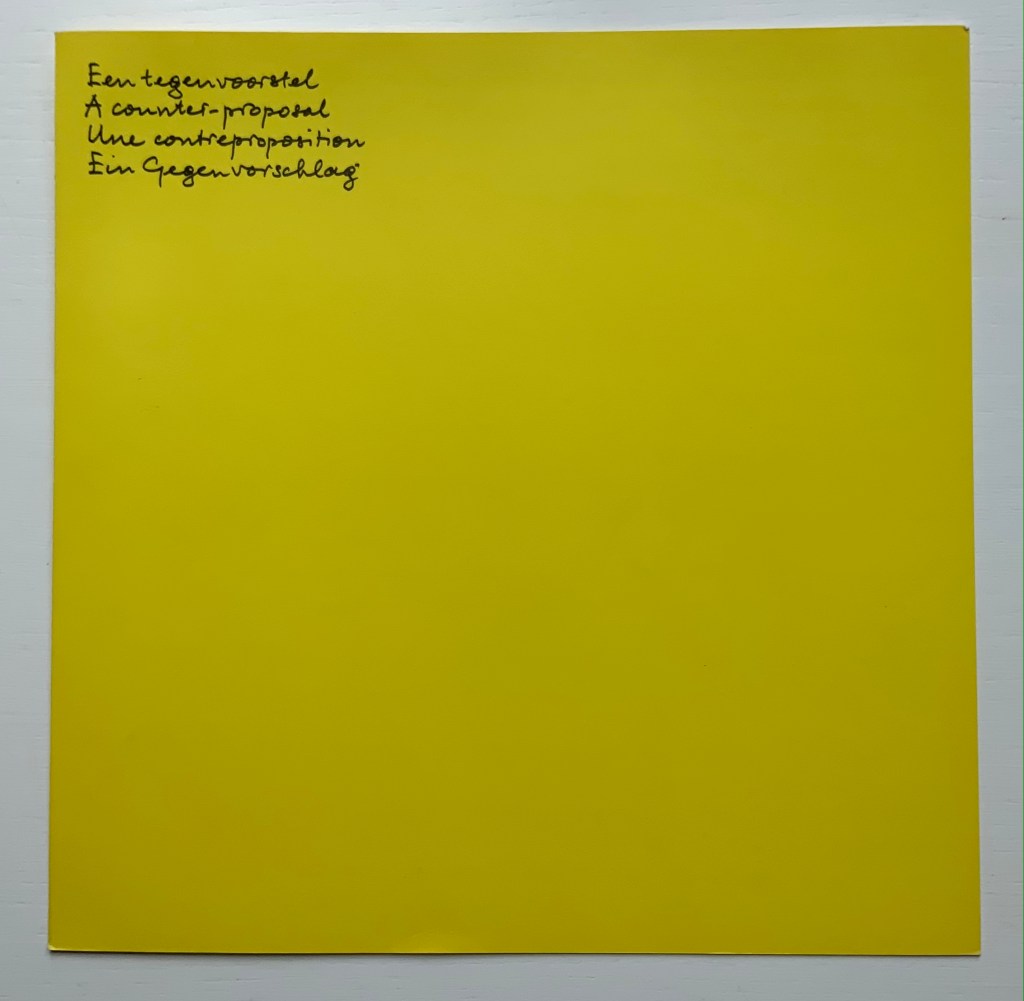
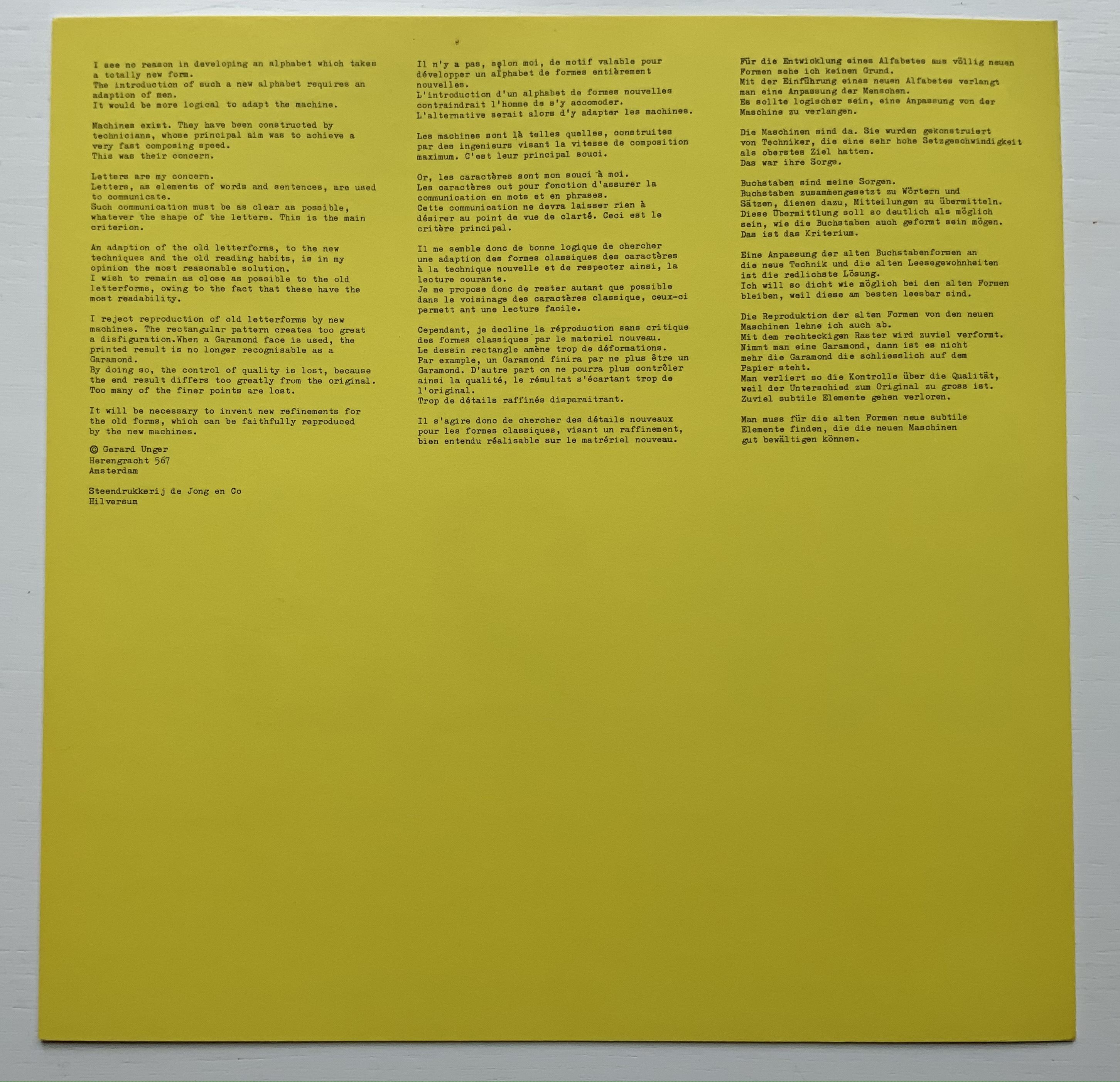
Disturbed by letting machines take precedence over the human eye, Gerard Unger, one of Crouwel’s colleagues, submitted a “counter proposal” — tellingly in handwriting. Juxtaposition of their lowercase “a’s” with Geofroy Tory’s majestic majuscules offers a counter-counter historic perspective on the art of the alphabet.

Clockwise: Tory, Crouwel and Unger.

Further Reading

Abecedaries I (in progress)“, Books On Books Collection, 31 March 2020.

Wim Crouwel“, Iconofgraphics. n.d. Accessed 10 May 2021.

Timothy Epps and Christopher Evans“, Books On Books Collection, 26 April 2021.

Raffaella della Olga“, Books On Books Collection, 8 December 2020.

Gerard Unger“, Books On Books Collection, 12 May 2021.

Owens, Sarah. 2006. “Electrifying the Alphabet“, Eye, No. 62, Vol. 16. Accessed 25 April 2021.

Place, Michael and Nicola. “Striking The Eye: An Interview With Wim Crouwel“, Creative Review, 29 June 2007/20 September 2019. Accessed 10 May 2021.

Books On Books Collection – Gerard Unger

A Counter-proposal (1967)

Een tegenvoorstel/A counter-proposal/Une contreproposition/Ein gegenvorschlag (1967)
Gerard Unger
Pamphlet. 250 x 250 mm, 4 pages. Acquired from Antiquariaat Frans Melk, 27 April 2021.
Photos: Books On Books Collection.

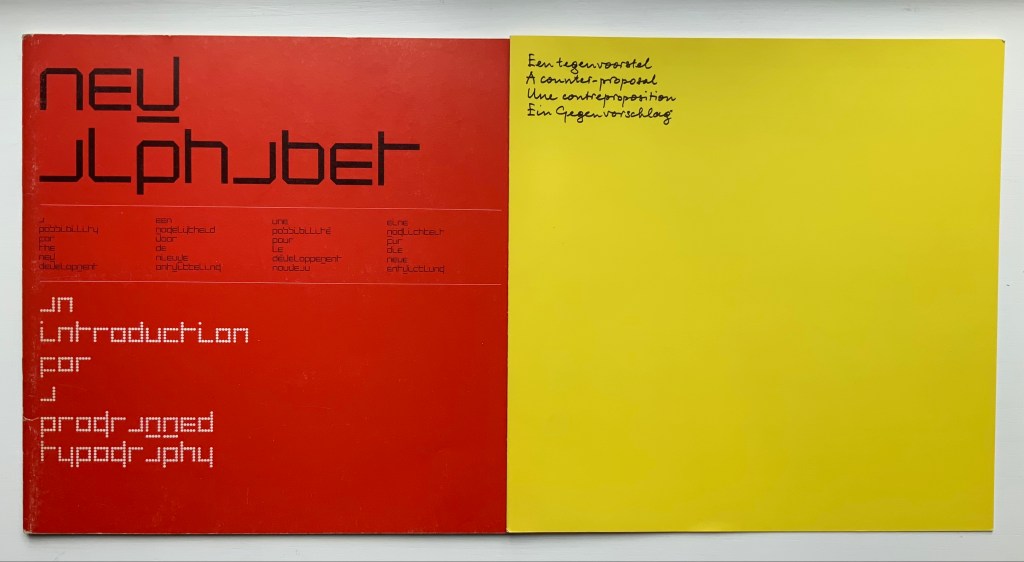
A few months after Pieter Brattinga issued Wim Crouwel‘s New Alphabet (below left), he followed up with this single-fold riposte from Gerard Unger, invited in fact by Crouwel.

Left: Crouwel. Right: Unger.

Unger urges designing or teaching machines to accommodate “human-readable” letterforms rather than inventing new fonts for machines. Given advances in digital type and artificial intelligence, Unger’s point may have been prescient, but there is still something to be said for the artistic stimulus of machine constraints.

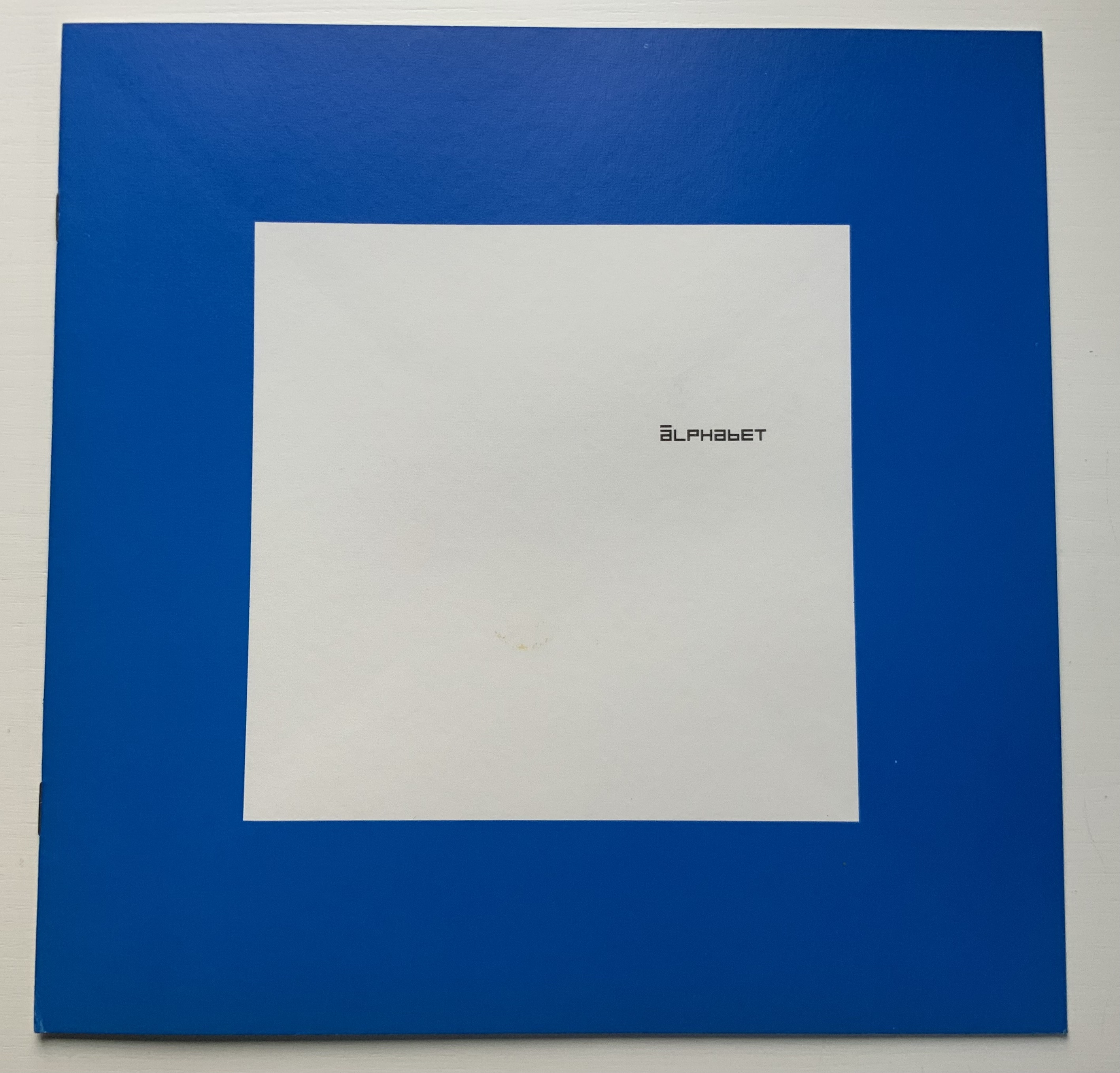
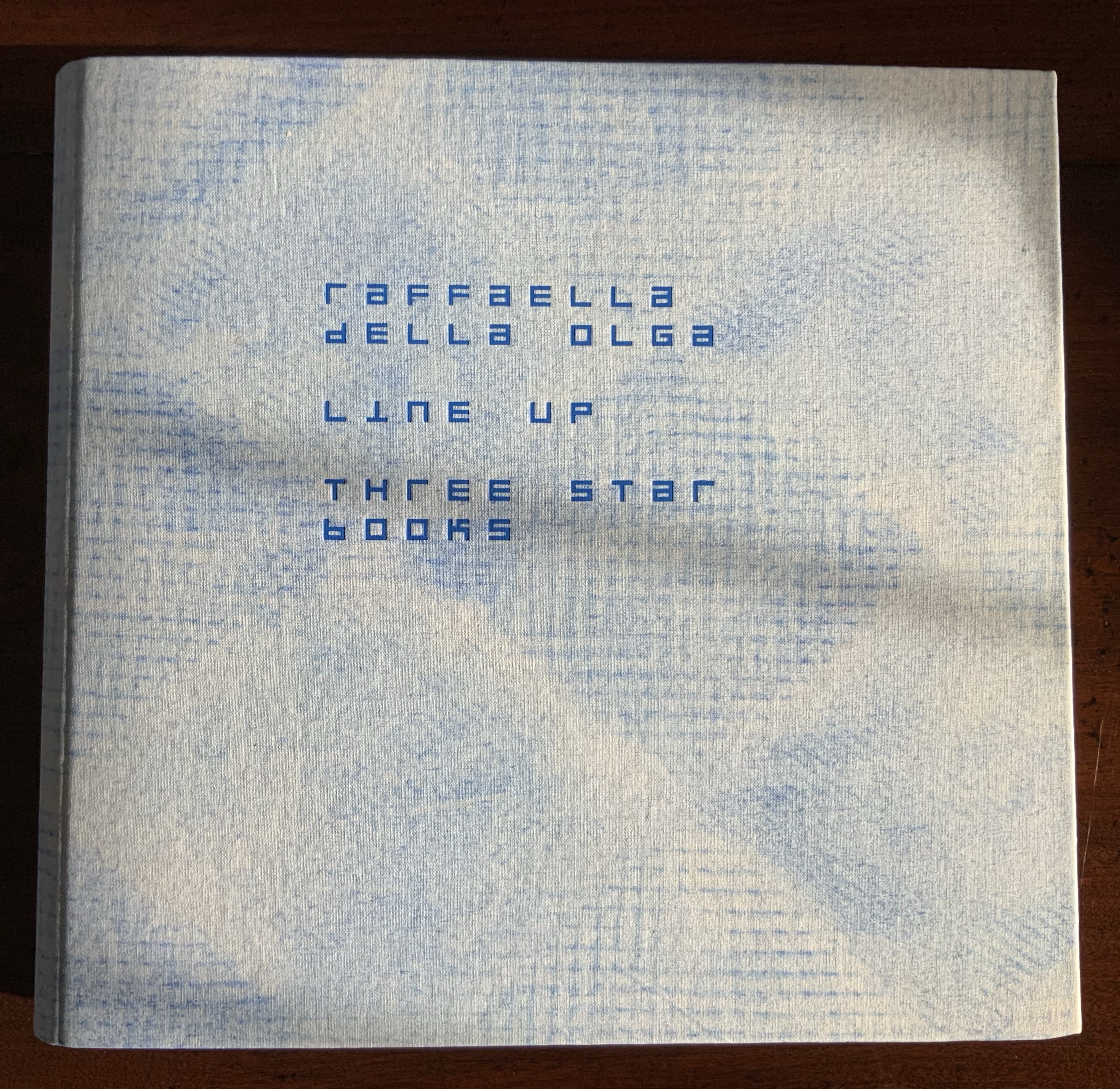
Brattinga extended the dialogue later to include Timothy Epps and Christopher Evans in 1970. If, as it did, the Epps/Evans alphabet led to LINE UP by Raffaella della Olga and Three Star Press, what other works of art have benefited from similar alphabetic and typographical dialogues?

Alphabet (1970), Timothy Epps and Christopher Evans; LINE UP (2020) Raffaella della Olga

Jeffrey Morin and Steven Ferlauto‘s Sacred Space (2003) has its roots in Ferlauto’s historical research into Roman capitals. Jennifer Farrell‘s The Well-Travelled Ampersand (2019) has its roots in the letterform and design thinking of Adrian Frutiger, Frederic Goudy, Dard Hunter, Edward Johnston and Russell Maret, among several others. Inclusion of source material like that by Crouwel, Epps and Evans, and Unger in the Collection offers paths to increased appreciation of those works of art inspired by them. Something for the future history of book art.

Further Reading

Abecedaries I (in progress)“, Books On Books Collection, 31 March 2020.

Wim Crouwel“, Books On Books Collection, 12 May 2021.

Timothy Epps and Christopher Evans“, Books On Books Collection, 26 April 2021.

Russell Maret“, Books On Books Collection, 20 September 2019.

Jeffrey Morin and Steven Ferlauto“, Books On Books Collection, 23 April 2021.

Raffaella della Olga“, Books On Books Collection, 8 December 2020.

The Last Word on the Ampersand“, Books On Books Collection, 27 June 2020. See for Jennifer Farrell.

Olocco, Riccardo. “The inner consistency of Gerard Unger“, CAST: The science of type, its history and culture, 18 May 2017. Accessed 10 May 2021.

Perondi, Luciano. “‘The digital wave’ by Robin Kinross“, CAST: The science of type, its history and culture, 17 March 2020. Accessed 10 May 2021.

Books On Books Collection – Leonard Baskin

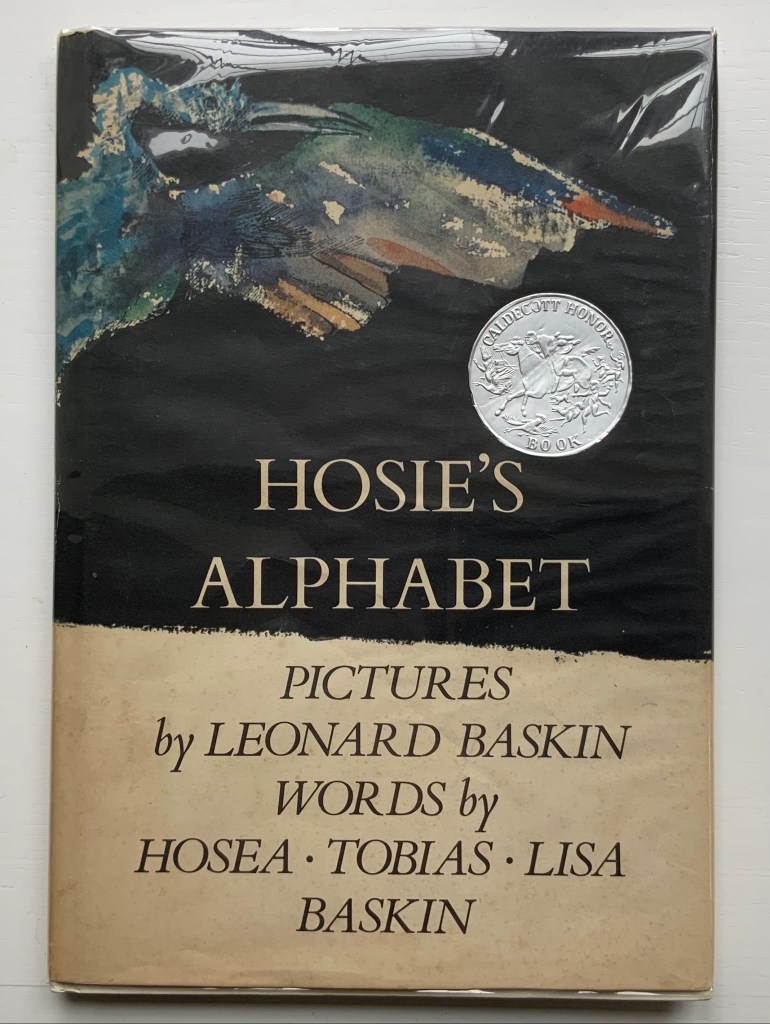
Hosie’s Alphabet (1972)

Hosie’s Alphabet (1972)
Pictures by Leonard Baskin, words by Hosea, Tobias and Lisa Baskin
Hardback H293 x W203 mm, 56 pages. Acquired from Springwell Books, 7 April 2021.
Photos: Books On Books Collection.

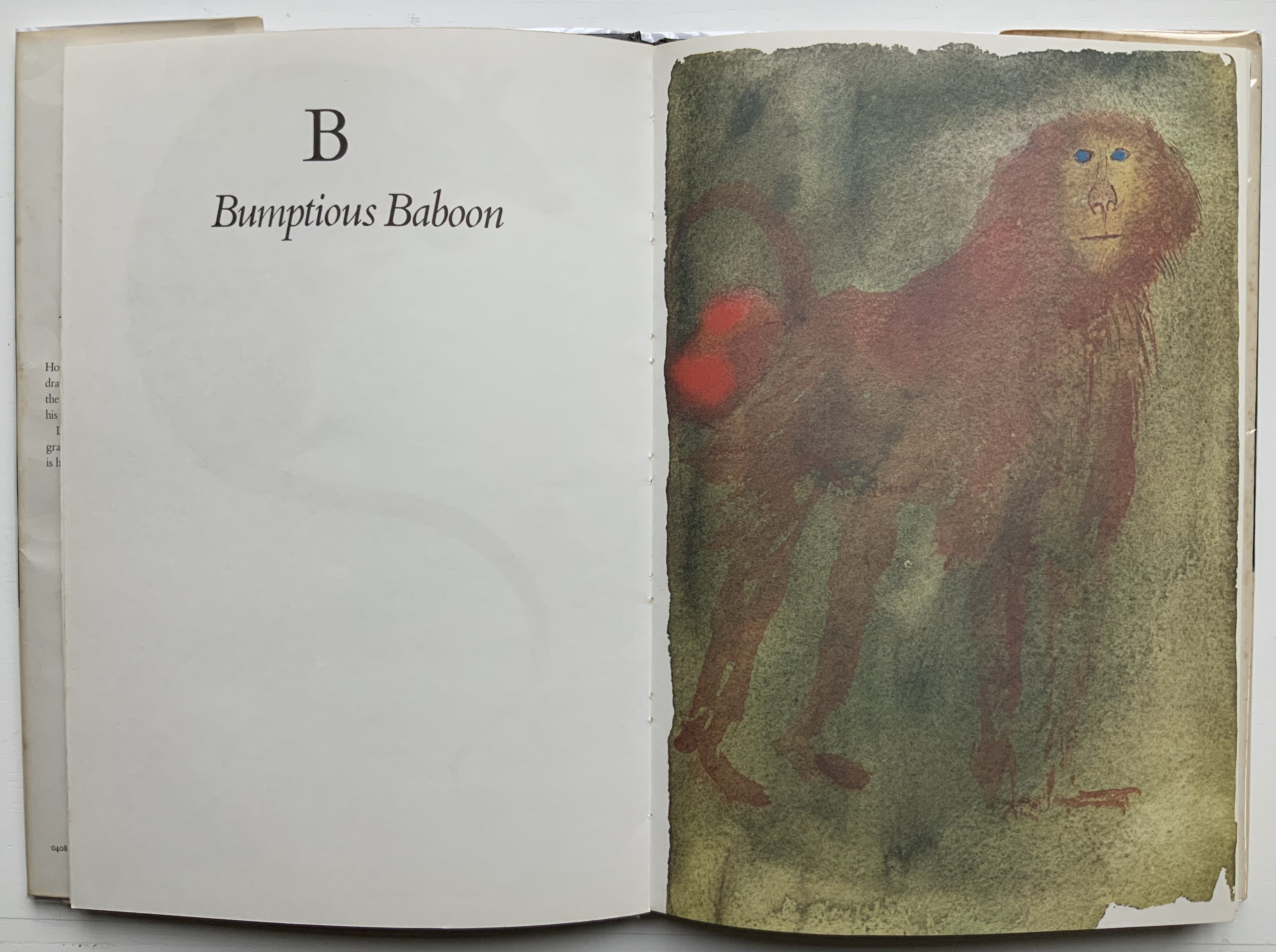
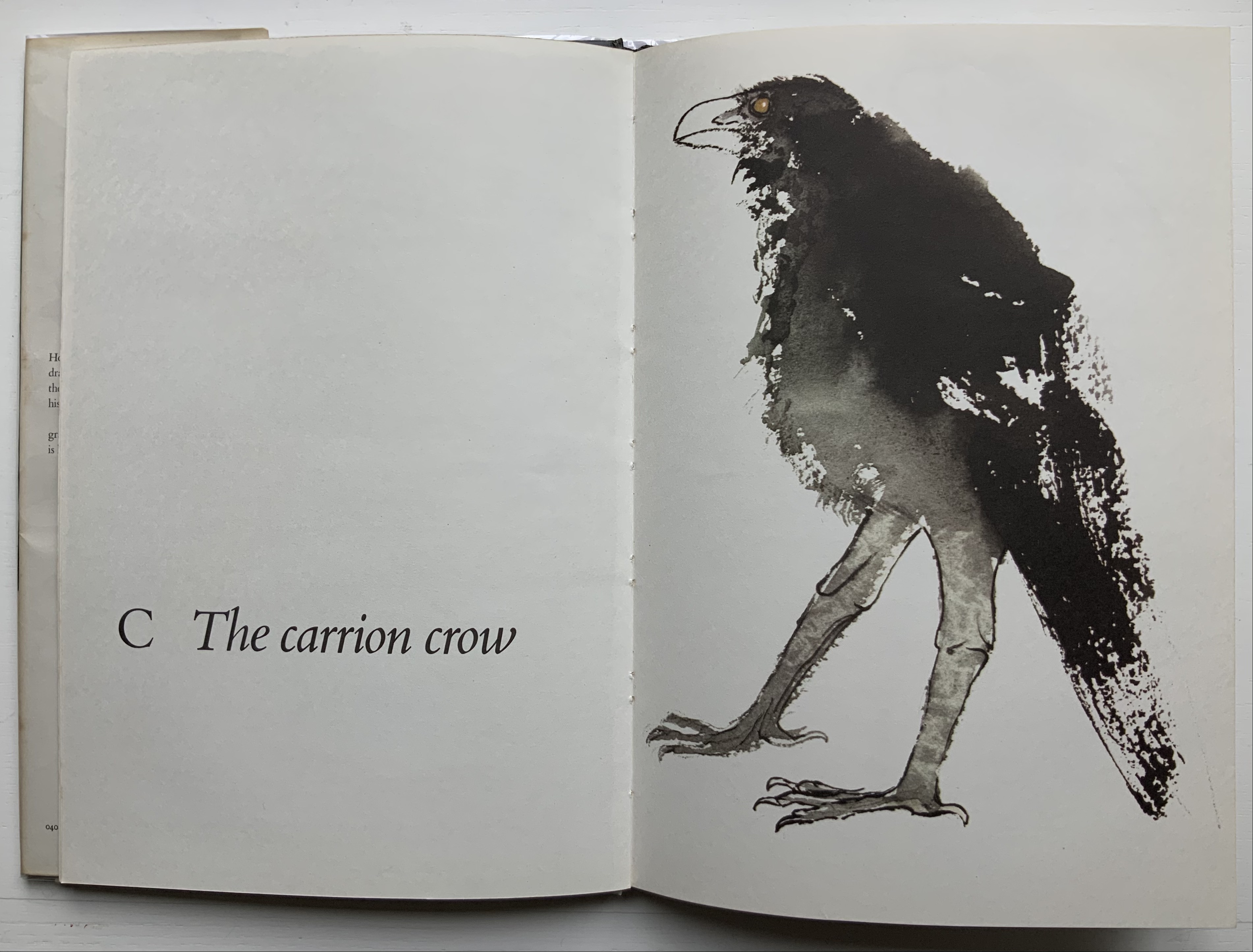
The Bodleian Library holds the Leonard Baskin archive, but strangely did not have a copy of Hosie’s Alphabet. Recently (19 July 2023 – 24 January 2024) for its exhibition “Alphabets Alive!”, the full set of original prints created for The Gehenna Alphabet (1982) went on display.

So this acquisition for the Books On Books Collection performs the double duty of adding a Caldecott winner to its subset of abecedaries and, when the Collection arrives as a donation, filling the gap in the Bodleian’s holdings.

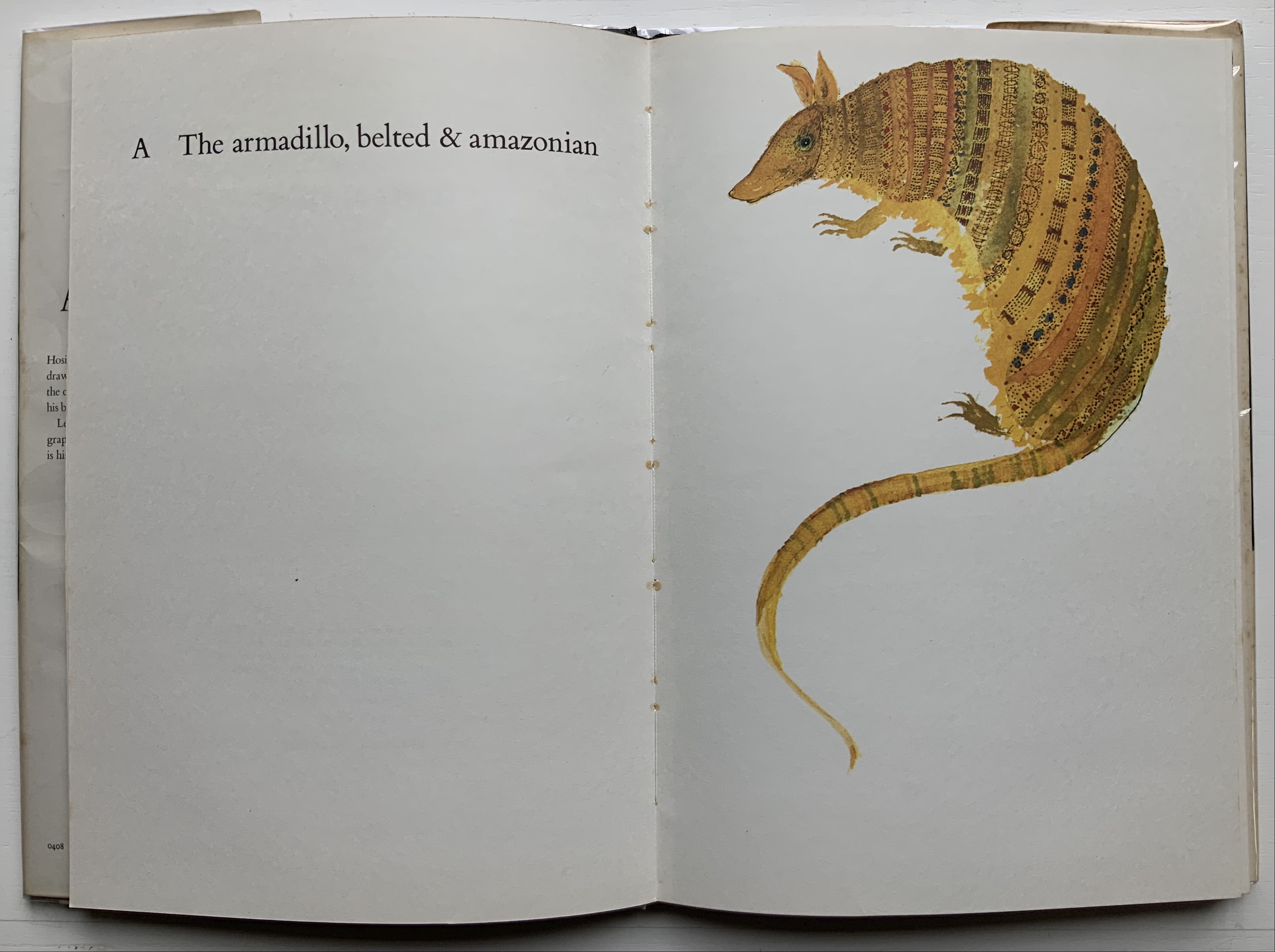
Baskin’s artistry in this book not only resides in the pictures. The layout and handling of Bembo vary — sometimes dramatically, sometimes subtly — in just the right way, be it in the use of uppercase, lowercase, roman, italic, bold, size, shading or the sudden introduction of Goudy Text.

Further Reading

Abecedaries I (in progress)“, Books On Books Collection, 31 March 2020.

Books On Books Collection – Takenobu Igarashi

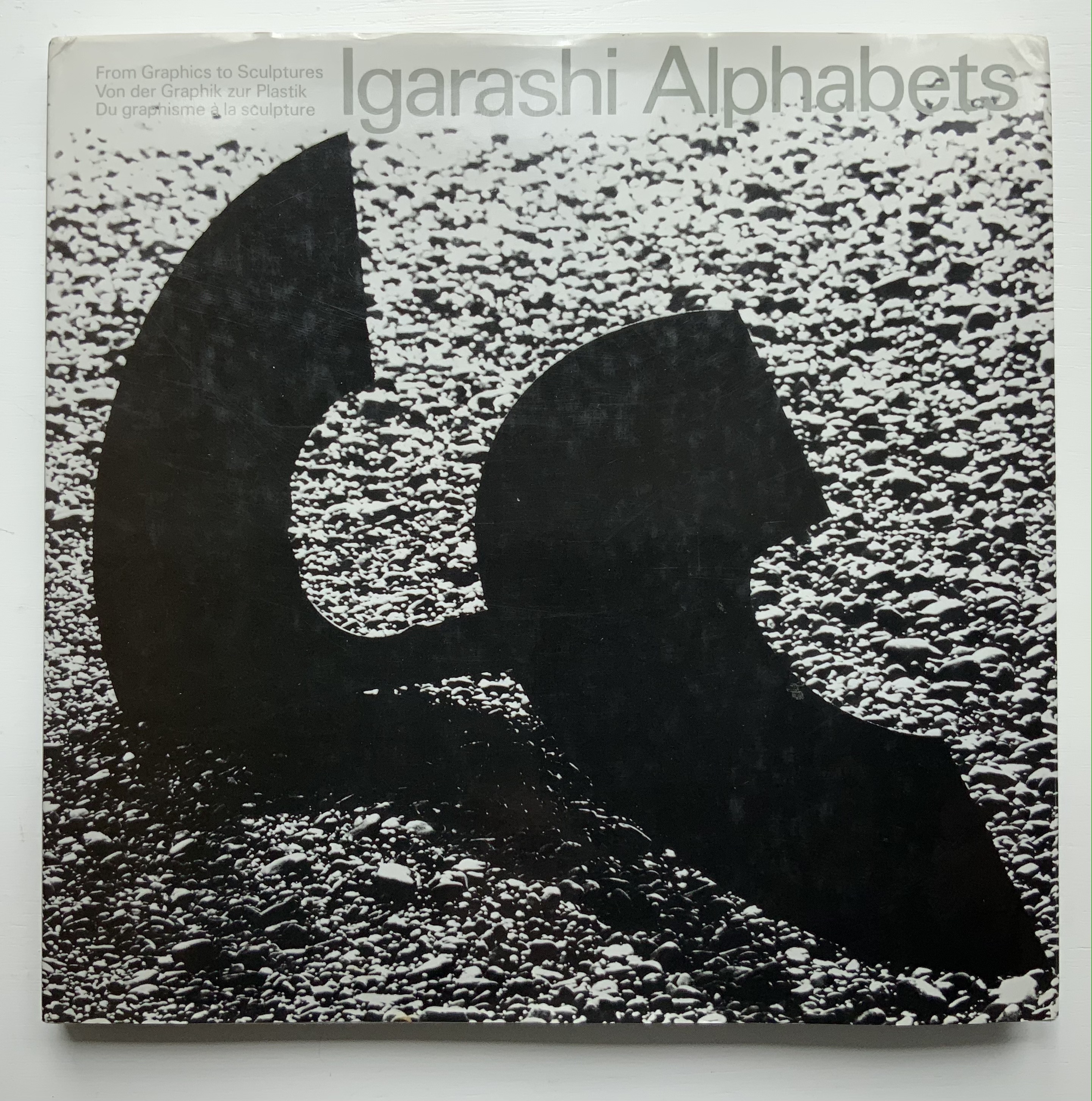
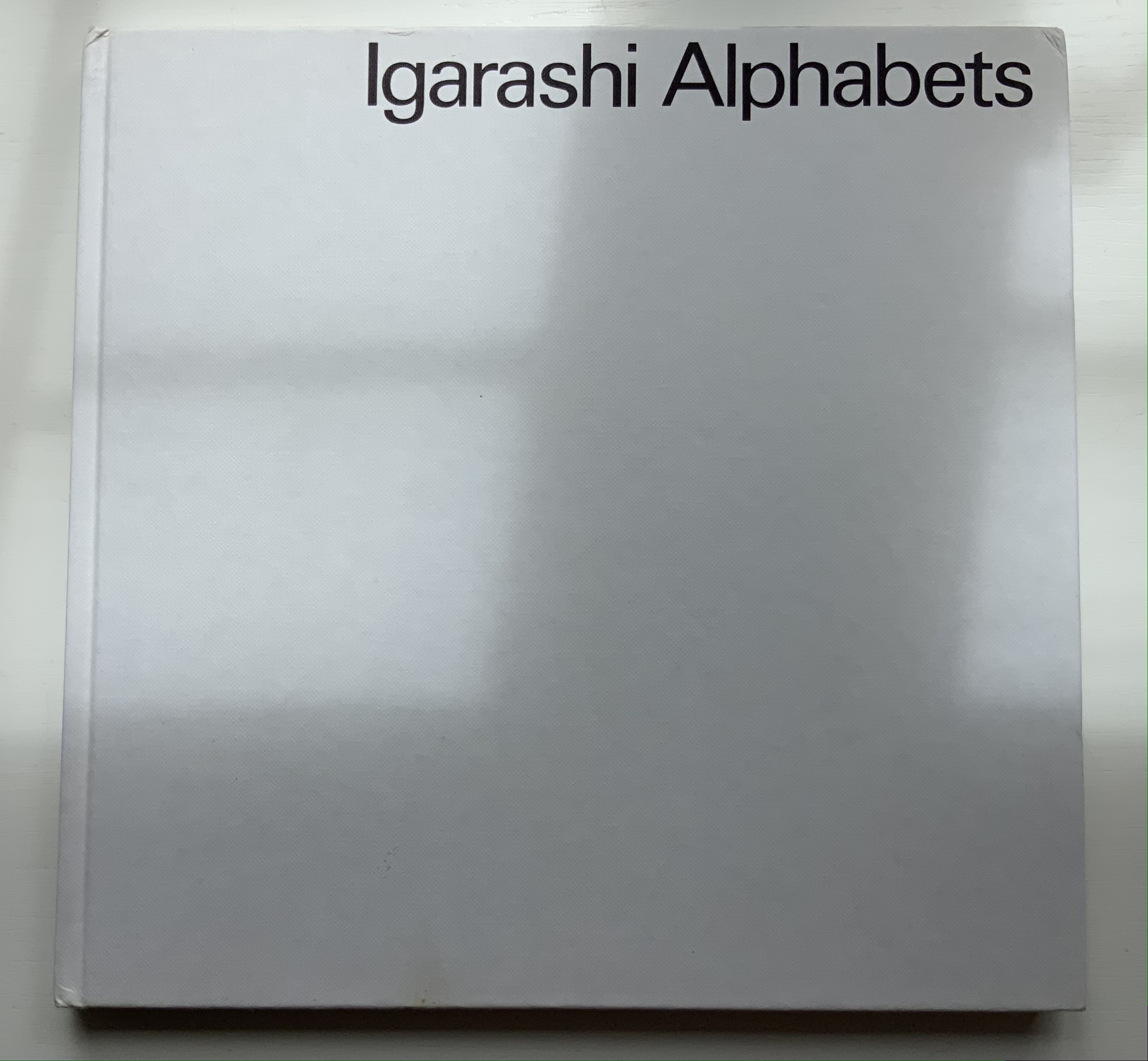
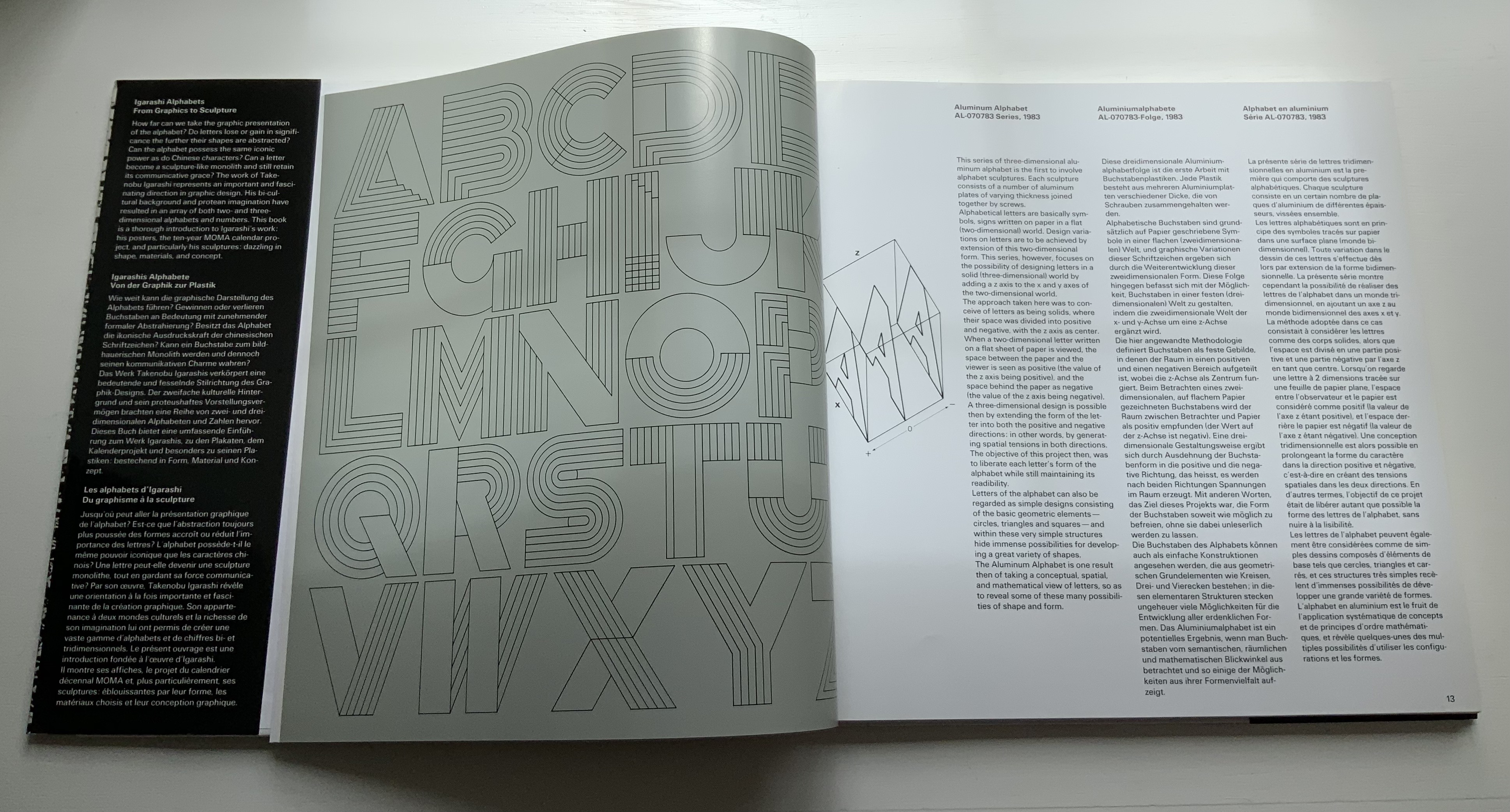
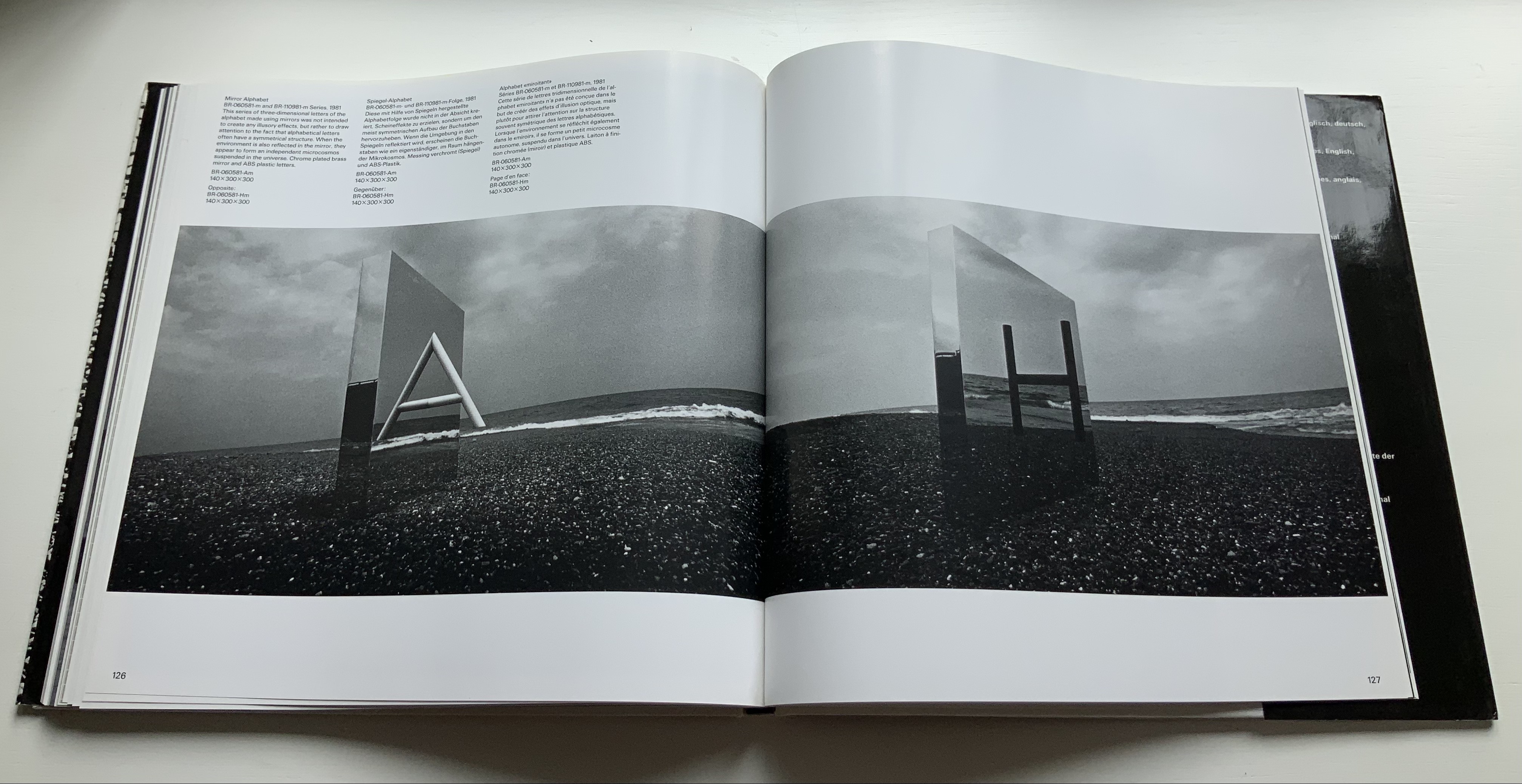
Igarashi Alphabets: From Graphics to Sculptures (1987)

Igarashi Alphabets: From Graphics to Sculptures (1987)
Takenobu Igarashi
Dustjacket over casebound H255 x W260 mm, 152 pages. Acquired from Scarthin Books, 7 June 2021.
Photos: Books On Books Collection.

Thirty-three years after this rare volume’s appearance, some renewed interest in Igarishi’s design and artistry has arisen. The Thames & Hudson volume noted below was widely noted but reviewed in depth in only a few places (see below).

In noting in their 1995 facsimile of Johann David Steingruber’s Architectonisches Alphabeth that three-dimensional alphabet design inevitably reflects its typographic and architectural milieu, Joseph Kiermeier-Debre and Fritz Franz Vogel single out Igarishi’s work in aluminum, concrete, wood and plastic as a perfect 20th century example. Unlike that of his European predecessors, Igarashi’s milieu has been both Eastern and Western. It shows not only in his design, surfaces and choice of material but also in the global attention paid to his work. The briefest search online yields sources in Poland, the Czech Republic, Spain, Singapore and many others besides those expected in the US and Japan.

Along with the works of Katsumi Komagata, Yasushi Cho and Zhang Xiaodong, Igarashi’s volume adds some Eastern balance to the Western bias in the Books On Books Collection.

Further Reading

Abecedaries I (in progress)“. 31 March 2020. Books On Books Collection.

Johann David Steingruber“. 23 April 2021. Books On Books Collection.

Katsumi Komagata“. 22 March 2020. Books On Books Collection.

Yasushi Cho“. 10 May 2021.

Zhang Xiaodong“. 1 December 2019. Books On Books Collection.

“Step inside the three-dimensional letters of cult graphic designer Takenobu Igarashi“. Spinach. 10 October 2020. Accessed 10 June 2021.

Black, Holly. 15 November 2020. “Takenobu Igarashi Conceives Type in New Dimensions“. Elephant.

Igarashi, Takenobu, Sakura Nomiyama, and Haruki Mori. 2020. Takenobu Igarashi A – Z. Farnborough: Thames &and Hudson.

Ong, Jyni. 2 October 2018. “Volume presents a long-overdue monograph on Japanese type master Takenobu Igarashi“. It’s Nice That.

Riechers, Angela. 14 October 2020. “Takenobu Igarashi Pushed the Parameters of Typography with His Hand-drawn 3D Letterforms“. AIGA Eye on Design. Accessed 6 June 2021.

Books On Books Collection – William Joyce

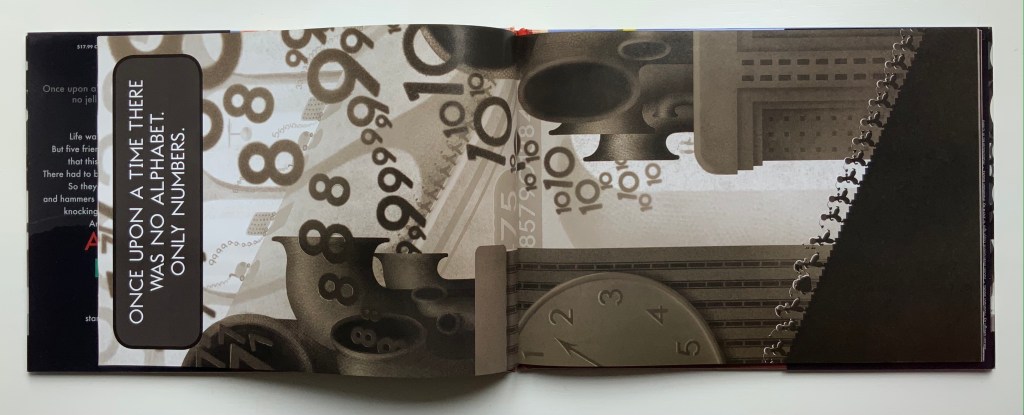
The Numberlys (2014)

The Numberlys (2014)
William Joyce and Christina Ellis
Hardback, paper on board. H220 x W300 mm, 52 pages. Acquired from London Bridge Books, 15 April 2021.
Photos of the book: Books On Books Collection.

Although bound in landscape, the book reads in portrait … to start and end.

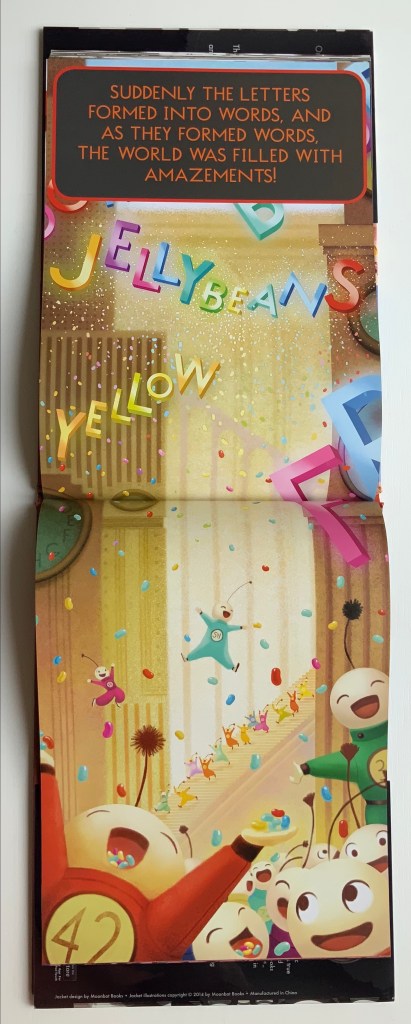
Life was…fine. Orderly. Dull as gray paint. Very…numberly. But our five jaunty heroes weren’t willing to accept that this was all there could be. They knew there had to be more.

So they broke out hard hats and welders, hammers and glue guns, and they started knocking some numbers together. Removing a piece here. Adding a piece there. At first, it was awful. But the five kept at it, and soon it was…artful! One letter after another emerged, until there were twenty-six. Twenty-six letters—and they were beautiful. All colorful, shiny, and new. Exactly what our heroes didn’t even know they were missing.
And when the letters entered the world, something truly wondrous began to happen…

Based on the award-winning app, this is William Joyce and Moonbot’s Metropolis-inspired homage to everyone who knows there is more to life than shades of black and gray. — from the Moonbot Studios’ website. Accessed 28 April 2021.

Archaeologists and paleontologists hypothesize that the alphabet evolved from counting. Clay tokens as signs (8000–3500 BC) and then pictographic marks on clay tablets (3500–3000 BC) were used for counting units of things. Around 3000 BC, someone merged pictographic signs and phonetic sounds to begin the invention of the alphabet. Orly Goldwasser (Hebrew University, Jerusalem) has hypothesized that illiterate Canaanite miners may have been the inventors of the alphabet around 1840 B.C.E.
Likewise in The Numberlys, our inventor-heroes (numbers 1-5 or, in their vocalizations, possibly the five vowel sounds?) lead a similarly manual existence, albeit in a more modern industrial setting. They can be viewed at work here in this clip from the award-winning app, no longer available but perilously stored on an early iPad in the Books On Books Collection. As in the app, the book proceeds in gray until the letter Z, when “THINGZ” begin to happen — “Pizza! Jelly beans! Color! Books!”.

Further Reading

Abecedaries I (in progress)“, Books On Books Collection, 31 March 2020.

Elliman, Paul. “My Typographies – Graphic Design Reading“, Eye, Spring 1998, 58-63. Accessed 143 May 2021.

Gelb, Ignace J. 1974. A study of writing. Chicago: University of Chicago Press.

Goldwasser, O. 2012. “The Miners that Invented the Alphabet — a Response to Christopher Rollston.Journal of Ancient Egyptian Interconnections 4-3: 9–22.

Havelock, Eric A. 1986. The Muse Learns to Write: Reflections on Orality and Literacy from Antiquity to the Present New Haven: Yale University Press.

Looze, Laurence de. 2018. The Letter and the Cosmos: How the Alphabet Has Shaped the Western View of the World. Toronto: University of Toronto Press.

Schmandt-Besserat, Denise. 2006. How writing came about. Austin, Texas: University of Texas Press.

Schmandt-Besserat, Denise. 2015. “Writing, Evolution of”, in James Wright, ed., International Encyclopedia of Social and Behavioral Sciences, 2d. Edition. New York: Elsevier. Accessed 15 April 2021.

Books On Books Collection – Aaron Cohick

The New Manifesto of the NewLights Press (third iteration) (2017)

The New Manifesto of the NewLights Press (third iteration) (2017) Aaron Cohick
Booklet, saddle-stapled, risograph, letterpress/collagraph, and hand painting. H165.1 x W139.7 mm (closed), 20 pages. #000611, unlimited, iterative edition. Acquired from New Lights Press, 11 December 2020.
Photos: Books On Books Collection. Displayed with permission of the artist.

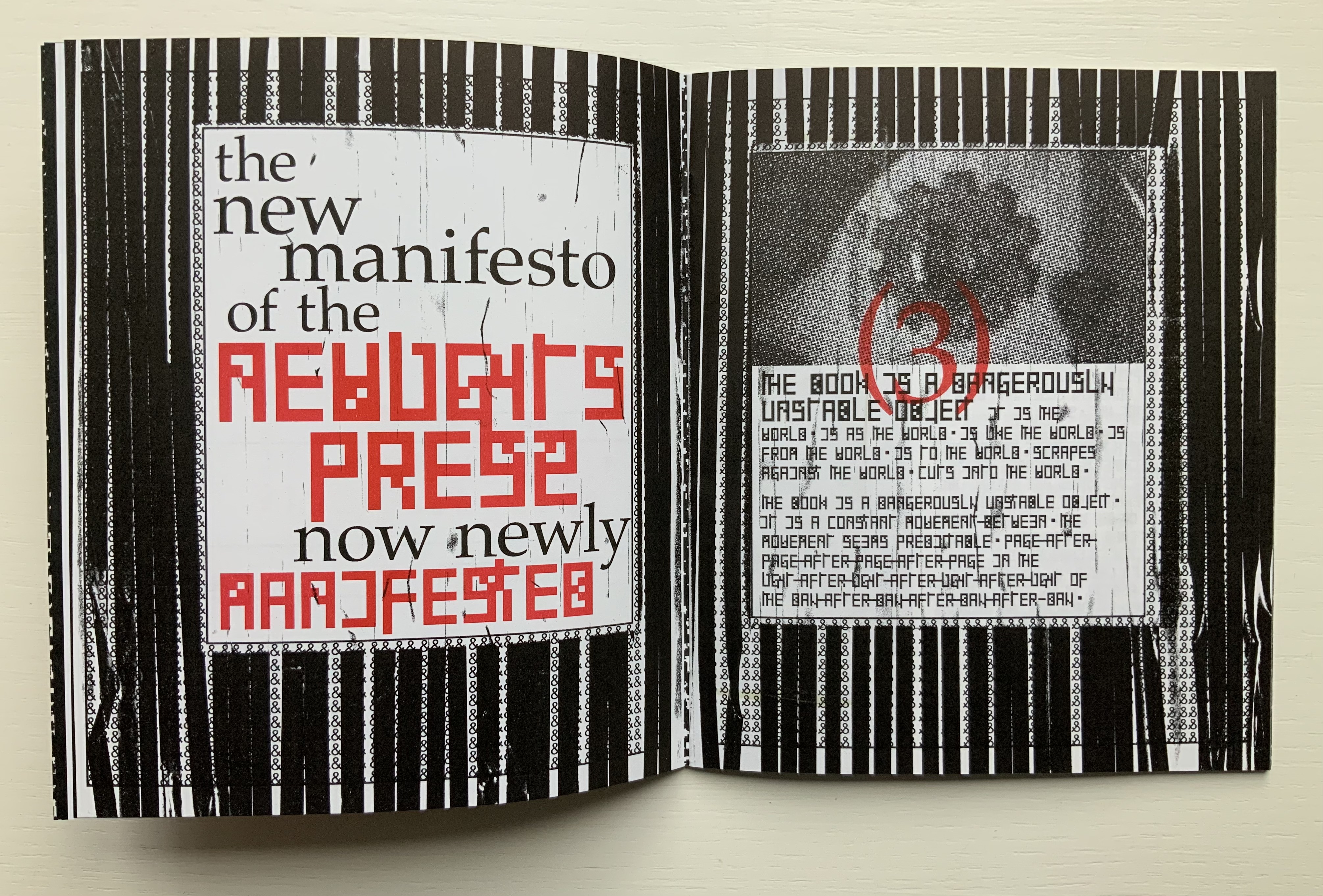
The New Manifesto of the NewLights Press (third iteration) has multiple starting points. Even in its first iteration, we have

  • The book is a dangerously unstable object, always between, continuously opening. It is interstitial, occupying many planes at once.
  • Digital technology has killed the book, finally.
  • The book is an impossible thing — comprised entirely of edges and full of holes. It moves. It happens in between.
  • Readers move through authors and books. Books move through readers and authors. Authors move through books and readers. They exist between each other’s pages. They only exist in between.
  • The form of the book, the history of the book, and the processes involved in its production provide a foundation for rethinking and re-evaluating the dominant discourse(s) of contemporary art.
  • The book … exemplifies a model that expands beyond form and content…. It is a field, whose axis points [form, content, production and reception] are always held in tension. In this model a piece or practice is a “zone of activity.”

Moreover, there are ten refinements on these starting points, touching on Julia Kristeva’s “intertextuality”, Roland Barthes’ “death of the author”, Michel Foucault’s “death of the book” and much more in the same vein. Each iteration even has diagram and footnotes, underscoring the academic nature of the starting points.

The New Manifesto of the Newlights Press (first iteration) (2009)

The second iteration emphasizes the starting points of physicality and more so the role of the reader:

  • [The book] is shot through with sunlight, hooks, teeth. It blinds, catches, gnaws.
  • From the book we gather the scraps of ourselves
  • [T]he reader is both a consumer and a producer.
  • Our existence is a constant generating of text.
  • A book read is a book alive — breathing, beating, shining and reverberating through its readers.

But the second iteration’s most important additional starting point is this:

  • We find [books] participating more & more in the world of visual art. This is extremely dangerous, but also potentially revelatory.

The New Manifesto of the Newlights Press (second iteration) (2013)

By its third iteration, The New Manifesto‘s words been further refined as a combination of announcement, exposition, lyric and prayer. It soars beyond literary theories and finds birds of a closer feather among Ulises Carrión and Michalis Pichler.

The book is a dangerously unstable object // It is a series of edges // Once clustered and knotted // Now open and spreading // Now cutting and bending // Mostly // The book betrays // Mostly // The book howls // The book falls apart in the face of our anguish // In the face of our quiet // In the silence of our slipping // Mostly // It will also always be something else // That we did not // Can not yet // See // The book is a remarkable technology // It is a shimmering substance // It is a noise of the hands and thought // The book is perhaps now a dead thing // In the hands of the dead // So be it // We never mattered much anyway // Beyond our capacity to consume // Our capacity to labor // We are fuel // So be it // We remain in the dark // With these books // The original autonomous window technology that is us looking through // At // In // Against // With care // The book returns our labor to us //

If a new edition of Publishing Manifestos is ever issued, Cohick’s hortatory words should be considered. The words, however, cannot be considered alone. Over the three iterations, The New Manifesto — the only one in the collection and, therefore, the only one tangible for the visitor — has “participated more & more in the world of visual art”. Cohick’s use of the collagraphic technique increases. It adds painterliness to the booklets as well as a sense of depth and spatial play within the page, across the gutter and from recto to verso pages. In a series of online essays for the College Book Art Association, Cohick confirms the pleasure and intent here:

Collagraph is a well-known technique and is usually taught as part of introductory letterpress courses. It has an immediacy and fidelity that is very exciting—you can stick a leaf or other flat object to a block, print it, and get a decent image of that object. Unfortunately it usually stops there. Those flat objects are hard to push beyond that initial single-color print. Linoleum, photopolymer, wood and metal type, and to some extent woodcut are all made to be “neutral” printing surfaces—flat and smooth. Trying to get collagraph to be flat and smooth begs the question: why use collagraph at all? In collagraph the material that makes the plate is not neutral—the material is exactly the point. That embrace of material and its many, varied effects and marks is what moves collagraph closer to the direct markmaking of drawing/painting. It makes all of those “unacceptable” (or abject?) marks readily available. Relief collagraph printed with letterpress equipment can be a method of painting or drawing in multiple, with control as good as—if not better than, but also different from—the hand. You’re doing it all wrong (Part 2)

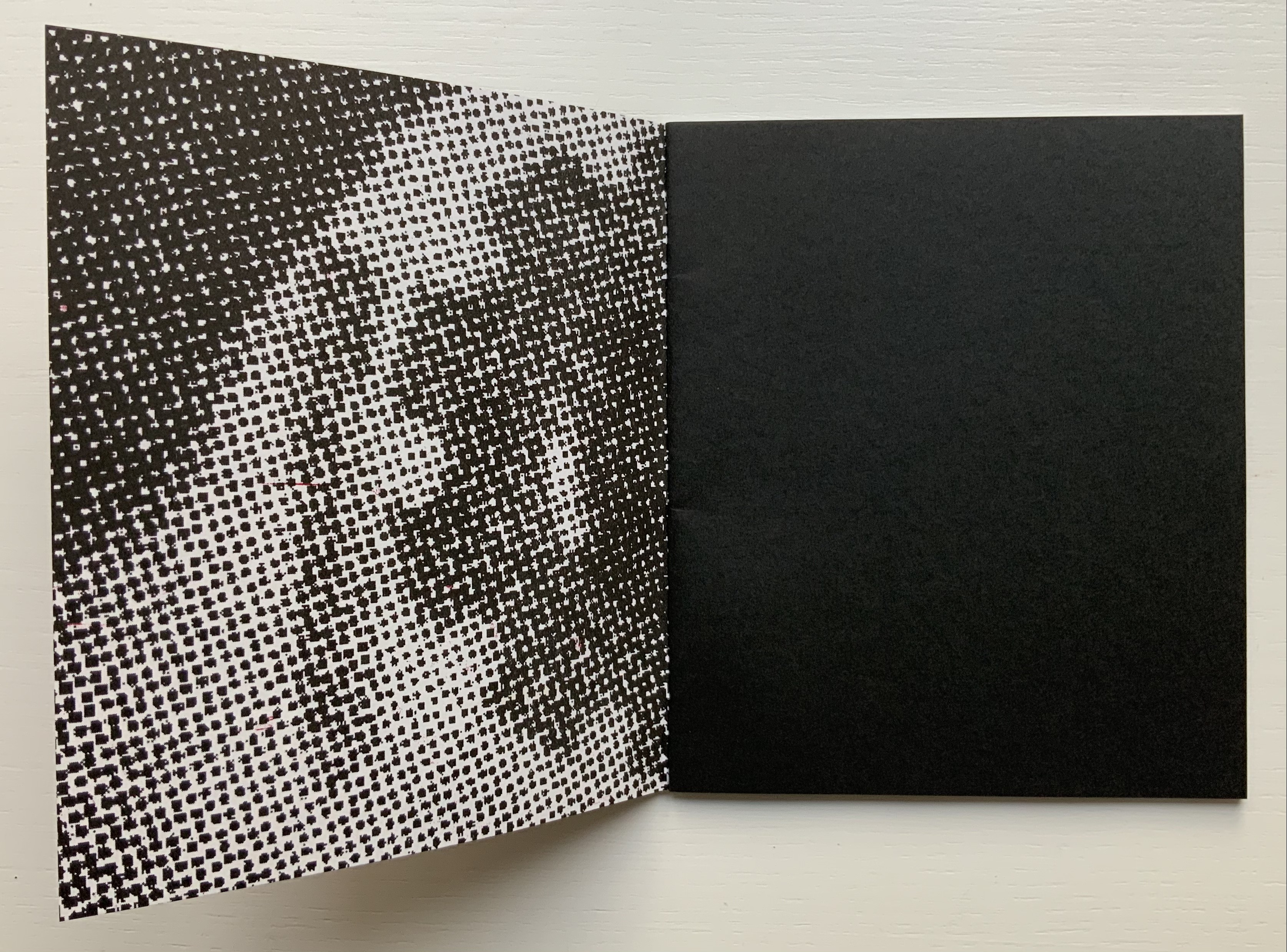
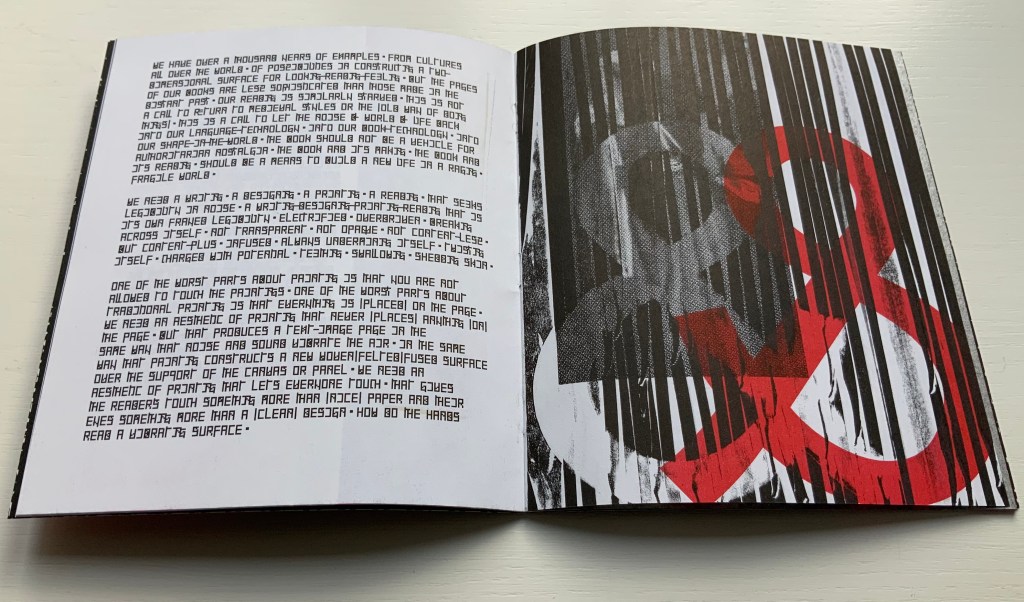
From the first iteration of the manifesto, black & white details of Jan Van Eyck’s The Arnolfini Marriage appear and are manipulated on the cover and throughout. Although they recede in the second iteration, they move strikingly to the fore in the third. Constantly alongside the Arnolfini details has been the ampersand, enlarged, reversed, in different colors, and present — almost ornamentally — within the text line. The increased visuality of the third iteration announces itself on the booklet’s cover and inside with the grainy enlarged detail of the mirror from The Arnolfini Marriage. What do the Arnolfini details signify? Although Van Eyck’s original itself is straightforwardly representational, its meanings are not always any clearer than that of its use in Cohick’s collage. With his slices of black (“a series of edges”) obscuring the image of the groom, perhaps Cohick is compounding obscurities to present “something else // That we did not // Can not yet // See”.

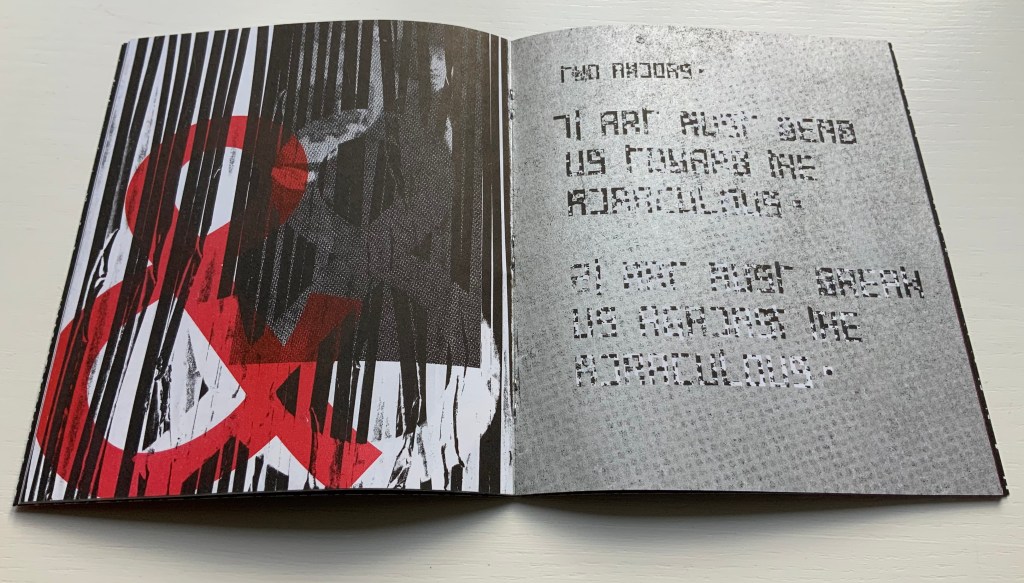
And what about the large overlapping ampersands in red and gray, systematically reversed and alternating in color? Are they emphasizing the “and so on and so on” of tradition in Cohick’s painterly printing technique? Are they alluding to the joining of hands in the marriage? Are they alluding to, and performing, a marriage of the book and visual art? On a verso page in the manifesto’s first iteration, he writes, “The form of the book, the history of the book, and the processes involved in its production provide a foundation for rethinking and re-evaluating the dominant discourse(s) of contemporary art.” On the facing recto page, the Arnolfini bride in reverse from the original extends her hand to a reversed ampersand.

In perhaps the most important enhancement of the third iteration’s visuality, Cohick’s full-blown typographic redesign of the alphabet occupies the visual foreground, middle ground and background. It is as if Cohick sets out to demonstrate Mallarmé’s proposition that the book is the “total expansion of the letter”. The first iteration’s completely legible Palatino, Arial and Placard Condensed typefaces used in the text line have yielded to what Cohick calls a “dislegible” font, which he often reverses, lays out as occasional “running sides” rather than “running heads”, and subjects increasingly to collagraphic layering. In his “You’re doing it all wrong” series, Cohick explains:

If “legible” and “illegible” are binary opposites, then the term “dislegible” is about looking at the space between those two poles. Dislegibility displaces, dislocates, deforms, and/or disrupts the process of reading, with the ultimate goal of making that process of reading (dis)legible to the reader. The dislegible can be read, but it resists closure or certainty.You’re doing it all wrong (Part 1)

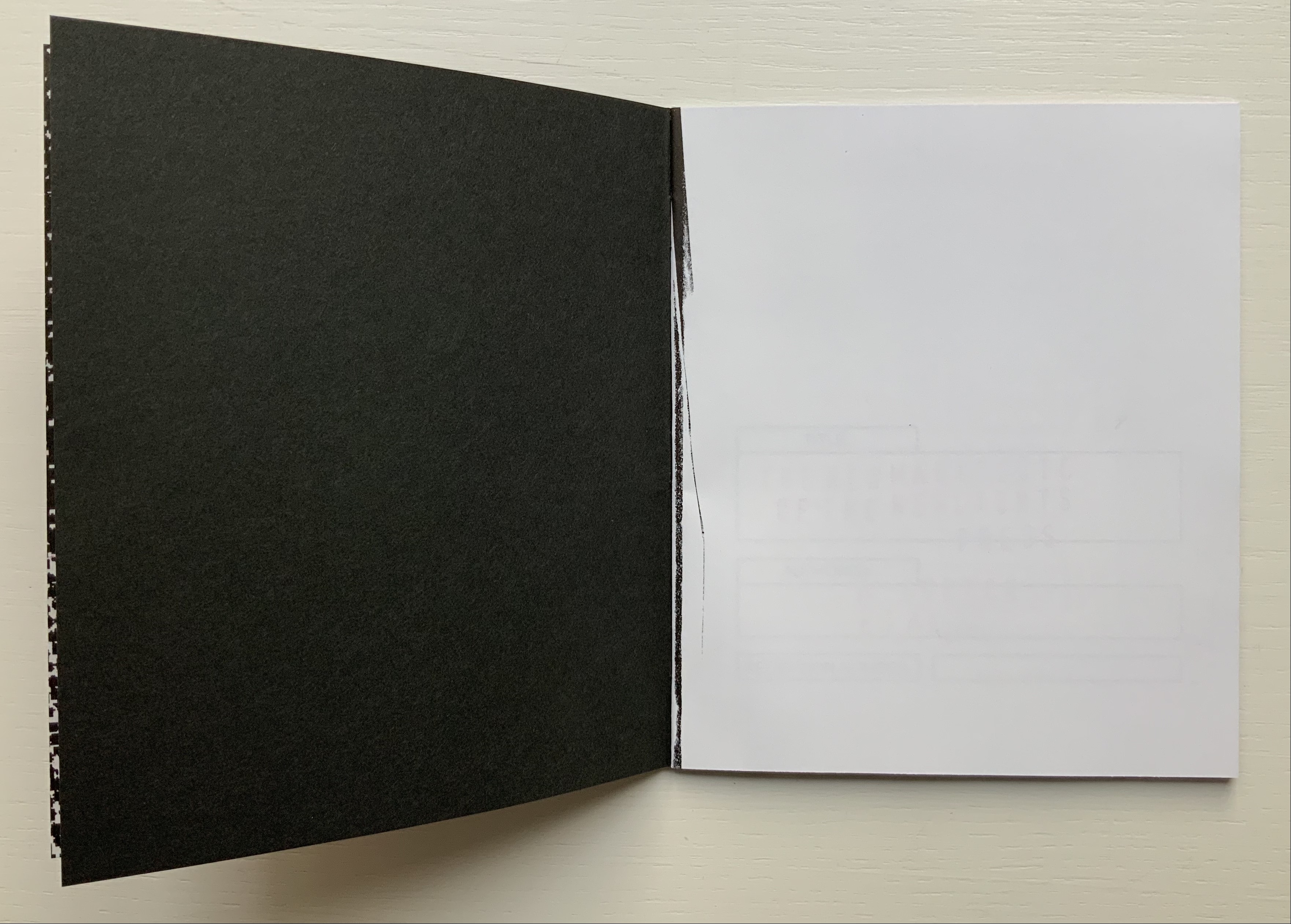
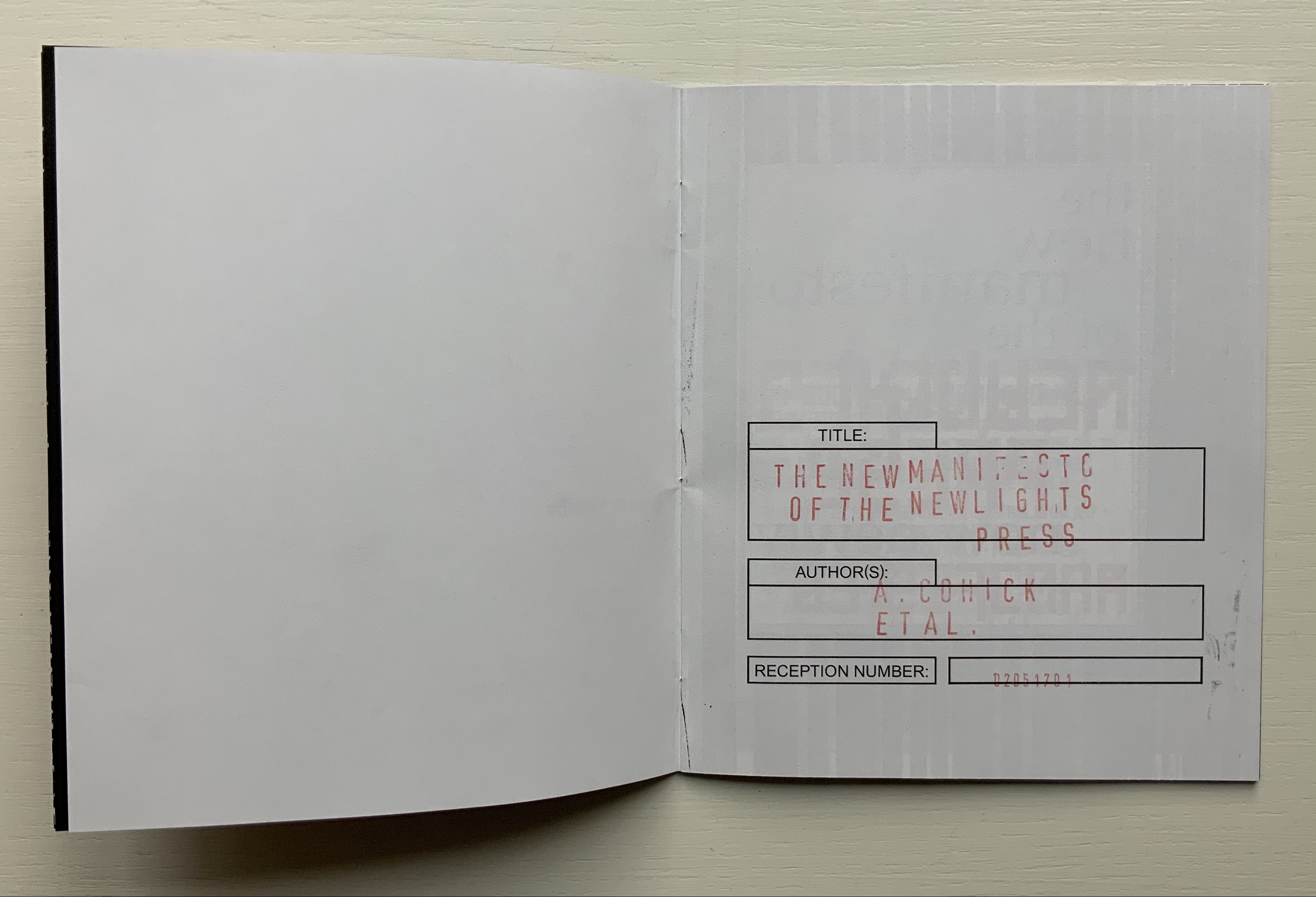
Also contributing to dislegibility is the reversal of images, the ampersand and letters. More than that, the reversal reminds us of what is involved in letterpress production — the inked relief surface and its reversed image or letter to be transferred to paper. Always in tension with form, content and reception, production makes up the open field from which the artist’s book emerges. The third iteration exudes production’s physicality. A black saturated endleaf bleeds over onto a stark white sheet that faces a stamped title page, intensifying a feel of mechanical working. Letterforms behave as so much raw material — as if they were oil, acrylic, brick or mortar — to be re-seen from different angles, noted for more than one function and their text read for more than one meaning.

According to Cohick, “For art to thrive, form and content must be in a dynamic relationship… It must contain enough disruptions, ambiguities, and peculiarities to resist the deadly state of stable signification.” The iterations of The New Manifesto enact that statement.

Alphabet One: A Submanifesto of the NewLights Press (2017)

Alphabet One: A Submanifesto of the NewLights Press (2017)
Aaron Cohick
Booklet, center-stapled. Letterpress printed from woven collagraph blocks on newsprint. H165 x W140 mm, 28 pages. Acquired from the artist, 11 December 2020. Edition of 250, unnumbered.
Photos: Books On Books Collection, displayed with permission of the artist.

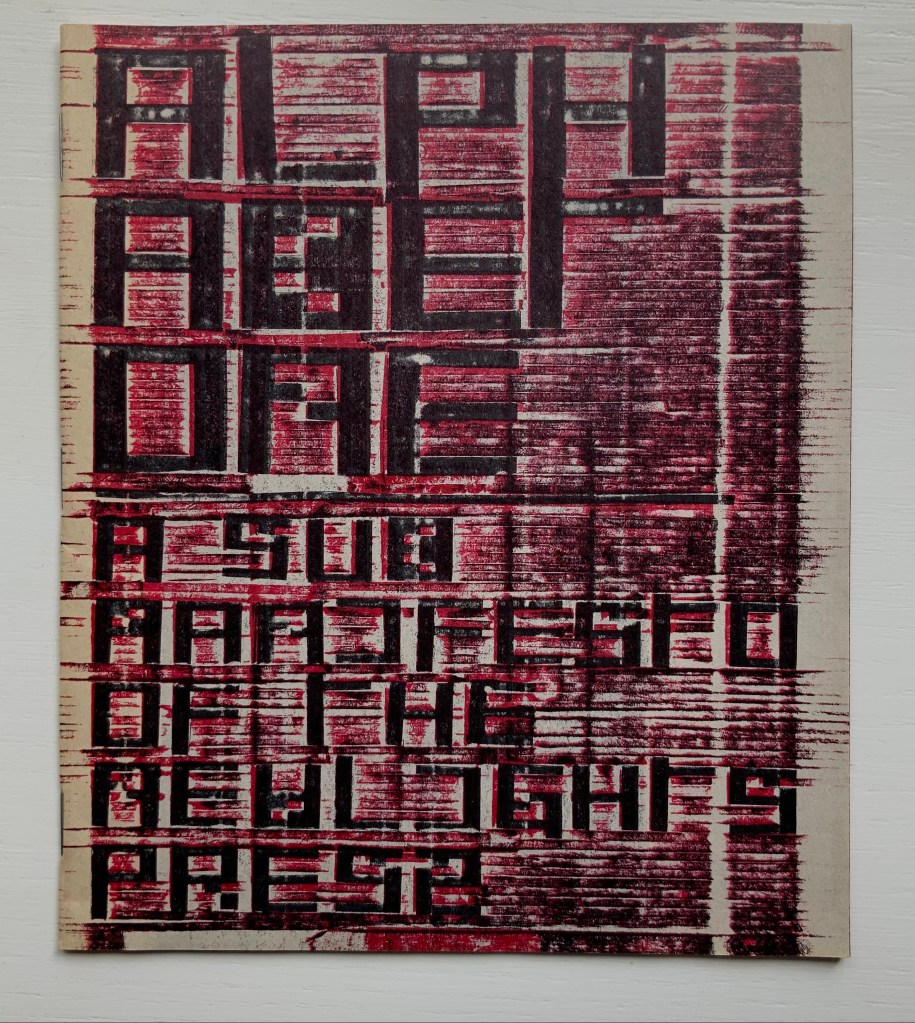
Alphabet One, “companion book to the third iteration of The New Manifesto of the NewLights Press”, presents Cohick’s “complete ‘noise’ alphabet, in order, in condensed and full form”. In The New Manifesto, Cohick has described the book as “a noise of the hands and thought”. Well then, being a book, Alphabet One demonstrates that the manifesto is the alphabet, and the alphabet is the manifesto, and “woven collagraph blocks” could hardly be less “a noise of hands and thought”. Lest those inferences seem strained, continue reading the passage Cohick reproduces from The New Manifesto immediately after the reference to the “complete ‘noise’ alphabet”:

This is not a utopian program // This is not an alphabet for saving the world // Such a thing is a dangerous lie // This is one possibility // Not a tool // But a movement-between // An object-between // A growing // Changing thing // Meant to do just that // It is about attention and its revitalization // It is about structure and our being in it //

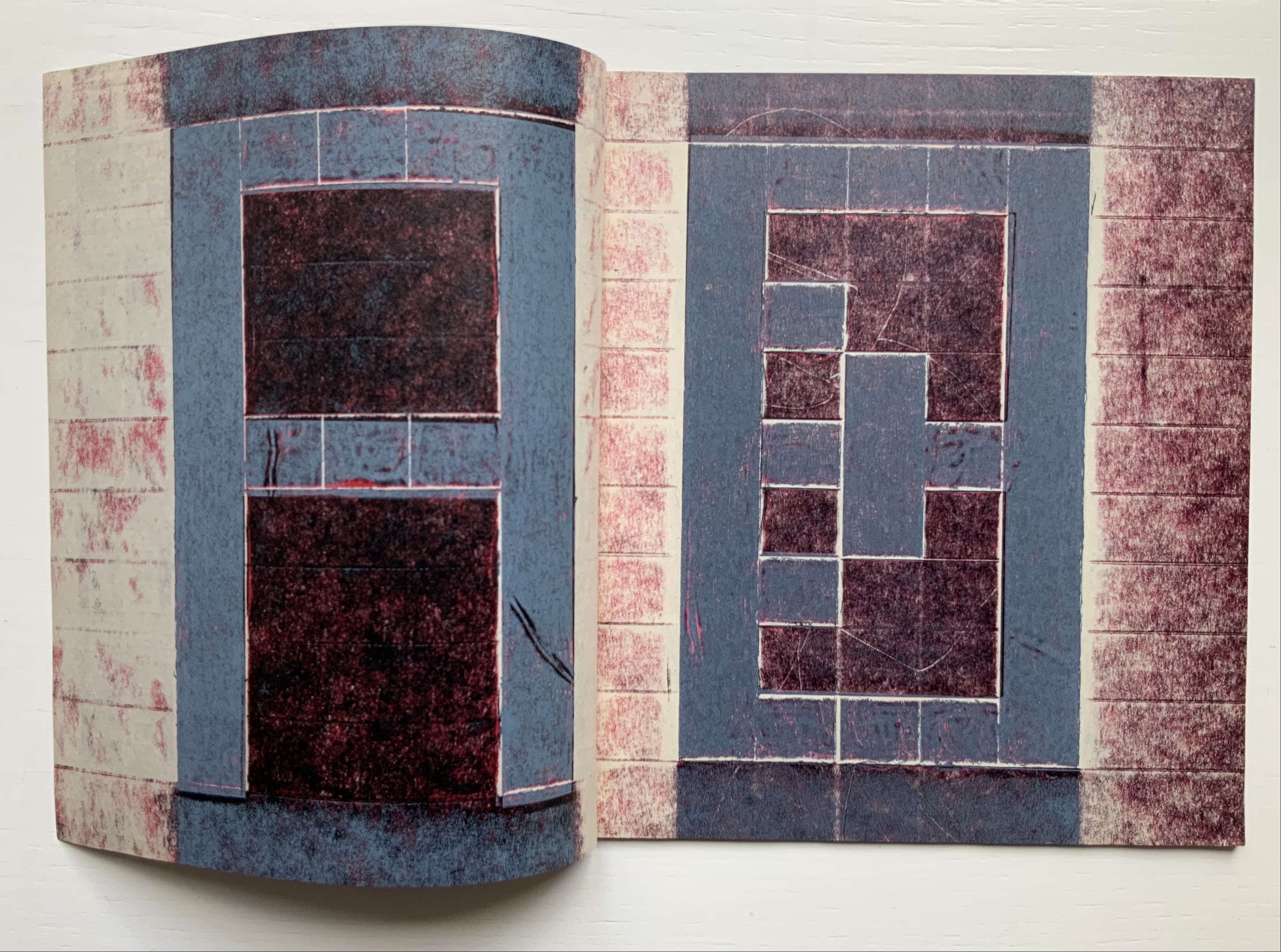
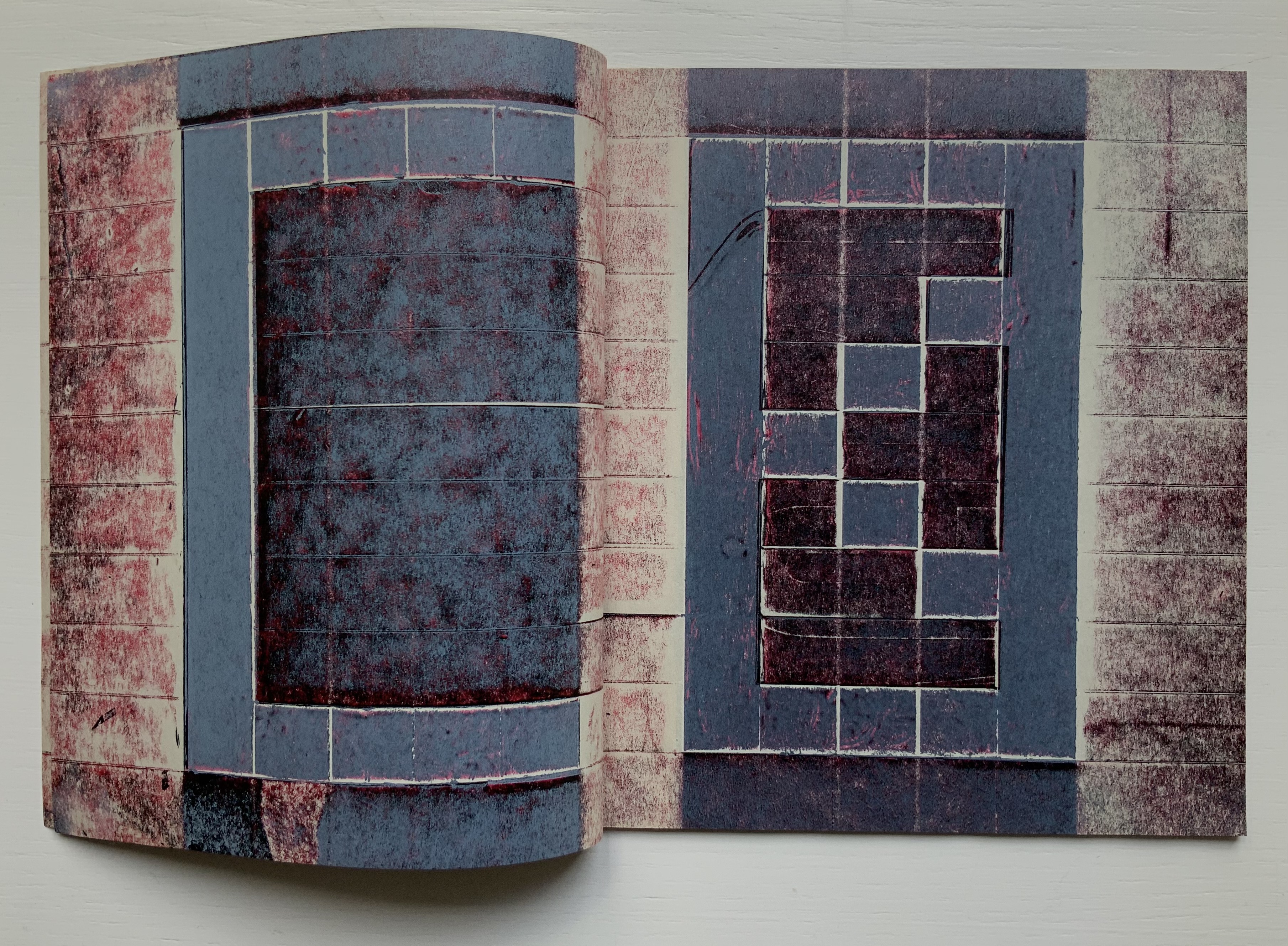
A, B, C, D. Photos: Books On Books Collection.

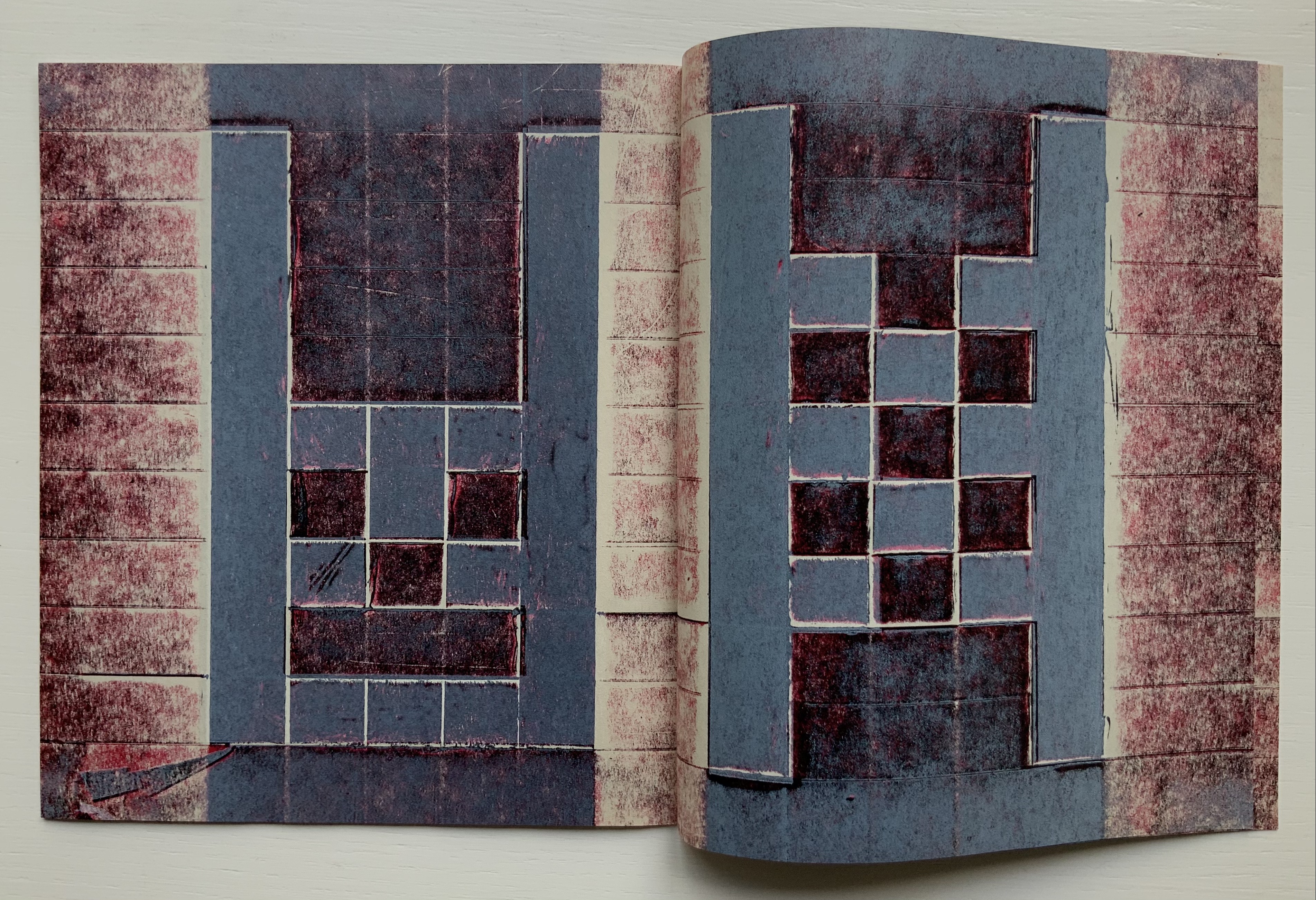
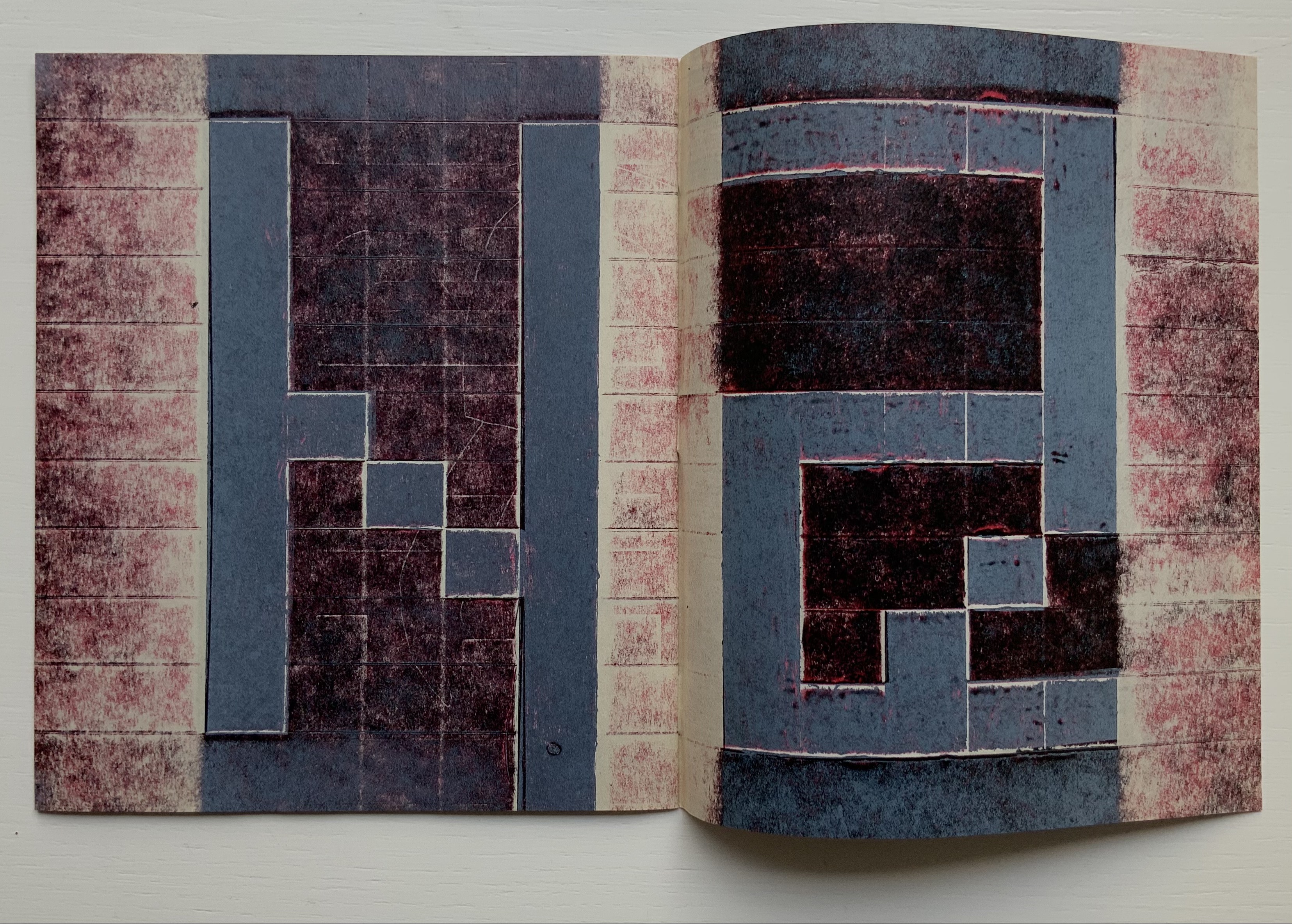
W, X, Y, Z. Photos: Books On Books Collection.

It cannot be an accident that the “noise” alphabet’s letterforms arise from varyingly shaded bricks: rose, gray, reddish gray and reddish black. To left and right of each letter, the rose color dominates. A reddish gray bar tops and tails each letter. The color gray forms the “strokes” of each letter. Reddish black fills the counters. Extracting the signal from the noise of the alphabet or books does not come easily. This is intentional. Just as The New Manifesto says,

With these books // The original autonomous window technology that is us looking through // At // In // Against // With care // The book returns our labor to us //

Days Open Air (2016)

Days Open Air (2016)
Aaron Cohick
Booklet, center-stapled, H203 x W152, 12 pages. Edition of 100, of which this is #40. Acquired from the artist, 11 December 2020.
Photos: Books On Books Collection, displayed with artist’s permission.

Days Open Air is one of those books returning our labor to us that The New Manifesto announces. Cohick call it “an artists’ book/poem thing … an experiment: with our new Risograph, with the alphabet, with writing, with random numbers, and with noise.” Letterforms stretch. Words run sideways, they break in the middle across lines, even across pages.

Look-See (REAED) (2014)

Look-See (REAED) (2014)
Aaron Cohick
Print. H300 x W456 mm.
Photos: Books On Books Collection, displayed with artist’s permission.

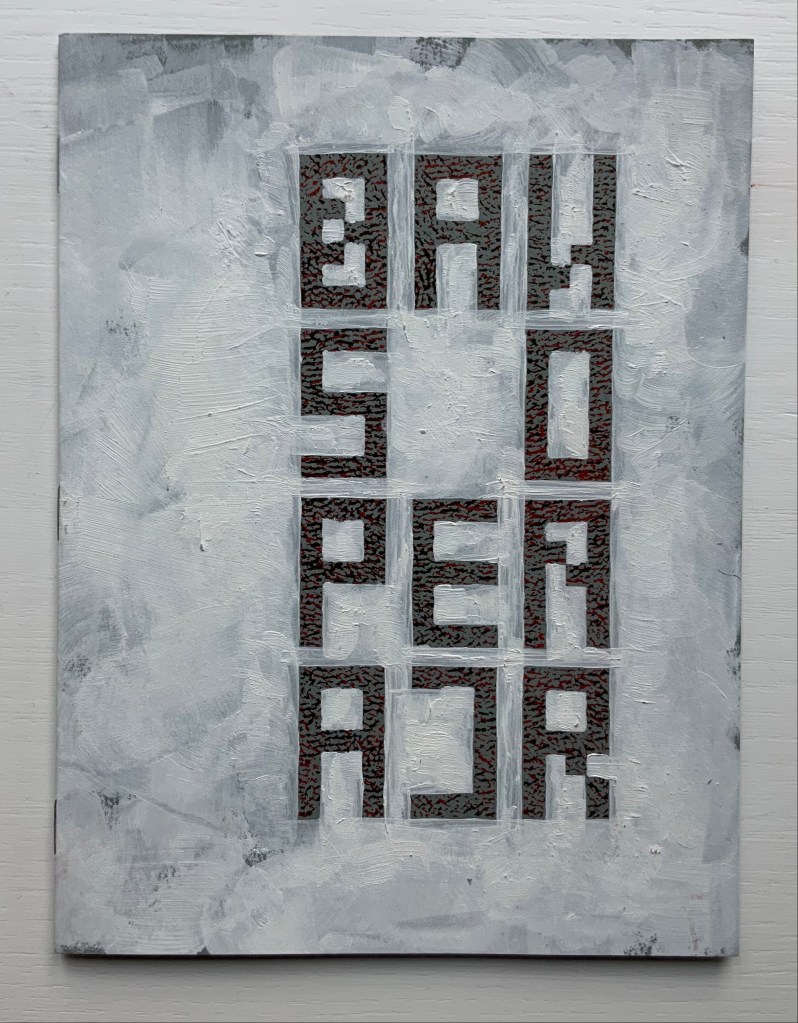
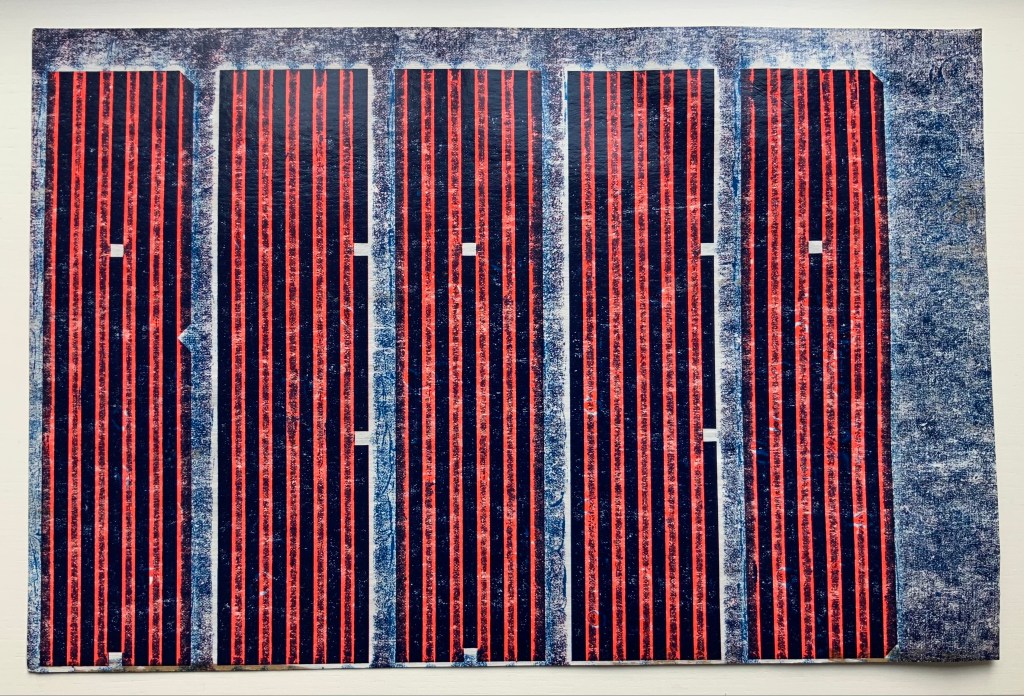
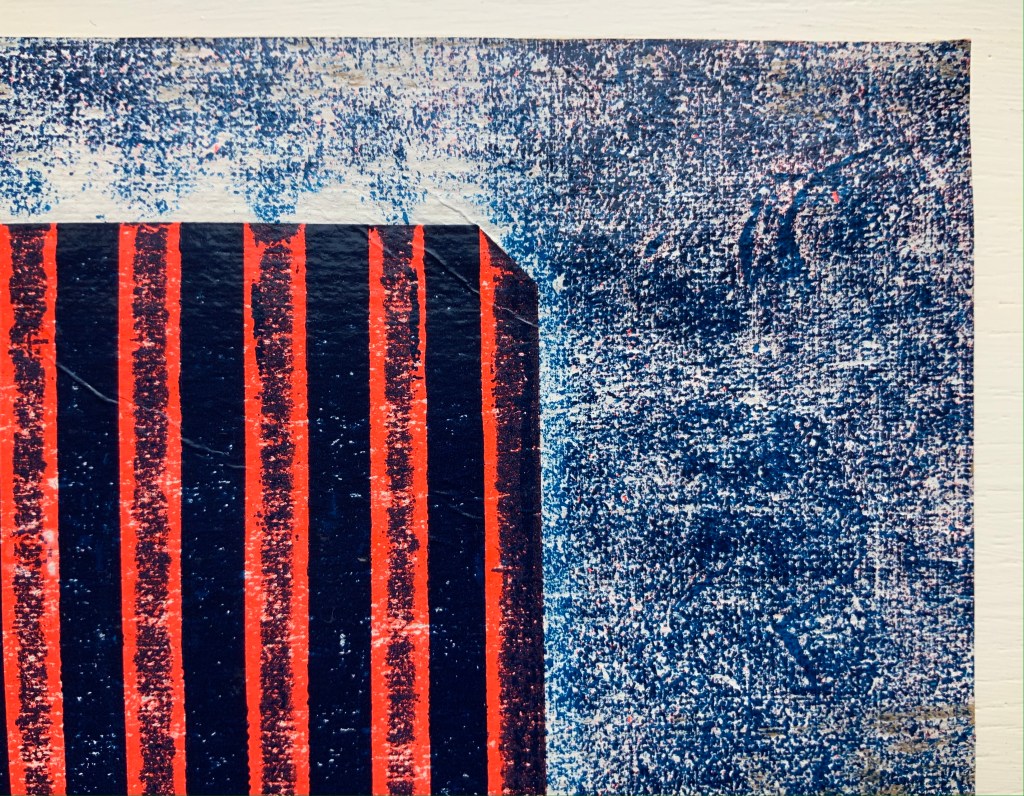
More evocative of barcode stripes than bricks, the letterform strokes in this poem-print-poster stretch even more than in Days Open Air. Printed on a Vandercook 219 from vinyl and gesso collagraph blocks, the letterforms challenge us to “look” and “see”. An angle at the top right, two angles midway on the right and two counters condensed to small squares suffice to define the first letter — R. The letters E and A are more efficient, requiring only the placement of two counters each. Note how the textural effect of the gesso and letterpress printed collagraph on chipboard joins The New Manifesto‘s celebration of the physicality and noise of production.

In Cohick’s world, the book and art make, and should be perceived as, a “strange” continuity. His vision and embrace of the collagraph suggest a 21st century version of William Blake. He names his nearer contemporaries as Ken Campbell, Walter Hamady, Amos P. Kennedy, Jr., Karen Kunc, Emily McVarish, Dieter Roth and Nancy Spero. In the Books On Books Collection, those far and near can also be found in Eleonora Cumer, Raffaella della Olga and Geofroy Tory.

Further Reading

Abecedaries I (in progress)“, Books On Books Collection, 31 March 2020.

Cohick, Aaron. “Notes toward the emergent book (Part 1)“. Book Art Theory, College Book Art Association. 1 July 2019. Accessed 14 May 2021.

Cohick, Aaron. “Notes toward the emergent book (Part 2)“. Book Art Theory, College Book Art Association. 15 July 2019. Accessed 14 May 2021.

Cohick, Aaron. “Notes toward the emergent book (Part 3)“. Book Art Theory, College Book Art Association. 1 August 2019. Accessed 14 May 2021.

Cohick, Aaron. “You’re doing it all wrong (Part 1)“. Book Art Theory, College Book Art Association. 15 September 2020. Accessed 15 May 2021.

Cohick, Aaron. “You’re doing it all wrong (Part 2)“. Book Art Theory, College Book Art Association. 1 October 2020. Accessed 15 May 2021.

Cohick, Aaron. “You’re doing it all wrong (Part 3)“. Book Art Theory, College Book Art Association. 15 October 2020. Accessed 15 May 2021.

Pichler, Michalis, ed. 2019. Publishing manifestos: an international anthology from artists and writers. Cambridge, MA: MIT Press.

Books On Books Collection – Olafur Eliasson

Your House (2006)

Your House (2006)
Olafur Eliasson
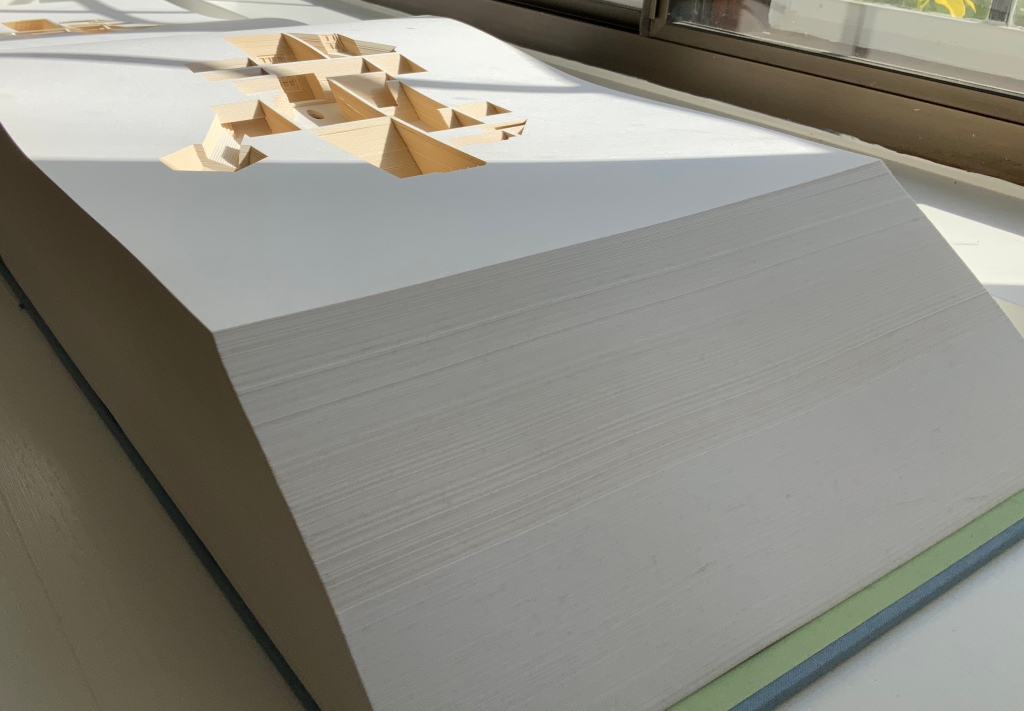
Hardback handbound with 454 laser cut leaves. H273 × W432 × D114 mm. Edition of 225, of which this is #210. Acquired from Carolina Nitsch Contemporary Art, August 2020. Photos: Books On Books Collection, displayed with permission of the artist.

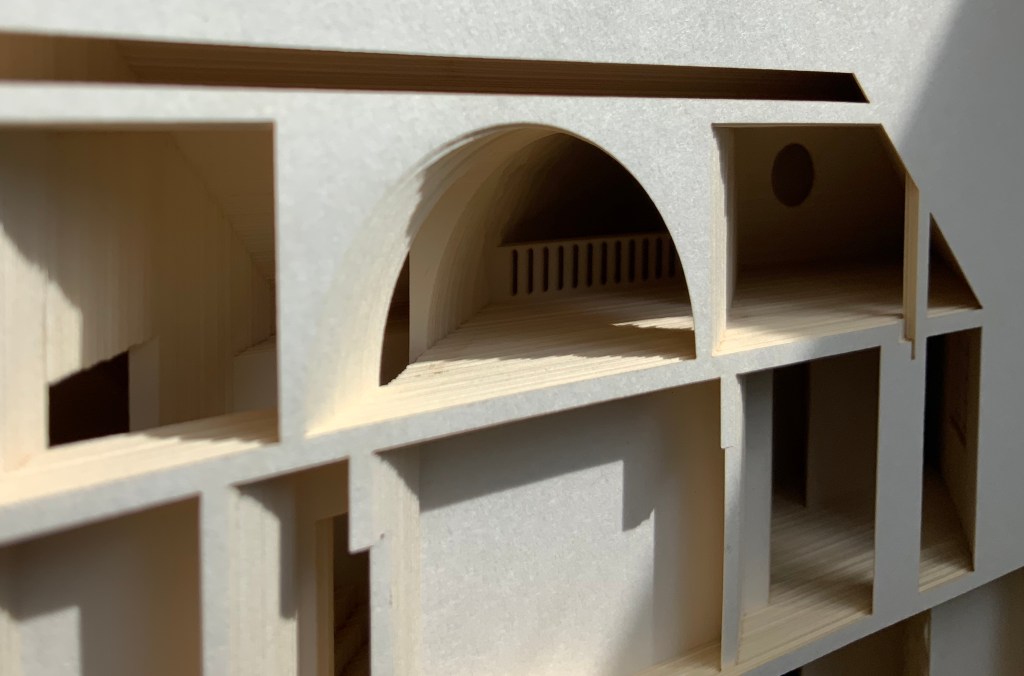
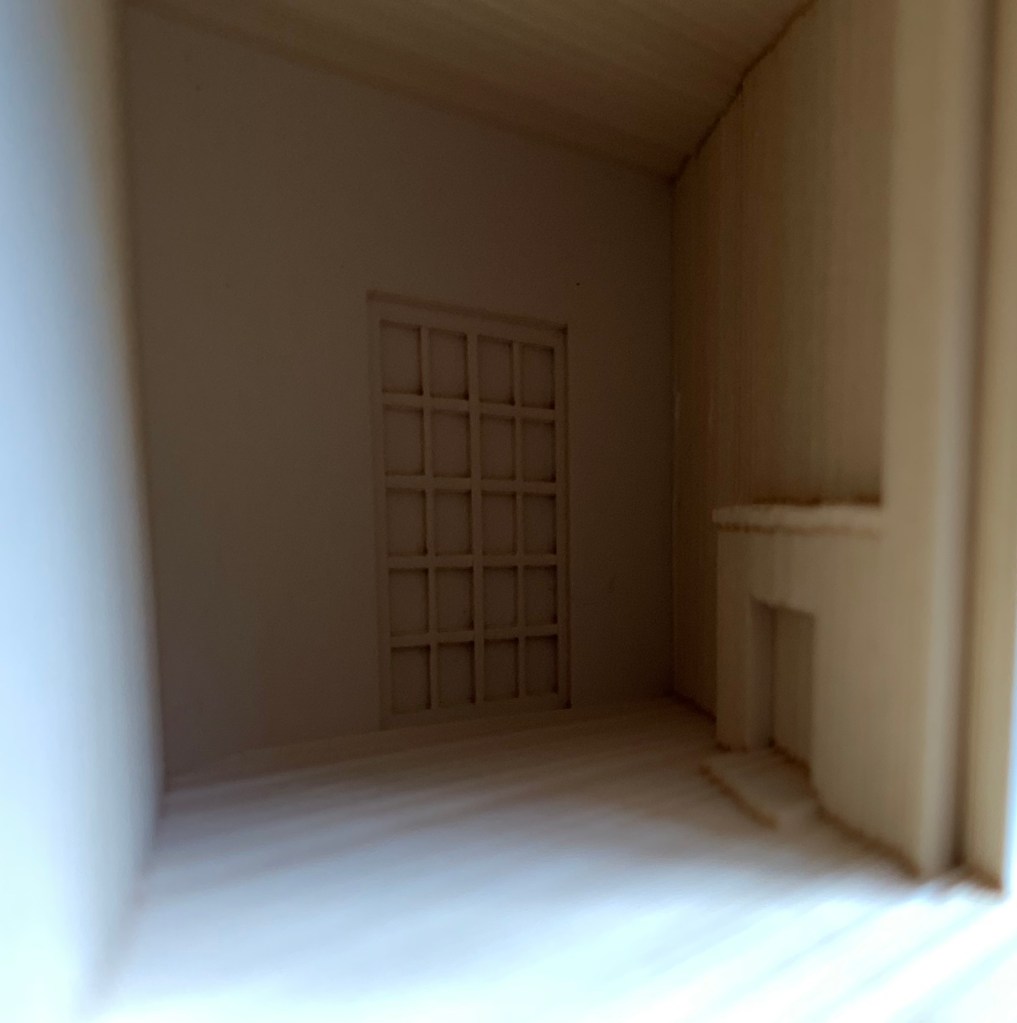
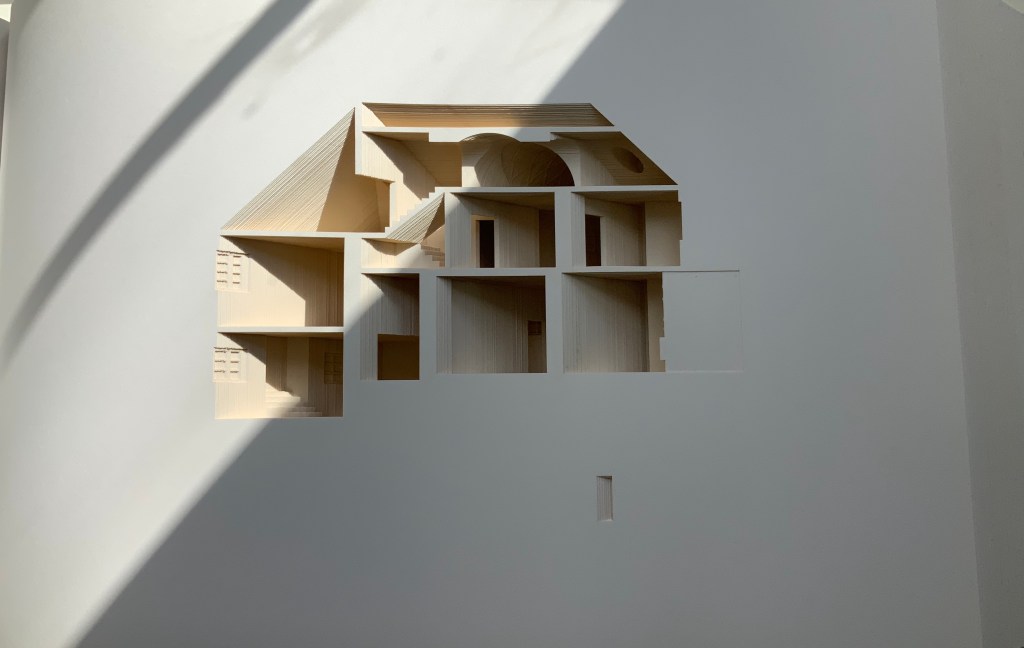
Your House is a laser-cut model of Olafur Eliasson’s residence in Copenhagen at a scale of 1:85, which means that each page equates to a 220 mm section of the actual house. How do you read a work like this — physically? At the 22″ mark in the video below, the pages fall in a cascade like a flipbook, but for the most part, their size, accumulated bulk and weight — and delicacy — defy that handling. They must be turned slowly and carefully. Your House heeds the task of the arts as posed by the architect Juhani Pallasmaa, “in our age of speed, …to defend the comprehensibility of time, its experiential plasticity, tactility and slowness” (The Embodied Image, p. 78).

Your House (2014)
Studio Olafur Eliasson

As you move from Your House‘s entrance to its exit, the outlines of walls, floors, stairs, doors, domes, windows, fireplaces and bookcases tremble in the air. Is this what Gaston Bachelard calls “the material imagination”? What Juhani Pallasmaa calls “the embodied image”?

Video: Books On Books Collection. Displayed with permission of Studio Olafur Eliasson.

Photos of the work: Books On Books Collection. Displayed with permission of Studio Olafur Eliasson.

There is something meditative about reading Your House properly. The cautious repetitive turning of pages can induce a daydream of inhabiting the space revealed. At some point in turning the pages, the empty shapes begin to become “your house”. Perhaps you see yourself moving through its spaces, and imagined furnishings occupying its rooms.

Photos of the work: Books On Books Collection. Displayed with permission of Studio Olafur Eliasson.

Or perhaps as in the sequence above — the end of one room (or chapter or part) and the start of another — you become a ghost — with all the work’s past and future readers — passing through the walls.

Video: Books On Books Collection. Displayed with permission of Studio Olafur Eliasson.

In The Poetics of Space, Bachelard writes of poetic time and prosodic time. The one is vertical, a spot in time, a frozen moment; the other is horizontal, a narrative, a continuity. But they are not mutually exclusive. Your House is a site where poetic and prosodic time occupy the same space. More than that, it is a site where temporality, as Eliasson puts it, “becomes something you perform by involving yourself physically over time” and thereby you become, “in the end, the createur” (“Not how, but why!”, p. 108).

Eliasson’s house in Hellerup, a suburb of Copenhagen, was advertised for sale in 2024. For comparison with the book, you can see photos of the exterior and interior here. Also, with thanks to Byopia Press, an X-ray documentation of the book can be found here.

Contact is Content (2014)

Contact is Content (2014)
Olafur Eliasson
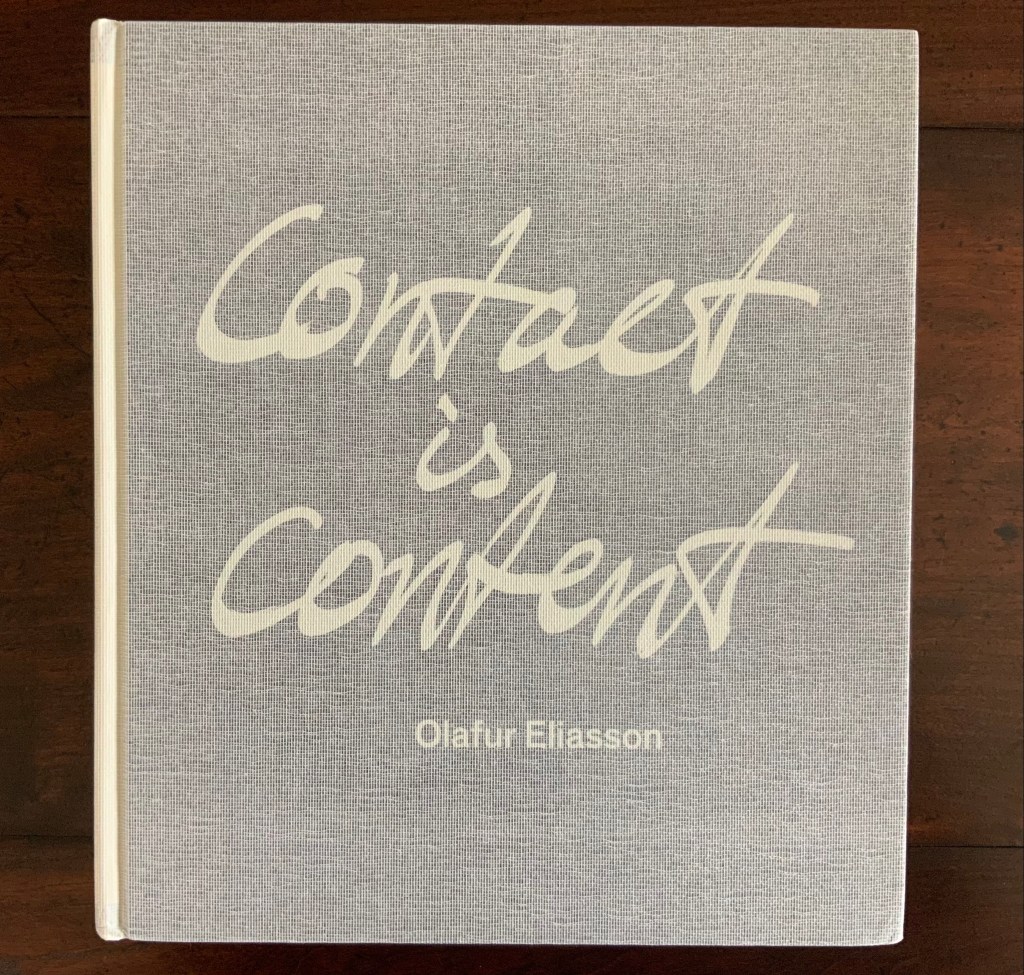
Casebound, cloth mesh-covered board. H345 x W310 x D50 mm, 416 pages. Photos: Books On Books Collection. Displayed with permission of the artist.

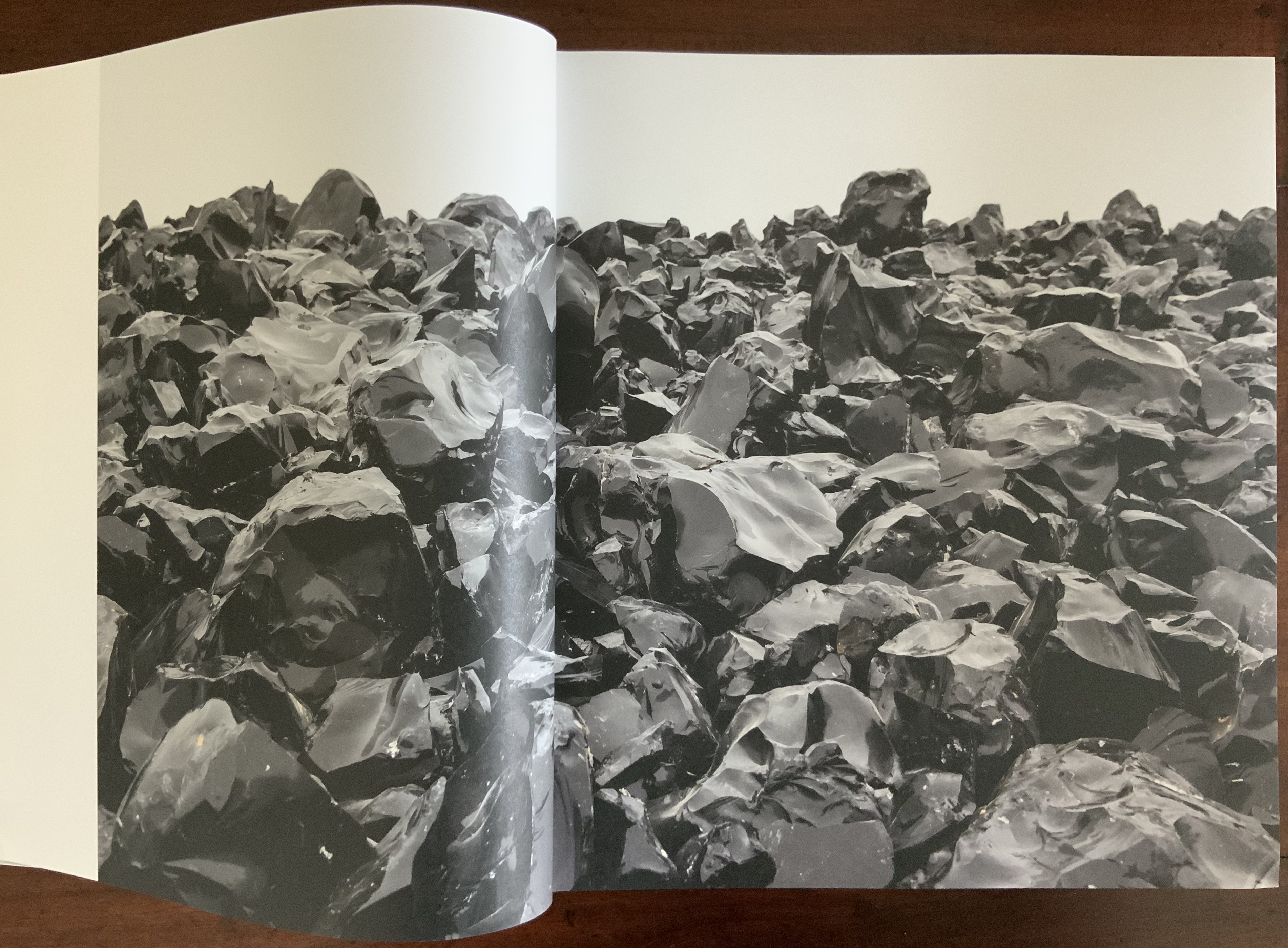
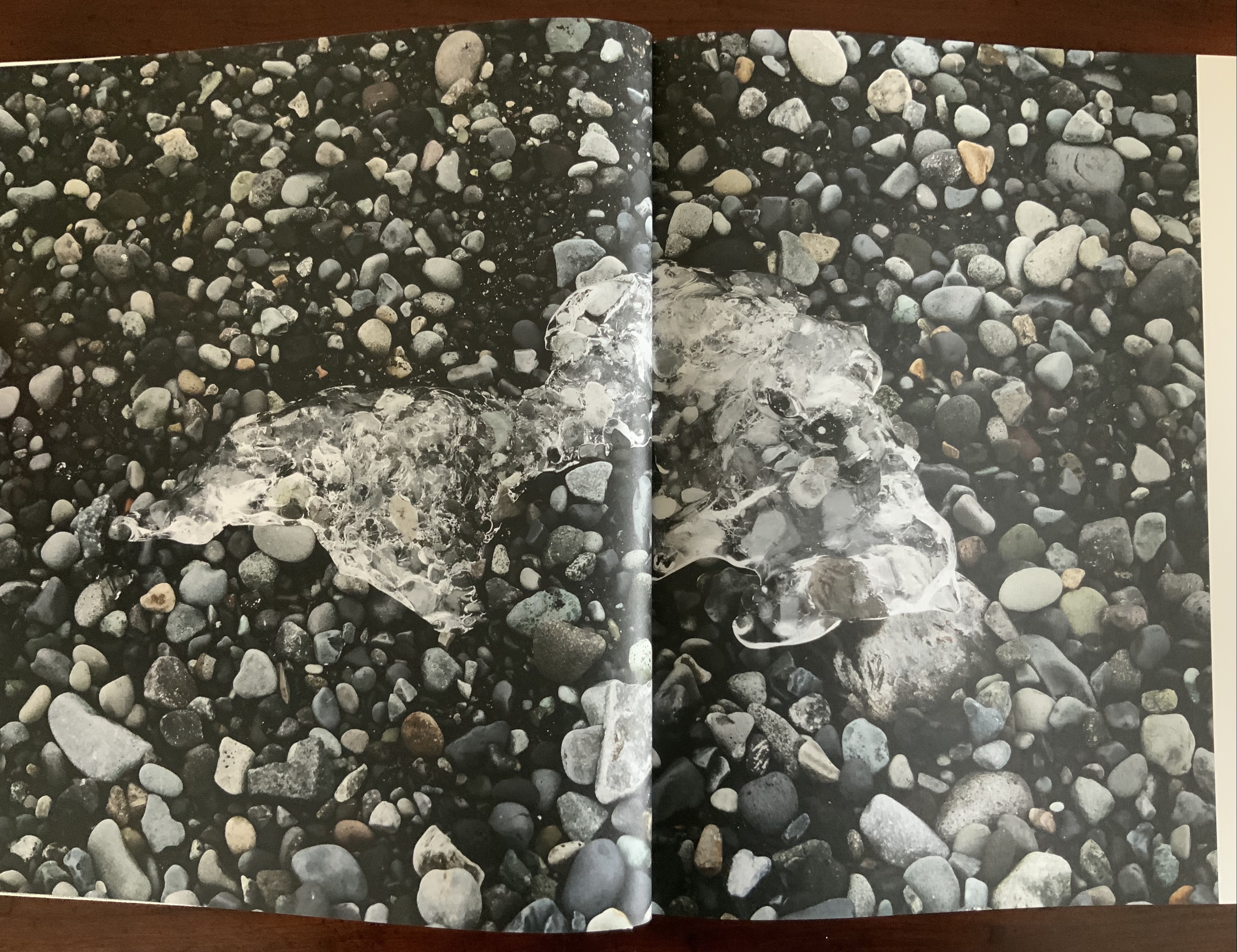
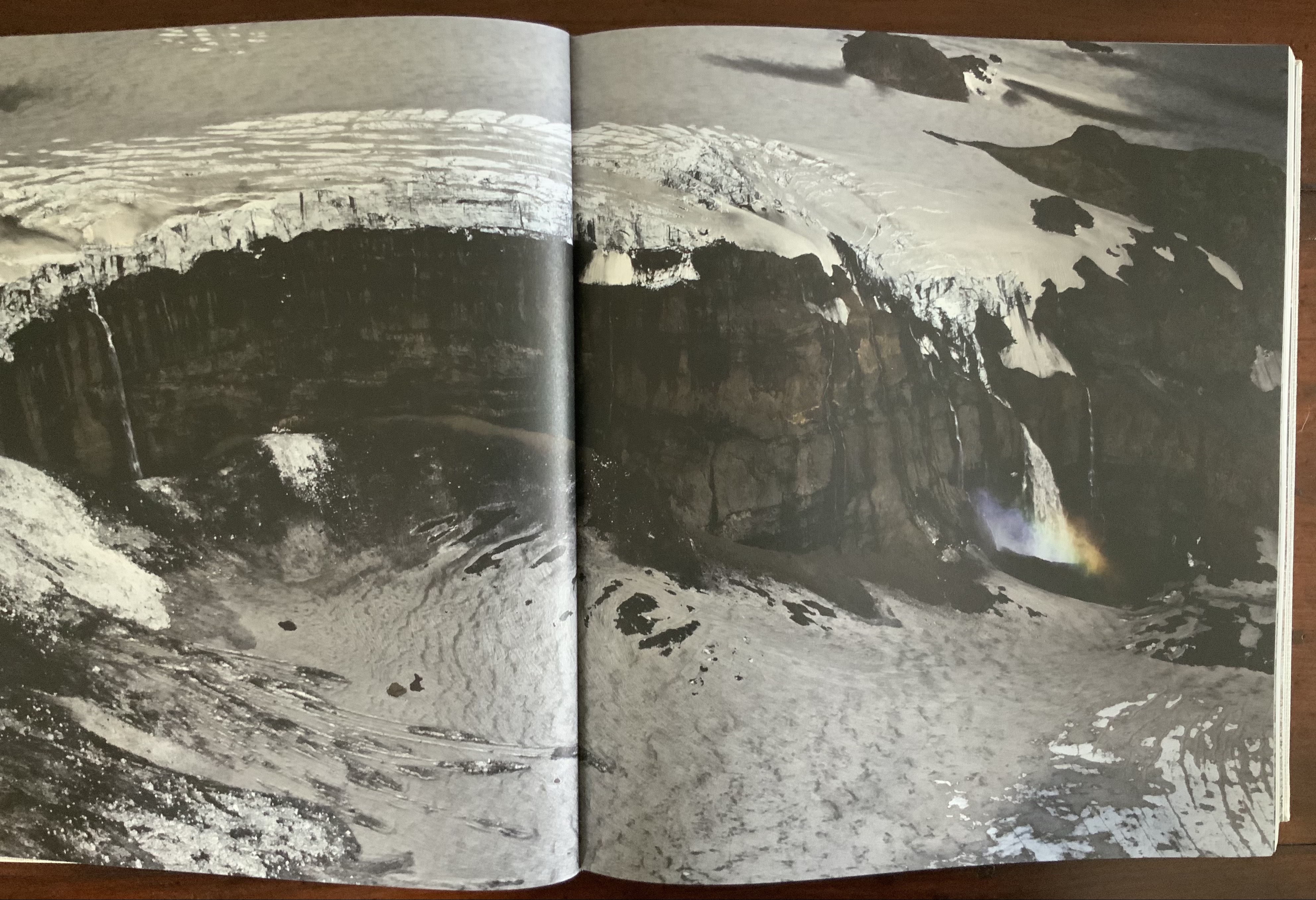
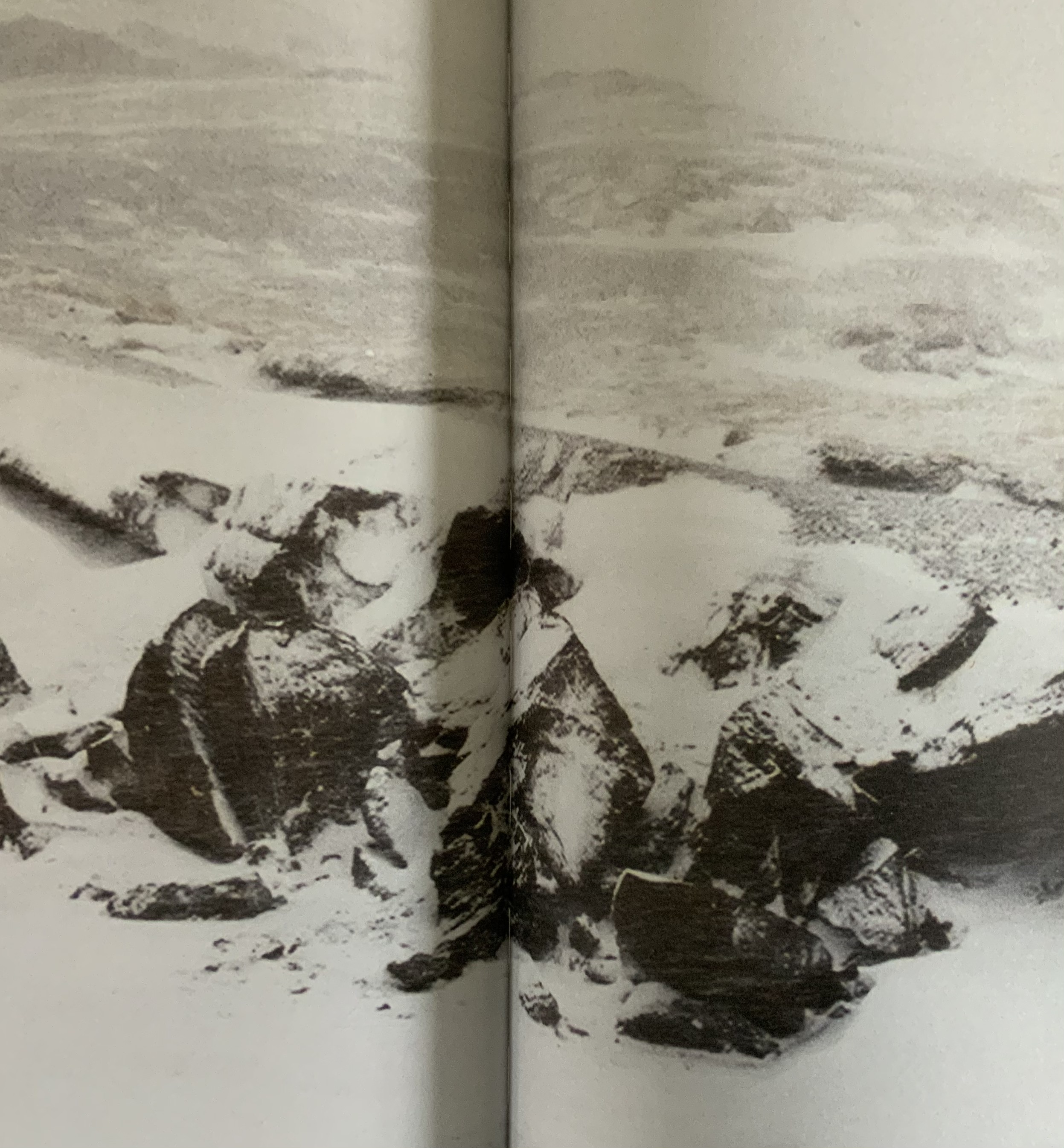
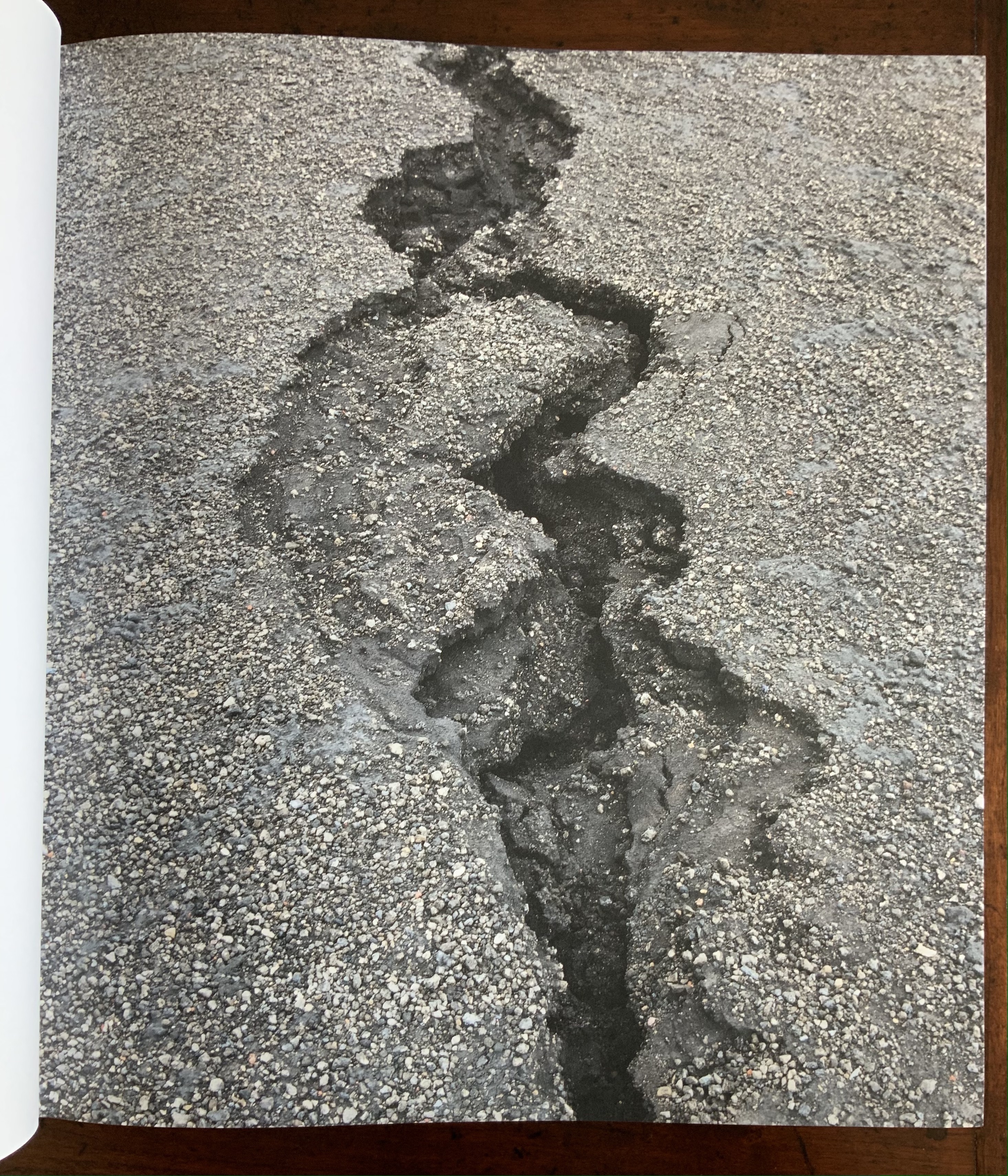
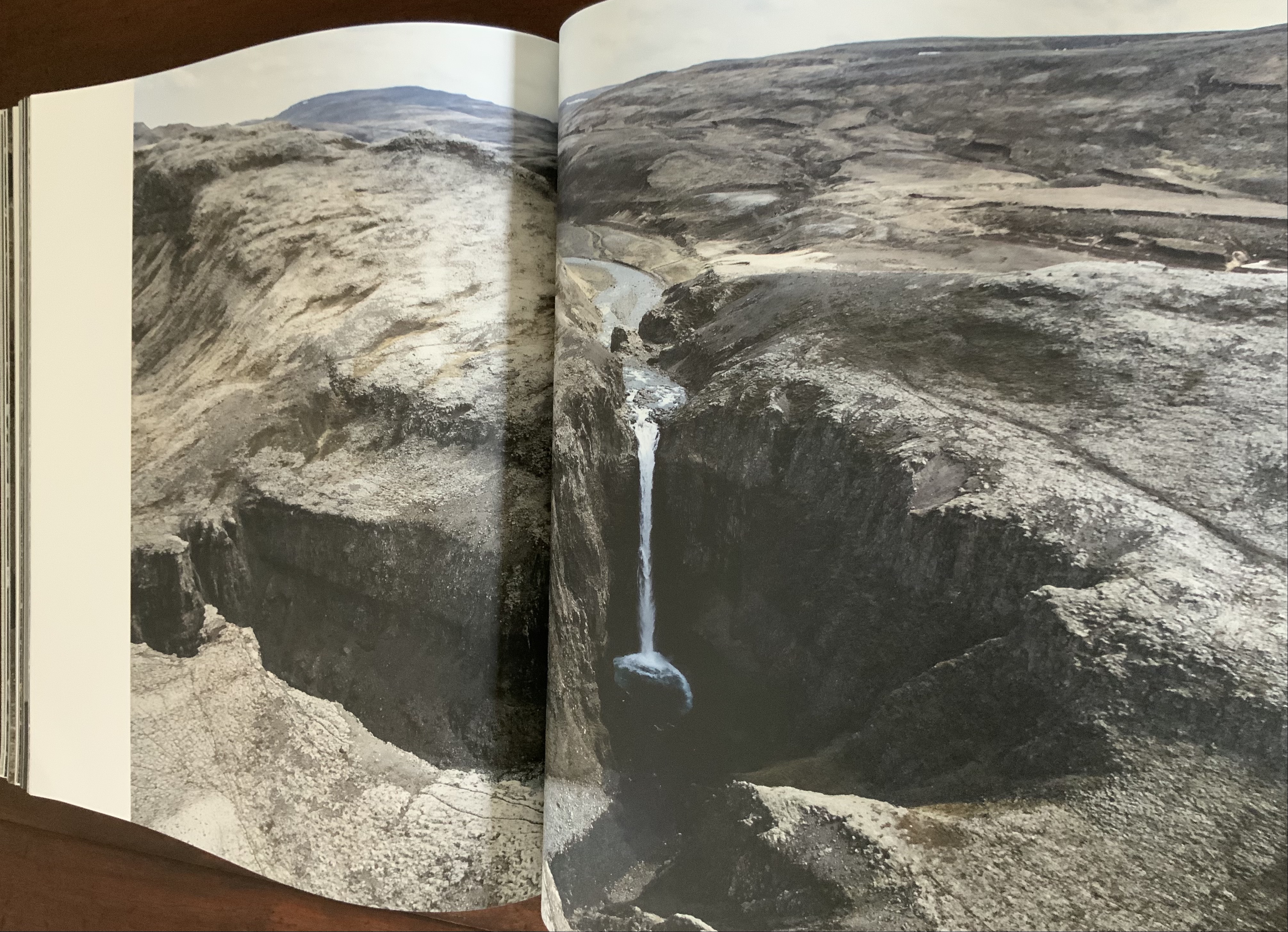
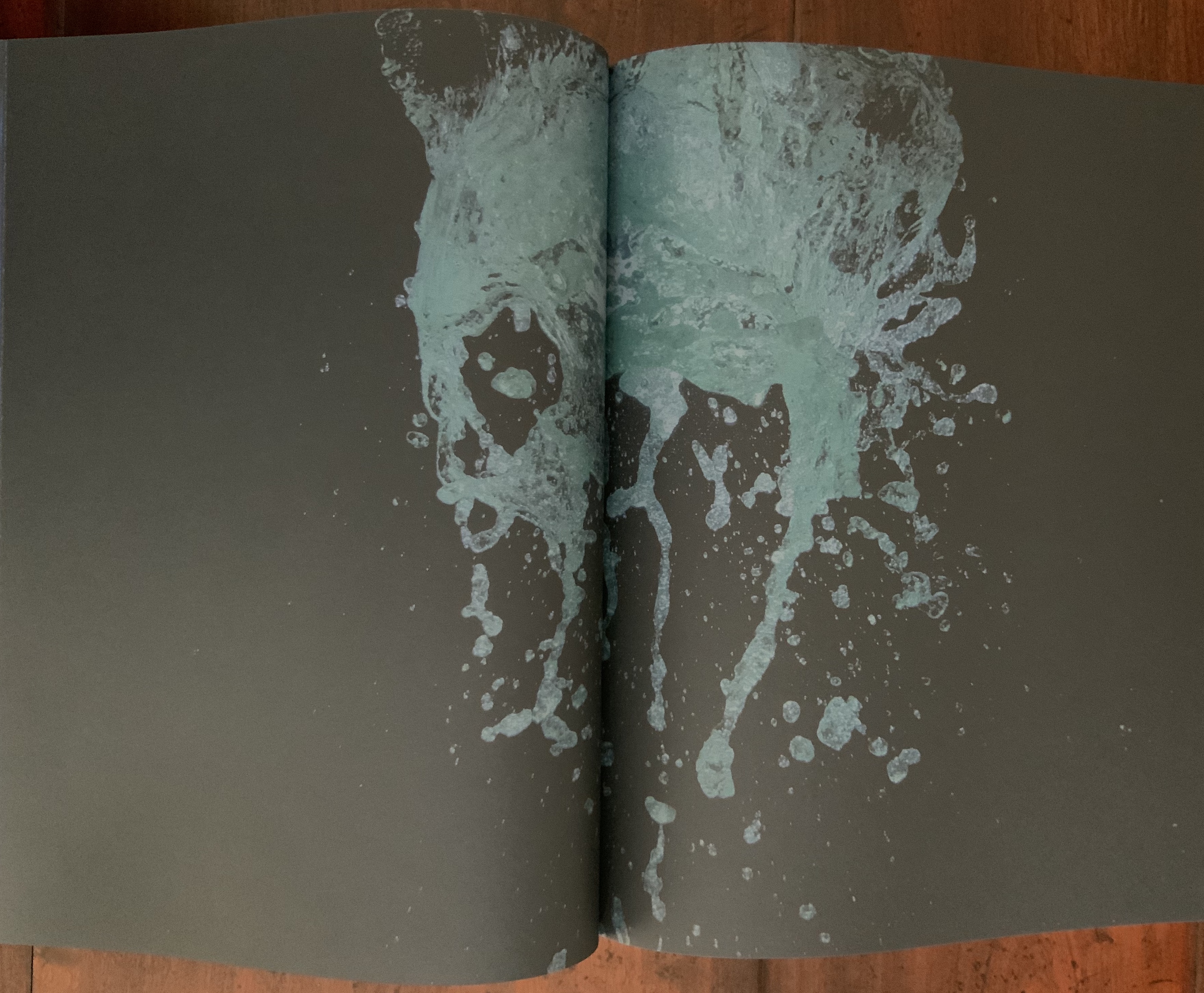
Like Your House, this work requires a slow, careful interaction in which viewing becomes learning the language of Eliasson’s images, discovering its syntax and exploring its rhymes and rhythms — reading the content presented with it. Unlike Your House, which focuses on contact with one source of content, Contact is Content draws on multiple sources: photographs Eliasson took in Iceland between 1986 and 2013 as well as images from his other projects and artworks. Over 80 different series make up the content of this work. The overwhelming number of round images — artificial and natural — in Contact is Content might suggest that Eliasson is completely sold on Bachelard’s pronouncement in The Poetics of Space that all being is round. But Eliasson’s world is spikier.

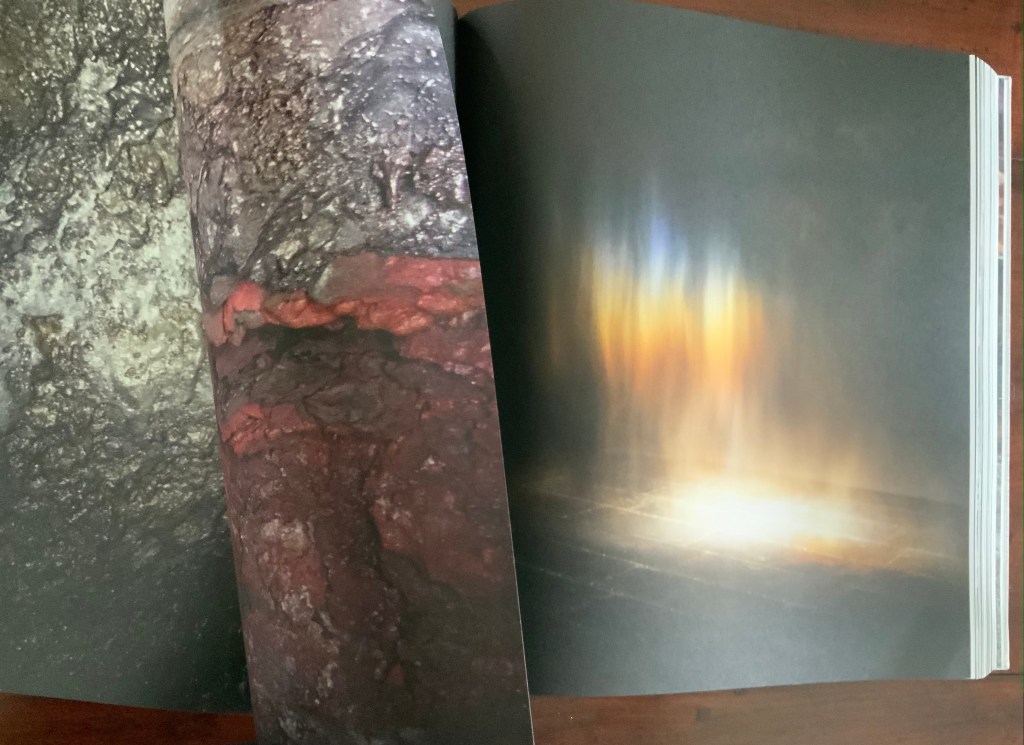
Within Contact is Content, images converse with one another — over near and far subjects, over aerial and ground level perspectives, over contrasting textures, over colors and their absence or presence, over artifice and nature

Often the conversations are reverse echoes: the reflective surface of blocks of ice echoes that of basalt.

The echo of near and far becomes a theme in itself: black-and-white aerial views of landscapes elide into black-and-white close-ups.

The absence and presence of color also emerges as a theme in its own right that interweaves with that of “near and far”: waterfalls without color vs waterfalls with the barest hint of color; close-ups of rocky terrain without color vs those dotted with intensely green or blue flora.

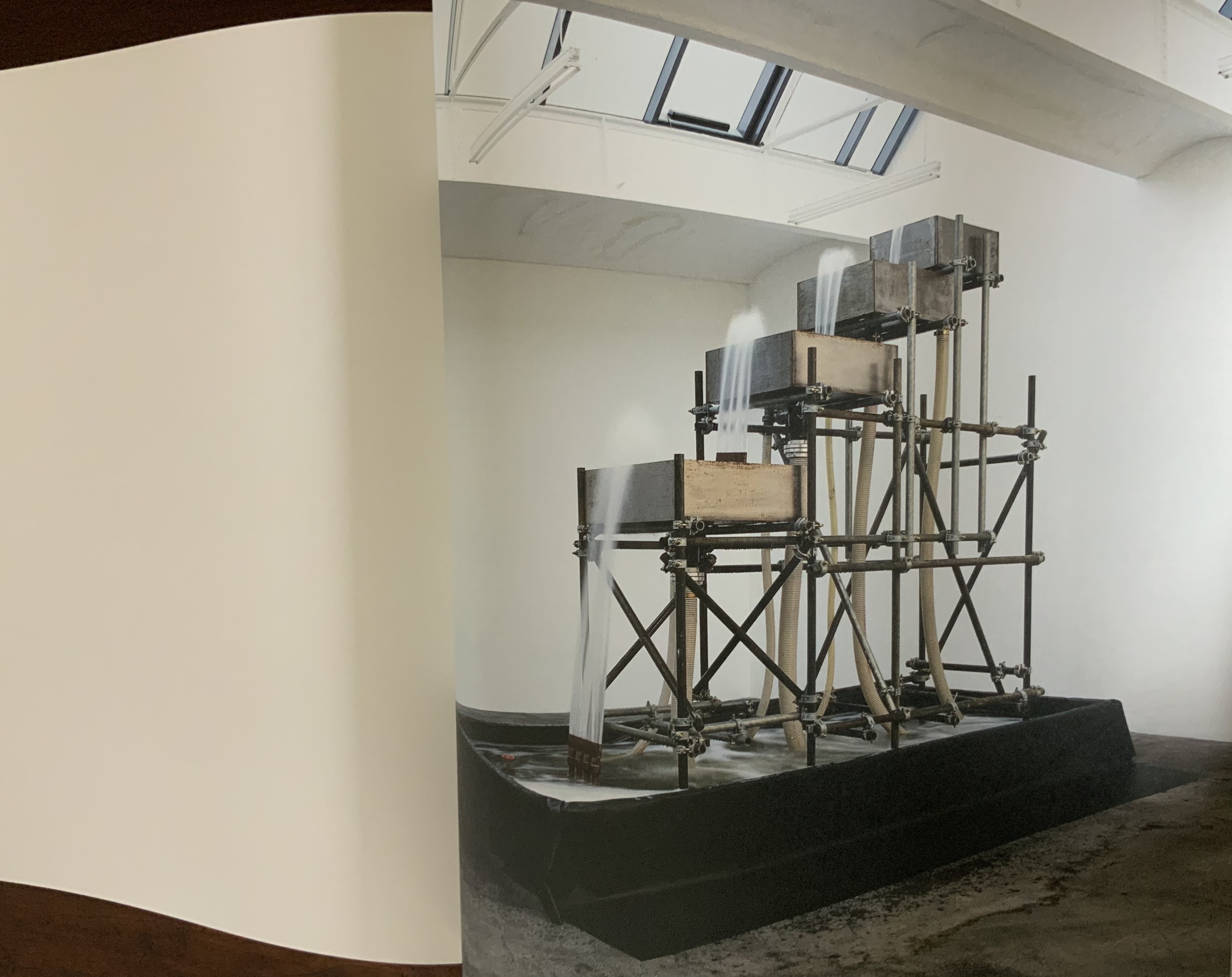
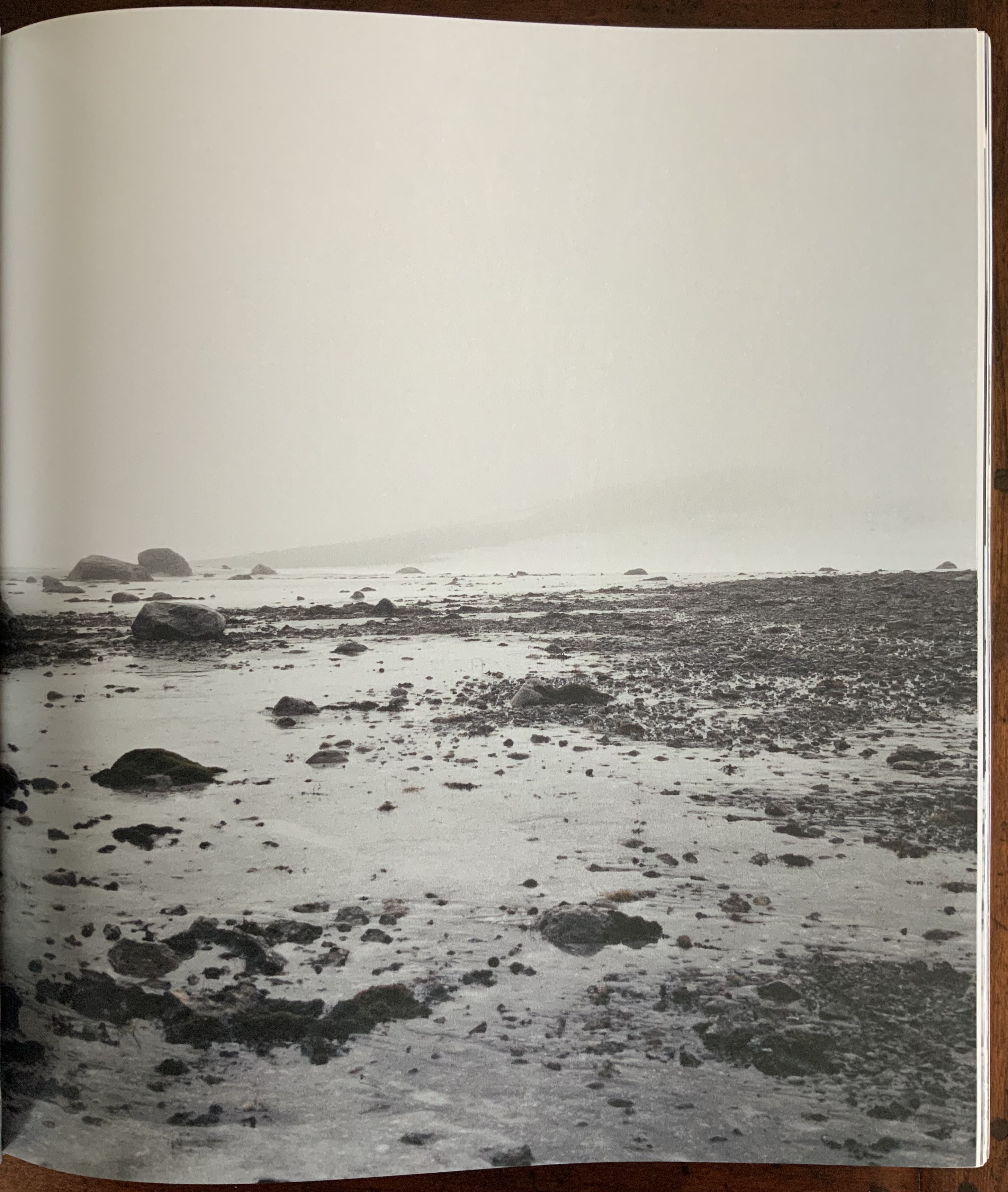
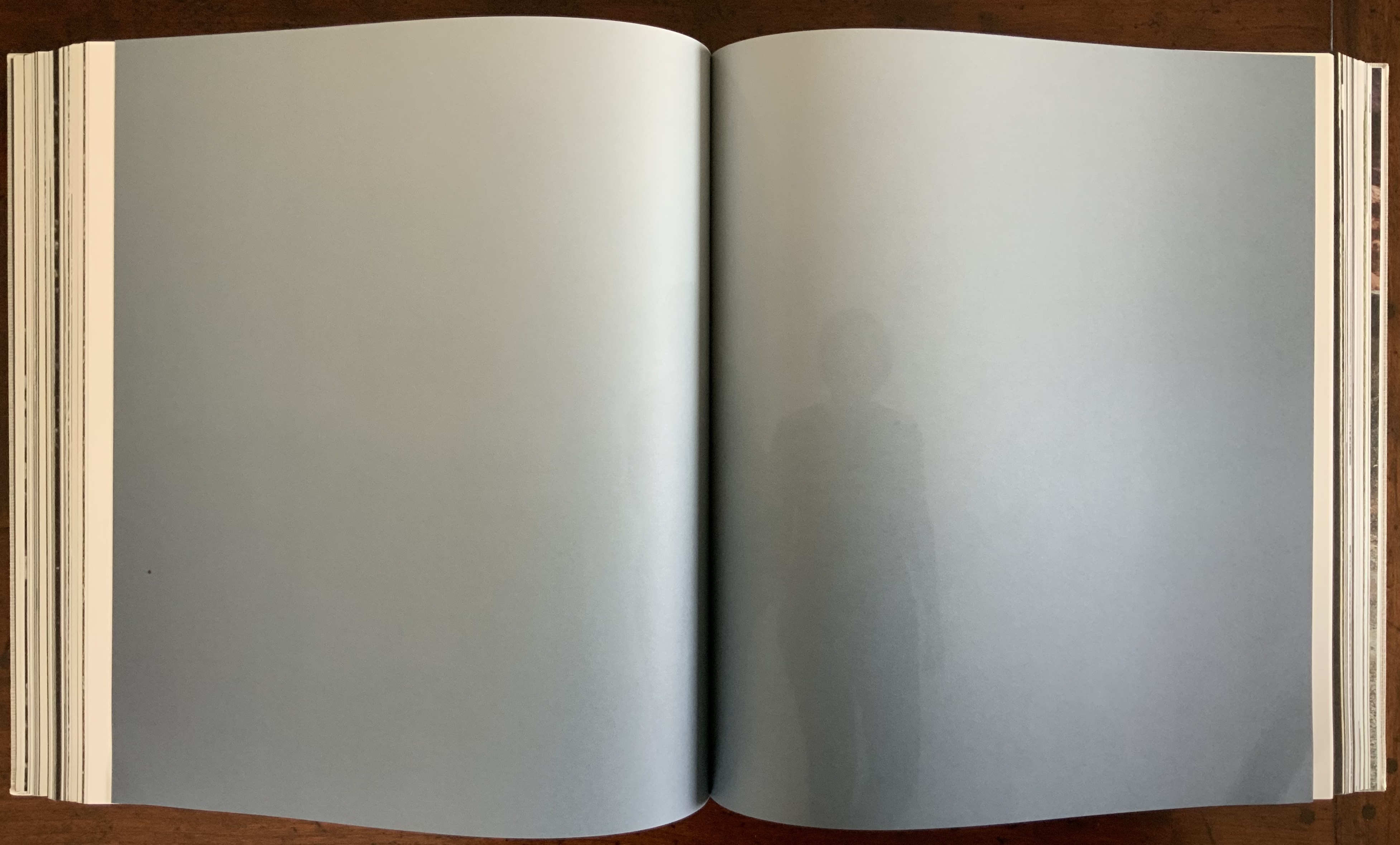
Some reverse echoes are the artificial conversing with nature: a gallery room containing a construction pumping water upwards over four levels echoes an Icelandic waterfall; or shorescapes under fog echo human outlines swallowed up in gallery rooms flooded with color-lit mists. Down to up; outside to inside; black-and-white to color; nature to artifice. And back.

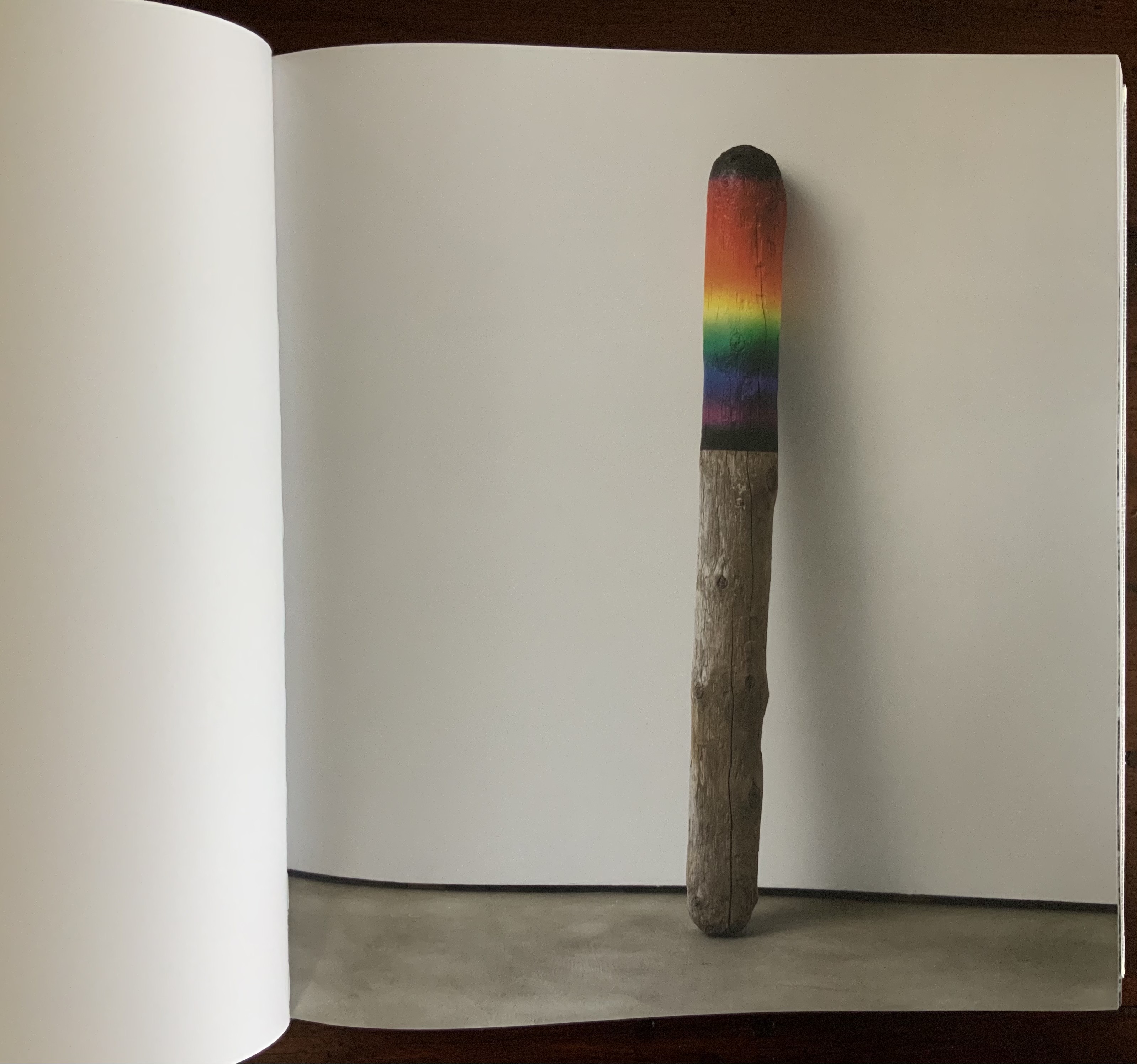
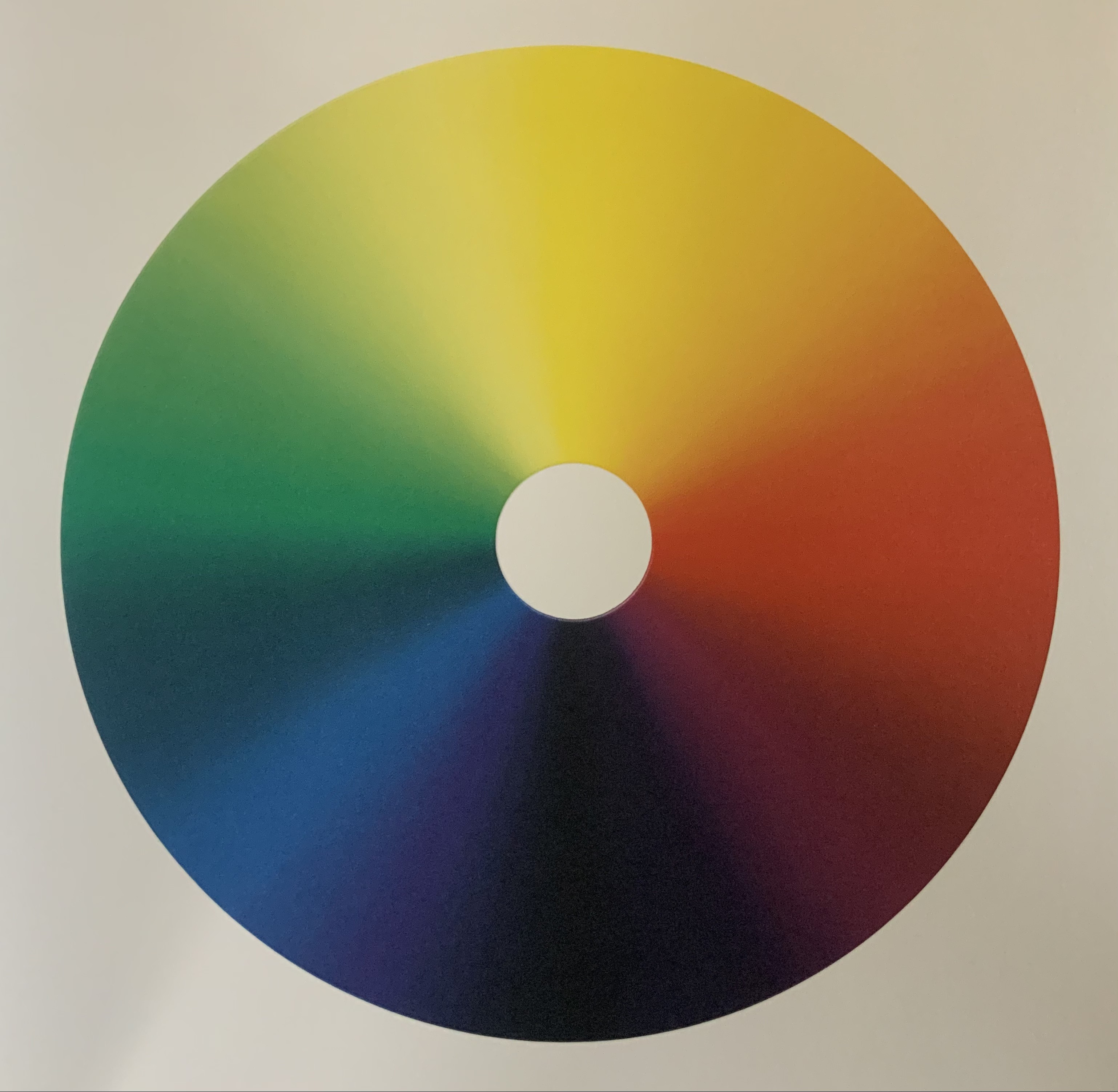
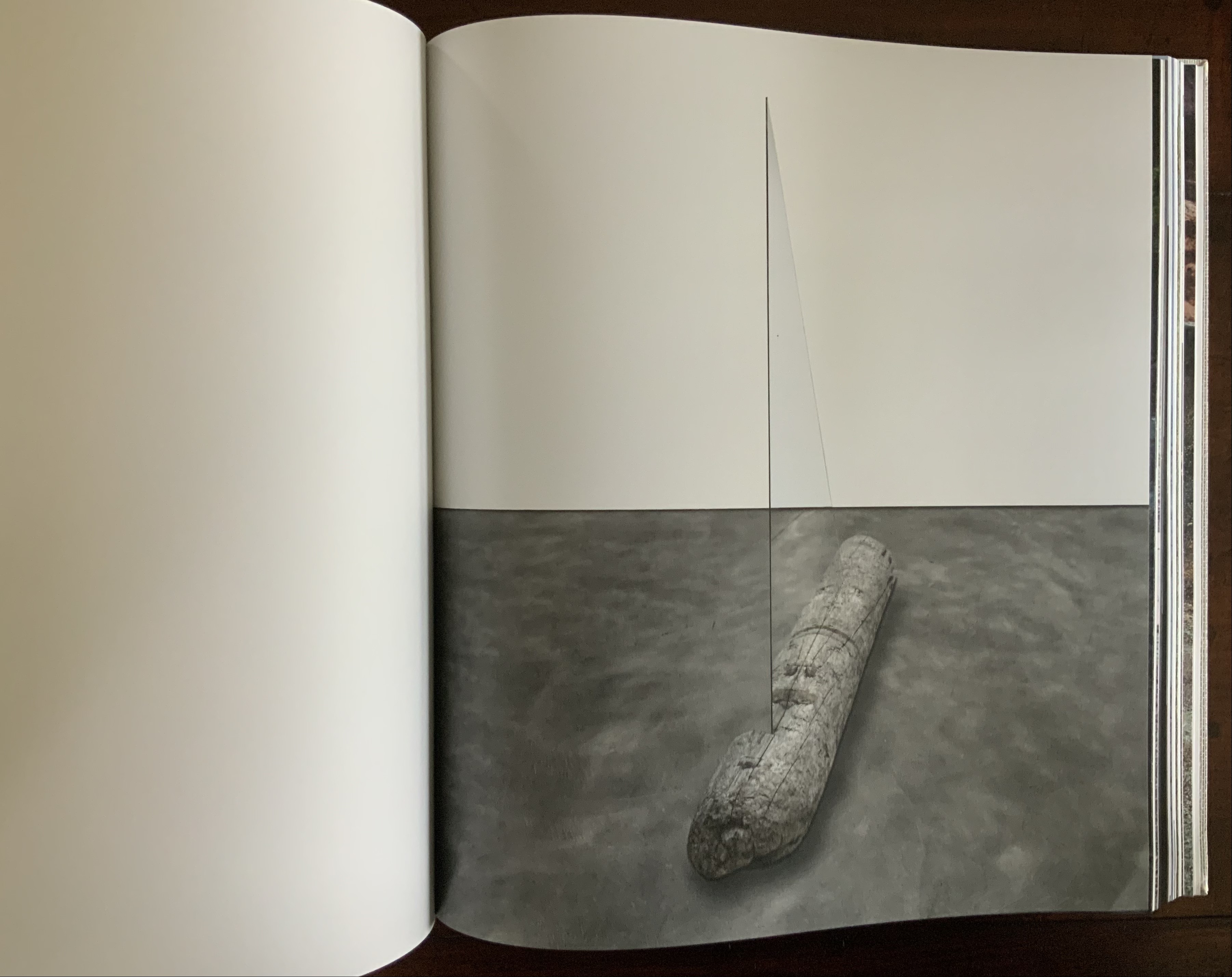
Some of these artifice/nature echoes are compressed into one image: a brightly half-painted stick of driftwood echoes the multiple color wheels used to punctuate the stretches of landscape images.

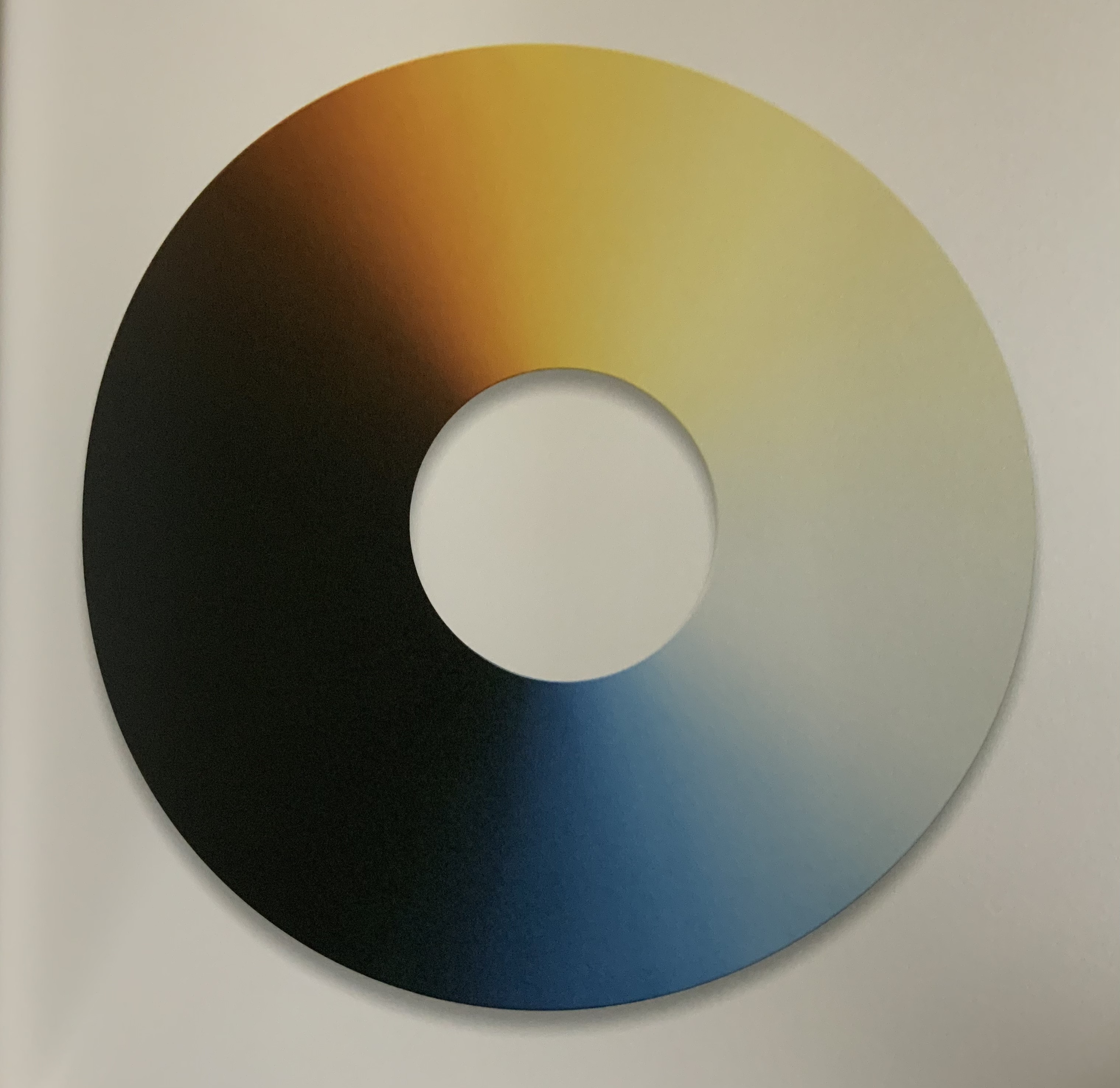
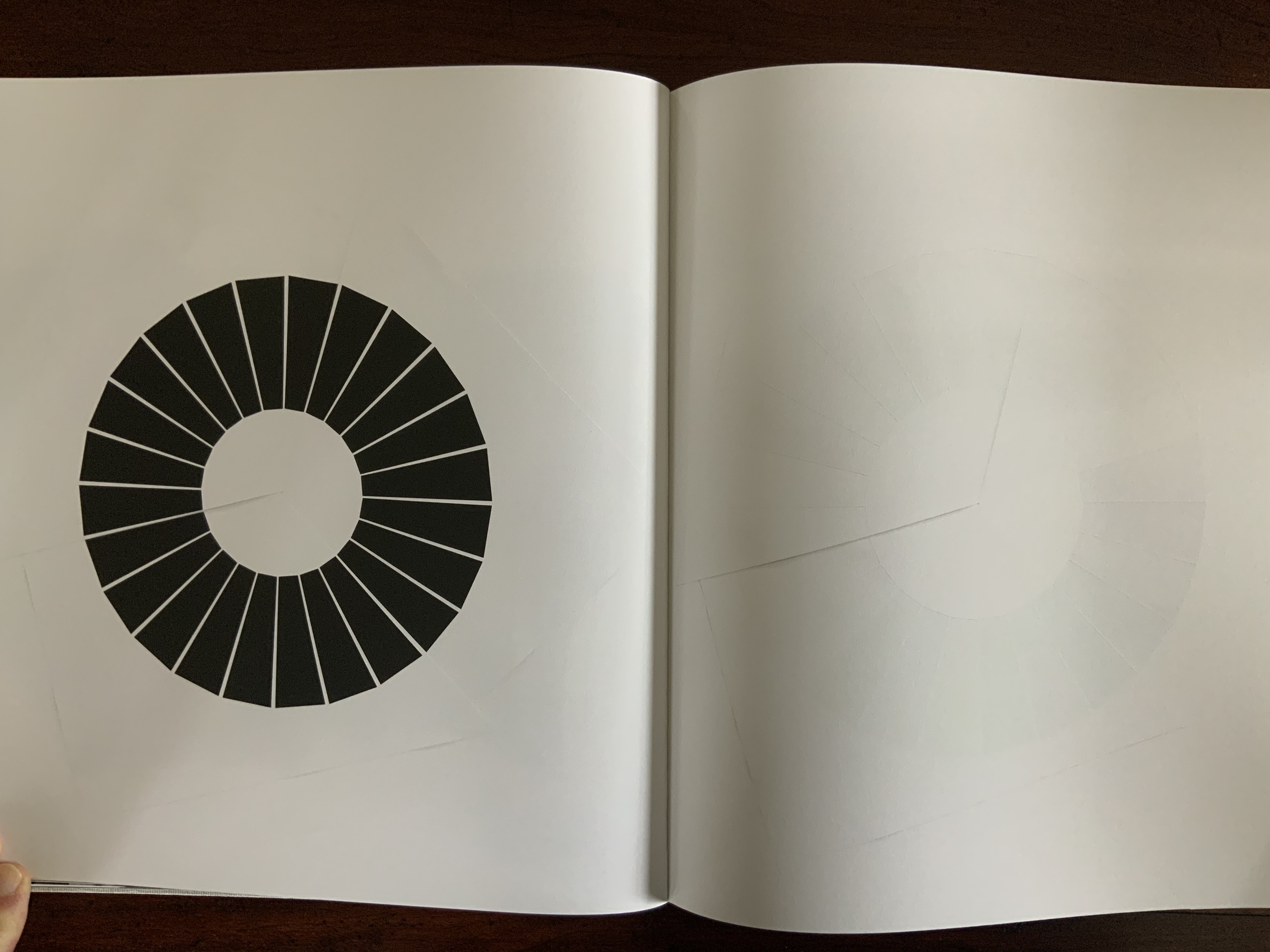
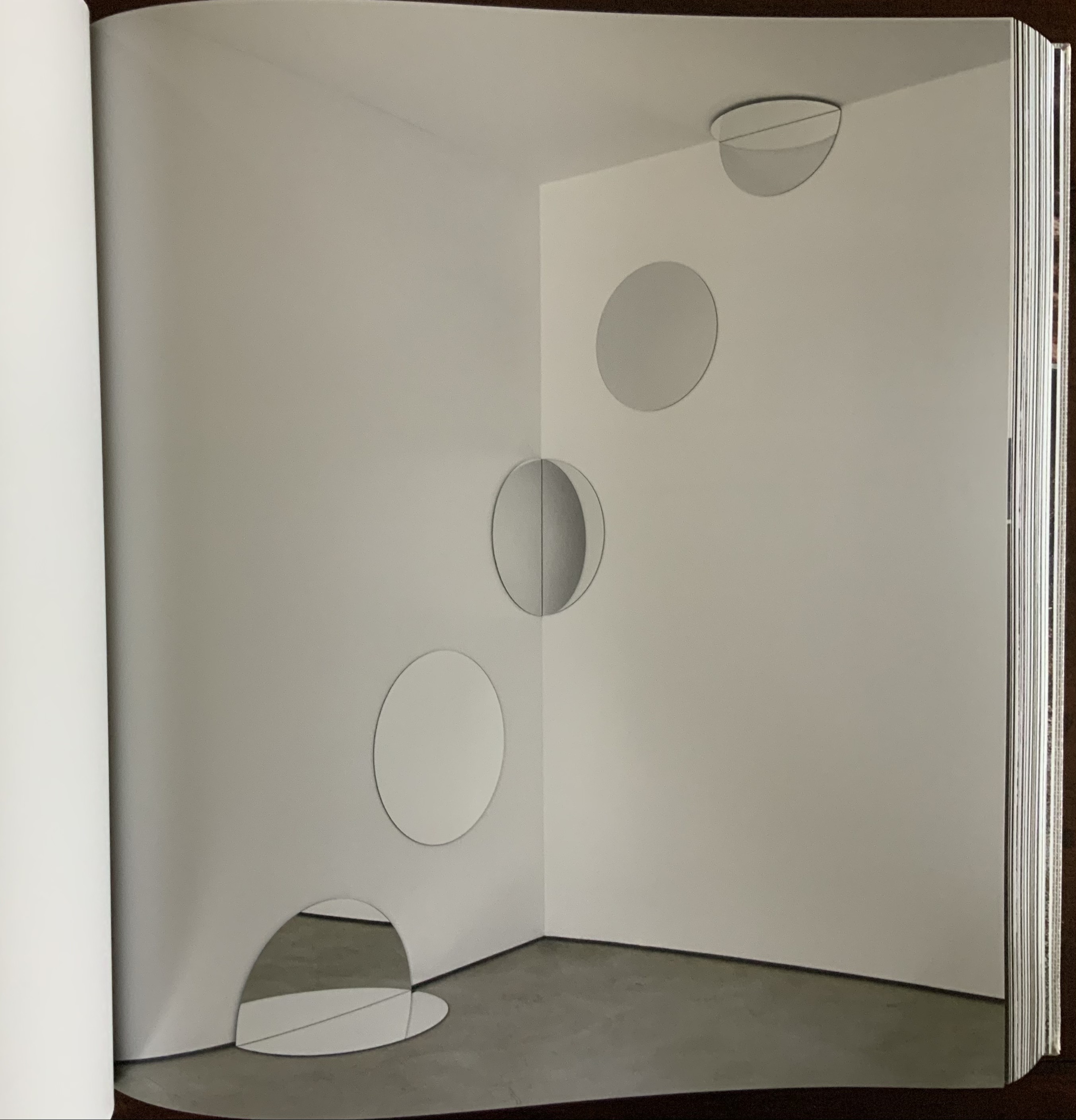
Other echoes occur within the span of artifice (whole color wheels echoed by sliced black ones) before colliding with nature (a piece of driftwood impaled by a glass triangle) and then jumping back to artifice (round mirrors bisected at floor and wall and cascading upwards to be bisected by wall and ceiling).

Some echoes occur across dozens and dozens of pages. Still others occur in the single turn of a page.

These are but a few of the themes that Eliasson weaves into a narrative with his images, artworks and projects. Every encounter with this book as container seems to reveal a new theme.

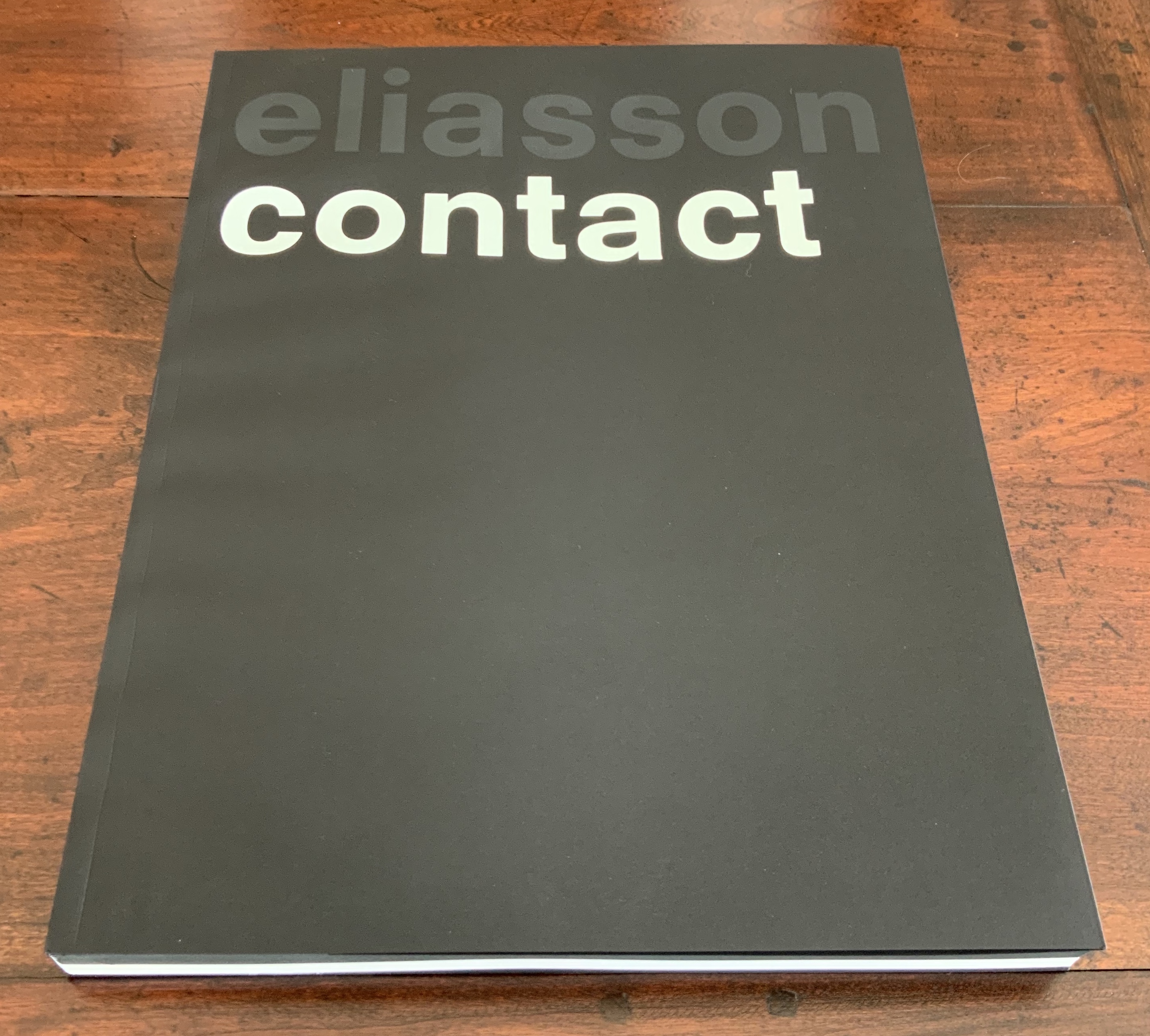
Contact (2014)

Contact (2014)
Olafur Eliasson
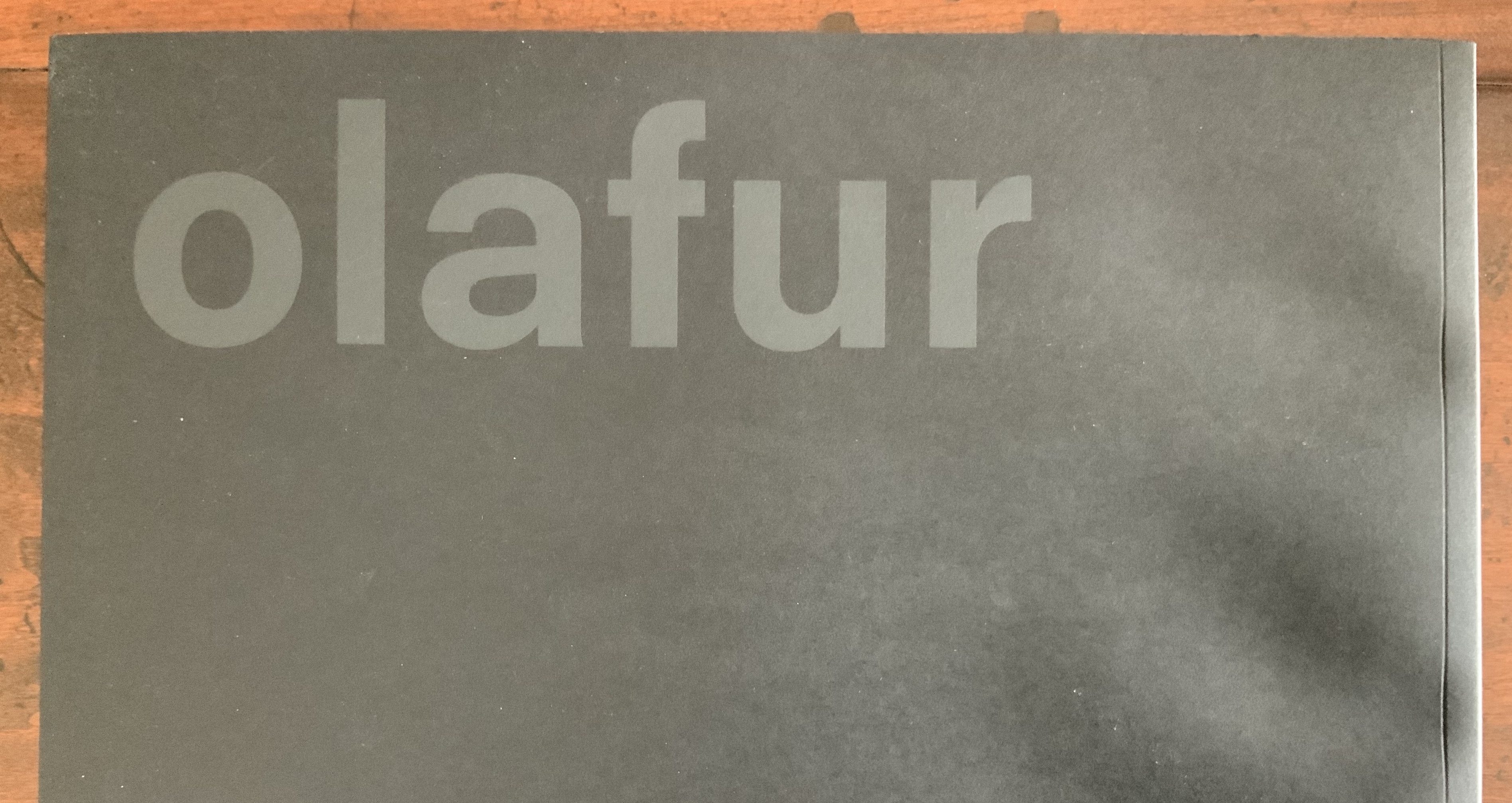
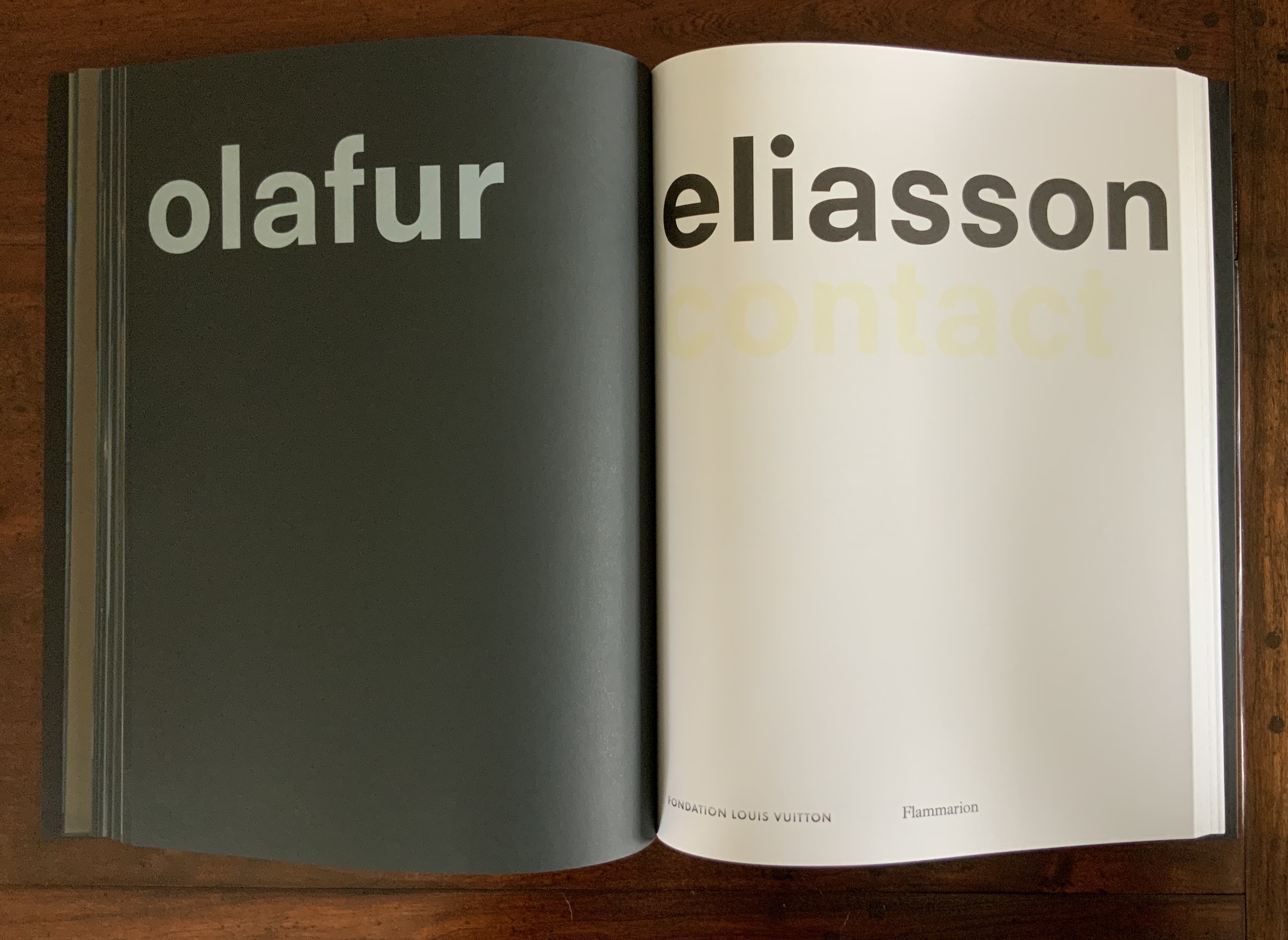
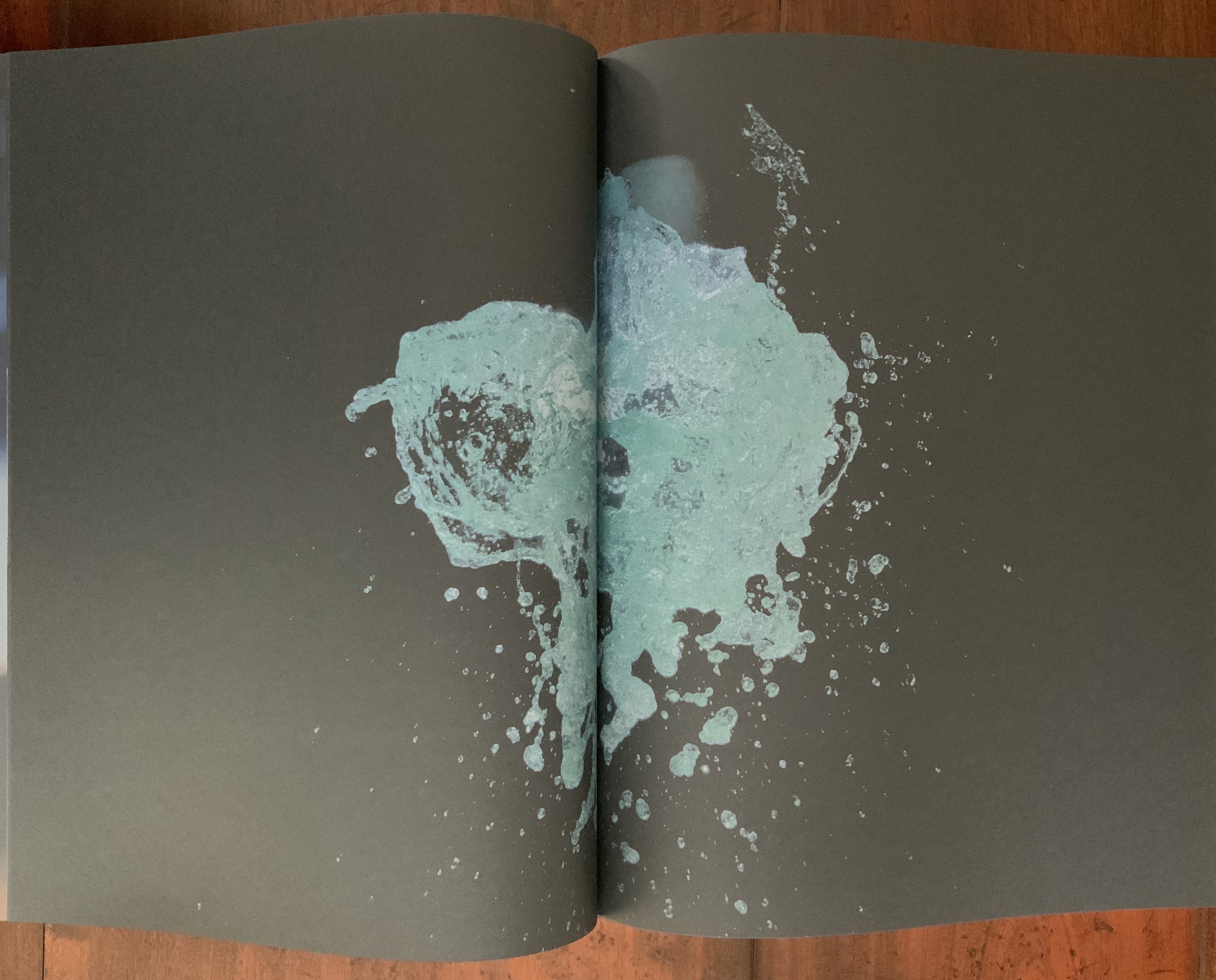
Front and back covers and center spread of exhibition catalogue in paperback. Designed by Irma Boom. Acquired from Artbooksonline.eu, 27 September 2020. Photos of the work: Books On Books Collection. Displayed with permission of Studio Olafur Eliasson.

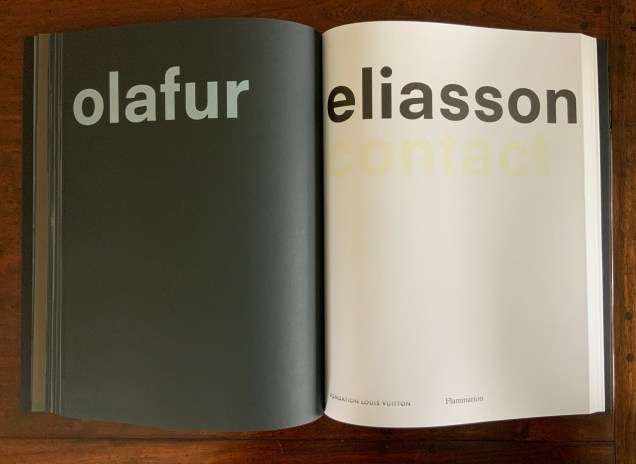
Contact interprets the eponymous site-specific exhibition, commissioned by the Fondation Louis Vuitton and held in its Frank Gehry-designed building, 17 December 2014 through 23 February 2015. Here is the artist’s statement on Contact:

being in contact is the opposite of being disconnected. to be in contact is to be aware of the consequences that your actions have in and on the world. contact is about experience rather than consumption. to be in contact is to be in touch with the good things in life as well as with the difficult things in life. contact can be a greeting, a smile, the feeling of another person’s hand in your hand. contact is not a picture, it is not a representation; it is about your ability to reach out, connect, and perhaps even put yourself in another person’s place. for me, contact is where inclusion begins. contact is the highest luxury of all. olafur eliasson

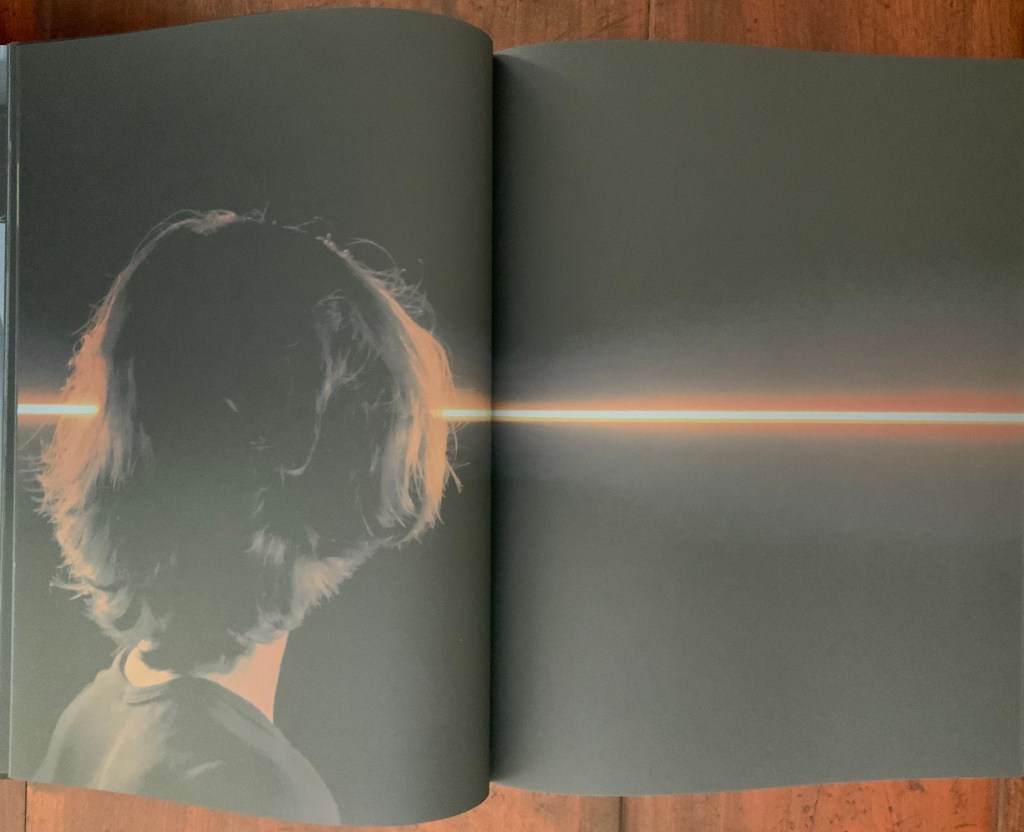
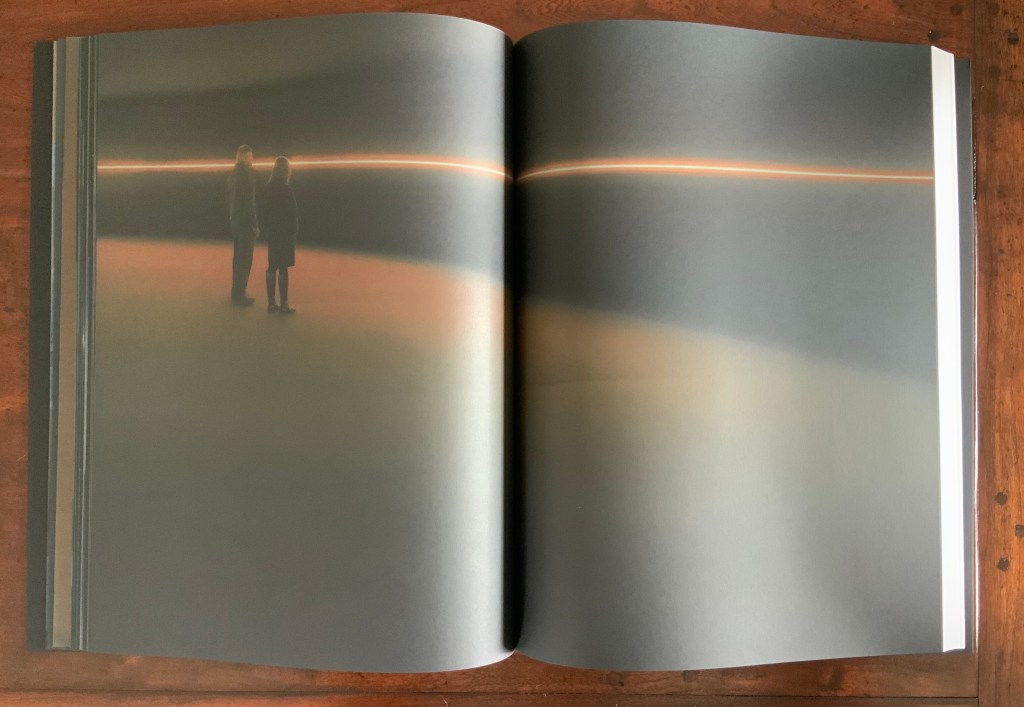
Contact is also between page and page. Eliasson and Irma Boom, “the queen of books”, have worked together on several works. Boom’s mastery of the full bleed, double-page spread and gutter is the perfect match for this volume that brings the virtual into contact with the material.

Contact is also between paper and ink, between black and white as well as between dark and light when the book’s fluorescent title glows in a darkened room. The cover’s fluorescent ink, however, is not integral enough with the rest of the book to rise above an amusing touch; whereas contact between black and white extends to the division of the book into black and white halves.

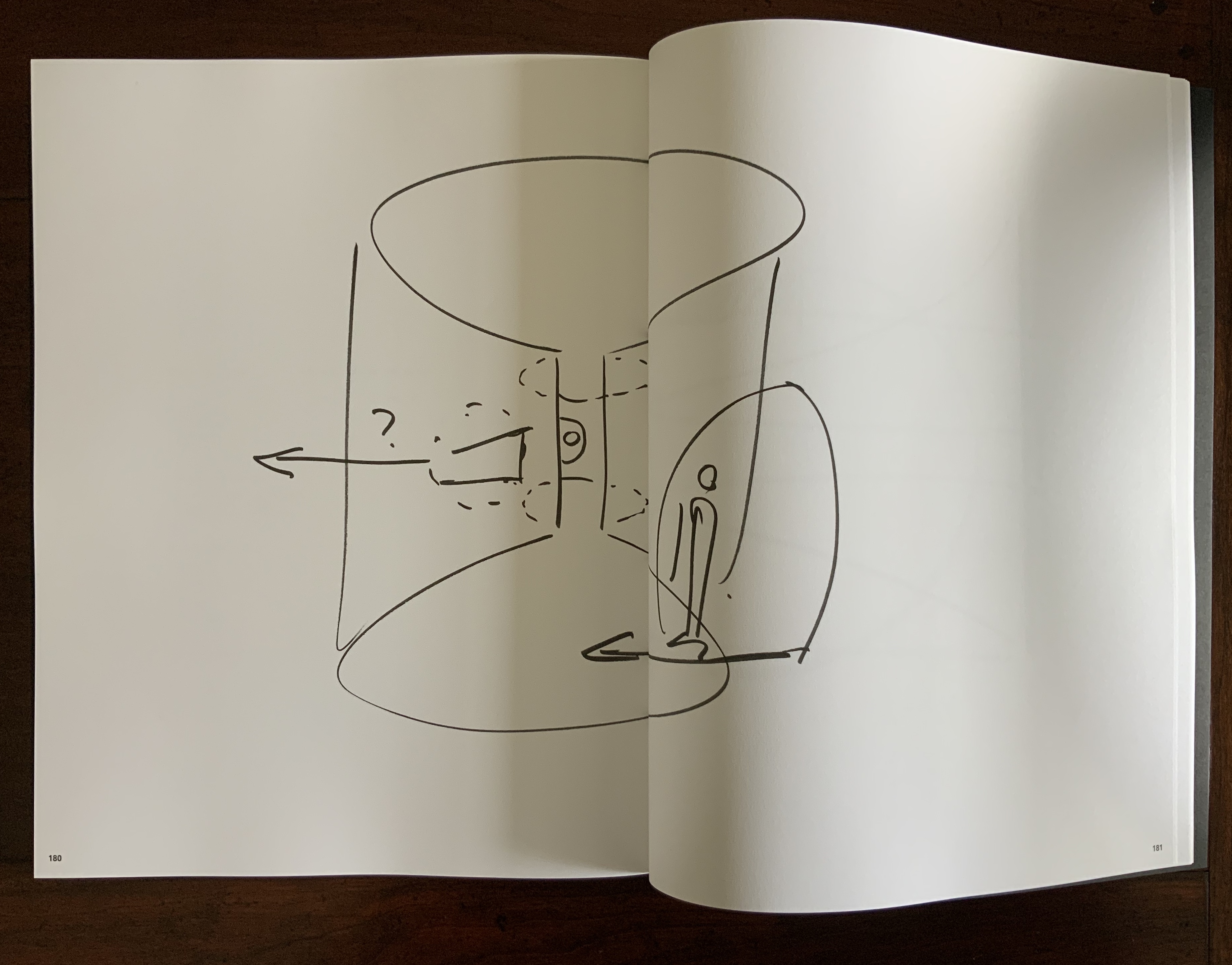
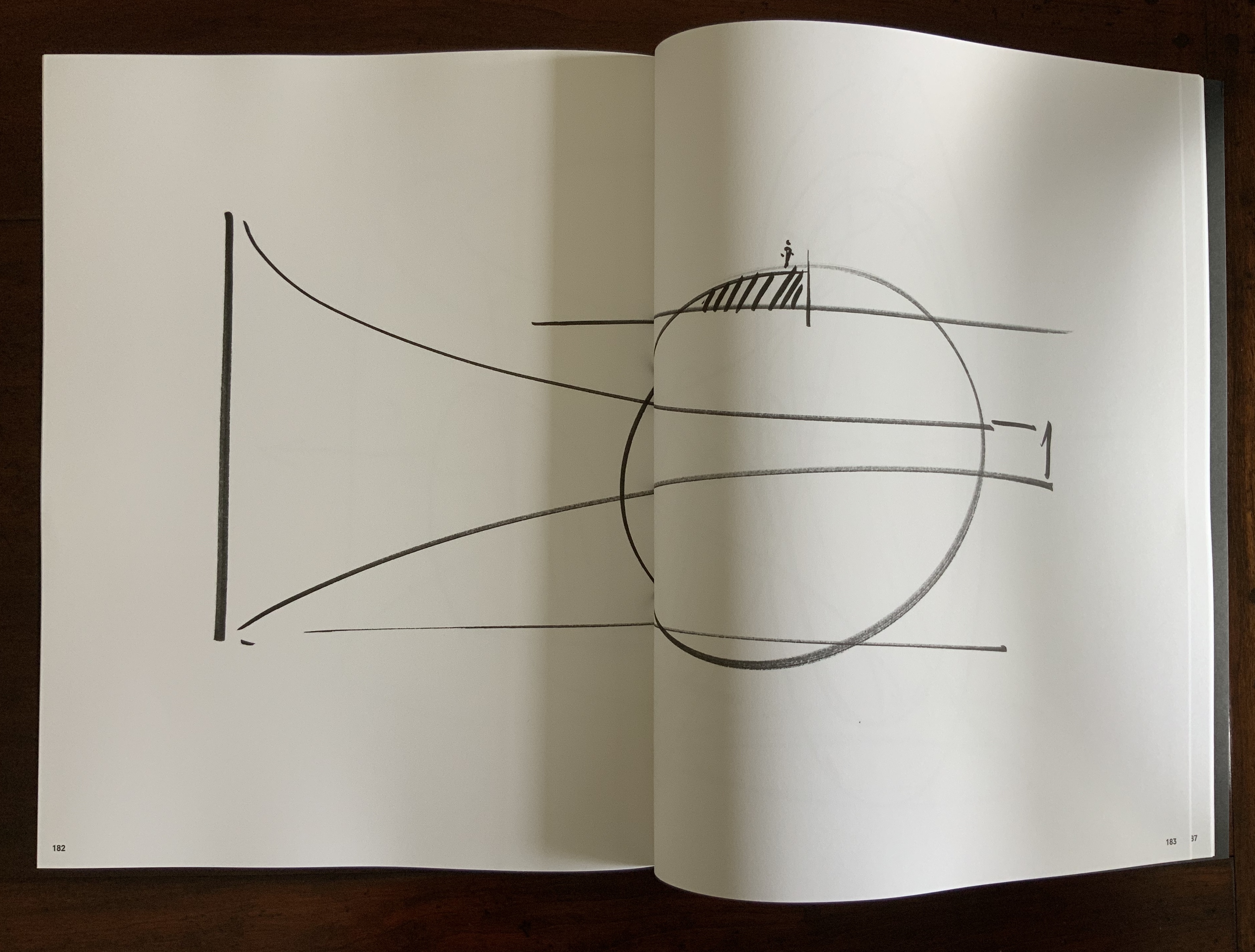
In the first half of the book, photographs on entirely black paper present a codex-experience of the exhibition. In the second half of the book, drawings take the viewer behind the scenes of the exhibition’s design and, retrospectively, train the eye to read the book as exhibition.

This incorporation of design drawings draws attention to time, and Contact is very much about our perception of time. In her book Binding Space: The Book as Spatial Practice, Marian Macken refers to “the tenses of the book”. Especially when presented in a book, architectural plan drawings “are not fixed in their sequence, but instead may be read and interpreted as existing within a range of times, such as the time of their making, of the present of the reader, the future they may refer to, and the contextual moment of apprehension” (p. 157). In the case of this “book of the exhibition”, published to coincide with the exhibition, the plan drawings and photographs exist in the exhibition’s past and present. For an exhibition attendee, they exist as a reminder of a personal past performance of contact with the exhibition. For attendees and non-attendees, they bring the exhibition’s past and future together in the present in a performance of contact guided by the architecture of the book.

How appropriate it is that, in her essay in the book’s white section, Caroline A. Jones writes, “Personally, I will not have seen the installations that the present text accompanies” — as is/will be the case for many of us experiencing Contact only in its book form. Jones’ essay is entitled “Event Horizon: Olafur Eliasson’s Raumexperimente”, which confirms that contact is not only about perception of time, but of space as well. While Jones teases out how the exhibition will play/plays/played with the astrophysical conundrum, she cites a comment from Eliasson in conversation that captures a simpler view: “There is a tradition of the horizon as a boundary between the known and unknown. But as you approach, it fades in, or comes into your experience. You can think of it as a space” (p. 133).

Space — which brings up the awkward point of the setting in which the exhibition occurred. Since the Renaissance, imagination in art and science has sat sometimes uneasily, sometimes too easily with wealth and privilege. There may be nothing democratic in Eliasson’s expensive, spectacular art, but Contact’s fusion of science, art, nature (Earth-bound and cosmic) and social connectedness contrasts pointedly and paradoxically with its setting in the opulent property of a global luxury brand — “the blandishments of follies and bling” as Jones puts it. As Eliasson’s artist statement asserts: “contact is about experience rather than consumption….is where inclusion begins….is the highest luxury of all”. But without the Fondation’s patronage, the experience of Contact in situ or even in these artfully designed pages would be denied.

Somewhat less reconcilable is the statement “contact is not a picture,… is not a representation”. Placing contact with art (a picture, a representation) in opposition to contact through human touch and empathy is not quite right. Just as Your House resonates with the perspective of the physicist/philosopher/humanist Bachelard, for whom the image is language, so too does the language of Contact as exhibition, images, objects, book — and experience. We cannot have contact without it.

Studio Olafur Eliasson. 2015. Olafur Eliasson, Contact, Fondation Louis Vuitton, Paris 2014 – 2015.

Further Reading, Looking & Listening

Architecture“, Bookmarking Book Art, 12 November 2019.

Bachelard, Gaston, M. Jolas, and Etienne Gilson. 1964. The poetics of space. Boston: Beacon Press.

Chavasse, Paule. Interviewer. 1959. “Gaston Bachelard – Entretien : La poétique de l’espace.” Radiodiffusion Française (RDF). 1959. Accessed 8 February 2021.

Denis, Claire. 2016. Contact by Olafur Eliasson. Video. 8 March 2016. Accessed 7 February 2021.

Eliasson, Olafur. 2009. “Not how, but why!” in Concrete Design Book on Implicit Performance. Eds. Siebe Bake and Billy Nolan. Brussels: FEBELCEM.

Fondation Louis Vuitton. 2015. Contact – Olafur Eliasson. Video. 13 January 2015. Accessed 7 February 2021.

Jones, Caroline A. 2014. “Event Horizon: Olafur Eliasson’s Raumexperimente”, pp. 132-37, in Contact. Paris: Flammarion.

Marian Macken. 2018. Binding Space: The Book as Spatial Practice. London and New York: Routledge.

Pallasmaa, Juhani. 2016. “Matter, Hapticity and Time Material Imagination and the Voice of Matter.” Building Material, no. 20: 171-89. Accessed February 8, 2021.

Pallasmaa, Juhani. 2011. The embodied image: imagination and imagery in architecture. Chichester: J. Wiley & Sons.

Razzall, Katie. 2013. “Celebrating books… with pages made of glass“, Channel 4 News, 20 September 2013. Accessed 3 November 2020.