Books On Books Collection — Ken Campbell

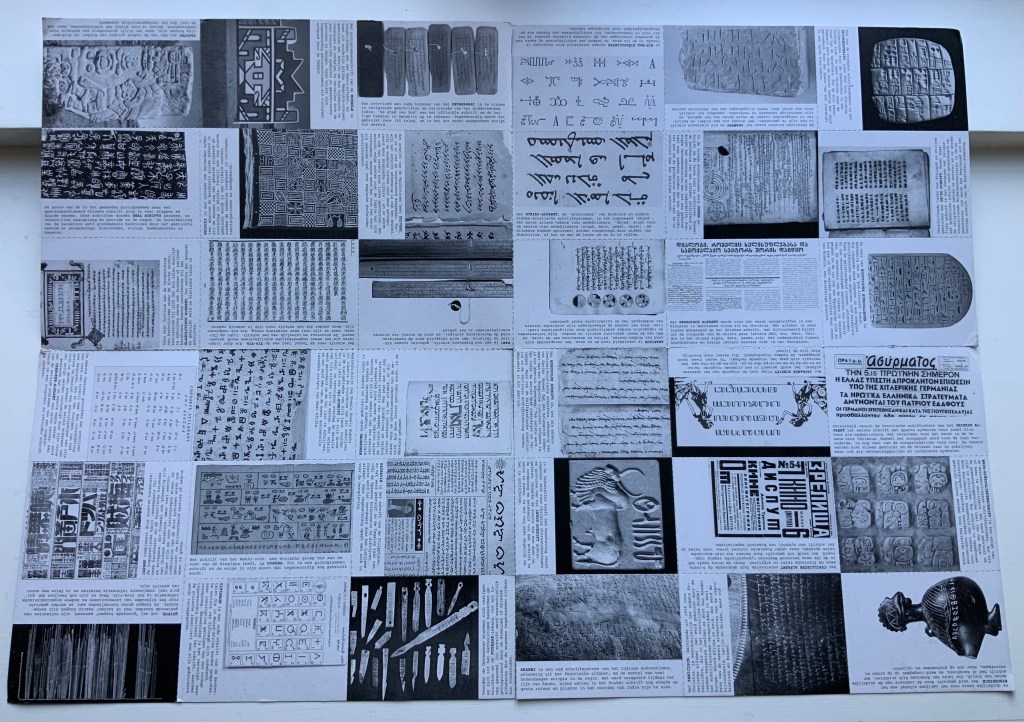
Flyer designed by Alexis Papatzaneteas with image from Ken Campbell’s Pantheon (2000).
Ken Campbell’s works hold a special place in the Books On Books Collection. Some connect with other artists’ works in the collection. Some connect with techniques, structures or themes pursued in other works. One, however, lays claim to being the original seed to the collection.
Sometime in 1987, after the Radcliffe’s neuropsychologist Dr. John C. Marshall introduced me to his associate Dr. Ruth Campbell, she invited my wife and me to dinner. A growly, jovial bear in hearing aids shouted us in with a greeting about his deafness, and a journey toward book art began. By the time we left, I had purchased a proof of his print called “In the Door Stands a Jar”. The artist’s book Ken Campbell describes below was in the works, but at the time, I had had no exposure to this form of art that a life with books and ebooks would finally teach me to appreciate.

Over the years, the print’s blend of textual and visual puns played out from the wall. A door that stands ajar is partly open, partly closed. Half-open, half-closed, the door exposes its hinge and the hour-glass shape the hinge makes. A shape that suggests “a jar” or a pair of breasts, the nipples being the screwheads. The center line of the hinge is askew, a visual pun on “ajar”. Until 2012, I had been happy enough to have the print. But then I finally woke up to book art, and it felt a bit alone, hanging on the wall — or rather “in the door … a jar”.

In the Door Stands a Jar (1987)

In the Door Stands a Jar (1987)
Ken Campbell
Slipcase (245 x 245 mm) enclosing handsewn casebound book (240 x 240 mm, 44 pages unnumbered). Edition of 40, of which this is #18. Acquired from Vamp & Tramp Booksellers, 2 March 2015. Photos: Books On Books Collection, displayed with artist’s permission.

It took three years to track down a copy. After the initial sense of accomplishment, and looking from print to book and back, I had to ask: Why a book? Instead of being printed back to back and casebound, the images could have been served up in a portfolio as prints to be framed; the text of its poem, in a chapbook tucked inside the portfolio. But they weren’t. As a book, they stand almost three dimensionally, served up as, and in, an object to be held half-open, half-closed, sequences to be puzzled out and followed, and colors and shapes shifting and overlapping like the syntax of the poem. Later, coming across Campbell’s description of the work, I learned that there was much more than that going on:

There’s usually some kind of formal problem in the books – a way of dividing space up for good clear reason and for making things work in a useful sequence. I had a notion of putting a reduced version of the book’s two-page spread, which is a designer’s term for an opened book, on one page and putting the same two-page spread reduced on the opposite page, so you’re looking at a kind of visual pun: two spreads on the whole spread.

Left: Double-page spread with title, author and date.
Right: Final page, numbered and signed, and pastedown endpaper.

The last two lines of the poem across two double-page spreads:
A MAN   AMEN IN    THE
DOOR   STANDS A    JAR

The centerline of the grid on each page provides the visual key to the double-page spread embedded in each single page. The centerline itself and the images falling across it almost encourage the reader/viewer to fold the single pages in half to see how the halves of the image match up or shift. Like closing and opening a door. And so the page and double-page spread become elements in the composition itself. Campbell goes on to explain that there is even still more to it:

On each page is another, smaller two-page spread printed on a black background. In each smaller spread is what is left after I have printed black solids as a window over and around the female forms. Black over colour gives ghostly images of the complete form. The poem runs laterally through the colour and bleeds off into the darkness on either side. There are very large dark borders. I had started to play with borders both as ways of containing the work in a field and as a dark space at the edge of things; a free-fire zone in which things seen in other parts of the book and things remembered can affect that which stands in the light.

I wanted to bury words in those borders as a kind of visual echo of the words being used in the poem, a metaphor for where words come from in one way of creating poetry: hearing echoes of sound and meaning from other places. This process is pursued in other, later books.

I cut a female form out of a background of zinc and wood, and then cut it in half so that there were four blocks which were then manipulated and printed in a variety of colours. The jar that stands in the door is both a woman’s thick-waisted torso, and a jar which is cut up, dismembered and moved around. It was a tilt back to my designer past, making a page move almost in a cinematographic way through the book, in the spaces between the two verses. It was a very formal piece, a very sculptural thing to do. So the book is about joy and darkness, and the sensual face of this world, and the fact that death moderates all. — Ken Campbell

For some, Campbell’s door will recall Marcel Duchamps’ various door/porte works, in particular Porte, 11 rue Larrey (1927), which Duchamps had a carpenter build. The door is hinged at the angle between two walls, each of which has a door frame to receive the door, making it a door that is always closing and opening at the same time. The direct reference to sexual engagement in Campbell’s door (and many of his other works) will also recall Duchamps’ eroticism in his Given (1946-66) doorway work. Conceptually, Campbell’s comments on the hinge, grid and edge of surfaces will draw comparison with Duchamps’ infrathin principle: “both a surface and an interval, whose deictical character points in two different directions at the same time” (Judovitz, Unpacking Duchamps).

In an insightful review of Campbell’s body of work (Parenthesis 22, Spring 2012, Mark Dimunation, Chief of Rare Books at the Library of Congress, notes these verbal, visual and conceptual doubles:

contemplation of the double emerges in several of [his] works. Opening phrases reappear in reverse at the close of a text. Positives are given counterpoint by a negative. Images flip, rotate and respond to each other as they move across the page. Phrases repeat, disassemble, and then reunite.

With its twenty-two double-page spreads, the book In the Door Stands a Jar not only doubles and re-doubles down on the visual layering of doubles — the “two spreads on the whole spread” —it also doubles and re-doubles down with its centering poem on the verbal/visual punning that hinges joy and darkness, opening and closing, and love and death together in this work. What an introduction to this form of art.

AbaB (1984)

AbaB (1984)
Ken Campbell
Formed from 17 joined sheets as one leporello, pasted onto heavy endboards of varnished wood, in a cloth slipcase. Silkscreened by Jim Birnie at Norwich School of Art on Heritage Rag acid-free paper. Edition of 50, of which this is #9. Acquired from the artist, 18 December 2020. Photos: Books On Books Collection, displayed with artist’s permission.

Campbell’s fourth work of book art, AbaB is the earliest of his works in the collection. It is certainly the most lighthearted of the works in the collection and, possibly, among all Campbell’s works. The text relays a conversation between ‘A’ (Campbell) and ‘B’ (Bruce Brown, a colleague at the Norwich School of Art), a conversation probably driven by the Cutty Sark to which it refers:

A: Think of a sea.
B: You mean the letter?
A: No, an ocean made of paper, upon which sits an open book: made of glass. On the water in the book bobs a bottle made of paper. The ship, afloat upon the label, we name the Cutty Sark.
B: Is that what you are going to do?
A: It just got done.

While the work is the only example of an accordion structure and silk-screen printing in Campbell’s work, and its use of varnished plywood for binding appears only in Father’s Hook (1978), the choice of the two typefaces reflects two processing characteristics to be found in almost every one of Campbell’s works.

I had two cases of woodletter, of different printing heights: one Anglo-American, an extra fatfaced serif; the other Didot, a Continental sans serif, very condensed and beautiful. They were so different in their respective fatness and thinness that they represented the polar ends of type design. As an act of cussedness I thought to do a book that brings the two together and see what happens. Ken Campbell

So, cussedness (or contrariety) and chance intertwined. The chance of two cases of woodletter, of different printing heights, contrary in weight and style, meets Ken Campbell, cussed and contrary enough to bring them to bear on a pun that launches an inside-outside pun: the message in a bottle becomes a message on a paper bottle afloat on an open book made of glass that sits on a sea/C of paper.

Another element of technique in AbaB stands out as recurrent in almost every one of Campbell’s works. It is an effect Campbell calls “stammering progress”. In AbaB he achieves it by running the conversation at different starting points in overlapping parallel lines that break awkwardly across the accordion’s panels. In other works, the awkward breaks come from words split across grid sections (as above with In the Door) or lines of verse split across recto to verso pages (again, as above, and below in -s wings, -s wings). Again, for Campbell, the page is not simply a surface, it is an element in a sculptural composition.

Hadrian’s Dream (1990)

Hadrian’s Dream (1990)
Asa Benveniste (text) and Ken Campbell (design and art)
Folded stiff paper cover over handsewn chapbook. Cover: H298 x W202 mm. Text block: H292 x W197 mm. Twenty pages unnumbered including two three-panelled fold-outs. Edition of 120 published by Circle Press Publications, of which this is #16. Acquired from Circle Press Publications, 22 June 2015.

In interviews and in most of his works, Campbell comes across as a solitary worker, possessed by tenacious vision, images, metaphors and engagement with the tools of his craft (one printing press he named “Lucille”). Hadrian’s Dream and the two exhibition flyers in the collection, however, shed light on moments of collaboration besides Jim Birnie’s screenprinting in AbaB.

Asa Benveniste was an expatriate American poet (1925-90), introduced to Campbell by Ron King in 1977. Later, King wanted to produce a series of chapbooks to celebrate the move of his studio to London and asked Campbell to take on “Hadrian’s Dream”. Benveniste’s poem is a striking one, actually about the creative process, and given Campbell’s recollection of a key line from the poem in a 2017 interview with Nancy Campbell (no relation, see below), it must have struck a lasting chord in his imagination. In the final result, though, Hadrian’s Dream is more Campbell than Benveniste.

A simple single-fold folio embracing all the other folios opens the chapbook. The half-title of the chapbook falls on the first recto panel. After that, things become less simple — either by virtue of image or fold. A second single-fold folio follows the first, and the full title page falls on its first recto panel, but inside this second folio on the copyright page (the fourth panel in the chapbook) is a glimpse of dark brown bricks that continue behind the other folios onto that second folio’s last recto panel (see below). Here the bricks turn a lighter brown then back to dark brown as they build an image of a wall, brick path or stairs, on which is superimposed a black print — an old-fashioned shadeless electric bulb emitting a jagged black corona of light and musical notes.

In correspondence (26 December 2020), Campbell notes, “the ‘bricks’ are the underside of the type used for the poem turned upside down and used to print from”. Delving into and repurposing his material at hand is a characteristic feature of Campbell’s art.

But who reads a book this way? Perhaps anyone who is puzzled after that copyright page by the succession of panels in which the seventh panel is actually part of a six-panel foldout opening leftwards. Inside the foldout on panel nine appears Benveniste’s poem, which with lines about “sunlight in the window”, a “desk lamp” and “everywhere there is only music” begins to shed light on the images. On closing this foldout and turning panels eleven and twelve, another surprise comes: a new foldout opening rightwards. It seems to be a four-panel foldout but is actually six. The missing two have already shown up before the first foldout! The complete image on the inside of this second foldout folio can be seen only when the folios it embraces are pinched together (see below).

This is the clue to go back to the copyright page and pinch together the folios between it and the penultimate panel (see below).

In the catalogue for his 1996 Yale exhibition “The Word Returned”, even Campbell comments: “the way the thing folds and unfolds is a bit confusing”. Nevertheless, Hadrian’s Dream provides lessons on reading Campbell’s art. Image, text and structure connect in multiple, meaningful dimensions. Where Benveniste’s last line reads “the start of the endless poem”, Campbell’s images facing the poem are two desk lamps connected by a single cord — light feeding light. For Campbell, “sunlight in the window” evokes the four quadrants through which the sun moves daily and, thus, the four panes of the window through which Benveniste sees Hadrian’s dream. With Campbell, in looking/reading and reading/looking, there are always more than “a few ways through the window”.

A few ways through the window: An exhibition of books, related prints and sculpture by Ken Campbell (1990)

A few ways through the window: An exhibition of books, related prints and sculpture by Ken Campbell (1990)
Designed by Robert Burn, produced by Ken Campbell and Robert Burn.
Saddle staple-stitched flyer, embossed cover with end-flap folding over 14 unnumbered pages, including a three-page foldout. Acquired from Oak Knoll, 30 January 2014. Photos: Books On Books Collection.

The title of this exhibition flyer is also the title of the first book in Campbell’s catalogue The Maker’s Hand (on which more below). The flyer and entry in the catalogue intensify the desire to see that book from 1975 — whose text is printed letterpress in Univers type on the rough side of poster paper and photos of tall inward-opening windows and outward-opening wooden shutters printed on the smooth side. The flyer’s main text comes from the neuropsychologist John Marshall, who introduced me to Ken and Ruth Campbell all those years ago.

Execution: The Book: An exhibition of limited edition artists’ books, related prints and small sculpture (1990)

Execution: The Book: An exhibition of limited edition artists’ books, related prints and small sculpture“, Granary Books, New York (1990)
Designed and printed by Ken Campbell; text by Steven Clay and Susan E. King.
Eight-panel flyer, H382 x W135 mm (closed), W530 mm (open). Acquired from the artist, 20 December 2020. Photos: Books On Books Collection, displayed with permission of the artist.

The title of this exhibition flyer is also the title of a book described in The Maker’s Hand. The year 1990 must have been one of Campbell’s most productive; it certainly brought recognition from the book and art worlds (Circle Press, London; Granary Books, New York; MoMA, Oxford). As will be expanded below, the exhibition flyers serve a particular function alongside Campbell’s bookworks in the collection.

-‘s wings, -‘s wings (1999)

-‘s wings, -‘s wings (1999)
Ken Campbell
Black laserprinted images overprinted with polychrome letterpress. Bound by Charles Gledhill using an adaptation of the seventeenth-century limp vellum form and wrapped in a folded black cloth. H197 x W140 mm, 64 pages unnumbered. Edition of 30, of which this is #18. Acquired from the artist, 20 December 2018. Photos: Books On Books Collection, displayed with permission of the artist.

-‘s wings, -‘s wings is a dark, rich and more than tactile work. Following what happens in it demands more of the reader/viewer’s faculties. Unwrapping it from the cloth that envelops it, you feel engaged in some sort of rite. The feel of the binding lies somewhere between softcover and hardcover. An oily ink smell emerges. So precisely aligned with the grid image, the long stitches of beige or white thread exposed down the center of unnumbered pages 4-5 and 60-61 (both shown below) barely register to the eye.

When, however, pages 10-11 are reached (shown below on the left), the threads emerge more plainly against a dark background. The whiter vertical lines elsewhere on the page highlight the threads’ drawing function — or grouting function. By now, the oily smell is stronger, and fingers feel an almost sticky thickness to the pages. As light moves across the turning page’s surface, layers and pock marks appear and disappear much like the rising and falling of the threads. As In the Door but more so, it has an impasto effect from layering and layering brought about by Campbell’s aforementioned cussedness and chance-taking in running the sheets through the printer over and over.

Against this background, images of wings dance and pull away from the center. Over those images and background, the letterpressed text introduces a chant to Agni (the Hindu fire god) and Kali (goddess of love and the great mother) and a poem describing a forest fire spread by birds with wings aflame and falling into the undergrowth. As in other works, Campbell breaks words, punctuation and lines across multiple pages and double-page spreads. In this instance, seventeen pages carry the text. The loose transcription below does not replicate the word and line breaks within pages, only those from page to page; the double-page spreads are indicated. The chant and poem reverse themselves (not quite verbatim) after the first double-page spread, which reminds me of the palindrome In Girum Imus Nocte Et Consumimur Igni (“We go round and round at night and are consumed by fire”).

-S WINGS AGNI I KALI I 
I KALI I AGNI -S WINGS

-S WINGS AGNI KALI I

BIRDS FLY OUT (THE) FO

REST FIRE (THEIR) WING

S AFLAME FALL DEAD (T

O) IGNITE THE AWAITING
 
BUSH

AGNI I THANK                [double-page spread]
DANCE (YOU)
IN MY BONE
FIRE

FIRE BONE                      [double-page spread]
ME IN (YOU)
DANCE
THANK I KALI

BUSH (A)WA

ITING IGNITE (&) DEAD F

ALL (A)FLAME FIRE FORE

ST OUT FLY (THE) BIRDS

I KALI I AGNI -S WINGS

I KALI I AGNI -S WINGS
-S WINGS AGNI I KALI I

The chant and poem also remind me of the image of birds and animals fleeing a forest fire in Elizabeth Bishop’s “The Armadillo” (a very different poem), but other readers will bring different memories to bear, and yet again this work of art will make a fine thing of chance.

The Maker’s Hand (2001)

The Maker’s Hand: Twenty Books by Ken Campbell (2001)
Ken Campbell
Perfect bound paperback. H305 x W240 mm, 104 pages. Acquired from the artist, 20 December 2018. Photo: Books On Books Collection, displayed with permission of the artist.

Like the exhibition flyers above, The Maker’s Hand is a work of ephemera — a catalogue of a selection of Campbell’s output. They are nonetheless important to the collection, not only because it wants certain key works by Campbell but also because together the ephemera document an important characteristic of Campbell’s oeuvre. The image on the cover should look familiar. It appears reproduced in whole and part in solid colors in the exhibition flyers above. It is an emblem of connectedness, the physical, conceptual and spiritual continuity of one work with another. It is also a reminder of the personal-ness of the art. The last book covered in The Maker’s Hand is Pantheon (2000), from which the catalogue’s final image is taken:

The self-portrait of the artist drives home the pairing of a life-long consistency of image and vision with life-long artistic growth and development. Life in art, art in life. For which this curator is grateful.

Postscript

It was an honor to be invited to Ken Campbell’s wake on 22 November 2022. Well attended and boisterous, with even a vase breaking in a corner, the event would have pleased him. Perhaps as much as the news he phoned about in June that year: that the Library of Congress was acquiring as near to an archive of his work as was possible.

John Howard, who wrote Ken’s obituary for The Guardian, spoke furiously about its best bits being cut: that Ken Campbell was the Fuller Brush Man of artists’ books and that his success was as much down to his being a brilliant hustler of his work to collectors, museums, libraries and galleries in the US as to his great talent. He went on to regale the crowd with memories, including breaking Ken’s leg in a VW van accident and loaning him a fine capacious briefcase for a ferry journey to France only to have it wordlessly returned reeking of sick. Filmmaker John Smith hailed Ken’s teaching and encouragement and noted Ken’s and Ruth’s much-needed support for his early films. Painter David Atkinson recalled the shouts from the street below his atelier in Paris — “Daveed At-Keen-Sawnh” — over and over because Ken had remembered the street but forgotten the address. While revealing that the British Library’s staff always know from the overpowering smell of ink when Ken’s books are out for display and study, poet and curator Richard Price reminded the party of Ken’s fierce and tender poetry so core to his work.

From now on, the toasts of thanks to Ken Campbell and his family will echo with every touch and look at In the Door Stands a Jar.

Further Reading

Atkinson, David. 24 November 2022. “Ken Campbell: 1939-2022“. Accessed 27 November 2022.

Drucker, Johanna, and Elisabeth R. Fairman. The Word Returned: Artist Books by Ken Campbell (New Haven: Yale Center for British Art, 1996).

Campbell, Ken. The Maker’s Hand: Twenty Books (London: K. Campbell, 2001). Foreword by Marcia Reed.

Campbell, Nancy. “Reading Between the Worlds: An interview with Ken Campbell“, The Blue Notebook, Vol. 11, No.2, 2017. Accessed 13 December 2020.

Chambers, David. “Ken Campbell: an artist’s text and image“, Matrix, No. 16, Winter 1996.

Dimunation, Mark. “Breaking Rules: The Insistent Vision of Ken Campbell”, Parenthesis 22, Fine Press Book Association. Accessed 13 December 2020. Clear commentary on Broken Rules and Double- Crosses (1984), AbaB (1984), A Knife Romance (1988),  Father’s Garden (1989), Execution (1990), Firedogs (1991), Skute Awabo (1992), Ten Years of Uzbekistan (1994), The Word Returned (1996), Pantheon (2000) and Wall (2008).

Judovitz, Dalia. Unpacking Duchamp: Art in Transit (Berkeley:  University of California Press, 1995). Accessed 13 December 2020

Li, Ruth. “Revelatory Words and Images: William Blake and the Artist’s Book“, Thesis, Wellesley College, April 2013.

Price, Richard. “A few ways through the window: welcoming Ken Campbell’s work to the British Library“, English and Drama Blog, British Library, 31 January 2017. Accessed 13 December 2020.

“Material Noise: Reading Theory as Artist’s Book”, Anne M. Royston (MIT Press, 2019): Review

As its subtitle suggests, Material Noise explores how the material aspects of works of criticism and media studies such as Le Da Costa encyclopedique, Jacques Derrida’s Glas, Avital Ronell’s The Telephone Book and Mark C. Taylor’s Hiding matter to understanding them — just as if those works were artist books. For the reader interested in book art, the artist book or whatever one might like to call that art, Material Noise might be better read back to front. The works of book art that Anne Royston explores in Material Noise — Mark C. Taylor’s Le Réal, Las Vegas, NV, Shelley Jackson’s Skin, Johanna Drucker’s Stochastic Poetics and Susan Howe’s and R.H. Quaytman’s Tom Tit Tot — come at the end of the book.

The order though is reassuring. Otherwise we might end with criticism, media theory and critical theory becoming the foreground, the works of art simply background, lost in theoretical translation. A case of Barthes for Barthes’ sake? It is fitting that the very material approach to engaging with book art — even with its most conceptual of instances — should be applied to critics and theorists to explicate their works, only then to conclude by showcasing works of art whose mastery of the material may be said to put the more academic works in the aesthetic shade.

Royston selects the journal — Convolution, founded in 2011 by Paul Stephens — to emblematize her starting point: “a blend of art and criticism that considers its material form at every step” and delivers “a materially immersive reading experience” (pp. 1-3). If her publication had occurred in the future, she could have selected Inscription, founded in 2020 by Adam Smyth, Gill Partington and Simon Morris to serve as an open closing point. But that would have spoiled the reassurance of concluding with the art.

As is the wont of theorists (social, literary and otherwise), she proposes a new term, or tool, with which to build her case: “artistic arguments (my emphasis), a term that indicates theory that pushes back against the expectations of the theory or criticism genre, specifically by employing signification that exceeds the semantics of printed text”. Leaving it to the academics to unpack that proposition professionally and evaluate its application, this casual observer suggests that it is analogous to “upward inflection” but without the implied lack of confidence. With a lack of confidence, it would be the declarative sentence that hedges its bet with that annoying, habitual rising tone that turns it into a question.

Royston does not hedge her bets. Her observations about Le Da Costa encyclopedique and its self-conscious, self-referential heterogeneous play with the material forms of the reference work, newspaper and the forms within them — columns, typographical signals (hyphenation), etc. — are assured. Her surfacing of “noise” as a concept and phenomenon key to the shape and message of Le Da Costa, Derrida’s Glas and Ronell’s The Telephone Book is equally assured in each case. Likewise, how — across those three works — she slips among the ideas of “noise” to “formlessness” to “white spaces” to end up on the “surface” of Taylor’s Hiding, his associated multimedia The Réal, Las Vegas, NV and then Jackson’s Skin project.

Royston’s true avatar must be the ilex. In the Taylor/Jackson chapter, she effortlessly moves from Taylor’s university press book then to his electronic artist book and then to Jackson’s embodied/disembodied story literally tattooed word by word on 2,095 volunteers (thereafter called “words”). Royston does it so well that it almost enacts an artistic argument proving her thesis that we should read theory in the way we read artist books.

But collecting theories may not be as satisfying as building real or fantasy collections of art. Being introduced to Taylor’s The Réal, Las Vegas, NV (1997) with its slot machine screen offers the chance to add it alongside Marcel Broodthaers’ Monte Carlo Bond (1924) and Muriel Cooper’s designed Learning from Las Vegas (1972) by Robert Venturi. If you happen across one of Jackson’s “words” in the tattooed flesh from Skin, you can forego a kidnapping charge by turning to Paul Emmanuel’s The Lost Men Project (2006). Crestfallen that no aluminum-covered version of Drucker’s Stochastic Poetics (2012) is easily available? Download the Ubu edition. Also unable to find a copy of Howe’s and Quaytman’s Tom Tit Tot (2014)? Place its link at the Museum of Modern Art Library Council alongside the Meermanno Museum’s for its “Reading as Art” exhibition.

Royston’s book provides collector and critic with an entire toolkit enabling them to encounter the “materially immersive reading experience” and perceive how it is really the “materially engaged reading experience”. Highly recommended.

Books On Books Collection – Béatrice Coron

Much has been written on Béatrice Coron‘s works — including “Machines“, the commissioned work below. Her interviews with Helen Hiebert and Steve Miller are excellent accompaniment to her pieces with TED.

Machines (2017)

Machines: Poem by Michael Donaghy (2017)
Béatrice Coron
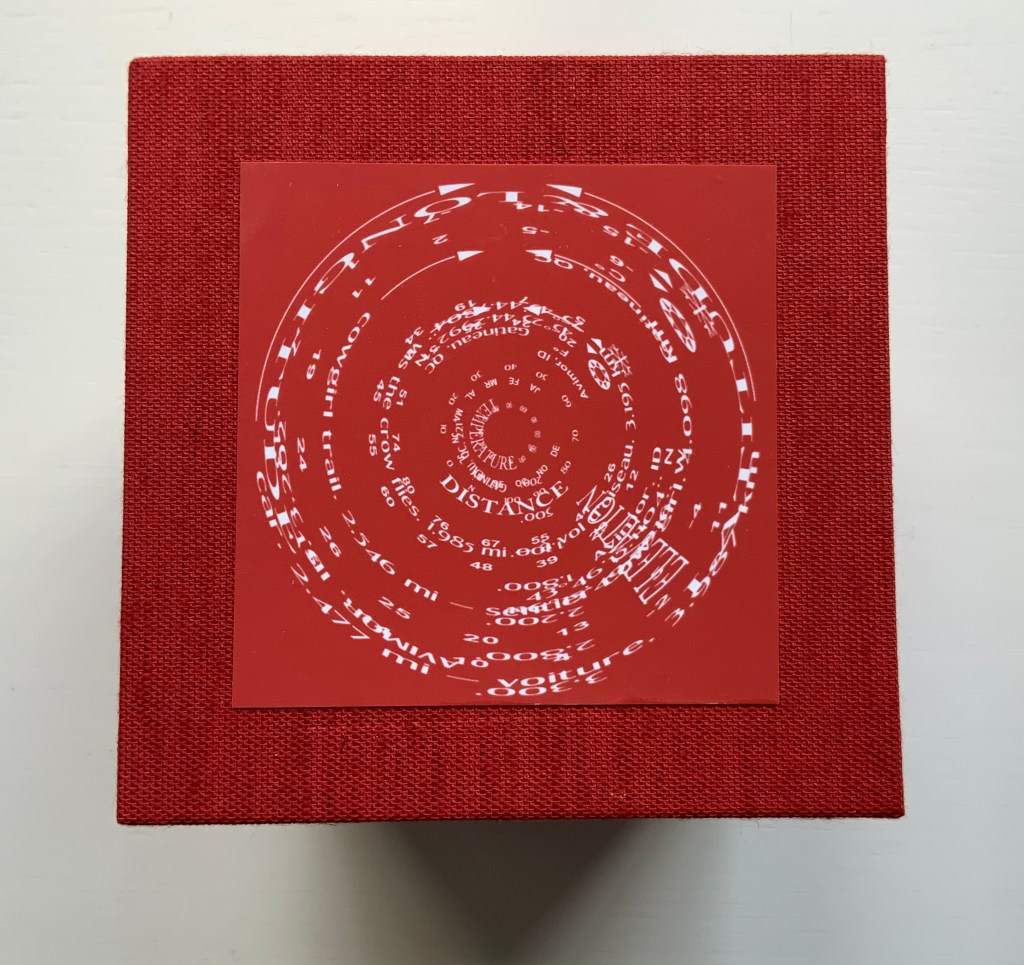
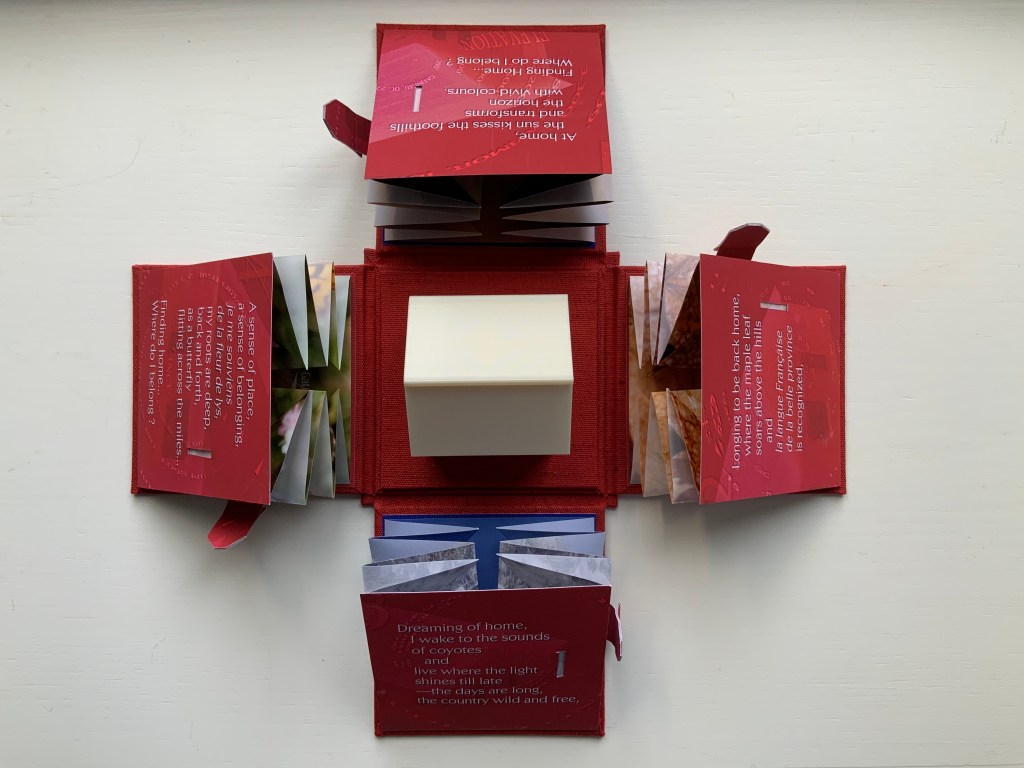
Leporello pop-up, enclosed in box with closure of small gear and black thread. Box: H205 x W162 x D27 mm. Leporello: H195 x W143 mm (closed), W1125 (open). Edition of 3, of which this is #1. Acquired from the artist, 31 July 2017. Photos: Books On Books Collection. With permission of the artist. “Machines” © Michael Donaghy Estate.

For more on “Machines” in the Books On Books Collection, click on the link.

Further Reading/Viewing

Carter, David A. and Diaz, James, The Elements of Pop-Up, A Pop-Up Book for Aspiring Paper Engineers (New York: Little Simon, 1999).

Chen, Julie. 2013. 500 Handmade Books. Volume 2. New York: Lark. P. 17 (New York Redux).

Miller, Steve. 2008. 500 Handmade Books : Inspiring Interpretations of a Timeless Form. Edited by Suzanne J. E. Tourtillott. New York: Lark Crafts. P. 48 (Le Mariage d’Anselme des Tilleuls).

Coron, Béatrice. “Stories Cut from Paper“, TED Talk, March 2011.

Coron, Béatrice. Interview with Steve Miller, Book Arts Podcasts, School of Library Information and Sciences, University of Alabama, September 2011.

Coron, Béatrice. Interview with Helen Hiebert, Paper Talk Podcast, 22 August 2020.

May, Kate TorgovnickDaily Battles, cut from paper, animated in 3D“, TED blog, 26 November 2013.

Wallace, Elaine. Masters: Book Arts: Major Works by Leading Artists (New York: Lark, 2011).

Books On Books Collection – Jérémie Bennequin

Un Coup de Dés jamais n’abolira le Hasard, Dé-composition (2009-2013)

In “Publishing as an Artistic Toolbox“, an exhibition in Vienna in 2018, Antoine Lefebvre displayed several rows of works from La Bibliothèque Fantastique. They were pinned to the wall at the rear of the exhibition space. One work and one only made up the third row from the bottom: Jérémie Bennequin’s hommage to Mallarmé’s Un Coup de Dés, clearly not singular and missing its “h” and “m”. An exhibition hall is a difficult setting in which to explore a multi-volume work of book art much less answer the questions “Why omage?” and “Why the hyphenation of “décomposition” at the foot of all twenty covers?”

Away from the exhibition and onto Bennequin’s and Lefebvre’s websites, the intrigue only grew with the knowledge that nineteen of those twenty booklets are the results of algorithmically dice-driven live performances of erasing the text from Mallarmé’s poem. With several works of homage to Un Coup de Dés in the Books On Books Collection, Bennequin’s omage composed with a single seemed an essential addition.

Dé-composition arrives in a sturdy cardboard box.

Un Coup de Dés jamais n’abolira le Hasard, Dé-composition (2009-2013)
Jérémie Bennequin
Cardboard box of 20 livres d’artistes. Each booklet 210 x 150 mm, 28 pages.
Paris: Éditions de La Bibliothèque Fantastique. Photos: Books On Books Collection

Booklet 1.0, which reproduces Mallarmé’s complete poem in its 1897 format, also contains a preface to Bennequin’s multi-volume boxed work. Arguing in the preface that Un Coup de Dés does not abolish chance but rather enhances, elevates, ennobles it, Bennequin poses the questions that initiate his homage. The first is:

“Or, le hasard peut-il abolir Un Coup de Dés?” (So, can chance abolish Un Coup de Dés?)

Bennequin argues that, being an artist of the eraser, he is well-suited to erasing or abolishing Mallarmé’s work, and that rolling the die to direct his act of erasure or abolition is fitting. But then comes his second crucial question:

… comment définir au juste, dans le détail, la cible de chaque coup? (how to define in detail the target of each throw?)

After considering such targets as the letter, the word, the page, the double-page spread, Bennequin settles on the syllable for reasons reflecting Mallarmé’s own theories of poetry and music. Booklet 1.0 represents the starting point, with the next volume 1.1 being the outcome of the end of a live performance on 23 October 2009, which involved Bennequin decomposing Mallarmé’s poem by repeatedly rolling a die then locating, vocalising and erasing the syllable corresponding to the number rolled. This occurred on computer screen in real time. With each of the subsequent eighteen performances, the starting point was the state arrived at in the preceding booklet; 1.2 began with 1.1, 1.3 with 1.2 and so on. By the last performance, very little — but something — of Un Coup de Dés was left. So Bennequin has the answer to his first question. As he puts it in the last sentence of his preface: Le hasard jamais n’abolira Un Coup de Dés (Chance will never abolish Un Coup de Dés).

To answer those awkward questions asked in the exhibition hall: First, the removal of “h” and “m” from hommage to create omage is a visual clue to the work’s destructive/creative process — the dice-driven algorithm’s targeting and erasure of phonemes. Second, the isolation of “dé” in the hyphenation of décomposition puns self-reflexively — as book art so often does — on the singular of dés, underscoring the means of Bennequin’s paradoxical decomposition/composition. No matter how this work is displayed or examined, it puts before us a visual constellation of fragments of sound. But, having completed the performances leading to this particular self-reflexive constellation, Bennequin produced another self-reflexive work, an homage within an homage.

Le Hasard n’abolira jamais un Coup de Dés, Omage (2014)

Le Hasard n’abolira jamais un Coup de Dés, Omage (2014)
Jérémie Bennequin
Perfect bound, 325 x 25 mm, 32 pages.
Paris, Éditions Yvon Lambert, Photos: Books On Books Collection.

Le Hasard n’abolira jamais un Coup de Dés replicates in size, colour and appearance the 1914 edition Un Coup de Dés jamais n’abolira le Hasard. The main textual difference — the inversion of the title — announces the work as an homage to Mallarmé. But a smaller textual difference — the replacement of Poème with Omage — subtly announces another homage: to Broodthaers’ 1969 homage to Mallarmé. Broodthaers had replaced the word Poème on the 1914 edition’s cover with the word Image.

But it is Le Hasard‘s preface that unequivocally announces its homage to Broodthaers’ homage. Broodthaers had printed all the text of Un Coup de Dés as a “Préface” within a left- and right-justified block of text, and he omitted Mallarmé’s own preface. He then went on to blot out Mallarmé’s verses and their carefully placed typographical rendering with strips of black, shaped with equal care.

Bennequin returns the favour of Broodthaers’ transformative gestures at least twice over. Like Broodthaers’ opening block of text, Bennequin’s includes all the text of Mallarmé’s poem but renders it in phonetic symbols. Even the word Préface is replaced with [pRefas]. The square brackets in Bennequin’s block of text surround the verse units that Broodthaers went on to blot out. In further gestures of lèse-majesté to Broodthaers and Mallarmé, Bennequin adds his own explanatory “Note” in place of Mallarmé’s note, the one omitted by Broodthaers. Furthermore, signalling an inversion to come, Bennequin inverts the order of words in Broodthaers’ block of text. The last line of verse in Mallarmé’s poem and in Broodthaers’ block of text is “Toute Pensée émet un Coup de Dés” (All thought issues a throw of the dice). The first verse in Bennequin’s square of text is [tutpãseemɛœ̃kudəde].

The “inversion to come” lies in the subsequent pages where Bennequin inverts Mallarmé’s words and lets them peek out in white from behind Broodthaers’ black strips. He “un-erases” Broodthaers’ erasure. He uses white on black to re-emphasize the black on white abstraction created by Broodthaers. But that inversion is more than meets the eye.

In his preface to Dé-composition, Bennequin has already shown us an exact inversion of Mallarmé’s title: “Le hasard jamais n’abolira Un Coup de Dés”. Moving jamais to its grammatically correct position, Le Hasard’s inversion of the title is deft artistic lèse-majesté. It proclaims the bookwork as allusive to but distinct from Dé-composition and its preface — and distinct from the two targets of homage. As “omage” to Mallarmé, Le Hasard does not abolish Un Coup de Dés; it pulls it back from obliteration albeit by inversion. As “Omage” to Broodthaers, Le Hasard does not abolish the “Image”; it re-establishes the link between the black-imaged “musical” score and the sounds of the text — again albeit by inversion and also phonetic symbols.

Allusive, self-allusive, creative and subversive through inversion — Le Hasard is a new constellation born from that encounter with the twin stars preceding it.

Sur un rêve de John Cage… les rayons roses d’un jour qui se lève colorent doucement un Mo(n)t de poussière… (2020)

Sur un rêve de John Cage… les rayons roses d’un jour qui se lève colorent doucement un Mo(n)t de poussière… (2020)
Jérémie Bennequin
MP4, duration 08:42.

Erasure is Bennequin’s paintbrush, sculpting tool and pen. Before his “omages” to Mallarmé and Broodthaers, Bennequin created “Ommage” (a play on gomme, the French for eraser) by rubbing out the words on each page of the seven volumes of Proust’s À la recherche du temps perdu. From this effort, he issues artist books in limited editions. But nothing goes to waste — not the eraser dust, not the worn erasers, not the activity, not even the sound.

Mo(n)ts et Tom(b)es is the display of small mountains of erased words (ink, paper and rubber) alongside the ruined tomes from which they came. Sur un rêve de John Cage … takes this work to another level. Bennequin has filmed a gradual passage of light over one such small mountain of erased words and timed it to coincide with a performance of Cage’s Dream (1948). In its visual effect, it could also be an homage to Cézanne’s Mont Saint Victoire series or Monet’s paintings of Rouen Cathedral. In its fusion of light, sound, material and thought, it takes us from the whimsy of omage and ommage to meditation.

Sur un rêve de John Cage … is a freely downloadable multimedia work of art.

Le Hasard N’Abolira Jamais Un Coup de Dés (Changes of Music) (2020)

Le Hasard N’Abolira Jamais Un Coup de Dés (Changes of Music) (2020)
Jérémie Bennequin
Film (4 minutes, 33 seconds) recorded on USB drive, embedded in cloth-tape-bound foam boards. H210 x W150 mm. Edition of 6, of which this is #2. Photos: Books on Books Collection, displayed with permission of the artist.

The film records dice being thrown against the open pages of Bennequin’s 2014 OMAGE (see above). Continuing with his technique of homage within homage, Bennequin’s Le Hasard N’Abolira Jamais Un Coup de Dés (Changes of Music): Film) reverses John Cage’s 1951 Music of Changes not only in its title but also in its recorded notes. The object in the Books on Books Collection fixes all these reversals on a USB drive. The reader can view and listen to it here and compare the recording with Cage’s original here.

Descent (2020)

Descent 2021
Jérémie Bennequin (text by Edgar Allan Poe)
Cardboard portfolio with pastedown prints on both covers, enclosing a double-sided print with spiraling erasure.
Portfolio: 330 x 330 mm. Prints: H300 x W295 mm.
Acquired from Jérémie Bennequin, 1 May 2021.
Photos: Books On Books Collection.

As early as 1988, the idea of reprinting an entire literary work onto a single sheet and silhouetting some relevant art found its way into commercial posters with the One Page Book Company, then Spineless Classics and, later, Litographs. No surprise then that the innovative journal Inscription chose to include an oversized poster version of Bennequin’s fine print in its inaugural 2020 issue. Bennequin’s treatment of Edgar Allan Poe’s short story “A Descent into the Maelstrom” is an oblique homage to Mallarmé, who would have found Poe’s vertiginous tale of an abyss resonant with the images that appear in Un Coup de Dés.

Erased English side of the print.

Beginning the descent into the erasure.

The center of the abyss or maelstrom.

The French side of the print.

Exhibition Catalogues

Further Reading

Inscription 1“. 15 October 2020. Books On Books Collection.

Bennequin, Jérémie. “Lecture”. Leeds Beckett University, 25 February 2016. Accessed 10 April 2020.

Briers, David. “Reading as Art”, Art Monthly, October 2016, pp. 25-26.

Mœglin-Delcroix, Anne. “De l’appropriation artistique d’œuvres littéraires dans le livre d’artiste: entre destruction et incorporation” in Annette Gilbert (ed.), Wiederaufgelegt. Zur Appropriation von Texten und Büchern in Büchern (Bielefeld : transcript, 2012) p. 233-264).

Pigeat, Anaëlle. “Jérémie Bennequin, effacements“, Art Press, No. 432, April 2016, pp. 66-67. Accessed 10 April 2020.

Books On Books Collection – Simon Morris

Reading as Art (2016)

Reading as Art (2016)
Simon Morris, ed.
Perfect bound paperback. H297 x W210 mm. Acquired from Information as Material, 22 August 2020. Photo: Books On Books Collection. Displayed with permission of the publisher.

Simon Morris and Books On Books crossed paths at the opening of an exhibition at the Meermanno Museum in The Hague. The exhibition was called “The Art of Reading“, and he gave a talk on his performative work Reading as Art (2004), a compiled-stills film of him reading and turning the pages of a book. (Not at all like watching paint dry or grass grow, if you are unkindly thinking so.) Reading as Art (the volume) provides a taste of Reading as Art (the performance) with black-and-white frames from the film appearing at the bottom right-hand corner of nearly every page: just run your thumb down the fore edge and let the pages flip to see the “action”.

Details from Reading as Art (the book). Photos: Books On Books Collection. Displayed with permission of the publisher.

That feature of this one volume speaks volumes about Simon Morris as an artist. The idea of “reading as art” is not far off “publishing as art”. Morris’s collaborative publishing operation Information as Material has employed nearly every tool in the “Publishing as Artistic Toolbox“, as the 2018 exhibition in Vienna was called: documented performances, polemics, apps, free downloadable PDFs, prints and broadsides, and a journal Inscription, whose first issue is a sculptural bookwork and comes with a vinyl LP record, poster and chapbook.

Do or DIY (2012)

Do or DIY (Information as Material, 2012)
Craig Dworkin, Simon Morris and Nick Thurston
Booklet, saddle-stitched. H137 x W104 mm, 24 pages. Acquired from Cornerhouse Publications, 31 October 2020. Photos: Books On Books Collection. Displayed with permission of the publisher.

It is strange that this polemic does not mention William Blake among literary history’s do-it-yourselfers. Although their primary message of “don’t wait for a commercial publisher” is for wordsmiths, the authors include the book artist Johanna Drucker among their hortatory examples as well as The Life and Opinions of Tristram Shandy, which can lay a plausible claim to being the first work of modern book art, even before Blake’s “artist’s books”. The authors themselves have even played their parts in book art. So why no nod to the world of book art and its past and current contributions to Do or DIY?

In the 1960s and 70s, book artists’ democratic multiples aimed to sidestep the galleries, museums and art industry. Whether chicken or egg, photocopying and cheap printing brought forth or hatched Siegelaub’s The Xerox Book, Ruscha’s Royal Road Test and many more fair fowl. By century’s end and into the 21st, book artists were still doing it themselves, but the democratic multiple ceded quite a bit of territory to limited editions and unique works. Toward the 20th century’s end, desktop publishing and digital publishing, however, offered up a different, much larger target — the super-concentrated publishing industry — for a much larger cadre of creators — wordsmiths. Perhaps that bit-torrent caught up the authors on this occasion.

Still, the occasion itself — an exhibition that saw the polemic printed on indoor walls and on outside posters — must have appealed to the book art community. Book art makes us read differently, and that clearly happened with this exhibition.

Royal Road to the Unconscious (2004)

Royal Road to the Unconscious (2004)
Simon Morris
Spiral bound paperback. H240 x W160 mm, 80 pages. Acquired from Johan Deumens, 10 October 2020. Photos: Books On Books.

This is the book of the movie. Or the book of the movie “made by the book” of the movie. Or…. Better let the artist explain:

Utilising Ed Ruscha’s book Royal Road Test as a readymade set of instructions, seventy-eight students cut out every single word from Sigmund Freud’s Interpretation of Dreams. On Sunday, June 1st, 2003, the artist, Simon Morris (thrower) threw the words out of the window of a Renault Clio Sport on Redbridge Road, Crossways, Dorset, travelling at a speed of 90mph, approximately 122 miles southwest of Freud’s psychoanalytical couch in London. The action freed the words from the structural unity of Freud’s text as it subjected them to an ‘aleatory moment’ – a seemingly random act of utter madness.

Daniel Jackson (filmmaker), Maurizio Cogliandro (photographer) and Dallas Seitz (photographer) documented the action as 222,704 words erupted from the window of the car. They also recorded the stream of words strewn along the side of the road. Dr. Howard Britton, a psychoanalyst (driver), directed them to any slippages or eruptions of the Real that occurred in the reconfigured text. The poetic act of liberating Freud’s text allows us to engage with what Jacques Lacan called the register of the Real. The concept of the Real is far removed from anything that we conventionally attribute to reality. It is the experience of a world without language. If language names, it is all that escapes the name – an encounter beyond images and words.

Conceptual art can do one’s head in. So, in the meantime, enjoy the aleatory moment.

Further Reading

The Art of Reading in a ‘Post-Text Future‘”, Bookmarking Book Art, 21 February 2018.

Bright, Betty. No Longer Innocent: Book Art in America 1960-1980 (New York: Granary Books, 2005).

Hubert, Renée Riese, and Judd David Hubert. The Cutting Edge of Reading: Artists’ Books (New York: Granary Books, 1999). Annotated here.

Mitchell, Beverly. “Q & A with conceptual writer and professor, Simon Morris“, Blog of the Hamon Arts Library, 22 February 2019. Accessed 2 December 2020. Good coverage of The Royal Road to the Unconscious as well as the exhibition “Reading as Art”.

Partington, Gill, Adam Smyth and Simon Morris, eds. Inscription: the Journal of Material Text – Theory, Practice, History October 2020.

Wisniewski, K.A. “Reading as Art: A Micro-Review“, The Projector, 19 September 2017. Accessed 2 December 2020.

Worth, Zara. “Reading as Art: Review“, This is Tomorrow: Contemporary Art Magazine, 25 November 2016. Accessed 2 December 2020.

Books On Books Collection – Raffaella della Olga

LINE UP (2020)

LINE UP (2020)
Raffaella della Olga
Cloth on board with spiral binding of 28 card folios. H270 x W290 mm (closed). Edition of twenty-six, of which this is #8. Acquired from Three Star Books, 4 November 2020. Photo: Books On Books Collection, displayed with the artist’s permission.

Formerly a lawyer, Raffaella della Olga turned from the manipulation of legal text to the artistry of the letter and its “total expansion” — the book — as well as its manifestation in light and textiles. Her chief tool of art is a set of customized typewriters. The output she calls “tapuscripts”. Most of her works are unique pieces, each entitled with the emblematic letter T followed by the ordinal number of its creation — up to T28 as of this writing.

T28 Alphabet (2019/2020)
Raffaella dell Olga
Typewritten on paper and silk paper with carbon paper 485 x 435 mm. Image:
© Raffaella della Olga and reproduced with the artist’s permission.

The limited edition of LINE UP offered an unusual opportunity to add to the Books On Books collection a work that resonates with its subset of abecedaries and one by an artist who shares a deep interest in another theme in the collection: Un coup de Dés jamais n’abolira le Hasard. Since 2009, she has created bookworks that reveal an artist’s and careful reader’s appreciation of the poem.

Title page and colophon from LINE UP. Photos: Books On Books Collection, displayed with the artist’s permission.

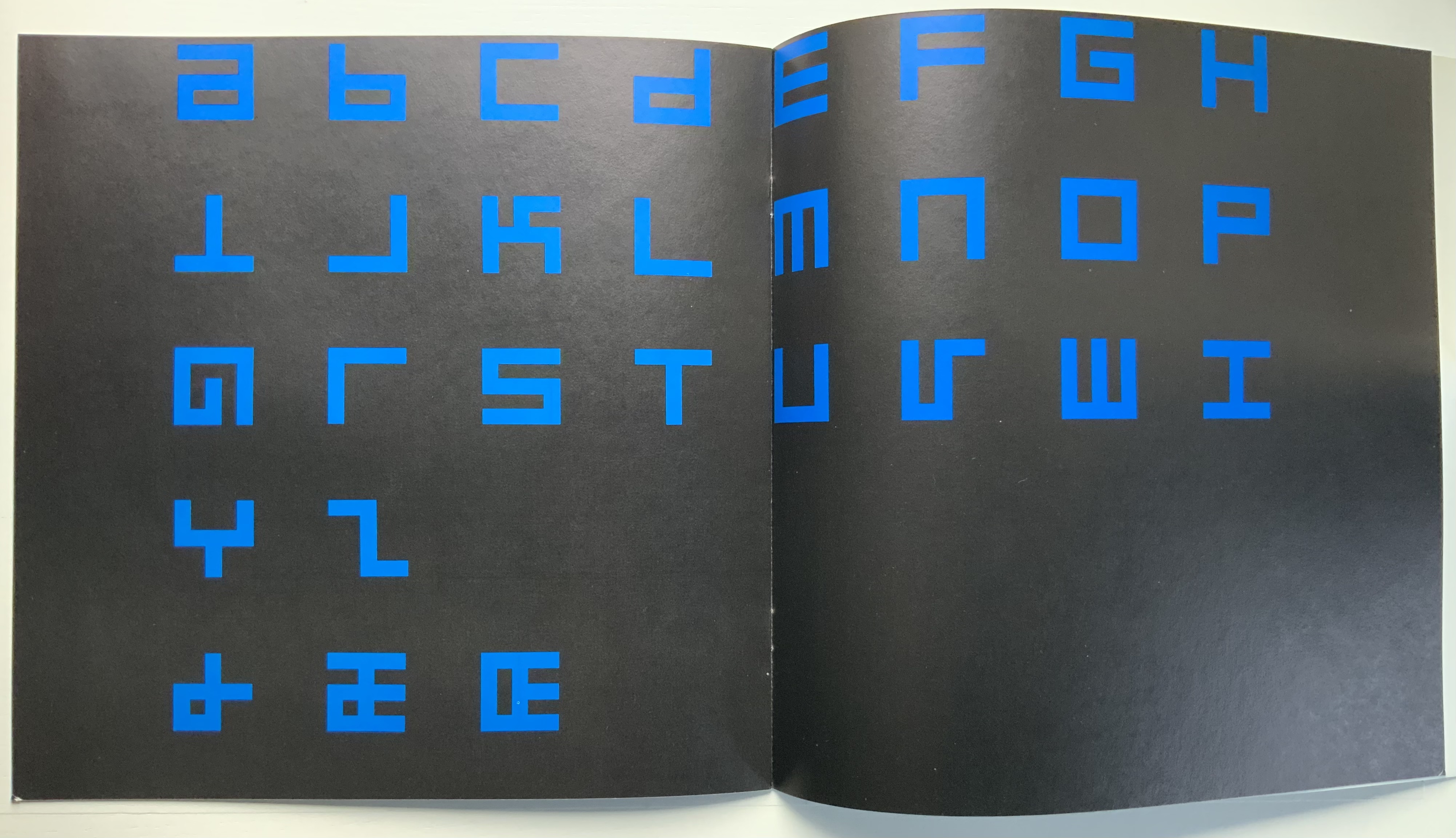
LINE UP is very much a collaborative work between Raffaella della Olga and Three Star Books, founded in 2007 by Christophe Boutin and Mélanie Scarciglia with Cornelia Lauf (2007-2015). The edition consists of twenty-six spiral-bound copies, each with a unique cover produced by rubbings on canvas and differently colored. The title page and colophon take up two of the card folios in the volume, which leaves twenty-six for the printed content. Blocks of vertical blue lines turn the pages into letters based on the Epps-Evans alphabet, designed in the 1960s with only horizontal and vertical strokes in an attempt at machine readability.

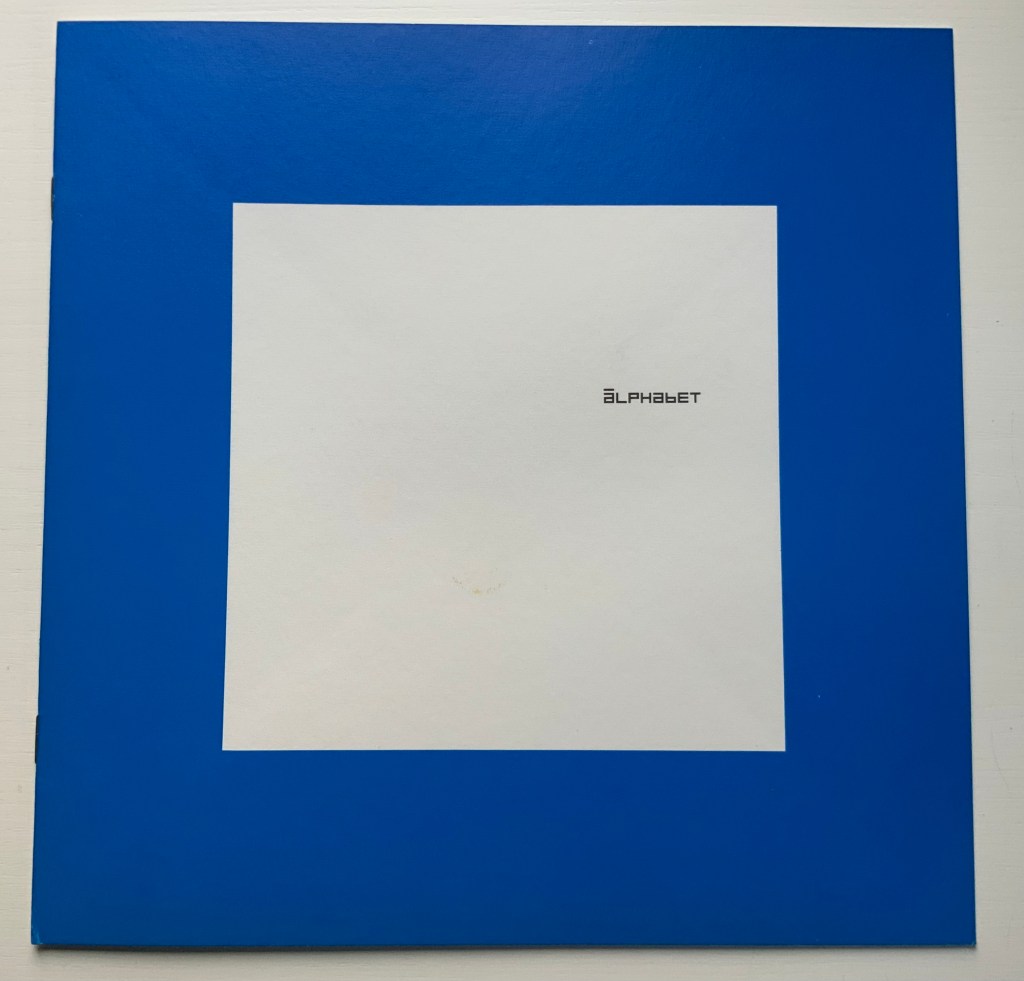
Alphabet (1970)
Timothy Epps and Dr. Christopher Evans
Hilversum: de Jong & Co., 1970. Photos: Books On Books Collection.

Discerning the letters in LINE UP feels sometimes like squinting one’s way through an optical illusion. The eye is bewitched by a color-shifting, almost stroboscopic effect created by four squares of embossed lines printed from the reverse side, always in the same position. Della Olga credits Christophe Boutin (Three Star Press) with introducing this effect.

The letters “a”, “b” and “c”.

Left: The four embossed squares seen from the verso. Right: The color shift between the embossed and flat squares.

The letter “k” at different angles of light.

The first of della Olga’s works reflecting the influence of Mallarmé’s poem was Un Coup De Dés Jamais N’abolira Le Hasard – Constellation (2009), which was shown in the Gulbenkian’s “Pliure” exhibition in Paris in 2015. In a darkened room with an attendant turning the pages, the poem’s words, painted in phosphorescent powder, flickered into existence.

Un Coup De Dés Jamais N’abolira Le Hasard – Constellation (2009)
Raffaella della Olga
Hand made work, white acrylic paint, phosphorescent powder, glue. H320 × 500 mm. Photos: © Raffaella della Olga, reproduced with permission of the artist.

A year later came this rendition: Jamais Le Hasard N’abolira Un Coup De Dés – Permutation (2010). Although the link goes to an online presentation, the work is analogue and unique. In correspondence (9 December 2020), Della Olga writes, “I took apart the book the Gallimard edition as a whole, without the paratext. I folded the double pages and deleted with white paint the part of the poem that appear.” A close look at the framed pages reveals the faint shadows of the painted-over text. On the wall, the permutation arises in the changeable order of hanging, which the online algorithm permits the viewer to perform.

Jamais Le Hasard N’abolira Un Coup De Dés – Permutation (2010)
Raffaella della Olga
Randomly generated computer graphic.

Her most recent homage to Mallarmé’s poem is Un Coup de Dés – Trame (2018). Like Constellation with its reference to and enacting of the poem’s constellation metaphor, and like Permutation with its reference to and enacting of chance, Trame well reflects della Olga’s penetration of the poem and transformation of it into artwork that stands strongly on its own and in comparison with other works of homage by Marcel Broodthaers, Michalis Pichler and Cerith Wyn Evans.

Un Coup de Dés – Trame (2018)
Raffaella della Olga
Unique. Typewritten on tracing paper with fabric and carbon paper, 320 × 500 mm. Image: © Raffaella della Olga, reproduced with permission of the artist.

The word trame is le mot juste in its application to the work and its referent. Its meanings — frame, woof, weft and weaving — shift across the work’s technique and material and evoke the poem’s typographical weaving as a framework with which to realize the “total expansion of the letter”.

Here’s hoping for further expansion into limited editions.

Further Reading and Viewing

Total Expansion of the Letter, Trevor Stark (MIT Press, 2020): Review“, Books On Books, 19 October 2020.

Epps, Timothy, and Christopher Evans. 1970. Alphabet (Typeface … designed by Timothy Epps in collaboration with Dr. Christopher Evans). Hilversum: Steendrukkerij de Jong & Co.

Owens, Sarah. “Electrifying the alphabet“, Eye, no. 62, vol. 16, 2006. Accessed 23 November 2020.

Spencer, Herbert, and Colin Forbes. New Alphabets A to Z (New York: Watson-Guptill Publications, 1974). Source of the artist’s first encounter with the Epps-Evans alphabet. (Correspondence with Books On Books, 6 December 2020)

Bookmarking Book Art – Yasutomo Ota

Even under the glass of vitrine or screen, Yasutomo Ota’s Die Forelle evokes by typography, image and structure a physical perception hard to shake.†

Die Forelle (2014)
Yasutomo Ota
Printed on 34 narrow laminated cardboard strips per sheet, which are held together by two threads, one on each side. Eighteen unnumbered pages H140 x 300 mm in box H160 x W340 x D50 mm. All photos with permission of the artist.

Franz Schubert first wrote a song called Die Forelle, based on a poem of the same name by Christian Friedrich Daniel Schubart. Schubert was later commissioned to turn it into a piece of chamber music, which resulted in the “Trout Quintet” (1819).

If you are lucky enough to live near one of the six libraries that hold a copy of Ota-san’s Die Forelle, you can take your phone and earbuds, cast your line for it in the quiet of the rare book section and listen to the music inspired by the poem printed across the pages made of thirty-four laminated cardboard strips held together by two rows of threads and wriggling in your hands like a fish and flowing over them like a stream.

Or failing such access, you can view the artist’s demonstration here. The book’s structure is based on the chikukan, originally a Chinese scroll formed of bamboo strips, written on vertically and linked by thread to be rolled up correspondingly. The Coptic binding, the type that reads horizontally and the printing on both sides of a leaf shifts the form from scroll to codex. Also, as the artist writes, “By using the alphabet on a panel intended for vertical writing brings a strong sense of the direction taken by the written word” (Correspondence with Books On Books, 9 November 2020).

Of course, the Asian printing tradition also included horizontal reading and printing on both sides of the scroll. Consider the dragon-scale binding of the Diamond Sutra re-created by Zhang Xiadong (demonstrated here).

Diamond Sutra, Dragon scale binding (2017)
Zhang Xiaodong
In 32 zhuan (seal) fonts, 152 x 382×160mm. Edition of 300, of which this #197. Acquired from Sin Sin Fine Arts (Hong Kong), 31 October 2019. Photos: Books On Books Collection.

Examples of dragon-scale binding in the National Library of China’s permanent display of the history of the book in China. Photos: Marcia Watt, reproduced with permission.

Balinese Bamboo Book”, Special Collections & Archives Research Center. Accessed November 10, 2020, .

Contemporary book art also holds vertical and horizontal variations on the related “Venetian blind” or bamboo book form. Consider the dynamic Diagram of Wind by Barbara Tetenbaum (demonstrated below) and Diane Harries’ Legacy (below).

Diagram of Wind (2015)
Barbara Tetenbaum
Letterpress printed texts and images cut into strips and adhered to Japanese ‘silk tissue’ (gampi). Sewn to cloth and wood backing. Supported by a wood wave-form platform and held inside a lidded box made of cloth and book board. Poem by Michael Donaghy: “Glass”. H17 x W10 x D3 inches, ten pages. Edition of 30, of which this is #. Acquired from the artist, 8 October 2020. Photos: Books On Books Collection.

Legacy (2018)
Diane Harries
Venetian-blind book. Photos: Reproduced with permission of the artist.

In all of the works above, form draws attention to itself but also inevitably back to the content. The reader/viewer marvels at the mechanics of each work and how its interaction with hand and eye creates a simile for its content. The unscrolling and fluttering dragon-scale binding demands a prayer’s concentration and contemplation. The “curveship” of the support, the segmentation of the Donaghy poem “Glass” into strips, and the stir and lift of pages under the slightest breath demonstrate the wave form that Tetenbaum investigated for three years. Panel by panel, connected by slender threads, Legacy draws together different pasts in Harries’s work. Likewise, the flipping, slipping, shuttering/shuddering of Die Forelle‘s pages re-create the trout in the brook. That is book art at its best.

† With thanks to Andrew Schuller for drawing attention to Yasutomo Ota.

Further Reading/Viewing

… in medias res … Barbara Tetenbaum“, Bookmarking Book Art, 18 August 2013.

Zhang Xiaodong“, Books On Books Collection, 1 December 2019.

Ambler, Charlie. “Yasutomo Ota Revives Book Art in the Digital Age“, Artsy, 7 July 2014.

Chinnery, Colin. “Whirlwind binding (xuanfeng zhuang)”, International Dunhuang Project, British Library. Posted 07 February 2007. Accessed 12 December 2019.

Donaghy, Michael. Collected Poems (London: Picador, 2014).

Ota, Yasutomo. From the POLA Museum Annex Exhibition, 2020, Ginza, Tokyo. Video of exhibition.

Books On Books Collection – Jane Paterson

Blue Whale (2015)

Blue Whale (2015)
Jane Paterson
Self-covering accordion book. H140 x W155 x D10 mm (closed); W750 mm (open). Unique. Acquired from the artist, 15 April 2015. Photos: Books On Books Collection.

An acquisition early in the early days of this collection, Blue Whale forged the way for later acquisitions that painted with paper. At the time, the artist was asked how Blue Whale was created:

In answer to your questions about the processes I use, I should explain that I have a background in textile design and a great love for indigo dye.  Since starting making books I have experimented with dyeing paper in an indigo vat.  I use khadi and various mulberry papers that have excellent wet strength and allow me to use many of the decorative processes that I use with textiles.  I also dye card board from boxes and have exciting results tearing the wet layers apart. I made the sea in the Blue Whale book from fine paper that had partly disintegrated in the vat.  The cover was made by clamping khadi paper between 2 square blocks so that the dye seeped underneath in interesting ways.  The whales are made from dyed khadi. Artist’s correspondence, 9 April 2015.

Paterson’s technique in Blue Whale occupies a middle ground between collage and pulp painting. The way the artist has manipulated the nearly disintegrated, indigo-dyed fine paper to evoke the depth, surface and spray of the sea is remarkable. Additional examples of her work with indigo dye as well as other book art techniques can be found in the Artists Book Club Dove (ABCD) site.

Khadi is also the name of a papermaking company founded in the 1980s in India. Based outside the village of Tarihal near Hubli, in Karnataka, South India, Khadi runs a mill that manufactures the 100% cotton-rag paper. The company also works with suppliers in Nepal (GET Paper) and Bhutan (Jungshi). The process is described here and demonstrated here.

Further Reading

The First Seven Books of the Rijswijk Paper Biennial“, Books On Books Collection, 10 October 2019. A wide variety of art with paper and the form of the book.

Pat Gentenaar-Torley“, Books On Books Collection, 8 October 2020. Examples of pulp painting.

John Gerard“, Books On Books Collection, 13 August 2020. Book art and pulp painting.

Claire Van Vliet“, Books On Books Collection, 8 August 2019. Book art and pulp painting.

Maria Welch“, Books On Books Collection, 18 September 2020. Book art and pulp painting.

Books On Books Collection – Martine Rassineux

Ilinx (2010)

Ilinx (2010)
Régine Detambel and Martine Rassineux
Slipcase H322 x W406 x D16 mm, Portfolio cover H280 x W385 x D8 mm, Folio H279 x W380, 6 folios. Slipcase made of wood and celloderm, Portfolio cover made of Japon nacré Torinoko Kozu 180 gsm, Folios made of Lana Velin édition blanc supérieur 180 gsm. Edition of 27, of which this is #18. Acquired from the artists, 21 August 2020. Photos of work: Books On Books Collection. Displayed with permission of the artist.

Emerging from its snugly fitting box constructed by François Da Ros, Régine Detambel’s and Martine Rassineux’s livre d’artiste hints at a debt to the legacy of Iliazd with its pearlescent case over a tapered paper cover for the loose folios, although the case’s fixed spine winks at differentiation. With the curling, diagonal and spiralling letterpress, the hint grows stronger. Yet, there is a roundness — almost softness — in the typographical acrobatics, leading away from the hint at the more linear, angular works of Iliazd. That is the mark of François Da Ros, typographer for Ilinx. Rassineux and Da Ros diverge as much from Iliazd as he diverged from the tradition of Ambroise Vollard, Daniel Kahnweiler and Aimé Maeght.

With folios removed. Note the tapering of the inner folder at both ends.

In its text and etchings, Ilinx also shouts and laughs a kinship with Pieter Breugel the Elder’s Children’s Games (1560). Ilinx does not share any tut-tutting at childish foolishness that may reside in Breugel’s depiction; rather it celebrates a shared exuberance and recognition of significance in child’s play. Where Breugel finds that significance in drawing parallels with adult activities and rituals, Detambel’s text and Rassineux’s etchings find it in sheer phenomenological physicality, which Da Ros’s typography enhances.

Just as Breugel must have observed children closely to show the eighty or so games in his painting, so has Rassineux. Ilinx began in a playground where Rassineux watched over her pupils (600 per week) and noticed one of the African girls, the first in Ilinx, turning her face to the sun and spinning in place. Over time, she noticed others, regardless of origin, doing the same — as if something universal were engraved unconsciously in each child. From this, came the Cours series — washes, charcoal drawings and some 40 engravings on rectangular plates.

Presented with some of these works, Régine Detambel introduced Rassineux to Roger CailloisLes jeux et les homines (1958), in which he outlined four basic categories of play or games:

  • Agon, or competition.
  • Alea, or chance.
  • Mimicry, or mimesis, or role playing.
  • Ilinx (Greek for “whirlpool”), or games inducing vertigo or disorientation.

With this background, Detambel insisted that the title of this livre d’artiste must be Ilinx. With their text and images, Detambel and Rassineux follow the children’s spinning games with a beginning and five “turns”, which appear in twelve pages across three folios. Caillois suggests that the spinning games are grounded in both a natural exuberance and need to escape the “tyranny of perception”. Rassineux’s drawings deliberately vary the perspective from which the children are viewed and encourage the viewer, paradoxically, to perceive that escape from the tyranny of perception. Likewise Detambel’s final verse. Likewise Da Ros’s cutting out the children from the etchings and positioning them in action on the page. And, most of all likewise, Da Ros’s spiral setting of lines, “re-enacting” the artist’s drawings, the poet’s words and the Ilinx (whirlpool).

At the last turn, there is no age. Only life in the blood. Flurrying as if into snow. Blood rose-red, flickering red-rose, clinging to a thread.

Curious about the sixth and blank folio after the colophon folio, I wrote to ask about its purpose. After the opening manipulations — removal of the encased portfolio from its celloderm and wood slipcase and then removal of the portfolio from its cover in Japanese nacré Torinoko Kozu (180 gsm) — there is no further prefacing to the loose folios. There is the title folio, then commencement folio, and the whirling has begun. So that the reader/viewer’s eyes and hands do not leave the book too abruptly, the sixth folio acts as a counterweight, a pause to allow the spinning to stop, a blank on which the pulse behind the eyes can project.

Ilinx – Collection VARIA (2019)

Ilinx – Collection VARIA is a follow-on hardback providing behind-the-scenes insight into the making of Ilinx the portfolio. It shows Rassineux and Da Ros at work in the studio, images of cast and locked type, etching plates juxtaposed with their proofs, paste-up plans. Note how, to have more latitude for the typography and layout, Da Ros cut out the engravings from the plates. The plates have been gilded, which is more elegant than scoring the plates to fix in place the limited edition.

Ilinx – Collection VARIA (2019)
François Da Ros and Martin Rassineux
H278 x W326 x D12 mm, 60 pages. Edition of 50, of which this is #2. Acquired from the artists, 21 August 2020. Photos of pages: Books On Books Collection, displayed with artists’ permission.

Although printed offset rather than letterpress, Ilinx–Collection VARIA demonstrates the same art-making attention to detail shown in Ilinx. Printed with an HP Indigo offset digital press on Mohawk proPhoto beaded paper semi-gloss 190gsm, the full-color images printed do not mask the texture or surface of the paper as sometimes happens with some toner prints. Instead, the ink is absorbed by the paper as happens with traditional offset lithography. As Rassineux further explained in correspondence with Books On Books,

We chose the photos in relation to the round shape that often comes up in the concerns of François who made mechanics for two years to be able to build and troubleshoot his presses and because he always saw in the mechanical movement a relationship with the universal mechanical. The final image is a wind-up spinning toy that belonged to my mother…. All the elements we use come from our daily lives, and from our experiences, that are a whole. (Correspondence, 11 November 2020)

Colophon page. Photo of page: Books On Books Collection, displayed with artists’ permission.

For another example of art driven “from our daily lives”, the reader/viewer can do no better than to visit the Koninklijke Bibliotheek (KB, National Library, The Hague: Koopman Collection) to see the gilded plates mentioned above. They reside in a drawer removed from the Da Ros/Rassineux studio and finished off as a wooden case for the library’s copy of Ilinx.

Photos: Books On Books Collection. Shown with permission of the artists
and the Koninklijke Bibliotheek (KB, National Library, The Hague: Koopman Collection).

Rassineux sends you best wishes on the first year of the third millennium (2001)

This elegant New Year’s greeting came with the Books On Books purchase of Ilinx. A sweet gift of ephemera that freezes a fresh start in place with the artistry of movable type in motion and a print made by gravure au sucre (sugar etching). Rassineux’s explanation:

The basic technique of the sugar engraving is that on a perfectly degreased copper you draw with a solution of sugar and China ink (which is only used to make your drawing very black near your etching) then it is covered with varnish and the sugar mixture will burst the varnish because the sugar dilates and you will find again the design in copper version that you will have to weave by an aquatint. (Correspondence, 11 November 2020)

† Translation: Books On Books. The phrase “Le sang qui tourne jusqu’a monter en neige” turns on a French culinary expression — jusqu’a monter en neige — for whipping egg whites into a meringue. Régine Detambel prefers the less literal translation, which echoes earlier lines and images in the poem.

Further Reading

Caillois, Roger. Man, play and games (Urbana, Ill. : University of Illinois Press, 2001).

Capelleveen, Paul Van. Artist & Others: The Imaginative French book in the 21st century (Nijmegen: Vantilt, 2016), p. 37.

Capelleveen, Paul Van. “The Unlimited Artist’s Book“, TXT: Exploring the Boundaries of the Book (Leiden: Boom Uitgevers, 2014).

Books On Books Collection – Heavenly Monkey

Francesco Griffo da Bologna: Fragments and Glimpses (2020)

Francesco Griffo da Bologna: Fragments and Glimpses (2020)
Rollin Milroy
H234 x W159 mm, 114 pages. Edition of 50, of which this is #32. Acquired from Heavenly Monkey, 4 November 2020. Photos: Books On Books Collection.

Several collections of Aldine volumes made themselves known around 2015, the 500th anniversary of the death of Aldus Manutius. Several have digitized their collections to make them more accessible. By gathering these fragments and glimpses of the hand behind the roman, Greek, Hebrew and italic typefaces designed and cut in late 15th-century and early 16th century Venice for those volumes, Heavenly Monkey (founded and run by Rollin Milroy) has followed a different path. A collector himself and artist of the book, Milroy has created this work to bring himself and the reader closer to Francesco Griffo da Bologna and the historical and contemporary hunt to identify him and appreciate his typographic accomplishment.

He presents a letterpress work in the modern version of the Bembo typeface cut by Griffo for the Aldine printing of Pietro Bembo’s tract De Aetna (1495), whence the typeface gained its name. In another step closer to Griffo, not only does Heavenly Monkey use simplified versions of initial letters attributed to Griffo, he offers up a note and display page that include those letters not used in the text (see below).

Note that distortion of the letters is due to photography of the curved page.

Physically true to its title, the book consists — except for the frontmatter, backmatter and brief explanatory text — of fragments: extracts from secondary sources and an actual leaf from the Aldine edition of Ovid’s Heroidum Epistolae set in Griffo’s first italic type. The leaf comes from the second of the three-volume Aldine Ovid, which over time was subject to prudish excision of racier parts, which Heavenly Monkey speculates may have led to the break-up of the copy used here to supply the leaf included. Some historians and collectors may question the inclusion of the leaf. Others as well as artists of the book will thrill to it as an act of preservation, appropriation, dissemination and homage.

The book’s prologue is an English summary of a passage from Giuseppe Fumagalli’s 1905 lexicon of Italian typography that sets out and settles the 19th century debate about the identity of Griffo, a confusion that would resurface for the legendary typographer Stanley Morison in 1923. With a narrative technique similar to an epistolary novel, Milroy lays out extracts from histories of printing, prefaces to reprints of Aldine works, biographies of the historians in the debate, the Fine Arts Quarterly Review and bibliographical journal articles to tell the story of “which Francesco was he?” The same technique lays out the development and differing opinions in reception of Griffo’s cutting of the roman, Greek, Hebrew and italic types. While following the stories of those faces, the reader walks through a hall of illustrious historians and typographers — Nicolas Barker, Joseph Blumenthal, Philip Meggs, Giovanni Mardersteig, Stanley Morison again, Alfred Pollard, David Pottinger, Daniel B. Updike and many others. The next set of extracts explores the feud that led Griffo to leave Aldus Manutius and Venice to set up on his own in Fossombrone.

The next set of extracts attests to Griffo’s typographic legacy, and then comes the tipped-in foldout that protects the leaf taken from the Aldine Ovid, followed by the listing of Griffo’s six works published on his own, documented in F.J. Norton’s Italian Printers 1501-1520.

An important contribution comes in Appendices I-IV with Emma Mandley’s translations of key passages from books, letters and documents of the main protagonists in the debate over Francesco da Bologna’s identity: Antonio Panizzi, Giacomo Manzoni, Adamo Rossi and Emilio Orioli. Lovers of type specimens and the style of Stanley Morison will welcome the samples of the modern versions of the roman fonts for Poliphilus and Bembo and the italic fonts for Blado and Bembo. In a grace note, Heavenly Monkey includes samples for the italic and roman fonts of Mardersteig’s Dante, which Robert Bringhurst opined “has more of Griffo’s spirit than any other face now commercially available” (The Elements of Typographic Style, 1996, p. 213)”.

Dante is the typeface Heavenly Monkey wanted initially to use but, on deciding that the main text would be set in italic, declined it. The Dante samples offer the reader the chance to compare and contrast it with the other faces and weigh Bringhurst’s opinion and Heavenly Monkey’s choice.

Like many fine press editions, Francesco Griffo da Bologna treads the boundary of the artist’s book or the work of book art. It certainly resonates with different works in the Books On Books Collection:

The leaf from the Aldine Ovid chimes with Jacqueline Rush Lee‘s sculptural interpretation of Ovid’s Metamorphoses and Ian Hamilton Findlay’s The Errata of Ovid.

Milroy’s “scrapbook” protrayal of Griffo and contemporaries will remind some of Russell Maret‘s typographic adventure in Hungry Dutch.

Anything to do with Venice brings to mind Peter Koch‘s edition of Joseph Brodsky’s love letter to Venice Watermark and Bodil Rosenberg‘s sculptural evocation of that city in Canal Grande.

But overall, Griffo‘s bibliographic historical nature resonates far more with that of another of Milroy’s works in the collection: About Agrippa.

About Agrippa (2015)

About Agrippa (a book of the dead): A Bibliographic History of the Infamous Disappearing Book (2015)
Rollin Milroy
Perfect bound softcover. H290 x W210 mm. 48 pages. Edition of 50. Acquired from Rollin Milroy, 5 December 2018. Photos: Books On Books Collection. Displayed with permission of Rollin Milroy.

In the Bodleian Libraries Rare Books Collection is a yellowed, oatmeal-colored remnant of a linen casebound thing holding leaves of paper, some sharply trimmed, some with deckled edges, various colored single-sided prints tipped in between and amongst the folded and gathered leaves, a square hollowed out of a final gathering of inseparable leaves and sealed with a lining of gritty silver-gray paste. And burned onto its cover is this:

William Gibson and Dennis Ashbaugh’s Agrippa (A Book of the Dead) (1992) is as wrapped in mystery and mystique as Griffo’s identity. For the collection, Milroy’s two books play the roles of historical bookends: each addresses works from the second phases of a technological shift in the history of the book. Griffo and Manutius mark the beginning of the post-Gutenberg and post-incunabula phase of book publishing. Gibson, Ashbaugh and their publisher Kevin Begos mark the beginning of the post-Apple I phase of digital publishing. Aldine books are rare; Agrippa is even rarer, designedly so. Gibson’s titular poem is on a floppy-disk embedded in a book (H16 x W11 inches). The disk was programmed to self-erase as it was played.

Milroy provides a valuable and attractive resource covering the inception, the production, pricing, dissemination/performance and reception of Agrippa. Like Griffo, About Agrippa brings the reader closer to the principals, the mystique and importance of the work. Both books deserve an audience of students of book art and book arts as well as collectors. Here’s hoping that any library with a strong collection of fine press books and artist books will acquire them.

An Anticipated History (2015)

An Anticipated History (2015)
Rollin Milroy
Eight pages sewn into peach-colored watermarked Italia Fabriano cover. One sheet, Arches. Semi-opaque vellum cut-paper with Jane Maru painting tipped in. H243 x W163 mm. [8] pages. Edition of “fifty-ish copies” Acquired from Peter Keisogloff Rare Books, Inc. (Brecksville, OH U.S.A.) 3 December 2018.
Photos: Books On Books Collection.

A catalogue of five titles forthcoming from Heavenly Monkey Press.

Nomi no Kai (2006)

Nomi no Kai (2006)
Shinsuke Minegishi.
Pamphlet sewn in a wrap of Reg Lissel’s handmade paper. H215 x W130 mm. [12] pages. Edition of 100, of which this is #98. Acquired from Charles Seluzicki Fine & Rare Books, 3 December 2018.
Photos: Books On Books Collection.

An homage to six Japanese wood engravers — the Nomi no Kai: Takao Hiwazaki, Sho Kidokoro, Hitoshi Karasawa, Susumu Yamamoto, Masahiro Kurtis & Keisei Kobayashi. Set in Bodoni and printed letterpress from polymer plates by David Clifford at Black Stone Press. Designed and assembled at Heavenly Monkey studio.

Further Reading

Aldus Manutius, 6 February 1515 – 6 February 2015“, Bookmarking Book Art, 8 February 2015.

Hall, Gary. 2013. “On the unbound book: academic publishing in the age of the infinite archive“. Journal of Visual Culture, 12:3, 490-507.

Hirsch, Rudolf. 1974. Printing, Selling and Reading, 1450-1550. Wiesbaden, Germany: Harrassowitz. See pp. 21, 70, 86, 111.

Milroy, Rollin. 2015. About Agrippa (a book of the dead): A Bibliographic History of the Infamous Disappearing Book. Vancouver, BC: Still Creek Press.

Milroy, Rollin. 1999. Francesco Griffo da Bologna: Fragments & Glimpses: A Compendium of Information & Opinions about his Life and Work. Vancouver, BC: A Lone Press. The first version of the work.