Bookmarking Book Art – Katerina Kyselica

Field Notes (2018)
Katerina Kyselica
Photo credit: Katerina Kyselica

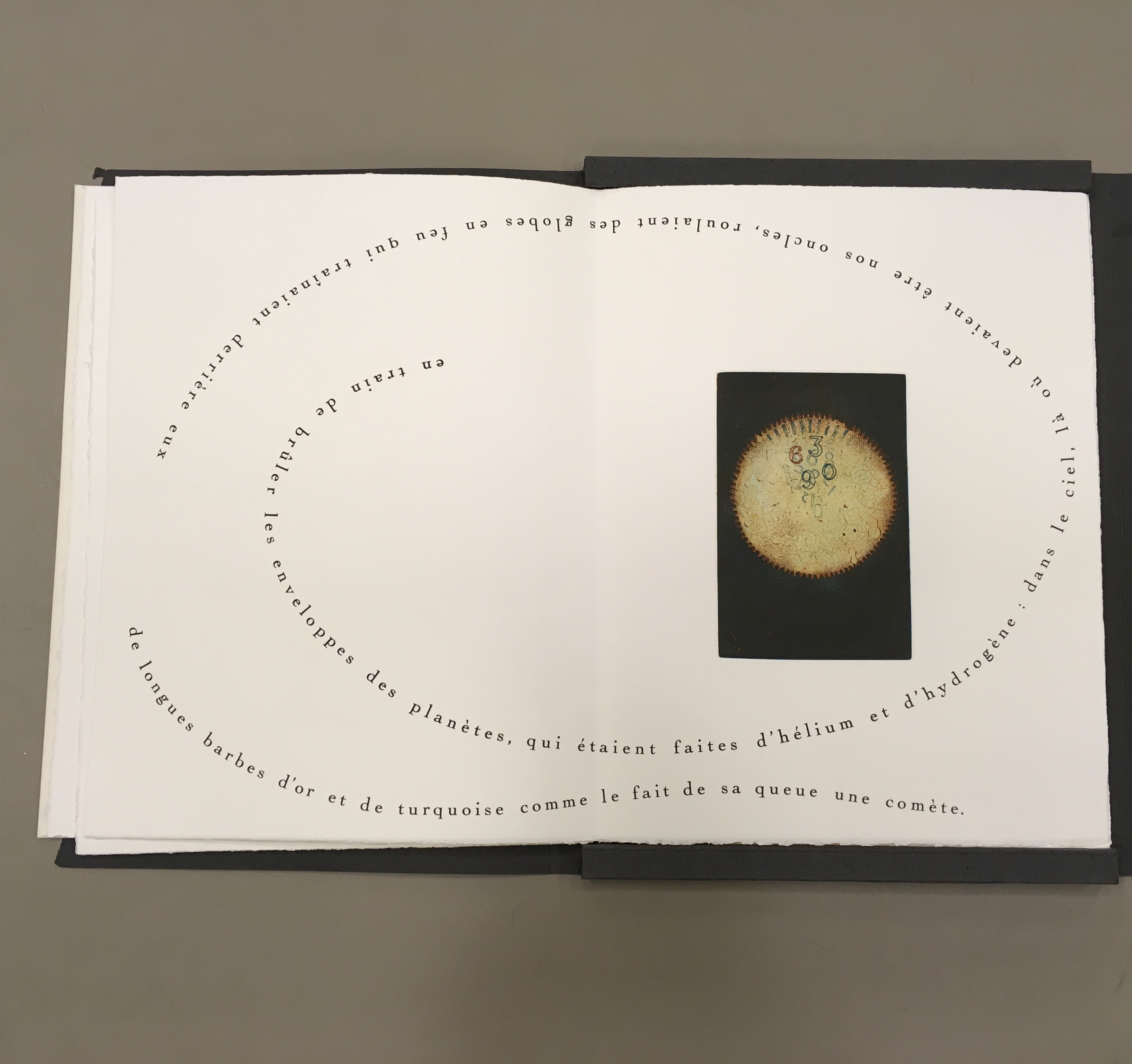
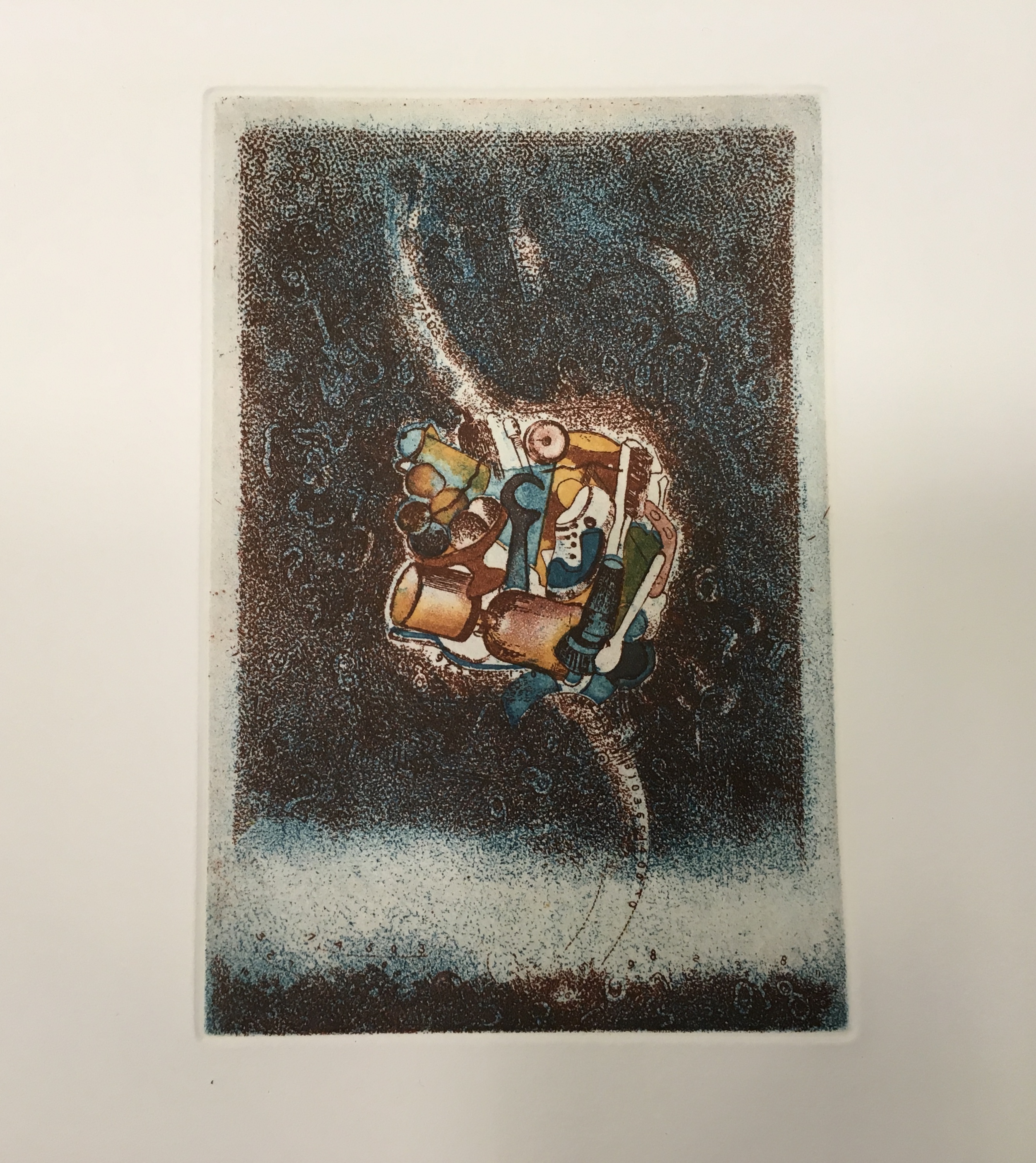
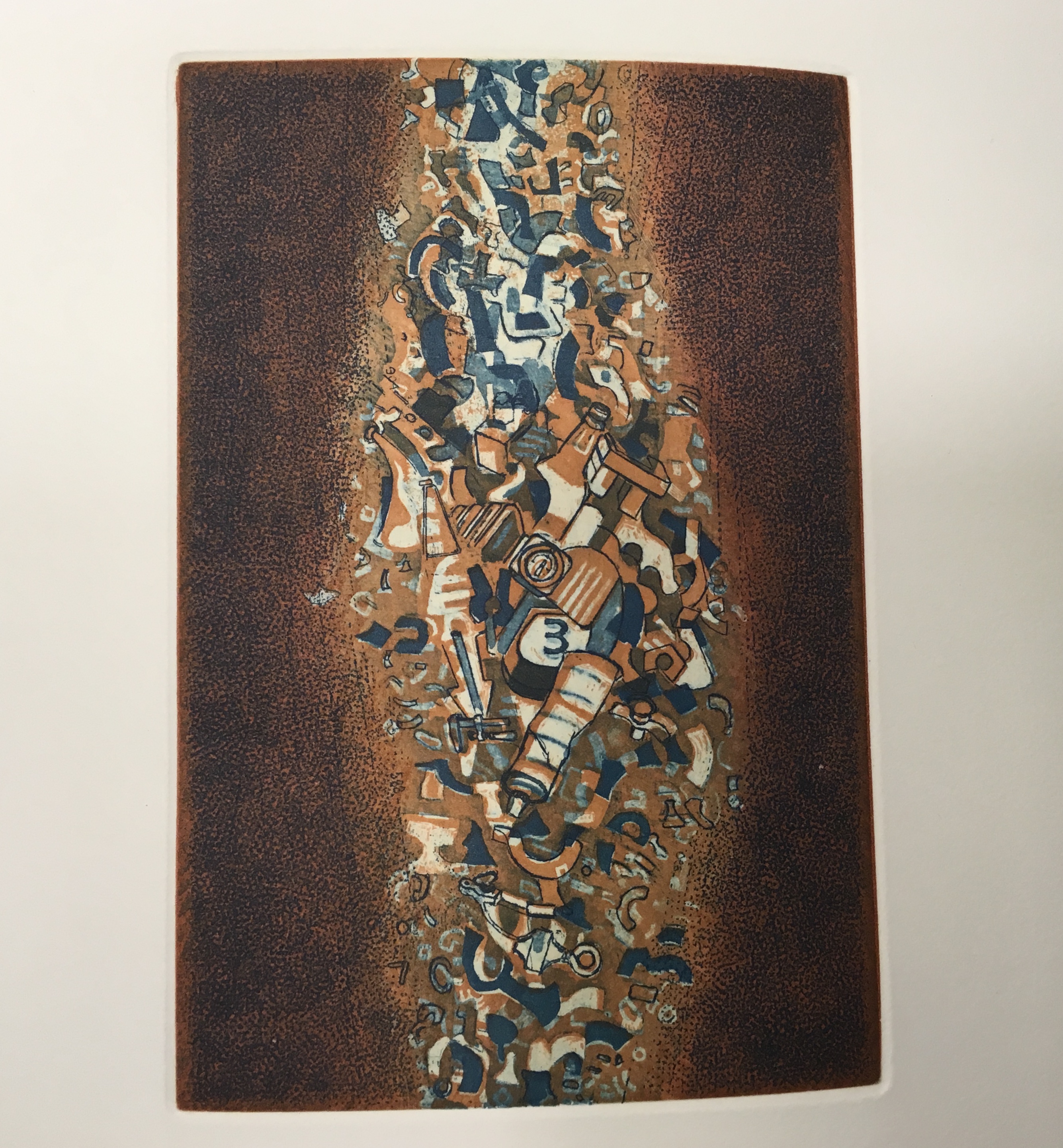
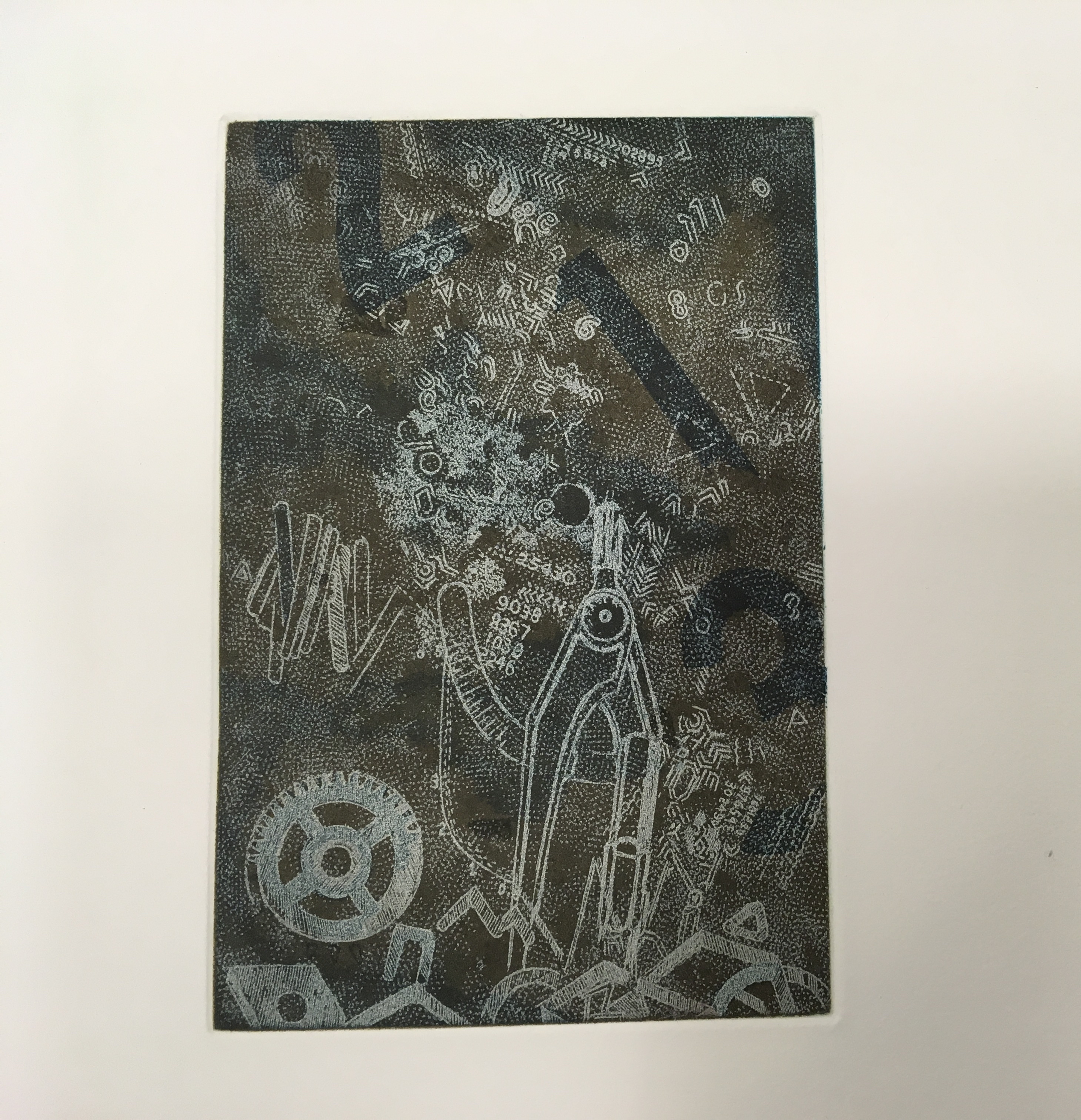
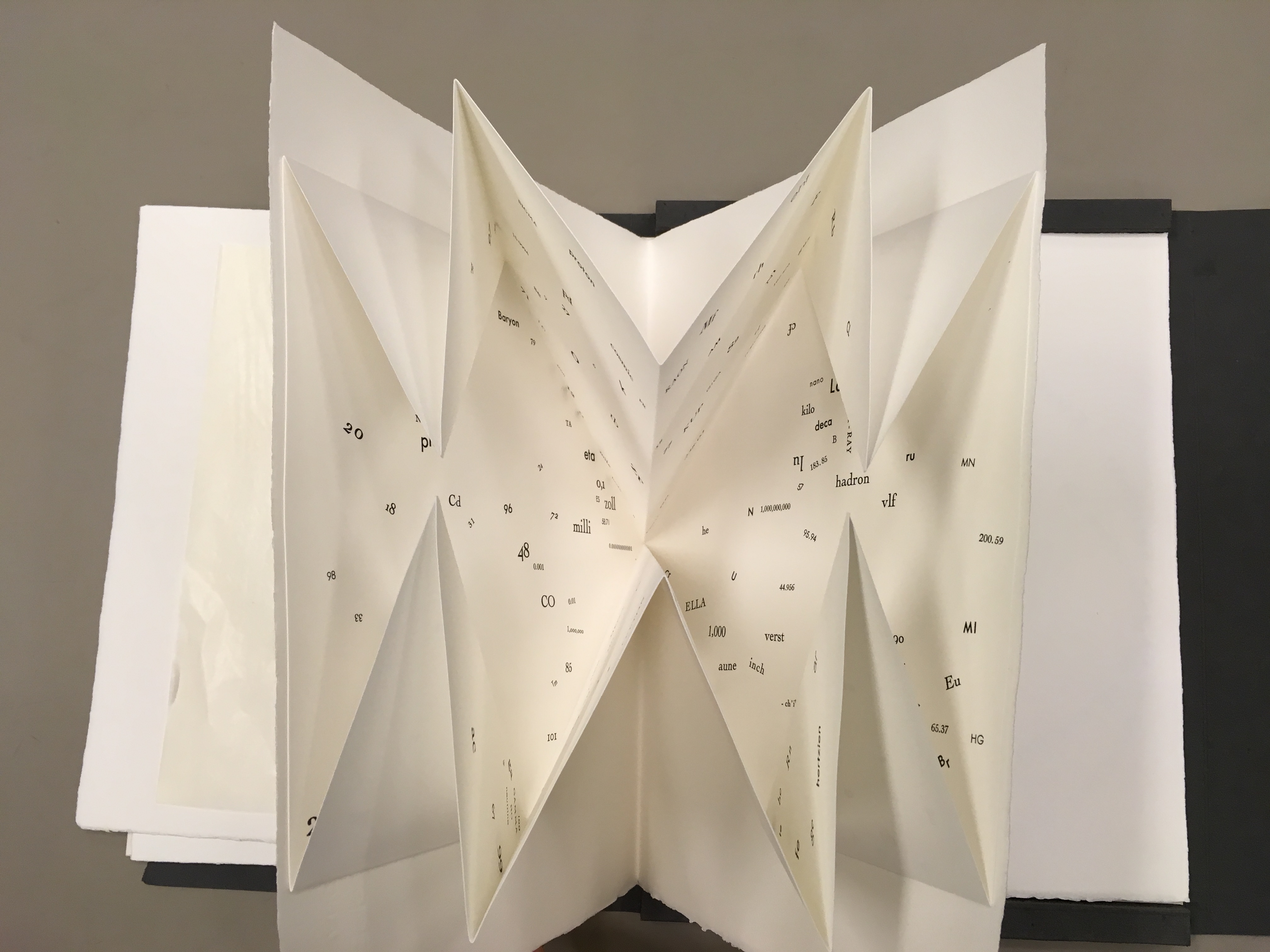
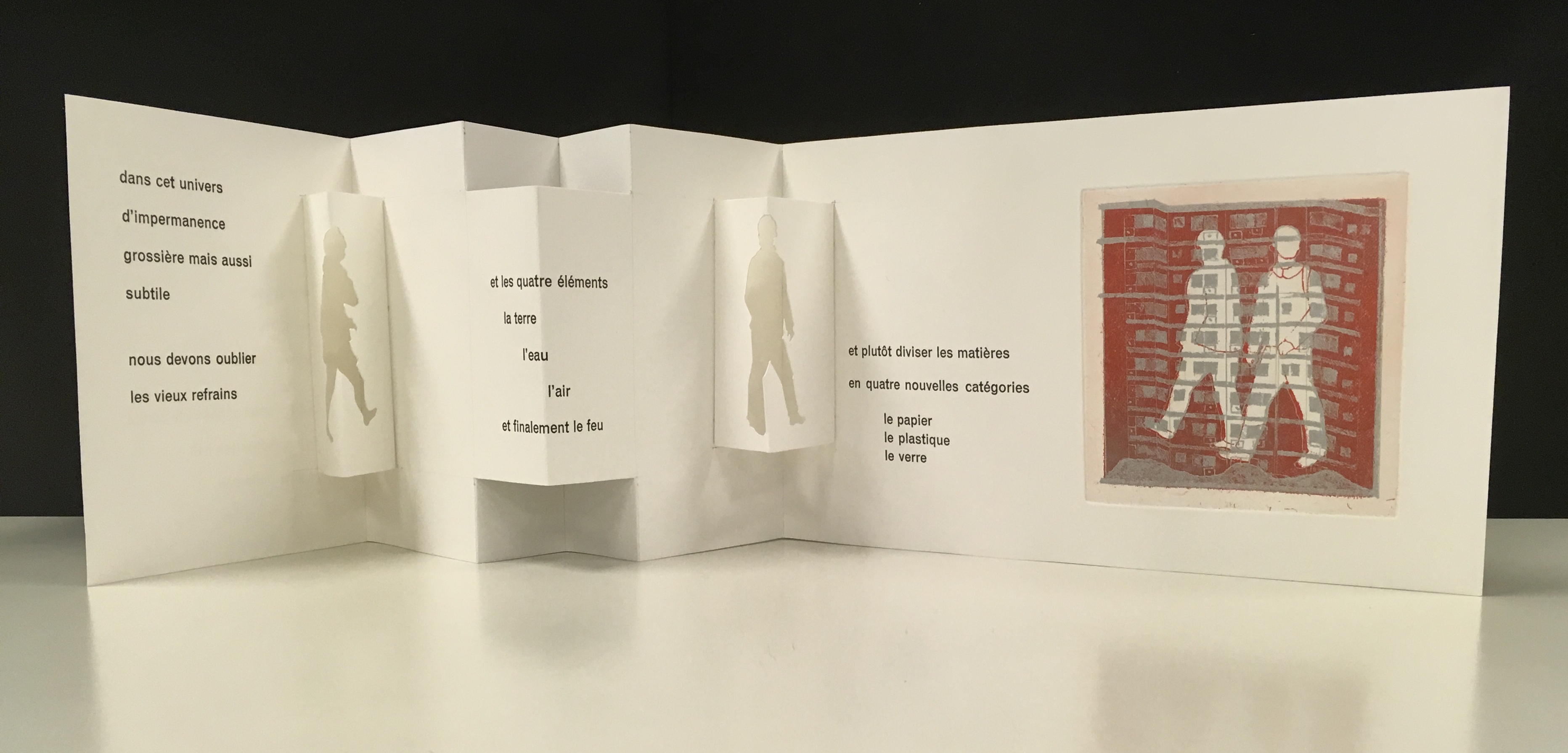
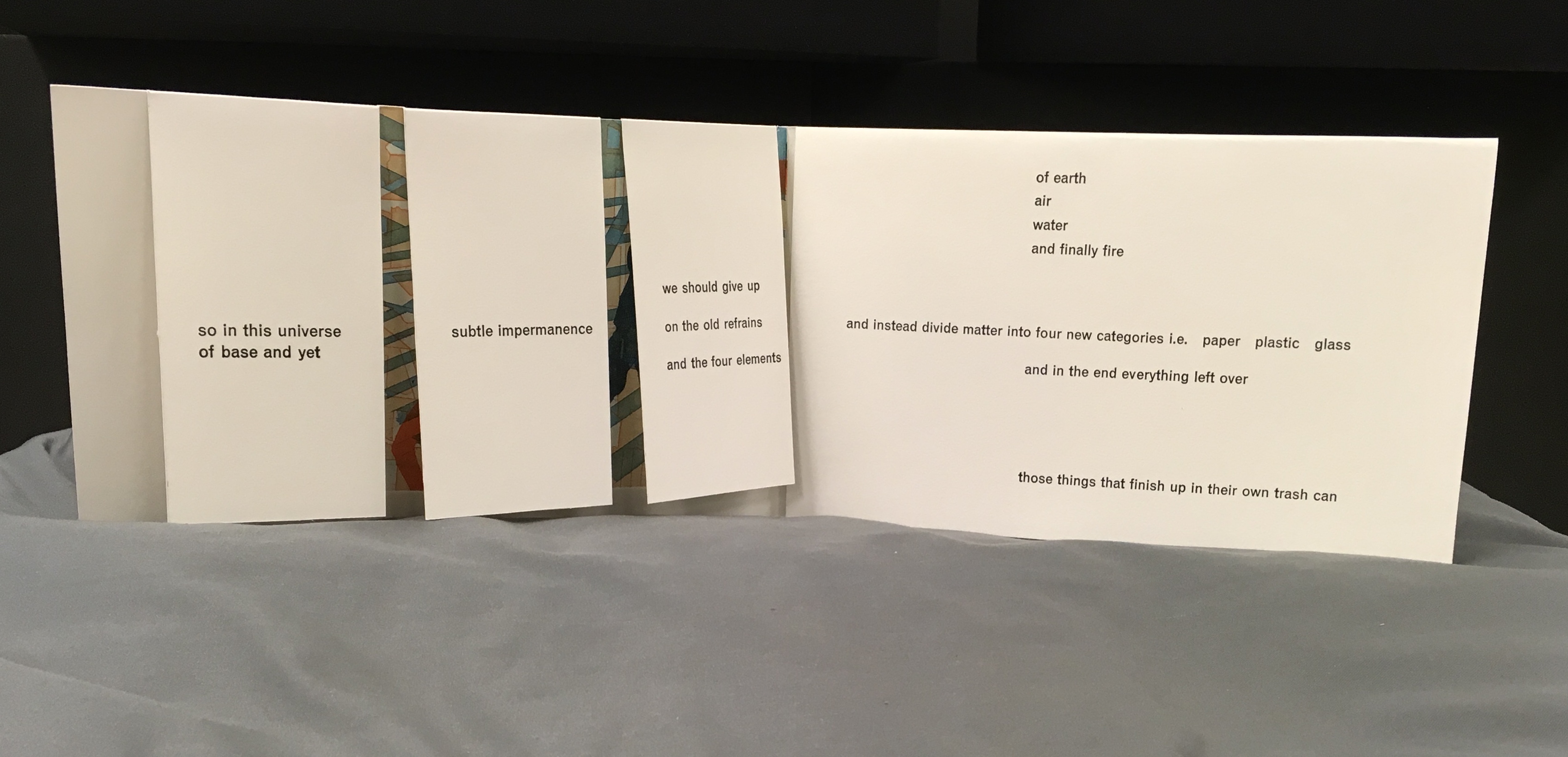
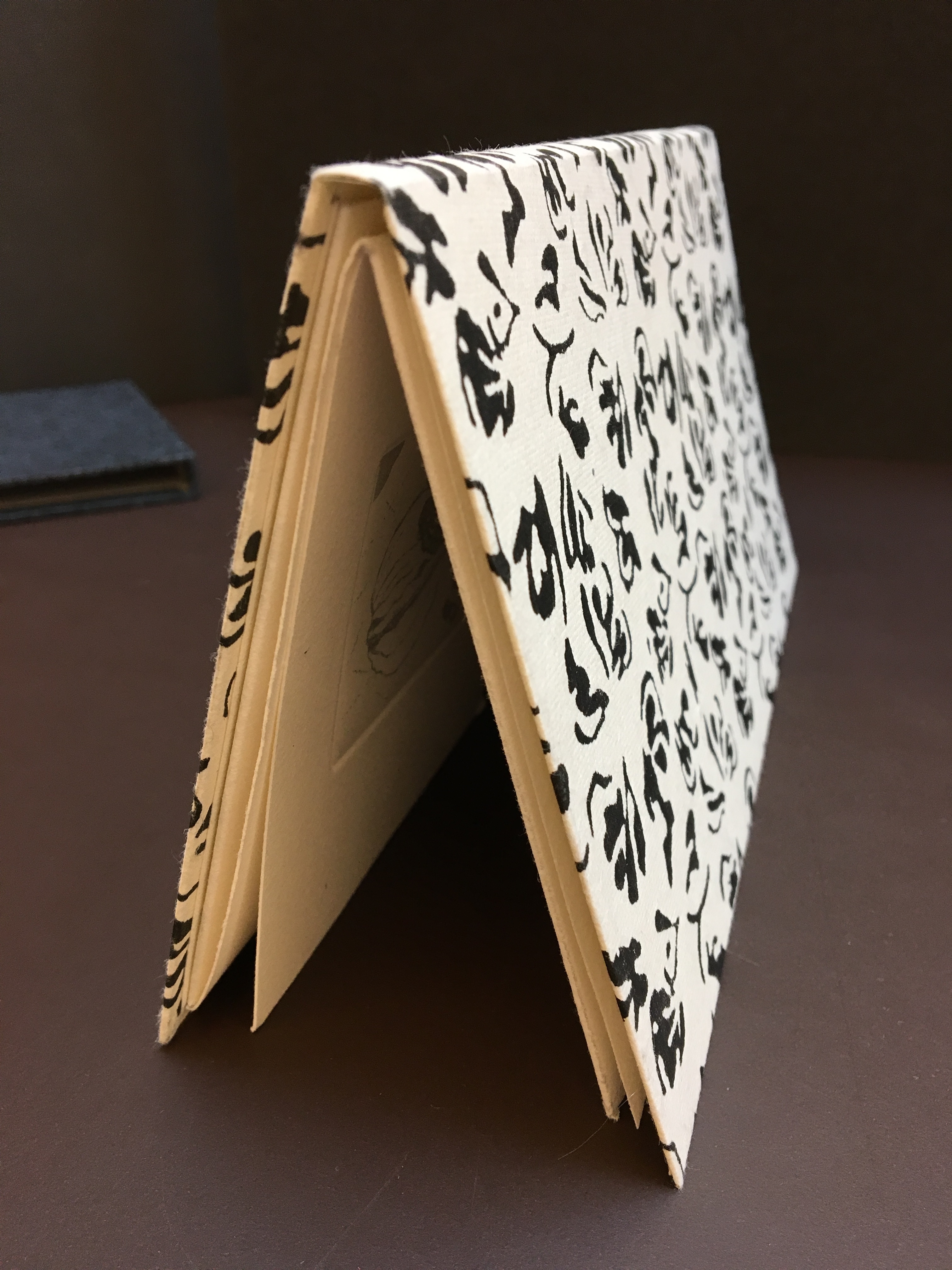
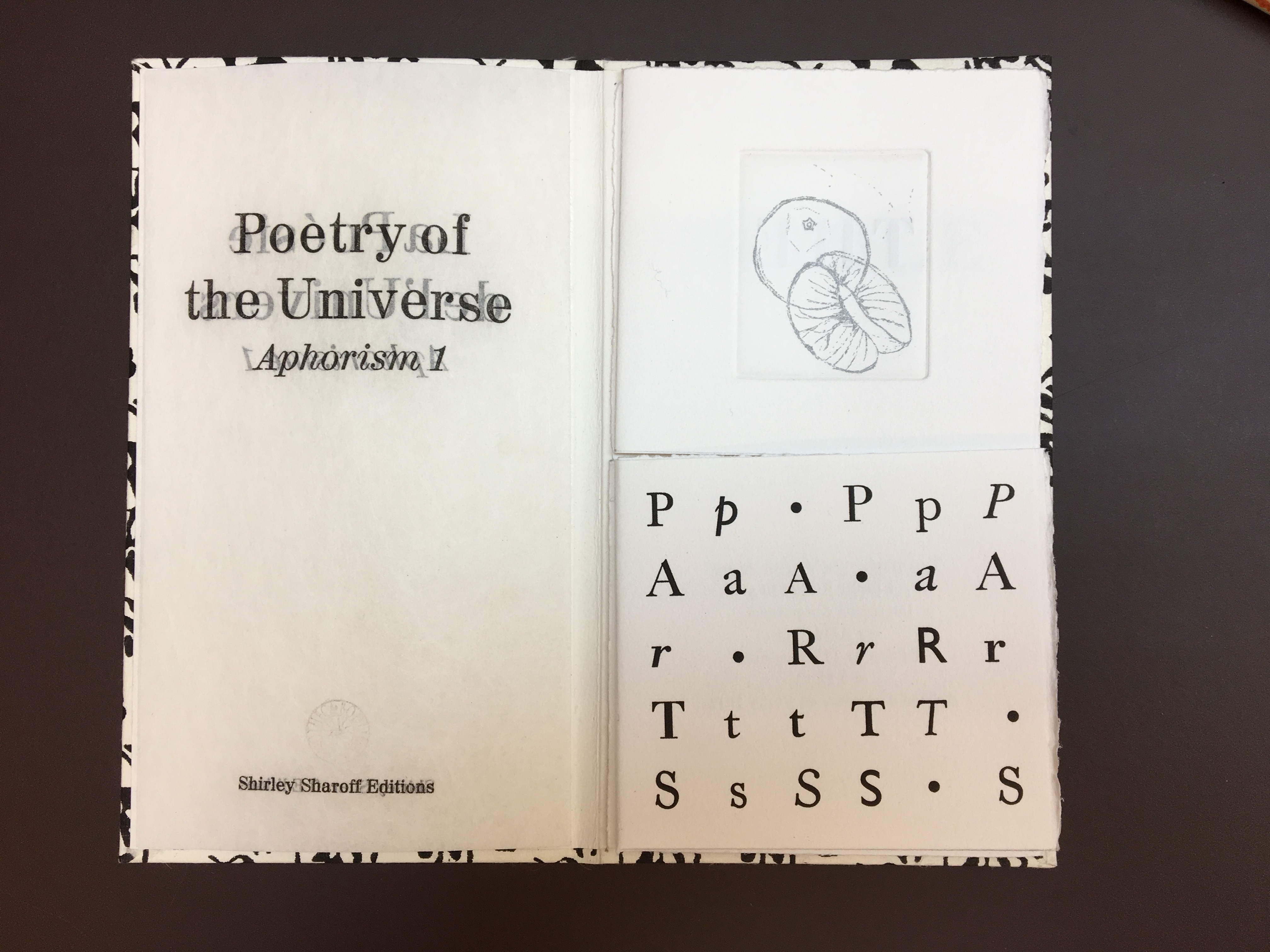
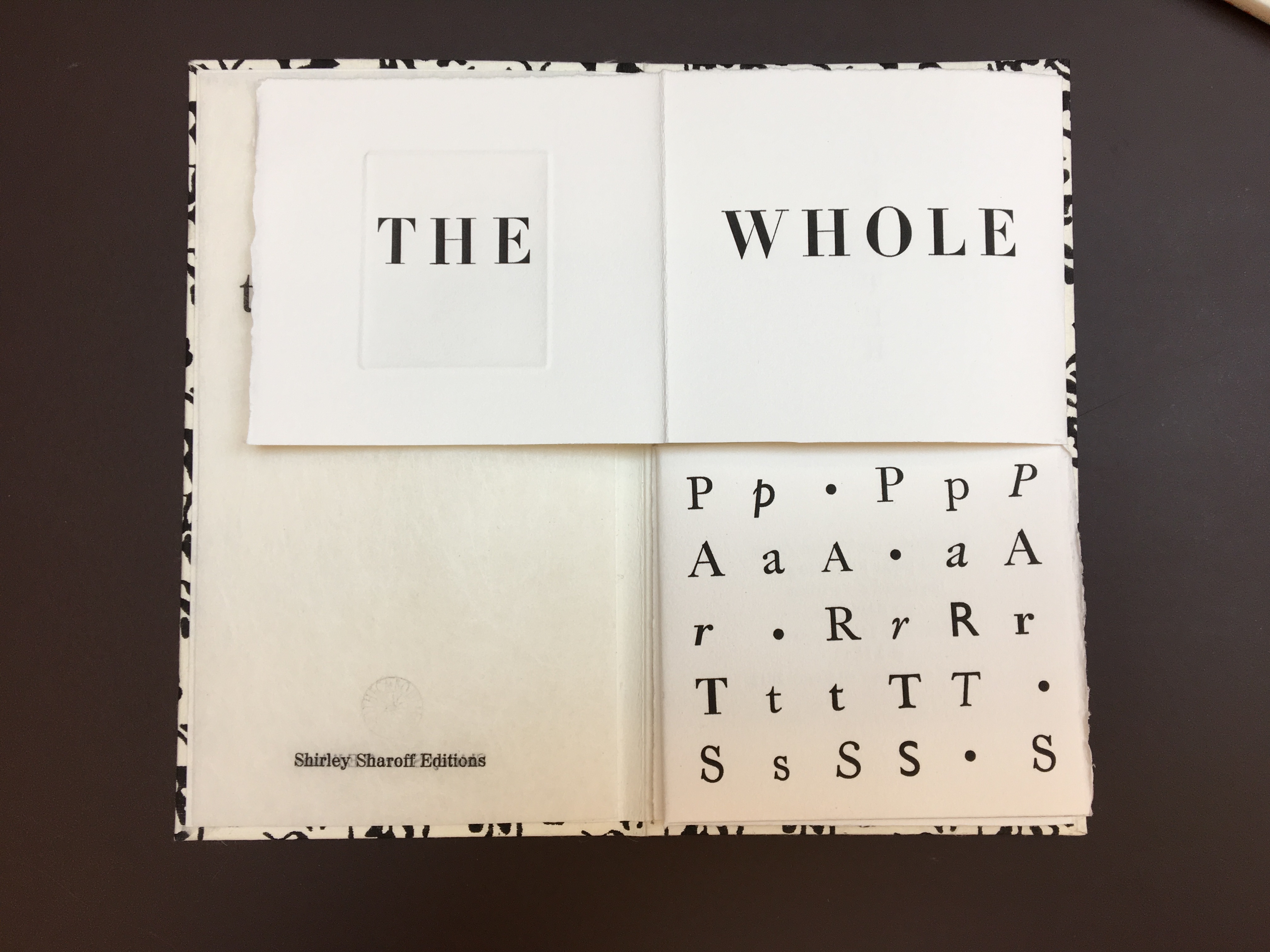
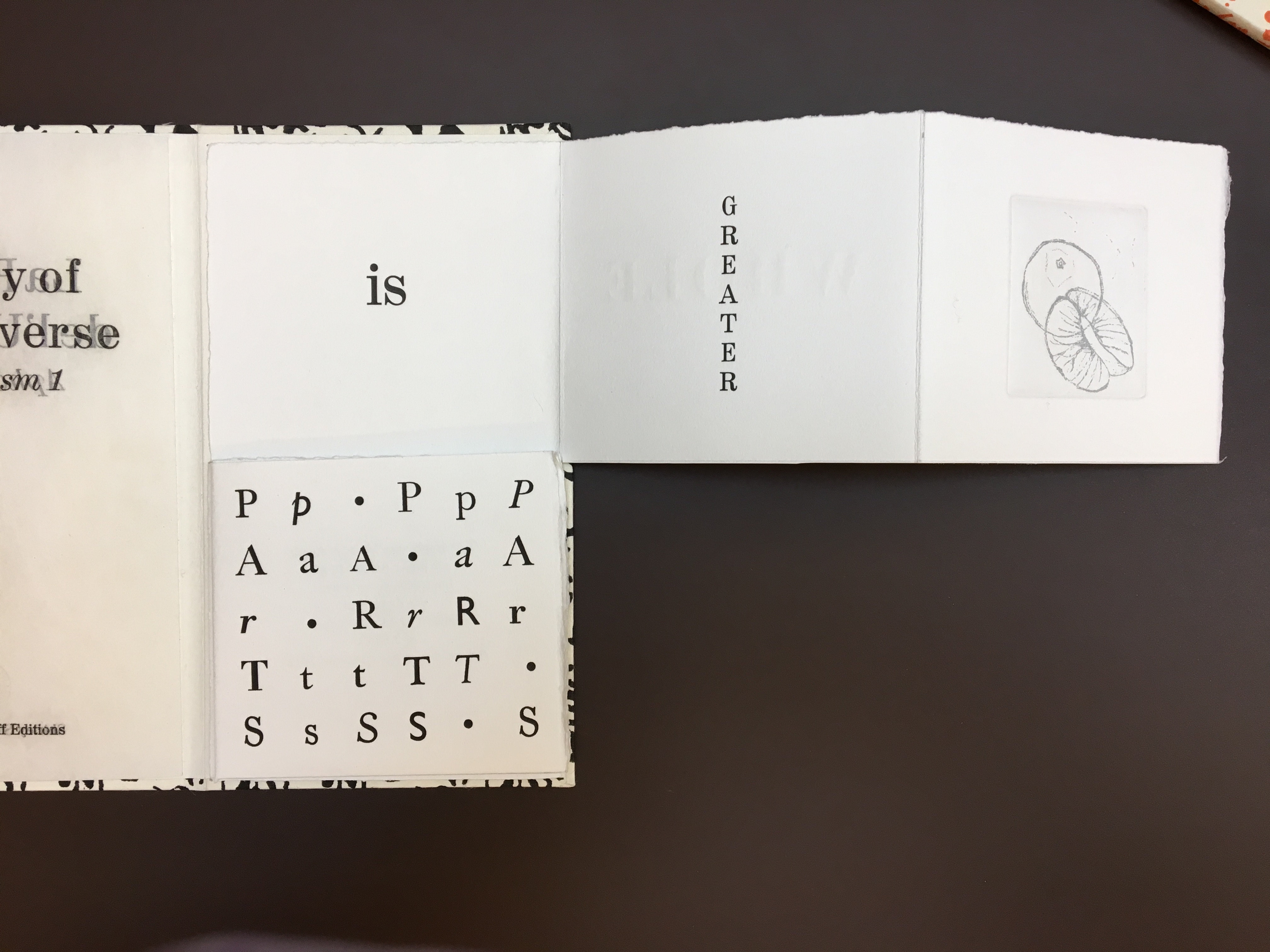
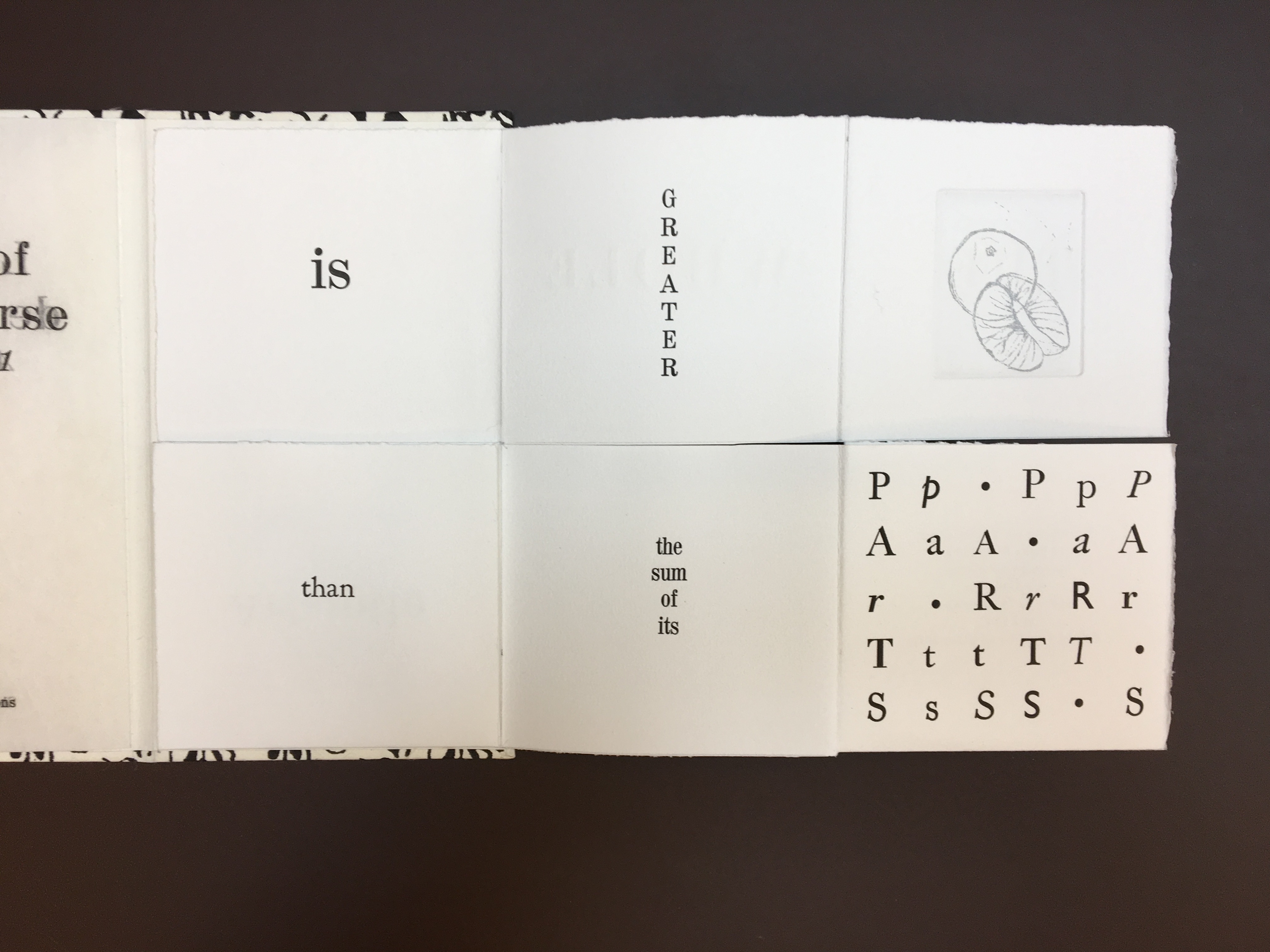
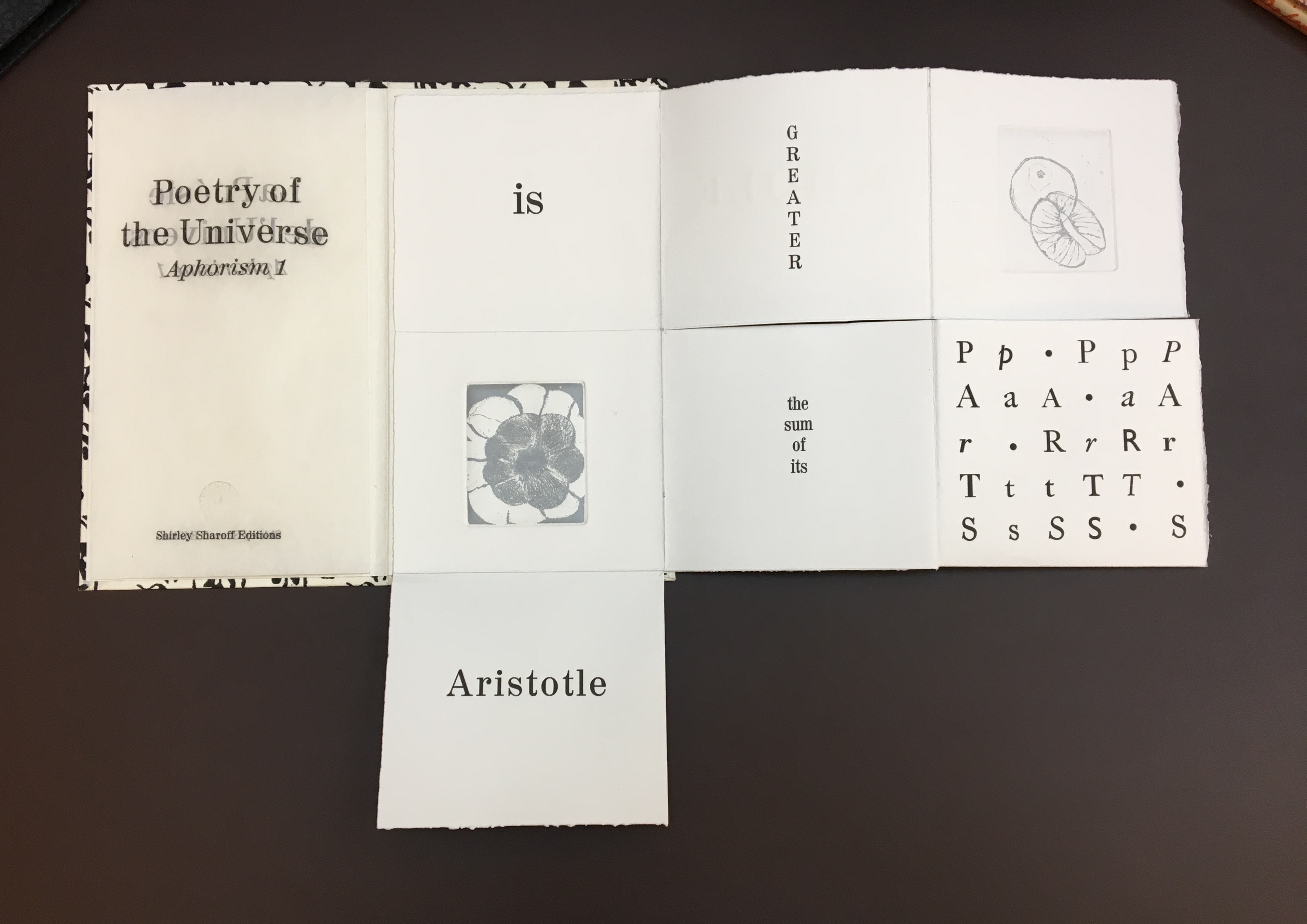
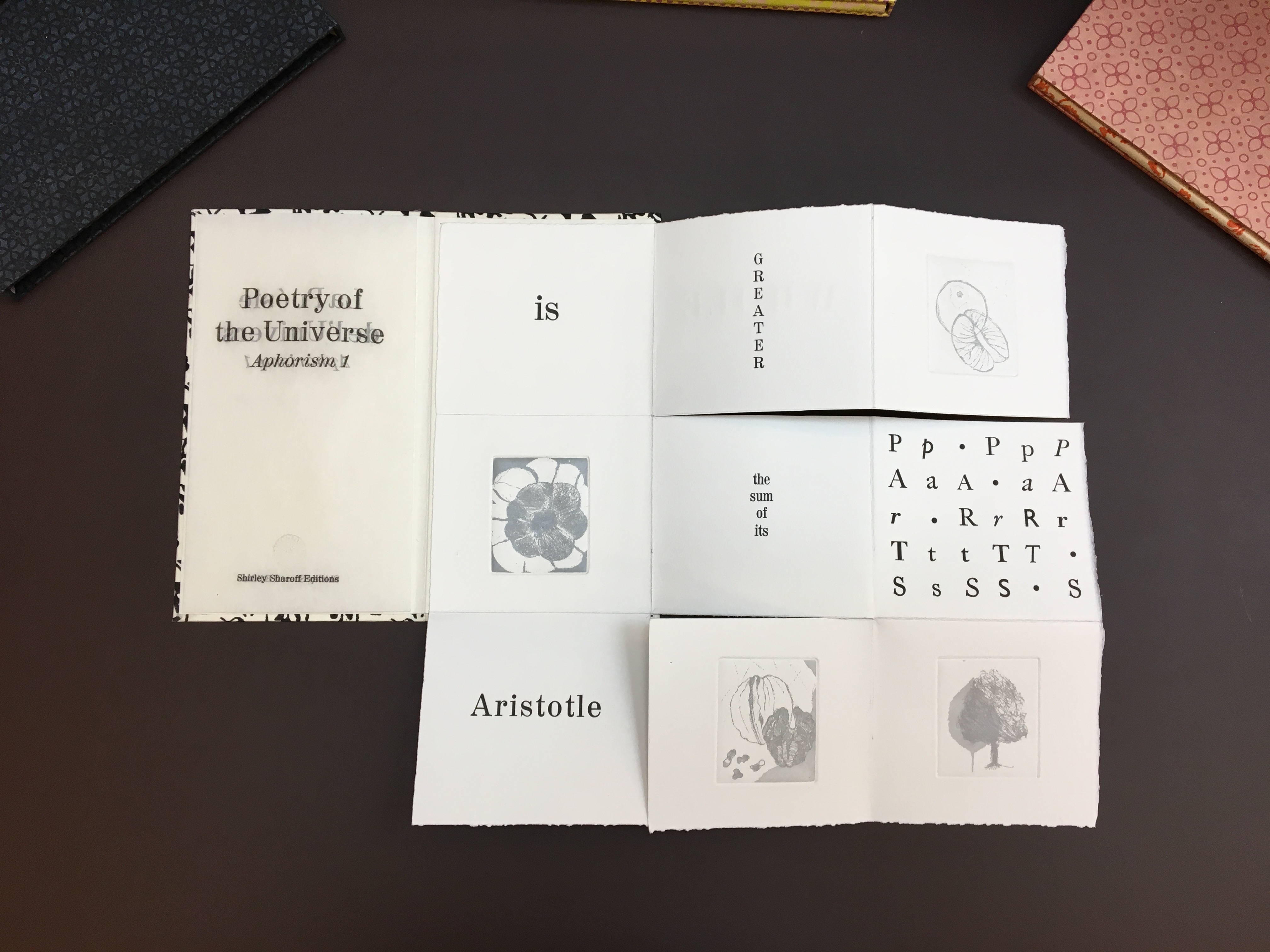
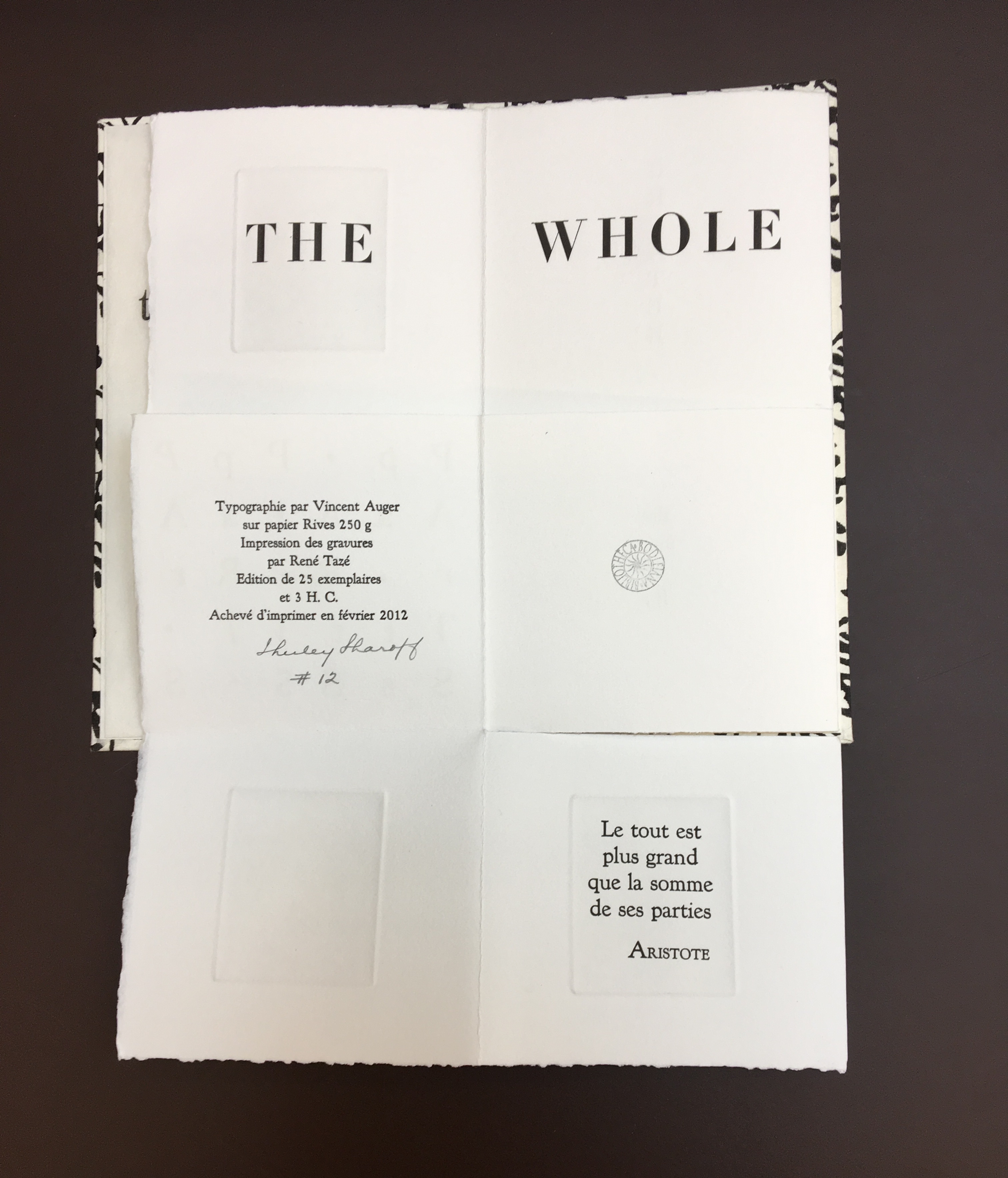
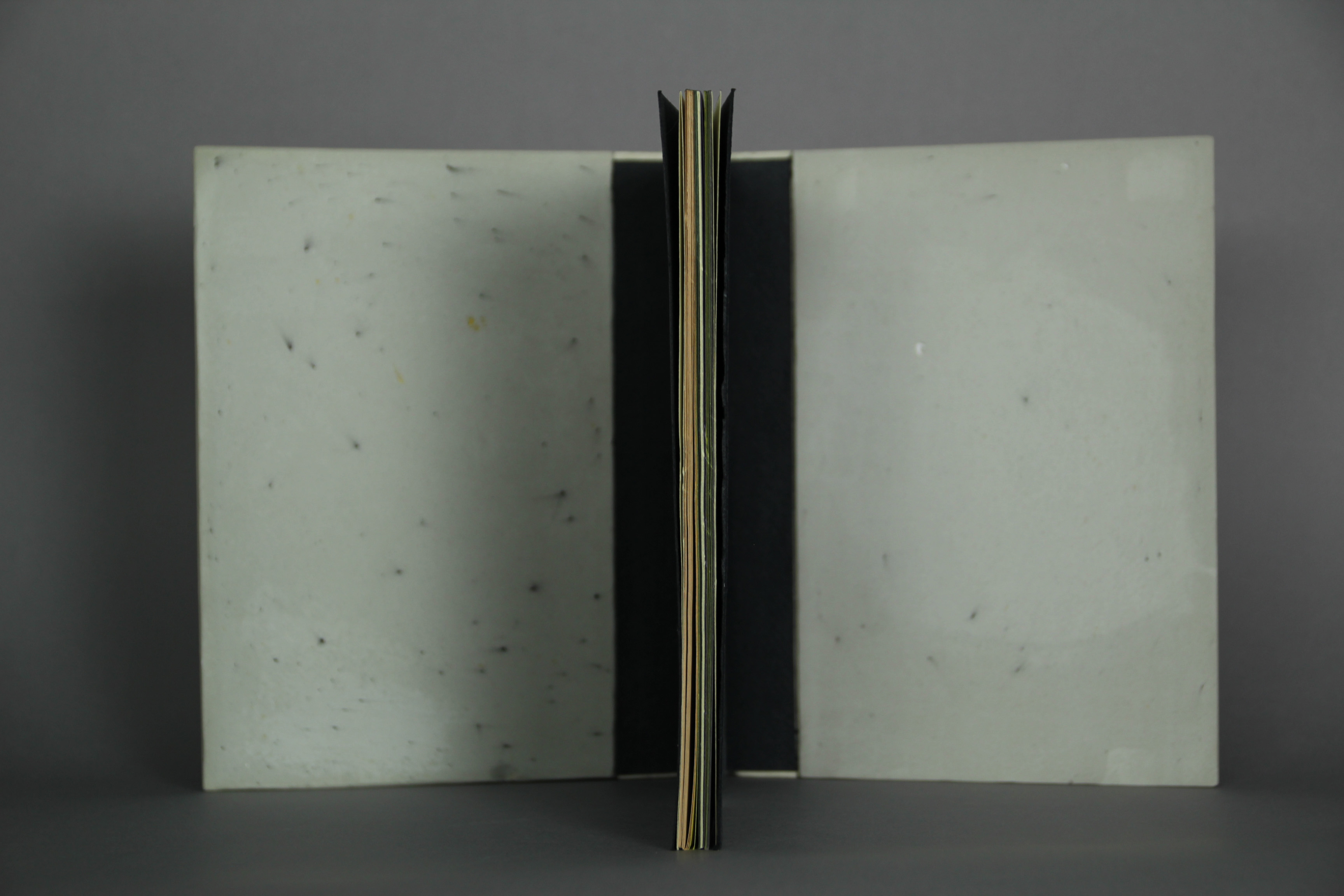
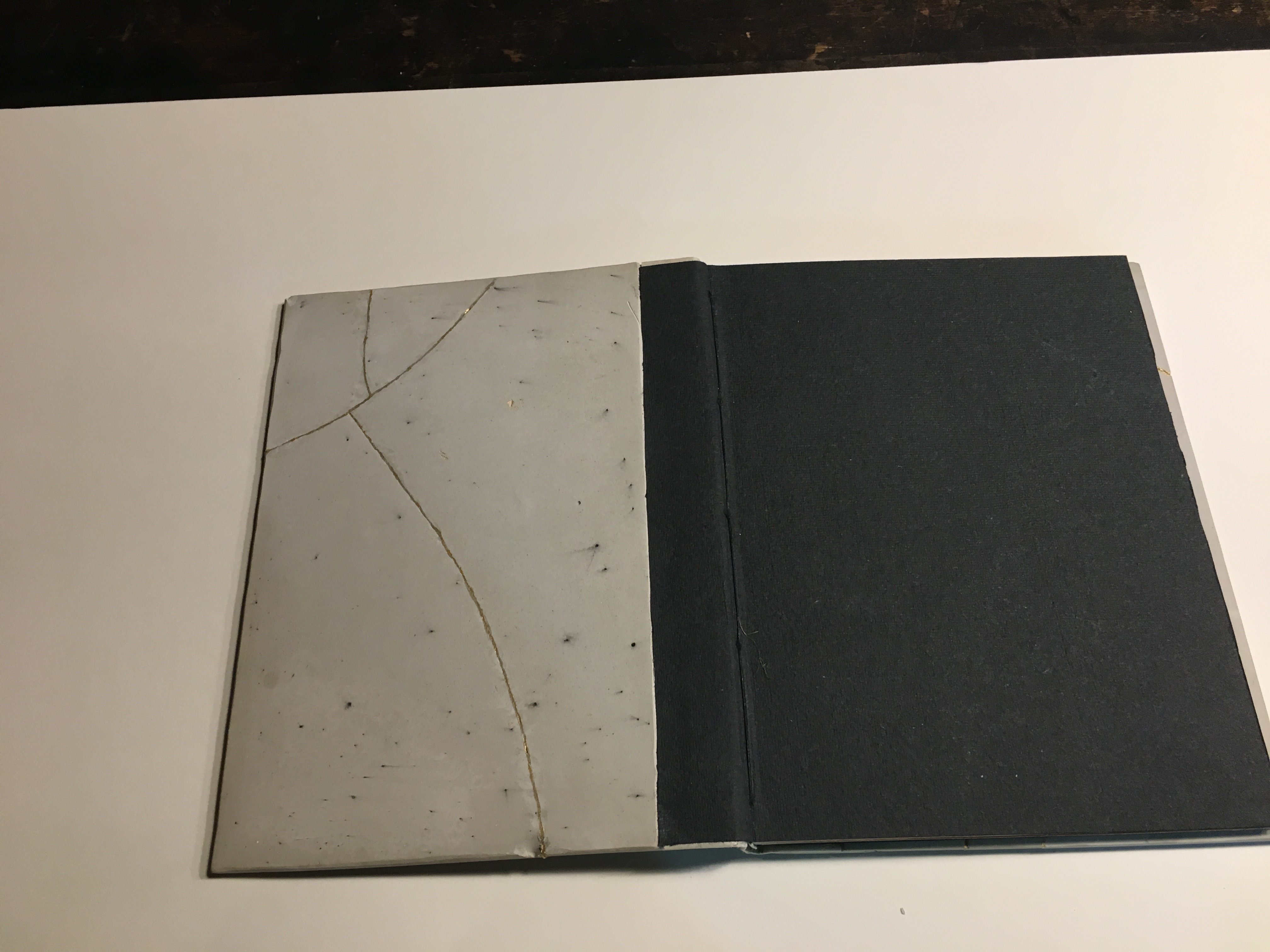
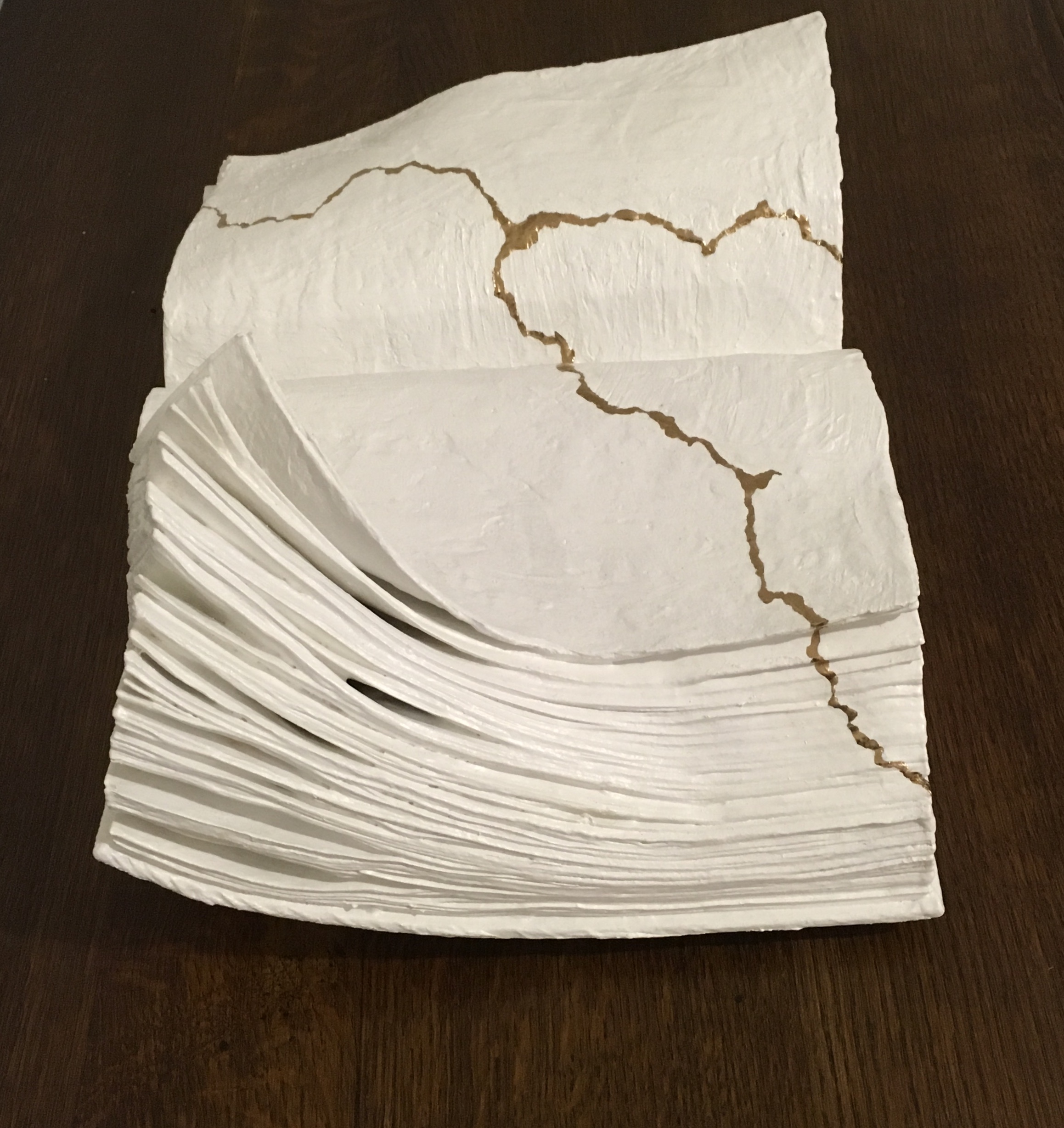
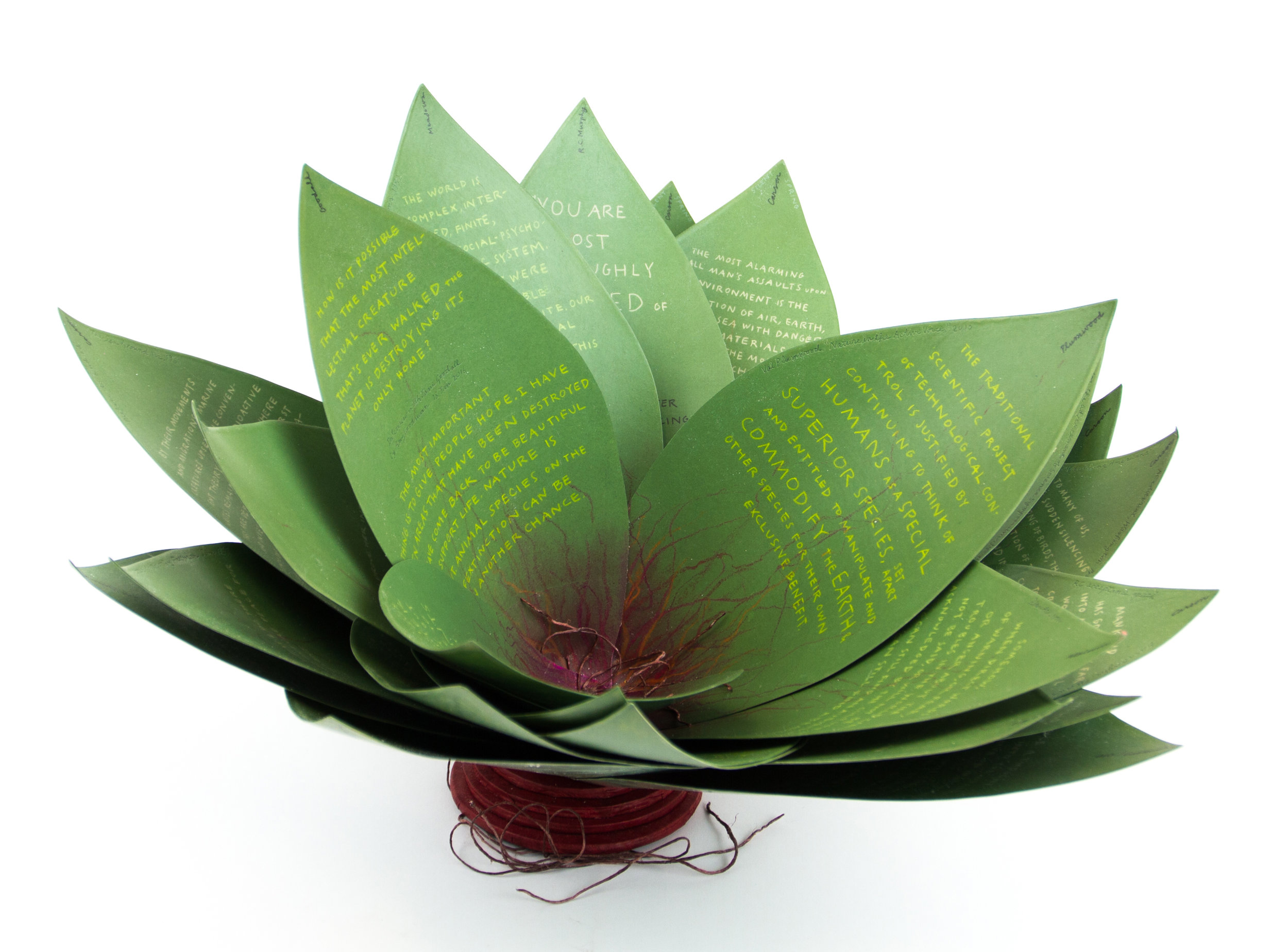
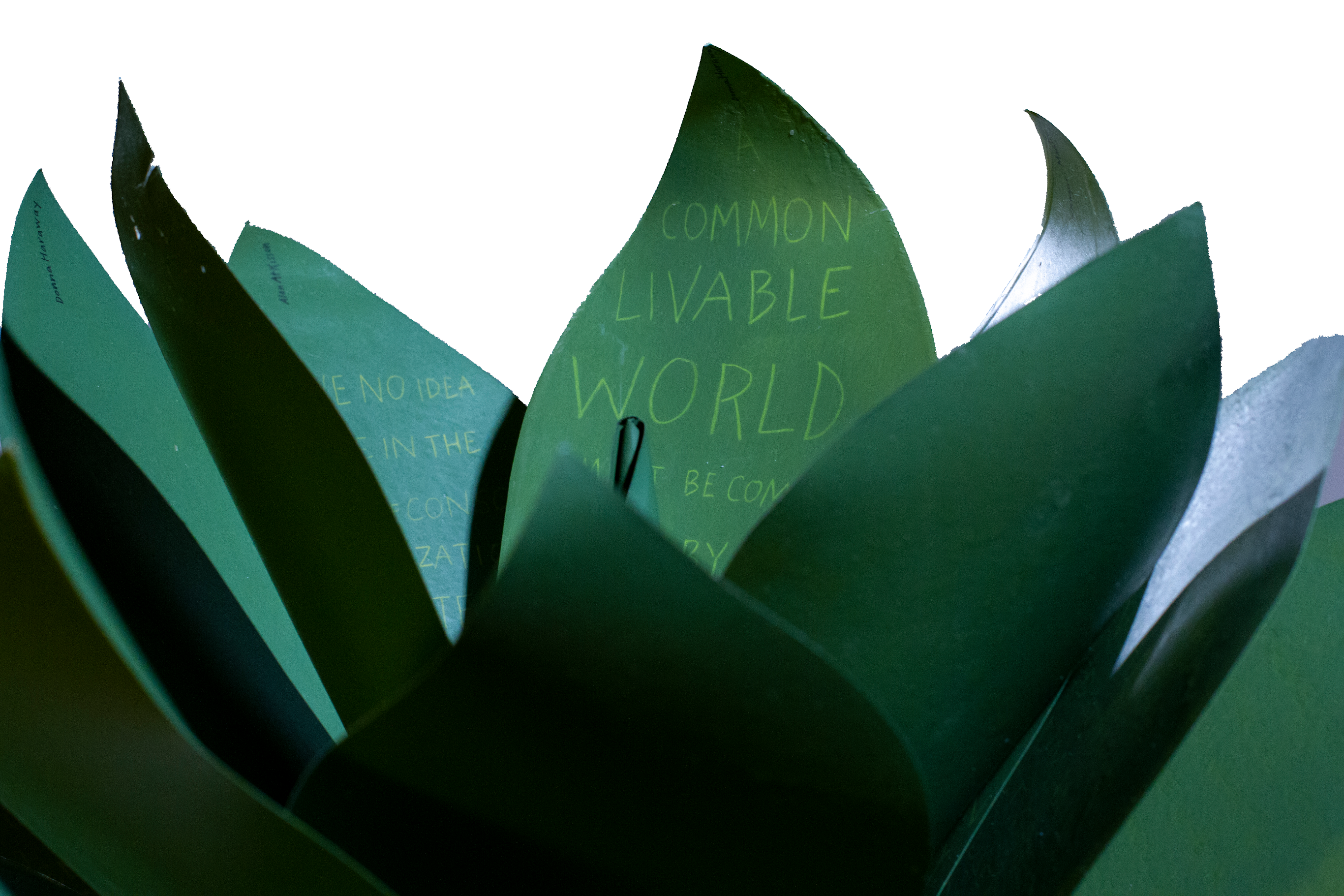
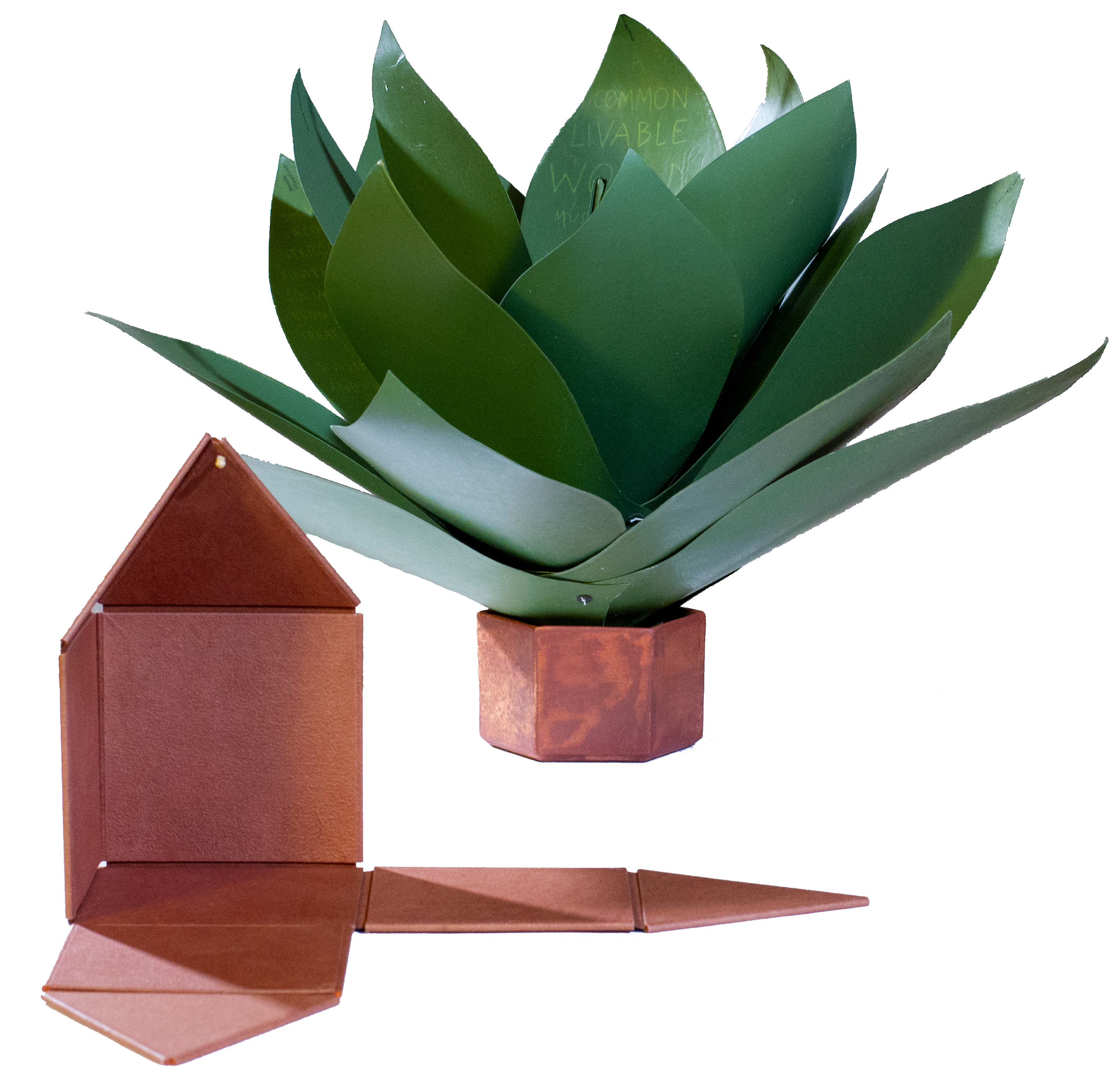
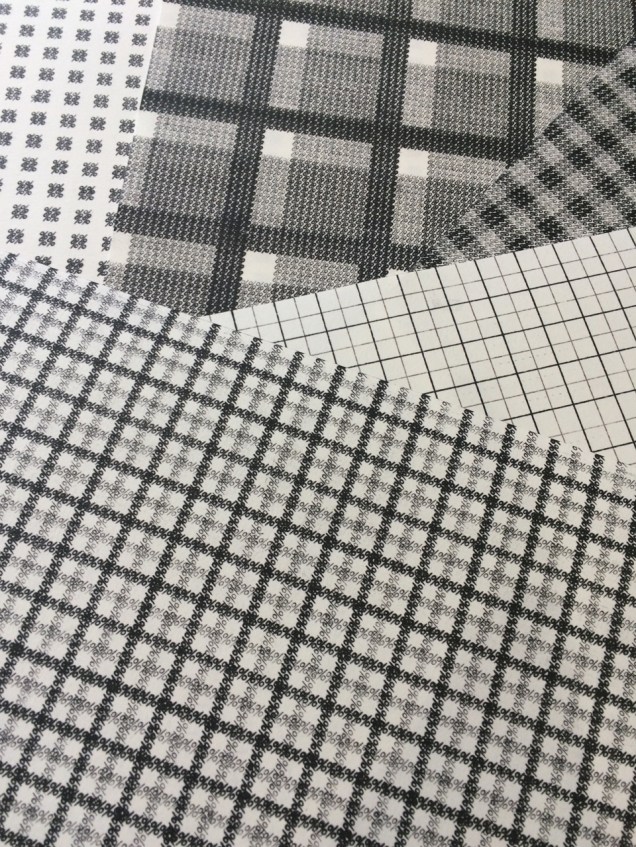
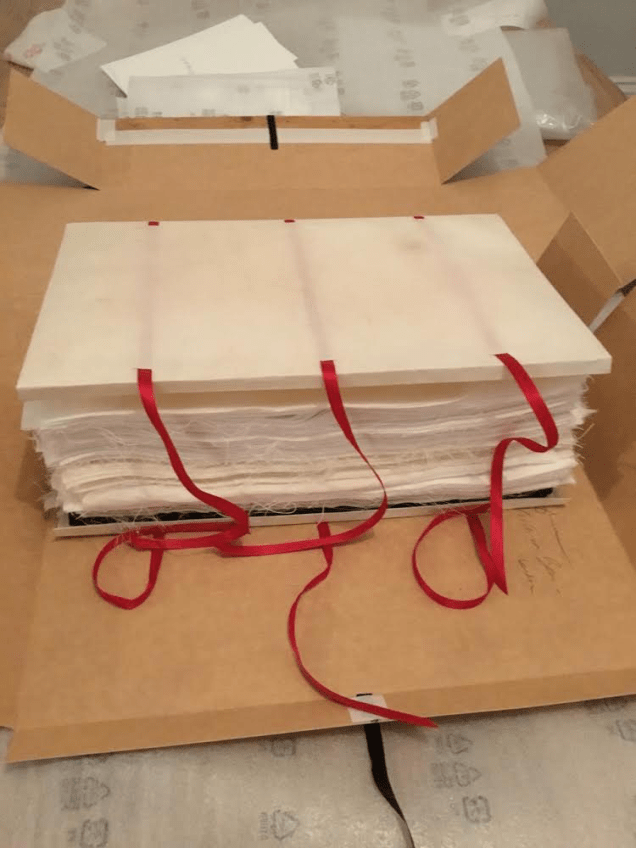
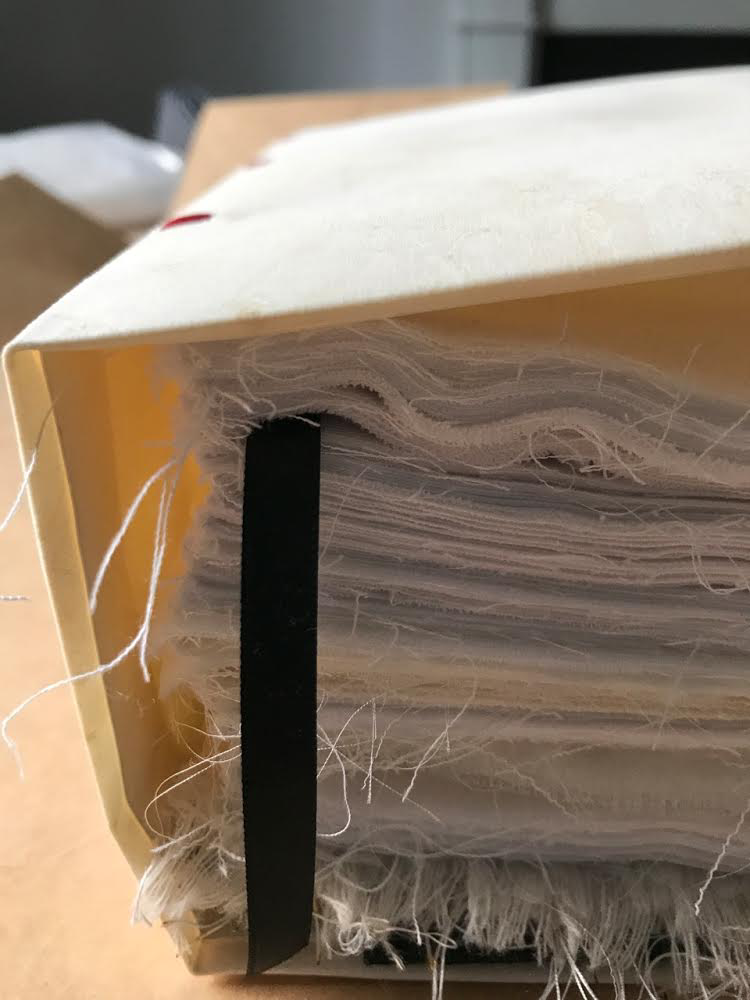
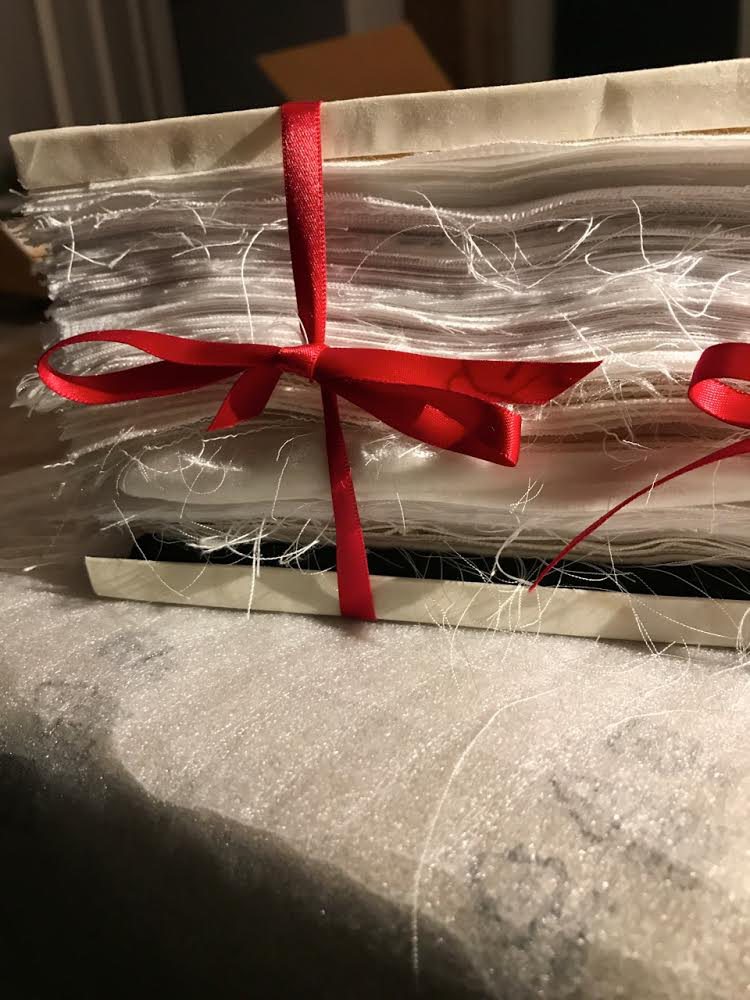
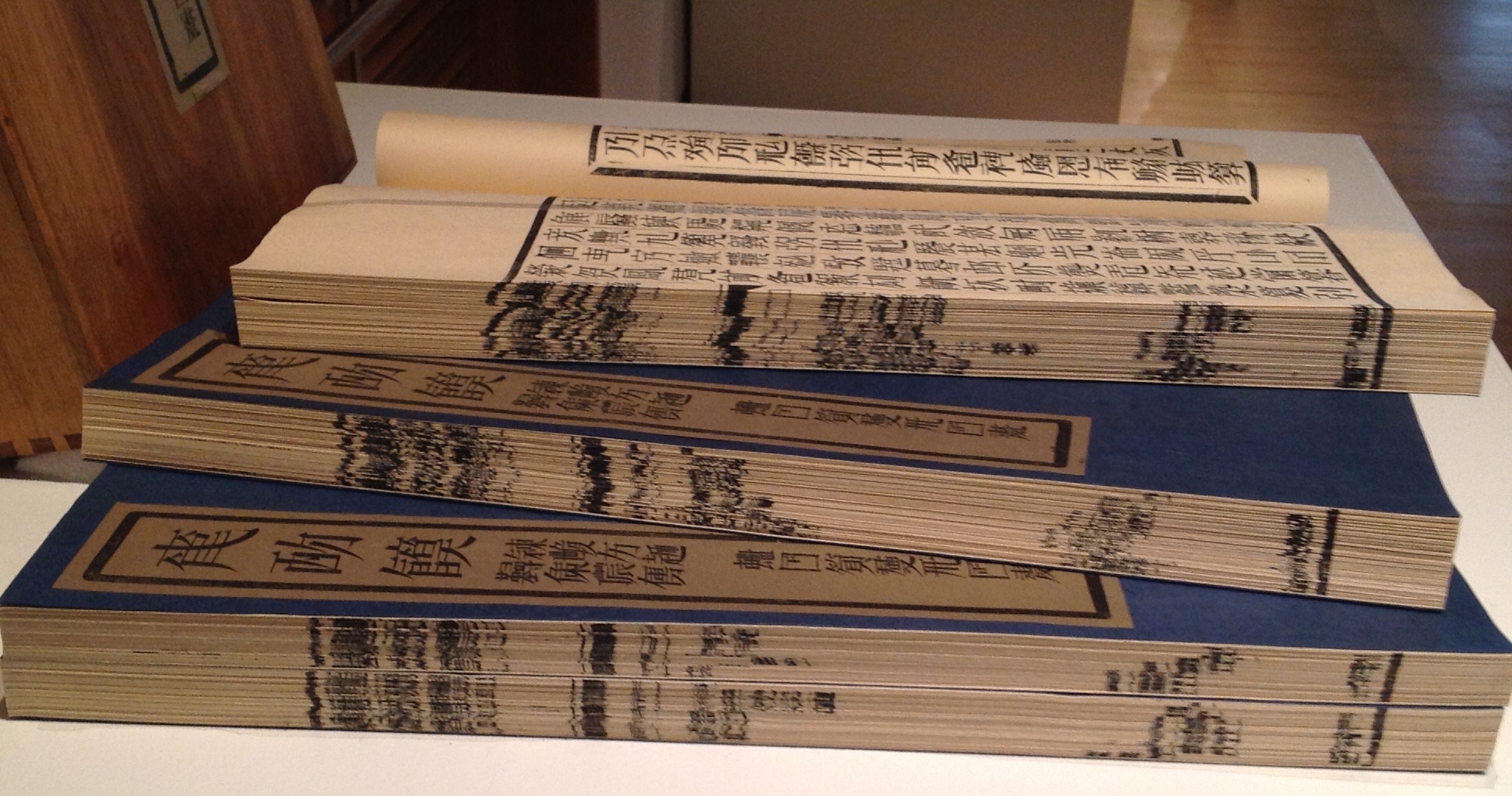
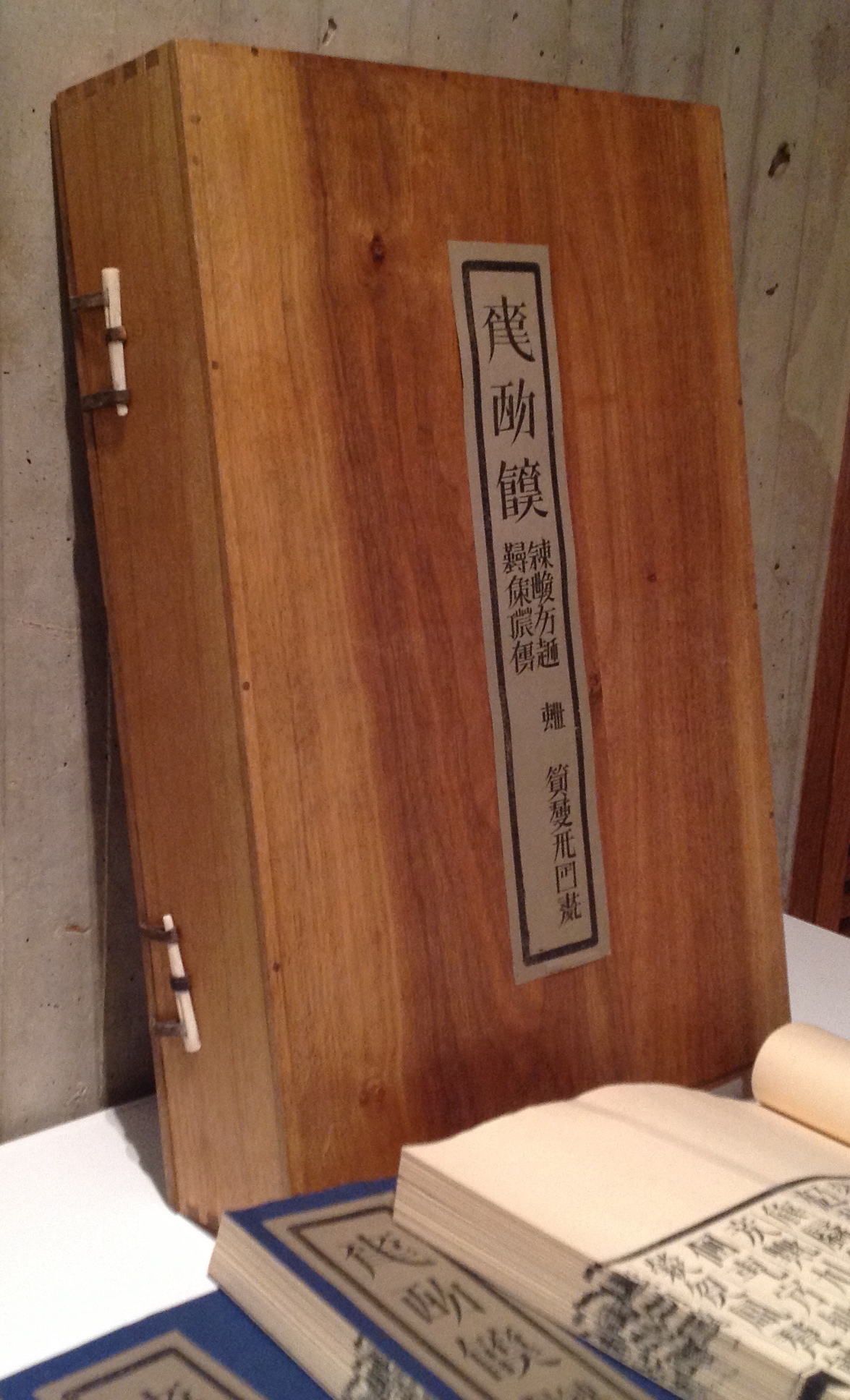
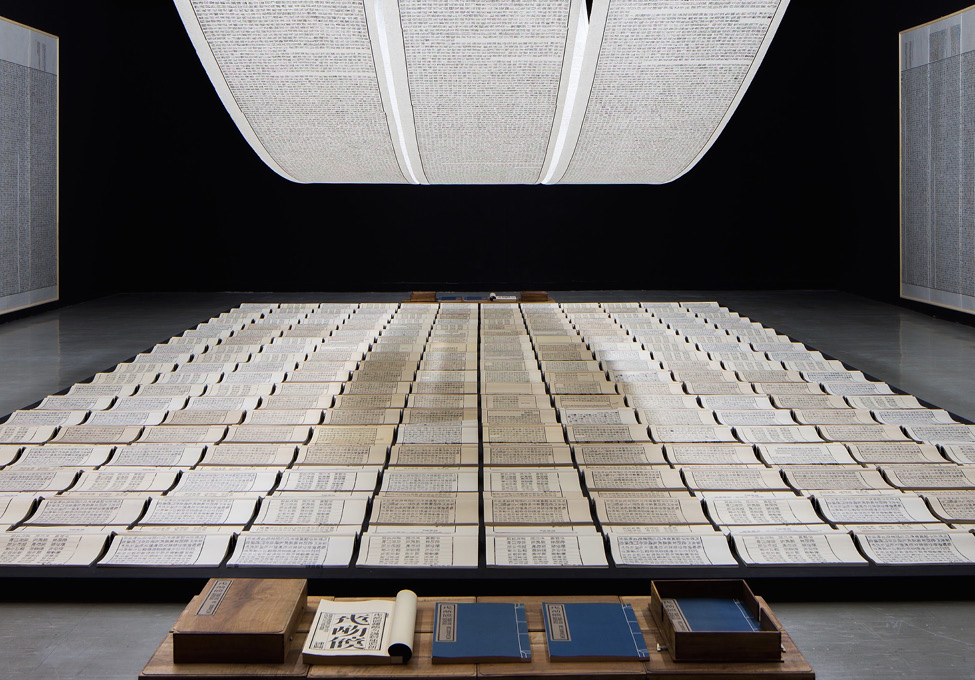
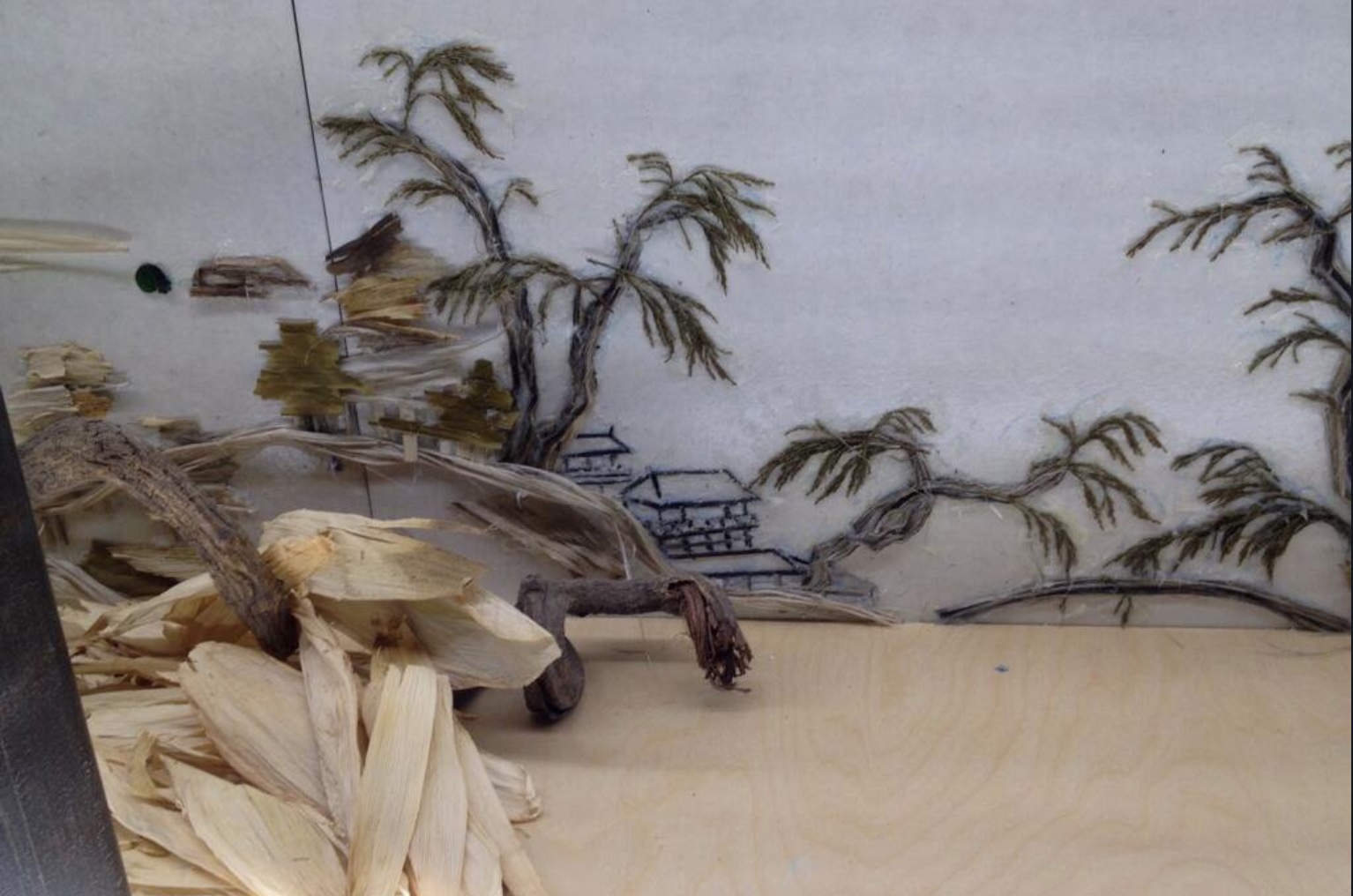
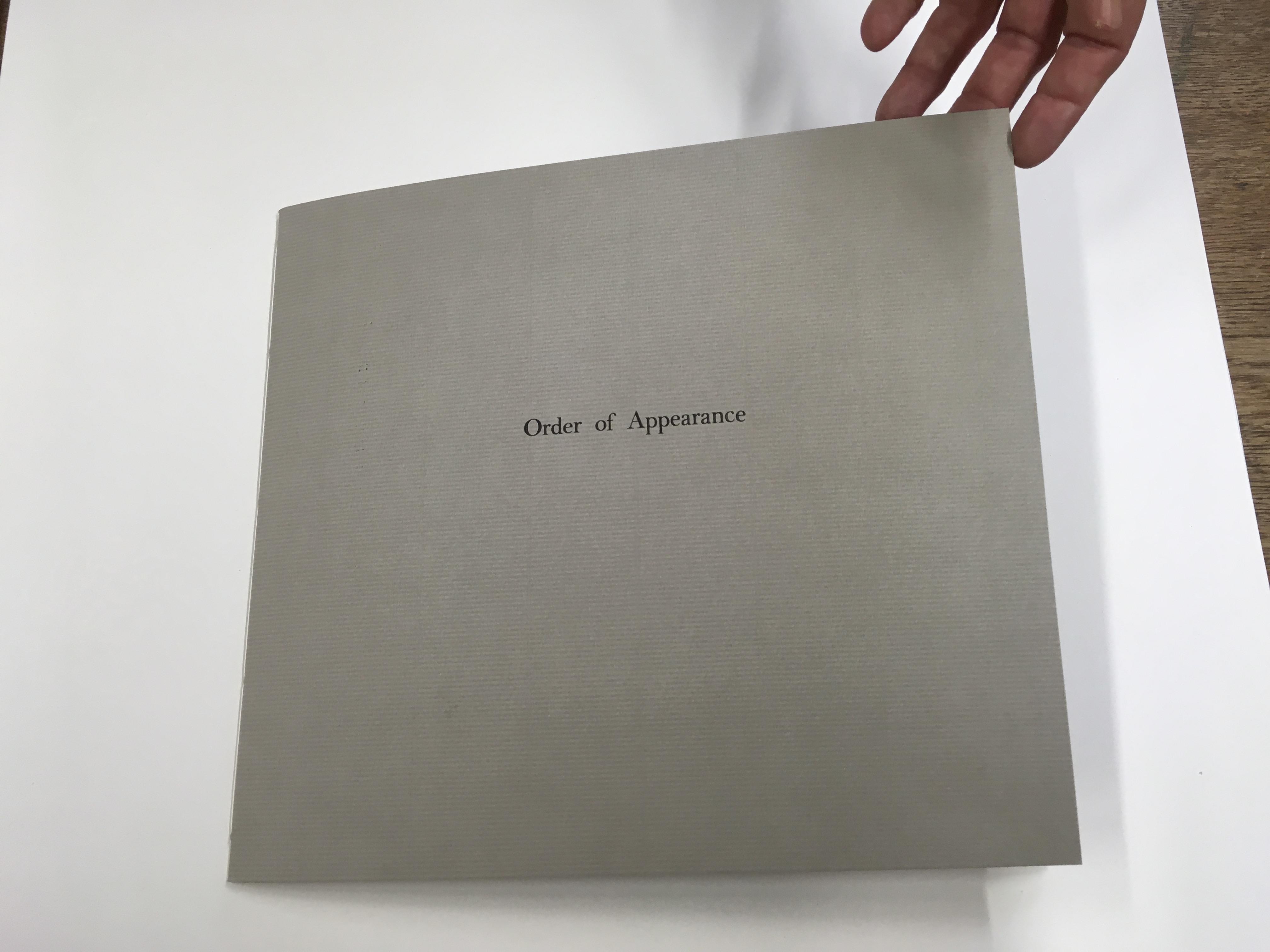
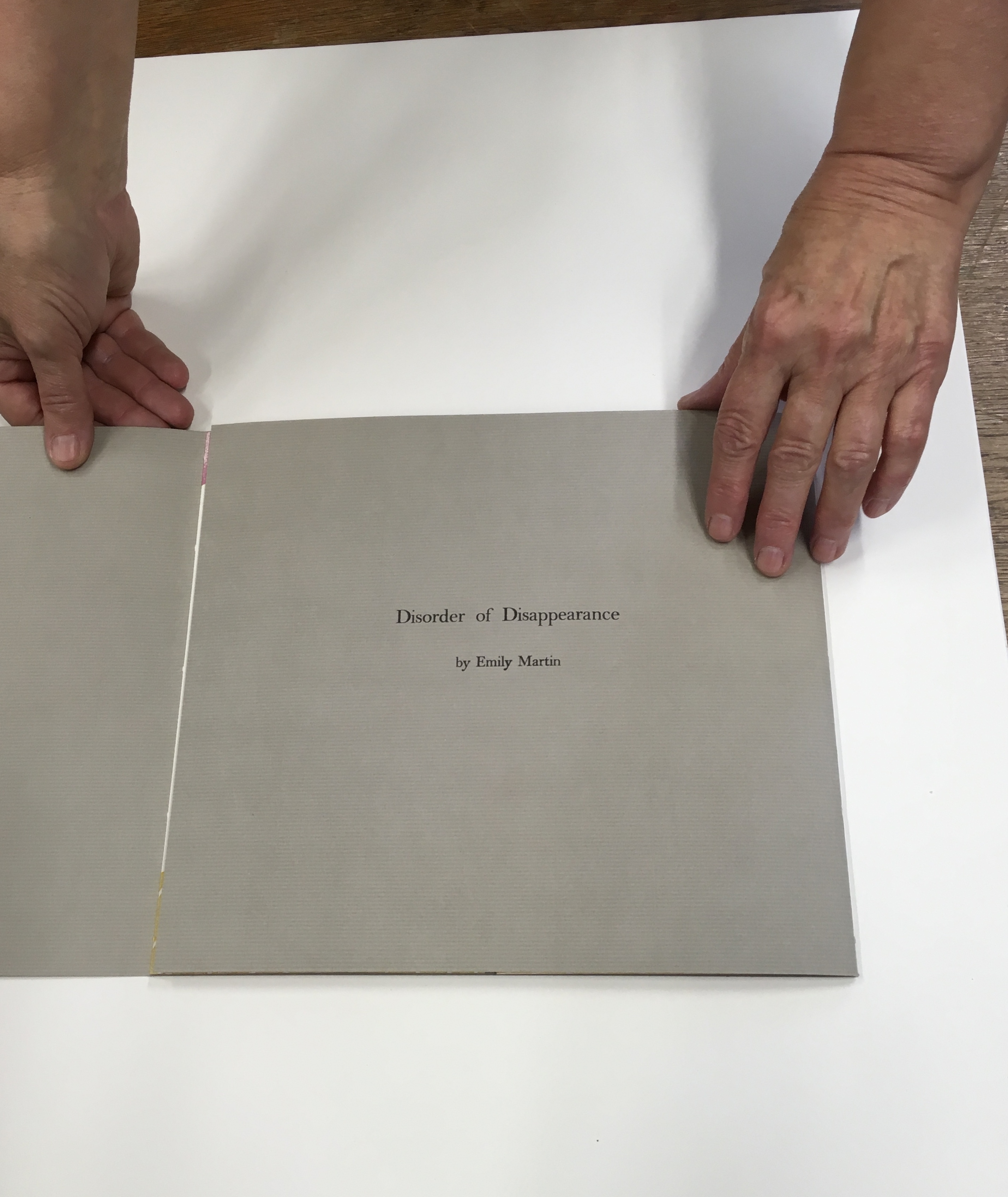
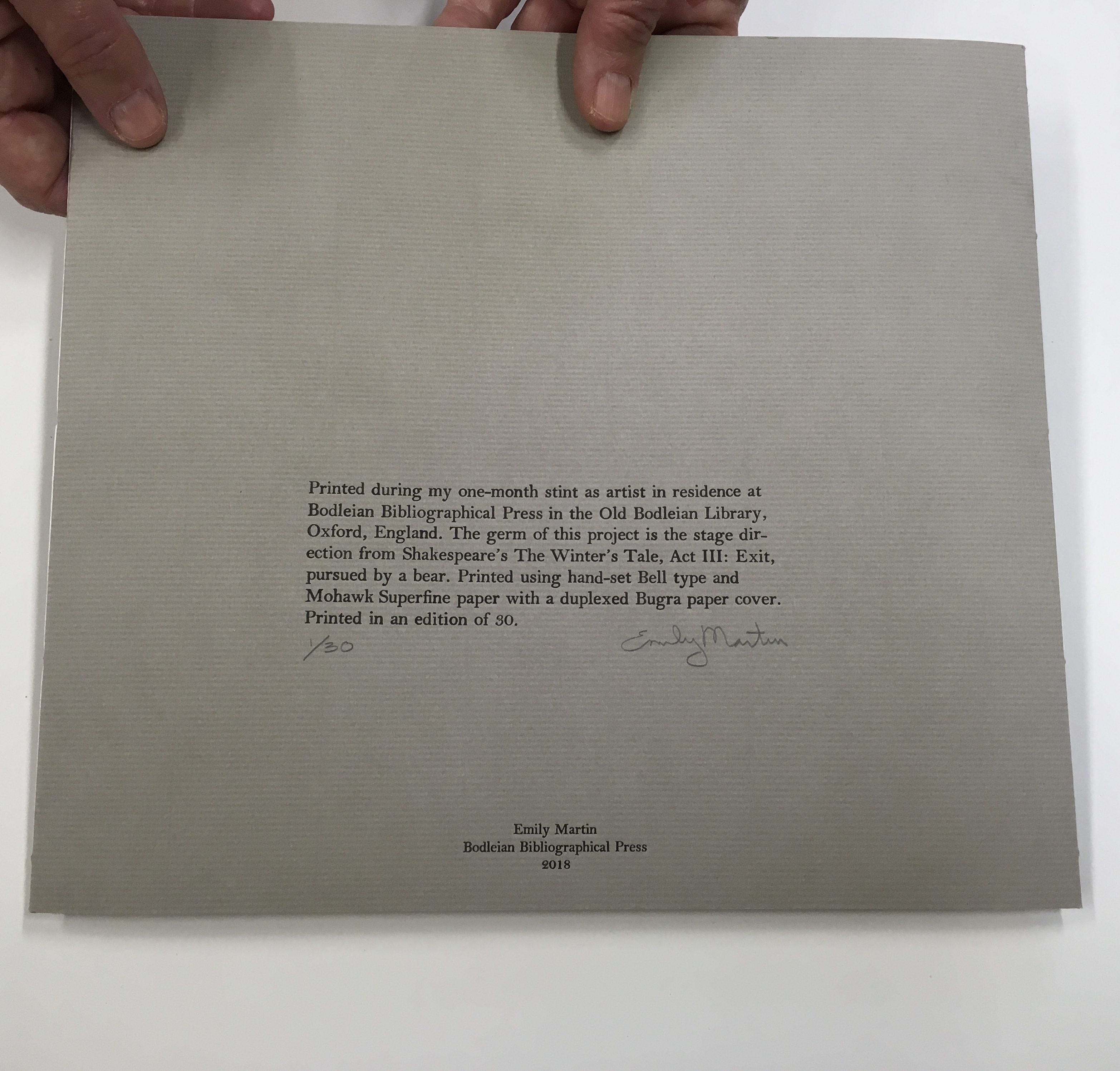
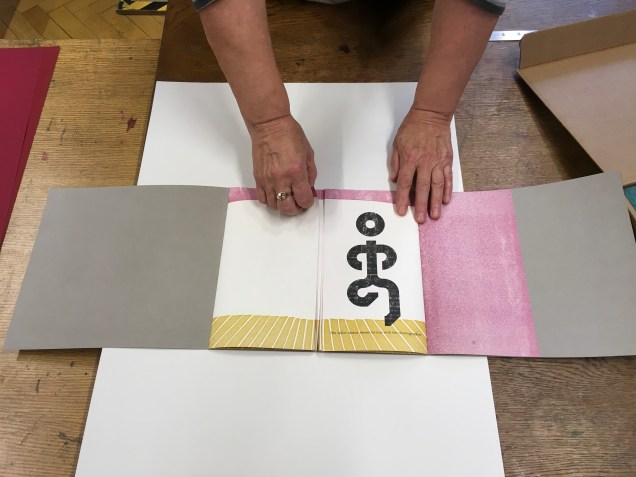
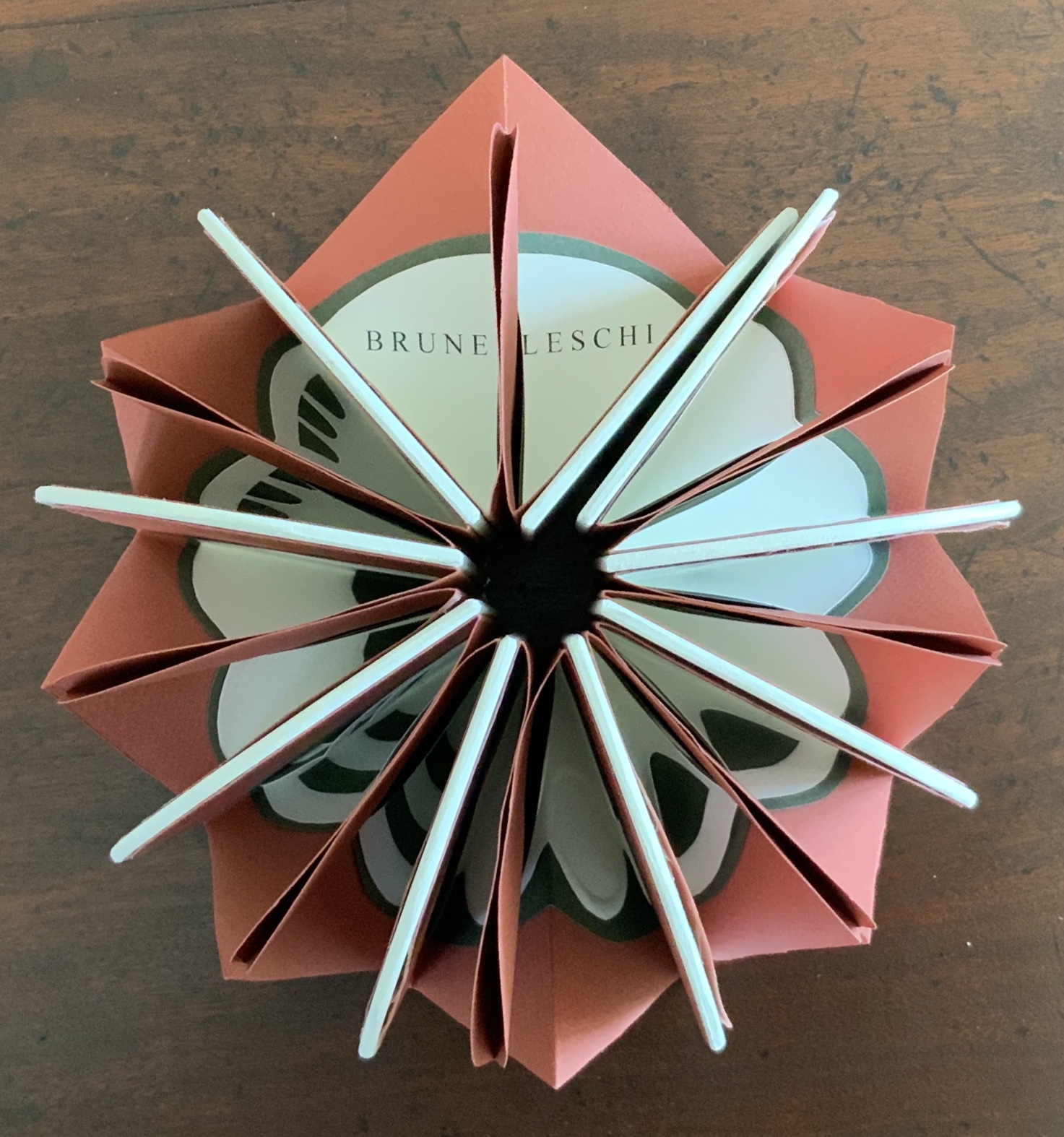
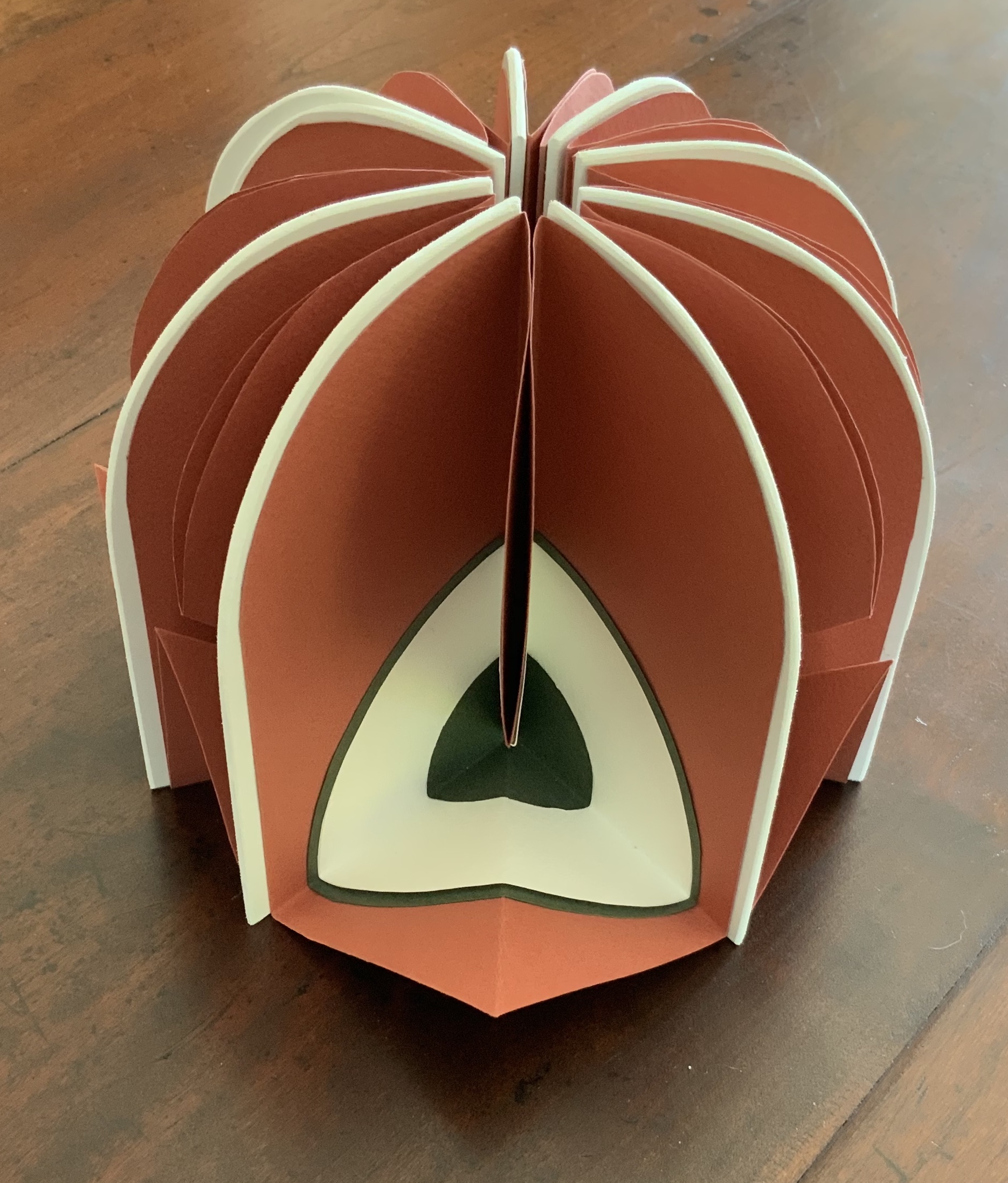
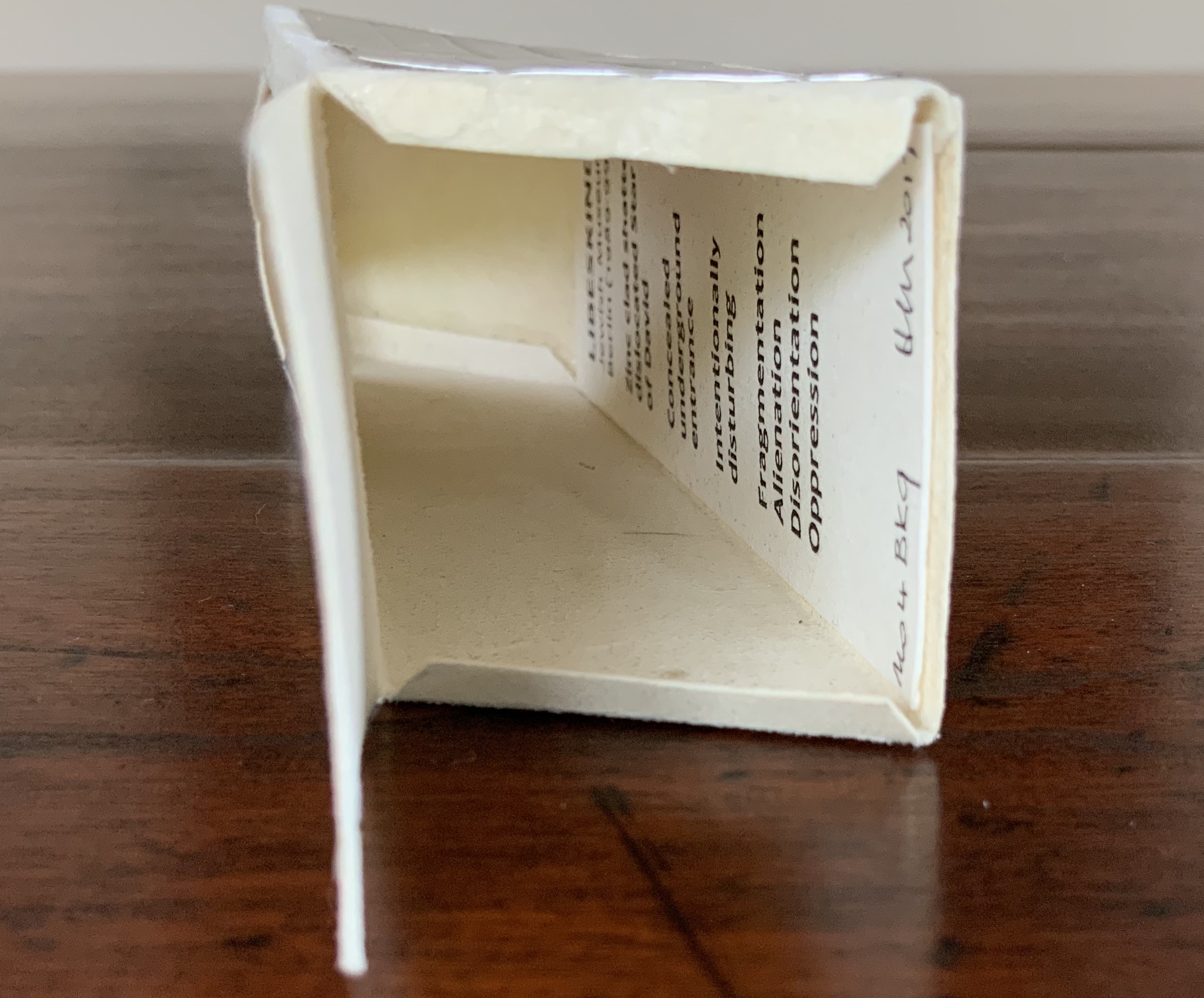
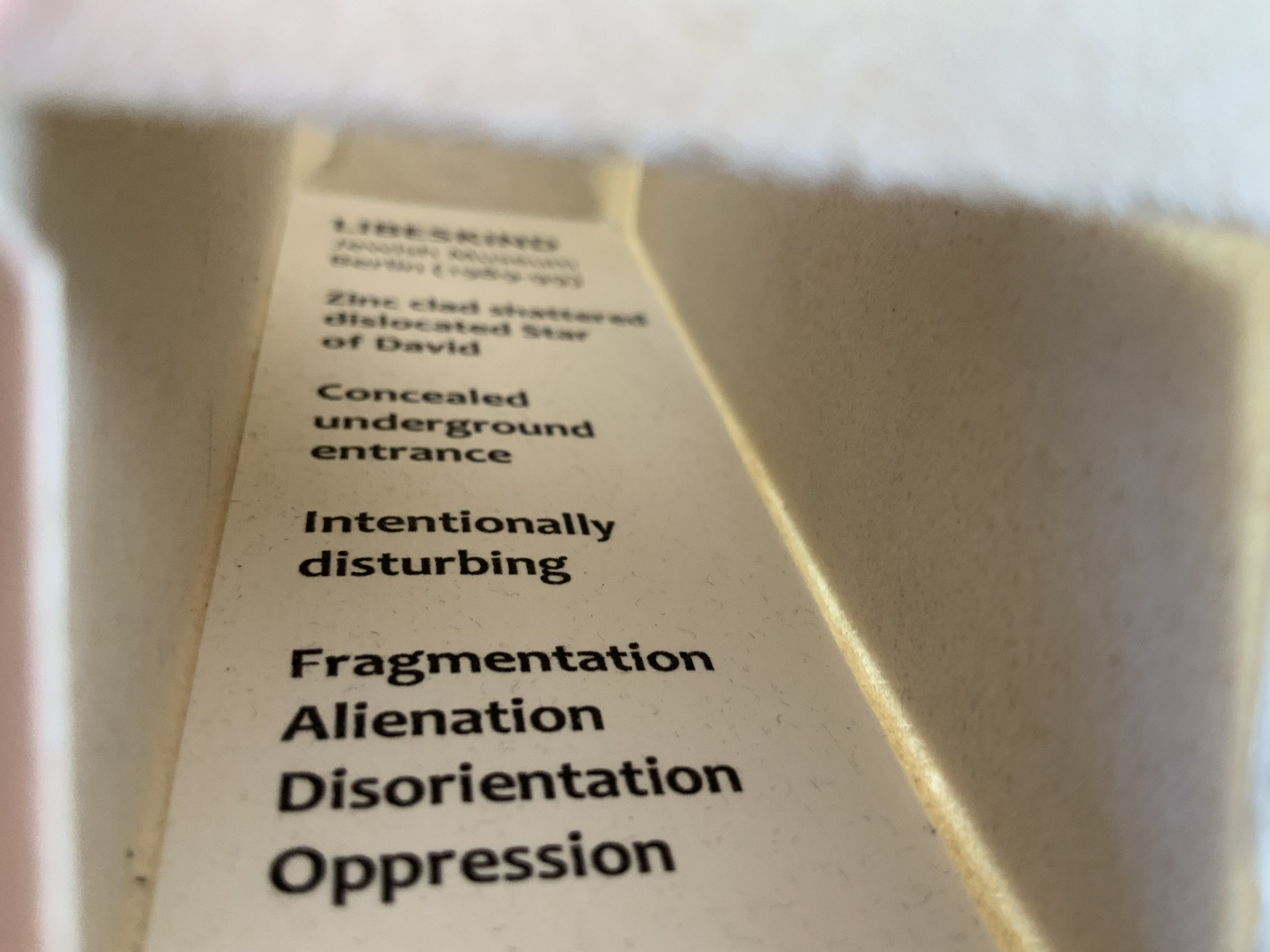
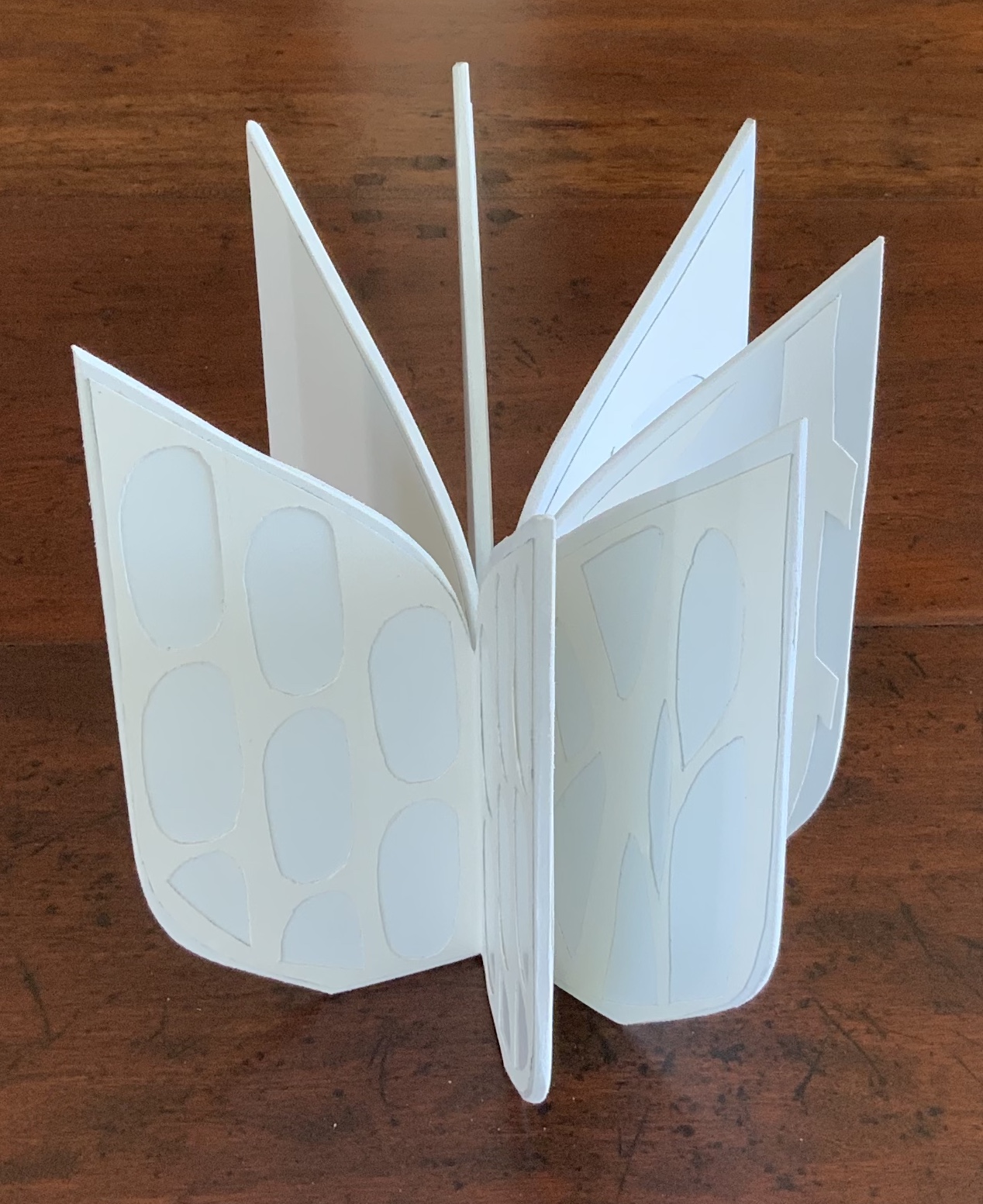
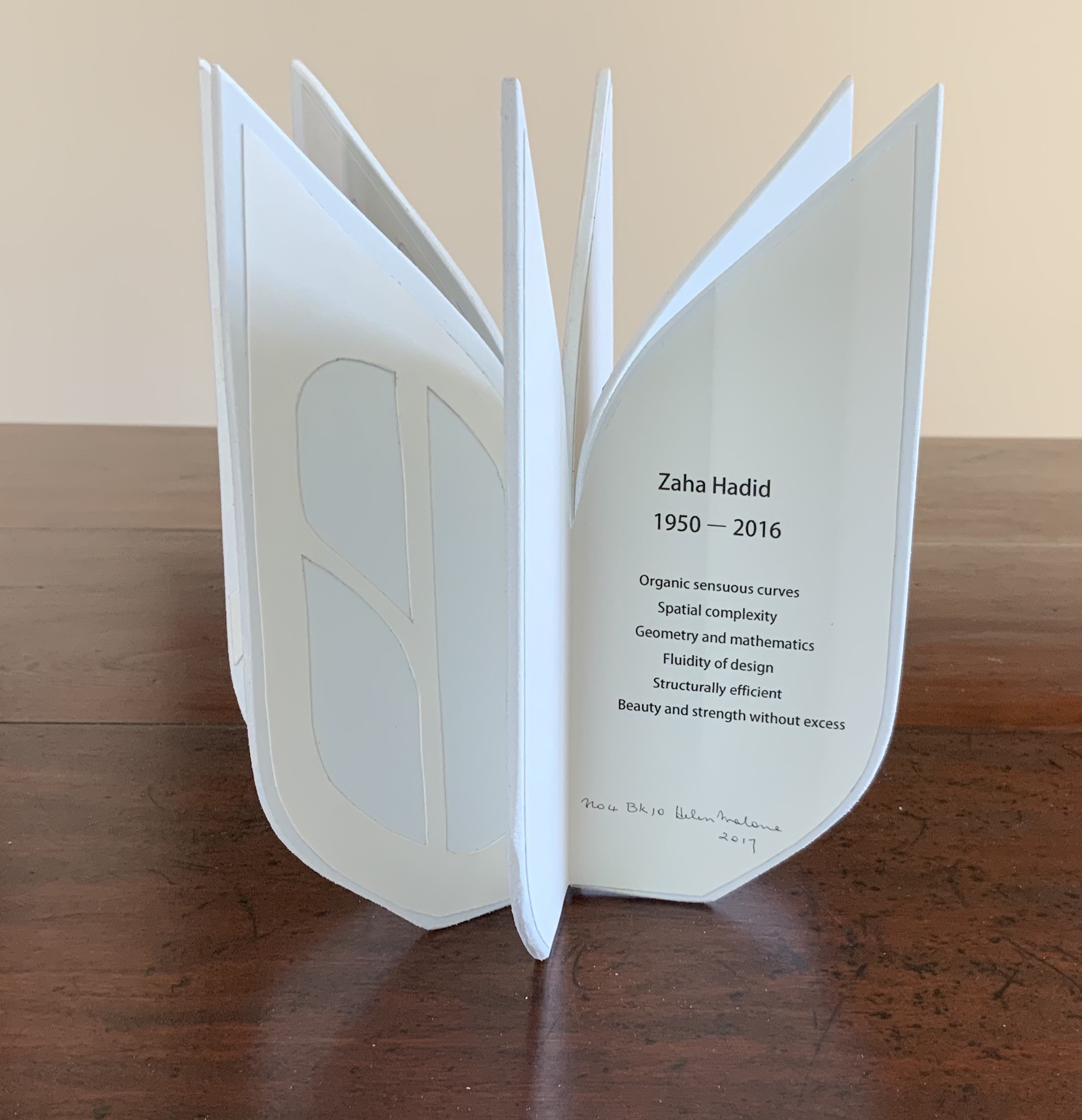
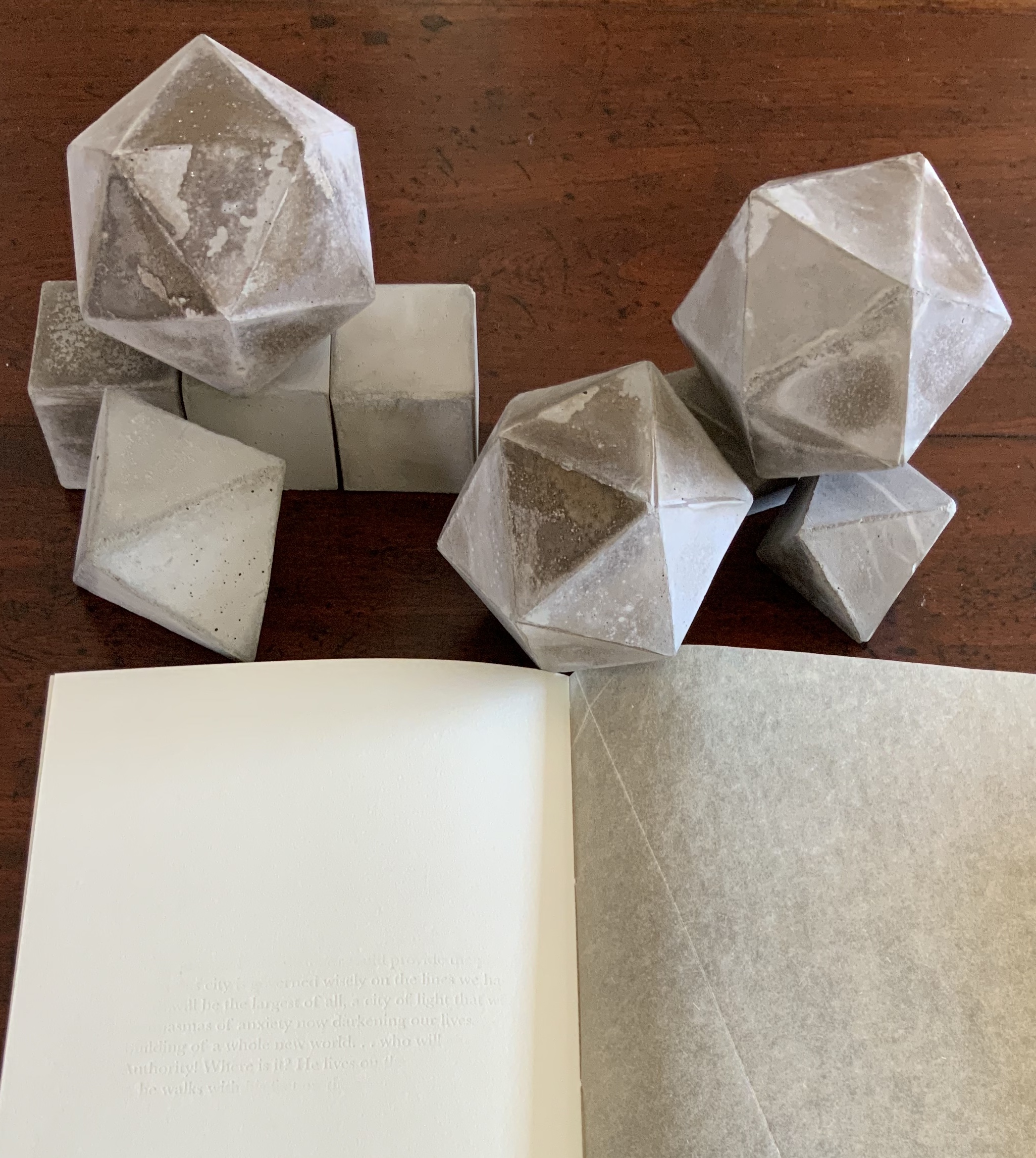
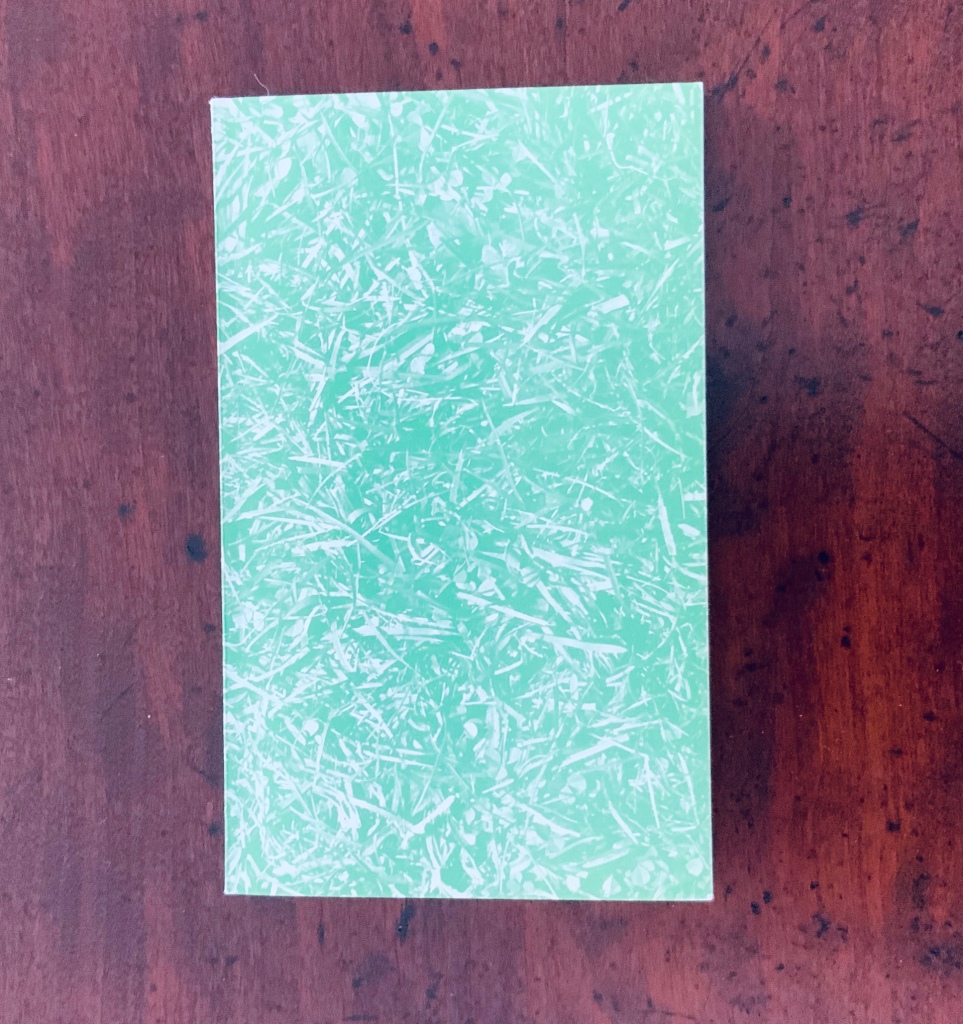
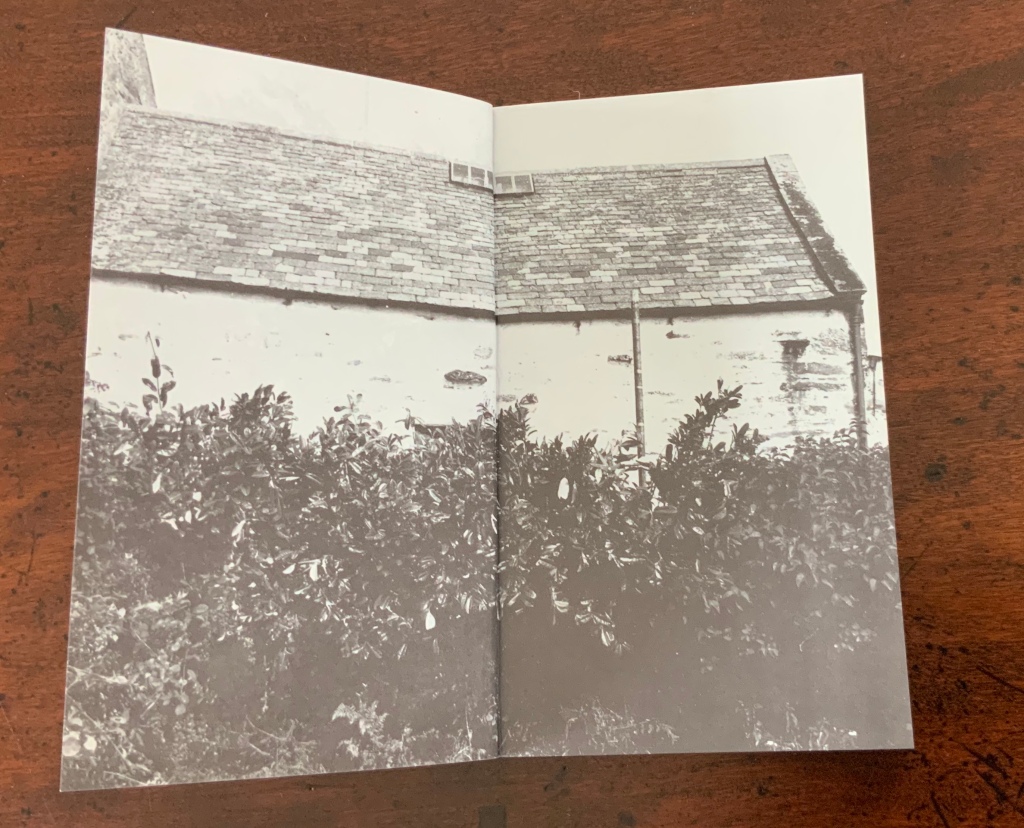
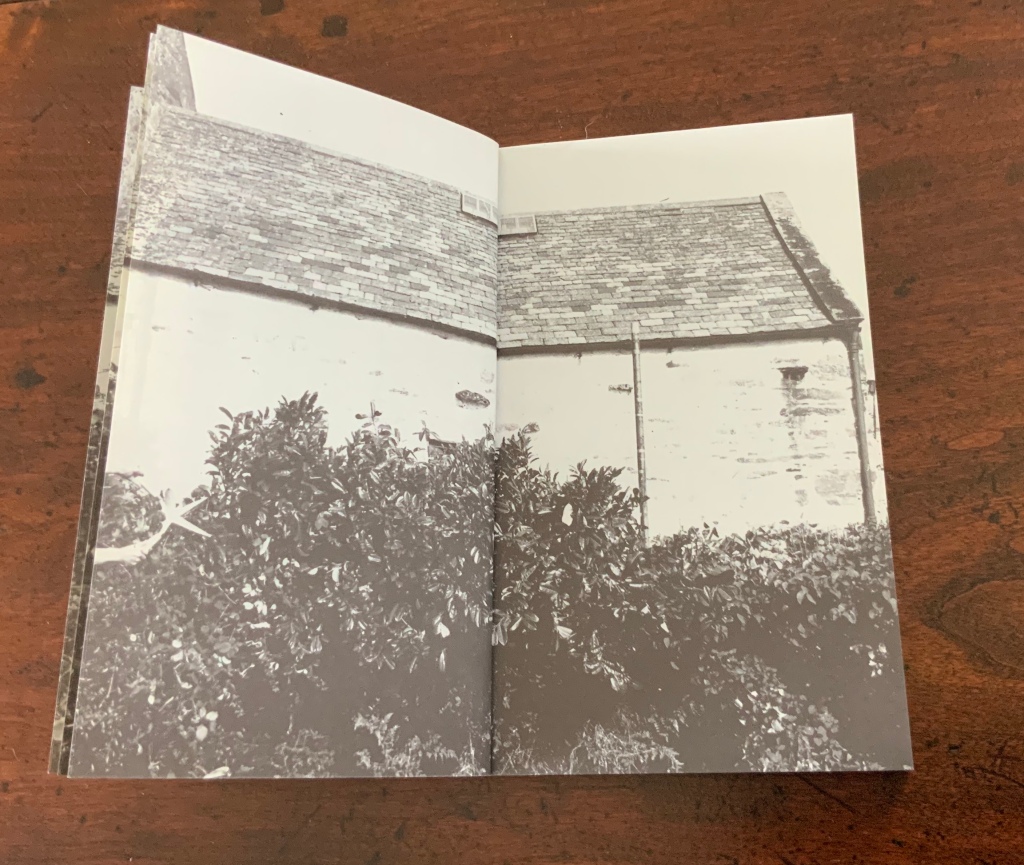
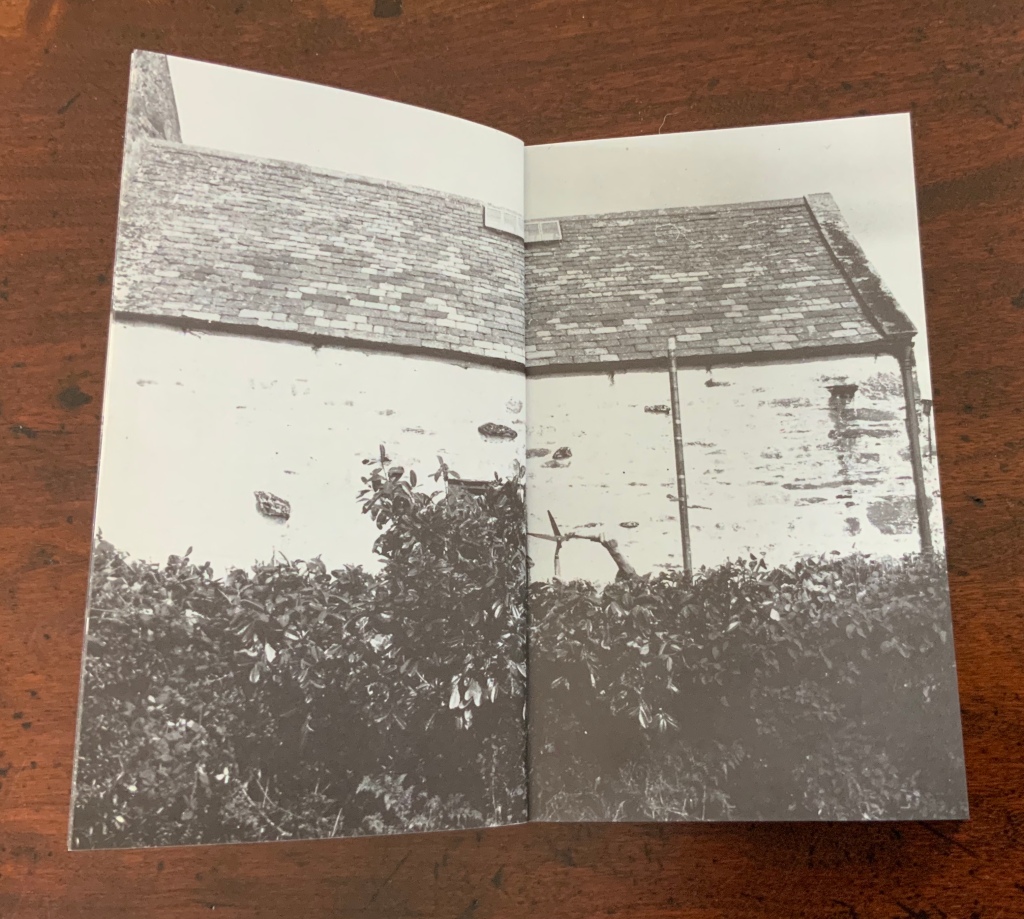
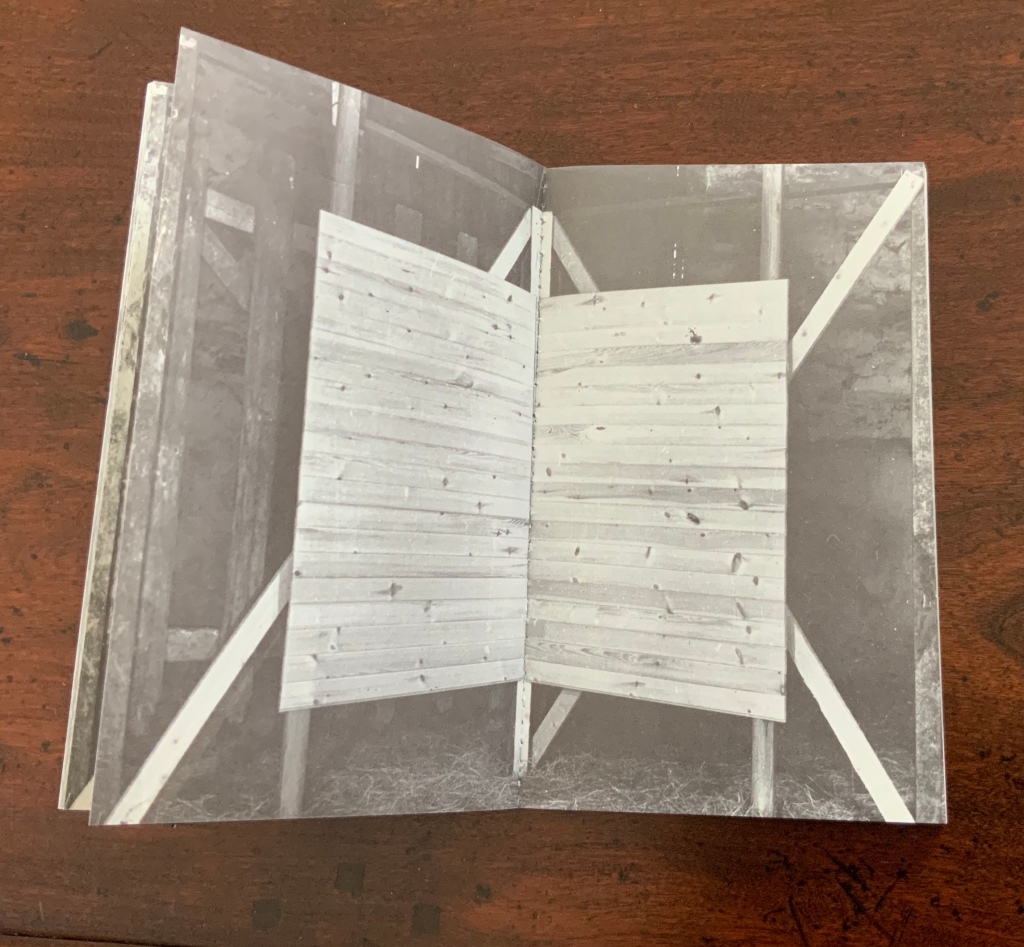
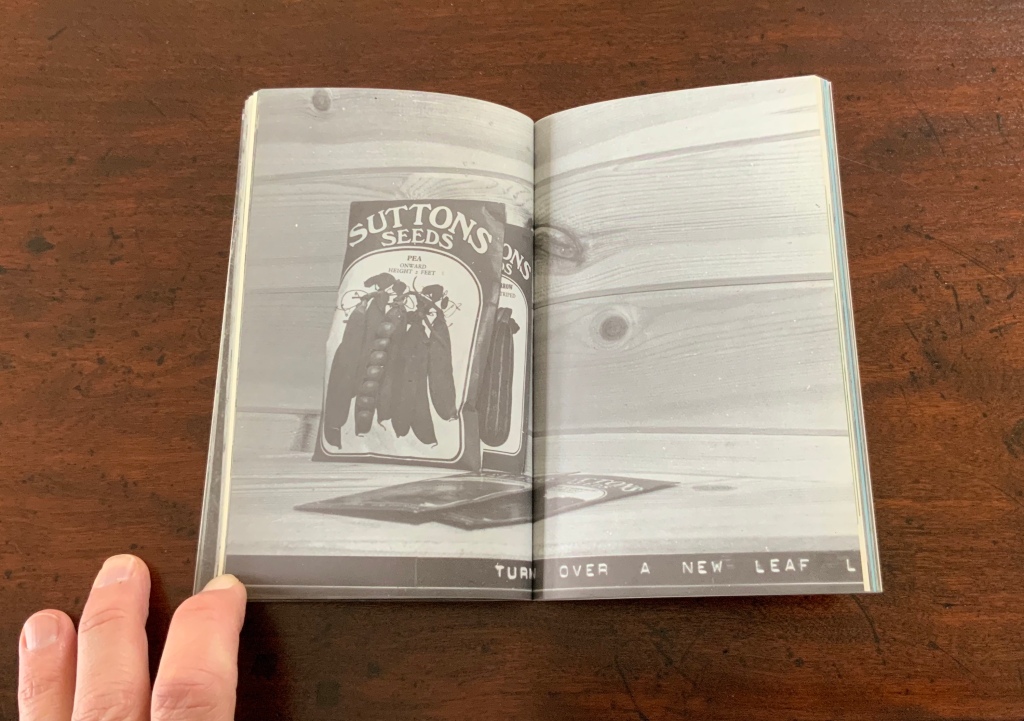
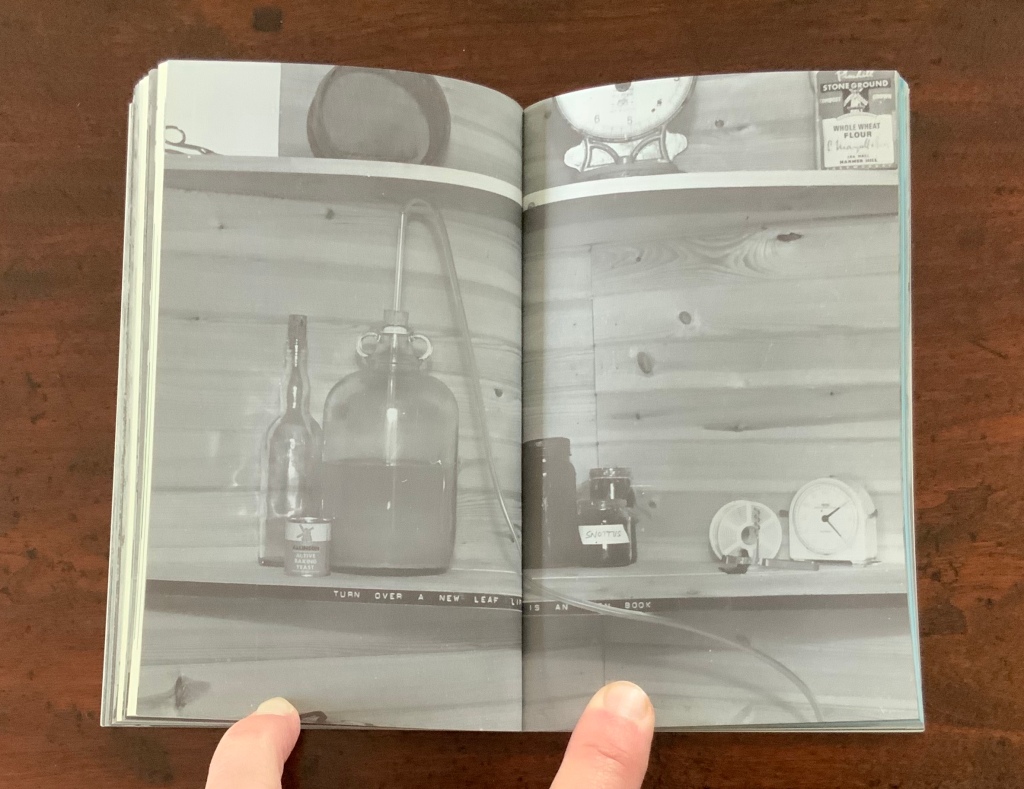
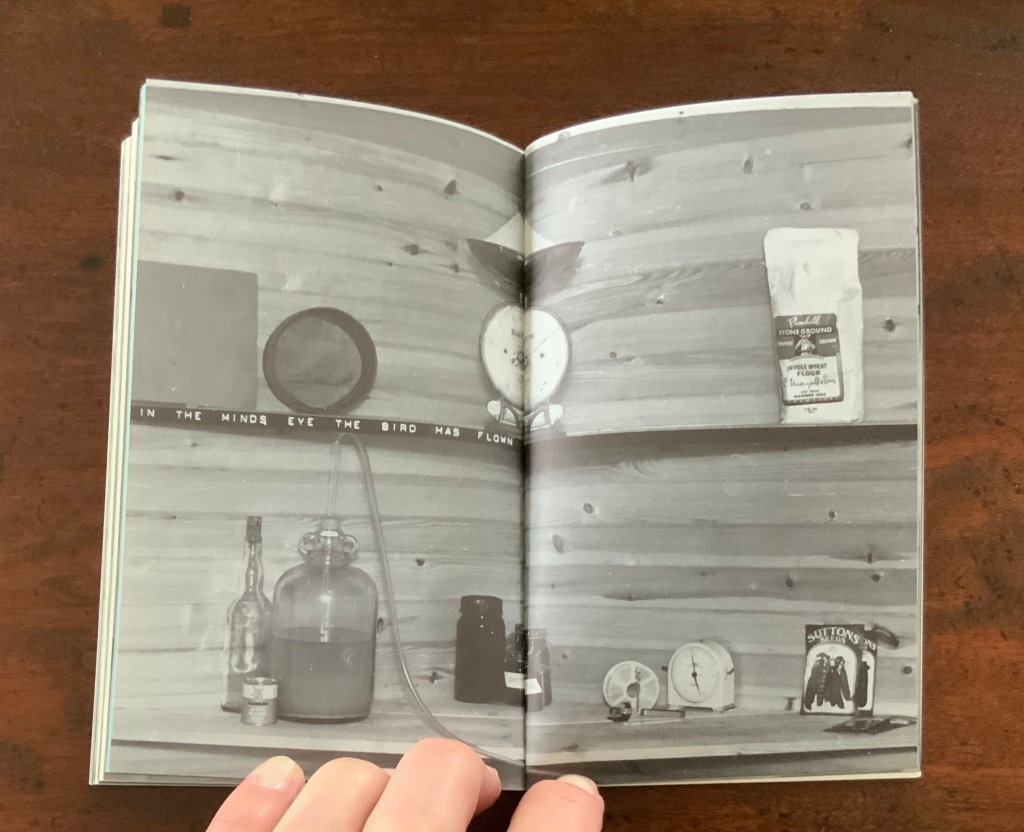
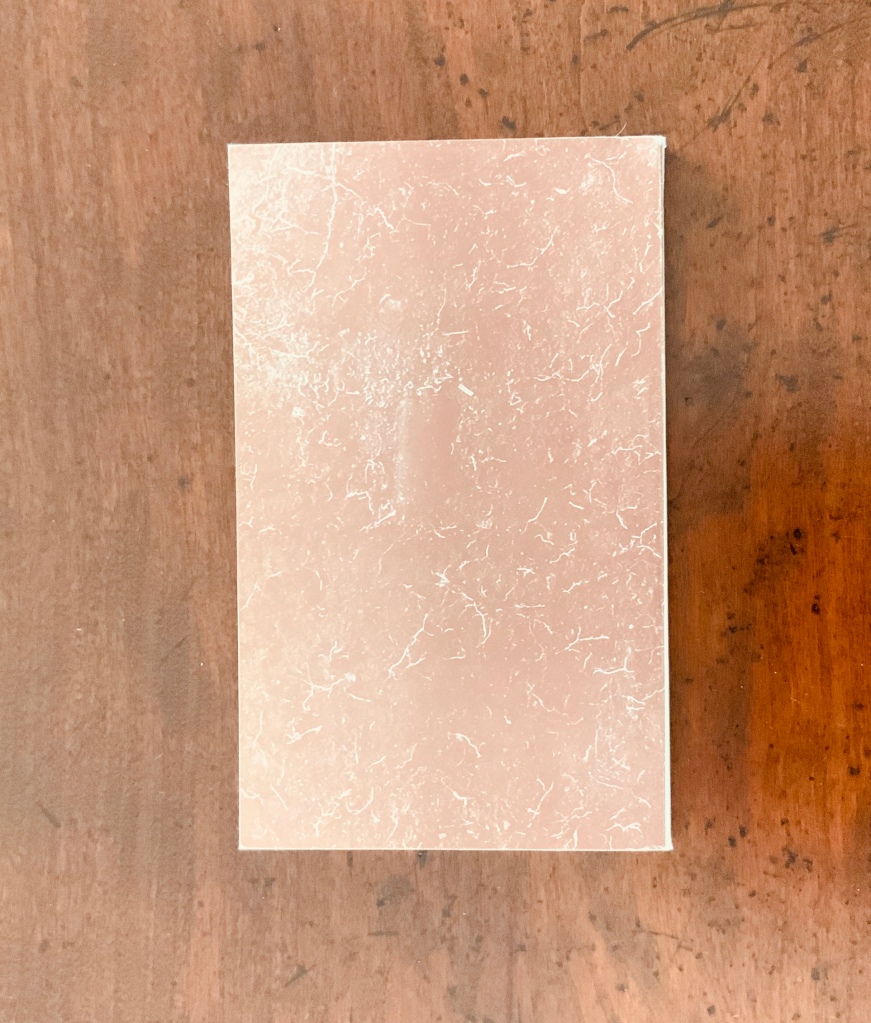
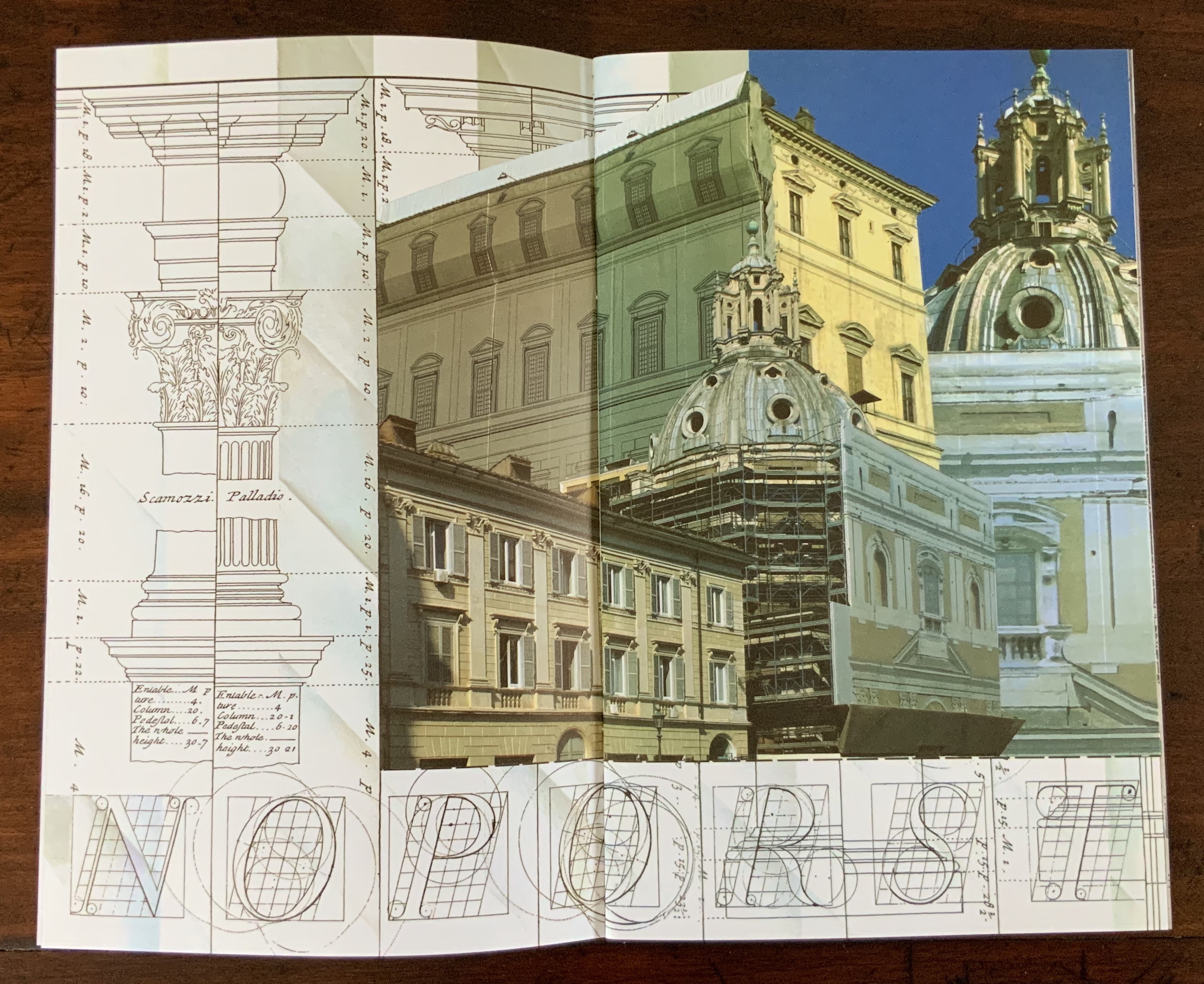
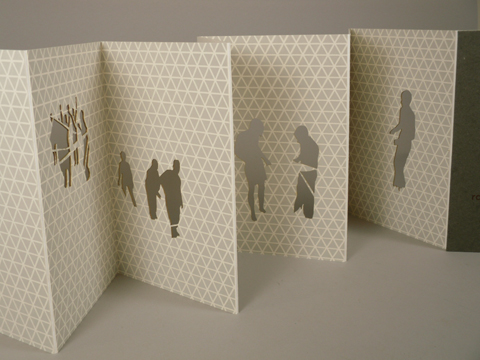
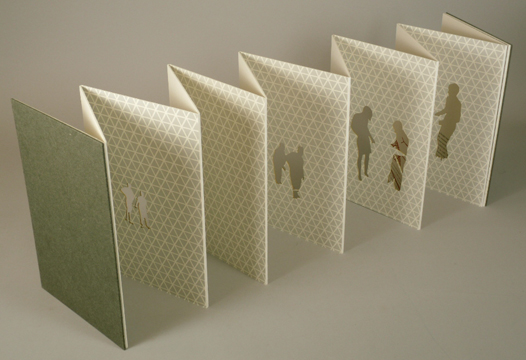
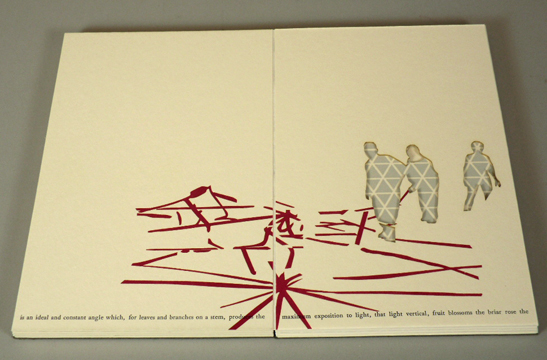
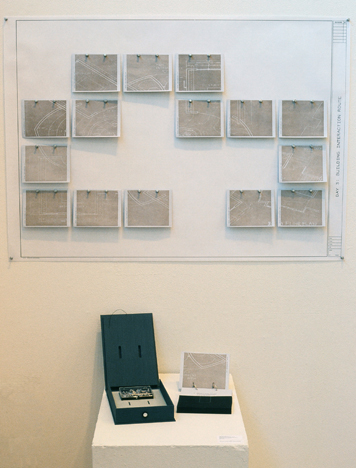
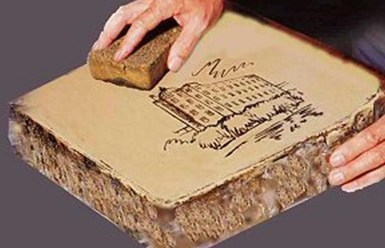
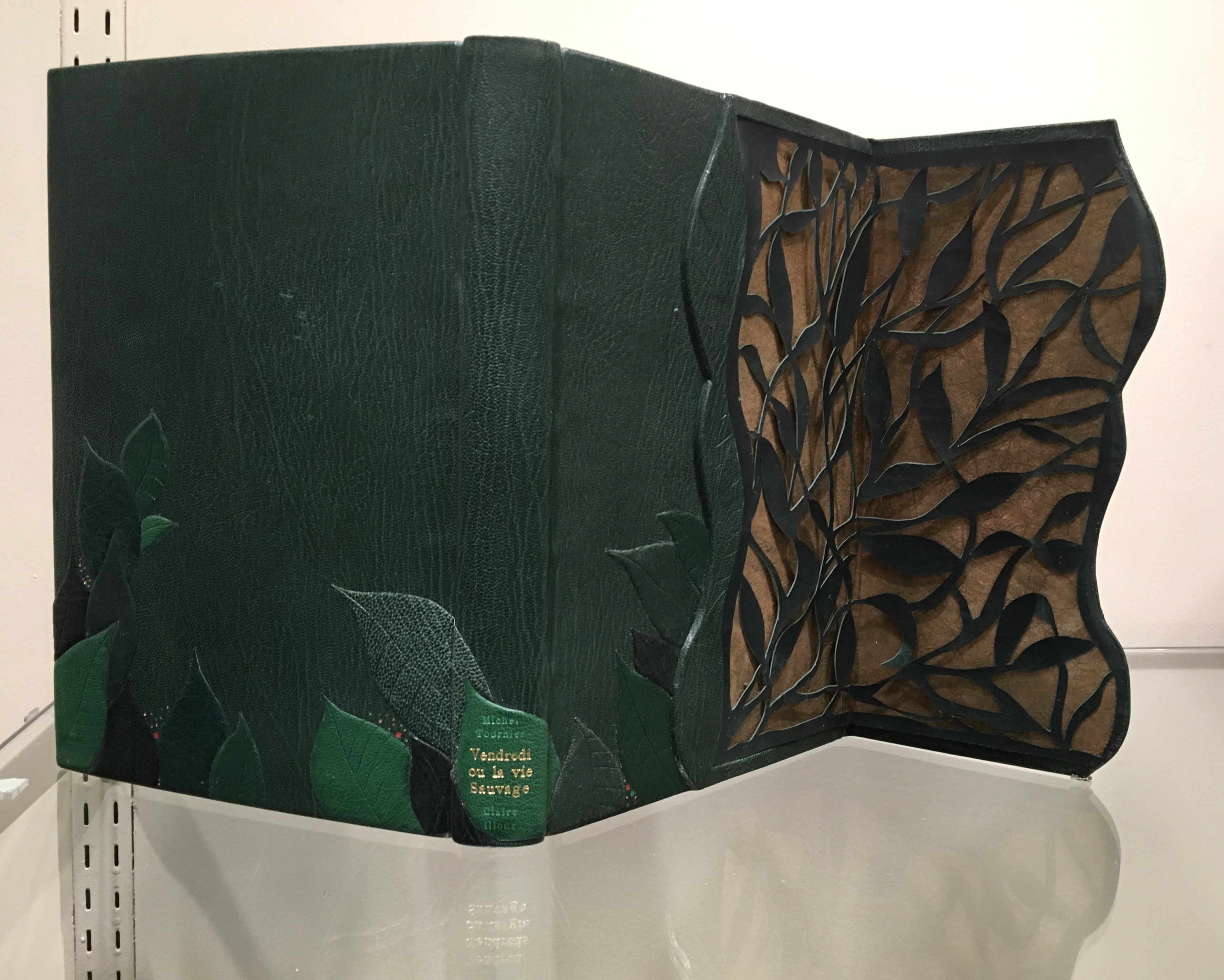
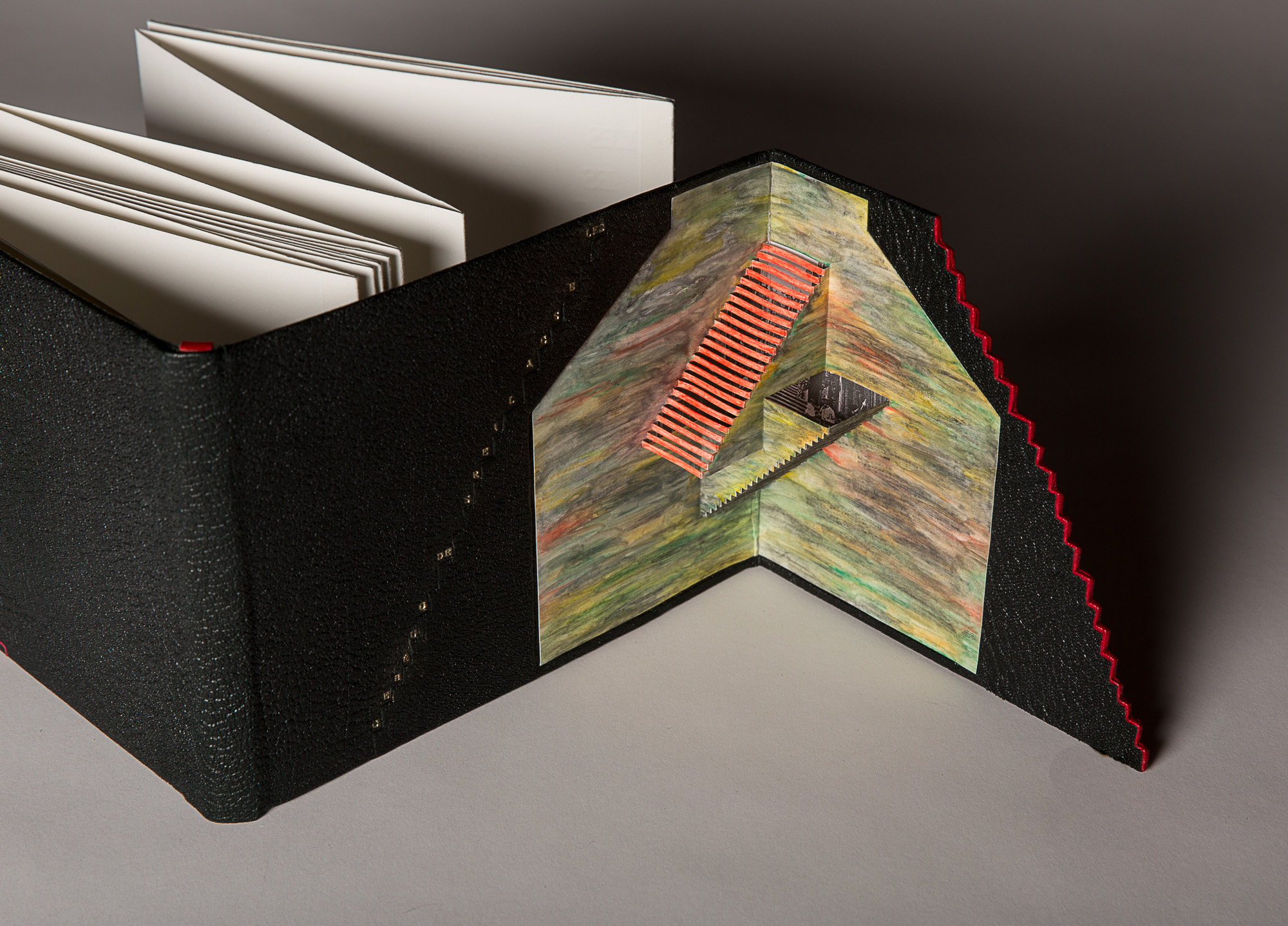
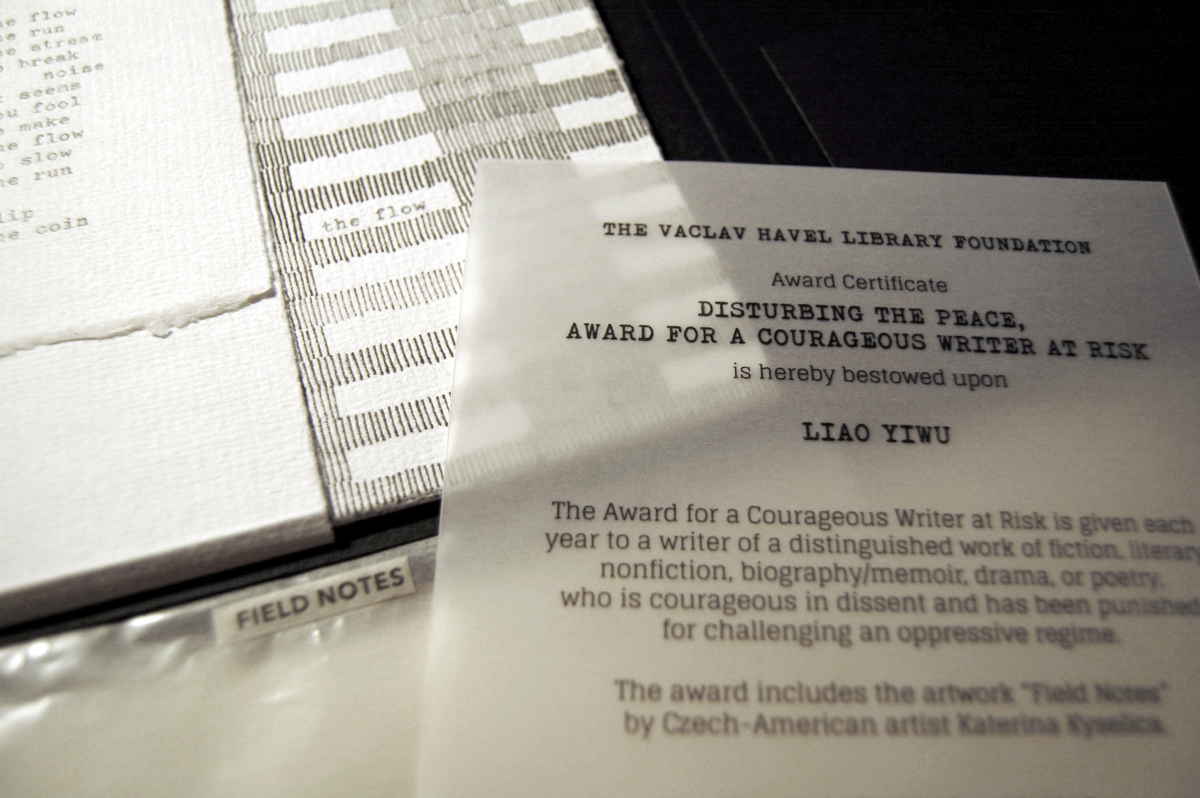
Field Notes was commissioned by the Václav Havel Library Foundation for its 2018 “Disturbing the Peace, Award for a Courageous Writer at Risk“, presented to the Chinese author, writer, musician and poet Liao Yiwu (aka Lao Wei) on 27 September 2018 at the Bohemian National Hall in New York. Across nine loose leaves, the typewritten words and lines of the poem are dispersed, arranged among fields of regimented rows of vertical strokes, drawn on handmade Losin paper. The drawings could represent anything: a field of grain, a tower block with windows, or marks on a prison wall to count the days. The loose format of the book allows readers to arrange the drawings or compose the text in an order as they see fit, although a colophon presents the full poem in its intended order. 

Kyselica’s website provides more views of Field Notes as well as views of her other artist’s books: American Colonies (2016), Code Red (Nicholas and Alexandra)(2016), News About Nothing (2015), 2×2 (2013) and untitled (2012).

What is striking about Kyselica’s works is how she combines a collage of book art techniques in each work to create a unified, unique effect.

Books On Books Collection — Ed Ruscha

I am wide awake when I see artist books. Here are people using actual ink on paper in the eventual age of total digital. For this reason I am retaining my hope and expectation of more books. — Ed Ruscha. Interview with Stephanie LaCava

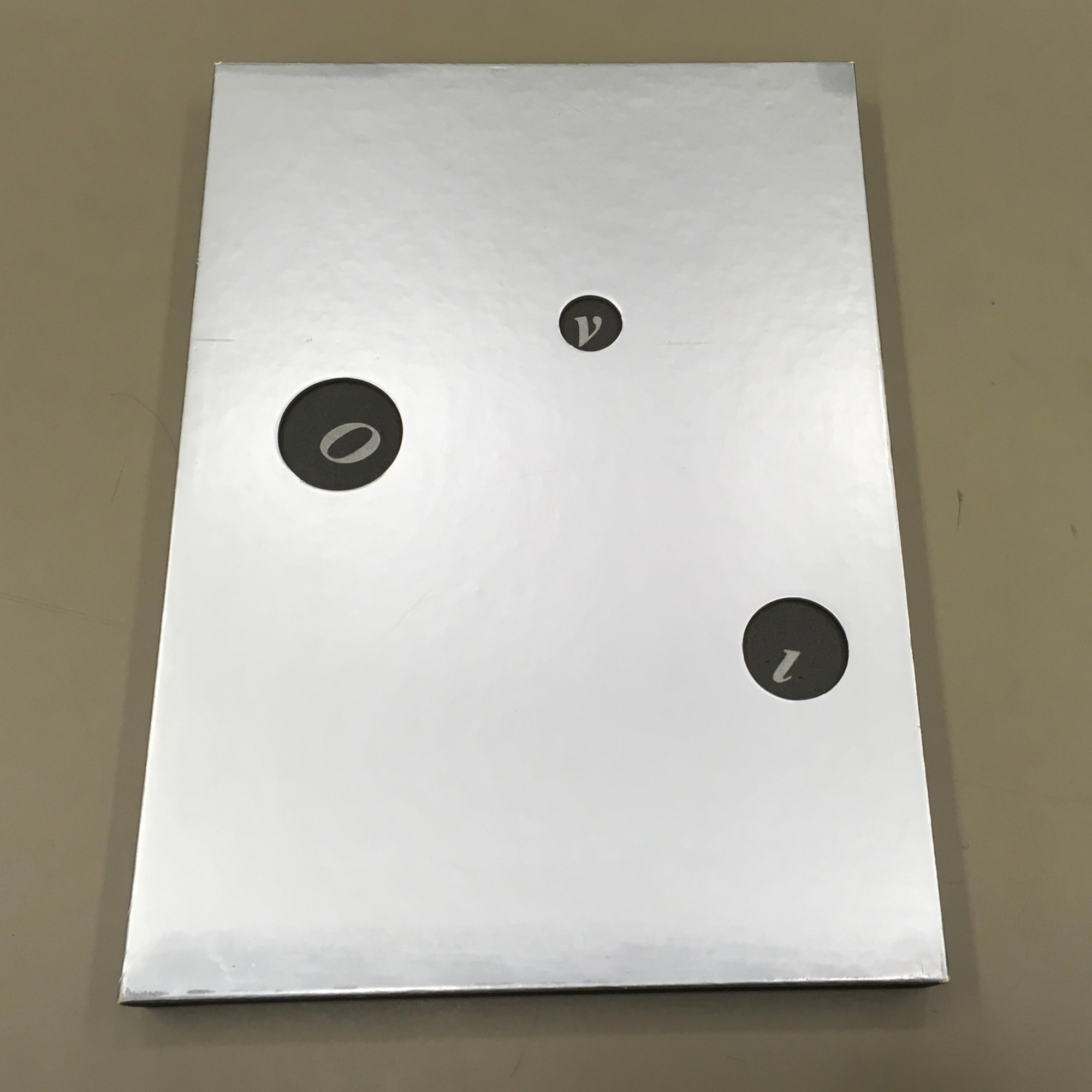
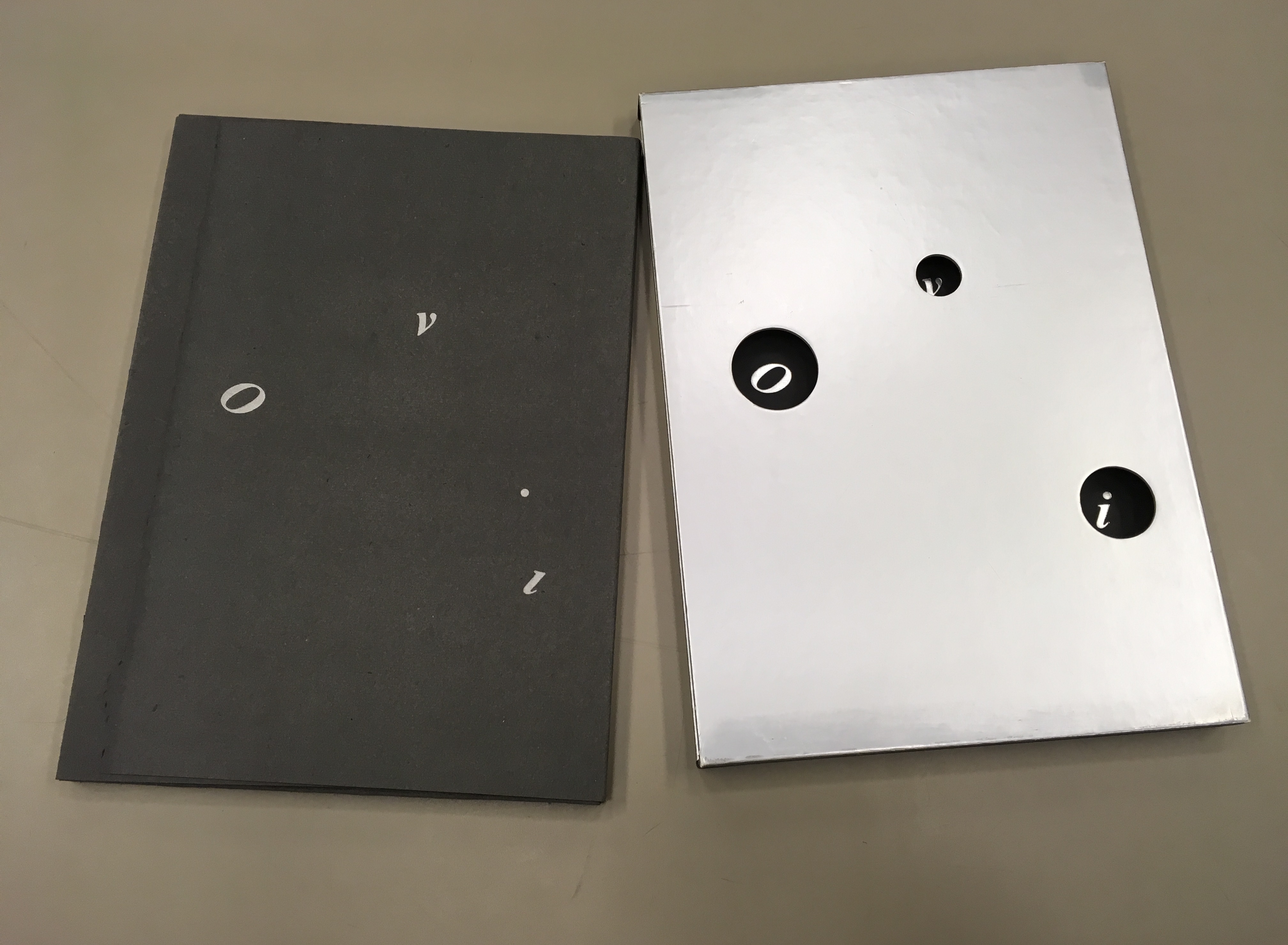
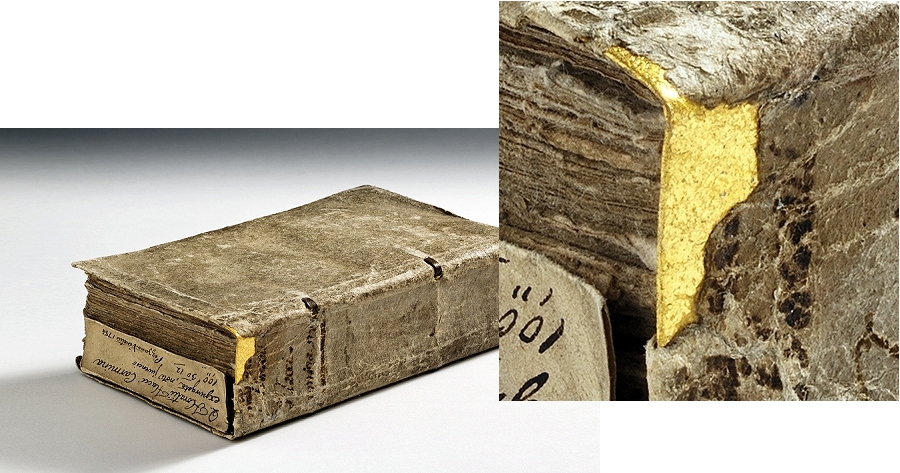
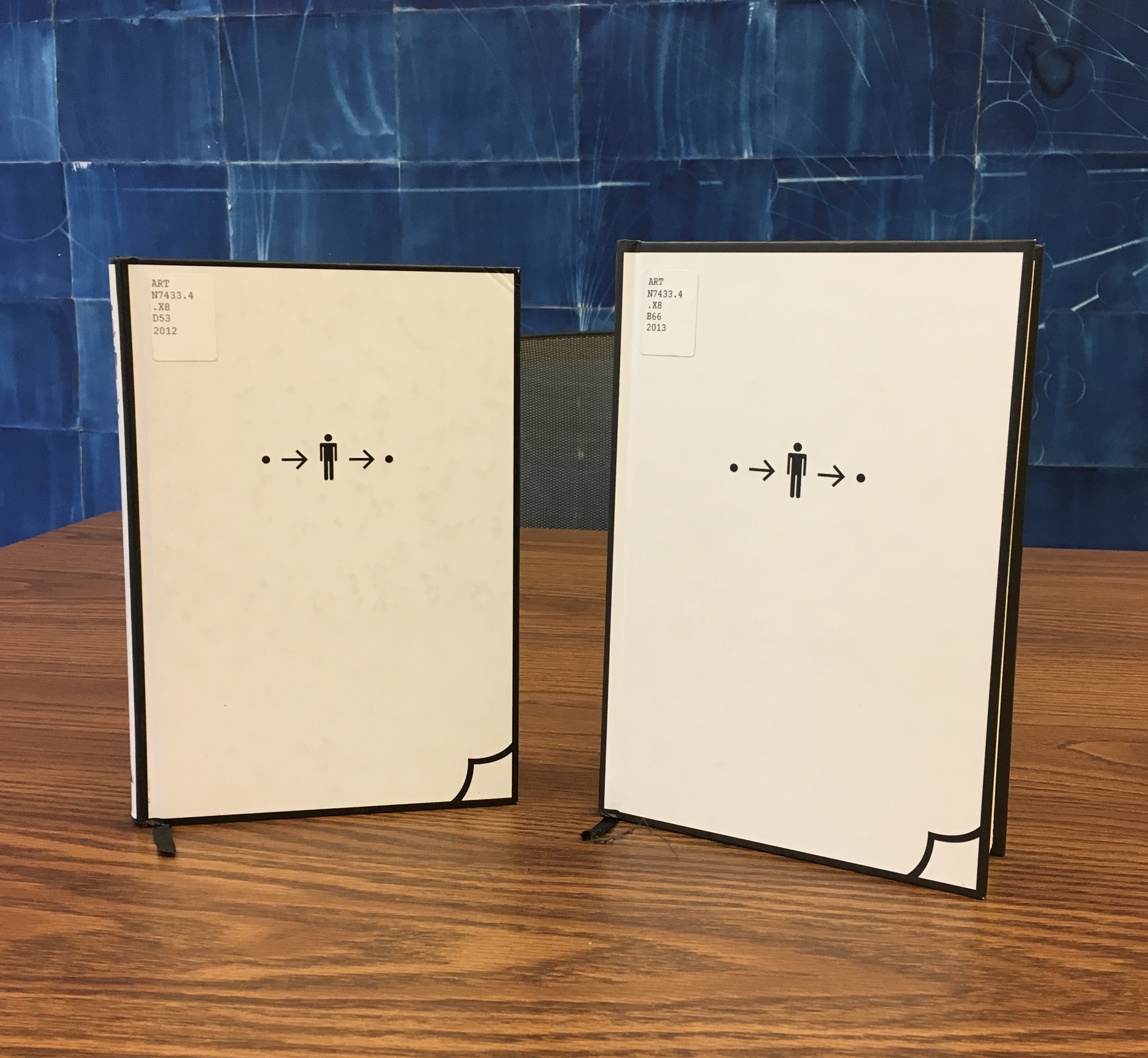
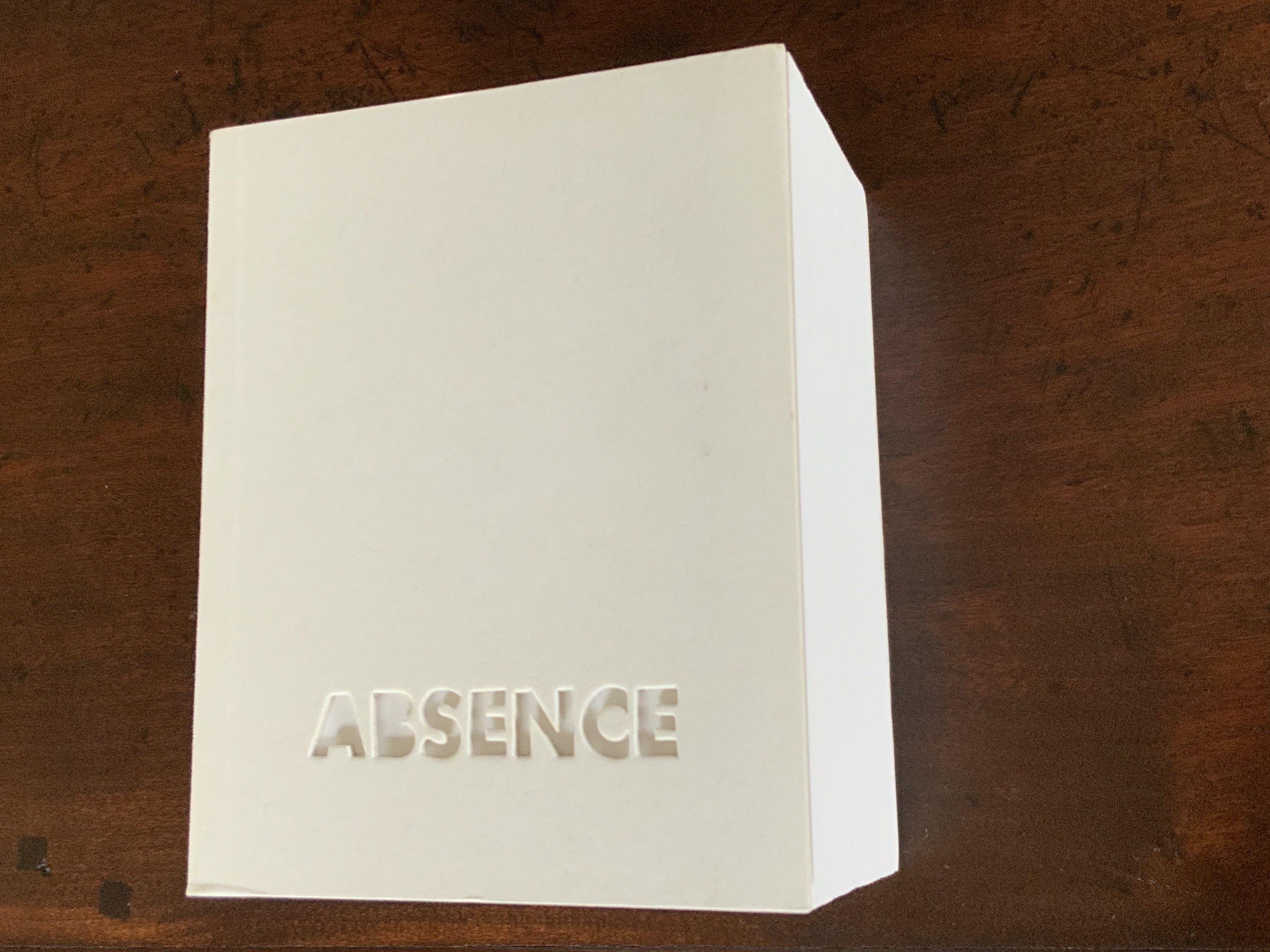
Any collection of book art must recognize the presence and contribution of Ed Ruscha’s work. For Books On Books, this has been not only a financial challenge but a thematic one. Every Building on the Sunset Strip and the elusive Dutch Details certainly speak to the collection’s representation of the accordion book structure, but so do many others in the collection. Even if one of those works in pristine condition could be afforded, it would not be the most satisfactory way of recognizing Ruscha’s work in this collection. For Ruschavian reasons, OH/NO (2008) scratches that itch.

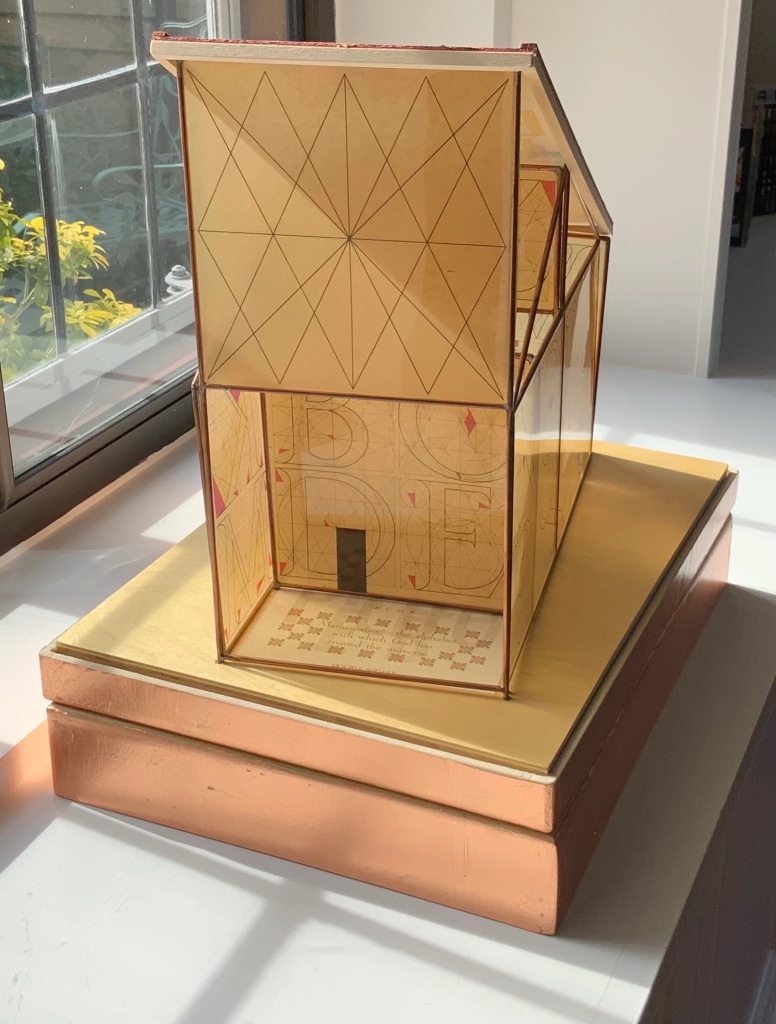
OH/NO (2008)

OH/NO (2008)
Ed Ruscha
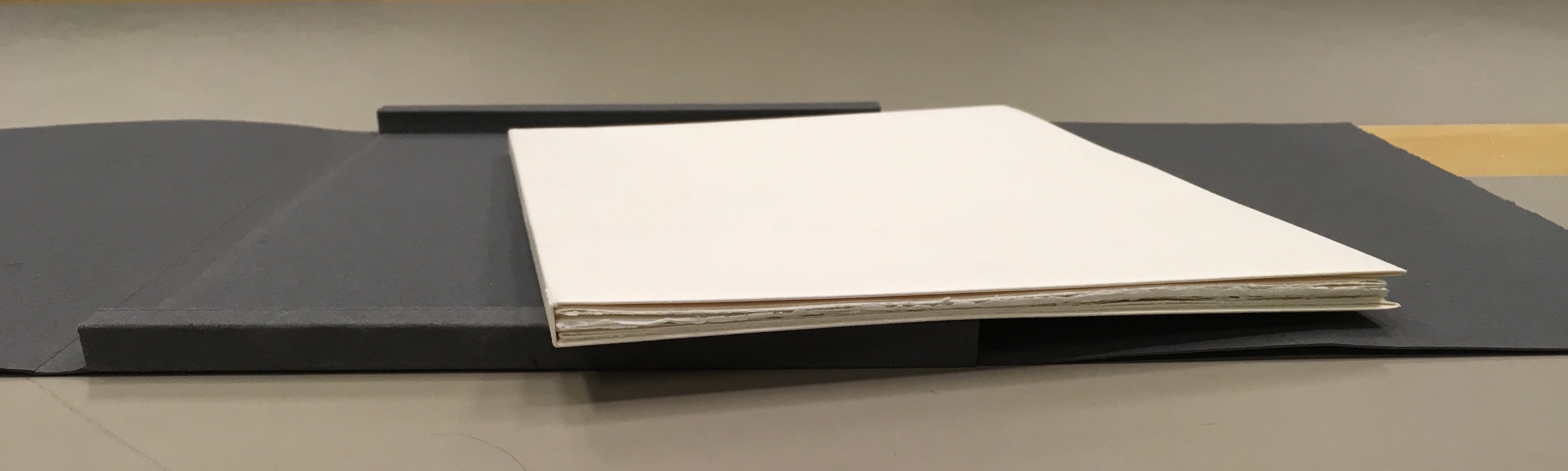
Sculptural book with silver gilt covered printed fore-edge. H5.25 x W7.25 x D2.25 in. Acquired from Hess Fine Art, 14 November 2020. Photos: Courtesy of the gallery.

In an interview in Artforum in 1965, Ed Ruscha commented, “What I am after is … a mass-produced product … none of the nuances of the hand-made and crafted limited edition book”. Well, here is OH/NO, clearly not a hand-crafted work, but nevertheless a limited edition and signed by the artist. It is a tongue-in-cheek machine-produced, if not mass-produced, product. Production and structure draw all attention to an element peculiar to the codex – its fore-edge. It applies printing in the place of hand-crafted fore-edge painting, and the interior is blank. Here is Ruscha applying his deadpan approach to a physical aspect of the book not addressed by those more famous accordion works.

OH/NO is not Ruscha’s first foray into fore-edge printing. In 2002, there was Me and The. Neither work extends the technique per se, but unlike their historical predecessors, Ruscha’s two works, whose pages are otherwise blank, focus entirely on the fore-edge of the book form and depend on its interaction with facetious text.

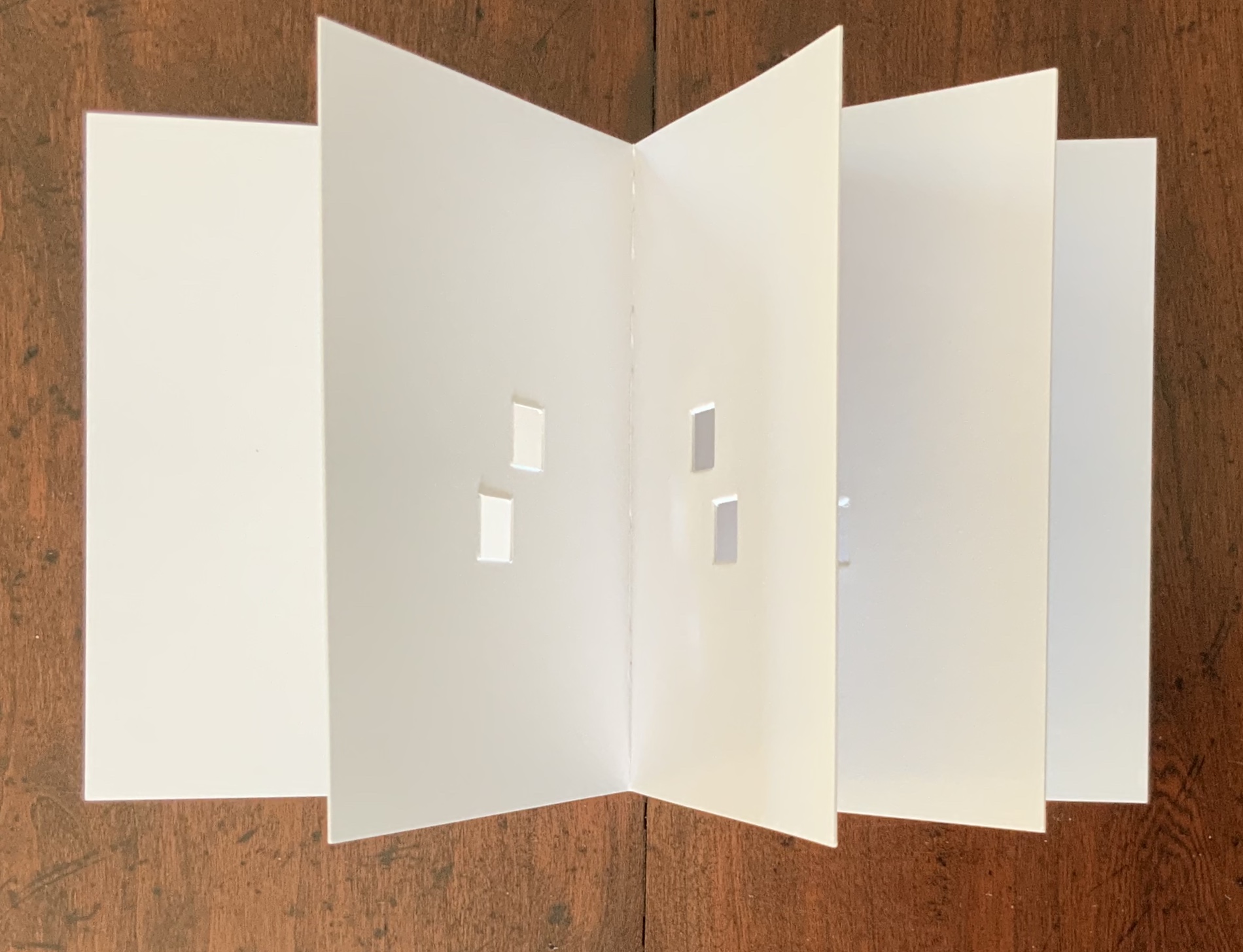
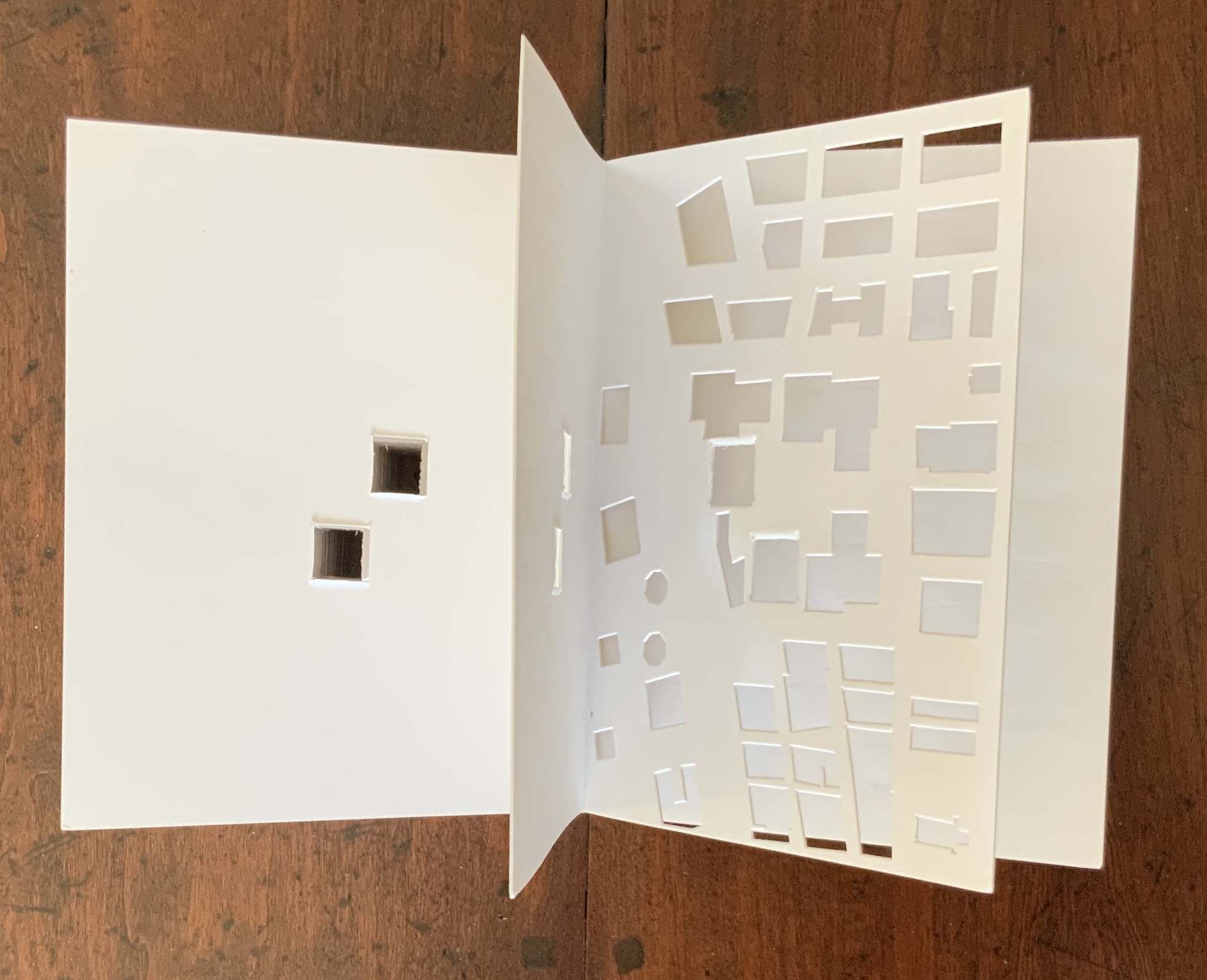
OH/NO provides a distinctive “other end of the spectrum” to Ximena Pérez Grobet’s Around the Corner (2020). Other than its title, Around the Corner is textless. By progressively manipulating images across all of the book structure’s planes, Pérez Grobet makes a sculpture out of the relationship of the fore-edge to the rest of the book. With OH/NO and Around the Corner side by side, we have a useful and satisfying point of comparison and contrast for considering the breadth of artists’ books.

Around the Corner (2020)
Ximena Pérez Grobet
Japanese bound in slip case open at both ends. H200 x W175 x D70 mm. Edition of 20, of which this is # 2. Acquired from the artist, 1 December 2020. Photos: Books On Books Collection.

Another aspect of artists’ books and Ruscha’s work that OH/NO addresses is production by a third party. As he happily acknowledges, not all of his photographic works are of his own hand, and production is often handed over to a third party. In the various histories and commentary on book art, though, those early works like Every Building on the Sunset Strip are heralded for their cheap one-man-band, democratic production values. But listen to Ruscha himself in the video below about Every Building, and it is clear that the concept of his artist’s books does not lie in their production. OH/NO‘s high production values could not be further from Every Building‘s. Look instead to the interaction of the text with the structure. Given Ruscha’s sense of humor, the title and sculptural object itself might be commenting on the studio approach of high-concept artists as much as it might be on the absence of text in the pages.

Various

Even though they are not works of appropriation themselves, Every Building and Ruscha’s Various Small Fires have engendered a small industry of appropriation in book art. Various Small Fires lent itself to a Gulbenkian/Calouste exhibition’s placing it as a high-concept centerpiece “reflecting on” Bruce Naumann’s appropriation Burning Small Fires.

Display of Ed Ruscha’s Various Small Fires and Milk (1964) at “Pliure: La Part du Feu”, 2 February – 12 April 2015, Paris. Photo credit: Books On Books Collection.
Reflected in the lower left hand corner is the display of Bruce Nauman’s Burning Small Fires; in the upper right corner, the film clip of Truffaut’s 1966 Fahrenheit 451; and in the upper left, Maria Helena Vieira da Silva’s La bibliotheque en feu (1974).

There is even an entire book devoted to the appropriation of Ruscha’s works.

Various Small Books : Referencing Various Small Books by Ed Ruscha (2013) 
Edited by Jeffrey T. Brouws, Wendy Burton, and Hermann Zschiegner
Casebound, printed cloth over boards. H236 x W160 mm. 288 pages.
Photos: Books On Books Collection

Beyond this brilliant collection of examples and commentary, additional appropriative works have appeared — so many that a second edition may be required.

Various Versions (2015)
Guy Bigland
Perfect bound soft cover. H190 x W190 mm. [158] pages. Acquired from the artist, 12 October 2023.
Photos: Books On Books Collection.
Various Small Dicks (2013)
Hubert Kretschmer
Saddle stitched booklet. H149 x W105 mm. [8] pages. Acquired from the artist, 11 July 2019.
Photo: Books On Books Collection.

It is fun to place OH/NO as an expression of mock horror in response to all that.

Further Reading/Viewing

Fore-edge Printing and Painting: Book Art and the Book Arts Revealed“. 12 May 2013. Bookmarking Book Art.
Guy Bigland“. 31 August 2023. Books On Books Collection. Updated 8 November 2024.

Hubert Kretschmer“. 7 November 2024. Books On Books Collection.

Ximena Pérez Grobet“. 7 July 2021. Books On Books Collection.

Cain, Abigail. 27 September 2018. “Unpacking Ed Ruscha“, Aperture. This is Cain’s review of the Harry Ransom Center’s 2018 exhibition Ed Ruscha: Archaeology and Romance, which used 150 displayed items to focus on 16 of Ruscha’s books. It contextualizes Various Small Fires neatly. Quoting the Center’s photography curator Jessica S. Macdonald, Cain writes: “… lack of artistry is one of the hallmarks of Ruscha’s artist books. ‘The photographs of gas stations are bad photographs on purpose,’ McDonald noted. ‘He’s trying to do the opposite of what a photographer trying to make an artistic photograph would be doing.’ In a 1965 Artforum interview concerning his second book, Various Small Fires and Milk (1964), Ruscha explained that it didn’t even matter to him who took the photographs. ‘In fact, one of them was taken by someone else,’ he said. ‘I went to a stock photograph place and looked for pictures of fires, there were none.'” 

Coplans, John. February 1965. “Concerning ‘Various Small Fires’: Edward Ruscha Discusses His Perplexing Publications”. Artforum. 3:5, 25.

Hoyle, Ben. 25 February 2017. “Ed Ruscha, the pop painter with ‘the coolest gaze in American art’“. The Times. London. Ben Hoyle’s easygoing interview with Ed Ruscha introduces his work as the heart of the British Museum’s exhibition “The American Dream: pop to the present” (9 March 9 to 18 June 2017).  That is a bold assertion as the show included Claes Oldenburg, Jasper Johns, Andy Warhol, Roy Lichtenstein, Cy Twombly, Louise Bourgeois, Robert Rauschenberg and others recognizable to anyone who was briefly awake in a college art history class — even as long ago as the 70s. But, back then, not so much “Ed Ruscha”. Hoyle’s article – with its paragraphs’ casual packing in of news, telling descriptive detail and sharp observations (whether his or others’) of Ruscha’s art – makes a persuasive case.   

LaCava, Stephanie. 20 February 2017. “Artist Books/Artist’s Novels (Vol. 5): Ed Ruscha”, The Believer.

Every Building on the Sunset Strip described by Ed Ruscha, courtesy of the V&A Dundee.

Giulio Maffei, Edward Ruscha's The Sunset Strip, 1966, 2015

From his series Le Vite dei Libri (The Lives of Books), Giulio Maffei provides a clever catalog entry on the Sunset Strip.

Bookmarking Book Art – Hanne Stochholm Exe

Danish artist Hanne Stochholm Exe‘s “assemblages”, which garnered first prize in the 7th International Artist’s Book Triennial Vilnius 2015, have cousins far afield — geographically and chronologically.

Remake (2015) 
Hanne Stochholm Exe
Reproduced with permission of the artist
Talks (2005) 
Hanne Stochholm Exe
Reproduced with permission of the artist
Small Talk (2005)
Hanne Stochholm Exe
Reproduced with permission of the artist

Geographically, this merging of book and metal finds common cause in the US (see Andrew Hayes’ works) and Israel (see the work of Neil Nenner and Avihai Mizrahi, represented — as is Hayes — by the Seager/Gray Gallery).

Offset (2013)
Andrew Hayes
Cover Story #4 (2017)
Neil Nenner and Avihai Mizrahi

Chronologically, the hold that books and metal have had on one another reaches far past the moveable type of Gutenberg’s Bible and Master Baegun‘s earlier Jikji.

Those metal “feet” embedded in the front and back covers kept the bottom edges of upright books chained in lectern libraries from wearing out.

Of course, those 11th century metal fittings probably passed unnoticed by studious readers. Not so with these studious artists in the 21st century whose imaginations have seized on the contrast of materials to recast the book object as an art object.

Bookmarking Book Art – Irma Boom on the future of the book

Fore-edge of Shelia Hicks: Weaving as Metaphor  by Nina Stritzler–levin and Arthur C. Danto
(Yale University Press, 2006)
Designed by Irma Boom

“AM: How would you sketch the future of the book?

IB: The book has a great future. In the statement in my little red book [Irma Boom: The Architecture of the Book] I talk about the renaissance of the book. It is already happening now. … 

At a recent event, Massimo Vignelli claimed ‘The book is dead’. …

I was shocked when Massimo repeated that sentence, I read it everywhere. But the printed book does not need any defender. It has survived 600 years or so. The way information spreads depends on the inventions of that time; paintings have survived, photos, and the book is another form.

Anne Miltenburg, “Reputations: Irma Boom“, Eye Magazine (Summer 2014). From 

Bookmarking Book Art – Kim Anno

From www.kimanno.com. Accessed 23 September 2018

The Albertine Workout is a collaboration between artist Kim Anno and poet Anne Carson. 

Albertine is Albertine Simonet, the central love interest in Proust’s In Search of Lost Time. The Workout explores her character in text and image.  The illustration above touches the biographical note that, according to Proust, the Albertine character was based on Alfred Agostinelli, sometime chauffeur and typist for Proust.

The images resting in the burgundy Solander box on Anno’s website are well worth a look. (Carson’s text not seen.)

Bookmarking Book Art – Leonardo Ulian

Atlas 004 – Vertical Space Order (2015)
Leonardo Ulian
Books, microchips, copper wire
190 × 36 × 41 cm

At the base of this sculpture is The Times Concise Atlas of the World, and at its top, The Observer’s Book of Manned Space Flight (No. 48). These two elements of the piece resonate with its rocket-like thrust, metallic gantry-like frame and micro-chip nodes, as does the textbook on projective geometry. Euclidean geometry describes shapes “as they are” while projective geometry describes them “as they appear”.

It is hard to suss what Walter Starkie’s picaresque travelogue about life with the Roma (Raggle Taggle) or Cyril Connolly and Jerome Zerbe’s picture book on 18th century French “pavillons” or Yehiel Dinur’s autobiographical novel of his post-holocaust life in Israel (Ka-Tzetnik 135633, House of Love) have to do with the rest of it.

Art composed of found elements is like that, I suppose. Just enough connectedness to suggest order and intentionality, just enough disconnectedness to suggest disorder and randomness. Ulian’s other works, incorporating electronic parts soldered together in “microchip synapses” and “technological mandalas”, however, imply other tensions — between technology and the human, the digital and the spiritual.  Or in the case of his Contrived Objects (wooden tennis rackets, microchips and copper wire), between the physical and the artificially cerebral.

Ulian’s more recent work has changed from that of 2010-11 (A fragile forest and From zero to one).  Even though some of the themes, materials and techniques are the same, the more recent works (those noted above) are more focused, self-contained, polished, static and perhaps decorative. I suspect there may be another cycle and even more engaging art coming from this artist.

Books On Books Collection – Sarah Bryant

In 1995, the Smithsonian Institute Libraries’ exhibition Science and the Artist’s Book explored “how science can serve as a springboard for artistic creation” and showed how “aspects of creativity … are common to science as well as to art”. The exhibition juxtaposed twenty-five rare books from the Heralds of Science collection at the Dibner Library with twenty-five bookworks commissioned as responses to them. For example,

Joyce Cutler-Shaw responded to Johannes de Ketham’s Fasciculus Medicinae (Venice: Impressus per Ioannes [et] Gregorius de Gregorijs fratres, 1495) with The Anatomy Lesson (Middletown, CT: Robin Price, Publisher, 1995);

George Gessert responded to Darwin’s On the Origin of Species (London: John Murray, 1859) with Natural Selection (Eugene, OR: self-published, 1994);

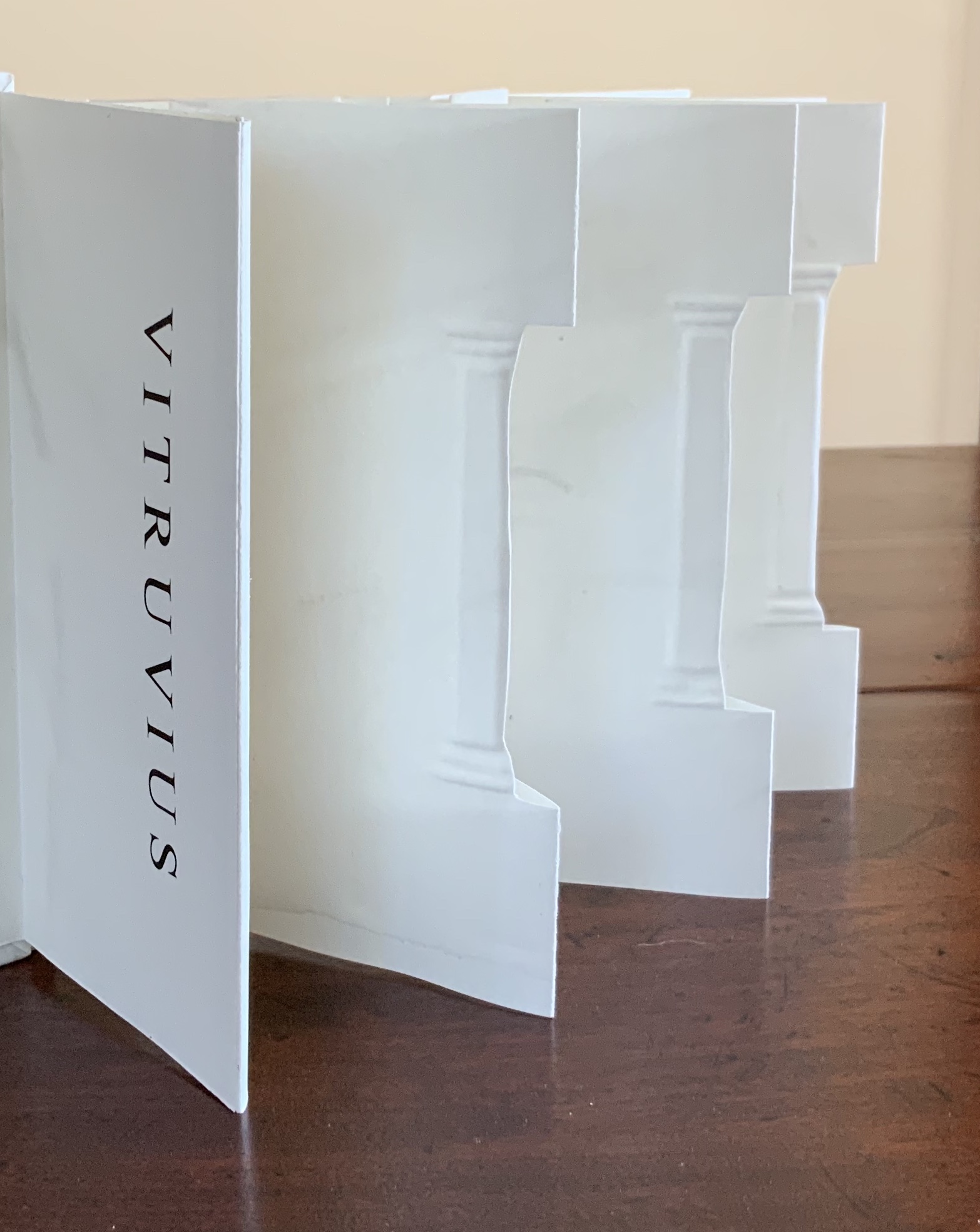
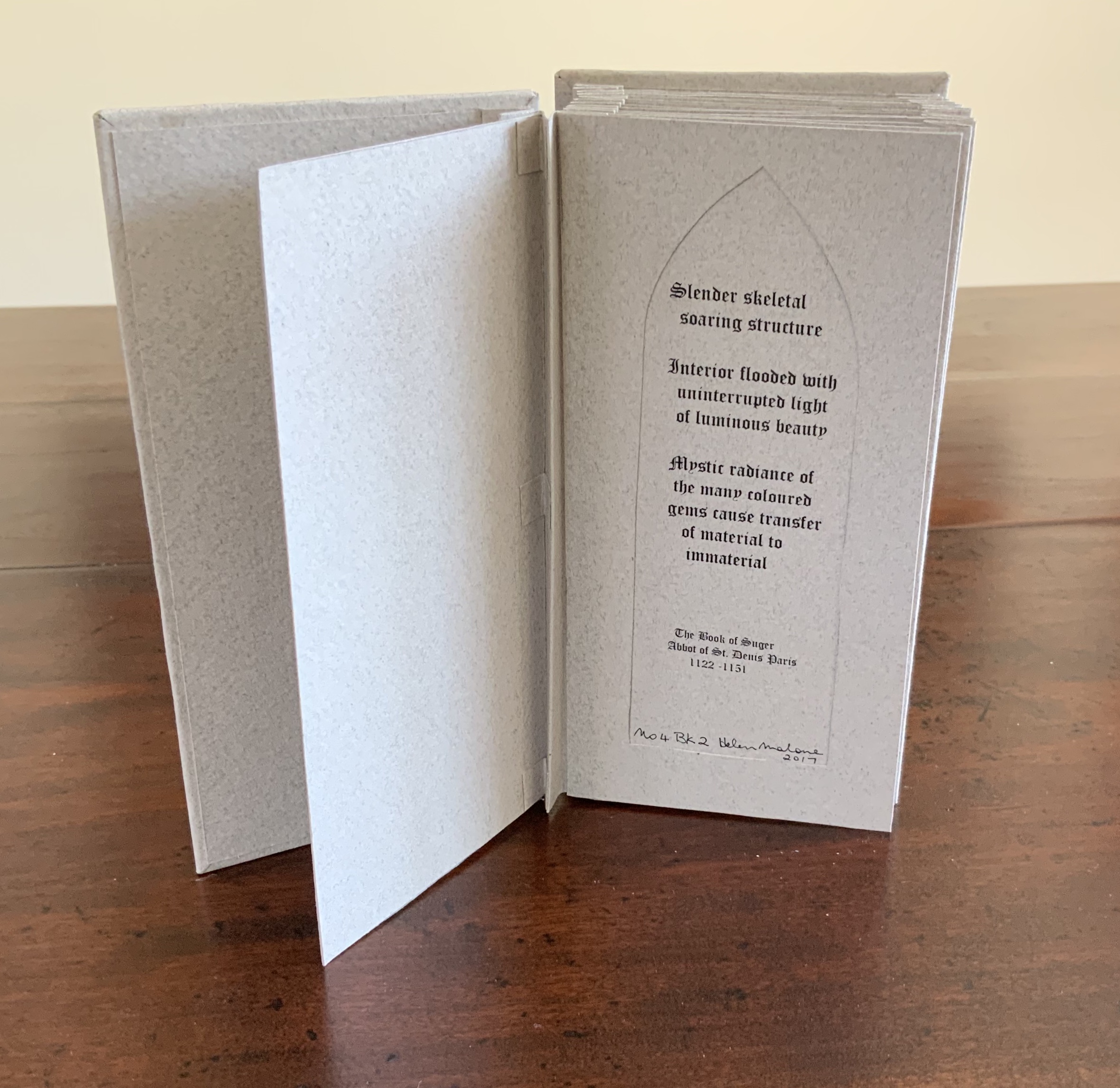
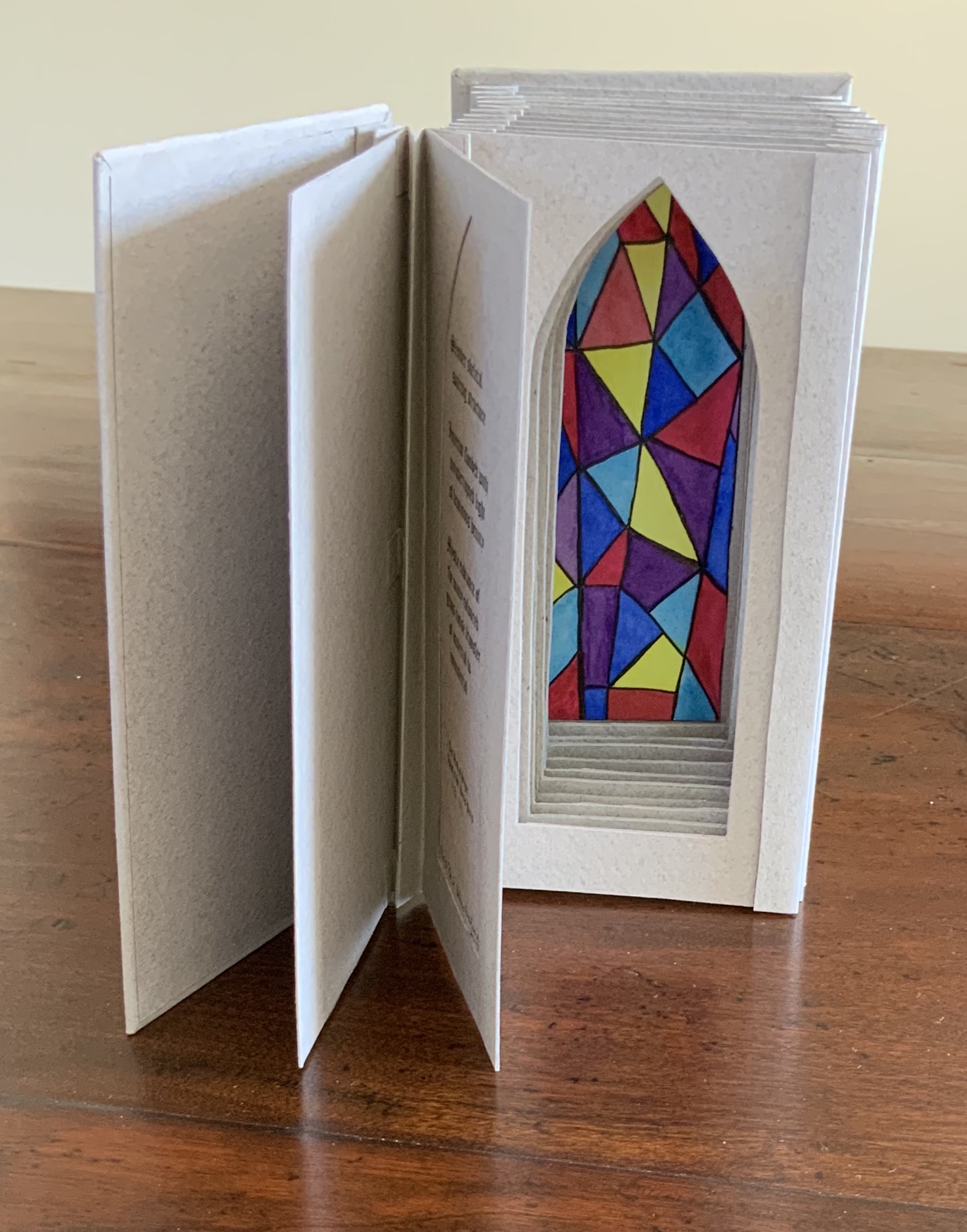
and Laura Davidson responded to Vitruvius Pollio’s’ De Architectura libri Dece [The Ten Books on Architecture] (Como, Italy: Gottardo de Ponte, 1521) with Ten Books of Vitruvius (Boston, MA: self-published, 1994).

As the exhibition demonstrated, the overlay of the dual traditions — those of art and those of the book — on the domains of science creates a rich soil for ingenuity and genius. Since that exhibition, science- and maths-driven book art has yielded harvest after harvest of outstanding book artists. Sarah Bryant is one of them. Bryant won the MCBA Prize in 2011 with Biography (2010) and was a finalist in 2015 with Figure Study (2015).

Biography (2010)
Sarah Bryant

“[A]n exploration of the chemical elements in the human body and the roles they play elsewhere in the world”, Biography (2010) is bound as a hard cover drumleaf and enclosed in a clamshell box. It begins with the periodic table and assigns a coloured square to each of the chemical elements found in the human body. Using those coloured squares, the six subsequent diagrams show the presence of the body’s chemical elements in the earth’s crust, man-made weapons, medicines, sea water, etc. The flip-up folio (above right) displays their presence in various man-made tools and building materials. Bryant’s inventive handling of colour, the flip-up folio and blind embossed printing foreshadow developments in her later work.

Figure Study (2015)
Sarah Bryant and David Allen

Collaborating with David Allen, a professor at Middlebury College in Vermont, Bryant created Figure Study (2015), a graphical “comparison of population data for every region on earth”. In this work, Bryant takes her handling of shape and colour to a new level.

All 114 of these figures have been printed from linoleum onto drafting film and are housed together alongside a grid. The figures are each numbered and can be interpreted using a booklet containing an alphabetical and numerical index, as well as a short essay by David Allen about our process and the source of the data. The design of the enclosure encourages the viewer to layer the forms to create different combinations of shape and color. This process and the resulting imagery is initially reminiscent of elaborate dresses, paper dolls, and dissection plates, but the source of the data gives a different picture, laying bare the vast and critical differences between the basic equations of life in different parts of the world. 2015 MCBA Prize Finalists

In correspondence with Books On Books, Bryant has noted the influence of Edward R. Tufte. Figure Study particularly may remind the reader/viewer of Tufte’s The Visual Display of Quantitative Information (1983) and Envisioning Information (1990). In his books and lectures, Tufte champions the connection of art and science as well as information display that is interactive, which Bryant’s statement above echoes.

As her two bookworks above and those below associated with the collective Shift_Lab demonstrate, she has the gift of transforming analytical data, diagrammatic imagery , text derived from reference materials as well as personal experience and taking them beyond “visual display” and into art.

Shift in Position (2014)
Sarah Bryant

In Shift in Position (2014), Bryant draws on her own sleep patterns and movements. Extraordinary how, in Shift in Position, she manipulates the elements of the book to embody the “message” of the work. Note how she plays with layout, in particular, by running text syntactically over the loose folios (“a change/ in the wind” and ensuring the alignment of the graphical image. The work invites the reader/viewer to turn the two folios 180º — like a restless sleeper — to read/see the additional run-on text (“a shift/ to the side”) and the aligned image from another perspective. This use of the material and form draw the reader/viewer into a kind of creative act — negotiating the act of close reading with that of close looking.

Listen Out for a Bell which Rings Continuously (2015)

Another collective work from Shift_Lab is Trace (2015). Bryant’s contribution is Listen Out for a Bell which Rings Continuously, which draws on sound and coastal mapping. It is based on her residence at the Brighton Marina, “a strange space between land and sea” where she immersed herself “in the quiet rhythm of the place”. In the first image above from Listen Out, it is obvious how the typography mimics the tide’s ebb and flow, perhaps less obvious how the overlapping texts’ rhythm and syntax surge, overlap, peter out. Look even more closely at the two lower images, two sides of the same sheet: note how the colours on the two sides of the sheet register against one another to create the kind of topographical mapping found in marine maps. Beyond that effect, the two pages challenge one’s sense of place in the world. On the left hand side, one is looking down on the boats crowding in on the marina; on the right, one is below the water and looking up at the hulls. To achieve a further infusion of place with the work, the work is even printed using chalk from the surrounding cliffs.

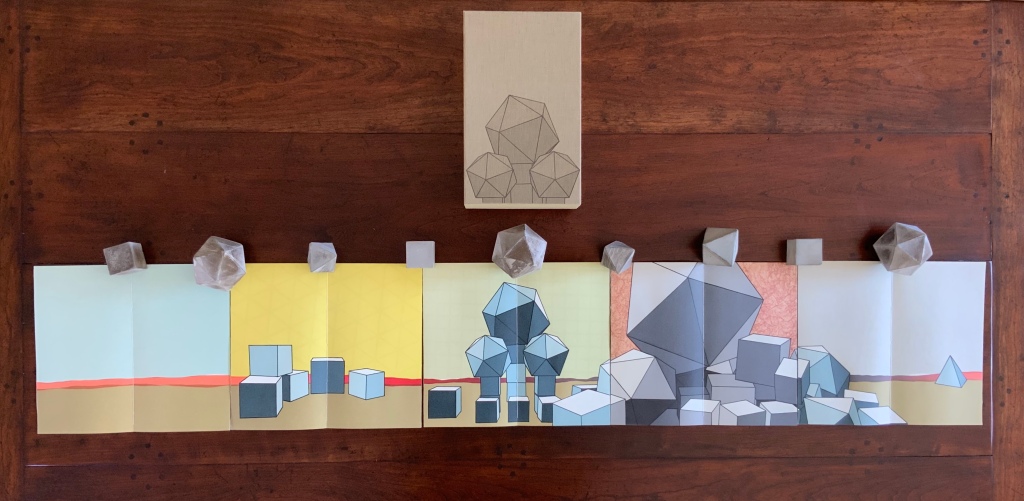
The Radiant Republic (2019) is one of Bryant’s more recent solo works. In her own words:

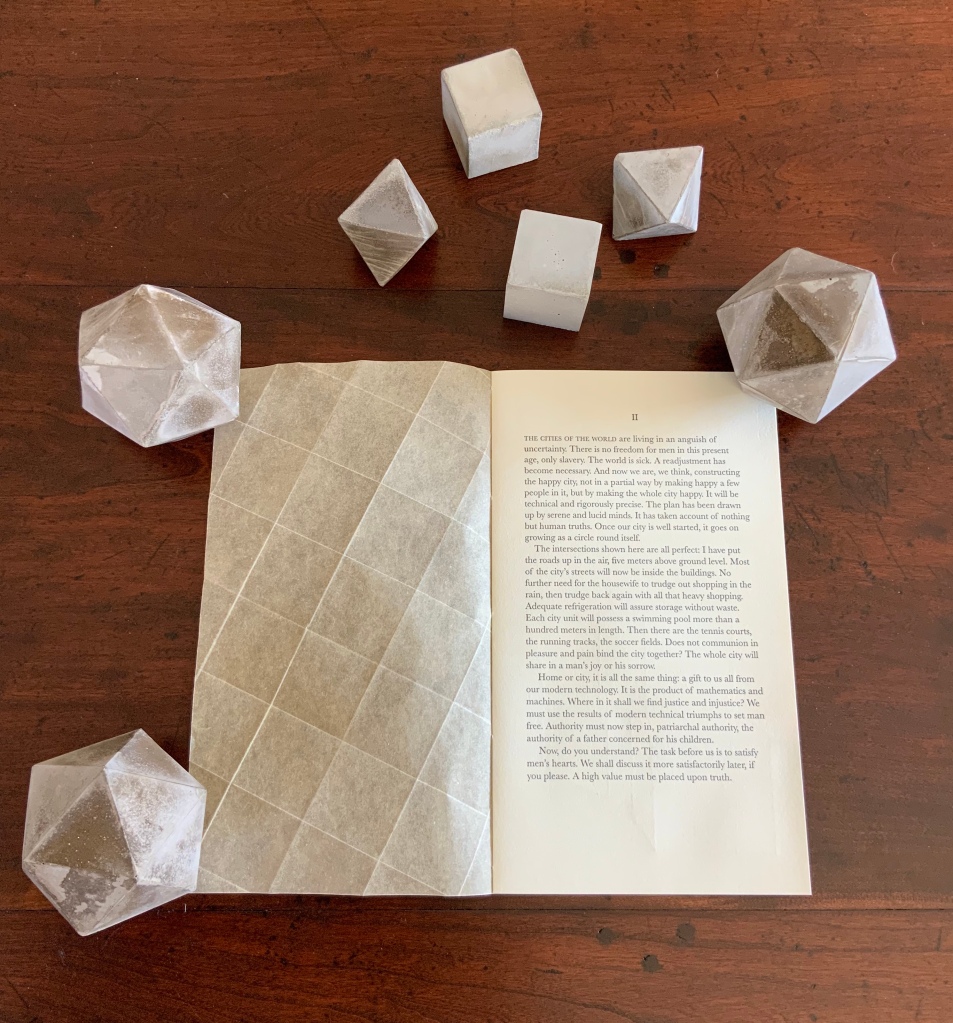
The Radiant Republic [is] built entirely out of language found in Plato’s Republic and Le Corbusier’s The Radiant City. In these texts, separated by more than two thousand years, Plato and Le Corbusier each describe a city plan designed to provide a framework for morality and ethics. These works are revered, but they are also deeply troubling. In The Radiant Republic, language from Plato and Le Corbusier has been combined to create a narrative in five parts. Big Jump Press/Portfolio/Artist Books/The Radiant Republic

When Bryant writes “combined”, she means it as the work’s title performs it. Paragraphs in each of the five volumes merge sentences from Plato with those of Le Corbusier. In its combination of the titles of Le Corbusier’s and Plato’s works, respectively, The Radiant Republic signals its textual ambition: to merge the two different texts. The disconcerting oracular tone and coherence of the narrative underscore the revered yet troubling nature of the two works, which is reflected in the epigraph to The Radiant Republic:

Every physical thing carries within its deepest layers a tendency towards its own destruction.

— Moshen Mostafavi and David Leatherbarrow, On Weathering: The Life of Buildings in Time (MIT Press, 1993)

But we are getting ahead of ourselves.

In The Radiant Republic, Bryant uses techniques and materials old and new to her in an aim for new heights of art and depths of thought. The box enclosure itself is the first new technical feature we encounter.

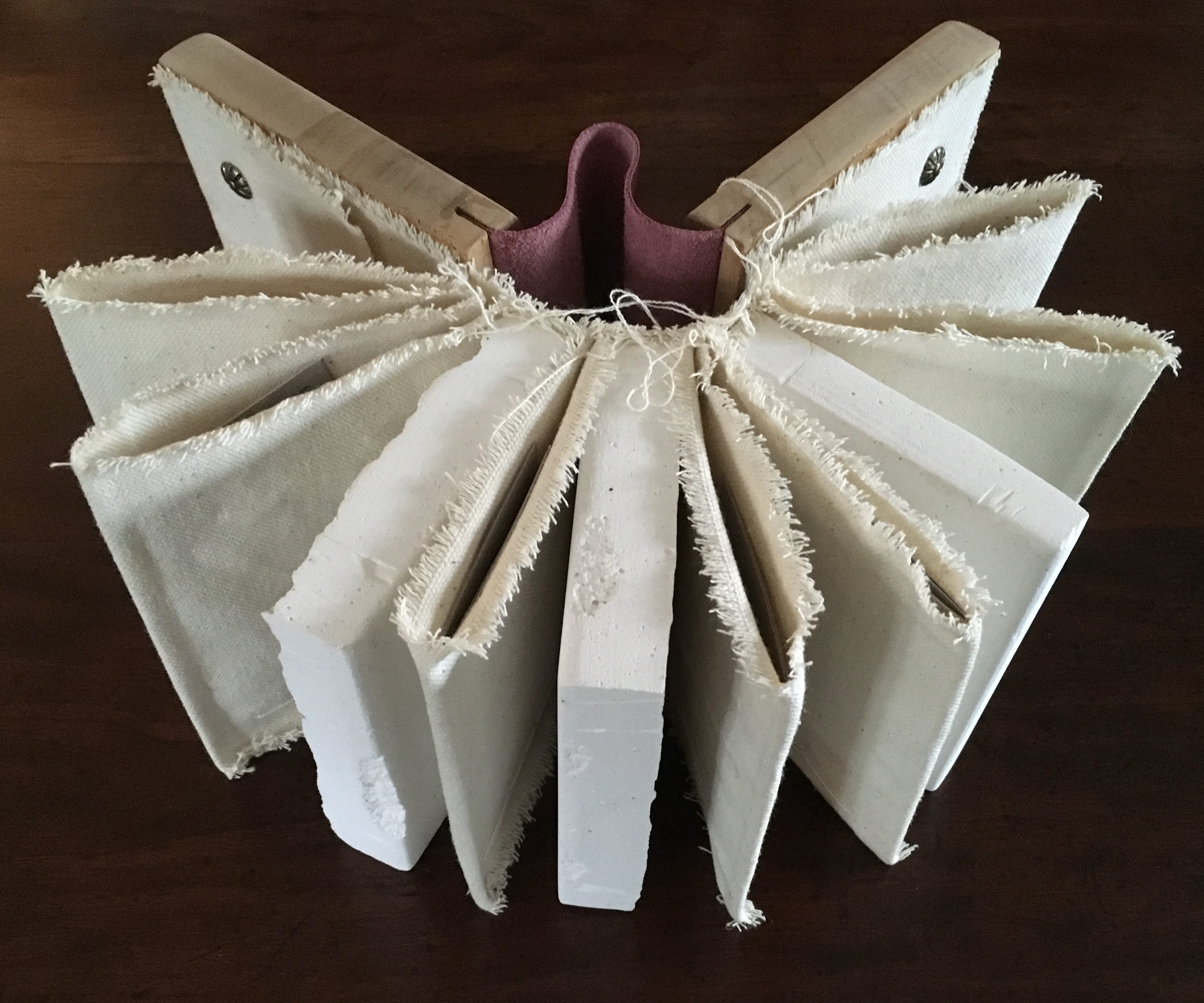
The Radiant Republic (2019)
Sarah Bryant
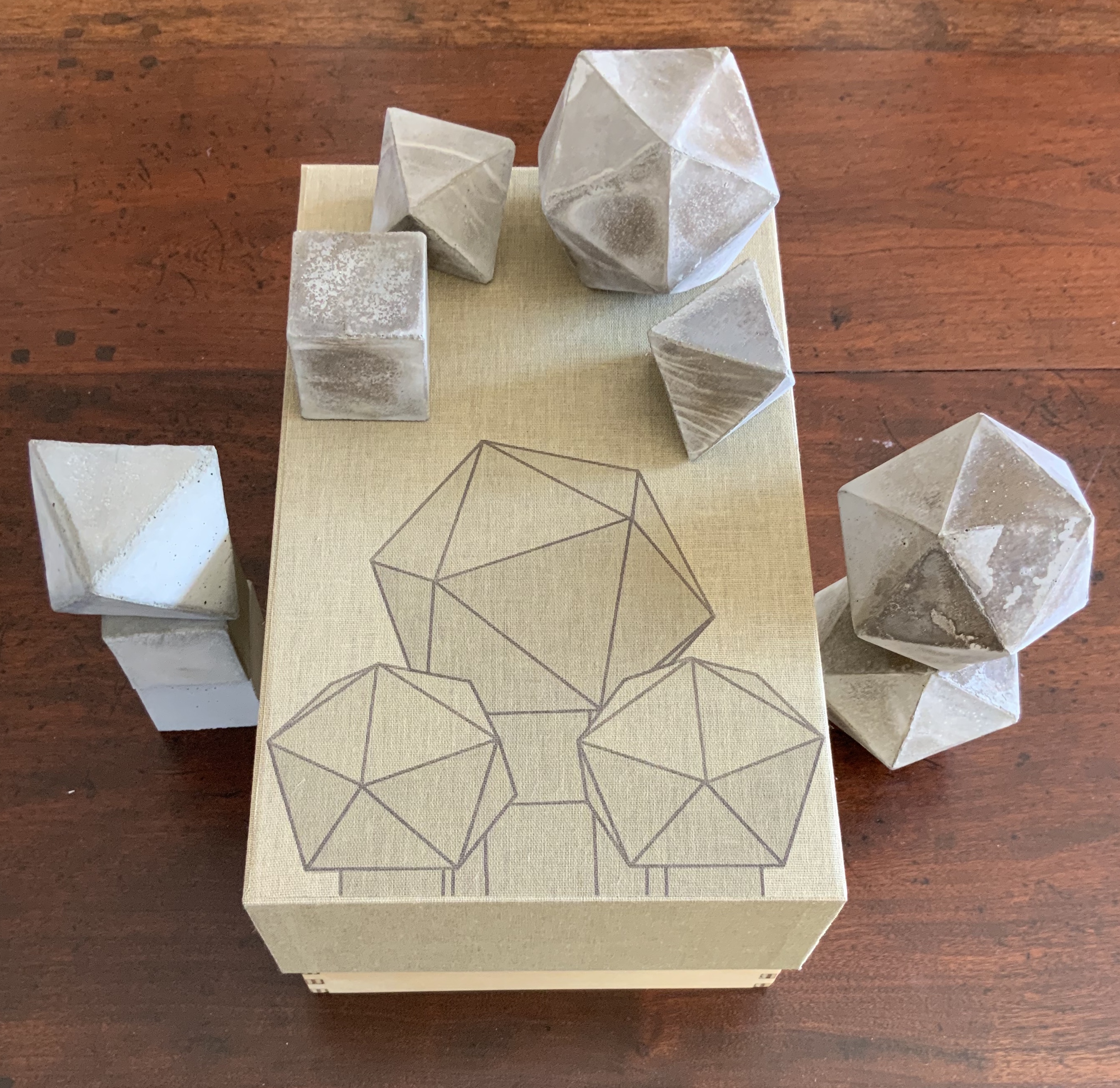
Box, glass, cement blocks, pamphlets. Edition of 50, of which this is #5. Acquired from the artist, 20 February 2019.
Photos: Courtesy of the artist; Books On Books Collection.

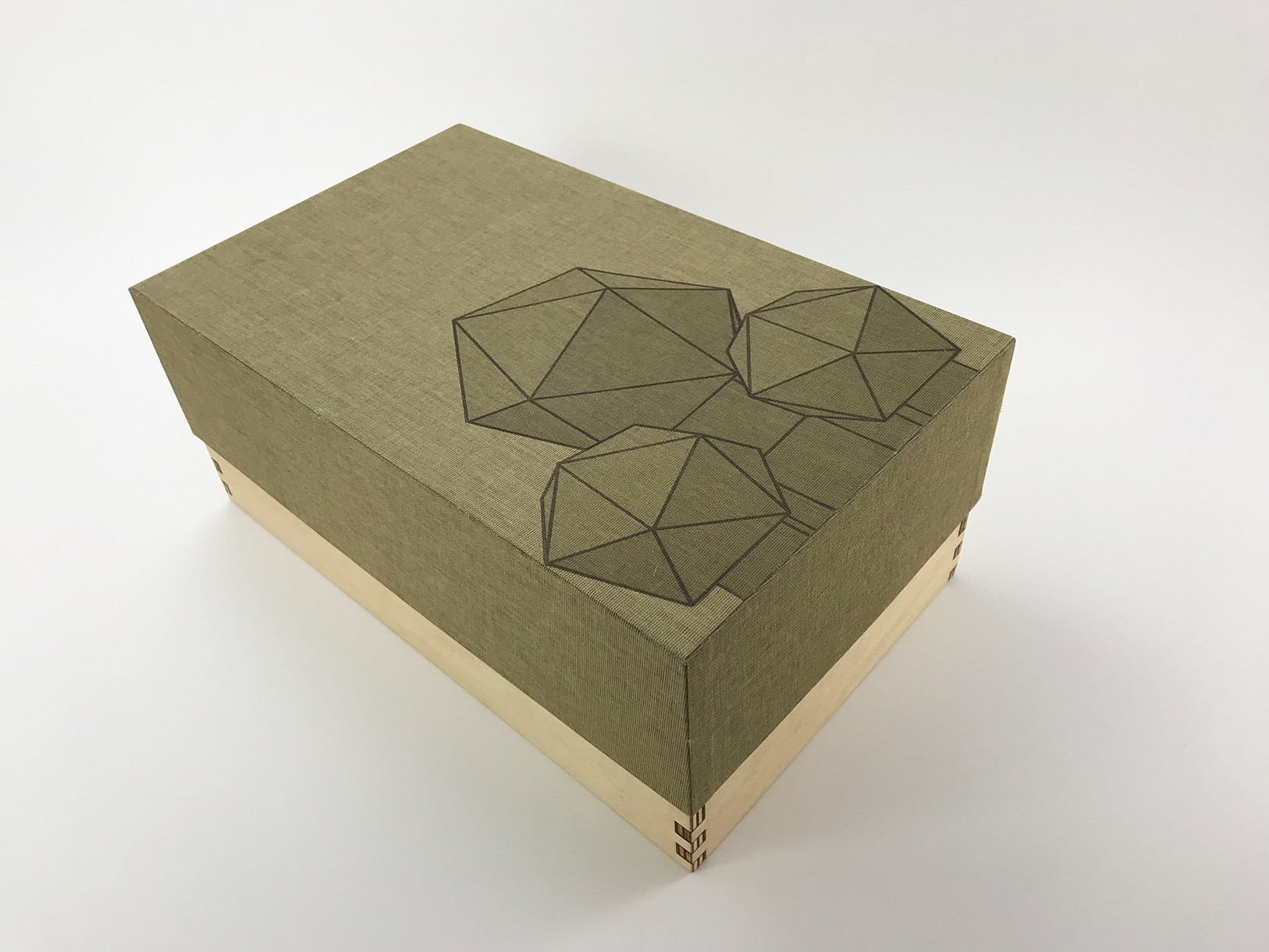
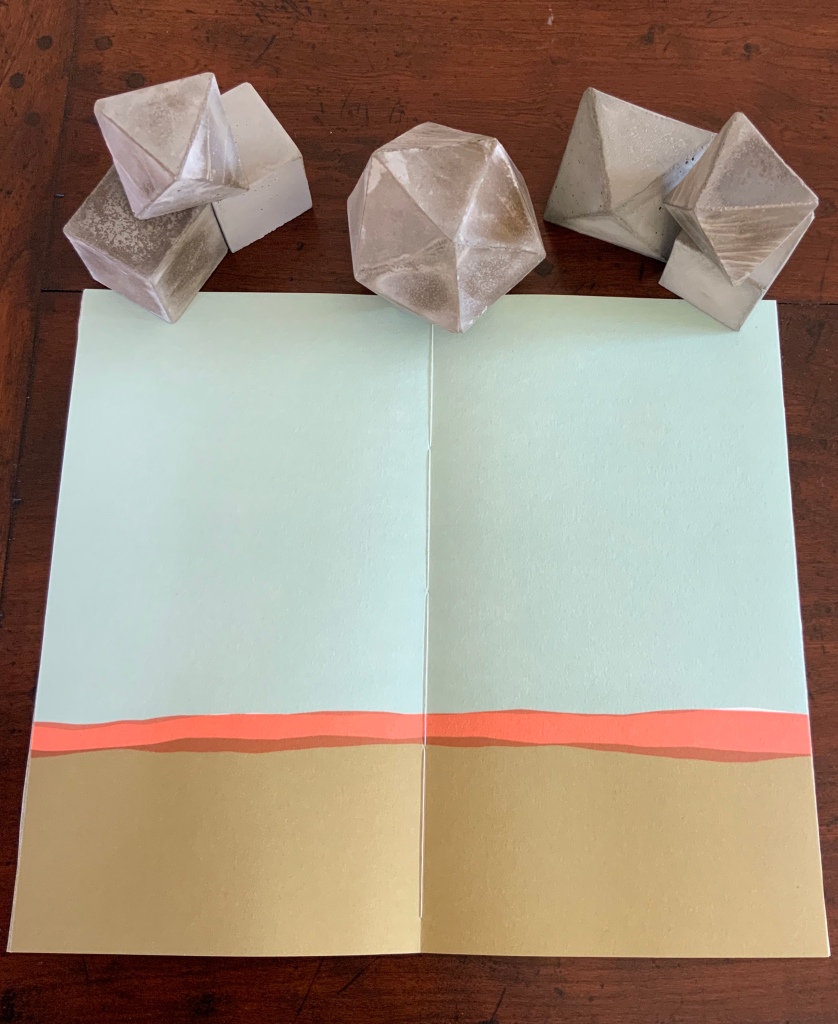
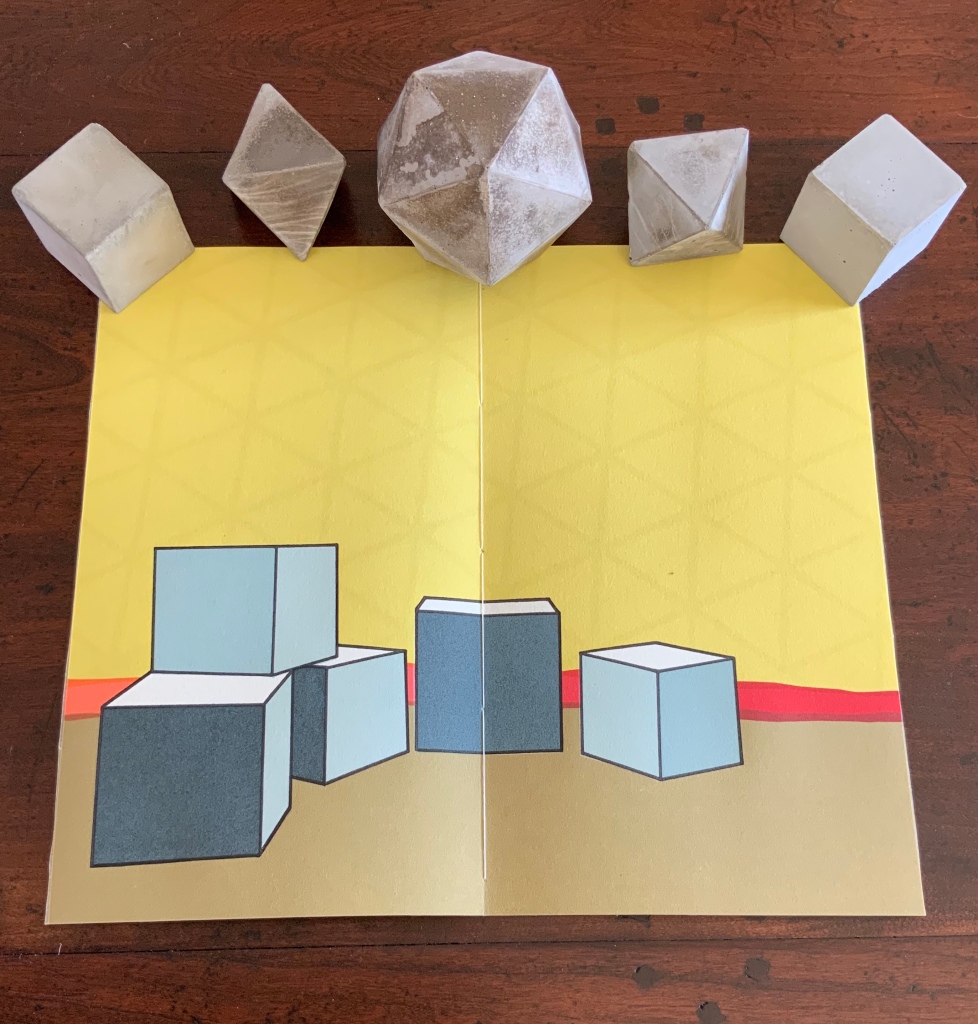
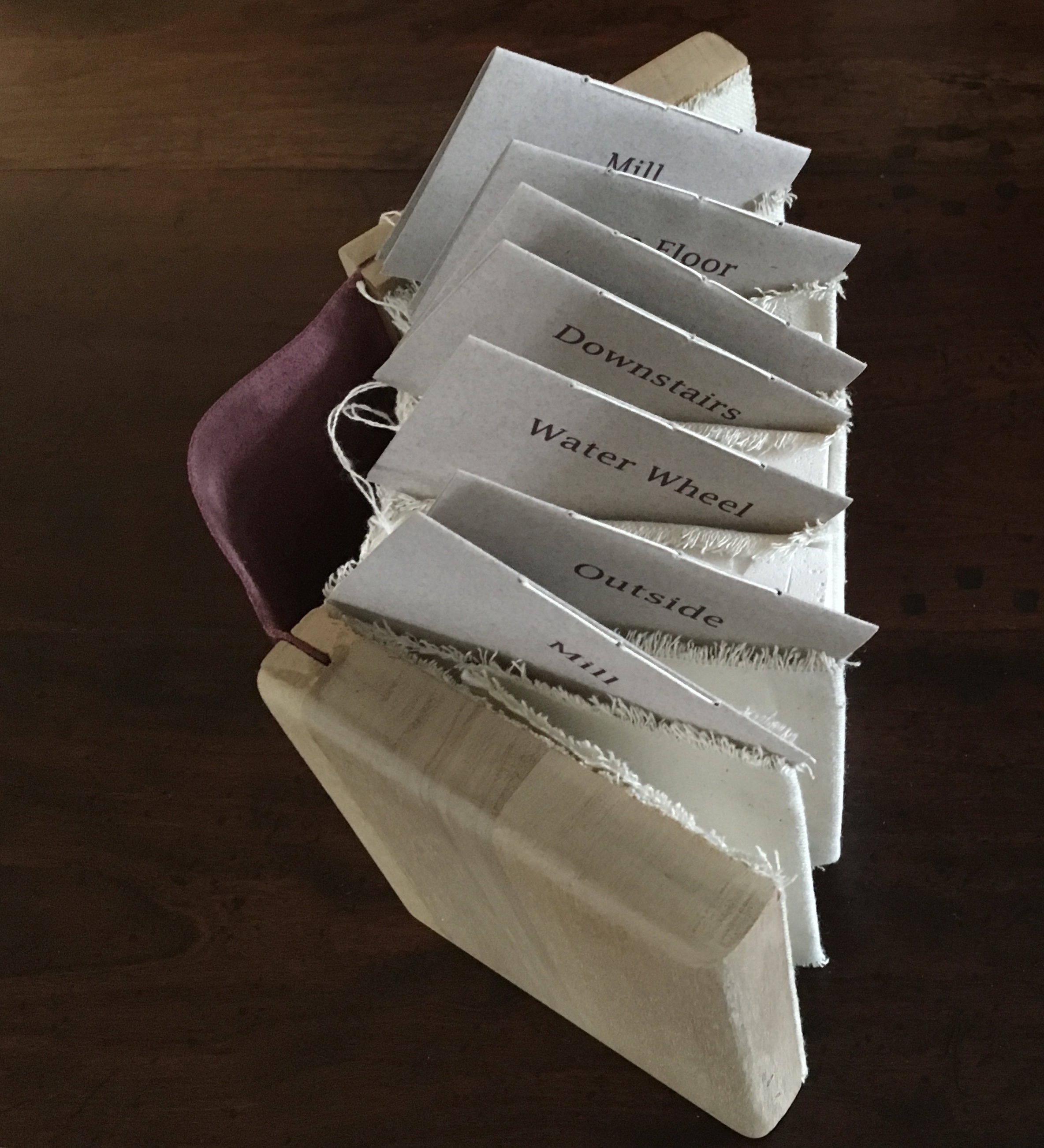
Although the collective works comprising Trace are housed in a box, this one is more elaborate in material and media. It is made of laser-cut Baltic Birch plywood, lightly treated with Tung oil. The lid is covered in Dubletta book cloth, which has been printed letterpress with polymer plates and linoleum. Lifting off the cover reveals yet further new materials and techniques. Five pamphlets each consisting of Rives Heavyweight paper sewn to a lightweight cover made of handmade Belgian Flax, produced at the Morgan Conservatory in Cleveland, and held together with a wrapper rest on a sheet of glass.

In several ways, the book component shows the encounter of previous techniques/media with the new. The precise fold work and registration to be found in Biography and Listen Out reappear, as does the meaningful integration of separate parts in Figure Study. Here, it is the geometric fold patterns in the covers echoing the geometric solids. Flax paper is a new element in Bryant’s repertoire.

The blind embossed printing from Figure Study moves from the cover there to the interior of the book component here and with substantive, non-decorative intent. Across the five volumes, the embossed text is the same as that printed in ink and always appears on the last folio. But here is the catch: the text that appears comes from the succeeding volume’s inked text, and it appears in fragments. When the last page of the fifth volume appears, the embossed text on its folio’s last page is a fragment of the inked text in the first volume. The fragmentation of the embossed printed version and its variation in depth mime the weathering of structures and ideas.

The circular movement and fusion of the past and present are also reflected in the double-page prints centered in each volume. Note how the technique of prints interlocking across folios in Shift in Position replays here in the prints interlocking across the five volumes to assert a narrative thrust but in a landscape with no fixed beginning or end.

The contrast of materials — cloth, wood, flax paper, Rives paper and concrete — plays out in the concrete solids. Some edges are sharp, others blunted; some surfaces are smooth, others rough. This happens also with the covers to the five volumes according to the absence or presence (and density) of folds and, in one case, of crumpling or no crumpling. It happens in the prints, where the backgrounds include faint images mirroring the structures in the other media. This technique of contrasting materials/media and that of recapitulating the contrast within one or more of the materials/media seems to be a new development in Bryant’s art or, at least, an intensified one.

The multiple materials and techniques and their many-sided interactions pose a pleasurable dilemma for the work’s display. As soon as one is in place, another beckons.

No surprise then that the first pamphlet’s opening words are “You and I at this juncture are not poets but founders of a city”. This self-reflexive invitation to creativity is like that invitation to negotiate reading with looking — an invitation to participate and to recognise our participation as part of the creative act. An increasingly characteristic aspect of book art.

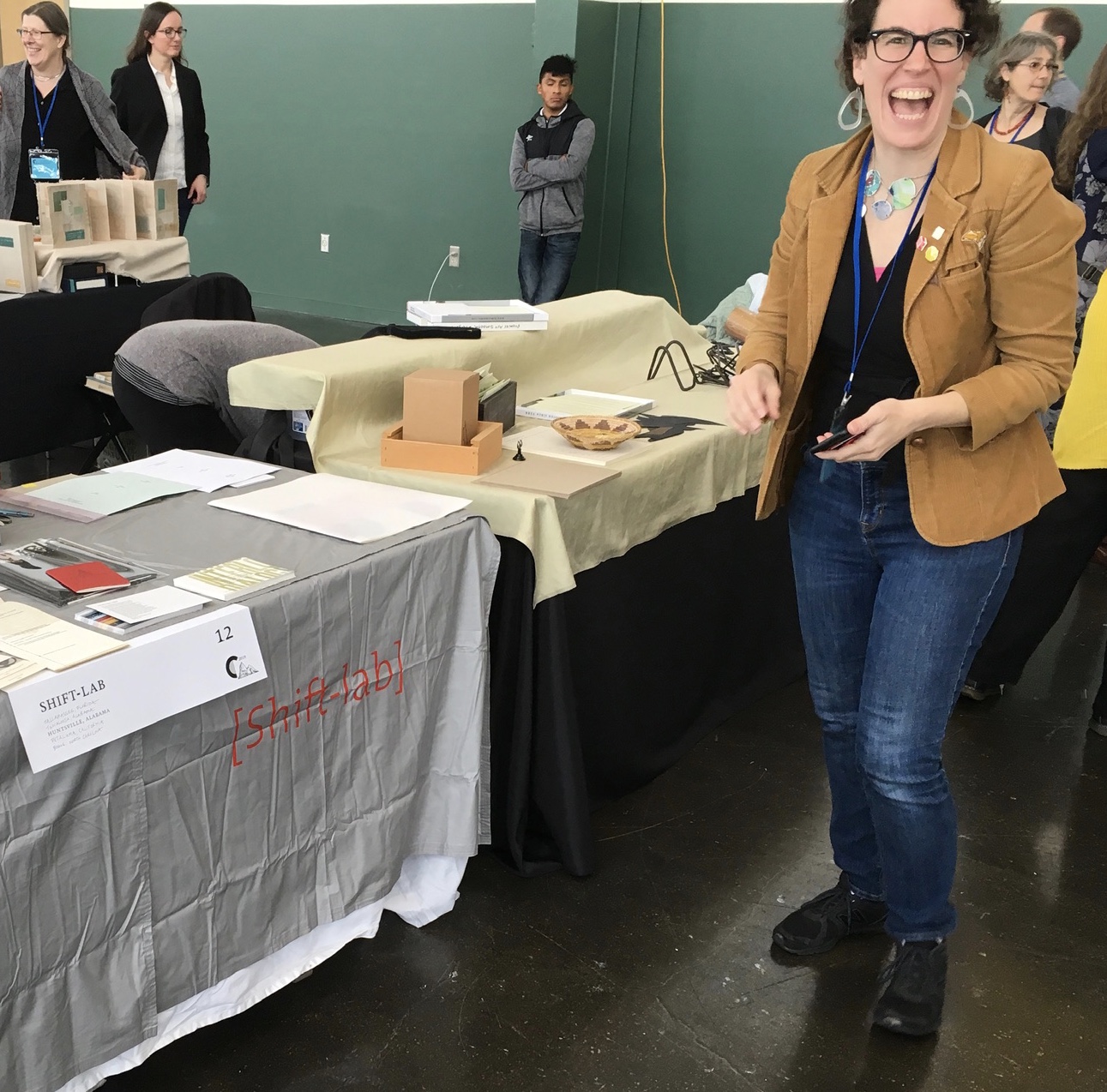
Sarah Bryant runs Big Jump Press, works with the collective Shift_Lab and teaches at the University of Alabama Book Arts Program.

Further Reading

Chen, Julie. 2013. 500 Handmade Books. Volume 2. New York: Lark. P. 146 (Biography).

Bookmark – “The Chapter: A History”

The Venerable Bede working on his translation

Nicholas Dames’s readable New Yorker piece presents telling episodes in the history of authors’ use of the chapter in non-fictional and fictional works — from Cato the Elder, Pliny, the Venerable Bede, Caxton, Fielding, Gissing and others.

Latin capitulum, Spanish capítulo, French chapitre, Czech kapitola, German Kapitel, Romanian capitol, Italian capitolo, English chapter: is it anything different in the digital age? The page can “disappear”, scrolling down a window, replaced by a percentage of book completed. What about the chapter?

The following paragraph from Dames is telling when juxtaposed with the final chapters of Amaranth Borsuk’s The Book (MIT Press, 2018), which brings to bear on the history of the book and its elements the perspective of an artist; reviewed here.

Like the momentary lifting of a pianist’s fingers while a chord still resonates, the classic novelistic chapter evokes time by dwelling in a pause rather than a strong ending. We feel time in the novel by marking it out into bits, but only bits that have no strong shape, that fade or blur into one another in the recollection. The greatest practitioners of the chapter have preferred to cast their divisions as fleeting caesuras with lingering aftereffects, scarcely memorable in their specifics but tenacious in the feeling they evoke. (italics added) Situations yielding silently to new configurations, feelings fading imperceptibly or stealing upon us, shifts in the atmosphere around us: time in the novel is made up of these chromatic transitions, and the usual name for them in the history of the form is the chapter. 

Nicholas Dames, “The Chapter: A History“, The New Yorker, 29 October 2014

Bookmarking Book Art – Hedi Kyle’s The Art of the Fold: How to Make Innovative Books and Paper Structures (2018)

The [artists’ book] movement had its beginnings with a few individuals (conceptual artists Dieter Roth, Hansjörg Mayer, and Ed Ruscha immediately come to mind), but in the area of structural experiment and invention only one person seems to have been markedly influential (albeit seriously ignored): Hedi Kyle.

Alastair Johnston, “Visible Shivers Running Down My Spine”, Parenthesis, Fall 2013, Number 25.

While Alastair Johnston’s 2013 interview with Hedi Kyle is a rich one and welcome, it is inaccurate to say Hedi Kyle has been seriously ignored.  After all, in 2005, the Guild of Book Workers awarded her an honorary membership, and Syracuse University’s Library invited her to deliver that year’s Brodsky Series lecture. In 2008, the Philadelphia Senior Artists Initiative recorded her oral history and posted her artist’s statement along with an extensive list of prior exhibitions, honors, professional roles and board memberships stretching back to 1965.

If, however, Johnston’s assessment is accurate, subsequent events have rectified the situation. In 2015, Kyle delivered the keynote address “Four Decades under the Spell of the Book” for the Focus on Book Arts annual conference. In the same year, the 23 Sandy Gallery held a successful international juried exhibition entitled “Hello Hedi“, an echo of the 1993 exhibition organized by the New York Center for Book Arts entitled Hedi Kyle and Her Influence, 1973-1993. In 2016, the San Francisco Center for the Book held a solo exhibition for Kyle: “The World of Hedi Kyle: Codex Curios and Bibli’objets“.

And now, in 2018, Laurence King Publishers has brought out the eagerly awaited The Art of the Fold by Kyle and daughter Ulla Warchol, which is the immediate impetus for this essay. The authors aim their book at artists and craftworkers, but there is a secondary audience: anyone interested in book art or artists’ books or origami — and learning how better to appreciate them.

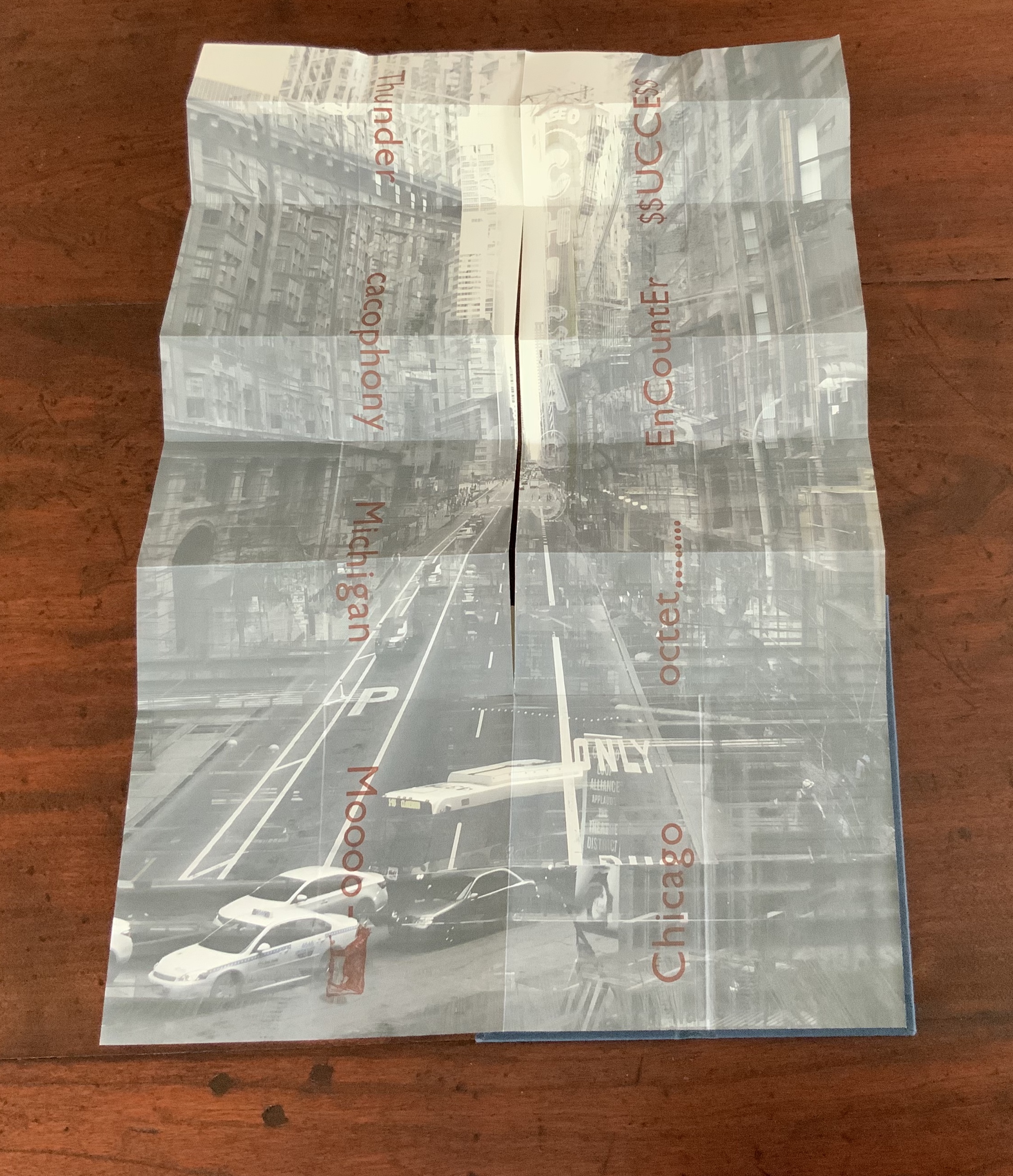
On picking up the book, the first thing its primary and secondary audiences should notice is the folded “dust jacket”. Why the quotation marks?  Just look:

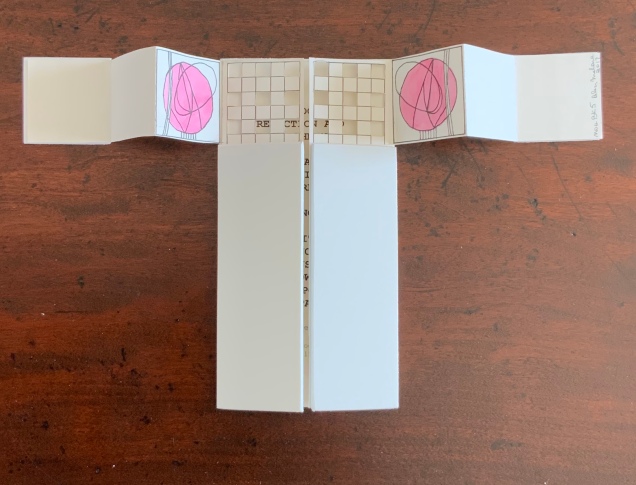
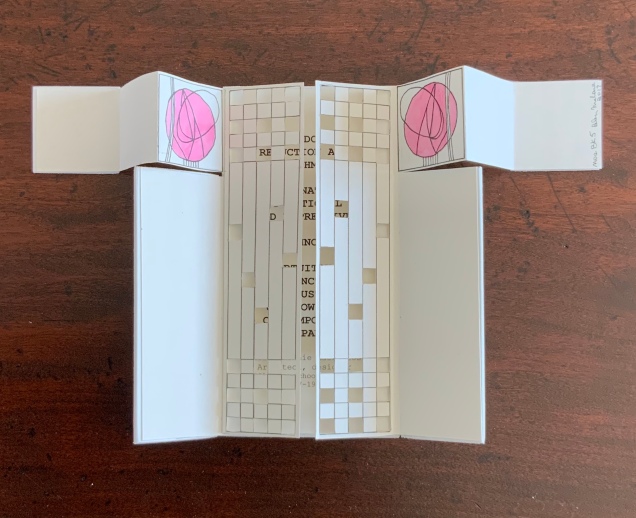
“Dust jacket” unfolded, side 1

“Dust jacket” unfolded, side 2

This innovative, subject-appropriate cut, fold and print can set the reader on a hunt for precursors such as Peter and Pat Gentenaar-Torley’s Paper Takes Flight/Papier op de Vlucht, designed by Loes Schepens, where the multilayered dust jacket has small envelopes attached to hold paper samples from the contributing artists, or Doug Beube’s Breaking the Codex, designed by Linda Florio, where the dust jacket includes a perforated bookmark, whose removal implicates the reader in a bit of biblioclasm and challenges Western parochialism.

Paper Takes Flight/Papier op de Vlucht (2006) Peter and Pat Gentenaar-Torley Note how the book’s title is revealed on the second dust jacket from the bottom.

The five opened dust jackets displayed beneath the title page

Bottom-most dust jacket folded from the backboard to the right revealing the airmail envelope, which contains a blank sheet of airmail stationery

The Art of the Fold‘s clean, balanced design (Alexandre Coco) and excellent diagrams (authors) mesh well with the text. While this integrated clarity in the introductory section on Tools, Materials, Terminology, Symbols and Techniques will be appreciated most by artists and paper engineers, the secondary audience of library/gallery curators, aficionados and collectors will benefit from the description and comments in particular on materials, terminology and techniques. Knowing these points about an object of book art enhances appreciation of it and improves its handling, presentation and preservation.

Following this introduction, Kyle and Warchol provide 36 sets of detailed instructions across 5 sections:

  • The Accordion
  • Blizzards
  • One-Sheet Books
  • Albums
  • Enclosures

This double-page spread introducing the accordion structure shows off the the diagrams’ clarity, a feature throughout the book. Also in this spread are two important statements in the verso page’s final paragraph:

The accordion fold as an independent component is our focus point in this book…. Let us start with a brief visual display of a variety of folding styles. Hopefully they will inspire you to grab some paper and start folding. (p .28)

The focus on structure “as an independent component” is a strength and weakness. The strength is self-evident in the thoroughness and attention to detail. The weakness? More than occasionally, the authors make asides about the meaningful interaction of structure with content and, occasionally, with other components (type, color, printing technique, etc.). Some exemplars selected by the authors would have been welcome. The artist’s and reader’s challenge is to provide their own examples of how the structural component might work with different types of content, mixed media and other components that combine to deliver the artistic object.

The second statement — the exhortation “to grab some paper and start folding” —  illustrates an unalloyed strength of this book. As towering an authority and figure in the book arts and book art as Hedi Kyle is, she and her co-author go out of their way again and again to keep readers open to playing with the techniques and structures and finding their own  inventiveness and creativity. For those content to collect or curate, both statements push them to look for or revisit outstanding examples and inventive variants of the structures elucidated. After this section, a browse of Stephen Perkins’ accordion publications, a site running since 2010, would be a good start.

This double-page spread introducing the section on Blizzard structures delivers that blend of the anecdotal with essential engineering-like detail that is characteristic of the authors’ style throughout. Having explained how this family of folded structures that bind themselves got its name (a fold discovered in a daylong fold-a-thon due to a blizzard’s shutting everything down), the authors dive into the proportionality so key to getting them right. Perhaps because of its non-adhesive, origami-centric nature, the blizzard book structure generates more than its fair share of kitsch exemplars. When blizzard books do come along that rise to the level of art — integrating structure, content, printing, typography, color and other components of bookmaking in an artistically meaningful way — they stand out all the more. One such work took first place in the 23 Sandy Gallery’s juried exhibition in 2015, “Hello Hedi”:

Blizzard Book (2015)
Virginia Phelps

Next to The Accordion section, the One-Sheet Books section has the most models. It is also the section that most addresses that challenge mentioned above:

A book folded from a single sheet of paper, including covers, offers a unique opportunity to consider the content and cover as one comprehensive design exercise. We explore the coming together of printing, layout and folding. (P. 94)

Given this opportunity, some treatment of imposition would have been useful, especially for the Franklin Fold and the Booklet Fold Variations. For the Booklet Fold Variations, one could lightly pencil into the book’s clear diagrams the usual markings and enumerations as below.

Again, a few selected photographs of examples of One-Sheet Books that achieve the coming together of content, design, printing, layout and folding would have been welcome.

The double-page spread above with which the Albums section begins exemplifies the book’s quality of photography (by Paul Warchol, Ulla’s husband). Like the “dust jacket”, the crisply photographed Panorama Book structure (upper right) and the pages that explain it will send readers on a quest to make their own or hunt for outstanding examples such as these by Cathryn Miller and Cor Aerssens, a long-time friend and correspondent with Kyle.


Westron Wynde (2016)
Cathryn Miller
Author’s statement: “This book presents the poem ‘Westron Wynde’ in a purely visual form. Letters become colours, and are used as graphic elements. The book manifests the essence, if not the sense, of the poem.”
Westron wynde when wyll thou blow,
The smalle rayne down can rayne – 
Cryst, yf my love wer in my armys
And I yn my bed agayne!

Memories (2012)
Cor Aerssens

Memories (2012)
Cor Aerssens

Memories (2012)
Cor Aerssens

A cautionary, or perhaps encouraging, note though: the fact that some structures can enfold others will frustrate readers with strict classificatory minds and exhilarate the more freewheeling. The Phelps’ Blizzard Book highlighted above includes in its sections items exemplifying the Flag Book and Fishbone structures. Aerssens’ Memories is even more so an integrated variant of the Panorama Book structure, featuring as it does panels within panels, two 8-leaf booklets bound into front and back with paper hinges, and mylar folders holding pressed flora from Aerssen’s northern Dutch environs.

The Enclosures section presents fascinating structures, not all of which are suited “to fit many of the projects in the previous chapters”. For example, the second-most fascinating form — the Telescoping Ziggurat, shown in the lower left corner of the recto page above — looks incapable of enclosing any of the other 35 structures. The authors acknowledge it is “less of a book and more of a toy — a stimulating and curious object whose inherent mathematical quality mesmerizes as it spirals inward and outward”. The most fascinating form, however, is as much a book as stimulating and curious object: the Sling Fold structure.

This structure looks suited to enclosing scrolls or narrow, collapsed accordion books of diminishing height, and its mechanics invite playful integration with content and variations of color, typography or calligraphy, printing method and materials.

It would not do to conclude a review of this book without touching on the Flag Book structure, for which Kyle is so well-known. It is found in The Accordion section. The outstanding works implementing this structure are legion. Here it is below in all its glory, which is exceeded only by the Two-Sided Flag book in the pages following it. 

The Art of the Fold should become an instant classic. If readers are tempted to “grangerize” their copies with photos and clippings of favorite examples and variants, they would do well instead to create one of the authors’ album structures in which to keep them. There could be many editions of this classic to come.

Update: for more on Kyle and Warchol, see their interview with Helen Hiebert in her series Paper Talk.

Bookmarking Book art – Gabrielle Fox’s “Julia Chatfield’s Scrapbook”

Filmed by Jay Bachemin 

Julia Chatfield, a young Englishwoman, brought the scrapbook in question to Ohio in 1845.  Over 170 years later, Cincinnati bookbinder and conservationist Gabrielle Fox restored the centerpiece with fine wheat starch paste and reassembled the binding with goatskin leather. It is housed in the archives of the Ursulines of Brown County, founded by Chatfield.  If the craft and artistry exhibited in the original is more than outstanding, it is then a reminder that the book art of the 20th and 21st century has its hidden traditions.