Inscription: The Journal of Material Text, Issue 5 (2025)
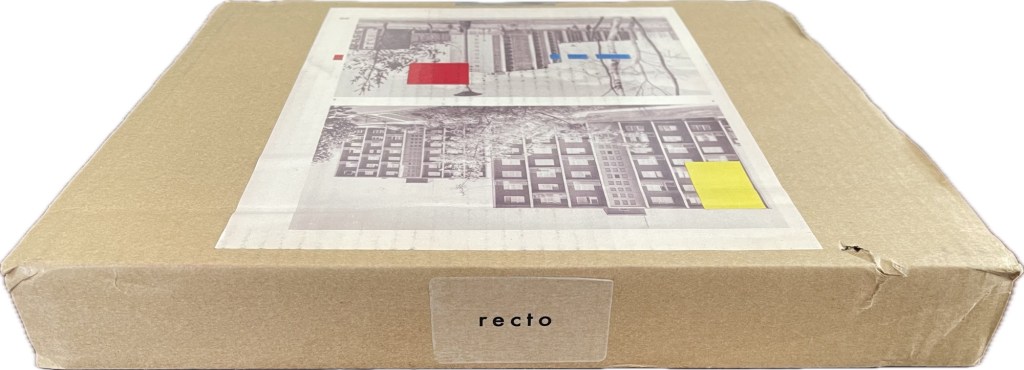
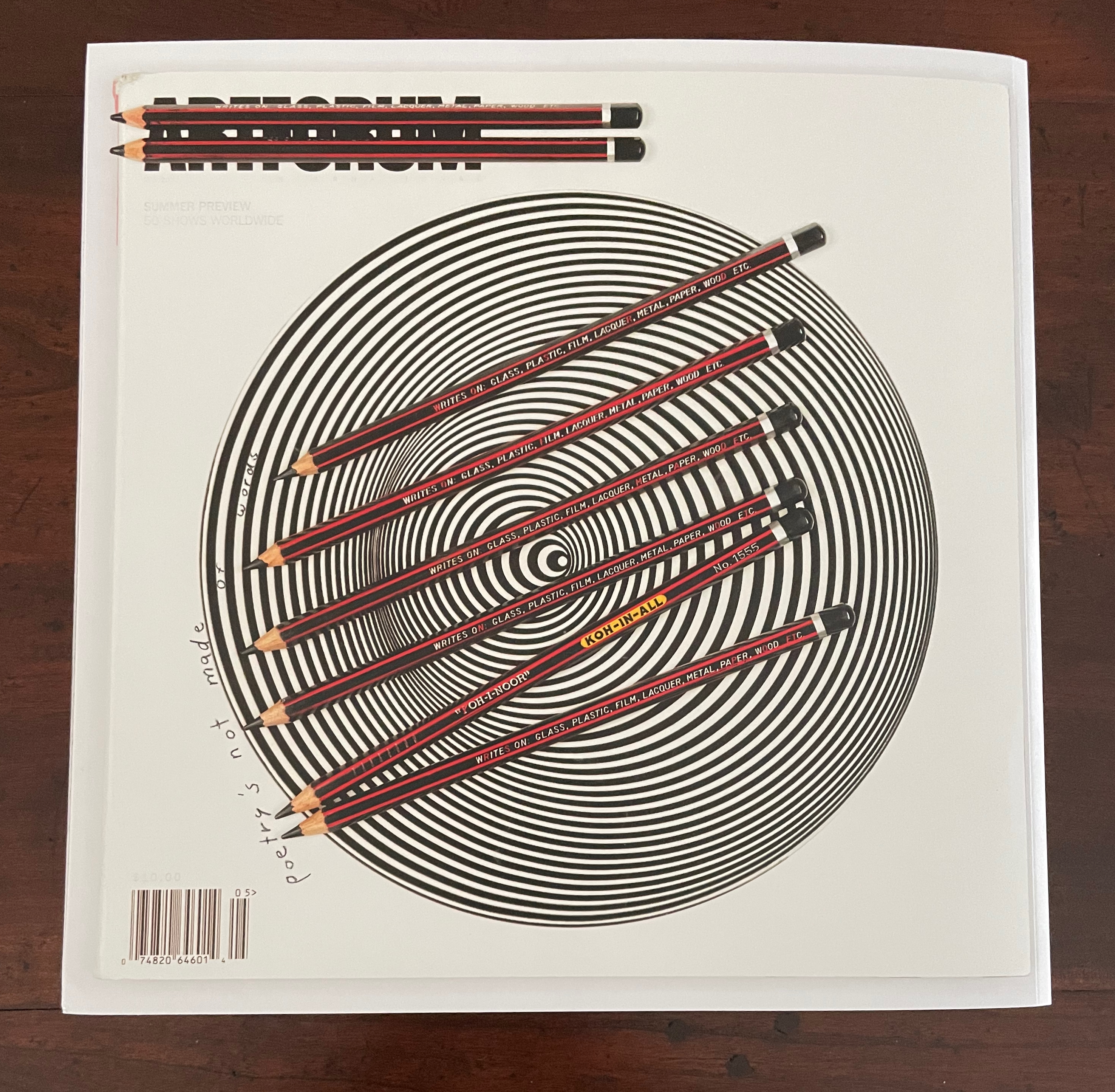
Although Theodore Roethke had a woman in mind when he wrote “The shapes a bright container can contain!”, the phrase readily comes to mind for this issue of Inscription once you’re past the difficult-to-open-up cardboard packaging. Not that you should rip through and discard it. The clues to proceed patiently are the label “recto” on one edge of the box and the page cut from a book and pasted on the box’s top. Is “recto” some sort of “this side up” label? If so, it seems topsy-turvy. Recto (or right-hand) pages are usually have odd-numbered, but the pasted-down book page is numbered 20. Wait a second; those random colored rectangles have been printed over the book page as if meant to draw attention to the “gridness” of the apartment blocks. Maybe this box is meant to be preserved and framed (after all, Toulouse-Lautrec drew on cardboard).
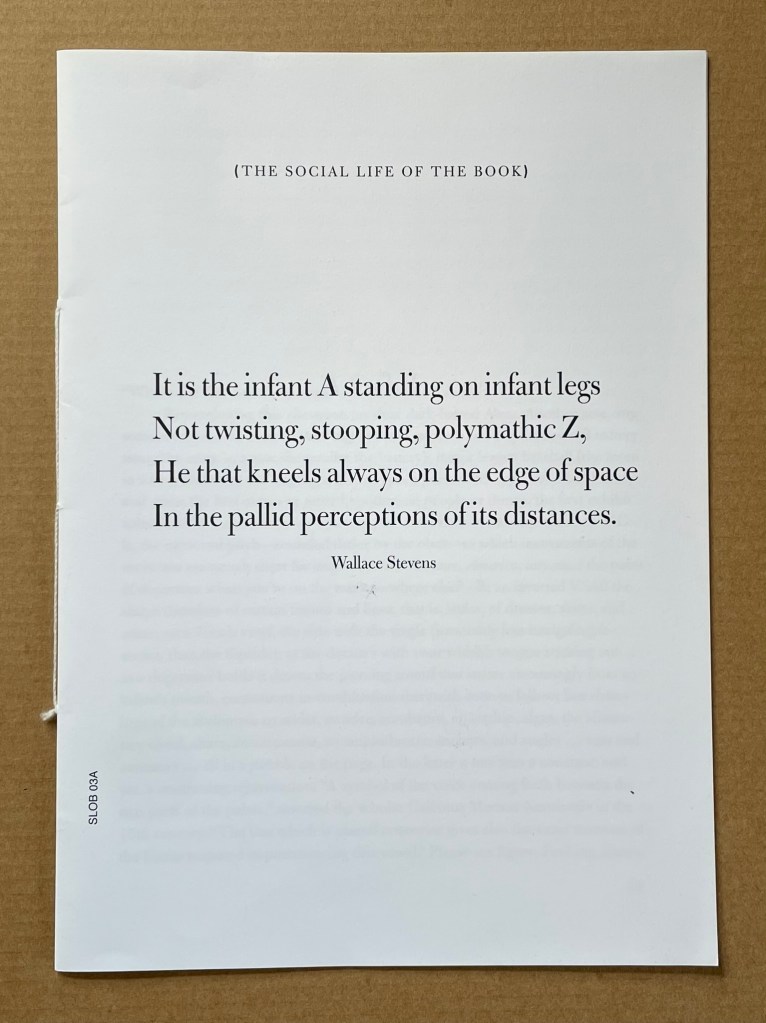
Infant A (2012) Louis Lüthi Thread-stitched signature. H225 x W160 16 pages. Edition of 1000. Acquired from Torpedo Books, 8 January 2024. Photos: Books On Books Collection
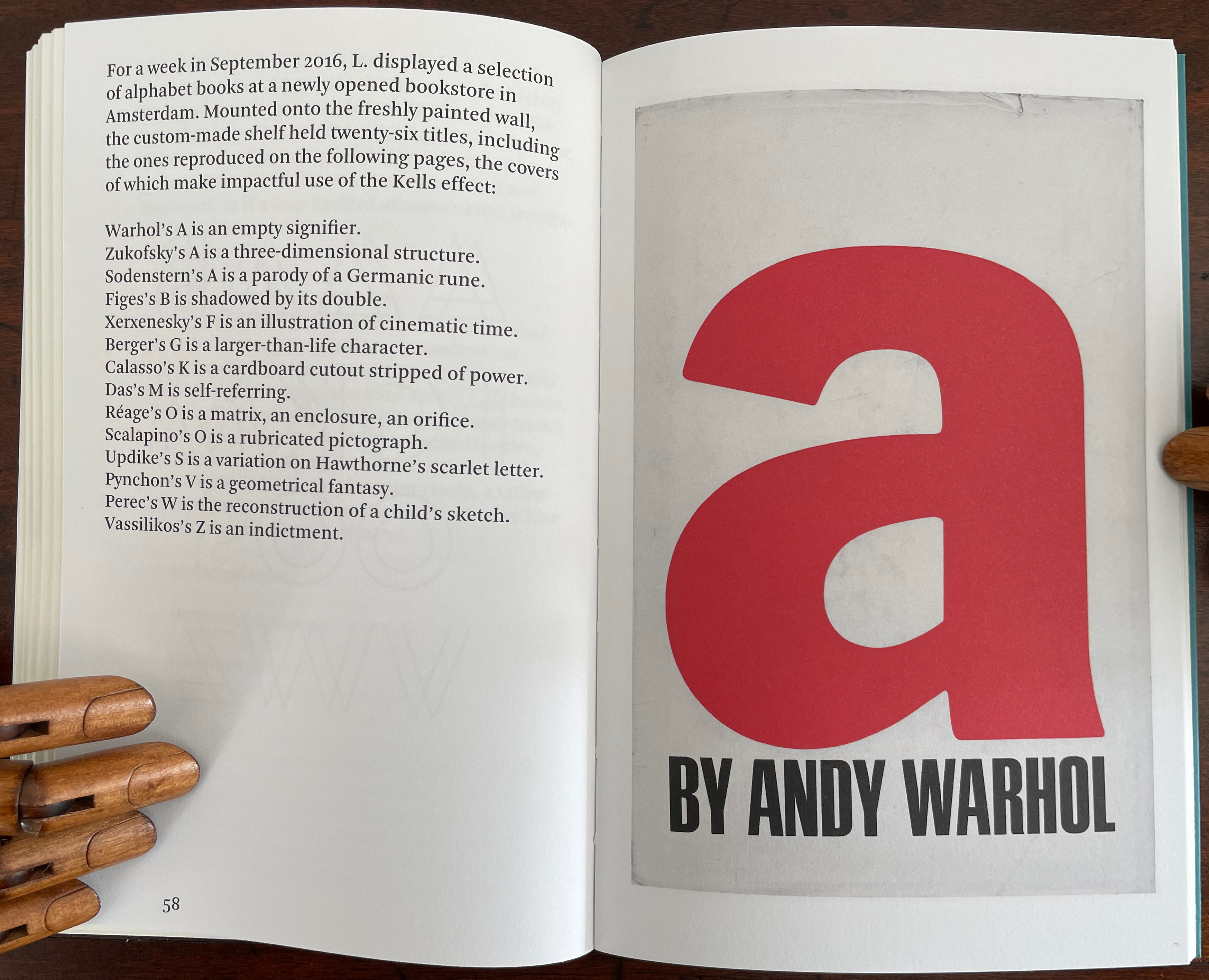
Infant A is part of a collection of essays commissioned by castillo/corrales and published by Paraguay Press under the series title The Social Life of the Book. Lüthi’s contribution fits the Books On Books Collection on several scores. First is the epigram’s invocation of the alphabet, which echoes the collection’s concentration of alphabet-related artists’ books and children’s books. See Alphabets Alive! Second is the epigram’s source: Wallace Stevens, whose poetry has inspired Ximena Pérez Grobet’s Words (2016). Would that other book artists be so inspired. Third is the narrator’s fictional conversation with Ulises Carrión in a celebration of all things A-related, in particular Andy Warhol’s novel a: a novel (1968), which finds analogues in Warren Lehrer’s A Life in Books: The Rise and Fall of Bleu Mobley (2013) and Derek Beaulieu’s a, A Novel by Andy Warhol (2017) (entry in progress). Fifth is how the dialogue reminds me of Suzanne Moore’s A Musings (2015).
A Die With Twenty-six Faces (2019)
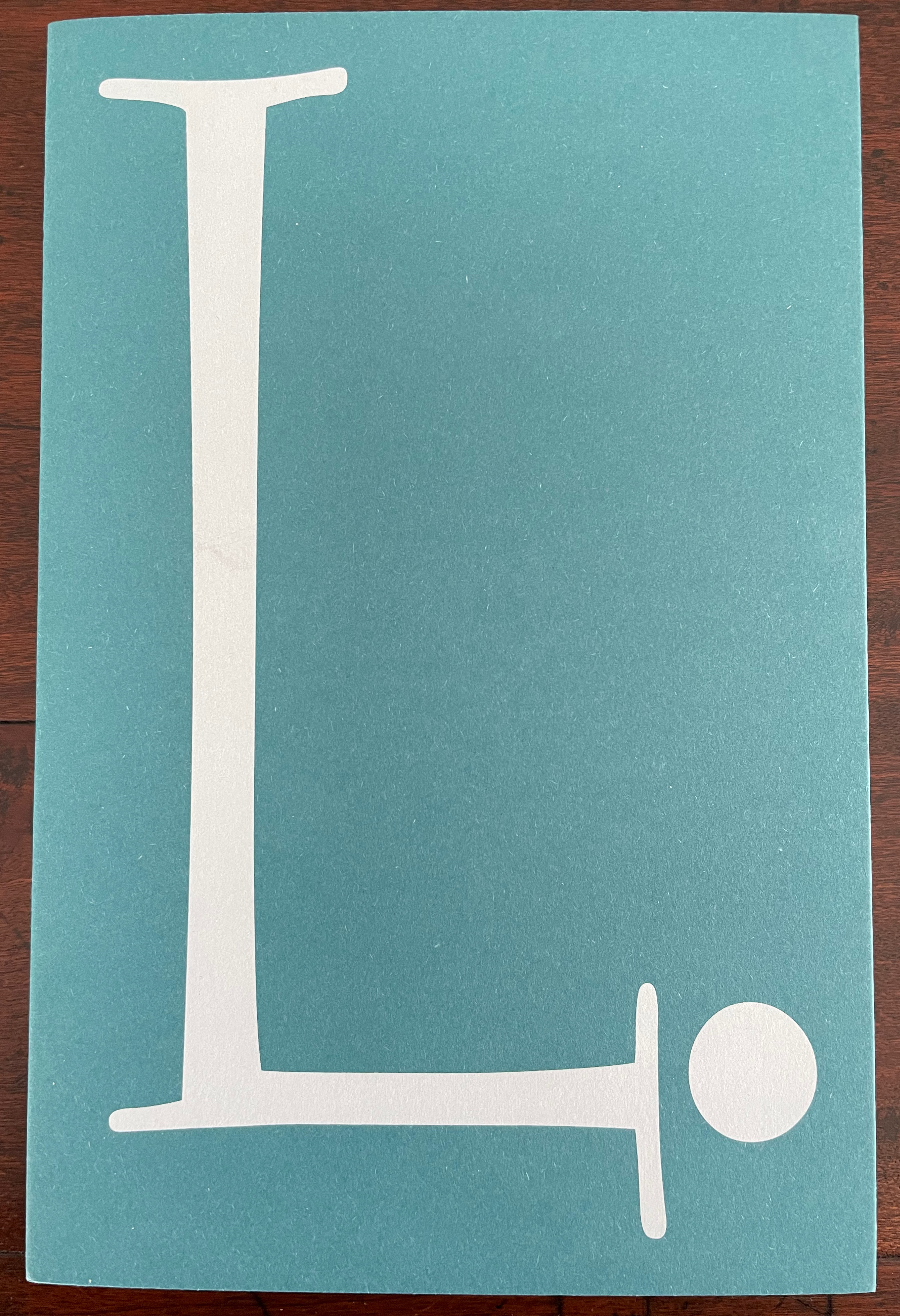
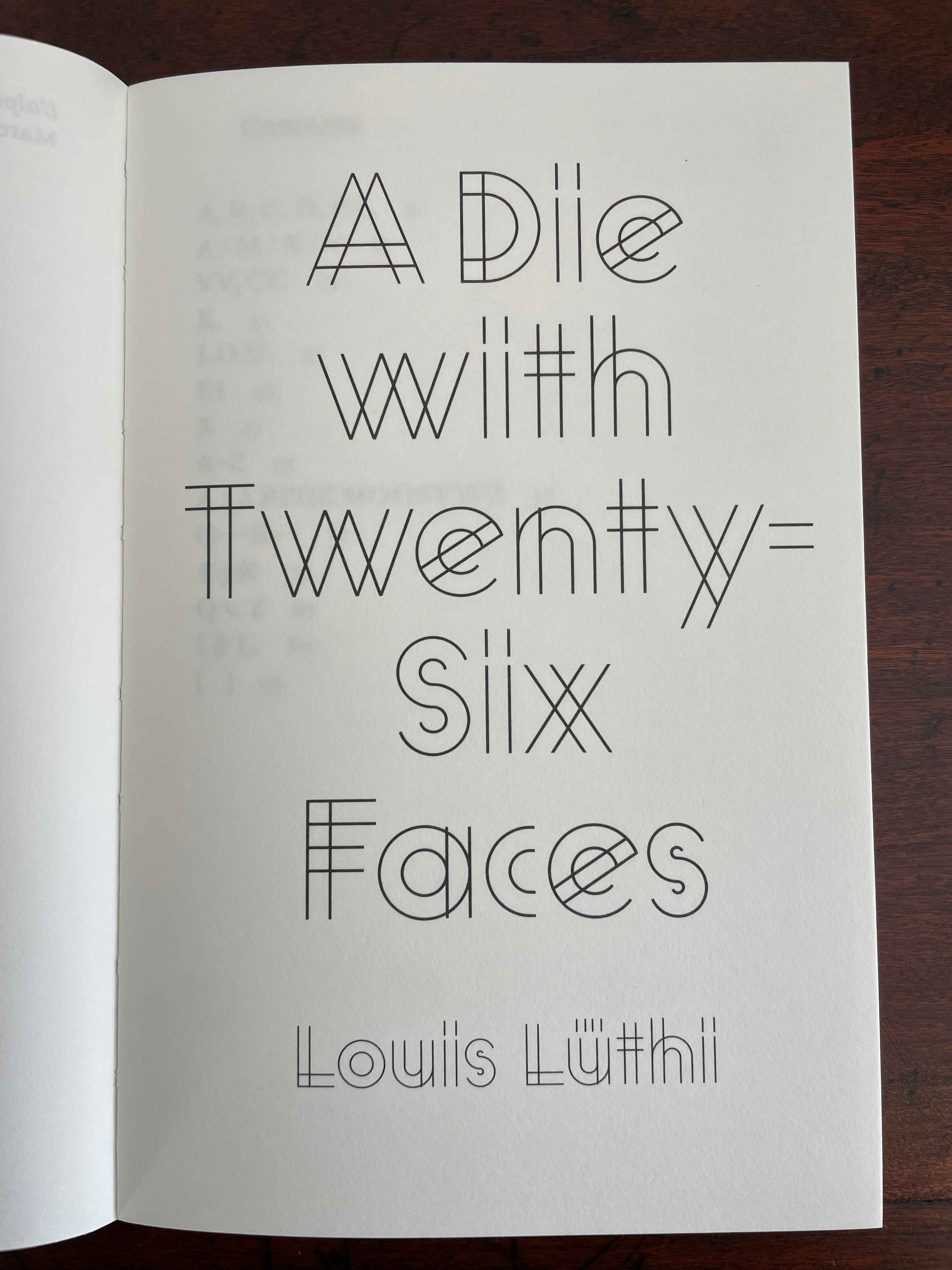
A Die With Twenty-six Faces(2019) Louis Lüthi Paperback. H200 x W130 mm. 104 pages. Acquired from Amazon, 18 September 2022. Photos: Books On Books Collection
Walter Benjamin’ unpacking of his library has a lot to answer for. Not only do we have Buzz Spector‘s take on it in 1995, but Jo Steffens’ Unpacking trilogy of photos of architects’, artists’ and writers’ bookshelves, Alberto Manguel’s elegiac Packing My Library (2018), and here is Louis Lüthi’s.
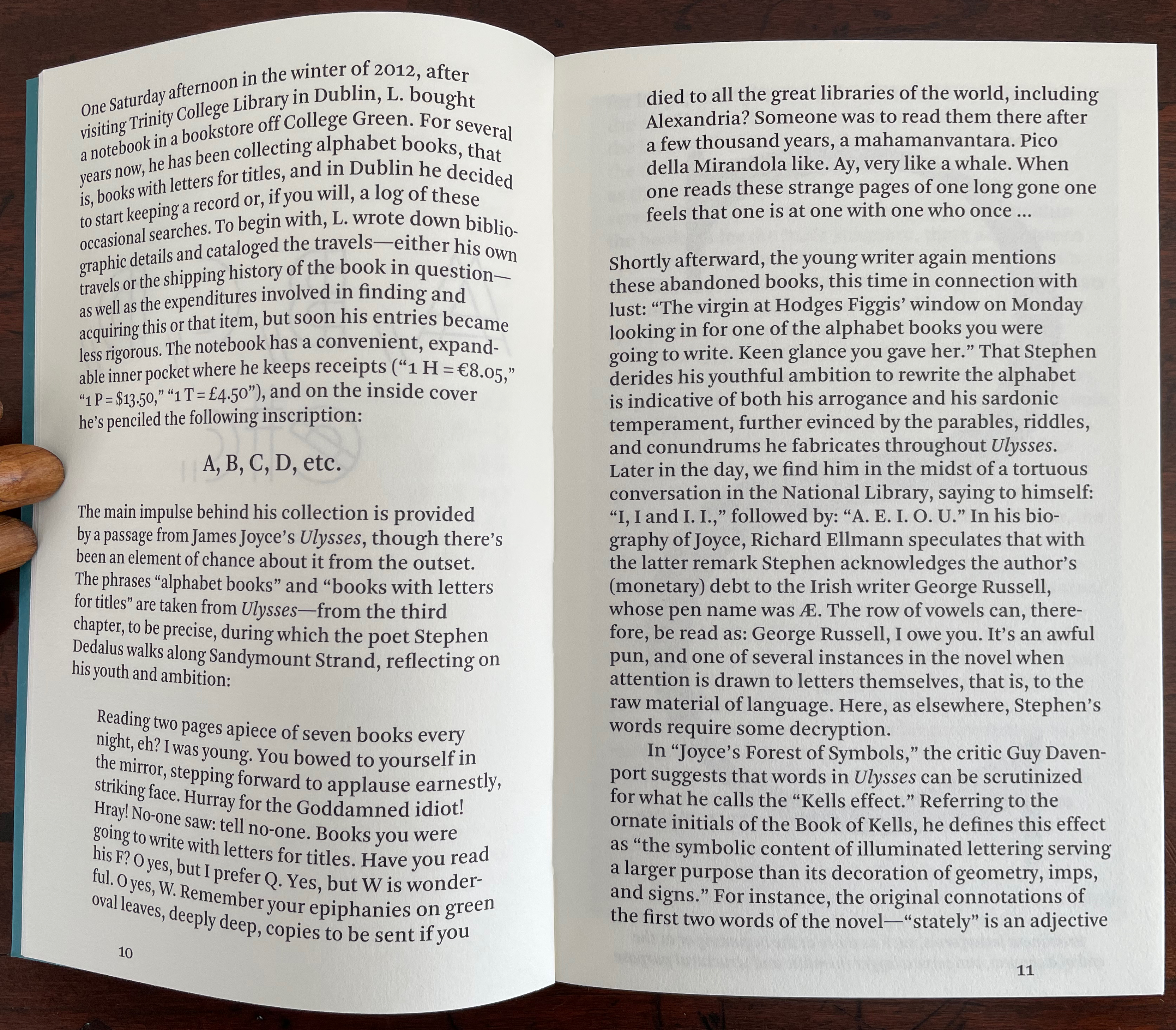
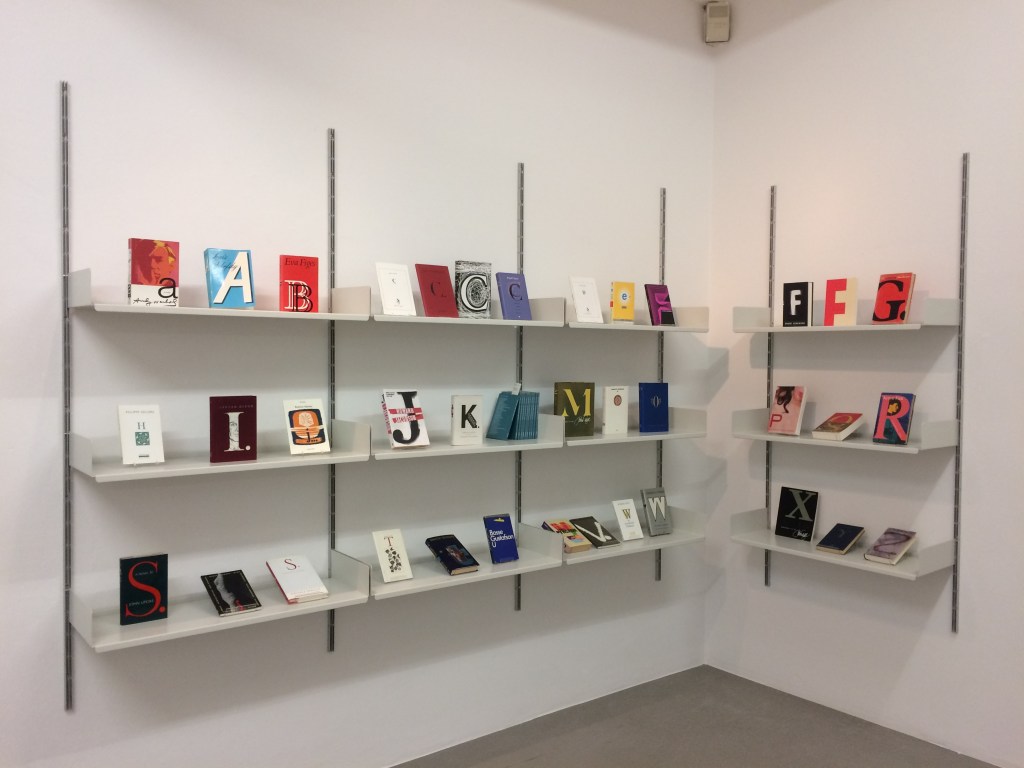
Publisher’s website: In A Die with Twenty-Six Faces, the author — let’s call him L. — guides the reader through his collection of alphabet books, that is, books with letters for titles. Some of these titles are well known: Andy Warhol’s “a,” Louis Zukofsky’s “A”, Georges Perec’s W. Others are obscure, perhaps even imaginary: Zach Sodenstern’s A, Arnold Skemer’s C and D. Tracing connections between these books, L. elaborates on what the critic Guy Davenport has called the “Kells effect”: “the symbolic content of illuminated lettering serving a larger purpose than its decoration of geometry, imps, and signs.”
The title stirs thoughts of Marcel Broodthaers’ oracular statement in 1974 “I see new horizons approaching me and the hope of another alphabet”. An alphabet that unrolls across the twenty-six faces of a die would certainly qualify as another alphabet. Broodthaers and the die also stir thoughts of Stéphane Mallarmé’s Un Coup de DésJamais N’Abolira le Hasard to which Broodthaers paid repeated homage. Throwing a twenty-six-sided die would certainly no more abolish chance than would a roll of Mallarmé’s six-sided die. Lüthi’s game, however, has little to do with chance unless we count his luck in finding the works to build his library of single-letter-entitled books. Even less to do with luck if some of the library is fictitious, a likelihood that the “publisher’s” statement suggests. Lüthi’s die is loaded!
A selection of Lüthi’s “alphabet” books on display. Courtesy of the author. Photo: Gesellschaft für Aktuelle Kunst Bremen
On the Self-Reflexive Page II (2021)
On the Self-Reflexive PageII(2021) Louis Lüthi Paperback. H200 x W130 mm. 304 pages. Acquired from Idea Books, 18 September 2022. Photos: Books On Books Collection.
This is a peculiar book in its order and nature. After two variant half-title pages, it begins with a section entitled “Black Pages”. Only on flipping through the volume can we find the remaining front matter — just after page 208. There’s another half-title and then the Table of Contents. Reproducing the marbled page from Laurence Sterne’s The Life and Opinions of Tristram Shandy, Gentleman (1759–1767), the book’s cover gives a clue to this peculiarity. Sure enough, Lüthi spells it out later in the section entitled “On Drawing Pages”.
So much in Tristram Shandy is presented out of order: a second dedication comes not after the first but on page 27, the preface is not at the beginning of the novel but in chapter 20 of volume three, and chapters 18 and 19 of volume nine come not after chapter 17 but are inserted after chapter 25. In a similar act of transposition, we find a marbled page in volume three, even though hand marbling is customarily used to decorate covers and endpapers. As Viktor Shklovsky observed, “It is precisely the unusual order of even common, traditional elements that is characteristic of Sterne.” (p. 240)
This one paragraph confers on Lüthi’s entire book the very self-reflexivity that it explores across a range of literature and artists’ books. Reflecting the custom to which it refers, On The Self-Reflexive Page II carries Sterne’s marbled pages on its front and back covers. In the text before his marbled leaf, Sterne refers to it as the “(motly emblem of my work!)“. Lüthi has taken that exclamation to heart (and cover) as if it were advice in creating this hybrid, motley work of his own: “part artist’s book and part essay, part literary excavation and part typographical miscellany” as he calls it in his middle-of-the-book Foreword.
Lüthi’s work is just one in the Books on Books collection of several inspired by Tristram Shandy. There is Erica Van Horn’s Born in Clonmel (2011), Simon Morris’ Do or DIY (2012), Abra Ancliffe’s The Secret Astronomy of Tristram Shandy (2015), and Shandy Hall‘s The Black Page Catalogue (2010), Emblem of My Work (2013), Paint Her To Your Own Mind (2018) and The Flourish of Liberty (2019). Outside the collection, there is Brian Dettmer’s Tristram Shandy (2004), commissioned by Shandy Hall’s Laurence Sterne Trust, and also Sean Silver’s Shandean online venture called The Motley Emblem (2022~) celebrating Sterne’s marbled leaf and the analytical chemistry of marbling. The latter may become a book, even an artist’s books to add to the tally. In The Century of Artists’ Books, Johanna Drucker draws attention to Sterne’s novel twice as an example of self-reflexivity or self-interrogation, but in 1994 and 2004, Sterne did not rise to the same level of precursor to book artists as William Blake or Stéphane Mallarmé in Drucker’s view. With these later works of book art inspired by Uncle Toby’s nephew in the bag, a dozen or so more might nudge Sterne up the scale.
In the meantime, anyone interested in artists’ books could fruitfully apply to the medium Sterne’s exhortation to his own readers:
Read, read, read, read, my unlearned reader! read, — or by the knowledge of the great faint Paraleipomenon — I tell you before-hand, you had better throw down the book at once; for without much reading , by which your reverence knows, I mean much knowledge, you will no more be able to penetrate the moral of the next marbled page (motly emblem of my work!) than the world with all its sagacity has been able to unraval the many opinions, transactions and truths which still lie mystically hid under the dark veil of the black one.
Artists’ books are to be read, handled and digested, not stored away in the archives.
Inscription: The Journal of Material Text, Issue 4 on Touch Simon Morris, Gill Partington and Adam Smyth (eds.) Cased perfect bound paperback, printed paper cover. 313 x 313 mm. 120 pages. ISSN: 2634-7210. Acquired from Information as Material, 29 November 2023. Photos: Books On Books Collection.
Different readers will come to different conclusions on whether Inscription #4 dedicated to the subject of touch evokes the level of tactility in Melville’s famous Chapter 94 “A Squeeze of the Hand”. But all can agree that they share a certain seminality. Like Herman Melville with his preliminaries to Moby Dick, the editors of Inscription lead their fourth issue with definitions and choice quotations on the subject of “touch”, as much a Leviathan subject as that of Melville’s novel. Where Melville merged scholarly apparatus with narrative fiction to create a novel literary work, Simon Morris, Gill Partington and Adam Smyth have merged photography, poetry, augmented reality and audio with academic and critical essays to create a novel form of scholarship.
Personal Libraries Library (Winter 2009-10 to Spring/Summer 2021)
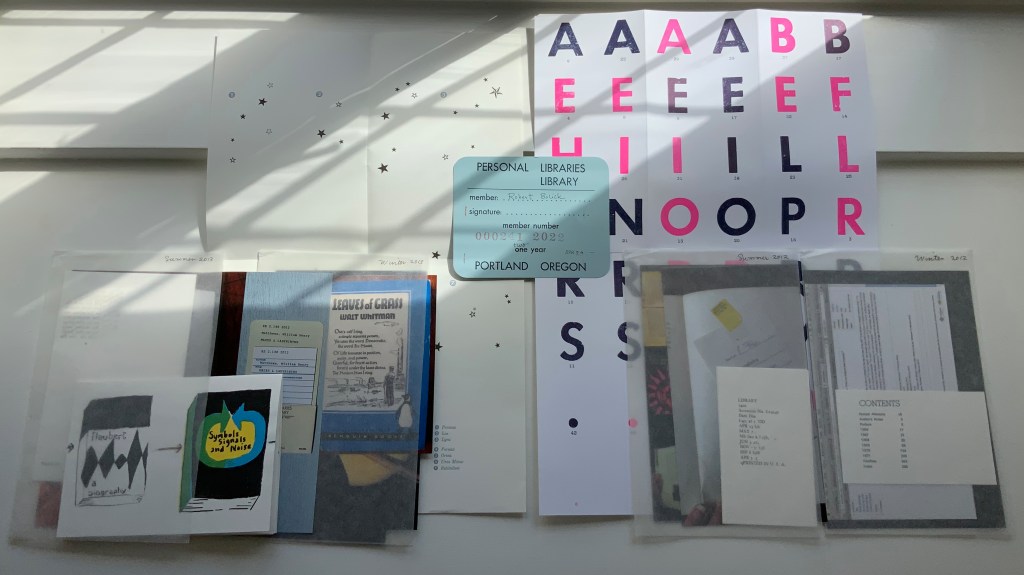
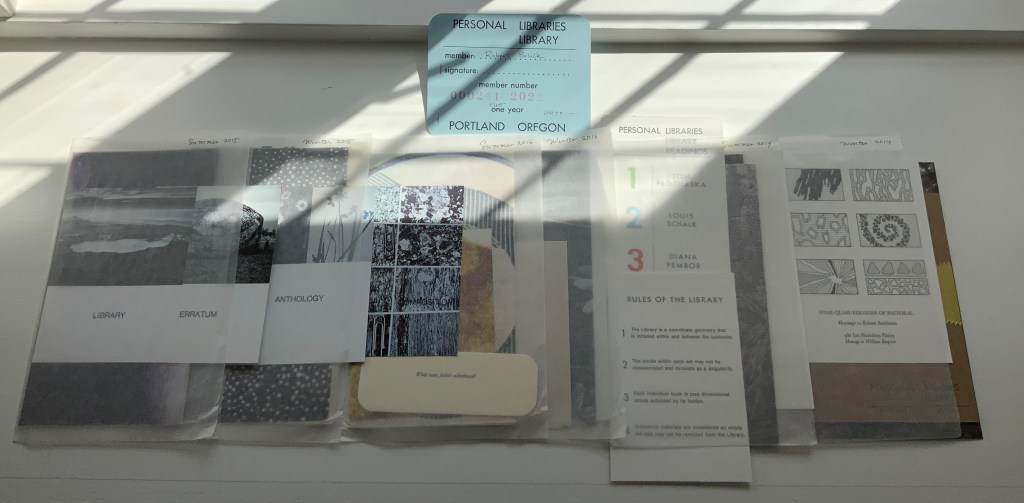
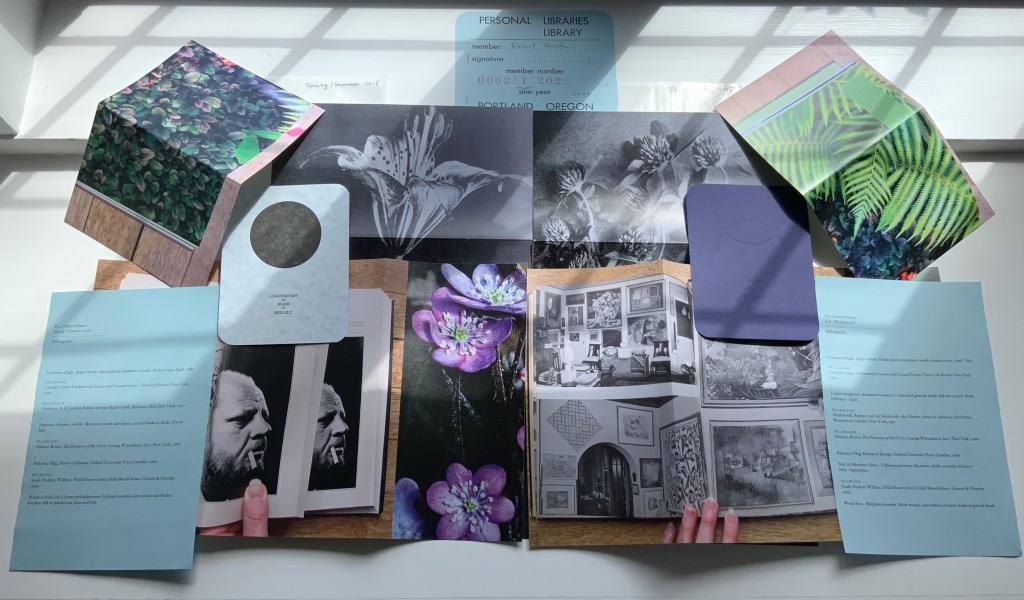
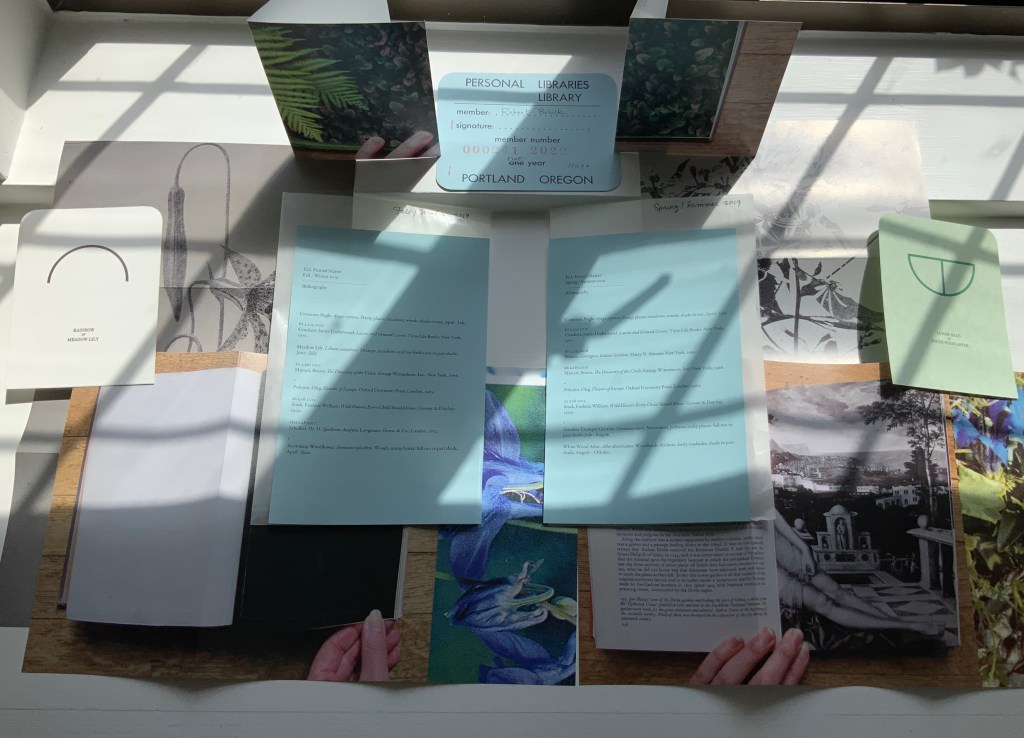
Imagine belonging to a library composed of selected personal libraries and housed on another continent. Imagine that the librarian who selects those personal libraries and hunts down copies of the works (preferably the same editions) needed to recreate those libraries completely is also constantly harvesting them for cross-references and delivers the discoveries to you in the form of ephemera. It exists. I have a library card for it.
Since 2009, Abra Ancliffe, its artist/librarian, has been replicating the personal libraries of
Maria Mitchell (1818-1889), Massachusetts astronomer, educator, suffragist and librarian Robert Smithson (1938-1973), New Jersey-born land artist, sculptor and art theorist Jorge Luis Borges (1899-1986), Argentinian writer of fiction, poetry and essays Italo Calvino (1923-1985), Cuban-Italian writer of fiction, poetry and essays Anne B. Spencer (1882-1975), Virginia-based member of the Harlem Renaissance circle, poet, civil rights activist, teacher and librarian
Each personal library has a catalogue derived from our librarian’s research and consultation with foundations associated with each of the owners. Each library has its wish list of works needed to complete the holdings; and a Reference Library Catalogue for background on each of the owners has been added. But why these particular personal libraries? Was there a rule?
The library itself has rules (courtesy of our librarian’s fellow artist Larissa Hammond):
1 The Library is a coordinate geometry that is initiated within and between the booksets. 2 The books within each set may not be disassociated and circulate as a singularity. 3 Each individual book is zero dimensional unless activated by its faction. 4 Reference materials are considered an empty set and may not be removed from the Library.
Given such rules, it is no surprise that our librarian has included Borges. The fabulist of “The Library of Babel” once held the job of first assistant in a Buenos Aires municipal library and reportedly remarked “if I were asked to name the chief event in my life, I should say my father’s library” and “I always imagined Paradise to be some kind of a library”. Also, given such rules and the inclusion of Borges, could the Cuban-Italian Italo Calvino, a member of the Oulipo movement, be far behind?
Maria Mitchell’s personal library was the seed or germinating star of the PLL in the winter of 2009-2010 (see the item in the upper right corner of the photo above). Flowers and constellations are two themes that our librarian finds as links among the personal libraries.
Another link between the libraries are the books common to more than one library. For instance, Ralph Waldo Emerson’s Essays appears in Maria Mitchell’s and Robert Smithson’s libraries. Perhaps there is a sort of transcendentalism driving the library! How appropriate that the first book from Mitchell’s library acquired and the first in the PLL was Ralph Waldo Emerson’s Essays.
By virtue of these collage-like connections that our librarian draws in the periodic issues of ephemera, a book published at a later date may seem to belong equally to an earlier owner. Perhaps, as in the collages into which the ephemera can fall, “one book may hide another” to paraphrase Kenneth Koch. The issues of ephemera arrive like challenges to Robert Smithson’s notion of site and non-site works of art. They are works that depend and do not depend on their site. They arrive so similar and so different, regular enough but sporadic enough, that they are like “Miss Mitchell’s comet” — non-periodic (until it appears again).
PLL Ephemeral Issues. Left to right and top to bottom: Winter 2009/2010; Summer 2010; Winter 2011; Summer 20012; Winter 2012; Summer 2013; Winter 2013; Summer 2014; Winter 2015; Summer 2016; Winter 2016; Summer 2017; Fall/Winter 2017; Spring/Summer 2018; Fall/Winter 2018; Spring/Summer 2019; Fall/Winter 2019; Spring/Summer/Fall/Winter 2020; Spring/Summer 2019.
The ephemera themselves represent “collaborations” among the personal libraries — courtesy of our librarian’s reading of the Library’s “coordinate geometry”, of course. For the Spring/Summer 2021 issue, the first piece of ephemera listed on the blue manifest (its Bibliography) is “Paper to be Placed in a Window” (see the upper left-hand corner of the photo immediately above). Glossy black on both sides, the single folded sheet displays an astronomical photo with holes of different size punched to let light light up the constellation. According to the manifest or Bibliography, the work connects the constellation Aguila (Eagle) “in and around the Milky Way south of Cygnus” with J.B. Sedgwick’s Introducing Astronomy from Smithson’s library with Laurence Sterne’s The Life & Opinions of Tristram Shandy, Gentleman from Calvino’s. The connection with Sedgwick is obvious. The connection with Sterne’s novel may be obvious to readers familiar with its “black page”, or will be to readers here who proceed to the entry for the next of Abra Ancliffe’s works in the Books On Books Collection.
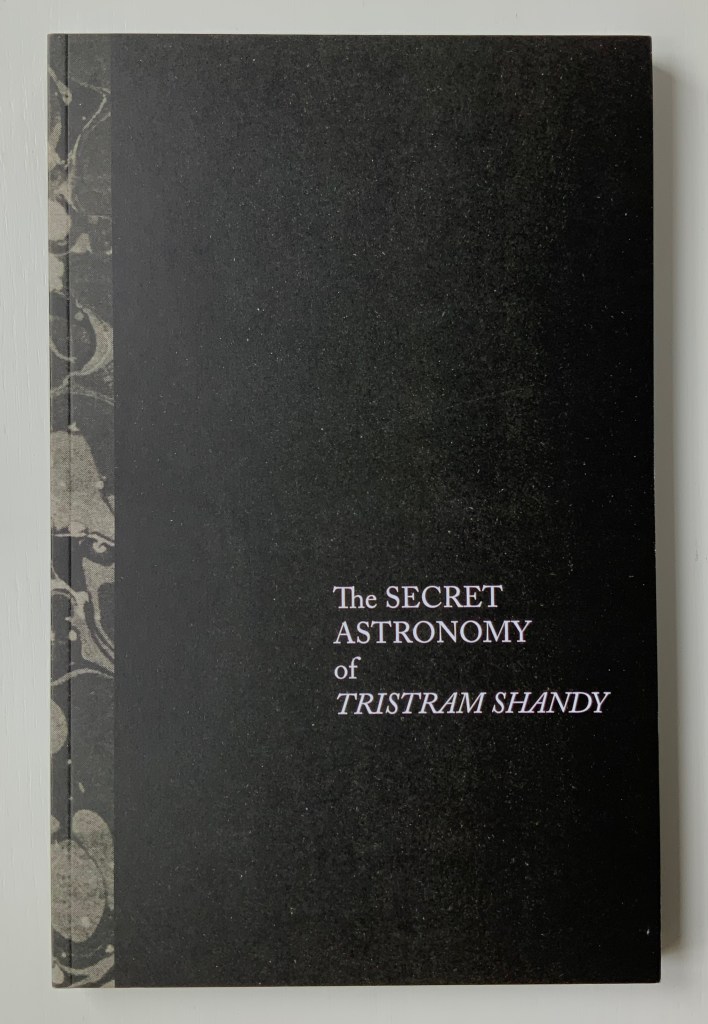
It is no surprise that Ancliffe’s work of book-art-cum-academic-treatise is part of the Laurence Sterne Trust Foundation’s permanent collection. Like Shandy Hall’s own The Black Page Catalogue (2010), The Secret Astronomy extrapolates and celebrates page 73 with the same whimsy and seriousness that the 73 writers and artists invited to make their own Black Page exercised. In its own self-publishing status, it also underscores like Simon Morris’s manifesto Do or DIY (2012) the same status of Sterne’s work as a forerunner to the self-published, self-referential works of book art of the mid- to late 20th century. It is Ancliffe’s elevation of the self-reflexive academic treatise to art status that secures The Secret Astronomy its position in the Books On Books Collection.
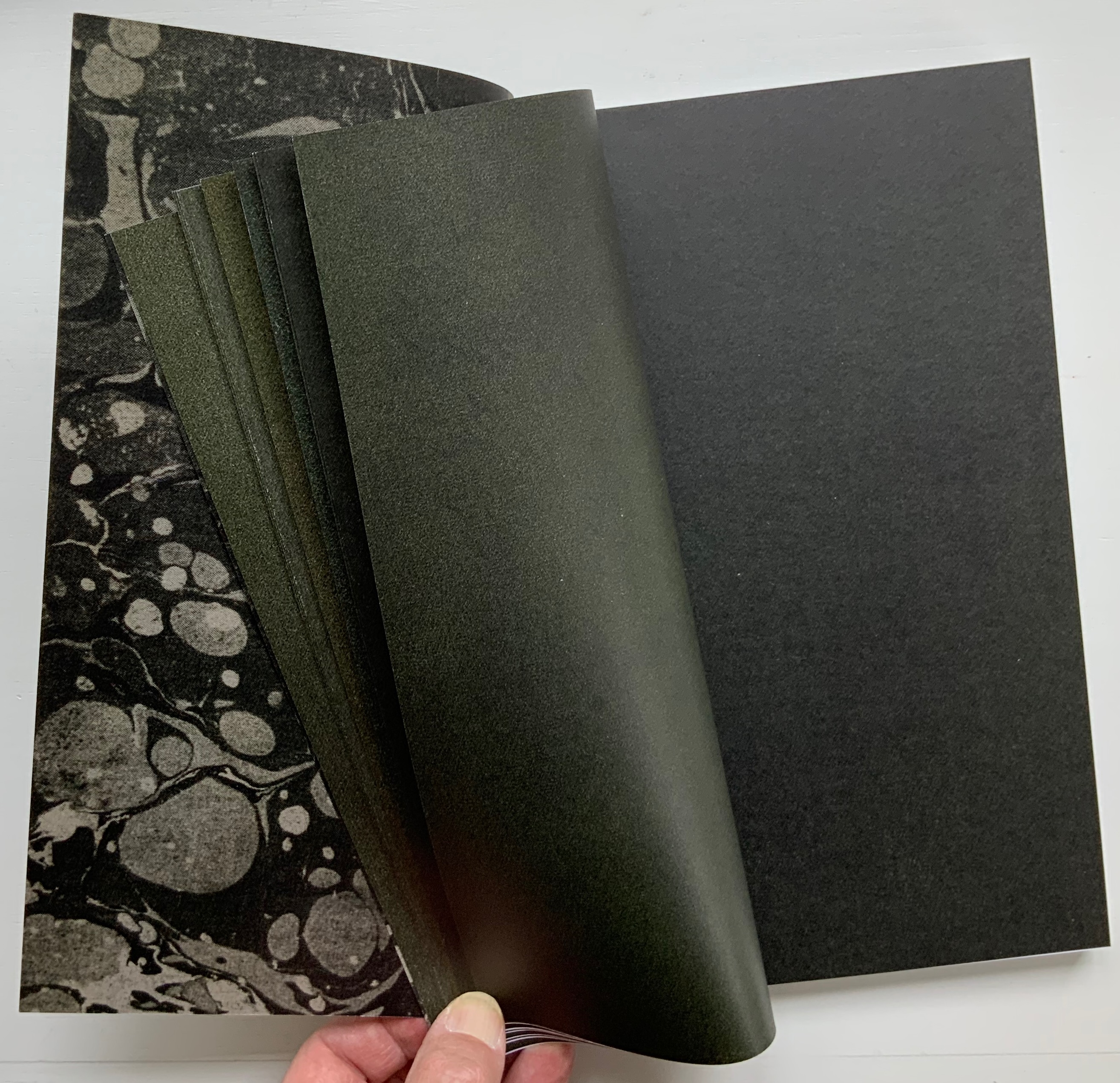
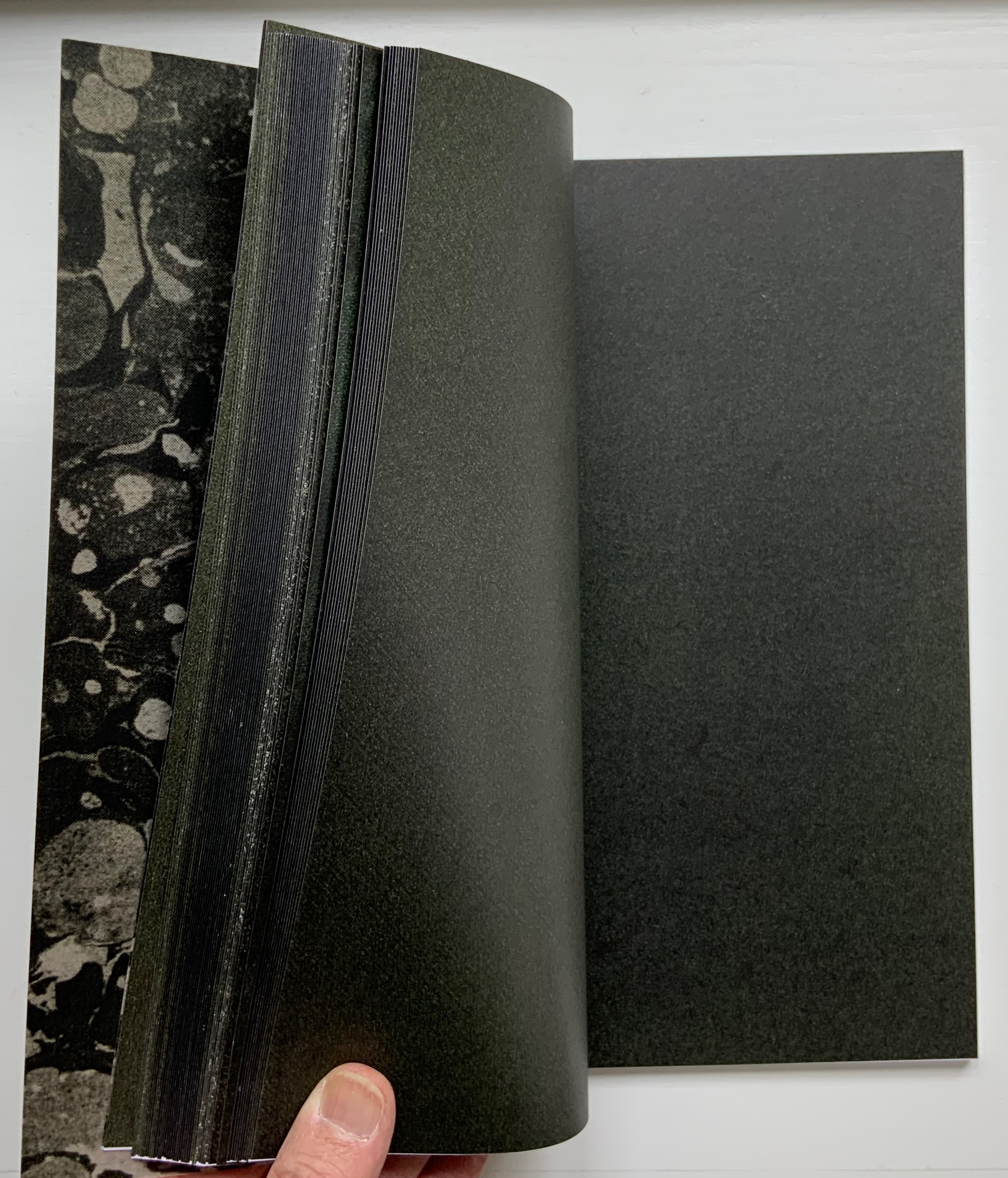
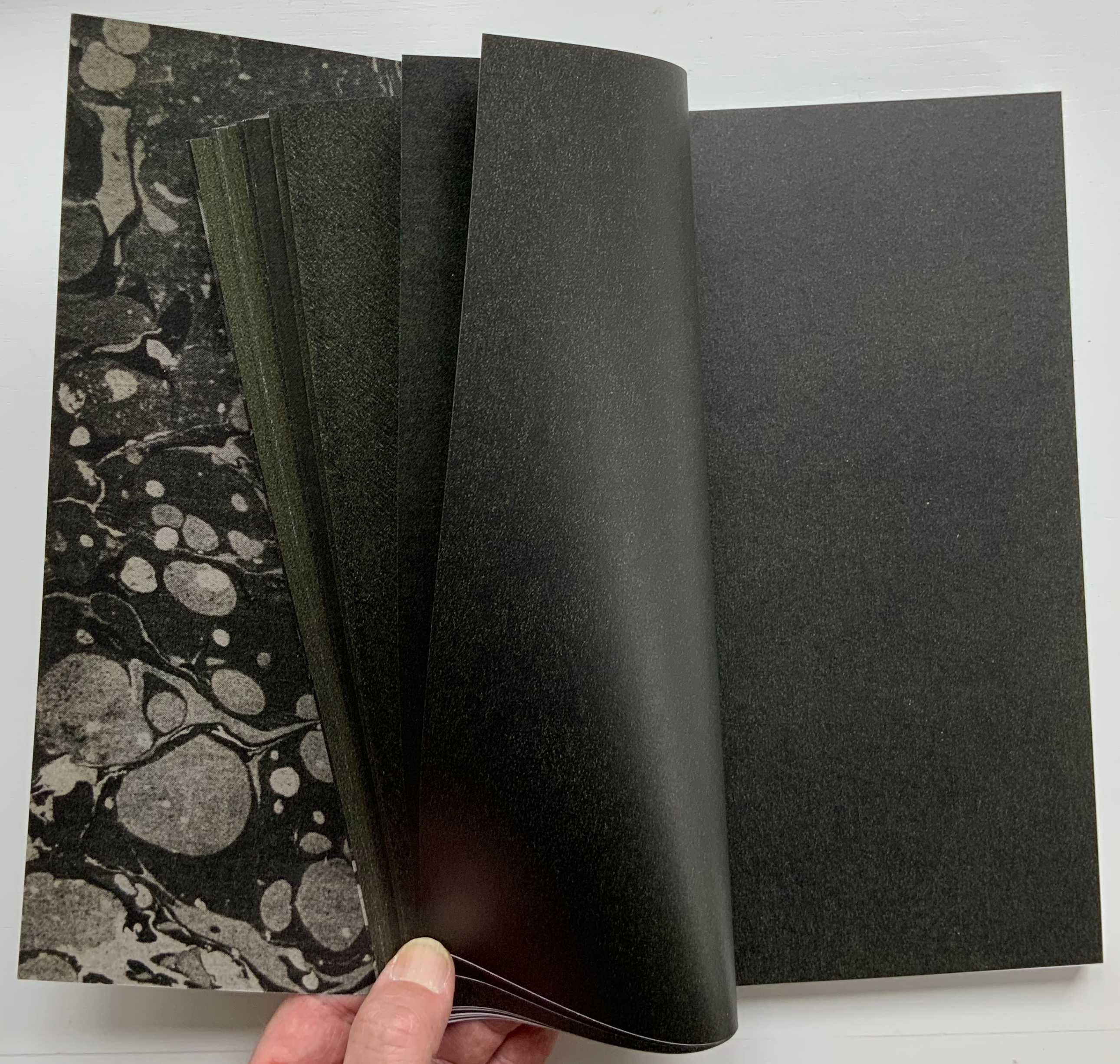
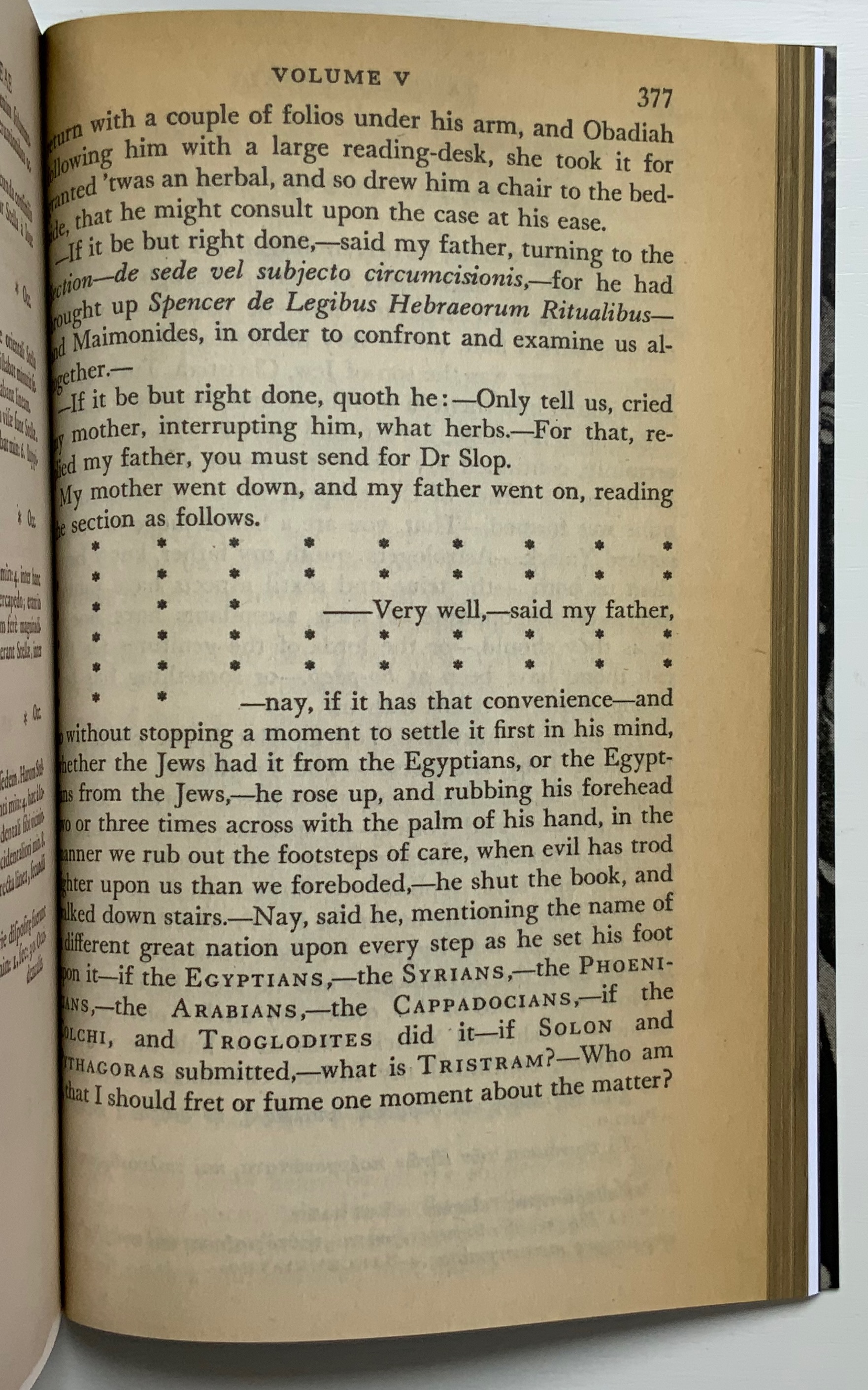
The rectangle of black appearing on page 173 in the first edition of Sterne’s novel faces the brief announcement of Parson Yorick’s death on page 172: “Alas, poor Yorick”. Taking off on the concept of academe’s variorum edition, Ancliffe has reproducedthe black pages from more than one hundrededitions of Sterne’s novel. What is a singularity in the novel becomes a contemplation of a regularity that reveals a material irregularity since the 1759 edition. Densities of ink have varied, oxidation occurred, spots from lint and fingerprints accumulated — even show-throughs from the next chapter’s text — so that the eye begins to read the accumulated pages for astronomical images — Tristram’s and Sterne’s secret astronomy. (The temptation to Grangerize this work by slipping into it Ancliffe’s ephemera “Paper to be Placed in a Window” is strong.) Ancliffe urges forward her case for the discovery of a secret astronomy with a series of appendices, one of which draws attention to Sterne’s use of the asterisk in the novel and proposes one of its hidden kabbalistic meanings in an equation: if star = *, and Sterne = star, then Sterne = *. There is even the dutiful source appendix listing all of the editions from which black pages have been gathered.
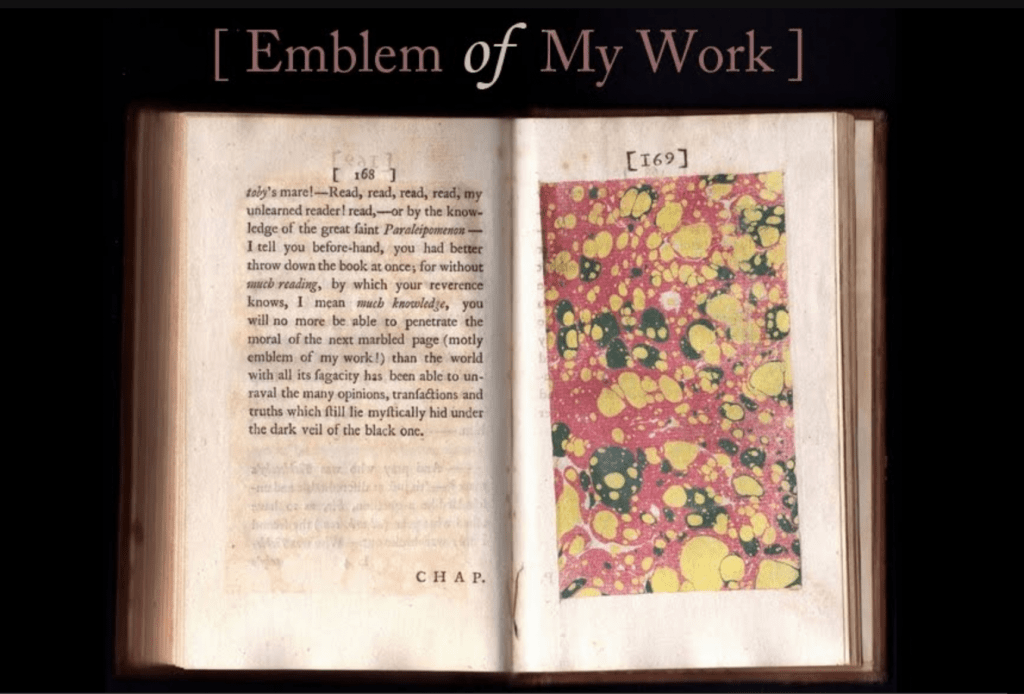
Pages 169-70 of the first edition of Tristram Shandy account for another famous singular, regular irregularity — the marbled page, which Tristram calls “the motly emblem of my work”. Ancliffe’s black, brown and gray marbled spine and inside covers make for an apt, ironic and artistic stroke — a reminder of the element of chance that is so characteristic of Sterne’s narrative project, of The Secret Astronomy and of the ephemera arising from the Personal Libraries Library.
From Shandy Hall’s Emblem of My Workblog, accessed 18 September 2019.
Further Reading
“Shandy Hall“. 1 January 2021. Books On Books Collection.
“Jorge Luis Borges“, last edited on 8 May 2022. Wikipedia. Accessed 15 May 2022.
“Italo Calvino“, last edited 20 April 2022. Wikipedia. Accessed 15 May 2022.
“Maria Mitchell“, last edited 8 March 2022. Wikipedia. Accessed 15 May 2022.
“Robert Smithson“, last edited 14 May 2022. Wikipedia. Accessed 15 May 2022.
“Anne B. Spencer“, last edited 25 April 2022. Wikipedia. Accessed 15 May 2022.
Baldwin, Kate, Denise Bookwalter, Sarah Bryant, Macy Chadwick and Tricia Treacy. 2021.REF.
Inscription: The Journal of Material Text – Theory, Practice, History, Issue 2 on Holes (2021) Simon Morris, Gill Partington and Adam Smyth (eds.) Perfect bound softcover, H314 x W314 mm, 180 pages. Editions included: Fiona Banner (aka Vanity Press), Full Stop, front & back covers; Kendell Geers, Stripped Bare, end papers; Carolyn Thompson, The Beast in Me, H1180 x W1180 mm; Erica Baum, Piano Rolls, H120 x W120 closed, W960 mm open; Harold Offeh, Crystal Mouths, H210 x W105 closed, W480 mm open; David Bellingham, Cigar Burn Apertures, H210 x W105 mm; Miranda July, Bookmark, H302 x W54 mm; Christian Bök, Supermassive, LP. Acquired from Information as Material, 10 October 2021. Photos of the issue: Books On Books Collection.
How materially perverse is it that the second issue of Inscription is devoted to “the hole”, yet it is the first issue that actually has a hole in it? The first issue of Inscription did set a seriously playful — or playfully serious — tone, and the second issue does not fail to maintain it. The second issue continues the dos-à-dos binding but with only the front and back covers as the external giveaway. In the middle of this single-spine paperback, pages 1-90 meet an inverted pages 90-1 in the middle, which prompts the reader to turn the open book 180° and flip back to page 1. From either direction, the reader meets the traditional backmatter of a journal in the middle.
Inverted cover and center of Inscription (2021).
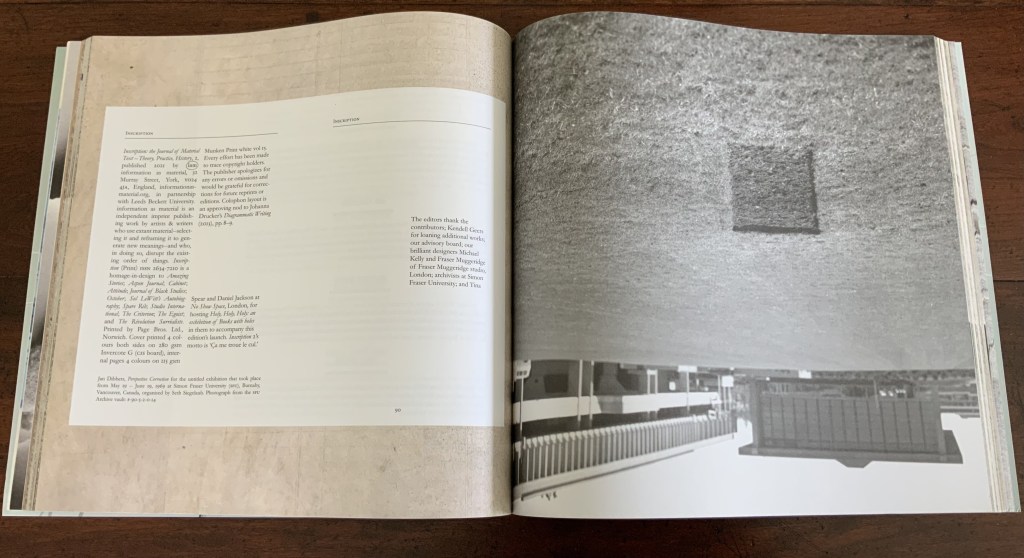
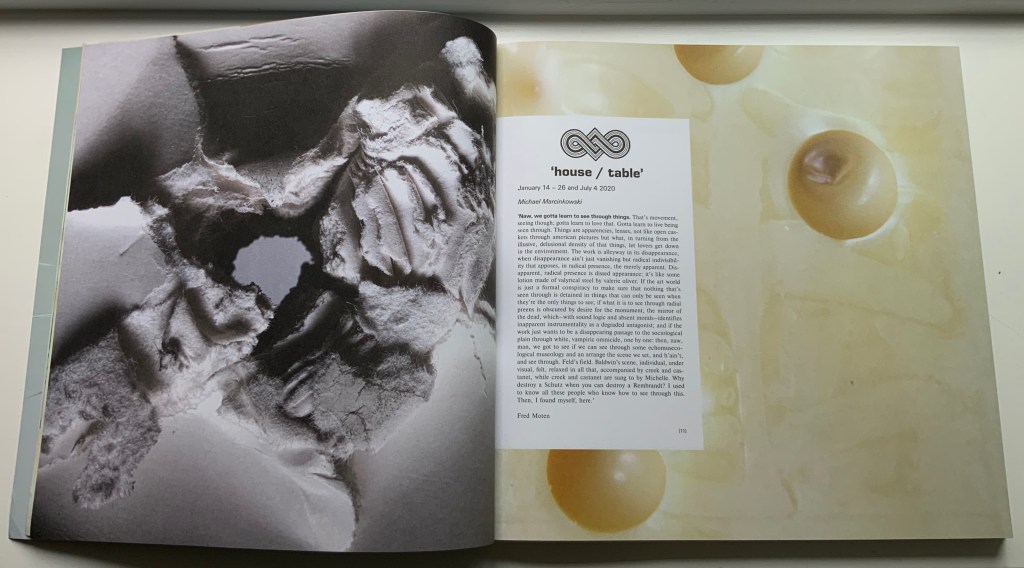
Such reversals of expectation call for a countervalent design element to avoid too much confusion. In this issue, that element consists of constant earth-tone backgrounds framing constant black-on-white text boxes (square holes?) for each article. Even within these constants, reversals of expectation play out. The backgrounds are drawn from 14 different sources, ranging from laid paper samples, parchment, pulp and brown boards to a slice of Emmental cheese (sorry, Gromit, no Wensleydale), and the layouts for each square hole differ, being taken from 16 other journals such as The Criterion, The Egoist and National Geographic.
List of backgrounds used throughout the issue.
List of publications whose layouts are used throughout the issue.
The Emmental cheese background around the opening of Marcinkowski’s essay; Hybrid wove/laid paper made for James Watt & Co around the opening of Lüthi’s essay.
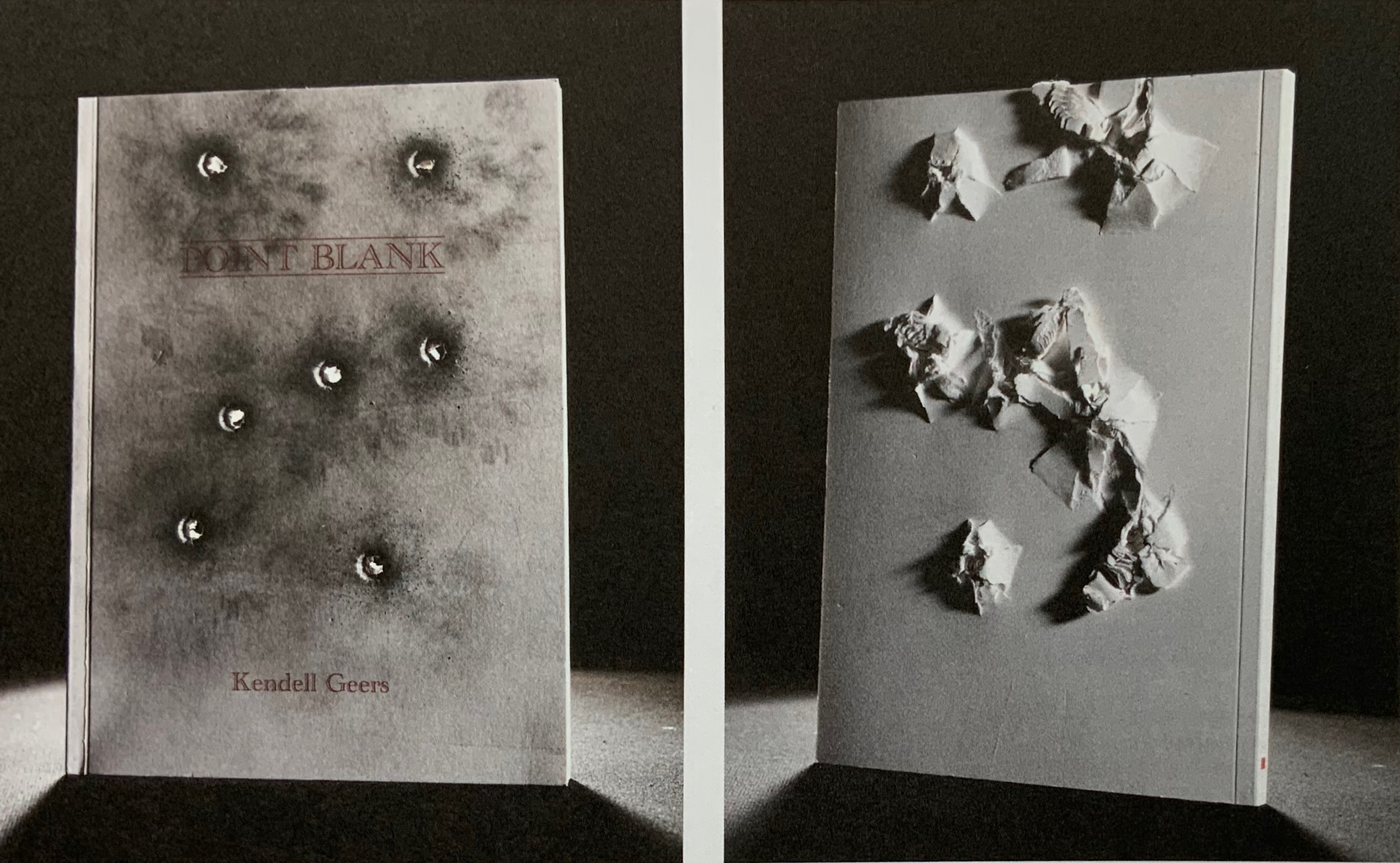
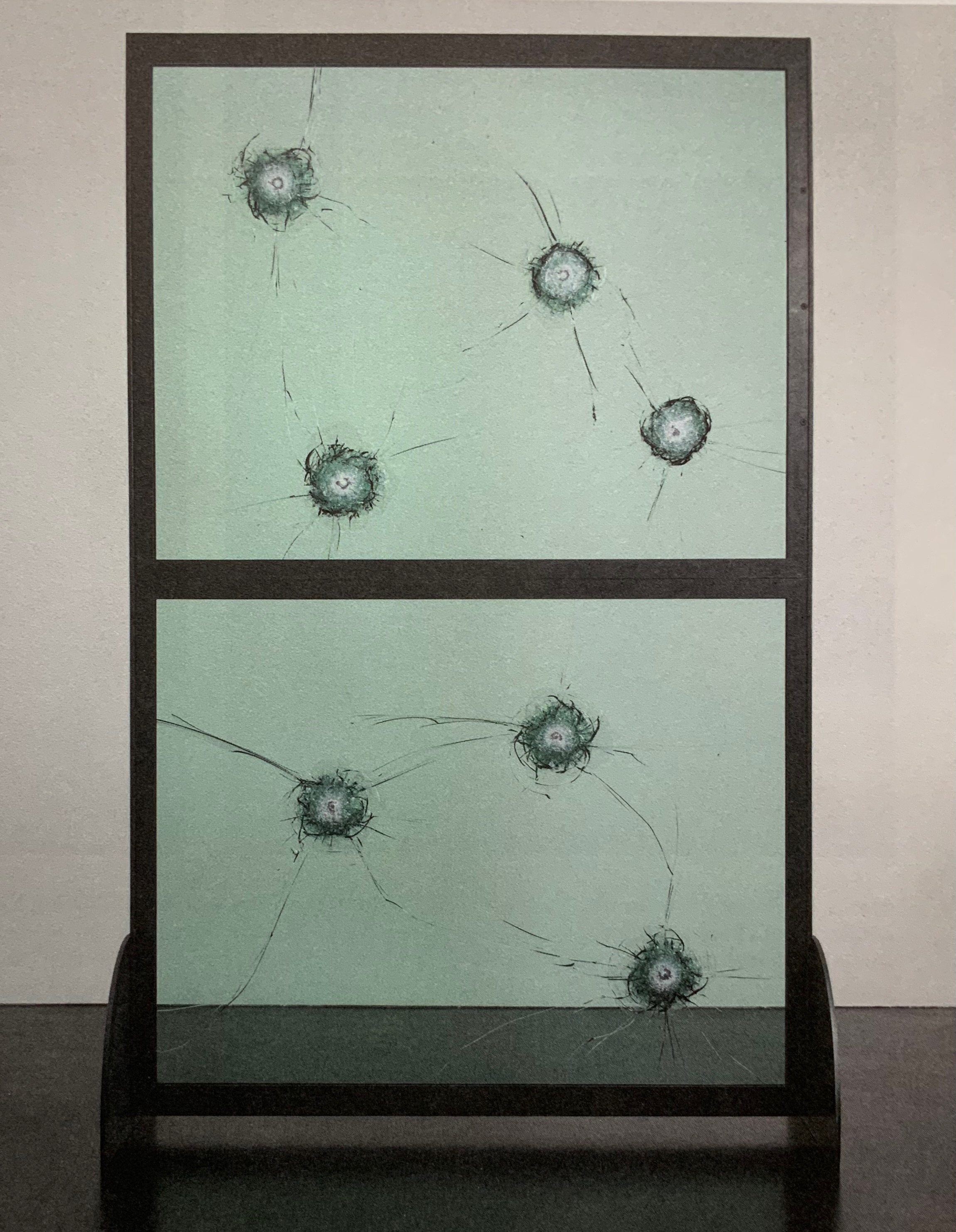
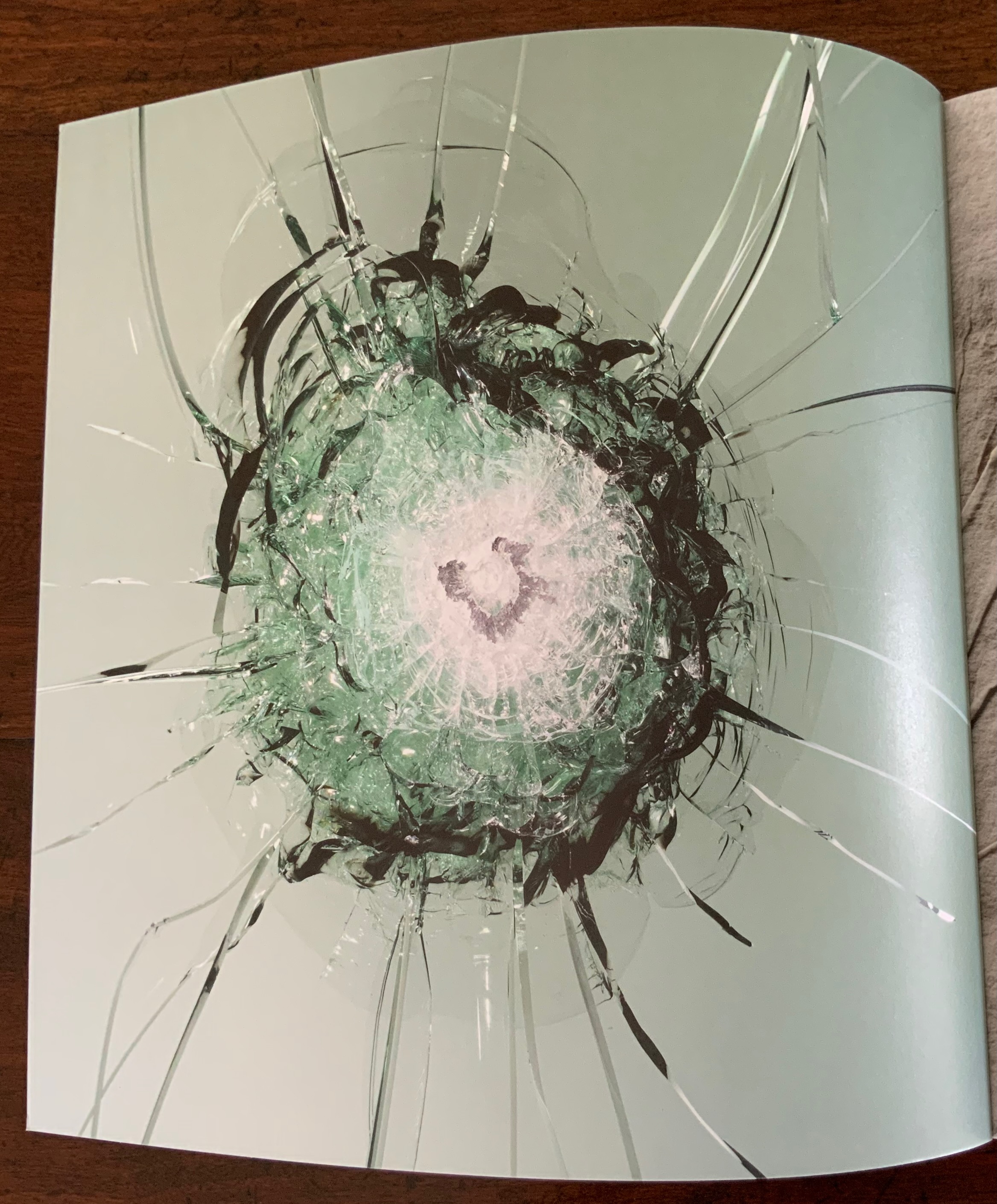
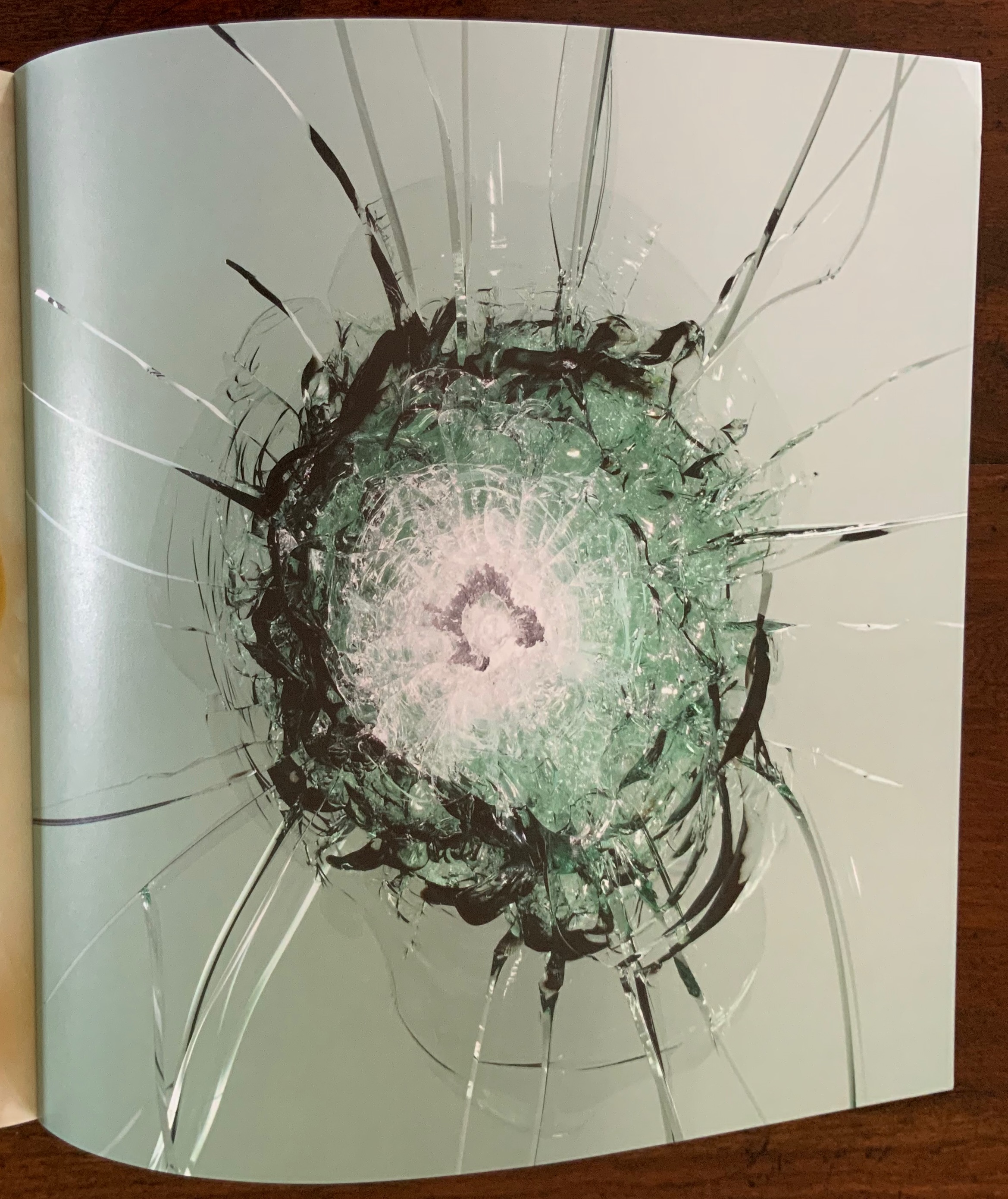
There is an even more recurrent “bass” line in this issue. It comes from the South African artist Kendell Geers, interviewed by the Editors. Even this bass line plays with variable perspective. Marking the start of most articles is a sheet bearing on recto and verso pages the image of a bullet hole (entry then exit) taken from Geers’ work Point Blank (2004). Bullet holes in glass — from Geers’ Stripped Bare (2009) — punctuate inversely the inside covers, bringing two symmetric/asymmetric openings to this topsy turvy production.
Kendell Geers, Point Blank (2004), front and back covers; Stripped Bare (2009; inside covers of Inscription (2021).
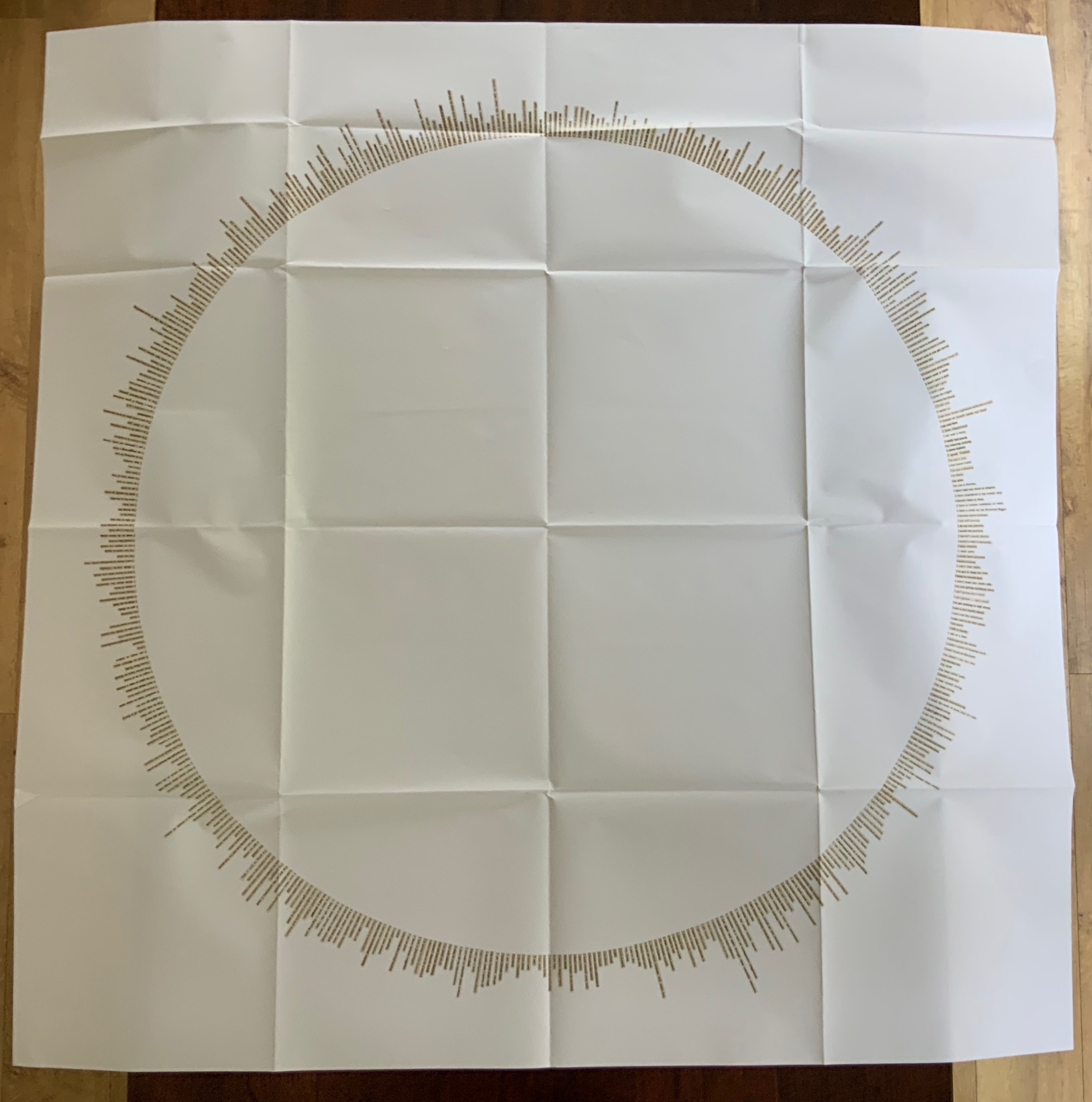
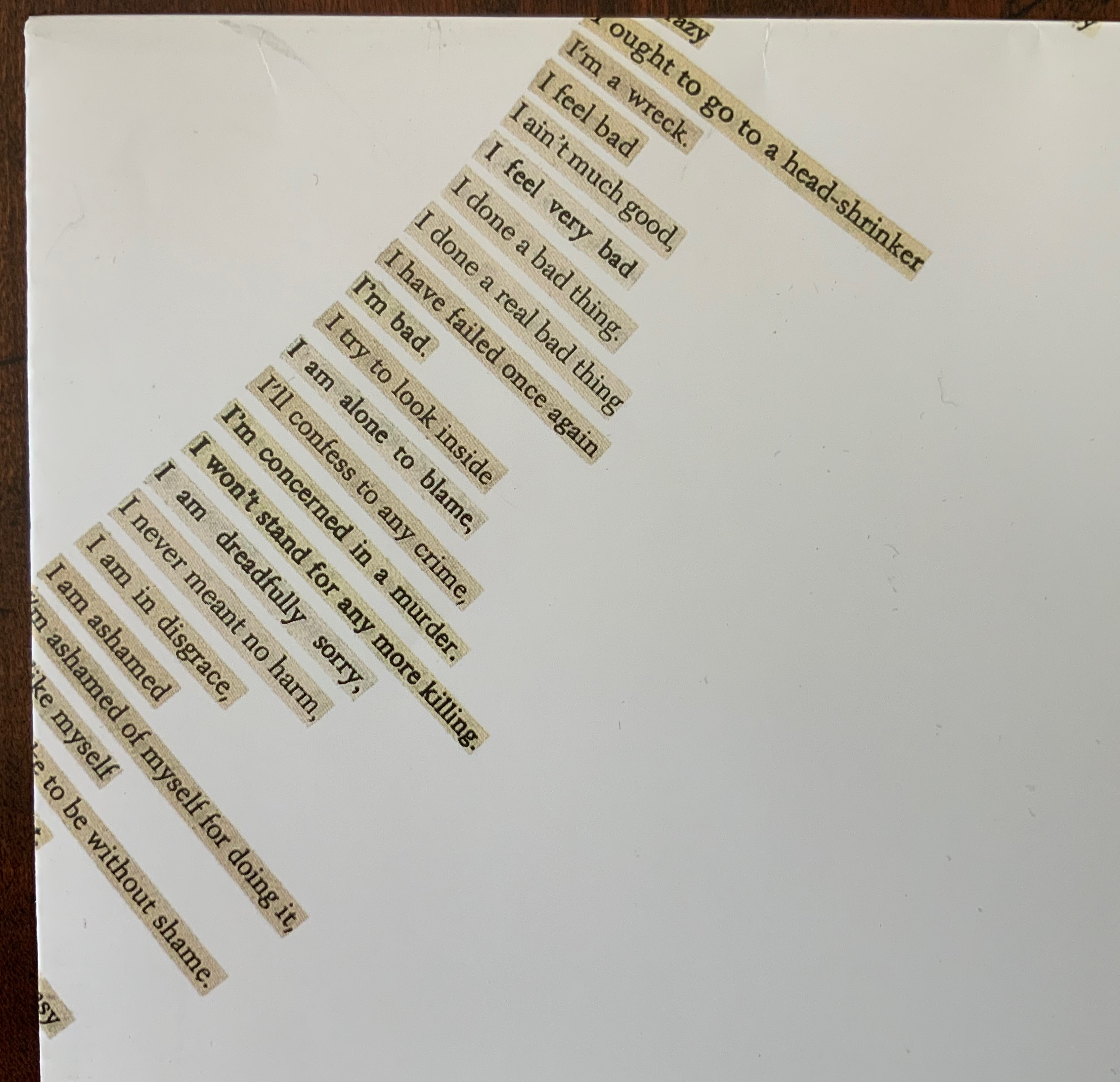
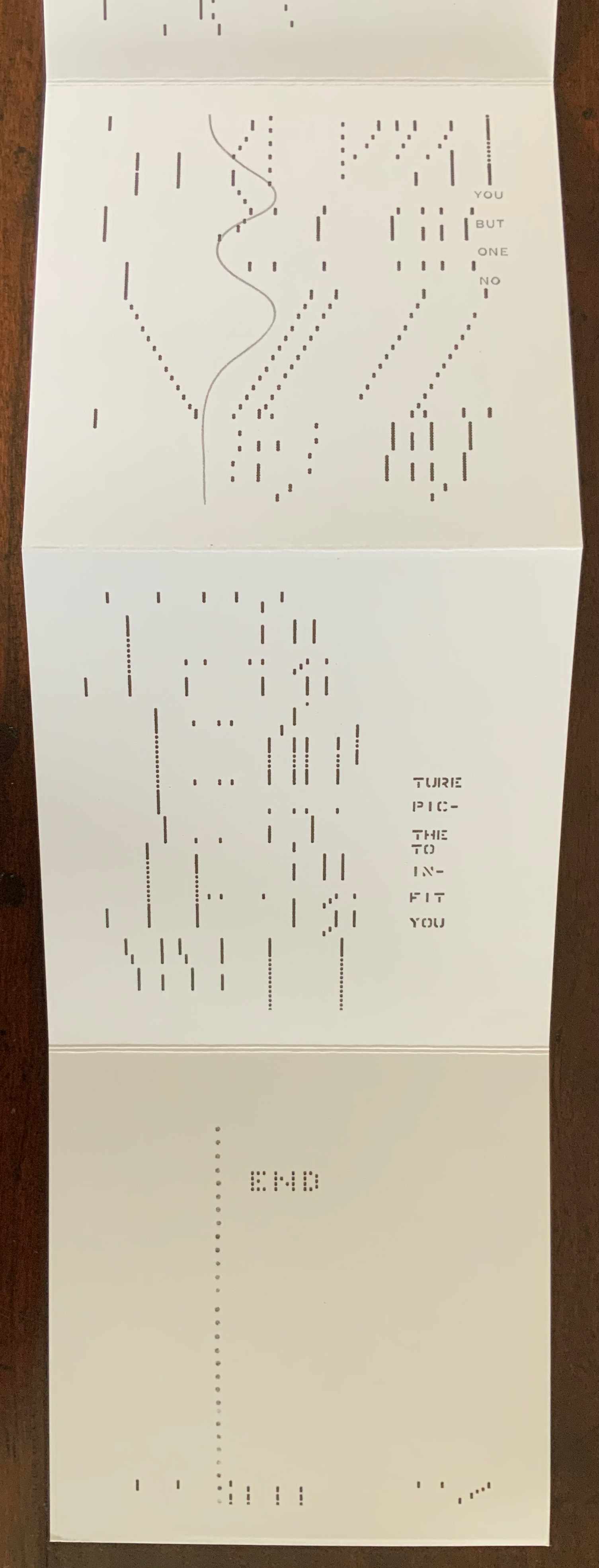
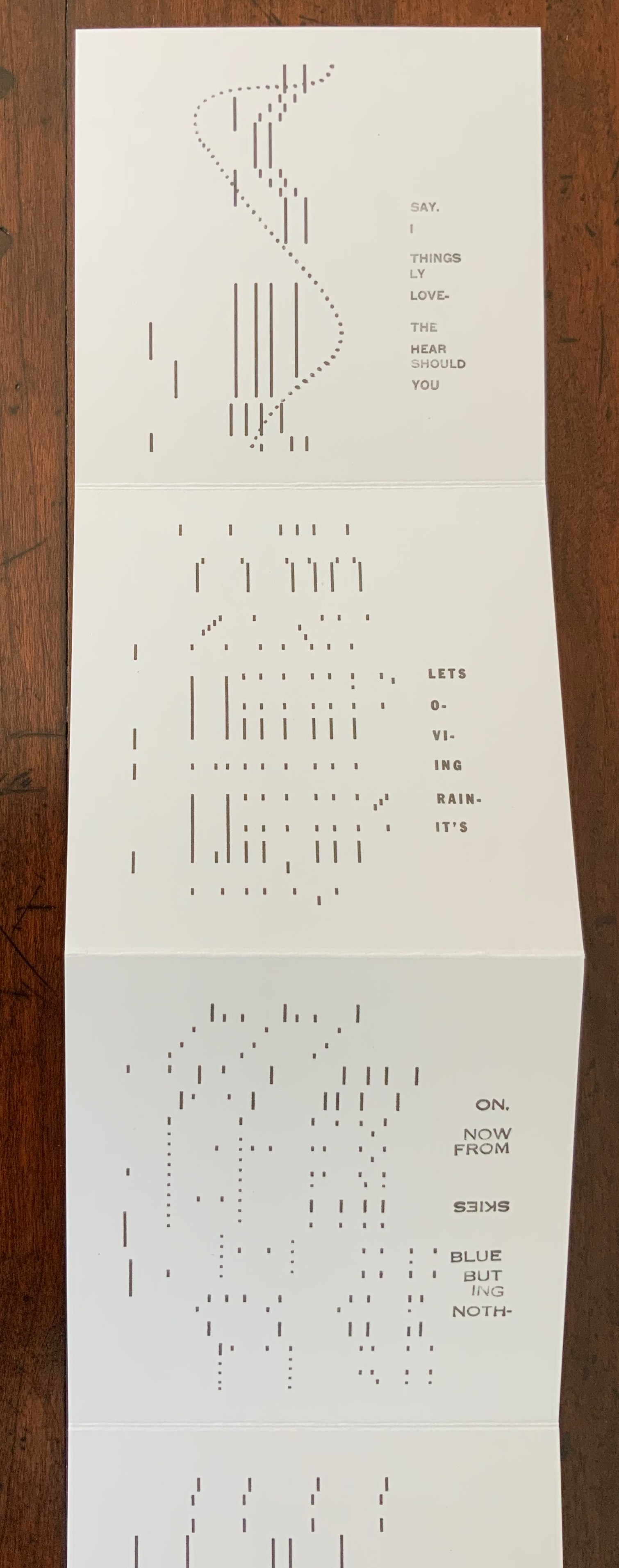
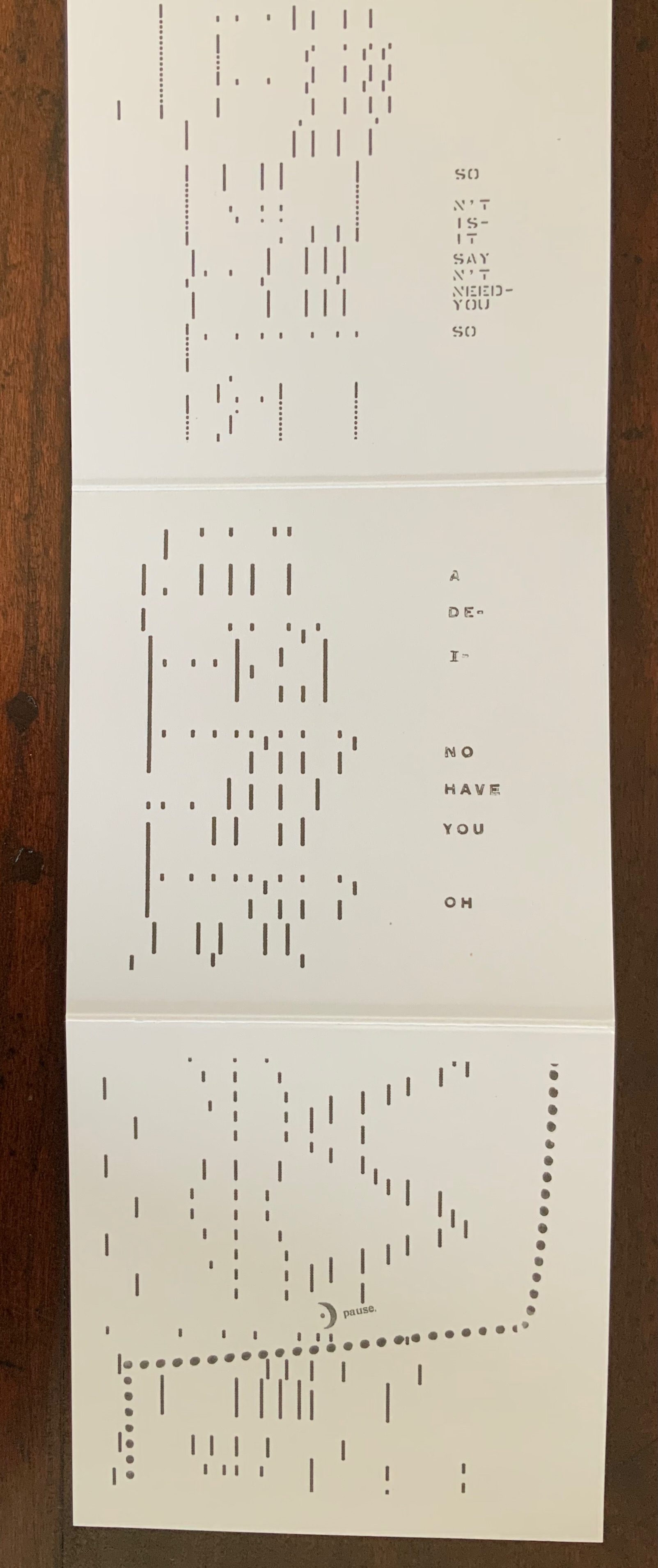
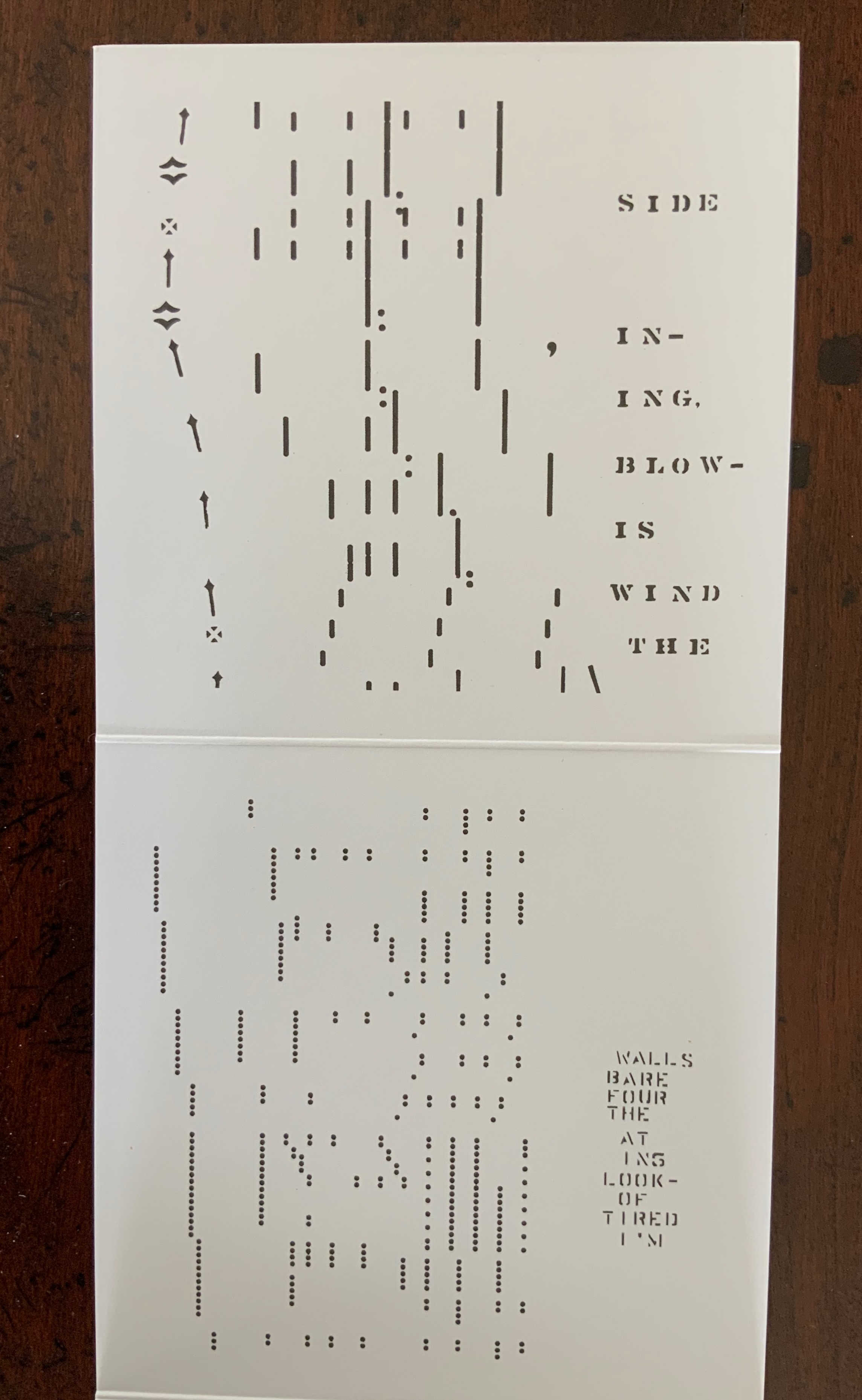
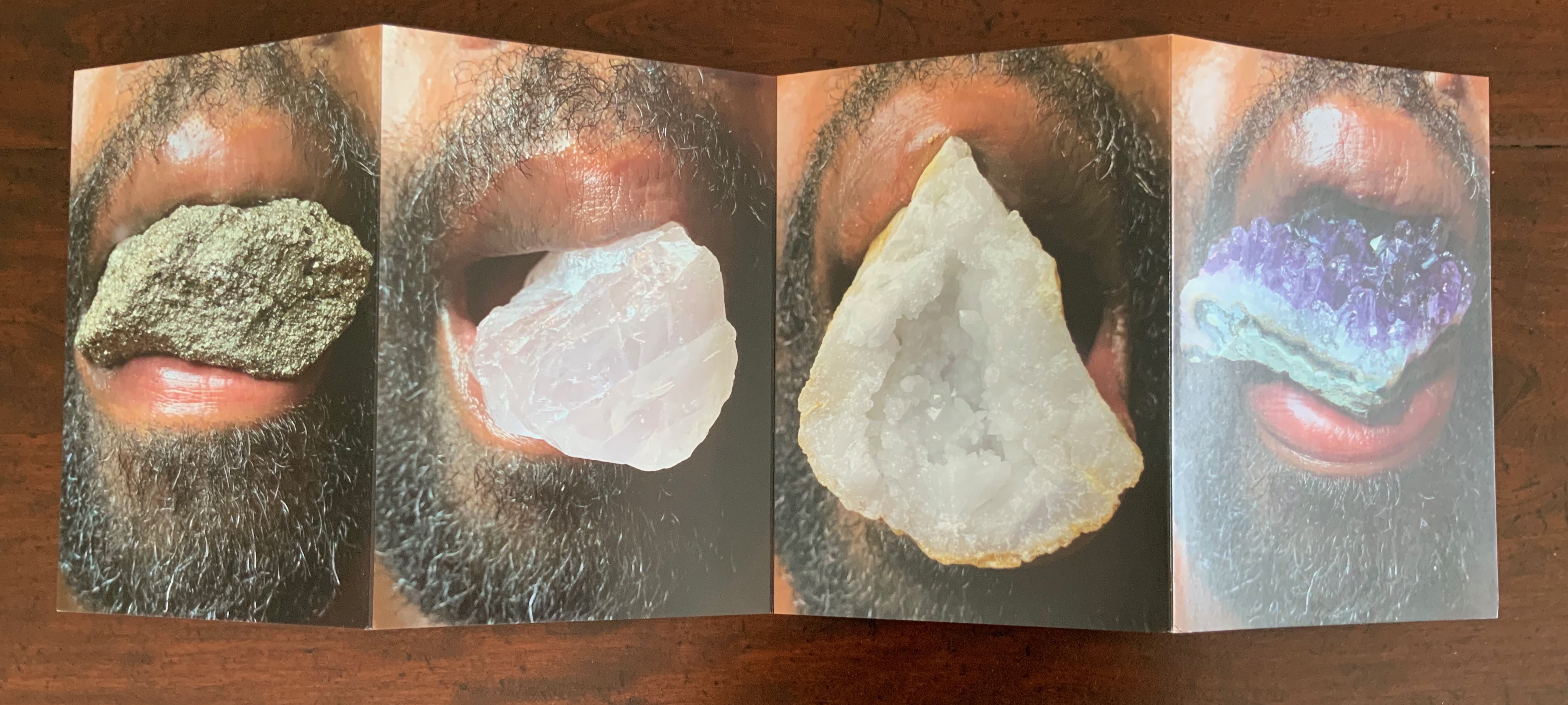
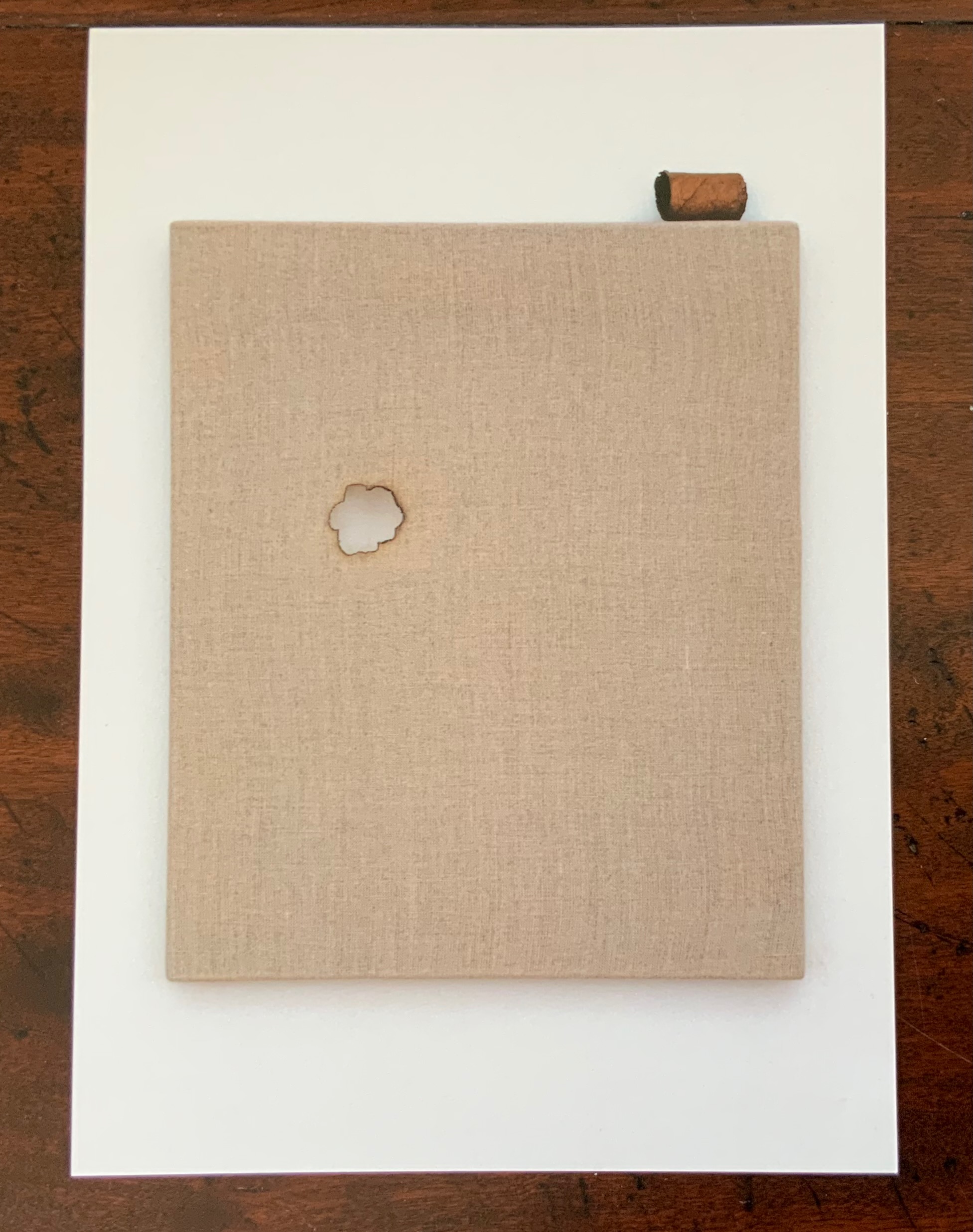
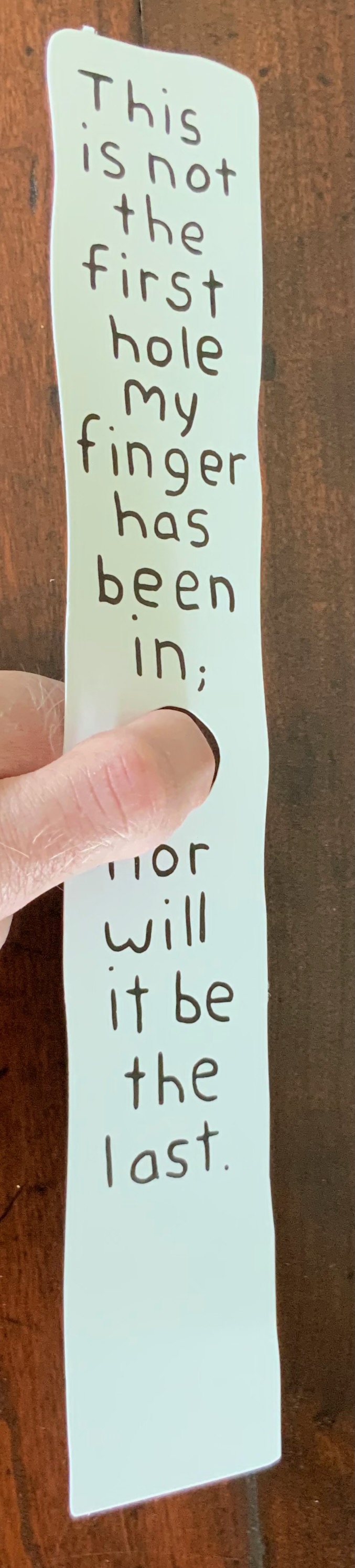
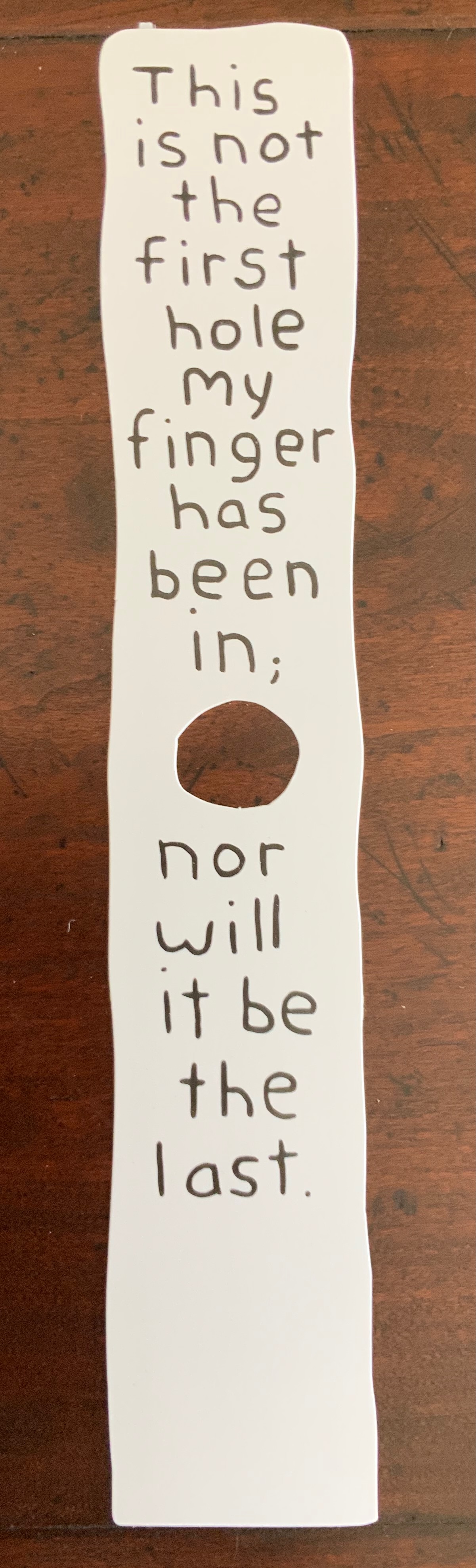
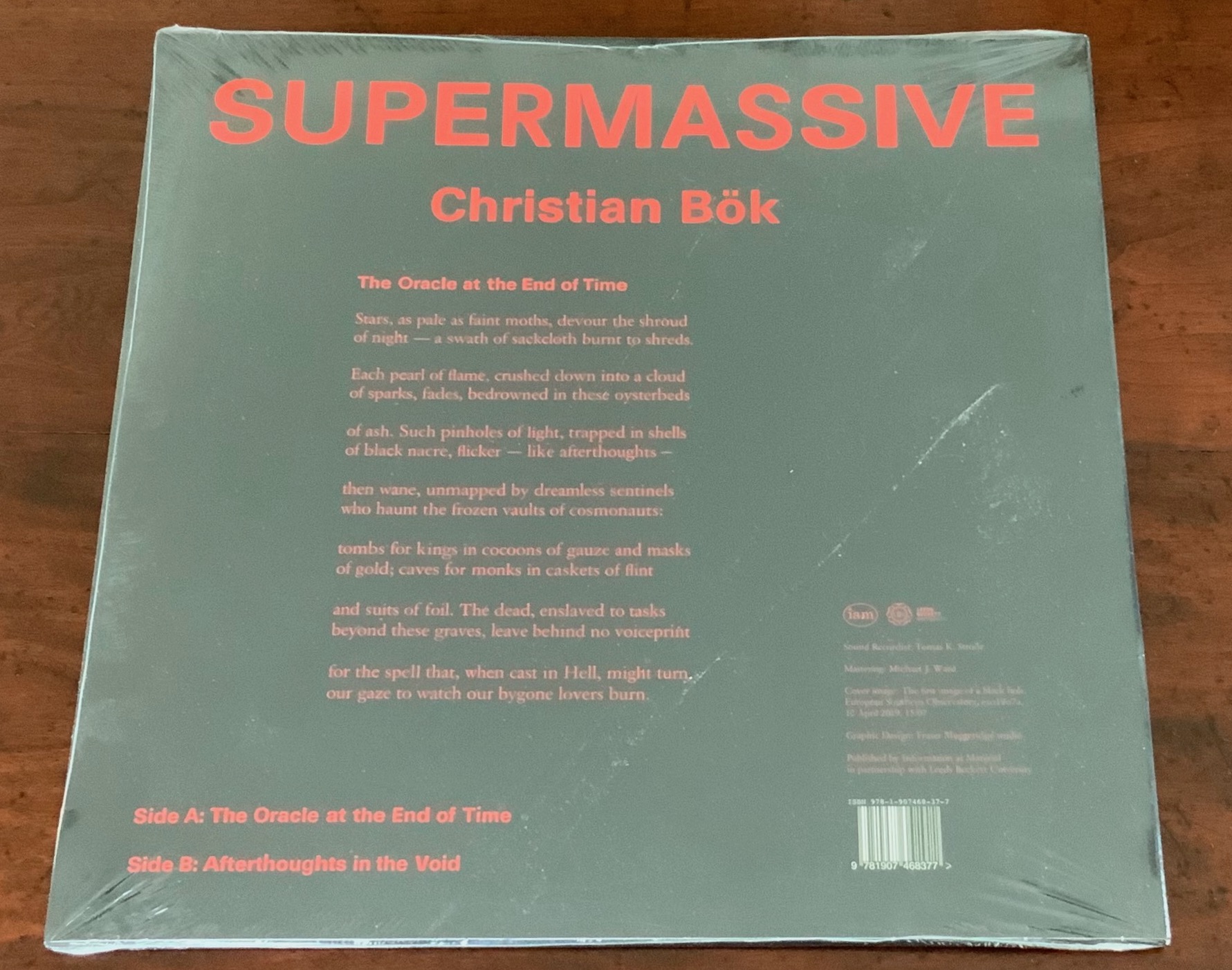
Long-time admirers of the 1960s-70s multimedia magazine Aspen, the editors have continued their practice of including unbound elements. In this issue, they have included Carolyn Thompson’s enormous poster The Beast in Me, whose sentences and part-sentences beginning with “I” have been cut from eight different novels and pasted down to form the hole seen below. Also included are Erica Baum’s Piano Rolls, Harold Offeh’s Crystal Mouths, David Bellingham’s Cigar Burn Apertures, Miranda July’s, Bookmark and Christian Bök’s Supermassive LP.
Carolyn Thompson, The Beast in Me, H1180 x W1180 mm. Photo: Ricky Adam. Photos of the work: Books On Books Collection.
Erica Baum, Piano Rolls, H120 x W120 closed, W960 mm open. Photos of the work: Books On Books Collection.
Harold Offeh, Crystal Mouths, H210 x W105 closed, W480 mm open; David Bellingham, Cigar Burn Apertures, H210 x W105 mm; Miranda July, Bookmark, H302 x W54 mm; Christian Bök, Supermassive, LP. Photos of the works: Books On Books Collection.
Like the famous combined Aspen issue Nos.5/6 — an homage to Stéphane Mallarmé — Inscription manages to pull off an eclectic unity with the essays included, which unlike Aspen was accomplished after a double-blind review process. Inscription‘s editors have turned on its head Robert Frost’s dismissive characterization of free verse as playing tennis without a net; they are playing doubles with a net and blindfolded and have created a work of art. This issue’s entries range from Paul Reynold’s erudite and whimsical definitions of all sorts of holes; the scholarly detective work on the holes that bind (pin holes and punch holes by Craig Robertson and Deirdre Lynch and filing holes by Heather Wolfe); James Mission’s tracking the crafts of scribe, typesetter and coder in representing lacunae, gaps or holes in the text; Louis Lüthi’s puncturing juxtaposition of W. Somerset Maugham’s 1948 abridgment of Moby-Dick, Orion Books’ 2007 Moby-Dick in Half the Time and Damion Searls’ 2009 riposte ; or The Whale; to Fiona Banner’s photo-essay on her hole-creating Full Stop‘s, granite sculptures of full stops (periods) created from the Peanuts , Klang and Orator typefaces, two of which were dropped into the marine protected area of Dogger Bank to put a sure stop to industrial fishing there. Here is the table of contents:
Michael Marcinkowski — “house / table” Galina Oustinova-Stjepanovíc — “Reading the Hole on the Last Address Memorial Plaques in Moscow” Fiona Banner — “Full Stop intervention with Greenpeace” Simon Morris — “Perspective Correction” Dianna Frid, Carla Nappi and Ian Truelove — “Wormholes, The Cascabel Butterfly and an AR collaboration” Aleksandra Kaminska and Julian De Maeyer — “The Perfect Cut: Talking with Myriam Dion” Paul Reynolds — “A Glossary of Holes” Louis Lüthi — “A Snow Hill in the Air” James Mission — “Signifying Nothing: Follow a Hole Through Three Text Technologies” Editors — “An Interview with Kendell Geers” Heather Wolfe — “On Curating Filing Holes” Craig Robertson and Deirdre Lynch — “Pinning and Punching: A Provisional History of Holes, Paper, and Books”
Inscription continues to provide one of the liveliest examples of what Anne M. Royston calls “artistic arguments (my emphasis), a term that indicates theory that pushes back against the expectations of the theory or criticism genre, specifically by employing signification that exceeds the semantics of printed text”.
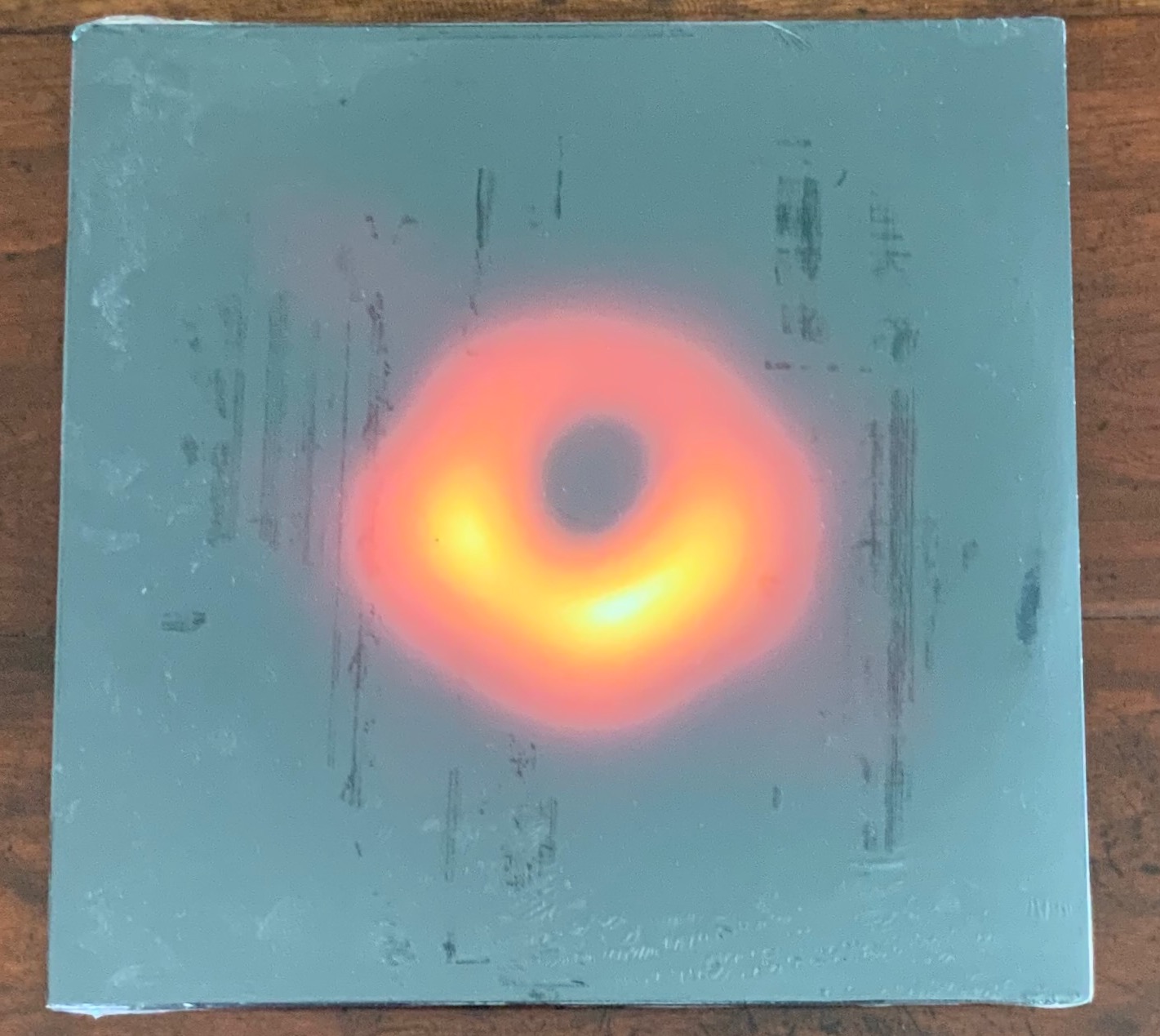
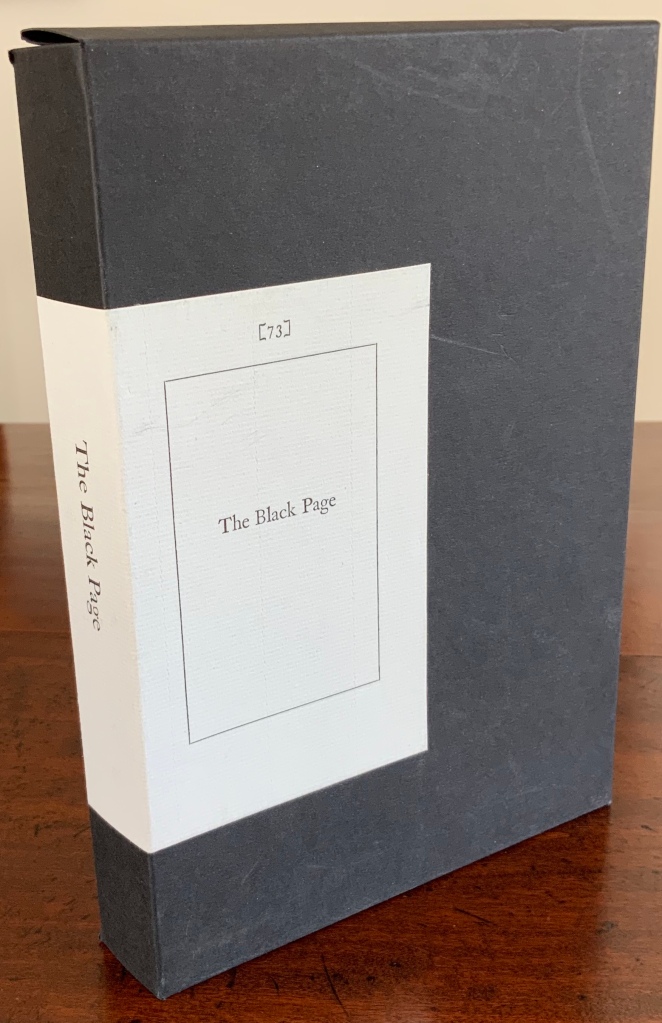
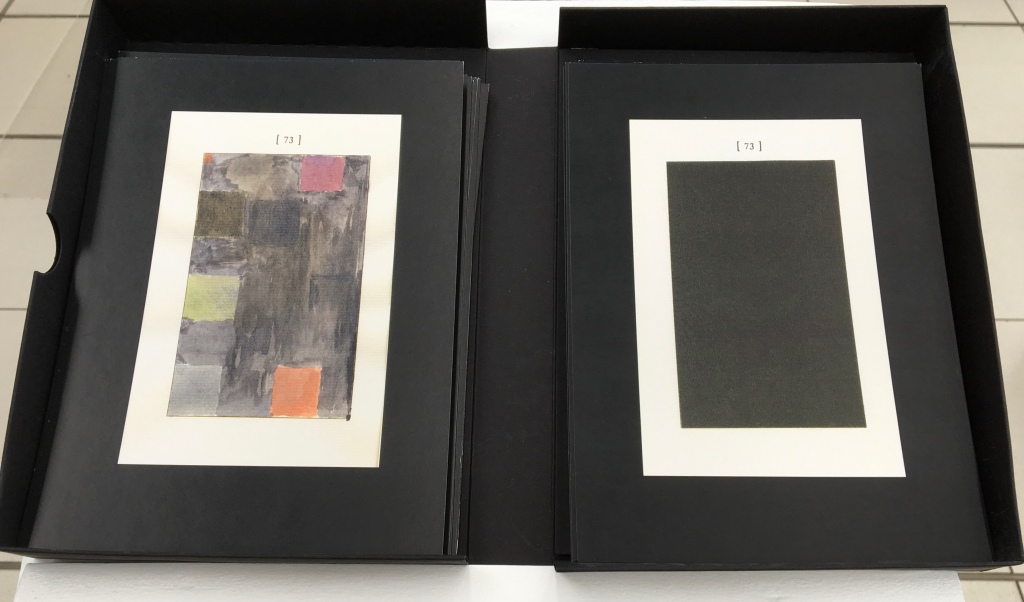
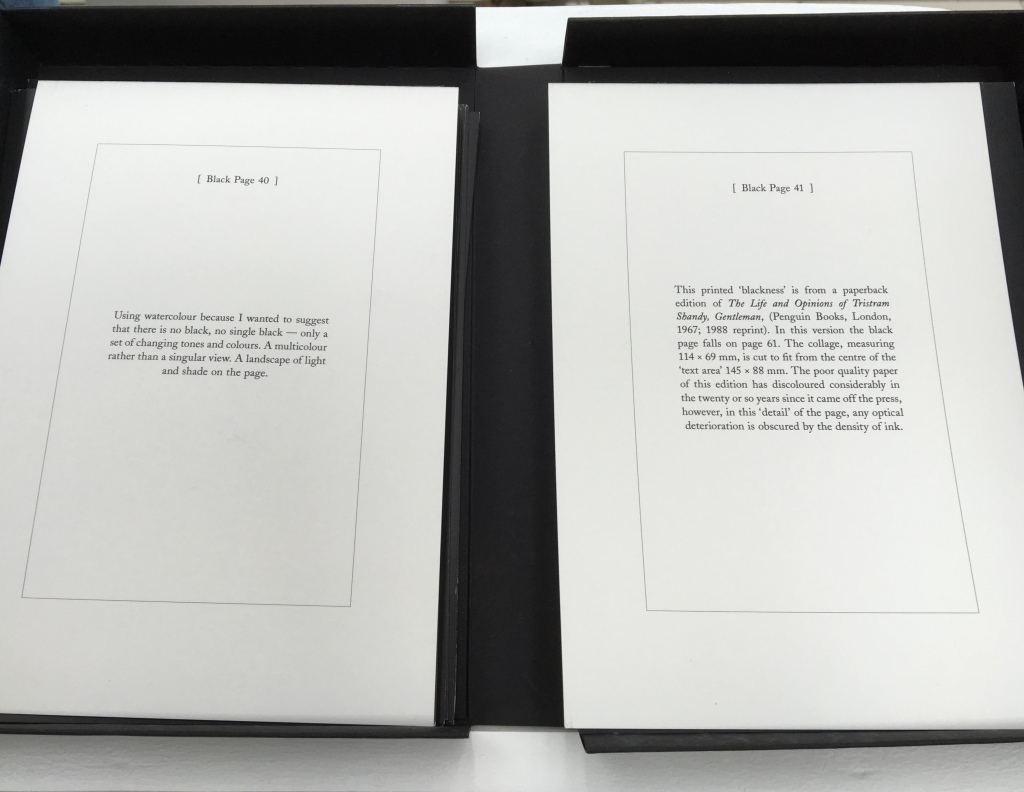
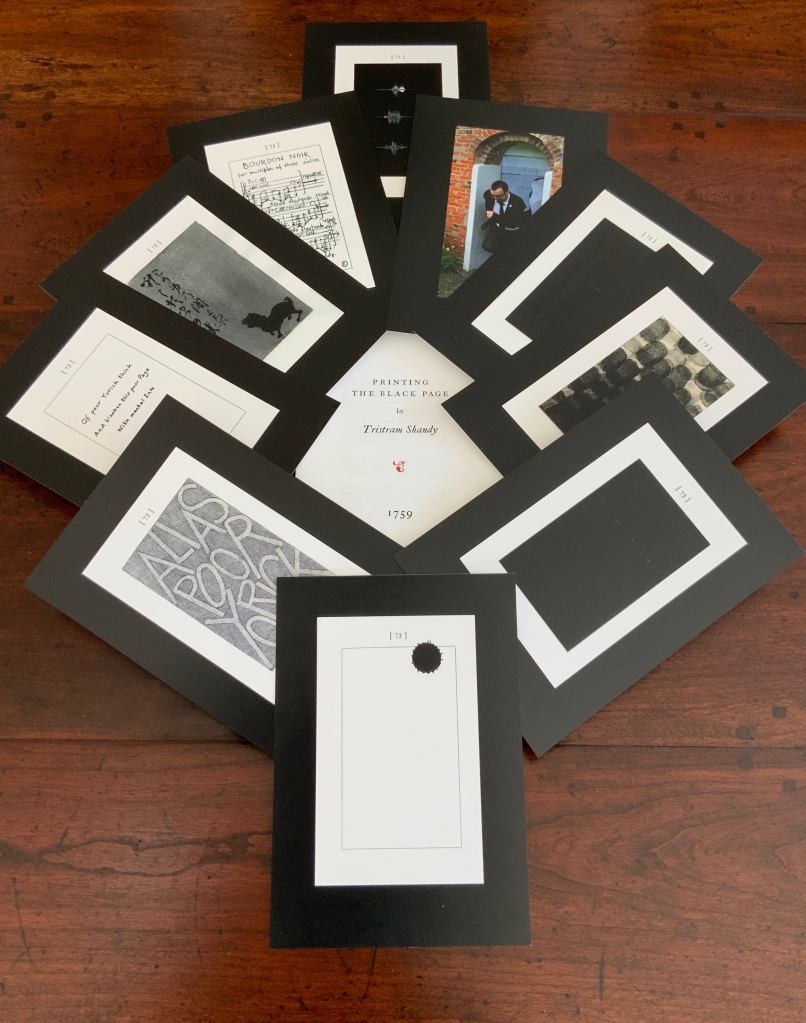
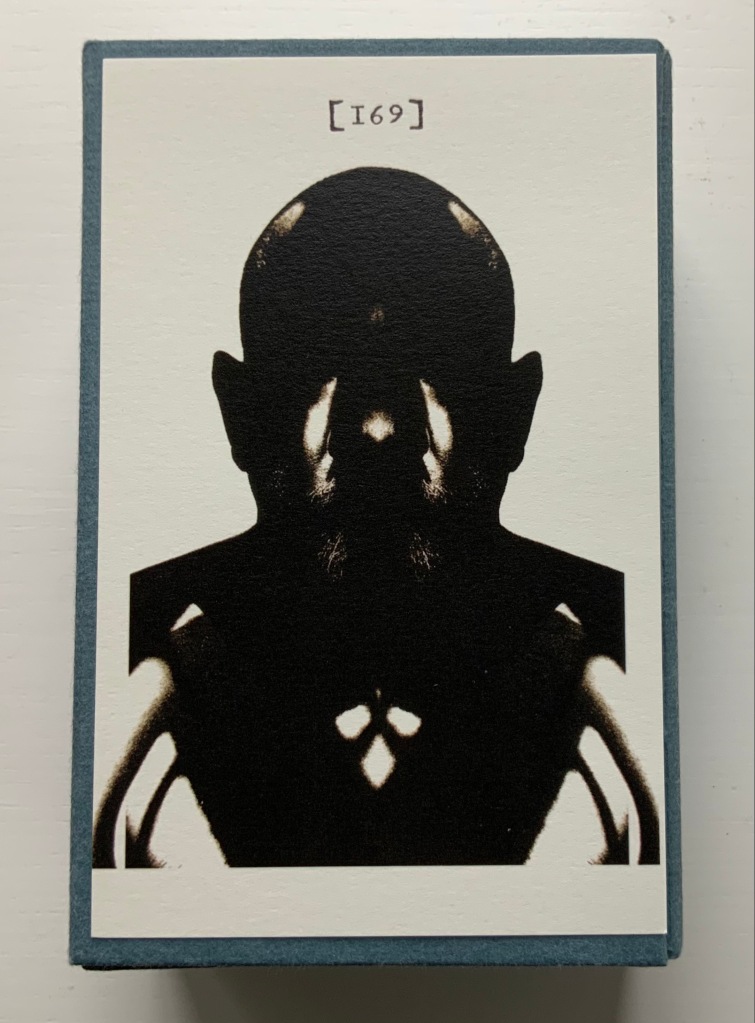
The Black Page Catalogue(2010) Coxwold, UK: Printed by Graham Moss (Incline Press) for The Laurence Sterne Trust. Contains 73 numbered leaves in a matte black card box (H235 x W168 mm). The leaves are glossy cards (210 x 148 mm) on which contributed texts and illustrations (chiefly colour) are printed; the reverse of each provides the contributor’s comments on the text or illustration and the “page” number. Also enclosed are a single-sheet folded pamphlet (“Printing the Black Page” by Graham Moss, Incline Press) and two cards, one of which is the invitation to the exhibition inspired by the ‘black page’, p. 73 of the first edition of The Life and Opinions of Tristram Shandy, Gentleman, held at Shandy Hall, Coxwold, North Yorkshire, 5 Sept.-31 Oct. 2009, and the other, sealed in an envelope, being the index of the contributors and their page numbers. Edition of 73. Acquired from the Trust. Photos: Books On Books Collection.
Collectors come up with the most ingenious reasons for acquiring things. In this case — along with astrological, numerological and other rational rationale — Rebecca Romney’s reminder that The Life and Opinions of Tristram Shandy, Gentleman is one of the earlier instances of book art led inevitably to my acquiring Shandy Hall’s The Black Page Catalogue. But it took time.
Several months after enjoying the Romney essay, I met Brian Dettmer in February 2015 by happenstance at a book art exhibition in New Haven, CT. As we chatted about past inspirations of book art, Tristram Shandy came up, so he told me of an upcoming event called “Turn the Page” in Norwich, UK, where I could more easily see some of his work — and one in particular having to do with Tristram Shandy. So in May 2015, I went.
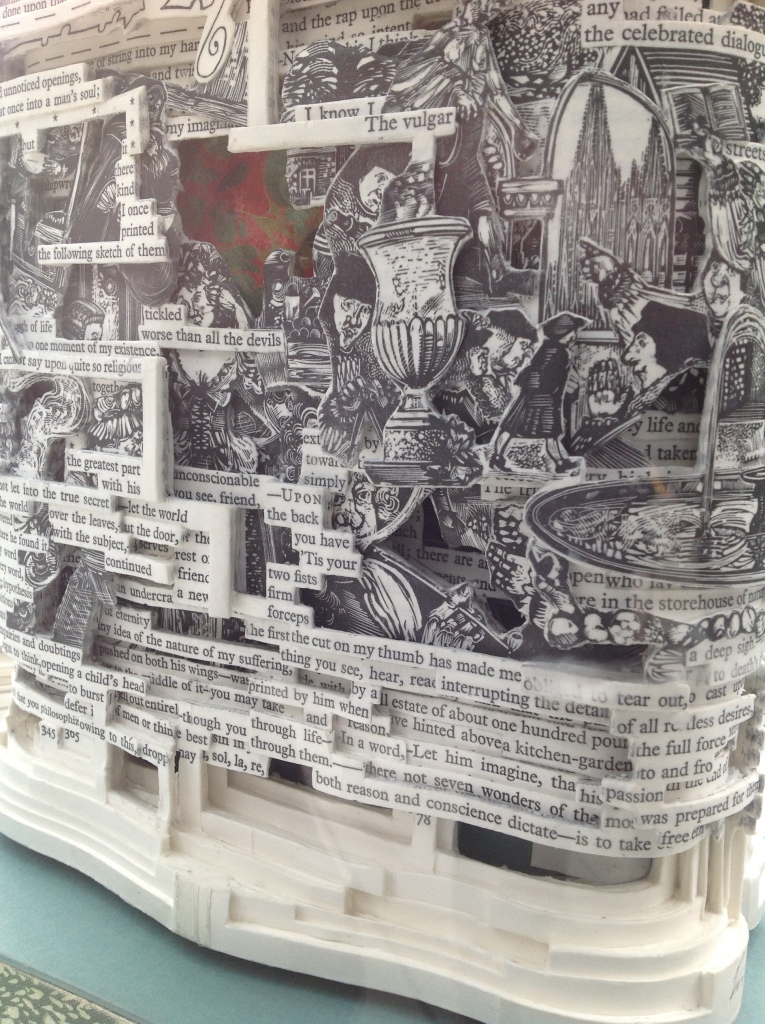
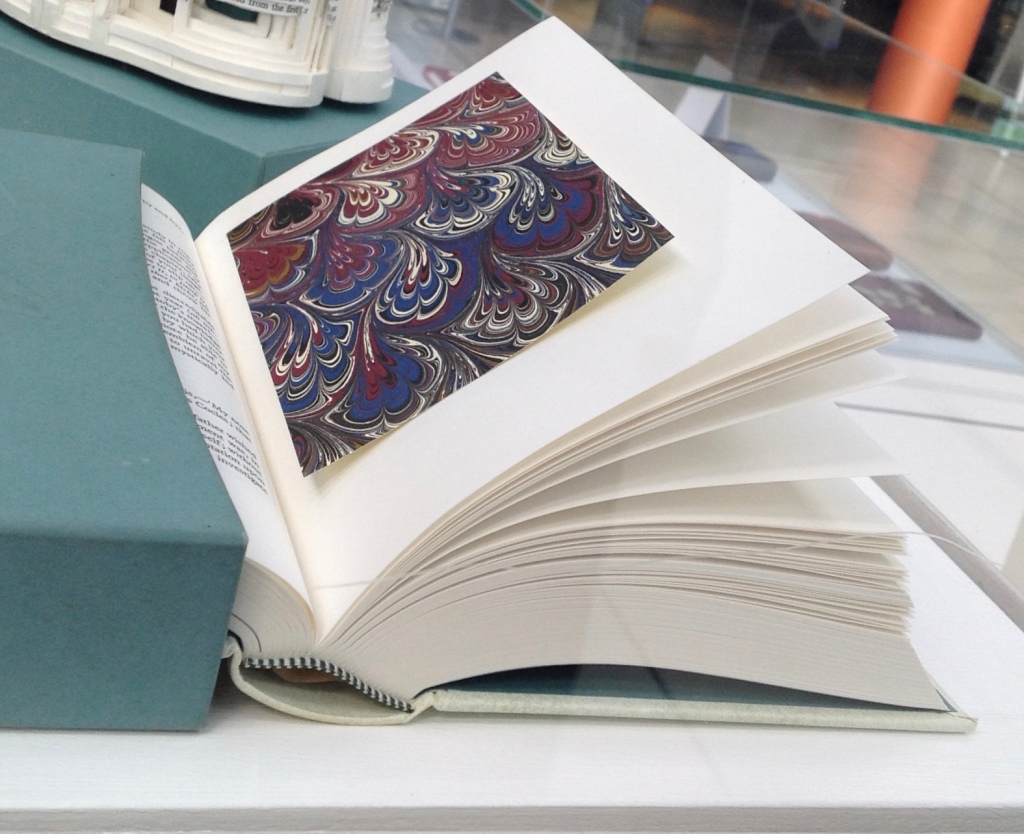
Tristram Shandy (2014) Brian Dettmer Carved and varnished, two copies of the 2005 Folio Society edition of Tristram Shandy. H230 x W190 mm Commissioned by The Laurence Sterne Trust, Coxwold, UK. Photos: Books On Books Collection.
The marbled page, an “emblem of my work”, p. 169. The Life and Opinions of Tristram Shandy, Gentleman (1759) by Laurence Sterne Illustrated with wood engravings by John Lawrence. Set in ‘Monotype’ Plantin, printed by Cambridge University Press on Caxton Wove Paper. New York: Folio Society, 2005.
So a year passed. Another visit to “Turn the Page” was made. And as I was leaving, lo, a sign and small display came unto me:
Only a negligent collector would ignore such clear signs.
Parson-Yoricks-to-be can select their own favorites here.
Emblem of My Work (2013)
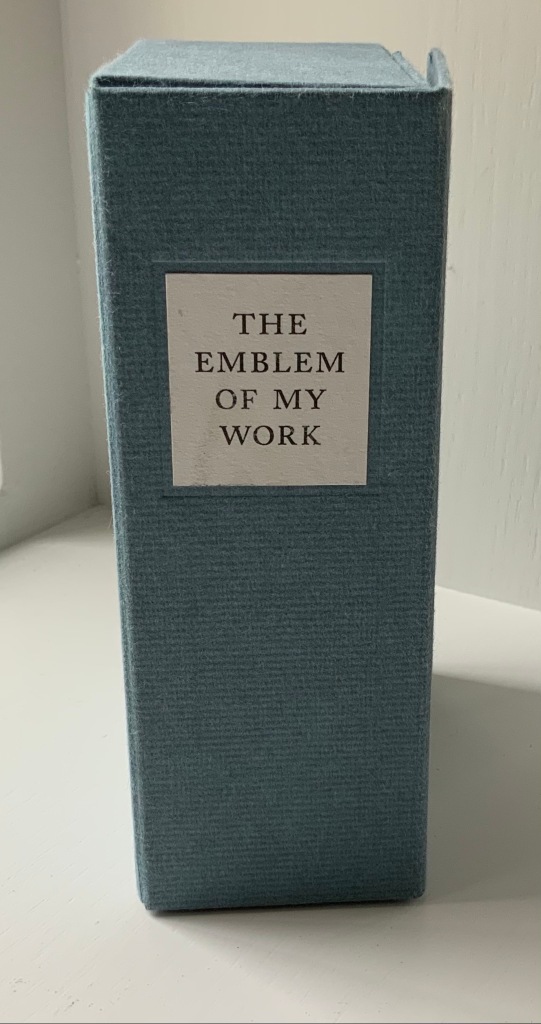
Emblem of My Work (2013) Coxwold, UK: The Laurence Sterne Trust. Consists of a 24-page booklet and 170 numbered cards in a hinged blue paper-covered box (H160 x W105 x D60 mm. The leaves of this catalogue are bright white cards (152 x 92 mm) on which the artwork is printed; the reverse of each provides the “page” number and the contributor’s comments on the art. The booklet provides alphabetical and numerically ordered indexes listing the contributors and their page numbers. Edition of 225, of which this is #79. Acquired from Shandy Hall, 1 October 2019. Photos: Books On Books Collection.
Volume III of Sterne’s work was the first to be handled by a publisher. Presumably the famous success of the first two self-published volumes helps to explain James Dodsley’s agreement to printing copies in which each page 169 and each page 170 showed uniquely marbled squares. Images from an original copy held at the British Library can be seen here. As Patrick Wildgust, director of Shandy Hall, explains in the booklet:
The central section of p. 169 was laid upon the marbled mixture in order that a coloured impression could be taken as cleanly as possible. This was left to dry and then reverse-folded so the other side of the paper could also receive its marbled impression. This side of the paper became page [170]. As a result, the marbled page in every copy of Vol. III is different — each impression being a unique handmade image. In the text opposite on p. 168, Sterne tells the reader that the marbled page is the “motly emblem of my work” — the page communicating visually that his work is endlessly variable, endlessly open to chance.
Two favorites — one for page [169], one for [170] — artists with other works in the Books On Books Collection. Left: Ken Campbell. Right: Eric Zboya.
Paint Her To Your Own Mind (2018) Coxwold, UK: The Laurence Sterne Trust. Contains 147 numbered leaves in a brown paper-covered box (174 x 124 mm). The leaves are bright white cards (145 x 105 mm) on which contributed texts and illustrations (chiefly colour) are printed; the reverse of each provides the contributor’s comments on the text or illustration and the “page” number. Also enclosed are a “title page” and “index leaf” listing the contributors and their page numbers. Edition of 200. Acquired from Shady Hall, 6 June 2018. Photos: Books On Books Collection.
Page 147 of Sterne’s sixth volume of Tristram Shandy is blank. On the preceding page, he metaphorically throws up his hands over any attempt to describe the most beautiful woman who has ever existed and exhorts the reader: “To conceive this right, —call for pen and ink—here’s paper ready to your hand, —Sit down, Sir, paint her to your own mind—as like your mistress as you can—as unlike your wife as your conscience will let you—‘tis all one to me—please your own fancy in it.” So, accordingly, Shandy Hall invited 147 artists/writers/composers to follow Sterne’s instruction to fill the blank page 147. From the 9th through 30th of September 2016, their efforts were displayed in the Shandy Hall Gallery, Coxwold, York.
The curious reader can choose his or her own favorites here.
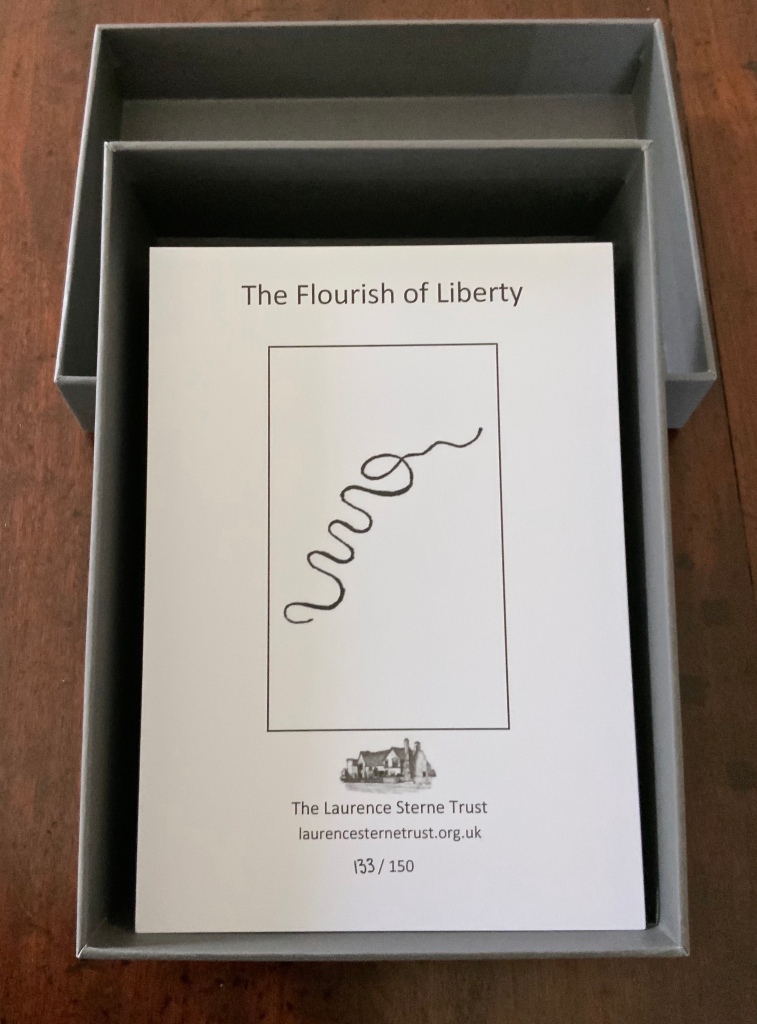
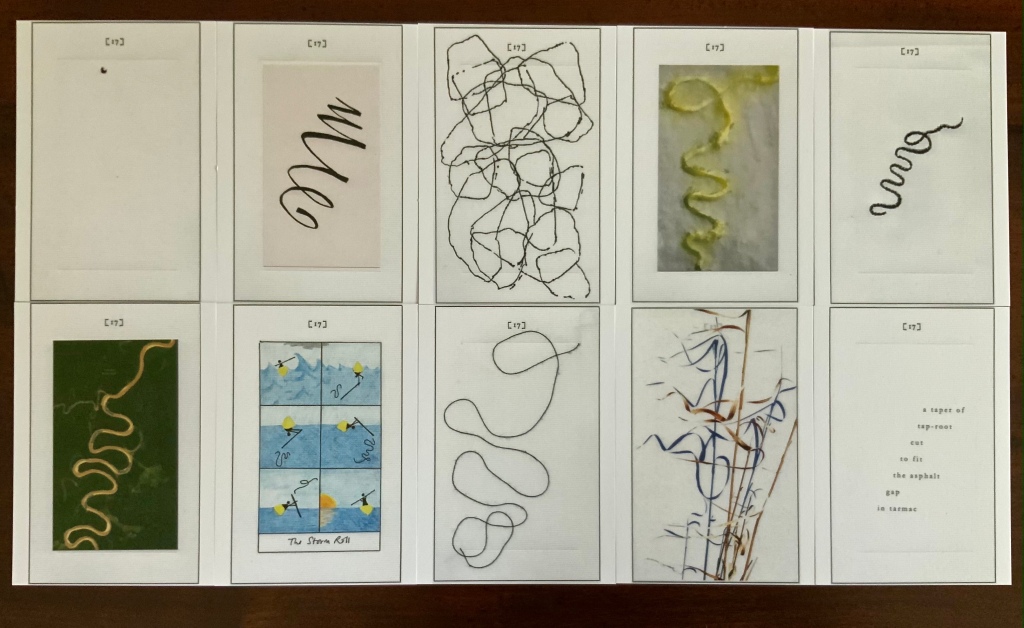
The Flourish of Liberty (2019)
In Volume IX on p. 17, the reader reads Corporal Trim’s advice to Uncle Toby, who stands at the Widow Wadman’s threshold about to propose marriage:
Nothing, continued the Corporal, can be so sad as confinement for life — or so sweet, an’ please your honour, as liberty. Nothing, Trim — said my Uncle Toby, musing — Whil’st a man is free — cried the corporal, giving a flourish with his stick thus —
The Flourish of Liberty (2019) Coxwold, UK: The Laurence Sterne Trust. Contains 103 numbered leaves in a gray paper-covered box (174 x 124 mm). The leaves are bright white cards (148 x 105 mm) on which contributed texts and illustrations (black and white, several in colour) are printed; the reverse of each provides the contributor’s comments on the text or illustration and the “page” number. Also enclosed are a “title page” and “index leaf” listing the contributors and their page numbers. Edition of 150, of which this is #133. Acquired from Shandy Hall, 26 October 2020. Photos: Books On Books Collection.
The rest of Corporal Trim’s flourishes flourish here.
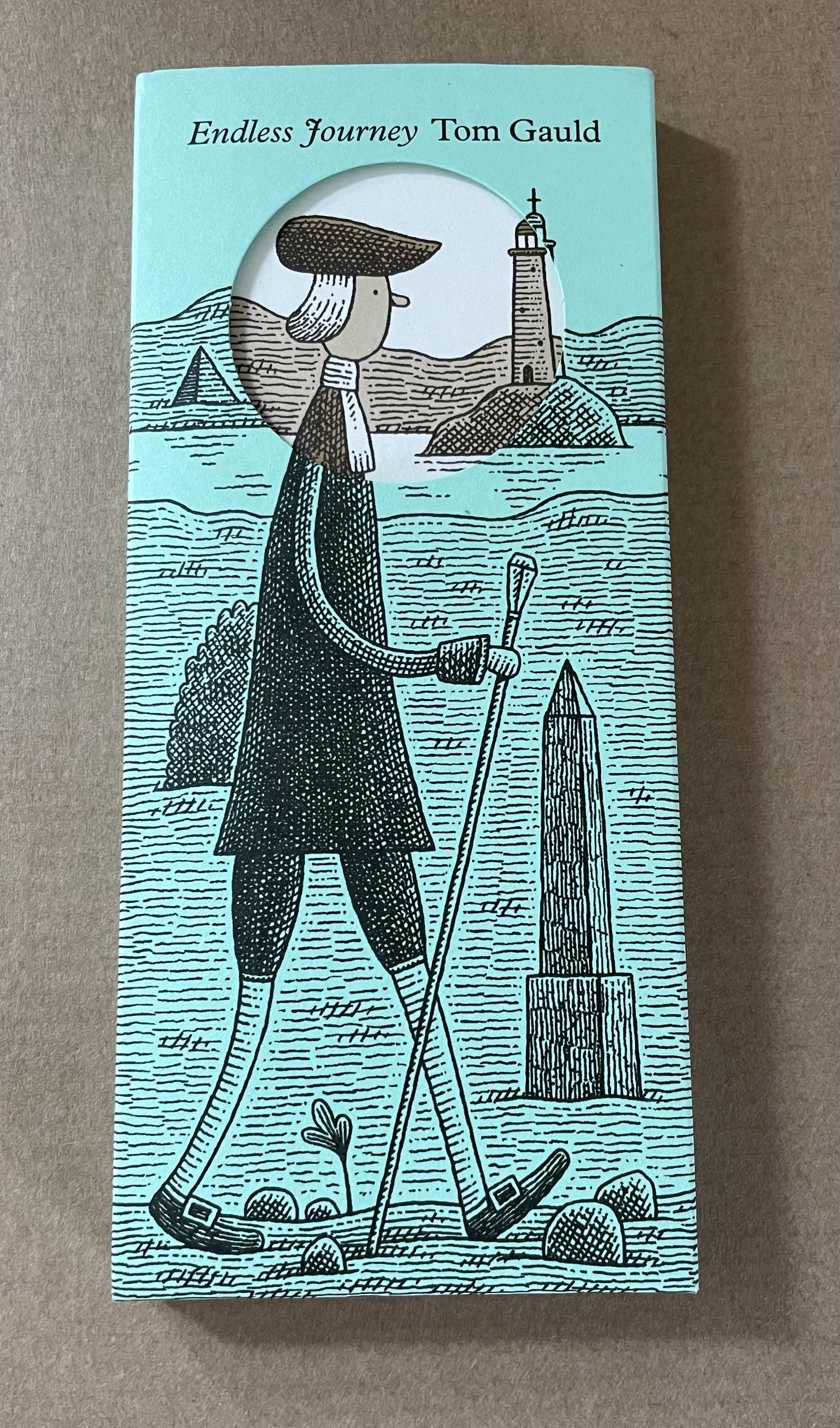
Endless Journey (2015)
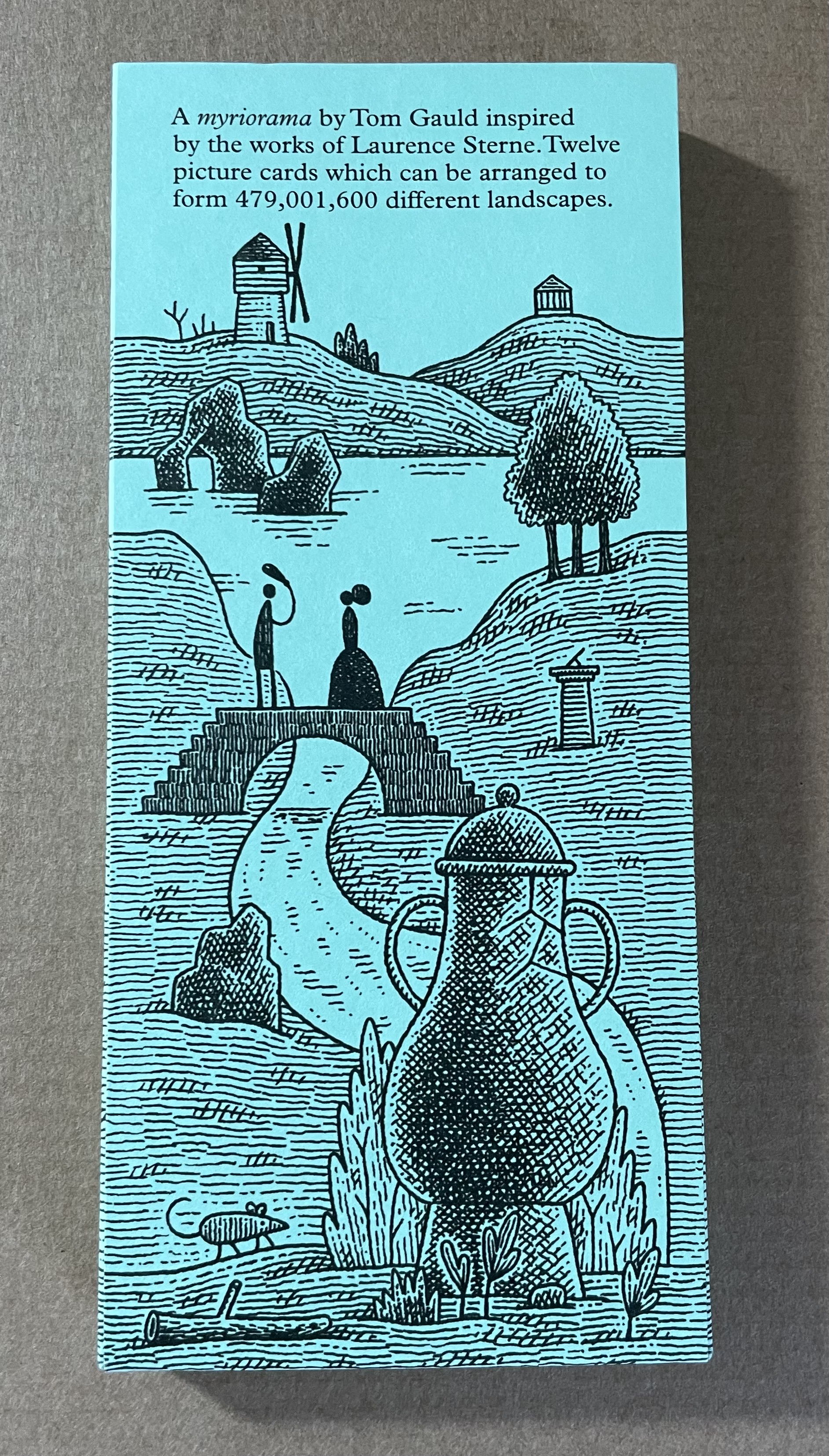
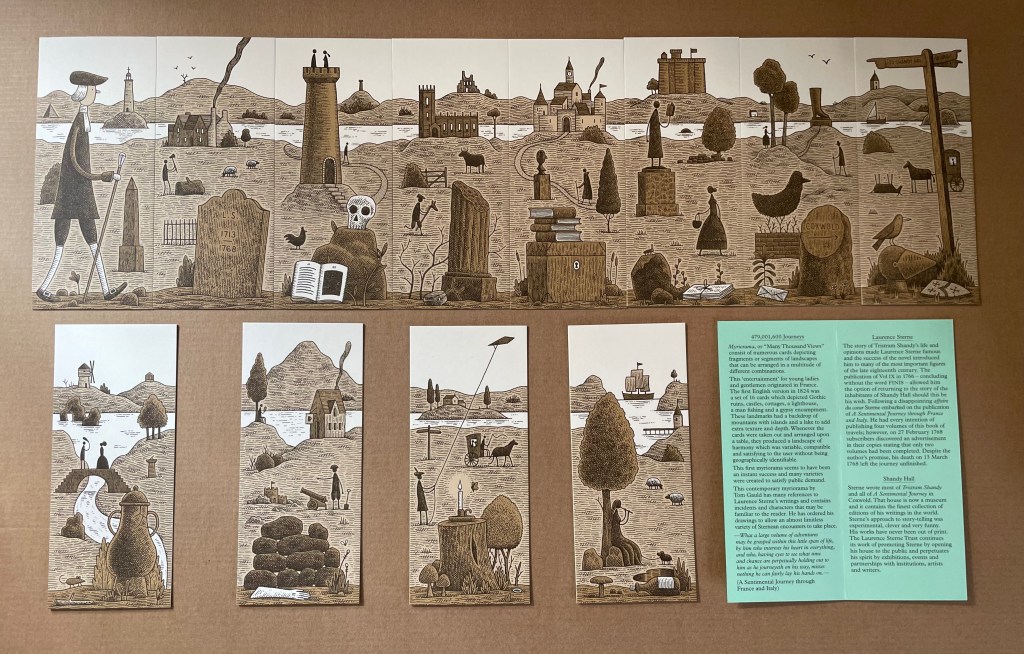
Endless Journey (2015) Tom Gauld Printed slipcase, twelve cards, leaflet. H165 x W73 mm. Acquired from the Laurence Sterne Trust. Photos: Books On Books Collection.
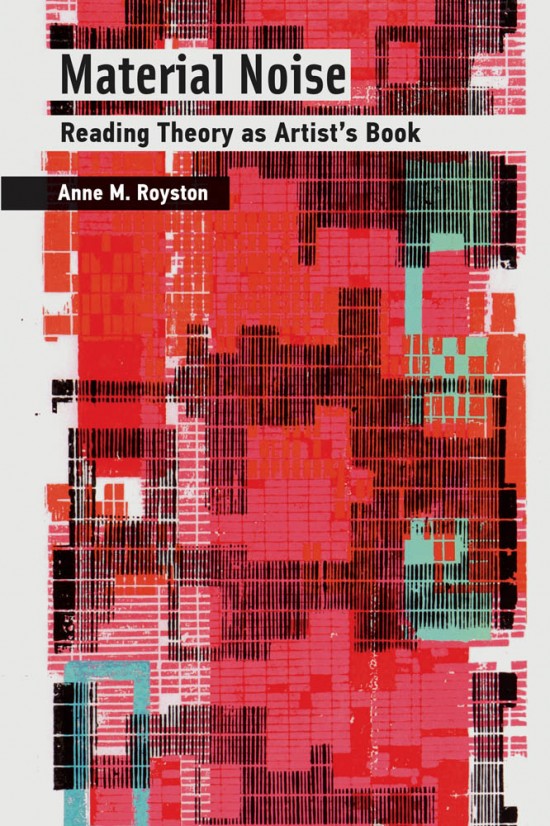
As its subtitle suggests, Material Noise explores how the material aspects of works of criticism and media studies such as Le Da Costa encyclopedique, Jacques Derrida’s Glas, Avital Ronell’s The Telephone Book and Mark C. Taylor’s Hiding matter to understanding them — just as if those works were artist books. For the reader interested in book art, the artist book or whatever one might like to call that art, Material Noise might be better read back to front. The works of book art that Anne Royston explores in Material Noise — Mark C. Taylor’s Le Réal, Las Vegas, NV, Shelley Jackson’s Skin, Johanna Drucker’s Stochastic Poetics and Susan Howe’s and R.H. Quaytman’s Tom Tit Tot — come at the end of the book.
The order though is reassuring. Otherwise we might end with criticism, media theory and critical theory becoming the foreground, the works of art simply background, lost in theoretical translation. A case of Barthes for Barthes’ sake? It is fitting that the very material approach to engaging with book art — even with its most conceptual of instances — should be applied to critics and theorists to explicate their works, only then to conclude by showcasing works of art whose mastery of the material may be said to put the more academic works in the aesthetic shade.
Royston selects the journal — Convolution, founded in 2011 by Paul Stephens — to emblematize her starting point: “a blend of art and criticism that considers its material form at every step” and delivers “a materially immersive reading experience” (pp. 1-3). If her publication had occurred in the future, she could have selected Inscription, founded in 2020 by Adam Smyth, Gill Partington and Simon Morris to serve as an open closing point. But that would have spoiled the reassurance of concluding with the art.
As is the wont of theorists (social, literary and otherwise), she proposes a new term, or tool, with which to build her case: “artistic arguments (my emphasis), a term that indicates theory that pushes back against the expectations of the theory or criticism genre, specifically by employing signification that exceeds the semantics of printed text”. Leaving it to the academics to unpack that proposition professionally and evaluate its application, this casual observer suggests that it is analogous to “upward inflection” but without the implied lack of confidence. With a lack of confidence, it would be the declarative sentence that hedges its bet with that annoying, habitual rising tone that turns it into a question.
Royston does not hedge her bets. Her observations about Le Da Costa encyclopedique and its self-conscious, self-referential heterogeneous play with the material forms of the reference work, newspaper and the forms within them — columns, typographical signals (hyphenation), etc. — are assured. Her surfacing of “noise” as a concept and phenomenon key to the shape and message of Le Da Costa, Derrida’s Glas and Ronell’s The Telephone Book is equally assured in each case. Likewise, how — across those three works — she slips among the ideas of “noise” to “formlessness” to “white spaces” to end up on the “surface” of Taylor’s Hiding, his associated multimedia The Réal, Las Vegas, NV and then Jackson’s Skin project.
Royston’s true avatar must be the ilex. In the Taylor/Jackson chapter, she effortlessly moves from Taylor’s university press book then to his electronic artist book and then to Jackson’s embodied/disembodied story literally tattooed word by word on 2,095 volunteers (thereafter called “words”). Royston does it so well that it almost enacts an artistic argument proving her thesis that we should read theory in the way we read artist books.
But collecting theories may not be as satisfying as building real or fantasy collections of art. Being introduced to Taylor’s The Réal, Las Vegas, NV (1997) with its slot machine screen offers the chance to add it alongside Marcel Broodthaers’ Monte Carlo Bond (1924) and Muriel Cooper’s designed Learning from Las Vegas (1972) by Robert Venturi. If you happen across one of Jackson’s “words” in the tattooed flesh from Skin, you can forego a kidnapping charge by turning to Paul Emmanuel’s The Lost Men Project (2006). Crestfallen that no aluminum-covered version of Drucker’s Stochastic Poetics (2012) is easily available? Download the Ubu edition. Also unable to find a copy of Howe’s and Quaytman’s Tom Tit Tot (2014)? Place its link at the Museum of Modern Art Library Council alongside the Meermanno Museum’s for its “Reading as Art” exhibition.
Royston’s book provides collector and critic with an entire toolkit enabling them to encounter the “materially immersive reading experience” and perceive how it is really the “materially engaged reading experience”. Highly recommended.
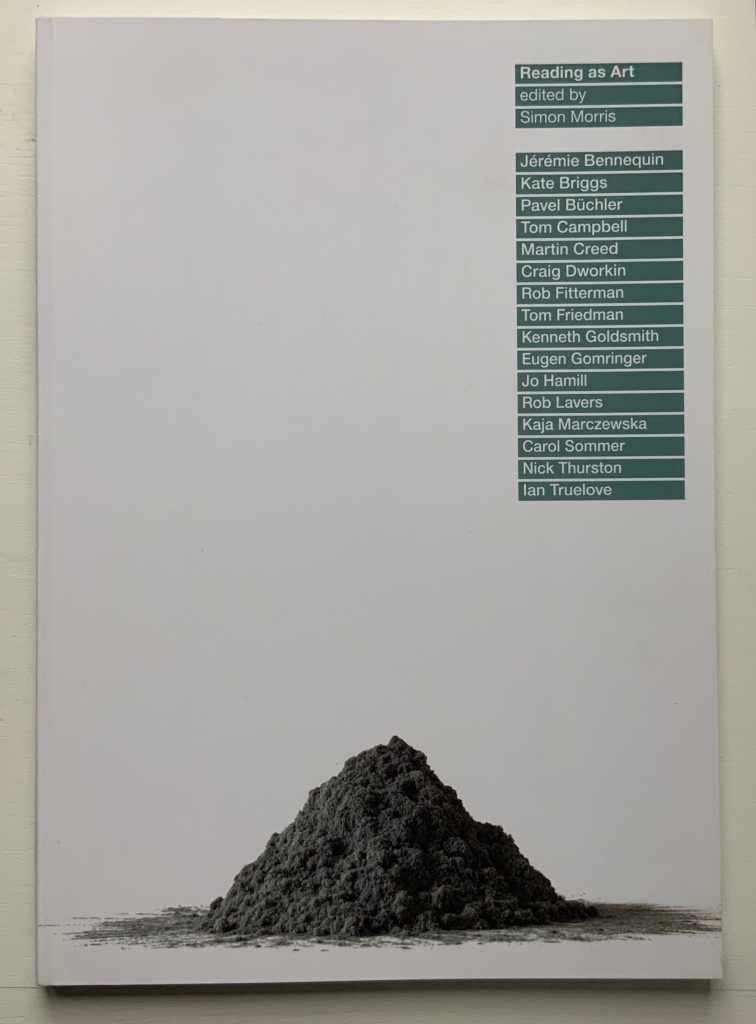
Reading as Art (2016) Simon Morris, ed. Perfect bound paperback. H297 x W210 mm. Acquired from Information as Material, 22 August 2020. Photo: Books On Books Collection. Displayed with permission of the publisher.
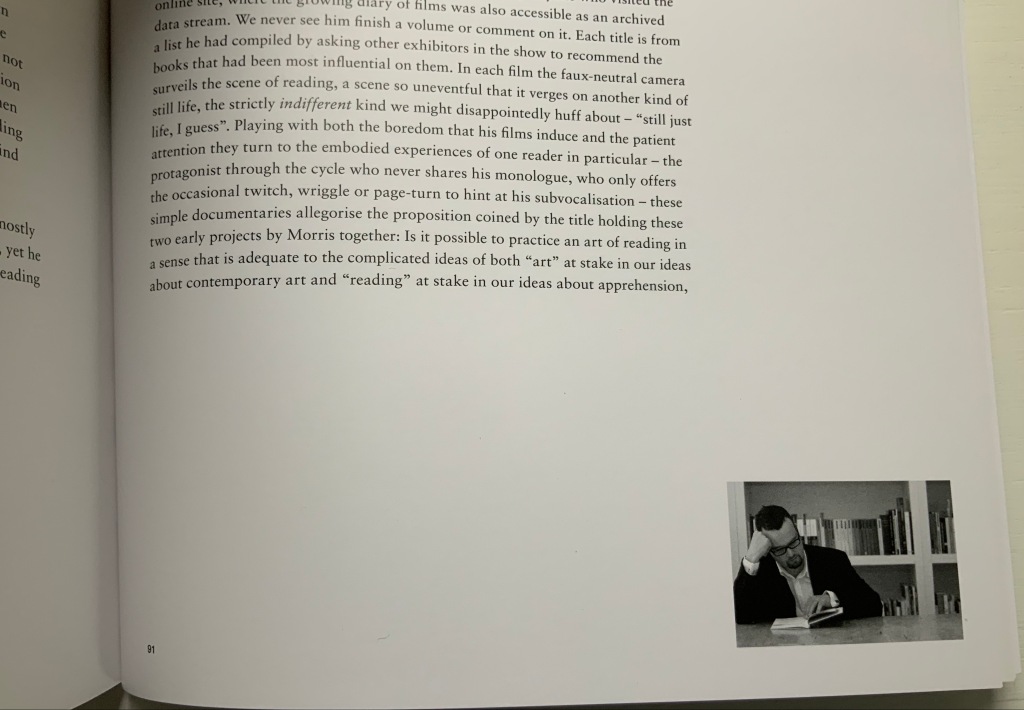
Simon Morris and Books On Books crossed paths at the opening of an exhibition at the Meermanno Museum in The Hague. The exhibition was called “The Art of Reading“, and he gave a talk on his performative work Reading as Art (2004), a compiled-stills film of him reading and turning the pages of a book. (Not at all like watching paint dry or grass grow, if you are unkindly thinking so.) Reading as Art (the volume) provides a taste of Reading as Art (the performance) with black-and-white frames from the film appearing at the bottom right-hand corner of nearly every page: just run your thumb down the fore edge and let the pages flip to see the “action”.
Details from Reading as Art (the book). Photos: Books On Books Collection. Displayed with permission of the publisher.
That feature of this one volume speaks volumes about Simon Morris as an artist. The idea of “reading as art” is not far off “publishing as art”. Morris’s collaborative publishing operation Information as Material has employed nearly every tool in the “Publishing as Artistic Toolbox“, as the 2018 exhibition in Vienna was called: documented performances, polemics, apps, free downloadable PDFs, prints and broadsides, and a journal Inscription, whose first issue is a sculptural bookwork and comes with a vinyl LP record, poster and chapbook.
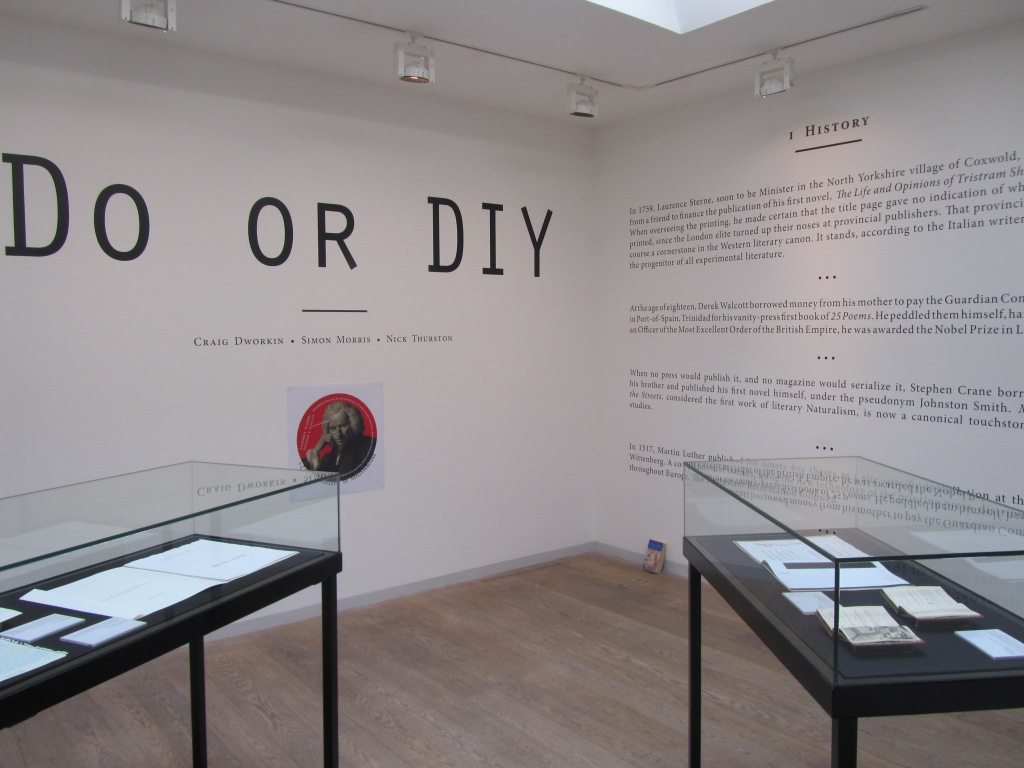
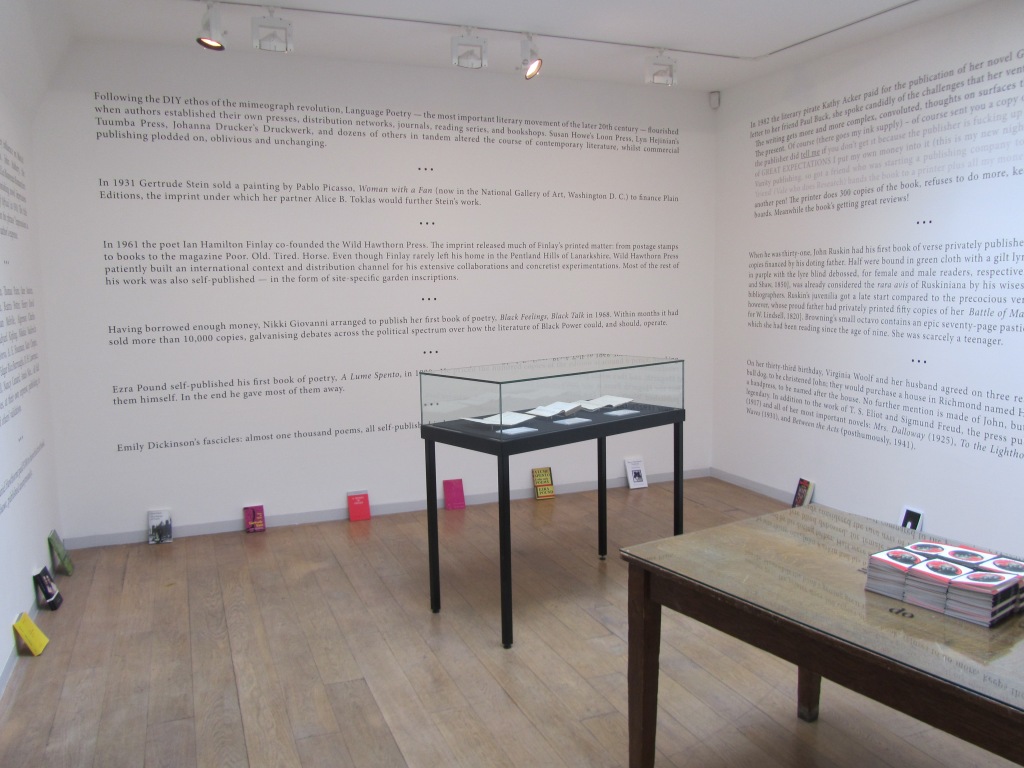
It is strange that this polemic does not mention William Blake among literary history’s do-it-yourselfers. Although their primary message of “don’t wait for a commercial publisher” is for wordsmiths, the authors include the book artist Johanna Drucker among their hortatory examples as well as The Life and Opinions of Tristram Shandy, which can lay a plausible claim to being the first work of modern book art, even before Blake’s “artist’s books”. The authors themselves have even played their parts in book art. So why no nod to the world of book art and its past and current contributions to Do or DIY?
In the 1960s and 70s, book artists’ democratic multiples aimed to sidestep the galleries, museums and art industry. Whether chicken or egg, photocopying and cheap printing brought forth or hatched Siegelaub’s The Xerox Book, Ruscha’s Royal Road Test and many more fair fowl. By century’s end and into the 21st, book artists were still doing it themselves, but the democratic multiple ceded quite a bit of territory to limited editions and unique works. Toward the 20th century’s end, desktop publishing and digital publishing, however, offered up a different, much larger target — the super-concentrated publishing industry — for a much larger cadre of creators — wordsmiths. Perhaps that bit-torrent caught up the authors on this occasion.
Still, the occasion itself — an exhibition that saw the polemic printed on indoor walls and on outside posters — must have appealed to the book art community. Book art makes us read differently, and that clearly happened with this exhibition.
Royal Road to the Unconscious (2004)
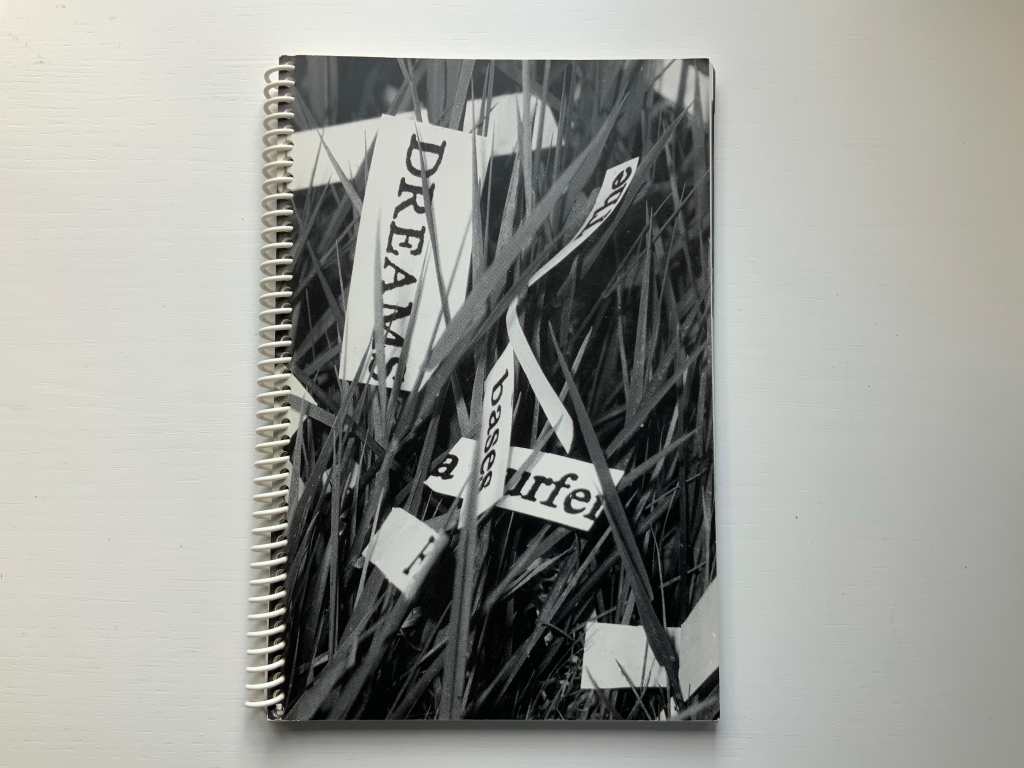
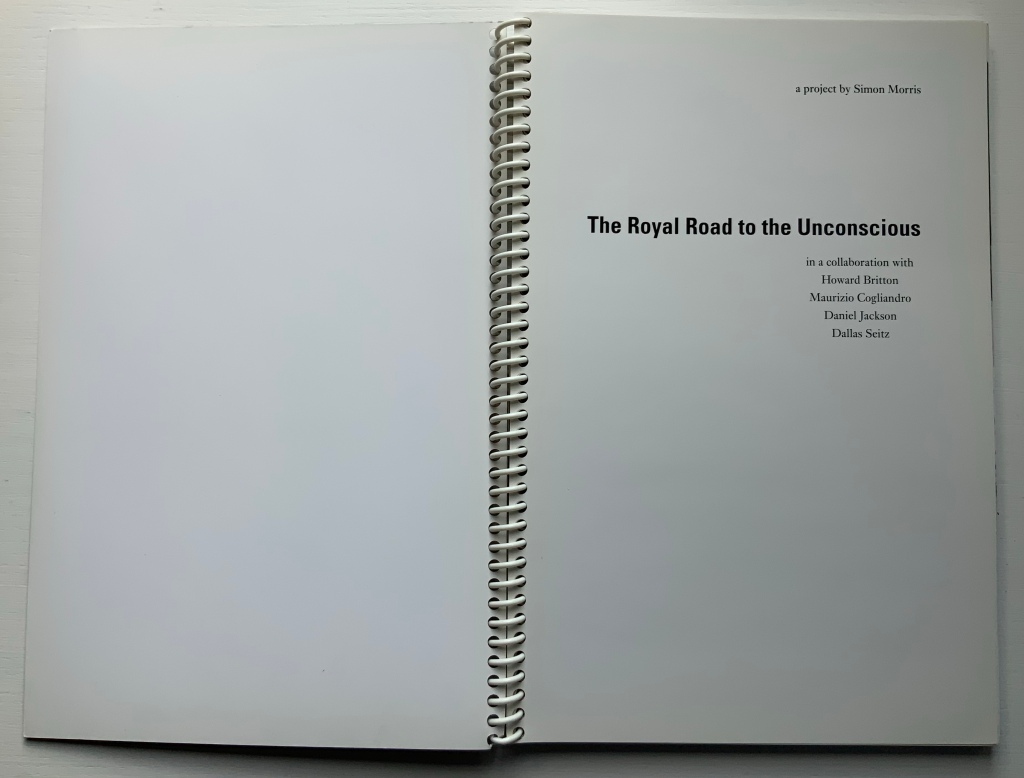
Royal Road to the Unconscious (2004) Simon Morris Spiral bound paperback. H240 x W160 mm, 80 pages. Acquired from Johan Deumens, 10 October 2020. Photos: Books On Books.
This is the book of the movie. Or the book of the movie “made by the book” of the movie. Or…. Better let the artist explain:
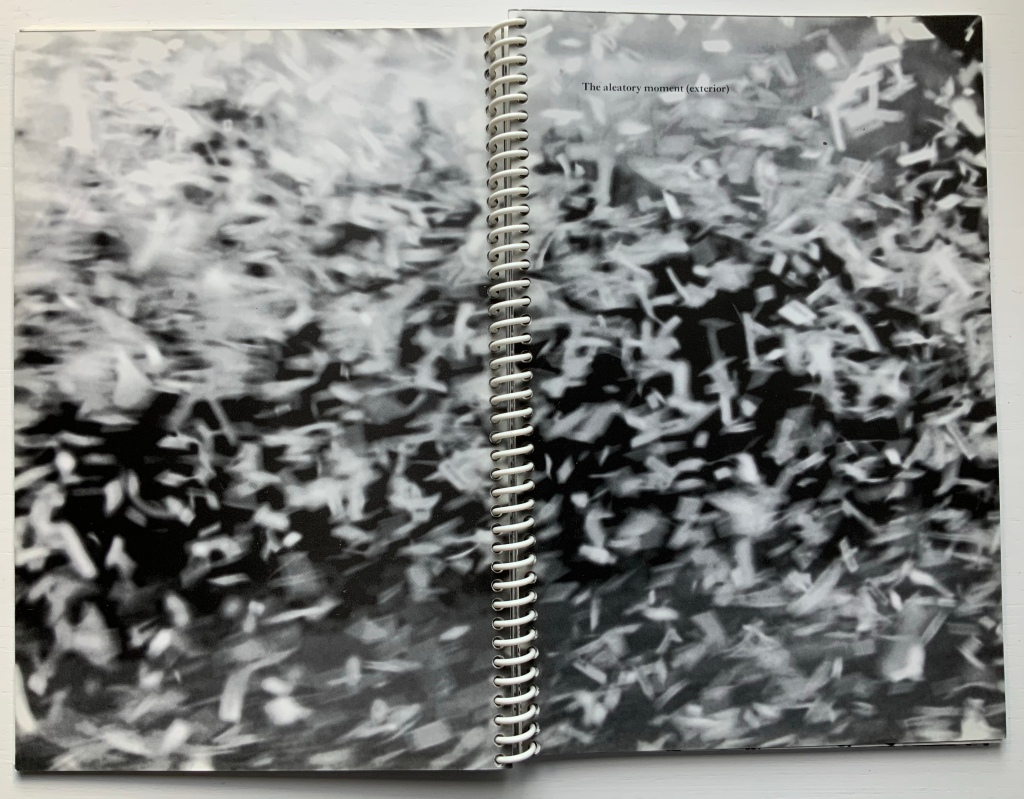
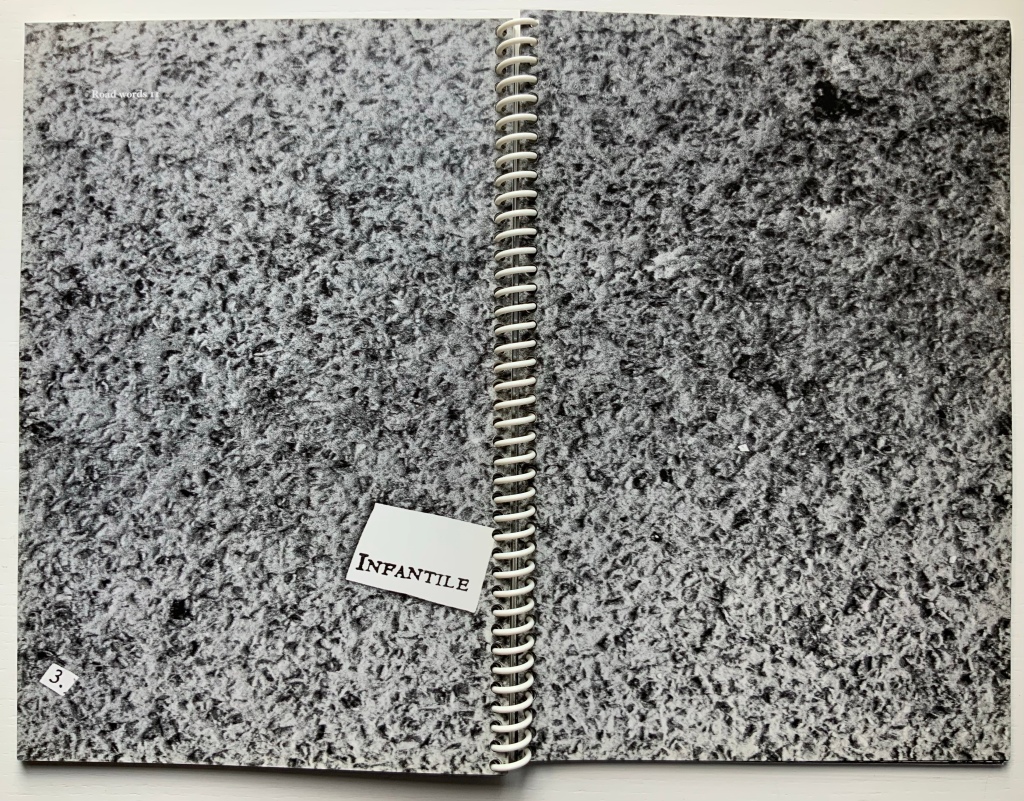
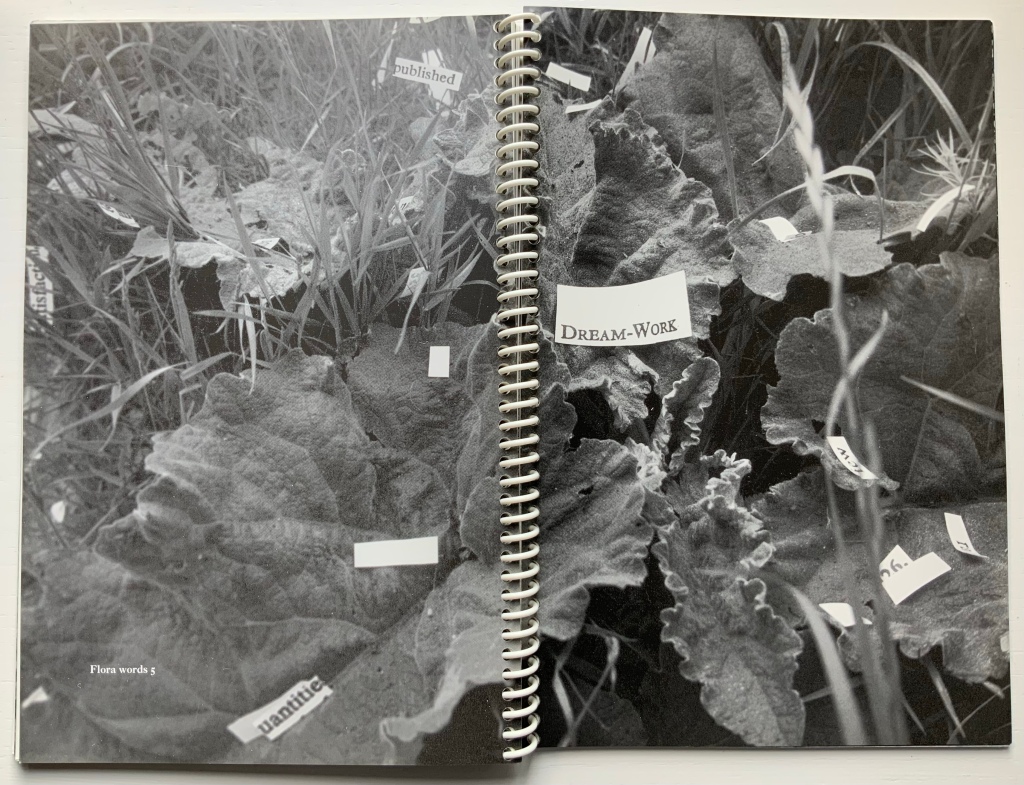
Utilising Ed Ruscha’s book Royal Road Test as a readymade set of instructions, seventy-eight students cut out every single word from Sigmund Freud’s Interpretation of Dreams. On Sunday, June 1st, 2003, the artist, Simon Morris (thrower) threw the words out of the window of a Renault Clio Sport on Redbridge Road, Crossways, Dorset, travelling at a speed of 90mph, approximately 122 miles southwest of Freud’s psychoanalytical couch in London. The action freed the words from the structural unity of Freud’s text as it subjected them to an ‘aleatory moment’ – a seemingly random act of utter madness.
Daniel Jackson (filmmaker), Maurizio Cogliandro (photographer) and Dallas Seitz (photographer) documented the action as 222,704 words erupted from the window of the car. They also recorded the stream of words strewn along the side of the road. Dr. Howard Britton, a psychoanalyst (driver), directed them to any slippages or eruptions of the Real that occurred in the reconfigured text. The poetic act of liberating Freud’s text allows us to engage with what Jacques Lacan called the register of the Real. The concept of the Real is far removed from anything that we conventionally attribute to reality. It is the experience of a world without language. If language names, it is all that escapes the name – an encounter beyond images and words.
Conceptual art can do one’s head in. So, in the meantime, enjoy the aleatory moment.
Mitchell, Beverly. “Q & A with conceptual writer and professor, Simon Morris“, Blog of the Hamon Arts Library, 22 February 2019. Accessed 2 December 2020. Good coverage of The Royal Road to the Unconscious as well as the exhibition “Reading as Art”.
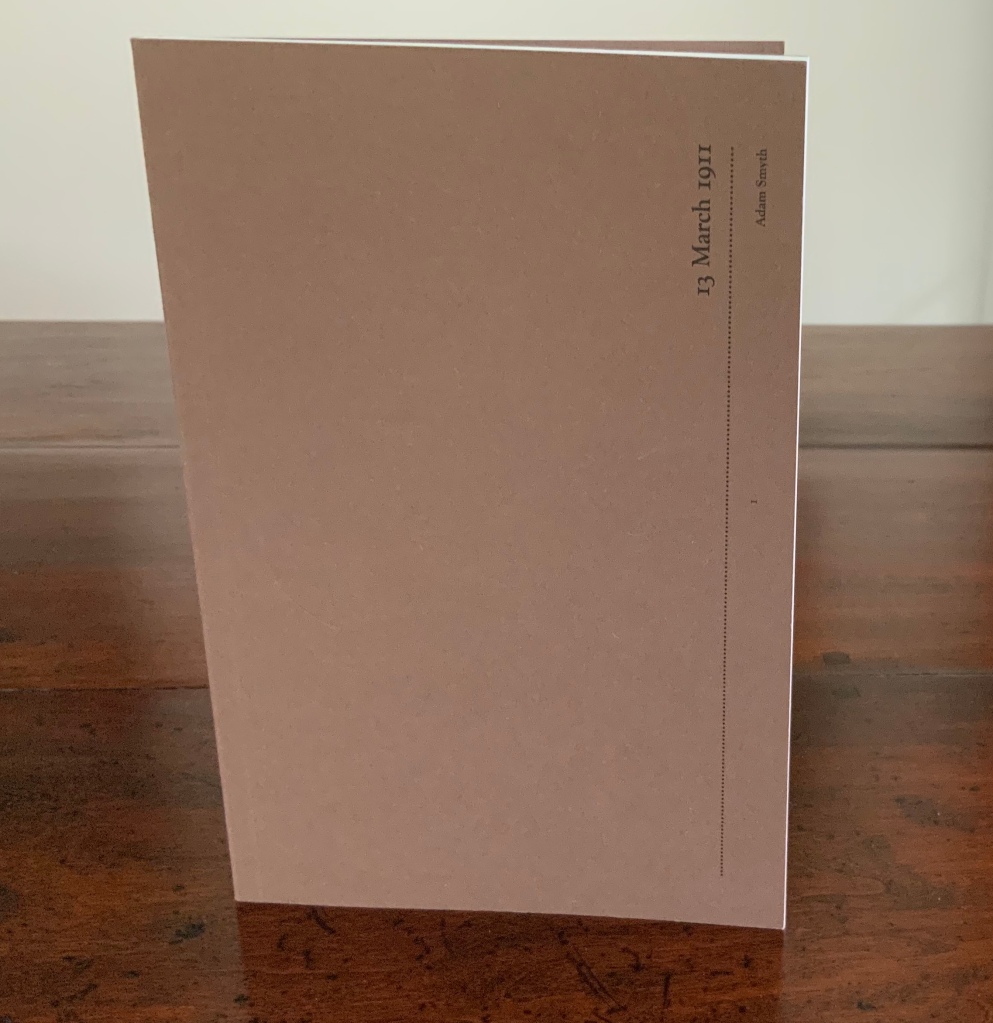
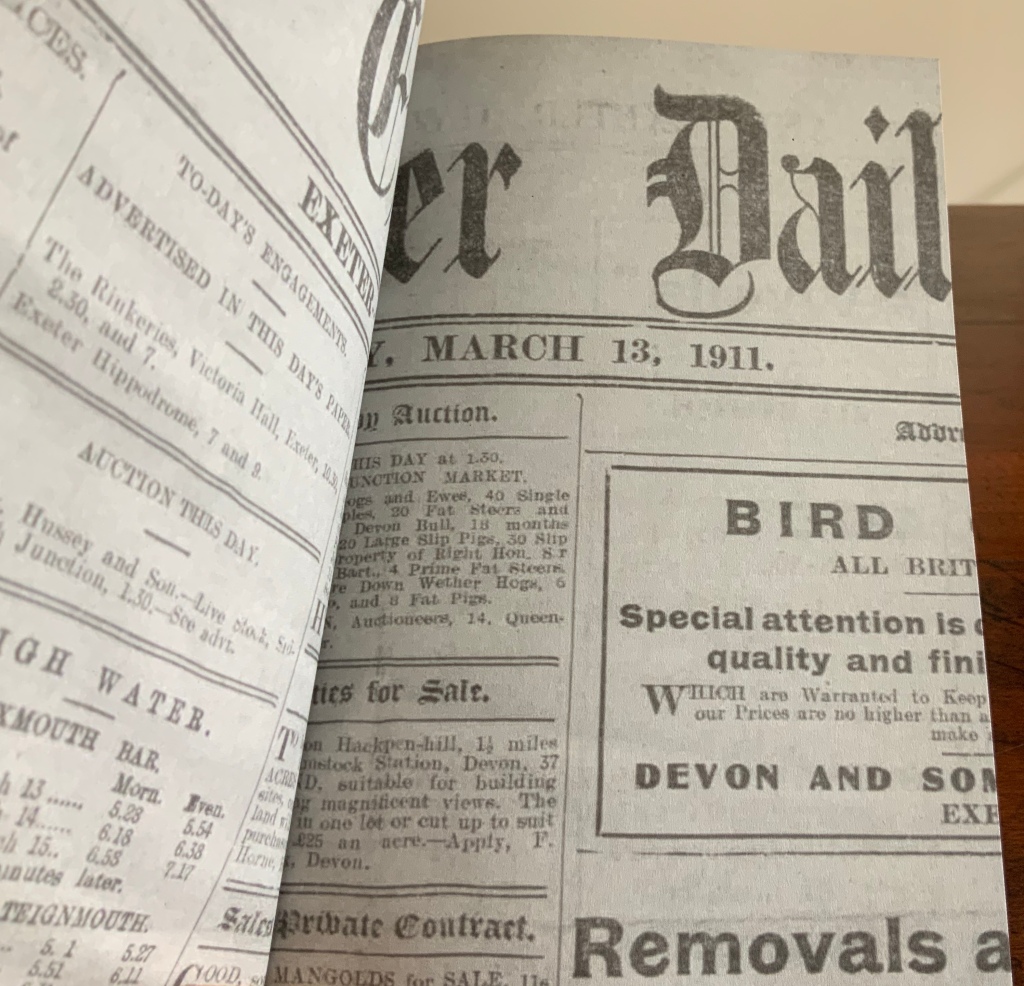
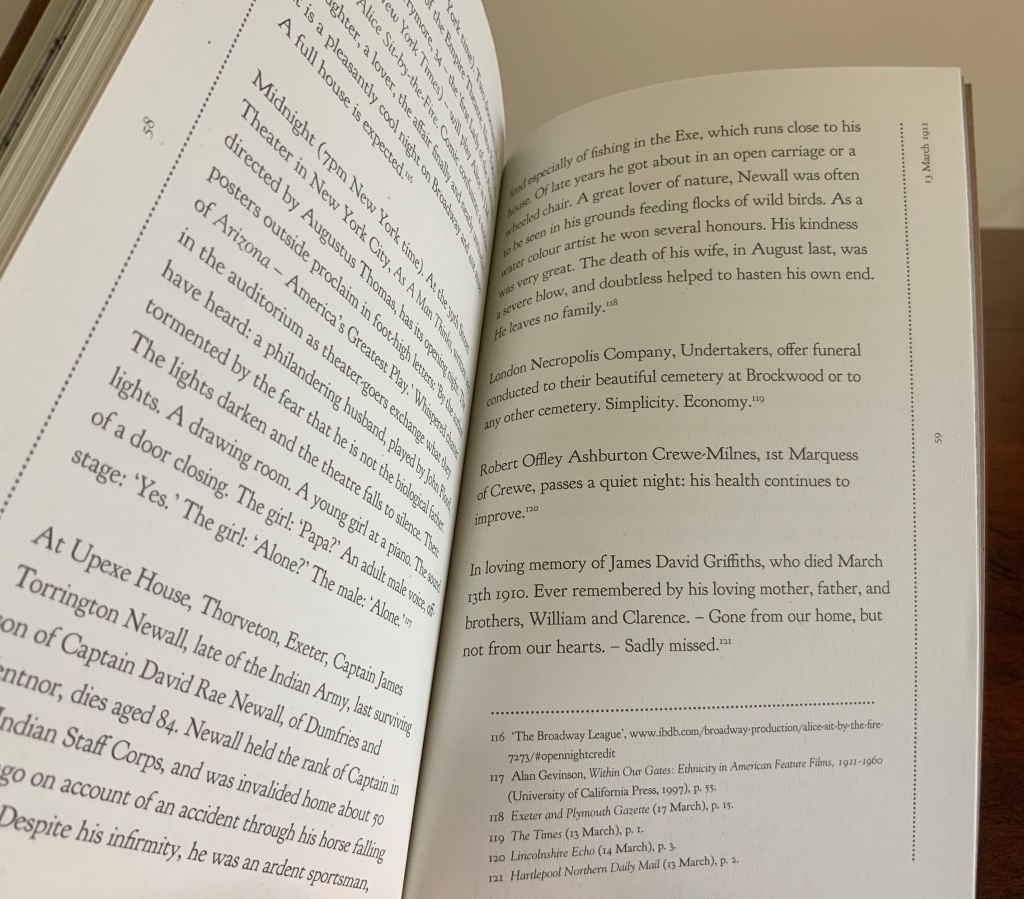
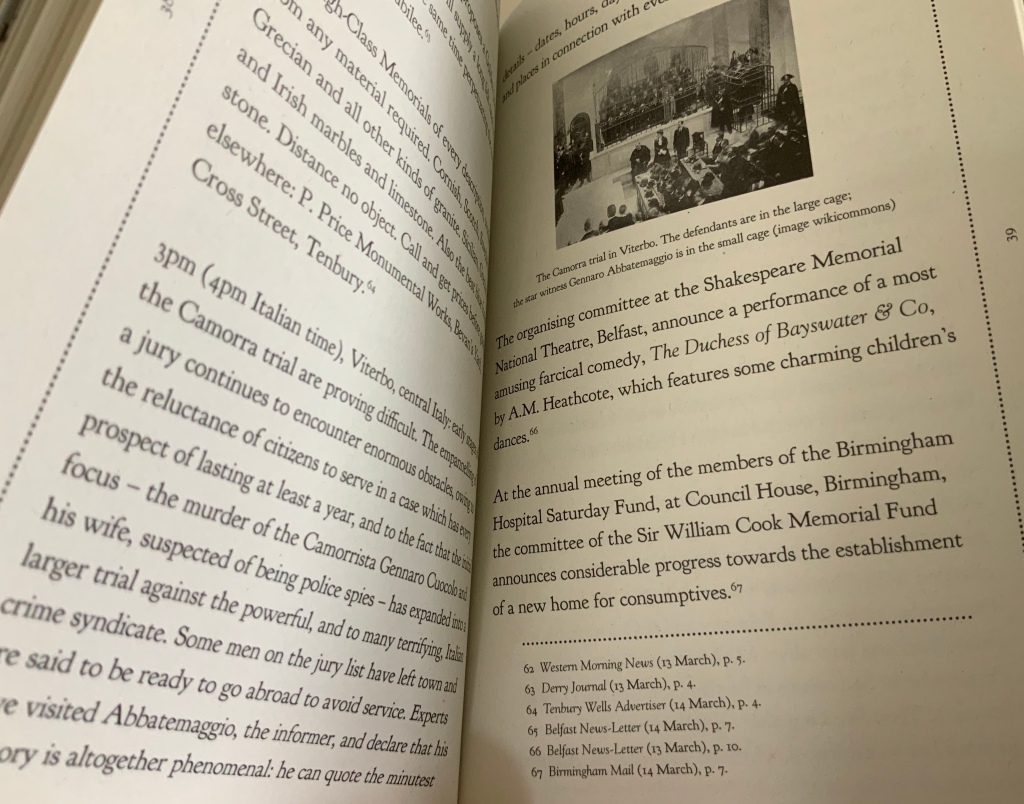
13 March 1911(2019) Adam Smyth Perfect bound paperback. H175x W115 mm, 64 pages. Edition of 500. Acquired from Information as Material, 10 October 2020.
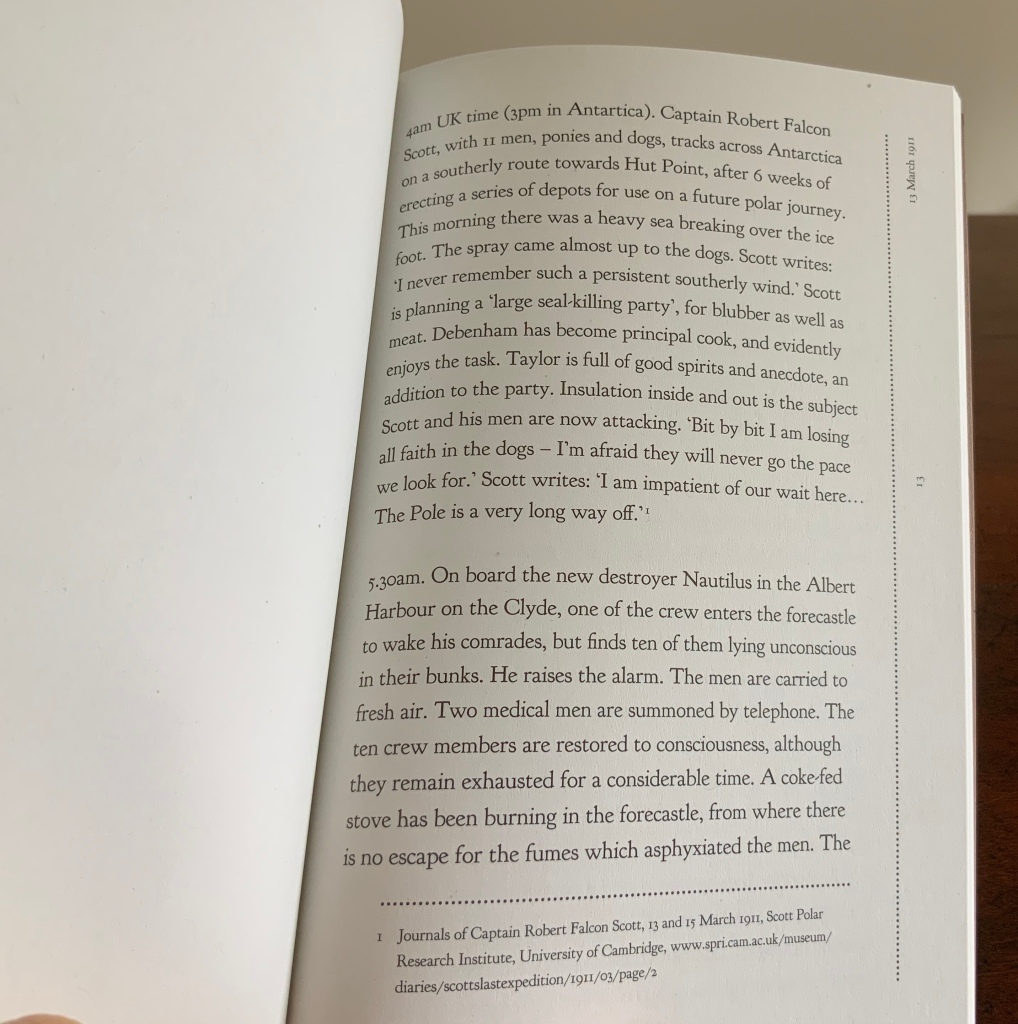
Although unremarkable in its production values, 13 March 1911 enters the collection as a brilliant composite with roots in OuLiPo, Grangerism and the collage technique, Walter Benjamin’s Illuminations and The Arcades Project and Stéphane Mallarmé’s “The Book, Spiritual Instrument”. The date is the birth date of Smyth’s grandfather, and it is what confronts us in a photographic detail of a newspaper masthead.
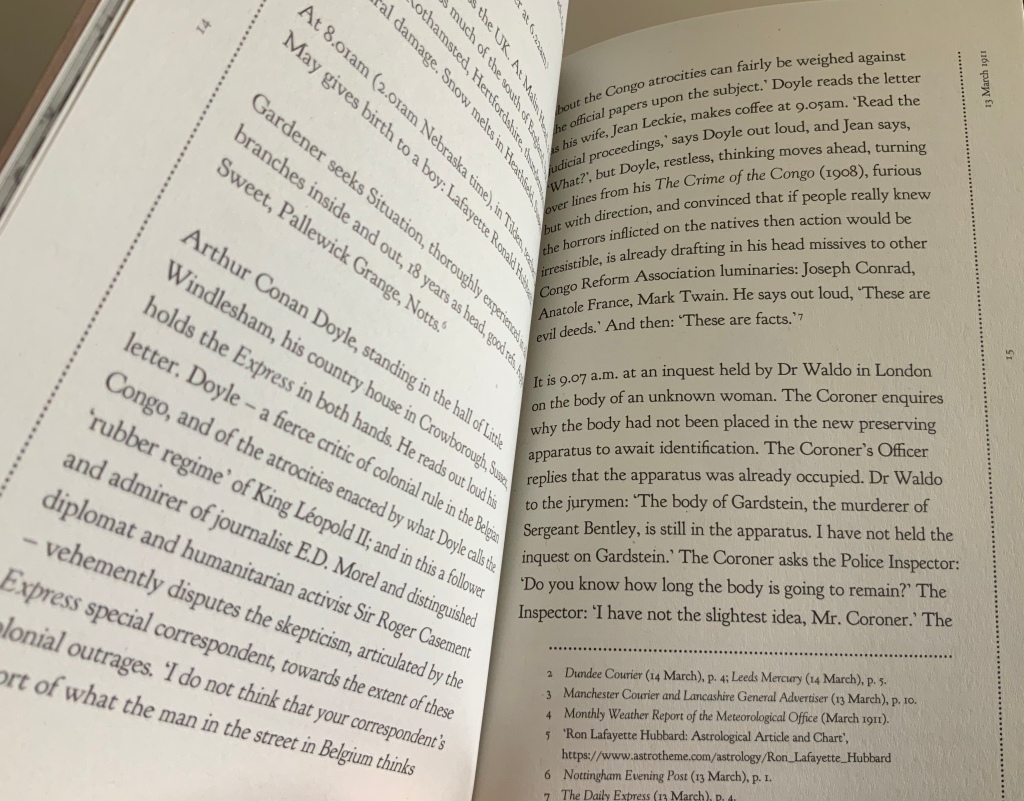
From OuLiPo, Smyth takes the rule of constraint to guide his creation. The constraint is that the content presented must refer to events occurring on 13 March 1911 and in chronological order. Added to the constraint are citability of each source, which often takes Smyth to the Internet and Wayback Machine. Although focused on a single day in time, the writer, book and reader fly back and forth as if tethered together in a time machine composed of print and digital reference material.
Strictly with Grangerism, there should be a previously published book into and onto which the reader/actor inserts, pastes and attaches clippings relevant to the book in hand. Instead of a book in hand, Smyth has a date in hand to which the clippings accrue. And in keeping with this non-material target for Grangerizing, Smyth’s collage technique eschews visual and physical overlapping, rather it lies more in overlapping different types of sources of “data”: newspaper articles, classified ads, advertisements, Captain Scott’s journal, weather reports, obituaries, theater reviews and much more.
In a sort of reversal of Benjamin’s unpacking his library, Smyth packs snippets from history into this one book that turns on his grandfather’s birth date. It is not that Smyth can recreate him with all these snippets, or that the reader can ever know the man from those snippets — anymore than a reader of every single book in Benjamin’s library could recreate Benjamin or know him from doing so.
Like Benjamin in Arcades, Smyth is a collector of fragments by which he tries to make the past present. But Smyth’s time machine is also richly multi-dimensional — especially in its being digitally and print powered. What Smyth gives himself and the reader is an extended moment of recognizing the wide-flung welter around any of us at any time and the wryness, despair, amusement, inspiration and poignancy of trying to define, find and memorialize others (however close) or ourselves by that welter — however retrievable or citable the elements of it.
Finally, Smyth gives us one day’s proof of Mallarmé’s dictum: “everything in the world exists to end up in a book”. And so it ends up in the Books On Books Collection.
Further Browsing
Information as Material (Smyth’s 13 March 1911 is a publication with IAM, which offers works from authors such as Derek Beaulieu, Francesca Capone, Craig Dworkin, Andrew Dodds, Sharon Kivland, Simon Morris and Nick Thurston).



































 Books On Books